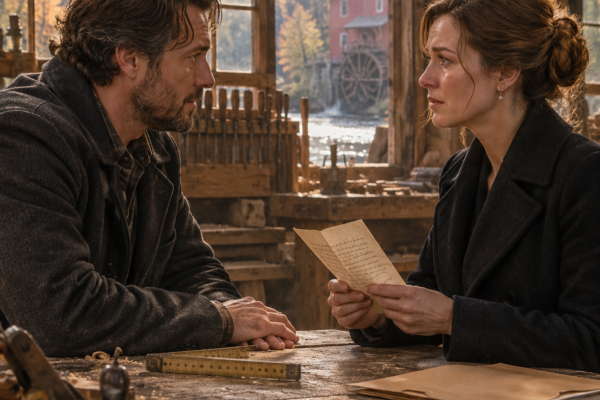
He Thought His Wife Would Fight for Him… She Simply Bowed, Left His Manor, and Never Returned
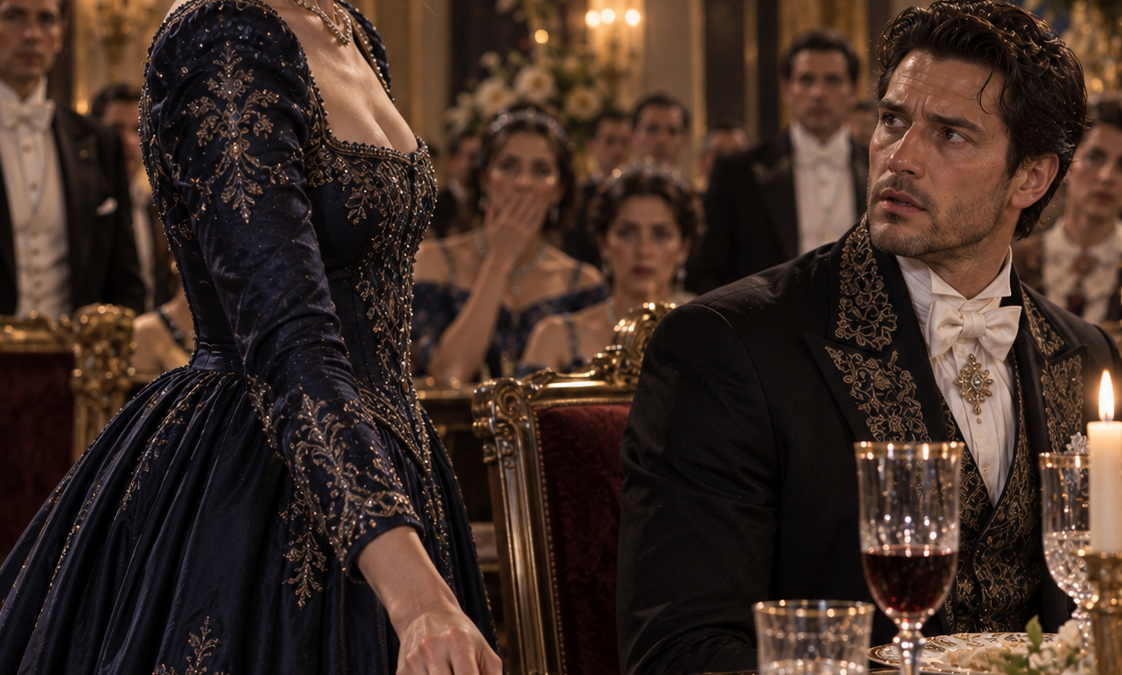
He Thought His Wife Would Fight for Him… She Simply Bowed, Left His Manor, and Never Returned
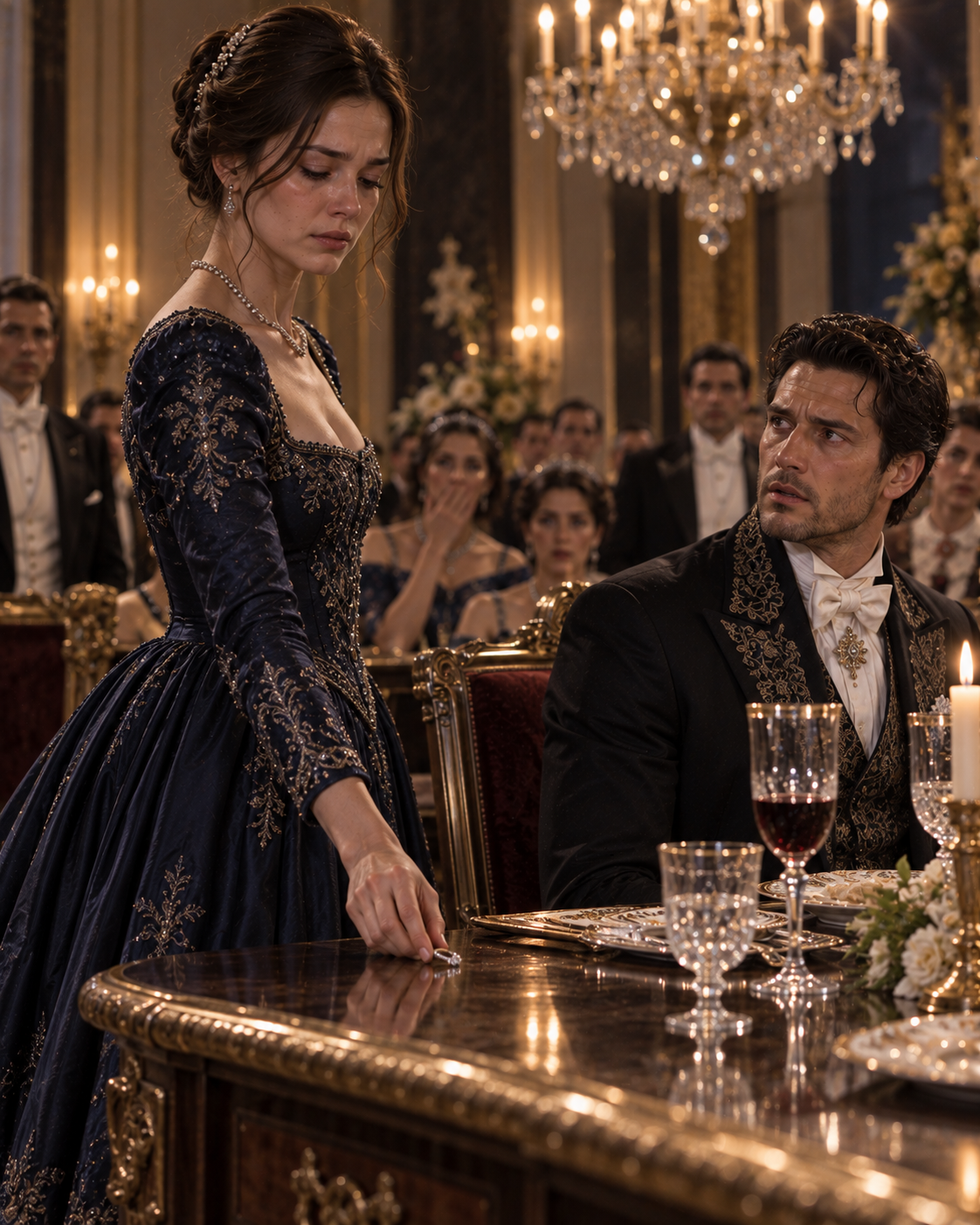
I am not asking you to stay, Eleanor. I am telling you this marriage is over.
He said it in front of 300 people. Lords, ladies, every powerful name in England, he expected her to collapse, to grab his sleeve, to cry, to beg him to reconsider in front of God and everyone who had ever mattered to them.
Instead, Eleanor Witcom reached up, removed her wedding ring, walked the full length of the banquet table, and set it beside his wine glass without a tremor in her hand. She curtsied precise, unhurried, unbroken.
Thank you. Your grace, for the years you allowed me to serve this family. Then she was gone, and Sebastian Wickliffe stood at the head of his table in front of 300 silent witnesses and understood too late that he had just made the worst mistake of his life.
The night of September the 14th, 1,886 was supposed to be a triumph. Sebastian Wikliffe, fifth Duke of Ravenshshire, had spent three weeks orchestrating every detail of autumn dinner, the guest list, the seating arrangement, the order of the speeches, the precise moment the announcement would be made, 300 guests, 12 members of the House of Lords, four cabinet ministers, two viscountes who held more social power than most men in Parliament. He had chosen this audience deliberately because Sebastian had always understood that power was not simply held.
It was performed. And the performance he had in mind required witnesses of consequence.
Elellanor had dressed that evening without knowing. She had chosen the deep navy gown he had always said made her eyes look like the sea in winter. She still chose things he had once praised.
Out of habit or hope or some quiet loyalty she had never quite been able to explain to herself.
Her lady’s maid had asked if she wanted the pearls or the sapphires.
Eleanor had said the pearls.
Simple, quiet, nothing that would draw attention away from her husband’s evening.
She had not known it was the last decision she would make. As Duchess of Raven share, Sebastian stood at the head of the long table as the dessert course was cleared.
He tapped his crystal glass. The room pulled itself to order the way rooms always did when Sebastian Wickliffe required it instantly. completely without question.
I want to thank each of you for being here tonight,” he said.
His voice carried the particular warmth he used at public events. The warmth that felt personal even when it was not.
“This autumn has brought significant changes to my life, and I felt it right to share them with the people whose council and friendship have mattered most.
” Eleanor sat at the opposite end of the table.
She watched him with the small composed smile she had learned to keep on her face during these performances.
The smile that said, “My husband is wonderful and I am proud of him and she waited to hear what he had arranged for Raven Shshire without telling her.”
He said, “As many of you already know, I have been in discussions with the Whitmore Investment Group regarding the Northern Estates.
Those discussions have concluded and I am pleased to announce a partnership that will secure Ravenshar’s financial foundation for the generation.
Applause moved around the table. Eleanor joined it.
This was not what she had feared. This was simply business.
Then Sebastian said, “There is a second matter.
” The room went quiet in a different way, slower.
The kind of quiet that does not come from obedience, but from instinct. The collective instinct of people who sense something sharp is about to enter the room. Sebastian reached inside his jacket and withdrew a singlefolded document.
“I have petitioned the ecclesiastical court,” he said, “for a formal separation from my wife.
The sound Eleanor heard was not the room’s reaction.
It was the blood in her own ears.”
the ground.
Sebastian continued, “His voice never wavering, our incompatibility of character, and the failure to provide an environment suitable to the continuation of this marriage.”
300 people turned to look at Eleanor Whitcom. She did not move. She did not blink.
She had rehearsed nothing. There was nothing to rehearse because she had not known.
But something inside her, some layer of self that had been built over 11 years of being this man’s wife in this man house by this man’s rules that part of her simply held.
Sebastian looked down the length of the table at her. She could see in his face what he expected.
He expected her voice to break.
He expected her to stand and say, “Sbastian, please.
We can speak privately. Sebastian, please.
I will do whatever you ask.”
He expected the humiliation to collapse her the way it had collapsed her three years ago when he had first raised his voice at her in front of the servants and she had run to her room and pressed her hand over her mouth to keep the sound in. She was not the same woman she had been 3 years ago.
Eleanor pushed her chair back. She stood.
She was not tall. She had never been tall, but she had learned in 11 years to carry herself as though height were beside the point. She reached up and removed her wedding ring.
She walked to the head of the table, all 30 ft of it, passed 300 pairs of eyes, and she set the ring beside Sebastian’s wine glass.
She curtsied. Clean.
Correct. The curtsy of a woman who had been trained from girlhood to perform grace under pressure, and who was now using that training for the last time in this house.
“Thank you, your grace,” Eleanor said.
“For the years you allowed me to serve this family.”
Sebastian’s mouth opened.
Nothing came out because that was not what a woman said when she was begging. That was not the voice of someone who needed his forgiveness.
That was the voice of someone who had already gone somewhere he could not follow and who was simply completing the formality of leaving. Eleanor turned and walked toward the door.
No one stopped her. No one moved, not even Sebastian.
She walked out of Ravenshshire Manor’s great hall with 300 witnesses at her back and the sound of her footsteps on the marble floor was the only sound in the room.
The door closed behind her inside the carriage she had quietly arranged 3 days earlier because Eleanor, who had learned to read the temperature of her husband’s moods the way a sailor reads the sky, had sensed something was coming, even if she had not known its shape.
She finally allowed herself to breathe. She did not cry. Not yet.
The crying would come later in private where it belonged. For now she sat with her spine straight and her hands folded in her lap, and she watched the lights of Ravenshshire Manor grow smaller through the rear window until they disappeared entirely.
Then she looked forward. She did not look back again.
Inside the manor, Sebastian Wikliffe stood at the head of his table in front of 300 people who were very carefully not meeting his eyes, and he understood for the first time that he had made an error in his calculations. He had expected a scene. He had braced for tears for argument, for the kind of marital drama that would ultimately make him look like the reasonable party.
He had a response prepared for her protests. He had a second document ready if she challenged the grounds. He had even in his worst moments half imagined she might cause enough of a spectacle that his guests would leave the evening sympathizing with him.
He had not prepared for a woman who simply walked away. Lord Perl Ashton seated three chairs from the head of the table and oldest friend Sebastian had in the world.
Looked at him for a long moment. Well, Perl said quietly. That was not what I expected.
Neither did I, said Lady Constants’s hail across the table, not troubling to lower her voice.
She had more dignity in those 30 seconds than most people manage in a lifetime. Sebastian picked up his wine glass.
He set it down again without drinking. The evening is concluded, he said.
But the evening had already been concluded by Eleanor.
Sebastian simply hadn’t been told.
The first letter arrived 4 days later. It came from the Ravener tenants, specifically the dozen farming families in the northern quarter of the estate who had been struggling through an unusually brutal winter cycle for the past 3 years.
The letter was addressed to Eleanor, Duchess of Ravenshshire, and it had been redirected to the manor’s main correspondence desk when the estate’s postal office realized she was no longer in residence.
The butler brought it to Sebastian’s study with an expression of extreme professional neutrality.
Sebastian opened it.
The letter read, “Your grace, we are writing to inquire whether the winter distribution of seed stock will proceed as arranged.
As Lady Eleanor had informed us, it would begin on the 1st of October.
We are also hoping to confirm whether the arrangement to wave October’s quarterly rent for the three families in the lower quarter is still in effect.”
As she had spoken with Mr.Hadley directly on our behalf, Sebastian put the letter down. He picked it up again.
Mrs.Brent, he said to the housekeeper, who had appeared in the doorway with another envelope. What is this? Mrs.Brent was 64 years old, had served Ravenshshire for 31 years, and had perfected the art of conveying enormous amounts of information through the precise positioning of her chin.
At this moment, her chin was positioned at an angle that said, “You are asking me a question whose answer you should already know, your grace, and I will answer it, but we are both aware of the situation.
” That would be the autumn tenant correspondence.
Your grace. Her grace typically managed the October cycle personally. What do you mean personally?
She met with each family quarterly. Your grace. She had a ledger.
She kept records of which families needed advanced seed credit, which children needed school fees covered, which widows received additional coal through the winter months. Mrs.Brent paused. She also managed the correspondence with the estate physician regarding the families in the lower quarter who could not afford the standard medical fees.
Sebastian stared at her. For how long? He said since her second year of marriage.
Your grace. He was silent for 11 full seconds. She never told me.
Mrs.Brent’s chin shifted two degrees.
I believe she mentioned it in the household reports. Your grace.
You may recall she submitted a quarterly report to your secretary. Sebastian had read those reports the way he read most administrative documents, the summary paragraphs, the final figures, the items that required his signature.
He had trusted the details to be managed. He had trusted Eleanor to manage them.
He had trusted Eleanor to manage most things. He had simply never looked at what that meant. He picked up the second envelope.
This one was from the estate steward.
It read, “Your grace, Lady Eleanor, had arranged for three of the summer tenant contracts to be renegotiated in October at terms more favorable to the families.
” As two of the households experienced crop losses, she had the documentation prepared.
“I am uncertain how to proceed without her review,” Sebastian set the letter down.
He said to Mrs.Brent, “Get me the household ledgers.”
The last three years, Mrs.Brent brought them. He sat at his desk for four hours. What he found line by line, column by column, was a version of Ravenshere he had not known existed.
He had believed the estate ran on his name, his capital, his network of connections, and those things were real. He had built them, and they mattered.
But layered underneath every visible structure of the Ravenshare estate, the tenant relationships, the local reputation, the loyalty of the staff, the goodwill of the families who worked the land, was 11 years of Eleanor’s work.
quiet, consistent, never announced, never presented to him for praise. She had not done it to be praised. She had done it because she believed it was right.
He closed the ledger. Where is she?
He said to Mrs.”Brent, I understand Lady Eleanor is staying with her cousin in Dorset.”
“Your Grace, get me a telegram.”
Mrs.Brent was silent. Mrs.Brent, yes, your grace, but she did not move immediately, which was notable because Mrs.Brent had never hesitated to carry out a direct instruction in 31 years. May I speak plainly, your grace?
When have you ever done otherwise? Her grace walked out of this house with nothing but the clothes she wore and her personal correspondence.
She arrived at Mrs.Caulfield’s home in Dorset at 2:00 in the morning.
She had not eaten since the morning of the dinner.
Mrs.Brent’s chin was now positioned at an angle Sebastian had never seen before on her face.
It said, “I have worked for you for 31 years, and I am choosing my next words extremely carefully.
If your grace is considering sending a telegram requesting her return, I would respectfully suggest that you consider what you plan to say before you send it.”
Sebastian looked at her for a long moment.
“Leave the telegram office address on my desk,” he said.
She left it. She did not look hopeful.
The telegram Sebastian sent said, “Elanor, I require your assistance with the October estate correspondence.
Please advise.”
He stared at it for 10 minutes after sending it. He was not a man who second-gued himself. He second-gued this.
The reply came the following morning.
It read, “Your grace.
I suggest speaking with Mr.Hadley, who has been my primary contact.
He is fully capable.”
Ew. Not Eleanor and not the Duchess and not your wife.
She had signed it with initials that matched her family name. The name she had been born with, the name she appeared to be returning to.
Sebastian read the reply three times. Then he sat back in his chair and he thought for the first time about what Perl had said as the guests were leaving that evening.
Perl had found him alone in the study poured two glasses of brandy without being asked and said with the frankness of a man who had known Sebastian since they were 12 years old. Sebastian, what exactly did you think was going to happen? She was making me miserable.
Sebastian had said. We had nothing in common anymore.
We disagreed about everything. You disagreed about the way she managed the estate. No, we disagreed about he had stopped.
She was too quiet. She had no interest in public life anymore.
She spent her time in the tenants cottages and the village school and she stopped attending half the functions that mattered. Perl had looked at him steadily. And that made you miserable.
It made me feel like we were strangers. And Lady Victoria Harkort, Perl said, not phrasing it as a question.
Did she make you feel less like a stranger? The silence had been its own answer.
Sebastian had met Victoria Harkort 6 months ago at a parliamentary reception. She was brilliant, electric, politically engaged, everything Sebastian valued in a conversation partner.
She made him feel for the first time in years that he was interesting rather than merely powerful. That distinction had mattered to him more than he wanted to admit.
Nothing improper had occurred. He was clear on that.
But something in him had shifted in her presence. And then he had come home and looked at Elellanor, quiet Eleanor, with her ledgers and her tenant visits and her low voice and her eyes that lately seemed to look past him rather than at him, and he had made the mistake of comparison.
He had looked at Victoria Harkort’s brightness and decided it was Eleanor’s fault for being dim.
He had not considered that Eleanor might simply be exhausted. He had not asked.
He had not asked any of the questions a husband asks when he is actually paying attention. He had paid attention to Victoria.
He had stopped paying attention to his wife.
And then, when the distance grew wide enough that he could feel it like a physical thing, he had decided the distance was Eleanor’s failure rather than the natural result of his own sustained neglect.
Persal had said very quietly at the end of the conversation, “Sbastian, Lady Elellanor has run your estate for 11 years.
She has managed your tenants, your staff, your household correspondents, and your local reputation. She has done this without complaint, without credit, and without, I sus, a great deal of gratitude from you. I say this as your friend.
I do not think Eleanor was the problem. Sebastian had said nothing.
He said nothing now, alone in his study, looking at the telegram signed e w, but something in his chest had shifted. something cold and insistent that he did not yet know how to name. The second thing Sebastian discovered was worse than the ledgers.
Three weeks after Eleanor’s departure, Lady Constance Hail came to call on the manor with the specific slightly too formal heir of a woman who has decided to say something she knows will be unwelcome.
Sebastian received her in the front sitting room.
I’ll be brief, Constance said, which meant she had rehearsed this.
I’ve been speaking with several women in our circle about the evening of the 14th.
Lady Constance, I am not here to argue the merits of your decision, she said. That is between you and God and the ecclesiastical court. I am here because something was said to me last week that I believe you do not know and which I think you have a right to hear.
Sebastian said nothing. The grounds you gave, Constance said. Incompatibility of character, failure to provide a suitable environment.
She folded her hands in her lap. I understand those were the words provided to you in the initial legal consultation.
They were. By whom? Sebastian said.
My solicitor. And who recommended that solicitor to you?
He was quiet. Sebastian Constant said very carefully.
Lady Victoria Harkort recommended that solicitor to you 8 months ago at the Whitmore reception. Before you ever formally consulted anyone about a separation. I know this because she told three people herself.
She told them you were unhappy in your marriage and that she had found you the right person to handle it quietly. The room was very still. She also told at least two of those same people.
Constance continued that once the separation was finalized, she expected to be received at Ravenshshire within the year. Sebastian did not move.
She had been planning this. Constance said not with you, for you. She decided what she wanted and she arranged the conditions and she left you thinking it was your own decision.
She stood to leave. At the door, she paused.
Eleanor Witcom was one of the finest women in this county, she said.
She was kind when she didn’t have to be and gracious when you gave her very little to be gracious about.
I hope you understand what you have done because I suspect she already has, and she will not be waiting for you to figure it out. The door closed. Sebastian sat alone in the room where Eleanor used to read in the evenings in the chair that still held the slight indent of her presence.
And he thought about a woman who had given him 11 years 11 years of quiet labor and unagnowledged effort and steadfast dignity. And he thought about the night she had walked the length of his table in front of 300 witnesses and set her ring down with a hand that did not shake.
He thought she knew she was leaving before she walked into that room. He thought she had already decided and then slowly he thought something he had never allowed himself to think before she was right to go. The rage that followed that thought was not directed at Eleanor.
It was directed at himself. And underneath the rage, quieter and more devastating was the specific grief of a man who had just understood the full weight of what he had been given and what he had thrown away. He reached for the telegram reply on his desk.
He read it one more time. Ew.
Not your wife, not Eleanor Wikliffe, not anything that belonged to him. She had already reclaimed herself. He folded the telegram.
He put it in his coat pocket. He carried it with him for the rest of that day without knowing exactly why, except that it felt like the last thing she had said to him, and he was not yet ready to put it down.
Endorse it. Eleanor Witcom was learning how to sleep.
This was not a metaphor. She meant it in the most literal sense.
She was learning to sleep through the night without waking at 2:00 in the morning to record something in her household ledger, without listening for the sound of Sebastian’s footsteps in the hall, without cataloging what she needed to do tomorrow and what she had failed to do today.
She slept until 7. She ate breakfast at a table where no one needed her to perform. Her cousin Margaret had asked no questions when Eleanor arrived at her door at 2:00 in the morning.
disheveled and quiet.
Margaret had taken one look at her face, said, “Come inside.”
and had not required explanations. This was the thing about Margaret that Eleanor had always valued most.
She had never been impressed by Sebastian’s title, and she had therefore never encouraged Eleanor to be impressed by it either.
“What are you going to do?”
Margaret asked on the morning. setting a cup of tea in front of Eleanor and sitting down across from her with the directness of a woman who knew that false comfort was an insult to someone as intelligent as Elellanor.
“I’m going to sell the Witcom property in Kent,” Eleanor said.
“It’s been in my family’s name since before the marriage.
The income from it is mine legally.
It’s enough.
Enough for what?
Enough for a school.”
Margaret was quiet for a moment.
“A school?
There is a building in Kingsford. It was a grain store.
The owner is willing to sell. It is large enough for 40 students, Eleanor wrapped both hands around her teacup. There are women in this county, Margaret, who have no education past the age of 12.
Who have no legal recourse when their husbands decide they are inconvenient, who have no name of their own once they marry, she paused. I was one of them, except that I happen to come from a family with property. I want to change what that means for other women.
Margaret looked at her for a long time. You have been planning this, she said. For 3 years, Eleanor said.
I didn’t know when I would need it.
I hoped I wouldn’t, but I made sure it was ready.
She had planned quietly, systematically, the way she had learned to plan everything without announcement, without fanfare, with the understanding that the only things that belonged to her were the things she had built with her own
hands. Sebastian had held the name.
Eleanor had built everything underneath it.
Now she intended to find out what she could build with the name she’d been born with.
She set her cup down. She picked up her pen.
She began to write the letter that would initiate the purchase. She did not think about Sebastian.
She did not think about the ring she had left on the table. She did not think about the way his face had looked that particular stunned stillness in the moment she had turned and walked toward the door. She thought about 40 women sitting in a room she had not yet purchased.
Learning things they had not yet been allowed to know.
She thought, “That is where I am going.”
And for the first time in longer than she could measure, Elanor Whitam felt underneath the grief and the exhaustion and the particular ache of a life closing, the first thread of something that might in time become joy. The first week after Ellaner left, Sebastian Wikliffe ran Ravenshere the way he had always believed he ran it with authority, with precision, with the assumption that the estate would continue to function because he commanded it to. By the second week, he understood he had been wrong.
It began with the school, not Eleanor’s school in Kingsford, the village school attached to Ravenshshire estate, the one that educated the children of tenant families.
It had been operating for 6 years. Sebastit had approved the initial budget, signed the deed, and considered the matter concluded. He had not thought about it since.
The school master, a thin and anxious man named Mr.Garvey, appeared at the manor door on a Tuesday morning with his hat in his hands and a look on his face that suggested he had rehearsed this visit several times and was still not confident it would go well.
“Your grace,” Garvey said.
“I apologize for coming without an appointment.
I wanted to inquire about the quarterly allocation. The allocation is managed by my steward, Sebastian said.
Speak with Hadley. I did your grace. Mr.Hadley informed me that Lady Eleanor managed the school account directly and that he does not have the allocation details in his records.
Sebastian looked at him. Then find the records.
We’ve looked your grace.
The ledger her Grace maintained is not on the estate premises. I believe she may have kept it among her personal documents.
The personal documents Eleanor had taken with her the night she left. Sebastian sent for Hadley.
Hadley arrived confirmed the situation with a particular discomfort of a man who has known for 2 weeks that this conversation was coming and has not enjoyed waiting for it. How much does the school require quarterly? Sebastian asked.
I don’t know the full figure your grace.
Lady Elellanor negotiated the supplier contracts for the school books, the paper, the heating coal, and the teacher’s supplementary salary, the last of which was drawn from a separate fund she maintained herself.
She funded part of his salary herself.
Hadley’s expression made clear this was not even the most surprising thing in the ledgers.
Lady Eleanor contributed personally to several of the estate accounts. Your grace, she was methodical about it. Sebastian was quiet for a moment.
Then he said, “Get me everything you have.
Everything that touches her name.
” Hadley brought a stack of documents the width of Sebastian’s forearm.
Sebastian read for 5 hours. What he found was not chaos. Eleanor had not left chaos when she left.
She had left order. Meticulous and complete.
The order of a woman who had known she might not always be there and had built the systems to outlast her presence. What he found was a map, a complete detailed map of every relationship Ravenshshire had with the world around it.
Every obligation and arrangement and goodwill agreement that kept the estate functioning as something more than a collection of buildings and land. She had negotiated with the local physician for a rate the tenant families could afford.
She had arranged with three local merchants to extend credit to Ravener families through difficult harvest years with the estate guaranteeing repayment at the following season.
She had personally corresponded with the county school board to ensure Ravenshar’s Village School was recognized as meeting the national education standards, a distinction that protected the school from a county reorganization that had closed four comparable schools the previous year.
She had done all of this with no instruction from Sebastian, no authorization, no acknowledgement. He had signed the original school deed and then turned back to his newspapers.
And Eleanor had spent 6 years building something real out of his signature. Hadley, Sebastian said, not looking up from the documents.
How many people in this county know who actually ran this estate? Hadley was quiet for exactly the wrong length of time. I see, Sebastian said.
Your grace.
That wasn’t a criticism of you.
It was a question. He set the documents down.
He pressed both hands flat on the desk.
She never told anyone I didn’t know.
No, your grace. She was She was very careful about that. Sebastian thought about what that cost her.
Not the work, the silence, the choice every day. To do the work and accept no credit for it.
to stand beside him at public dinners while people praised Ravenshshire’s good reputation and to smile and say nothing.
He thought about the night of the 14th. He thought about 300 witnesses. He thought about the grounds he had announced failure to provide a suitable environment.
And he felt sitting at his desk surrounded by the evidence of what she had actually provided something close to physical illness. He stood up. He needed to move.
He walked to the window below. The ravenure grounds stretched in every direction, tidy and well-maintained, the result of careful management by people who had worked for Eleanor as much as for him.
The groundskeeper who had served the estate for 20 years, the headgroom who had trained every horse under Eleanor’s oversight, the cook who had adapted the household menus quarterly to accommodate the visiting tenant families.
Eleanor invited for seasonal dinners, a tradition Sebastian had attended without ever asking who organized it. He had moved through his own life like a man walking through a building he had never looked at.
He had known the address. He had not known the rooms. The letter arrived 3 days later.
It came from Lord Ashton Persl, and it was written in the shorthand of a man who has been choosing his words carefully and has finally decided to stop. Sebastian, I am writing because I consider you my oldest friend and I find I cannot remain silent. Last week, I spoke with Lady Constants Hail, who informed me that several members of our circle have received correspondence from Victoria Harker Court in the past month.
The correspondence in question appears to be, to put it plainly, a campaign. She is managing with some care the story of your separation.
The version being circulated presents Eleanor as emotionally withdrawn and socially negligent and positions you as having made a regrettable but necessary decision.
The version does not mention Victoria’s own role in advising you toward that decision.
I thought you should know, if you didn’t already, that the story is being told without your participation, and I thought you should know who is telling it.
Sebastian read the letter twice. He put it down.
He picked up the telegram from Eleanor. The one signed EW. He had kept it in his coat pocket for 3 weeks, transferring it each morning when he changed clothes with the absent mechanical habit of a man who does not examine what he is doing or why.
He smoothed it flat on the desk beside Perl’s letter.
Two documents. One was the beginning of what Victoria had arranged. One was the last thing Eleanor had said to him.
He thought about Constance’s visit, about what she had said.
She decided what she wanted and she arranged the conditions and she left you thinking it was your own decision. He had believed the decision was his.
He had believed the unhappiness was his.
He had believed Elanor’s quietness was Eleanor’s failure and his restlessness was Eleanor’s fault and the distance between them was a problem Eleanor had created.
He had not once, not in six months of moving toward this separation, not in the weeks of legal consultation, not in the careful orchestration of the dinner, he had not once seriously asked himself, “What if I am wrong?”
Because Sebastian Wikliffe did not make those kinds of errors. He was careful. He was
methodical.
He trusted his own judgment. He looked at the ledgers piled on his desk.
He looked at Perl’s letter.
He looked at Eleanor’s two initials.
He had been managed slowly, skillfully, by a woman who understood exactly what his pride required, and had fed it to him like a prescription, and he had never noticed, because he had been too occupied with his own certainty to notice anything at all. The rage was enormous. He sat very still inside it.
Then he pulled a fresh sheet of paper toward him, and he began to write.
Lady Victoria Harkort received Sebastian’s letter on a Thursday morning.
She read it in her sitting room with a particular composure of a woman who has anticipated several possible responses and prepared for each of them.
The letter said, “Lady Victoria, I am writing to inform you that I have become aware of correspondence you have circulated in recent weeks regarding the circumstances of my separation.
I am also aware of certain other information regarding the timeline of your involvement in events preceding the separation, including your recommendation of my solicitor and the representations you have made to mutual acquaintances about the anticipated outcome. I will ask you directly what was your intention.
I expect a truthful answer. Sebastian Wikliffe.
Victoria set the letter on her writing table. She looked at the window. She thought about Sebastian brilliant, proud, occasionally exhausting Sebastian, who could not bear to be wrong, and who, once he understood he had been wrong, would not rest until he had corrected it.
She had underestimated the speed at which he would put it together. She had also, she recognized now, underestimated Elellanor.
She had expected Eleanor to be quietly erased from the situation, to return to her family, lick her wounds, disappear. Instead, Eleanor had apparently walked out of Ravenure Manor with her head up and immediately begun purchasing property in Dorset, which was the kind of thing a woman did when she had spent years preparing for exactly this contingency.
Victoria’s maid knocked and entered.
“Are you receiving this morning, my lady?”
Victoria said she picked up her pen. She would need to think about this carefully in Kingsford.
Eleanor did not know about Victoria’s letter campaign.
She had been too busy. The grain store building had been inspected.
The roof was sound. The floor needed work.
Three local carpenters had agreed on a rate for the repairs.
The first teacher, a woman named Agnes Bright, recently widowed and formerly a governness for two of the county’s most respected families had agreed to take the position.
They had sat together for three hours at Margaret’s kitchen table and drafted the curriculum.
reading, writing mathematics to the level required to manage a household account independently. Basic legal literacy enough for a woman to understand what she signed, what she was owed, what she could refuse. This last part will make some people uncomfortable, Agnes said.
Looking at the legal literacy section. Good, Eleanor said. Agnes looked at her steadily.
You know this will draw attention. a woman running a school for women, teaching them about their legal rights. In a county where your former husband is the most prominent figure, people will assume you are doing it out of spite.
People will assume what they choose, Eleanor said. The women in this room will learn what they need. That is what matters.
Agnes was quiet for a moment. Then she picked up her pen and continued writing. Eleanor had a particular gift for choosing the right people.
She had chosen Mrs.Brent when she was new to Ravenshshire and needed a housekeeper she could trust. She had chosen Hadley when Sebastian had wanted a different steward and she had quietly argued until he deferred to her judgment.
She had chosen the physician, the schoolmaster, the three merchants. Now she chose Agnes.
She was learning slowly that the skills she had applied to Ravenshire could be applied anywhere.
They were not Sebastian’s skills.
They had never been his. He had the title and the capital and the political connections.
She had everything else. The letter from Mrs.Brent arrived on a Wednesday. Mrs.Brent had been at Ravenshshire for 31 years.
She was not a woman who communicated with former employers unless she had something specific to say. Eleanor read the letter twice.
Lady Elanor, I write informally and without his grace’s knowledge as I consider myself to owe you a personal word.
His grace has spent the past 3 weeks reviewing the household records. He has been. He has been very quiet.
I thought you should know that he understands, at least in part, what he did not previously understand. I also write to inform you that Lady Constance Hail visited the manor last week and appeared to say something of significance. His grace did not share the content with staff, but he was visibly disturbed.
There is also a matter of letters from Lady Victoria Harkort, which I believe he has only recently become aware of. I tell you this not to encourage any decision you have not already made, but because I believe you deserve to know that the truth is beginning to find its way into the right rooms. With sincere respect, MB Eleanor sat with the letter for a long time.
She was not surprised that Sebastian was beginning to understand. She had always known he was intelligent.
She had spent 11 years watching him see through complicated problems with the speed and clarity of a man whose mind was genuinely exceptional.
She had admired it early in their marriage before she understood that his intelligence was entirely outward-f facing applied to politics, to business, to other people’s motives, and almost never turned inward.
He would figure out
Victoria. He would figure out what had been done and how. He would probably be furious in the specific controlled way.
Sebastian was furious cold and methodical and deeply uncomfortable to witness. He would not figure out Eleanor, not entirely because what had happened between them was not a conspiracy.
Victoria had provided the kindling, but Sebastian had provided everything necessary for the fire. His inattention, his comparative eye, his assumption that Eleanor would always be there, would always manage, would always adapt, would never require tending herself.
Victoria had shown Sebastian a door, but Sebastian had chosen to walk through it.
That was the distinction, and it was the distinction Eleanor had been turning over in her mind for 3 weeks in the quiet mornings at Margaret’s house.
In the long walk she had begun taking along the Dorset coast. In the hours she spent with Agnes planning the school.
Margaret had asked her one evening gently. Could you forgive him?
If he came to understand what happened if he came to you and asked could you? Eleanor had looked at the fire for a long time before she answered. I forgive him now.
She said forgiveness isn’t the question.
Then what is the question is whether the woman who would go back to him exists anymore. She paused. I was the Duchess of Ravenshire.
I managed his household, supported his reputation, quietly built everything he stood on. I did it because I believed in the marriage and I believed for a long time that if I worked hard enough and was patient enough, he would see me.
She looked at her hands, he didn’t see me.
He was too busy deciding I was the problem. And while he was deciding that, I had 11 years taken from me.
11 years I spent building someone else’s life instead of my own.
She looked up.
She doesn’t exist anymore.
The woman who would go back, she doesn’t exist.
I buried her the night I walked out of that hall.
And I won’t call her back.
Margaret said nothing for a moment.
Then she reached across the table and covered Eleanor’s hand with her own.
Then build something new, she said. Eleanor looked at the fire again. I already am.
Sebastian arrived in Dorset without warning on a Thursday afternoon. He had not sent a telegram.
He had not written a letter.
He had simply, after three weeks of sitting with the ledgers and Persol’s letter and the knowledge of what Victoria had done.
After 3 weeks of understanding, opening inside him like a slow, cold flood gotten into his carriage and given the driver an address. Margaret Caulfield met him at the door.
She was a small woman with a direct gaze and no particular opinion of Dukes which she communicated clearly without saying a word. She looked at Sebastian for a long moment taking him in assessing him the way women who have seen a great deal of the world assess men who arrive at their doors unannounced.
Lady Elellanor is not here at present she said I’ll wait.
Margaret’s expression said she had thoughts about this.
She said come in then I’ll have tea brought.
Sebastian sat in the front parlor of a house that was modest and bright and entirely unlike Ravenshshire, and he waited. He was not good at waiting. He had spent his life moving toward things at the pace he chose.
This was not his pace. This was not his territory. He was acutely, uncomfortably aware of both.
Eleanor came in an hour later. She had been at the building site.
Her coat was dusty at the hem, and she was carrying a folder of papers, and she stopped in the doorway when she saw him. Her face went absolutely still, not cold, not angry, still the particular stillness of a woman who has prepared herself for many possibilities and is now moving with great care through a moment she did not specifically prepare for. Sebastian, she said.
He stood Elellanor. She looked at him for a long moment without moving closer. You should have written.
I know.
You have never once done anything that required you to wait for someone else’s permission.
So coming without notice felt natural to you. She set her papers on the table by the door.
It is not natural to me. No, he said.
I imagine it isn’t.
I’m sorry.
She studied him. He had never not in 11 years of marriage apologized to Eleanor without qualification.
Without the however that followed, the but I must point out that came after. This was a plain apology. No additions, no conditions.
She recognized it as something she had not heard from him before. She came into the room. She did not sit near him.
She took the chair by the window. The one that put the most space between them.
She folded her hands in her lap.
“Why are you here?”
she said. He had prepared an answer to this. He had in the carriage rehearsed a version of it careful, honest, not asking too much.
He said it. I know what Victoria did.
I know about the solicitor recommendation and the letters she has been circulating. I know she was arranging things, he paused.
And I know it doesn’t matter in the end because none of it would have worked if I hadn’t if I hadn’t already been the kind of husband who would believe it.
Eleanor was very quiet. I read the ledgers, he said, everyone.
Three years of them. I know what you built. I know what you did for Raven.
And I know I never I never once acknowledged it. No, she said.
You didn’t.
I’m telling you now.
I hear you. He looked at her.
Don’t, she said quietly.
Not harshly quietly. in the voice of a woman who has thought this through and knows exactly what she is willing to say.
Don’t say what comes next.
I know what you came here to ask, and I need you to hear me before you say it.”
He closed his mouth. He waited.
“What you took from me was not 11 years of work,” she said.
“I chose that work.
I chose it because I believed in what we were building, and I believed you were worth building it for.
What you took from me was the right to be seen.”
Her voice stayed level. Every year I managed your estate and received no acknowledgement. Every function where your reputation was praised and I smiled and said nothing.
Every decision I made that disappeared into the fabric of your success without your awareness. She looked at him steadily. You did not see me, Sebastian.
For years you did not see me. And when Victoria Harkort showed you someone who seemed more interesting, you did not look hard enough to ask why I had gone quiet. You decided I was the problem and you arranged a solution.
Yes, he said. I did.
And you stood at the head of my table. At the table I had set and managed and kept running for a decade.
And you told 300 people that I had failed to provide a suitable environment. He flinched.
He had not expected to flinch. He was not a man who flinched.
Yes. In front of everyone I had ever served in this county.
Yes, that is what I am holding. Sebastian.
She looked at him. Not with hatred. That was the thing he had not expected and it was almost worse than hatred.
She looked at him with the clear considered gaze of a woman who has moved past rage into something steadier. Not what Victoria arranged, not even your inattention. What I am holding is that moment, the ring on the table.