“JUST A NURSE,” They Said — Until a MILITARY K9 Revealed What She Could Really Do (part 3)
Part 3
Terrao was on the floor, not badly. She was conscious, already getting up with her hand pressed to the side of her head and the particular focused expression of someone doing a rapid self assessment. Clare was at her side in three steps.
What happened? Two of them, Vo said. Her words were clear, which was the most important thing.
Came from the supply corridor.
I didn’t hear them until she stopped, took a breath.
One from behind. I went down fast.
Did you lose consciousness? 2 3 seconds maybe? Any vision changes?
Ringing?
No, I’m okay.
She meant it as a statement of fact rather than reassurance. They took him on a gurnie. There was a gurnie in the hall.
Maintenance left it after the linen delivery. Clare stood.
The supply corridor ran along the east side of the ward, a service route she knew, narrower than the maintenance corridor, used primarily for equipment transfers.
It connected at its far end to a service exit that emptied into a parking area on the building’s south side.
The south side, not the east entrance, where three tactical personnel had been standing in full view.
Not the parking structure where Burell’s vehicle had been.
The south side, the side no one had covered because no one had expected a second simultaneous approach because the tactical team at the east entrance had been exactly what it appeared to be and also exactly what it was designed to be, a distraction. She she turned and nearly walked into Puit who had come through the bay entrance behind her.
South exit, she said. He was already on his comm unit. I have one man near the south corridor.
One isn’t enough.
How many vehicles does the IG team have outside? He looked past her to where the woman in the dark suit had appeared in the bay entrance.
The woman, Deputy Inspector General Ranata Oay, which was the name Solace had provided in the 15 seconds since they’d come back inside, was reading the room with the rapid, methodical attention of someone who had walked into the middle of an active situation and was building her picture without asking questions that would slow her down.
Three vehicles, Oay said.
She’d heard the question.
Two out front, one on the south access road. She looked at Clare.
I repositioned after I read Solless’s update on the drive-in.
The south vehicle is ours. They took a patient, Clare said. Military, postsurgery, partial anesthesia, pulled IV.
He’s going to be in distress and he can’t move fast.
Jose pulled her radio.
She spoke into it with the compressed efficiency of someone who gave instructions that didn’t need repeating, and whatever she said produced a response that made her jaw tighten slightly.
Not panic, but adjustment.
They’re not at the south exit, she said.
Then they didn’t go through the supply corridor, Clare said.
They changed routes.
She looked at the bay, at the gurnie track she’d followed, the faint scuff marks on the floor from rubber wheels moving fast.
She looked at the direction they came from, not the supply corridor. The marks came from the east side of the bay, from the short connector hallway that linked bay 1 to the cardiac monitoring suite, which was a room most people at Harllo General thought of as a dead end because there was no public exit from the cardiac suite.
There was a staff exit behind the equipment cabinet on the suite’s north wall, behind a door that blended with the wall paneling well enough that three of her colleagues had asked her once why there was a latch on what they thought was cabinetry.
She’d noticed it on her second day.
She went. The cardiac suite was dark. Patients cleared, equipment on standby.
She hit the lights, moved to the north wall, and found the door exactly where she’d put it in her mental map.
It was closed, but not latched. The equipment cabinet in front of it had been moved, not far, maybe 18 in.
And not carefully, because there was a scratch on the floor tile where its base had been dragged. She pulled the door open.
The passage beyond it was a utility access route, wide enough for one person, used for cable management and the building’s older ventilation infrastructure.
It ran about 40 ft and exited through a hinged panel into the main corridor on the building’s north side.
The north side, which connected to the secondary parking area behind the hospital’s administration wing.
She understood it fully now.
They’d had someone in the building, someone who knew the layout well enough to map a non-standard extraction route, which meant research and time, and someone who had studied Harlo General, not as a hospital, but as a problem to be solved.
They’d known she was here before this morning, not through the convoy, not through Rogue, before.
She came back out of the utility passage and found Puit in the cardiac suite doorway.
North Secondary Parking, she said, tell your people and tell Oay’s people.
They went through the utility access behind the wall panel. He relayed it.
His face was doing the specific controlled neutrality of a managing something that was evolving faster than his contingencies. Claire.
His voice was low. The man outside. The one who used your name.
She’d been waiting for this.
He knew your name before today.
Puit said it wasn’t a question.
That means someone gave it to him. Someone who knew your location here.
Yes.
That’s an internal breach.
Someone in our coordination chain. Yes, she said again.
I’ve been running a closed team.
The personnel I brought here today are It’s not your team, she said.
She looked at him. Think about the timeline. The archive surfaced 3 weeks ago.
You’ve been building the case for 3 weeks, coordinating with Solless, running down documentation.
In 3 weeks, how many offices did you contact? He was quiet for a moment.
IG field division, he said. Records division JAG for the warrant analysis.
Two offices in naval intelligence. He paused.
And we flagged a potential witness location request through. He stopped.
Through what office? He said a name.
A routing division. A standard interdep departmental clearance office that processed personnel location requests for legal proceedings and had unremarkable access to employment records and hospital credentiing databases. the office that would have received a query about a nurse named Clare Ashford in Redfield, Montana.
Someone in that office, she said, his jaw set.
I’ll make a call.
Make it after we find Marsh us. The north secondary parking area was a narrow lot behind the administration wing used primarily by administrative staff and overflow from the main structure. It had six spaces, a single access lane, and a gate that was supposed to be locked after hours, but was typically propped open with a concrete block by whoever arrived first because the key fob system had been unreliable for 7 months.
The gate was open when they got there. There was an empty space at the far end of the lot where the asphalt was wet, not from rain, but from a vehicle that had been idling long enough to leave a condensation patch from its exhaust. fresh.
Maybe 5 minutes.
Oay’s radio crackled.
She listen she listened, her expression shifting through something that landed on controlled urgency.
They’re on the east service road.
My vehicle has them in sight. Are they stopping?
Clare asked. They slowed at the service road junction. They may not know the east access is compromised.
They know.
She looked at the access lane, at the gate, at the service road beyond it, which ran along the building’s east edge and connected to the main road in one direction and a dead-end maintenance area in the other.
They’re not lost.
They’re deciding.
Deciding what? Puit asked. She thought about what she knew about the people who had built this operation.
The Iron Tide coverup had run for 6 years.
The personnel routing that had buried her team’s deaths had been maintained through three separate audit cycles.
The breach in Puit’s coordination chain had been identified and acted on within 3 weeks.
These were not people who improvised. They were told to recover a witness, she said. Sergeant Marsh is not the witness they want.
He’s a complication.
He was in that bay because of a leg wound, not because he knows anything about Iron Tide. She paused.
They took him because they needed a reason for me to follow. Puit absorbed that in about a second. A leverage play.
They’re out of moves except one.
They need me to come to them and they need it to happen in a space they control rather than this building. She looked at the access lane.
If I were running this, I’d choose the maintenance area at the dead end of the service road contained one entry point enough distance from the hospital to complicate a response.
Then we don’t let you go.
Oay said.
You don’t let me go alone.
Clare said the service road was not a long drive.
It was approximately 400 m from the hospital’s north gate to the maintenance area at its end, a concrete pad with two storage units, a utility shed, and a chainlink perimeter that had been there long enough to rust at the joints.
The vehicle they were tracking was a dark gray van, which OE’s south team had picked up after it exited through the administration wing’s access gate and looped around using a route that had avoided all three of OE’s perimeter vehicles through the specific competence of people who had planned their exit
before they’d executed their entrance.
They hadn’t planned on the south team repositioning in the last 40 minutes.
OC’s vehicle had them in sight but was staying back close enough to track far enough to not trigger a response inside the van.
Puit was in the vehicle with Clare Kellerman with Rogue in the back and one of the IG team’s agents driving.
Solace had remained at the hospital with two of Puit’s people and the woman from the lobby.
the middleman with green eyes whose actual credentials had turned out under OSI’s authority and a rapid identity verification to be exactly what they appeared to be, federal, real, authorized, which complicated things in a way Clare was still processing as they moved down the service road.
His credentials were valid.
She said to Puit, “They were, which means someone with actual federal authority issued the recovery request.”
Yes. Not a rogue operation, not someone acting outside their mandate. Acting within a mandate that someone with enough rank authorized, Puit said, which is the worst version, she said.
Yes.
The van had stopped at the maintenance area, as she’d predicted.
They could see it from the service road parked near the utility shed. Engine off.
OC’s vehicle held back at 300 m.
The radio reported no movement from the van. They were waiting.
If I get out and walk in, Clare said, they need about 90 seconds to realize I’m not alone.
If I stay in this vehicle, they start making decisions about Marsh that we don’t want them making.
What’s the play?
Puit asked. She looked at the maintenance area at the storage units, the shed, the chain link perimeter. At the single access point, which was a gap in the fence where a gate had been at some point and had been removed for reasons lost to maintenance history.
at the concrete pad’s edges where the storage units created angles and dead zones.
“Rogue goes first,” she said.
Kellerman looked up from the back seat.
“Off leash, independent approach along the south perimeter of the fence line,” she said.
“He’s quiet and he’s low, and he’ll get a read on the van’s occupants before anyone in that vehicle knows he’s there.
” She looked at Kellerman.
“Can he do that?”
“He’s done it before,” Kellerman said.
Not not in a situation like this, but in a drainage channel in the dark, she said quietly.
Yes, he’s done it before.
Kellerman was quiet for a moment.
Then he’ll need a signal.
I know the signal, she said. Kellerman looked at her, looked at the dog, made a decision that cost him something, and gave it anyway. He unclipped the leash.
They watched Rogue move along the fence line from 200 m, low, deliberate, using the concrete storage unit’s shadow, the way a dog used it when he’d been trained to use shadow, and had internalized the training deeply enough that it wasn’t training anymore, just sense.
He reached the fence gap in 40 seconds and went through without hesitating.
The radio from Oay’s vehicle said quietly, “We have movement in the van.
Passenger side mirror adjusted.”
They’d seen something.
Maybe rogue, maybe movement from the IG vehicle. Either way, the window was compressing.
Clare got out of the vehicle.
She didn’t run.
She walked toward the maintenance area with the same deliberate pace she’d used going through the east entrance door 40 minutes ago.
The pace that said she’d made a decision and wasn’t performing confidence because performed confidence had tells and she wasn’t interested in giving tells right now.
She heard Puit’s door open behind her.
She didn’t turn.
The van’s side door slid open when she was 30 m from the gap in the fence.
Two men got out, not the tactical team from the east entrance, different people, which confirmed what she’d been building since Marsh disappeared.
This was a second group coordinated separately, which meant the operation had at least two independent cells and someone above both of them with enough authority to run parallel tracks.
One of the men she didn’t recognize, the other one she did.
Not from the hospital, not from this morning, from a briefing room in Virginia Beach in 2019, three days before Iron Tide went active, where she’d sat around a table with seven team members and two mission coordinators, and a man who’d presented the operation strategic framework with the specific
polished authority of someone who had made this kind of presentation before.
He’d been a senior liaison then.
She’d known him as Whitmore.
She hadn’t known his first name.
She hadn’t needed it.
He was older now, obviously. Grayer with a face that had traveled the particular road that running a six-year coverup travels a face. He was wearing civilian clothes that cost more than the civilian clothes worn by anyone else in the parking lot.
He looked at her. She looked at him.
Lieutenant Vance, he said. Mr.Whitmore. Something moved in his face at the name, not surprised that she knew it, but the particular adjustment of someone recalibrating how much she knew.
Where’s Marsh?
she said in the van unharmed. He said it as a fact, not a negotiation.
He’s not what I’m here about.
I know what you’re here about.
Then you know this is the end of a long road. He folded his hands in front of him with the composure of a man who had rehearsed this moment.
Whatever Solless’s office has put together, whatever the IG team brought here today, it’s not enough.
The archive that surfaced, the documentation from Iron Tide.
I’ve had access to that archive.
I know what it contains. You know what you put in it, she said.
You don’t know what I took out before your team destroyed the site.
Silence. Real silence.
The kind that arrives when a specific piece of information that someone has been calculating around turns out to be a variable they hadn’t accounted for.
The secondary drive, she said from the site server before the building went down. She watched him.
You knew I pulled something.
Your people reported it, but you didn’t know what I got because the site log was destroyed with the building and there was no secondary record of the server’s contents.
She paused.
15 months after Iron Tide, when I had a stable enough identity to set up a secure drop, I put a copy of everything on that drive into a sealed archive with a legal contact in a city I’m not going to name.
Keyed to my biometric, accessible on two conditions, my death or my authorization. She watched him understand what that meant.
She’d had a dead man switch for 4 years, and the people who’d been looking for her had never found it because they’d been looking for Clare Ashford or Mara Vance or a woman on the run.
And the archive was filed under a legal entity name that had no connection to either identity. The drive contains, she said, the complete authorization chain for the weapons routing operation. Primary communications, financial routing, personnel signoffs, including yours.
She held his gaze.
Everything the current archive doesn’t have, everything that makes the case circumstantial rather than airtight is on that drive.
Whitmore’s composure had not broken, but it had changed.
A subtle shift in the way his shoulders were set, a slight adjustment around the eyes that she recognized as someone rerouting around an obstacle that was larger than they’d expected.
“You’ve had that for 4 years,” he said.
“You didn’t use it.”
“No.”
Why? Because using it meant surfacing, and surfacing meant trusting a system that you were inside. She looked at him steadily.
I needed someone outside your reach to find me first.
Someone I couldn’t have reached deliberately.
She looked down. Rogue was at her left side.
She hadn’t heard him approach, but he was there the same way he’d been there in a drainage channel in the dark with the weight of something irreplaceable against her palm.
“He found me,” she said.
“Not your people.
not the archive team. Him. Whitmore looked at the dog and in the specific unguarded moment that followed, a moment where a man who had maintained composure through a six-year coverup and a coordinated two-cell operation against a single witness looked at a 90lb dog in a faded orange vest patch and processed the full chain of events that had brought them to a concrete maintenance pad in Montana.
His composure did what composure does when it finally meets something it didn’t account for.
It slipped. Not much. Enough.
From behind Clare came the sound of multiple vehicles.
Oay’s team advancing now that the conversation had reached its natural end.
She heard Puit’s voice giving coordinates.
She heard Kellerman somewhere behind her left shoulder. She heard the specific sound of federal authority arriving with enough personnel and enough documentation to make not enough a category that no longer applied.
The man who’d come with Whitmore, the one she didn’t recognize, looked at the vehicles and made the calculation that people make when the math stops working in their favor.
He sat down on the concrete, put his hands in his lap, made the decision that this was over. Whitmore did not sit down.
He stood and watched Oay’s agents come through the fence gap and spread across the maintenance pad and his face was doing the final version of the calculation, the one where every remaining option has been assessed and none of them changed the outcome.
The drive, he said. His voice was low.
Whatever’s on that drive is already in the hands of my legal contact, she said.
I authorized it 40 minutes ago from the east entrance of this hospital. When I understood who sent you, she watched him. I made a call.
Took about 2 minutes. He closed his eyes briefly, opened them.
Oay was at his shoulder, credentials in hand, and the words she spoke were formal and specific, and covered all the relevant legal terrain of what was happening and would continue to happen for the foreseeable future. Two agents moved to
the van and opened it and Marsh was there sitting upright pale and furious with a field dressing where his IV had been pulled and the expression of a man who was going to have extensive opinions about all of this as soon as someone handed him a phone.
Clare went to him. She checked the dressing first. Rough but adequate.
No active bleeding. His BP was readable from the color in his face.
She put two fingers to his wrist and counted. and the number she got back was uncomfortable but not critical.
“You’re okay,” she said.
“I know I’m okay,” he said.
“I’ve been okay for 20 minutes.
I just couldn’t do anything about it with my hands zip tied to a cargo hook.
” She looked at his wrists, found the zip ties, looked around, found nothing useful immediately, and looked at Puit, who produced a multi-tool from his jacket with the efficiency of someone who had never once in his career gone anywhere without a multi-tool.
She cut the ties. Marsh flexed his hands, looked past her at Whitmore, who was now in handcuffs, which was not a sight that required much emotional processing.
“That him?”
Marsh asked.
“Part of him.”
“There’s more?”
“There’s always more,” she said.
“But we have what we need.”
She stood, stepped back from the van. The maintenance pad was full of controlled motion now.
federal agents, Puit’s people, Oay managing the documentation in real time with a tablet she’d produced from somewhere, and an assistant Clare hadn’t noticed before, who was recording everything with the quiet efficiency of someone whose job was to make sure none of this became a question of what had or hadn’t happened.
Rogue pressed against her left calf. She looked down at him.
His ears were at ease. His breathing was slow. He had the posture of a dog who had completed a task.
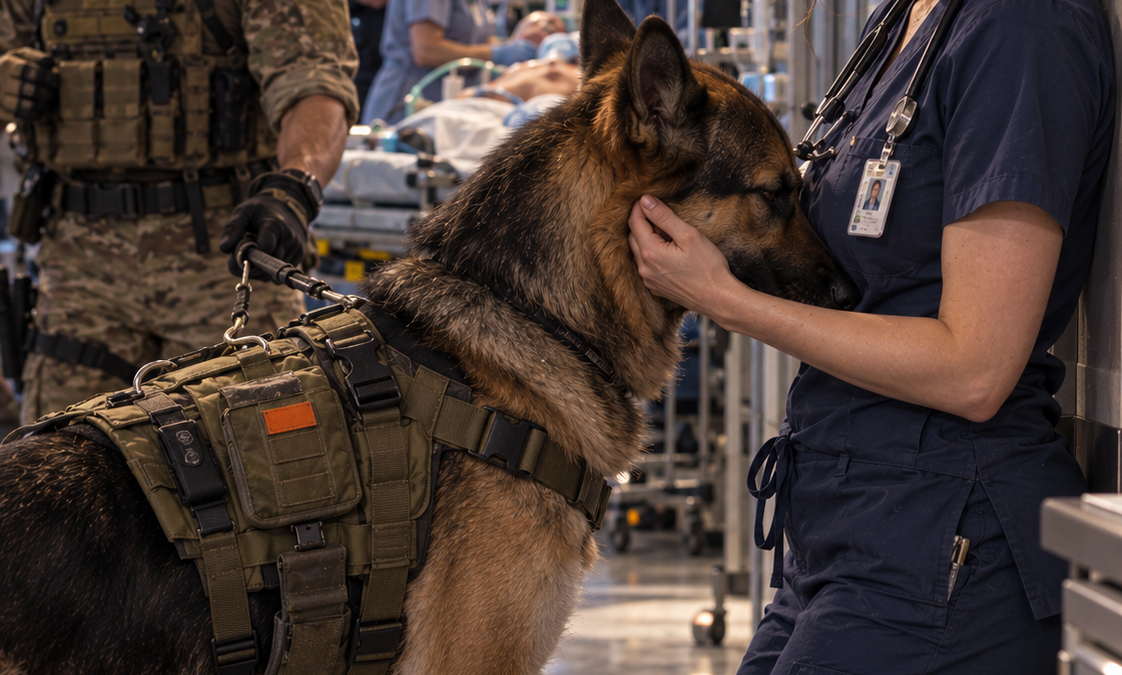
not relaxed exactly, but settled like something that had been unfinished for a long time had finally reached its last page. She crouched, put her hand on the side of his face.
He turned into it slightly.
The same movement he’d made in the hospital corridor that morning, the same weight and certainty like finding her the first time had been a beginning, and this was something closer to an answer.
Good boy, she said. It was inadequate.
She said it anyway.
From the maintenance pad’s access gap, she could see the hospital building, the east wing, the administration wing, the unremarkable exterior of a regional medical facility in Redfield, Montana that had started the morning as the
backdrop of a life she’d built from careful pieces and was ending it as something she hadn’t fully named yet.
Oay was moving toward her.
The expression on the deputy inspector general’s face was not triumphant.
It was the expression of someone who has done a difficult thing correctly and knows that the difficulty is not finished only changed. We need your statement. Oay said formal formal on record today if possible.
I know. And the archive the legal contact you used.
I’ll make the introduction.
Clare stood.
There’s going to be a chain of authorization questions.
The legal structure is specific.
I’ll walk your team through it.
How long have you had that setup? 4 years.
She looked at the hospital.
“I’ve been waiting for someone I could trust to find me first.”
O looked at the dog.
“A Navy K9,” she said.
“He wasn’t looking for a witness,” Clare said.
“He was just looking for me.”
O was quiet for a moment.
Then the legal hold on the hospital, Greg’s credentiing review, the suspension recommendation, is already being addressed, Solless said, appearing at Oay’s shoulder.
She had a phone in her hand.
I’ve been on with the medical board for the last 20 minutes.
It’ll be formal by end of day.
Clare didn’t say anything to that.
She wasn’t sure what there was to say.
2 years of serviceable of pulling compression wraps and fielding passive dismissals and eating half a granola bar over a sink.
It didn’t undo itself with a phone call.
The phone call mattered. The two years also mattered in a different way.
For different reasons, she didn’t have the time or the inclination to sort through on a maintenance pad in the afternoon cold.
Puit was at her elbow. He had the commun pressed to his ear and the expression of a man who had just received a piece of information that was significant. The routing office, he said when she looked at him.
The one that processed the location query.
Yes, there’s an analyst there.
Name’s being flagged now.
He’s been processing requests for the past 3 weeks under a secondary authorization code that isn’t tied to his clearance level.
He paused.
He didn’t know he was being used.
The code was borrowed, piggybacked from a legitimate senior authorization.
He ran the query thinking it was routine and the senior authorization Whitmore’s office.
He let that land. Whitmore had enough access to borrow an authorization signature without the originating officer being aware.
The breach wasn’t someone in my coordination chain.
It was a phantom query that looked legitimate from every angle the analyst would have checked. She absorbed this.
So there was no mole, she said. Not the way I was afraid there was.
Whitmore’s team found you through Whitmore’s access, which he apparently still had because nobody had flagged him yet.
Because flagging him was the thing we were still building toward. It had a horrible logical elegance.
The machine that had buried her had used its own mechanisms to nearly finish the job.
And the only thing that had broken the sequence was a dog who wasn’t following an order, who was following something older than orders, who had crossed a hospital ER on a Monday morning because he remembered a person the world had tried to delete.
She looked at the hospital again.
Then she looked at Whitmore standing in handcuffs at the edge of the concrete pad with Oay’s agents on either side and the weight of six years of decisions arranged in documentation that was right now traveling toward oversight offices that were not inside his reach.
He was
looking back at her, not with anger or contempt or the controlled authority he’d carried into every room of his career.
He was looking at her with something that didn’t have a clean name.
A man at the end of a long calculation, seeing the variable he’d missed.
She did not feel the satisfaction she’d imagined in the 11 hours in the dark after I iron tide when she’d kept moving by thinking about this moment.
The satisfaction she’d imagined had been clean and simple.
This wasn’t clean.
Six people were still dead. A hospital had been put at risk.
A life she’d built out of careful pieces was now known to everyone in this parking lot.
But Marsh was alive. The drive was in transit.
Whitmore was in handcuffs.
And Rogue was at her left side where he’d been all day.
She turned away from Whitmore and looked at Oce.
Let’s get the statement done, she said.
O nodded and turned toward the vehicles, and Clare started to follow.
And that was when her phone, the hospital phone, the pager function she’d never turned off because two years of being someone’s nurse, did not unwire itself in a single morning, buzzed against her hip.
She looked at it. Bay 3, a patient code she knew.
The 60-year-old man with the infected leg wound she’d been dressing when the convoy arrived this morning, whose follow-up was 3 hours overdue because the morning had gone in the direction that it had gone.
She stood in the Montana afternoon with federal agents and Navy officers and a dog and a man in handcuffs and she looked at the page. Then she looked at Oay. 20 minutes, she said.
I need to finish addressing in Bay 3. Oay looked at her, looking at the phone, looked at the maintenance pad, which was in the process of becoming a federal crime scene.
Seriously, she said, he’s been waiting since 6:00 a.m., Clare said.
Oay made the expression of a person who has dealt with a great many unexpected things in her career and has reached the outer limit of her expectation. 20 minutes, she said. Clare went back to the hospital.
Rogue went with her, and as she came through the east entrance, past Solless’s people, past the waiting room that was filtering back to its normal configuration, past Sandra Wills at the charge desk, who looked at her and then at the dog, and then back at her with an expression that would eventually become a story told at every staff gathering for years.
She
heard from the direction of the administrative corridor the raised and unsteady voice of Dr.Harlon Greg. He was on the phone. She caught fragments as she passed.
My decision and credentiing review and then a silence and then a longer silence and then in a tone she had never once heard from him in 2 years. Yes, sir. She kept walking.
Bay three. The curtain was half open.
The man inside, Leonard Pool, 63, retired electrician, three kids whose names she knew because she’d learned them across the 12 minutes she’d spent on his admission, looked up when she came in.
Thought you’d gone home, he said.
Long morning, she said.
She pulled fresh dressing materials from the cabinet, snapped on gloves, moved to the bedside, and began the removal of the old dressing with the same clean, methodical attention she’d brought to the work 6 hours ago before the day had become what
it had become.
Rogue settled near the curtain. Pool looked at the dog.
“That yours?”
“He keeps following me,” she said.
Dogs know things, P said. She removed the last layer of dressing and examined the wound.
Better than that morning, the inflammation down a fraction, the margins cleaner.
She’d been right about the treatment protocol.
She was usually right about the treatment protocol.
She was under the name of a woman who didn’t exist, an exceptionally good nurse, and she had been doing that job for 2 years in this building, whether or not anyone had been writing it in a folder marked serviceable.
“This is looking better,” she told him.
Yeah. He sounded cautiously hopeful.
The way people sound when they’ve been in pain long enough to have stopped trusting good news.
Yeah.
She said, “Another 3 days on the antibiotic and we should be past the worst of it.”
She began the new dressing, clean, tight, no air gaps. Outside the bay curtain, the hospital was reorganizing itself around what had happened.
the federal presence, the military personnel, the administrative questions that would take days to fully answer. She could hear it, the particular texture of a disrupted institution finding its way back to function.
It sounded under everything the same as it always did, the monitors, the calls, the movement of people doing necessary work in a building where necessary work was always being done. She finished the dressing, taped the last edge, stepped back.
Pool was watching her.
You’re a good nurse, he said.
Just said it.
The way a person says something when they mean it and haven’t rehearsed it.
She looked at him for a moment. Thank you, she said. She stripped her gloves, moved toward the curtain, and she was one step through it when she nearly walked directly into Joyce Marin, hospital administrator, compact reading glasses on their beaded chain, with the expression of a woman who had spent the last 4 hours managing
a situation that bore no resemblance to anything in her administrative training.
👉 [Tap here for the Next Part ] 👈
