Mafia Boss Walked Into the Wrong Hospital Room—Then the Night Nurse Changed Everything
Mafia Boss Walked Into the Wrong Hospital Room—Then the Night Nurse Changed Everything
The woman Camila Langston Devo hired to destroy had no idea she was being watched. That was the first mistake. The second was assuming a night shift nurse from a cramped Boston apartment would simply absorb the humiliation and disappear.
Camila sat sat sat in the back of her chauffeur car outside Blackidge Medical Center on a Thursday afternoon, scrolling through the tabloid stories she’d paid to manufacture, and she smiled.
The headline was everything she’d wanted.
The photograph Audrey Bellamy in her unworn wedding dress at that foundation. Gala had been twisted into something grotesque by careful captioning and selective context.
The billionaire’s calculated nurse.
Camila read it twice. Then she forwarded it to threes more editors.
She never once considered that she was holding a match next to something she didn’t fully understand.
She never once considered that the billionaire she thought she knew had already changed.
The night Everett Ror Langston opened the wrong door. He was not supposed to be there at all. He had told no one he was coming.
Not his driver, Marcus, who sat in an idling car three blocks from Black Ridge Medical Center’s private entrance.
Not his head of security. Not his head, a man named Bryce, who had been with the Langston family for 19 years, and who knew better than to ask questions whenever it went quiet. Not his personal assistant.
Not anyone on the foundation’s charitable board, not a single person in the organization.
He ran the one that moved money and men and silence through the darker arteries of Boston’s economy like blood through a body that didn’t know it was sick.
Every year on the 14th of November, Everett came here alone. He had been doing it since the year his mother died. It was the one appointment in his life that appeared on no calendar, in no file, in no record anywhere.
just a private man standing in front of a memorial plaque in a hospital cardiac wing, reading his mother’s name on a bronze plate until the weight of the November air outside became less crushing than the weight of everything inside him.
Marble Langston had been the kind of woman who remembered the names of people she’d met once at a party 3 years ago.
She baked things for strangers.
She once held a grieving woman’s hand in a hospital waiting room for 40 minutes without knowing her name simply because no one else was.
She was soft in ways that made Everett, even as a child, feel protective of her in a world that misread softness for weakness.
He had inherited his father’s empire and his father’s discipline and his father’s capacity for cold, precise authority.
from his mother. He had inherited the one thing he could never quite figure out what to do with a conscience that never fully went quiet no matter how loud everything else got.
She had died 8 years ago, pancreatic cancer, fast and merciless. The cardiac wing at Black Ridge bore her name because Everett had funded it the following year quietly through the foundation without announcement or ceremony. He had not wanted the wing.
He had wanted more time. But more time was not something money could purchase.
And Everett Langston had learned that lesson on a Tuesday morning in October when a doctor came through a door and said words that made the world stop making sense. So every year on the 14th of November, he came back.
Tonight the renovations had rearranged everything. New signage, new room numbers, a temporary construction partition redirecting the main corridor.
Everett, who had walked this route for eight years without looking at the signs, followed his memory instead of the new layout, and his memory was wrong.
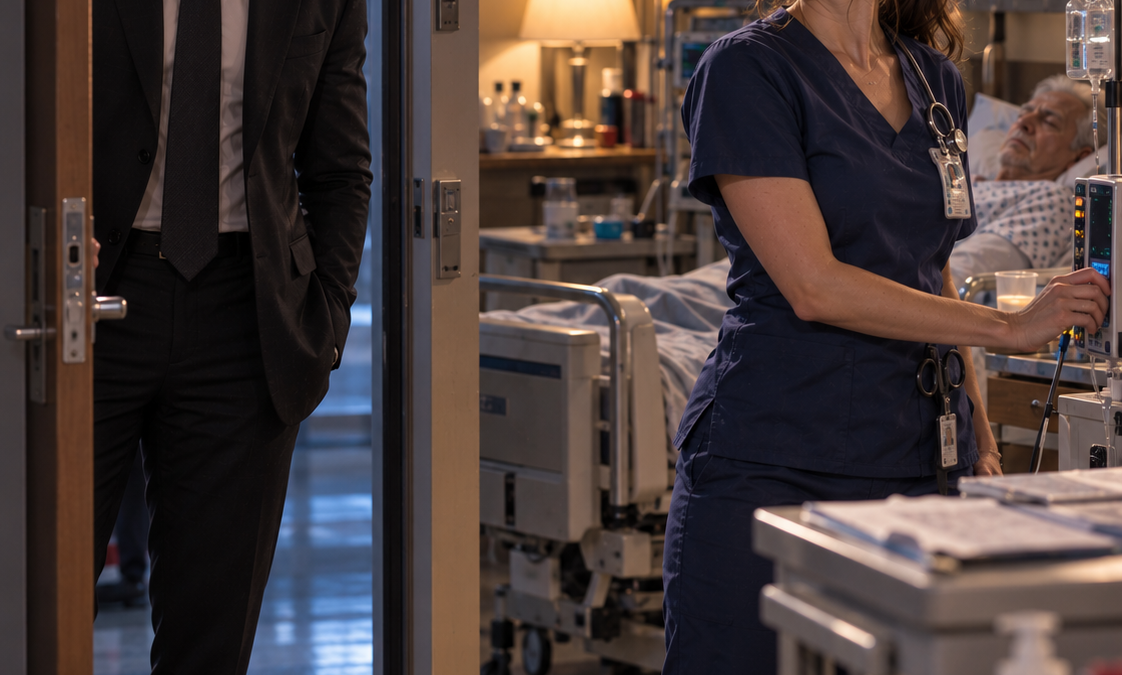
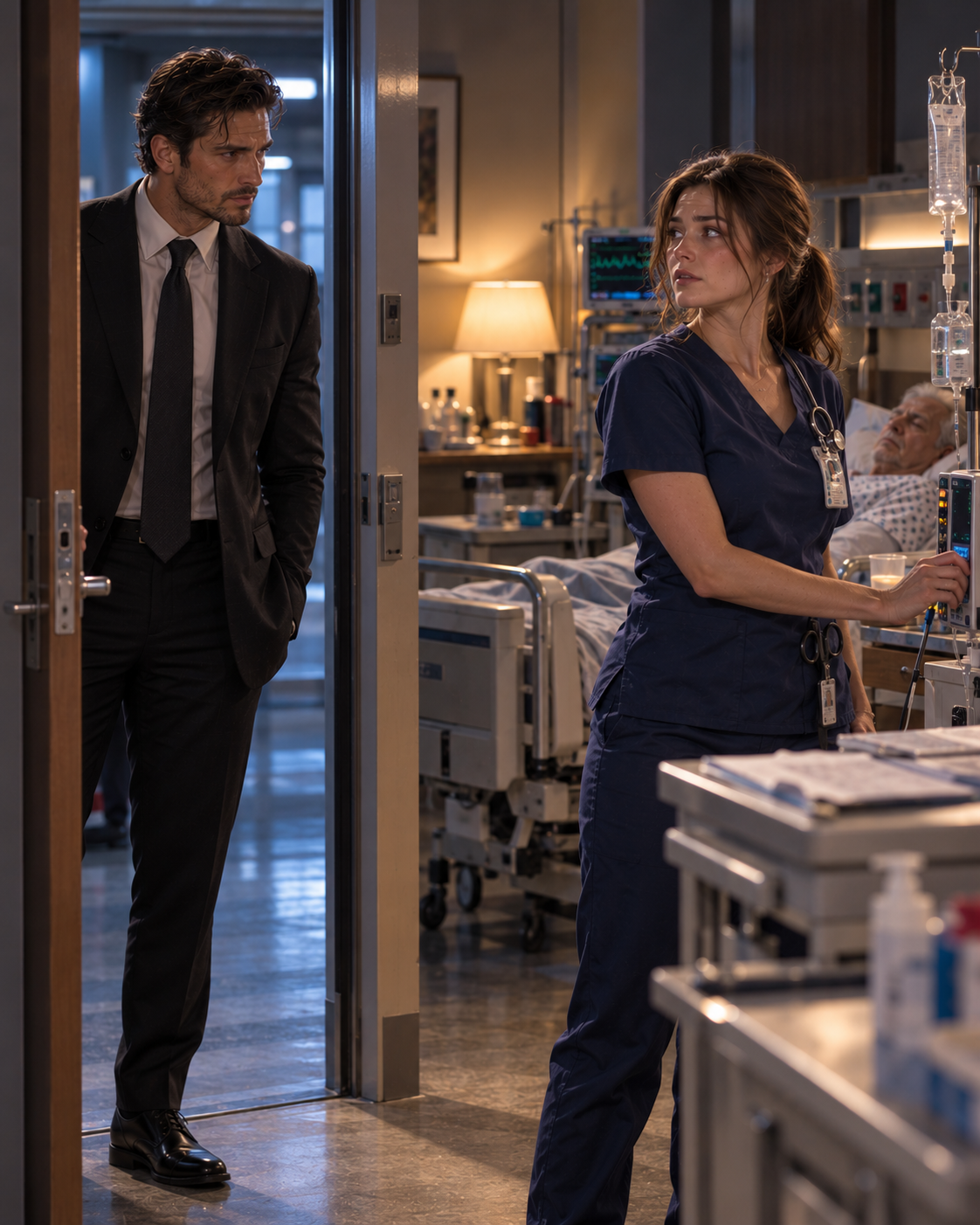
He reached the room number he’d always turned into, pushed open the door, and found himself standing in a patient room that was not the cardiac wing memorial al cove.
It was occupied.
A man he didn’t know lay sleeping in a hospital bed on the far side of the room connected to equipment that hummed at a frequency that made Everett think of machines that measured time instead of kept it.
The room smelled like antiseptic and the faint sweetness of medication and the overhead light had been dimmed to almost nothing. A lamp on the bedside table threw a pale circle onto the sheets. And standing beside the bed, adjusting the flow rate on an IV line with the focused patience of someone who had done this 10,000 times, was a woman.
She was wearing blue scrubs. Her hair was chestnut and long and pulled back imperfectly, a few strands coming loose around her face in the way that happens when someone has been on their feet for 7 hours and has stopped thinking about their appearance entirely.
She had fair skin and a composed face, not beautiful, in a way that announced itself, but the kind of face that became more interesting the longer you looked at it because what was behind it kept surfacing.
She didn’t notice him immediately.
She was writing something on a small notepad clipped to the foot of the bed, her handwriting fast and practiced. Then she looked up.
She didn’t startle.
She didn’t become immediately apologetic the way most people became when they realized they were suddenly sharing space with Everett Langston.
She simply looked at him with the kind of measured tired calm that belongs to people who have stopped being s surprised by the strange things that happen in hospitals after midnight. This room is occupied, she said, not unkindly, just plainly.
I can see that Everett kept his voice equally plain. I have the wrong room.
The cardiac memorial al cove is down the main corridor left at the construction partition third door past the nursing station.
She said it the way someone gives directions to a place they’ve pointed people toward before.
They moved it during the renovation.
The new signage isn’t posted yet, which is apparently someone’s problem that isn’t my problem tonight.
Everett looked at her. In 36 years of life, in the last 14 of them spent operating as the uncontested head of an organization that politely terrified most of the city of Boston, he had become accustomed to a specific texture of social interaction. People either became very careful around him or very performative.
They managed their voices and their expressions and the distance between themselves and him. They were helpful in ways that contained a faint undertone of self-preservation.
This this woman was none of those things. She was simply waiting for him to leave so she could continue doing her job.
“Thank you,” he said.
He started to turn, then stopped, for a reason he couldn’t have explained cleanly afterward.
“Maybe it was the sleeping patient.
Maybe it was the particular quality of the quiet in that room, the way it felt like a quiet that someone had intentionally built and was actively maintaining. Maybe it was just the specific exhaustion on her face that was different from the exhaustion he saw on people who were tired of fighting. This was the exhaustion of someone who had kept going when stopping would have been easier and had done it so many times that keeping going was simply the shape of them now.
You’re here alone, he said.
She looked at him with mild patience, the kind you learn after years of of managing people who need things from you. Night shift, she said.
That’s generally how it works.
He’s your patient.
Mr.Harland is my patient.
Yes, she said it with the particular neutrality of a medical professional who has decided that the fact of the patient’s name is allowed, but the rest of his information is not, and he’s resting, which he needs more than he needs an audience.
You should go find your al cove. Everett almost smiled.
He wasn’t sure why.
You noticed I looked tired. She glanced at him briefly.
The way someone glances at a problem they don’t have time to fully assess.
I I noticed most things.
It’s part of the job.
She picked up the notepad again. The plaque will still be there in the morning. He left.
Marcus was still in the car. The engine was still running.
Everett got in and said nothing. and Marcus, who had been with him long enough to know the difference between silences, did not ask.
Everett sat in the back of the car while Boston moved around them in its wet, cold November way, and he thought about a woman who had looked at him, Everett Ror Langston, a name that made grown men careful, and had simply seen someone who was tired. He came back the following night. He told himself it was to visit the memorial al cove, which he had not actually reached the night before.
He walked the new route without difficulty, found the bronze plaque, stood in front of it for 11 minutes.
He read his mother’s name.
He stood in the particular way of a man who is not praying but has nowhere else to put the field. On his way out, he walked past the room with the turned down lamp.
The door was open. Different patient, same nurse.
She was talking to an elderly woman who was having difficulty understanding something on a discharge form.
The nurse was sitting in a chair beside the woman’s bed, not standing over her, not conducting the interaction from a position of efficient authority, but sitting at her level, pointing to each section of the form and explaining it with the careful, patient repetition of someone who genuinely wanted the other person to understand, not just
comply.
Everett stopped in the hallway. He stood there for approximately 40 seconds before she looked up and saw him.
There was a pause, not an uncomfortable one, just the pause of someone recalibrating to an unexpected variable. You found the al cove, she said.
It wasn’t a question.
I did. Good.
She returned to the form, pointing to the next section. The elderly woman said something in a small, worried voice.
The nurse said, “No, that part doesn’t apply to you.
We can skip it.
Look here instead.”
Everett walked to the nursing station and found the charge nurse on duty. A sound like Greenwood Splitting, an older woman named Naen Prescott, who looked at him the way seasoned professionals look at wealthy men who appear in inconvenient places with the specific weariness of someone who has seen this particular category of problem before. He identified himself.
He mentioned the foundation. He asked whether the hospital had an ongoing relationship with Langston Charitable.
Nadine Prescott looked at him for a moment. That lasted about 3 seconds longer than most people would have tolerated from someone of his standing.
It’s 11:30 at night, she said.
I’m aware.
The administrative offices close at 5.
Also aware then whatever you need from the foundation’s relationship with this hospital, Naen said in the tone of a woman who has survived 30 years of night shifts and does not intend to be managed can wait until 5:01 tomorrow afternoon.
She picked up a clipboard.
“Is there anything else?”
Everett almost smiled again.
“It was happening more than usual lately.”
“No,” he said.
“That’s all.”
He came back the next afternoon through official channels with the foundation’s director of charitable partnerships and a briefcase containing the current allocation documents for the Marble Langston Cardiac Initiative.
Naen Prescott was on dayshift. She looked at him across the administrative conference table with the expression of someone who had expected exactly this and had already decided how she felt about it. The meeting was supposed to be about a potential reallocation of foundation funds.
That was at least what the document said. What the meeting was actually about, though Everett was the only person in the room who knew this was whether he could find a legitimate reason to spend time in this hospital without anyone understanding exactly why.
He had not told his foundation
director why he’d returned.
He had not told Marcus. He had certainly not told his head of security. He had simply picked up a phone and said the words foundation meeting Blackidge Thursday 3P M and watched the machinery of his professional life arrange itself accordingly.
The reallocation in question was $40 million. Currently, those funds supported the aging cardiac program.
His mother’s foundation had established equipment upgrades, nursing staff development, family support services.
Camila had been pushing for 18 months to redirect the money toward a new medical pavilion. The pavilion would bear the Langston name in large letters on its exterior wall.
It would attract press. It would attract influential attendees at ribbon cutting ceremonies. It would photograph beautifully.
It would also strip the cardiac wing of the ongoing funding that kept it functional. Everett had been resistant, not because the pavilion was a bad idea on its face, but because resistance to Camila had become a kind of habit, one of the few areas in his life where he still exercised the specific discipline of making her work for every inch of ground.
Camila Langston Devo was his father’s daughter from a first marriage that ended before Ever was born.
She was 41, polished in the way of people who have spent decades cultivating the appearance of warmth while using it instrumentally.
She had been managing the foundation’s public face for 6 years.
She was very good at it, was very good at it.
She was also good at managing Everett’s grief in the specific that involved pointing his guilt in directions that happened to benefit her.
He had known this for years.
He had allowed it anyway because in the aftermath of his mother’s death, allowing things had been easier than fighting them.
Meeting Audrey Bellamy on the wrong side of a hospital door had not changed that calculation overnight. But it had made him notice the calculation for the first time in a long time as something he had a choice about.
The meeting at Blackidge ended with nothing resolved. Everett asked to see the hospital outside of official hours, framing it as due diligence before any reallocation decision. The administrator looked uncertain.
Naen Prescott, who had been seated at the far end of the table in a capacity that nobody had quite explained, looked at him with the specific expression of someone who has seen men like him try to make the world available for their inspection before. My staff and my patients, she said quietly when the administrator had stepped out to take a call, are not entertainment for wealthy donors.
Everett met her eyes.
No, he said they’re not.
Something shifted very slightly in Naen Prescott’s expression.
Not warmth exactly, but a slight recalibration. 2 days later, she walked him through the hospital on a Tuesday evening after visiting hours.
He wore no tie, no bodyguards.
The foundation’s public relations director had called three times asking to attend, and Everett had declined three times.
He carried a legal pad and wrote almost nothing on it, which told Naen more about what kind of attention he was actually paying than if he’d filled every line.
She showed him things that didn’t appear in grant reports.
The the supply room that had flooded twice in the last 18 months because a drainage issue nobody had found budget for. the cardiac monitoring equipment that was technically functional but had been flagged for replacement 3 years ago.
The family waiting lounge room where parents, spouses, and adult children sat through the worst hours of their lives that contained 12 chairs, a broken television, a coffee machine that worked on alternate Tuesdays, and a window that faced a concrete wall. Everett stood in the waiting room for a long time.
My mother died in a room like this, he said finally. He said it almost to himself, which meant Naen understood it was not a performance. A lot of mothers do, she said.
He nodded slowly.
Then I’d like to speak with the charge nurse Bellamy.
Nadine’s expression did not change, but something in her became very still.
About the cardiac wing.
She’s been here 5 years according to your staff records.
Longer than most. She has.
I’d like her perspective on what the wing actually needs.
The stillness in Naen lasted another beat. Then she picked up her radio and called for Audrey. Audrey arrived 4 minutes later.
She was on the tail end of a shift hair escaping its tie again, eyes sharp despite the fatigue. She looked at Everett with the mild recognition of someone who has encountered a variable before and filed it under unexplained but not currently threatening.
You’re back, she said.
tour of the cardiac wing.
He said, “Your boss said you might be willing.”
Audrey looked at Naen, who gave her a look that communicated approximately 17 things without moving a single facial muscle. Then she looked back at Everett.
I have two rules, she said. All right. No staged anything.
If you walk through this wing with me, you see what’s here, not what’s been arranged for a donor visit.
Agreed.
And if a patient needs something while we’re walking, we stop and I do my job first.
Of course. She studied him for one more moment. Okay, she said.
Come on. She walked fast, not to impress him, just because fast was how she always walked.
The permanent pace of someone whose environment required her to be in multiple places in sequence. He kept up.
She didn’t wait for him, but she didn’t lose him either.
that she got the improtist exactly where he was in the corridor at every point without appearing to look. She showed him everything.
The leaking sink in the medication room, the outdated monitors, the storage closet where two nurses had been eating their 30inut meals because the staff lounge was overcrowded. The call site system that had a 3-second delay no one had ever explained.
the supply cart that had a broken wheel and moved sideways instead of forward, which created a problem every single shift that every nurse on the unit had simply absorbed into their workflow as a permanent inconvenience.
Nobody’s reported it, he asked.
It’s been reported, Audrey said without looking back at him.
There’s a difference between reporting something and having the infrastructure to fix it.
They ended up beside a window at the far end of the wing.
It overlooked the hospital’s interior courtyard, a small square of grass with a concrete path around it, lit by exterior lights that gave everything a slightly blue gray color.
Everett looked at the courtyard for a moment, then without quite planning to. How long was she in here?
Audrey looked at him. Your mother?
He nodded.
I didn’t work here when she was a patient.
A pause. But I know the room.
Fourth door on the right before the renovation. good window.
She would have had a view.
Something moved in him that he didn’t expect.
He kept his face still, which was something he was very good at. But Audrey was someone who noticed things as as a professional reflex, and she noticed it anyway.
She didn’t make a thing of it.
She simply said, “How old were you?”
“28.”
She was quiet for a moment.
“Then my mother died of the same thing.”
“Pancreatic.”
“She was 53.”
She paused.
“No window.
” The word sat between them in the particular way that words sit when both people in a conversation have lost the same thing in in the same place and understand that discussing it further would not make it better only louder.
After a while, Audrey said, “The family lounge is the worst of it.
That’s where people fall apart, and there’s nowhere to fall.
12 chairs and a broken television.”
She looked at him evenly.
“If I were spending $40 million, I’d start there.”
Everett looked at her. She was not trying to manage him. She was not pitching him.
She was simply saying the thing that was true and leaving him to do whatever he was going to do with it.
I’ll start there, he said.
She looked at him for a moment.
That same careful, tired, honest look she’d given him in the dark of the wrong room on the wrong night.
The look that saw what was actually there instead of what was supposed to be there. Then she picked up her radio because someone down the hall needed something and she left him standing at the window.
Everett stood there a moment longer. Looked at the courtyard at the blue gray light at the small cold square of grass where nobody sat because it was November and it was late and the world outside the window was not the world people in this wing were thinking about. Then he picked up his legal pad and wrote three words at the top of the otherwise empty page.
start with the lounge.
He didn’t fully understand yet that the decision he had just made the first real decision, the first one that belonged entirely to him and not to the organization or the foundation or the inherited weight of everything his father had built and his mother had softened, was not about $40 million.
It was about which kind of man he wanted to be.
He didn’t know that yet.
But Audrey Bellamy walking back down the corridor toward a patient who needed her was the reason he was starting to ask the question. Outside, Marcus waited. The car was running.
November pressed its cold against every window in the building. And somewhere across Boston in a townhouse that smelled of expensive candles and strategic calculation, Camila Langston Devo had just received word that her stepbrother had spent two hours at Blackidge Medical Center without a publicist.
without a photographer, without a single staff member from the foundation’s communications office.
She sat down her wine glass very carefully.
“Find out why,” she said to the person across the table.
The answer she eventually got back was not the one she expected, and it would cost her more than she had planned to spend.
Camila’s Langston Devo did not panic.
Panic was for people who hadn’t thought three moves ahead.
She sat in her home office on the fourth floor of her Beacon Hill townhouse, a glass of bo going untouched at her elbow, and she read the report her private investigator had compiled in 48 hours. Six pages, singles spaced. She read it the way she read everything fast, looking for the angle, cataloging what she could use and what she needed to contain.
The night shift nurse, Audrey Bellamy, 29 years old. Oncology charge nurse. Blackidge Medical Center.
No criminal record. No debt beyond manageable student loans. No social media presence.
Worth noting. Rented a two-bedroom apartment in Jamaica Plane with her younger brother Wesley, who was completing a graduate degree in architectural engineering and used a wheelchair following a car accident four years ago. Camila set the page down.
A nurse. Everett had been coming back to that hospital repeatedly for a nurse. Not a socialite, not a lawyer, not someone from the overlapping social and professional worlds where Camila could apply the usual pressures.
A woman who worked nights in a hospital and went home to a small apartment and had apparently absolutely no idea what she had walked into.
Camila picked up her phone and called the foundation’s legal director.
the 40 million,” she said when he answered.
Where are we on the reallocation timeline? A pause.
Mr.Langston hasn’t signed off.
He’s asked for a 90-day review period before any decision.
He asked for that today. His assistant communicated it this afternoon. Camila was quiet for 3 seconds.
3 seconds was a long time for Camila. All right.
She said, “Thank you.”
She hung up, picked up the baro, set it back down without drinking. 90 days. Everett had spent 2 hours at that hospital, come home, and immediately created 90 days of space between Camila and the money she had spent 18 months positioning herself to redirect.
She understood then that this was not about charitable philosophy. This was not about the cardiac wing versus the pavilion.
This was about a woman who had apparently without any deliberate effort made Ever Langston start thinking for himself again. Camila had spent 6 years keeping that from happening.
She closed the investigator’s report, placed her palm flat on the cover, and thought carefully about what came next.
She was still thinking when her phone buzzed with a text from her half-brother’s foundation director.
Meeting request. Everett wants full board review of all current allocations. Thursday at 10:00.
She stared at the message, then she smiled slowly.
the way a person smiles when they’ve realized the game has changed but haven’t yet decided they’re going to lose it.
All right, Audrey, she said quietly to no one in the room.
Let’s see who you actually are.
Audrey didn’t know any of this.
On Wednesday morning, she came off a 12-hour night shift, drove home in her 2017 Honda Civic with a cracked rear bumper and a heating system that only worked on the driver’s side and let herself into the apartment at 7:14 in the morning.
Wesley was already up. He
was always already up. His sleep schedule existed in a different time zone from the rest of the human population.
Something to do with the thesis deadline bearing down on him like a physical weight. and he had developed the habit of making coffee at 6:30 and leaving a cup on the counter for her covered with a small saucer to keep it warm.
She picked up the cup, sat at the kitchen table, did not take off her coat immediately because the apartment was cold and she had been warm in the car and she wasn’t ready to give that up yet.
Wesley rolled in from the hallway, laptop balanced on his legs, a pencil behind each ear in the specific chaotic fashion that meant he had been working since at least 4 in the morning. How was it? He asked.
Mr.Harlland’s numbers are better.
That’s not what I asked.
She looked at him over the rim of the coffee cup.
Wesley had their mother’s eyes dark and direct and completely uninterested in being managed.
It was fine, Wes. You have your fine but not fine face.
I have my tired face.
They’re the same face.
They are not the same face, and you know it. He set the laptop on the table.
The rich guy came back, didn’t he?
Audrey sat down the cup.
He’s a foundation donor.
He’s reviewing the hospital’s grant relationship.
He came back twice in one week to stand in a hallway.
He’s doing due diligence.
People doing due diligence, Wesley said, send associates. Rich people especially, they do not personally come back to a hospital at 11 at night twice in a row unless something specific is pulling them back.
He tilted his head and you gave him a tour. Naen asked me to. Did Naen ask you or did he ask for you specifically?
The question sat in the kitchen between sat in the kitchen between them with the specific weight of a question from someone who knows the answer already and is giving you the chance to say it out loud.
Audrey stood up, took off her coat, draped it over the back of the chair with the careful precision of someone who is organizing their movements because their thoughts are less organized than they’d like.
He’s a wealthy man who comes to that hospital to visit his late mother’s memorial plaque once a year.
He opened the wrong door.
Now he’s doing a proper foundation review.
She picked up her coffee again.
That’s the whole story.
Wesley looked at her steadily.
What’s his name?
I told you I’m not Audrey.
She looked at him. He was doing the thing where he went very still and very direct, which was something their mother had also done, and which Audrey had no reliable defense against.
Langston, she said, Everett Langston.
Wesley’s expression didn’t change immediately.
Then it did in the slow, specific way of a man whose brain is connecting dots he didn’t expect to be connecting.
Everett Langston, he said. Langston. As in the Langston Foundation.
Yes. As in the Langston family. As in, he stopped.
As in a wealthy real estate family with a charitable foundation. Yes. Wesley looked at her for another moment.
Something moved across his face that she couldn’t entirely read.
Not alarm. Exactly.
More like the expression of someone who has just realized the edge of the room is closer than they thought. Audrey, he said carefully.
That family is not just real estate money.
Don’t, she said.
I’m just I know what you’re saying and I’m telling you not to.
She finished the coffee. Set the cup in the sink.
I showed a foundation donor around the cardiac wing. He saw what the wing actually needs.
Maybe something gets fixed.
That’s a good outcome, Wes.
That’s it.
Wesley was quiet for a moment. Then you like him.
I don’t know him.
That’s not what I said.
Audrey turned and looked at her brother. this person who had been the other half of their small, battered, tenacious family for his entire life, who had sat with her through the worst nights and the worst mornings, and who knew the exact texture of her particular silences better than anyone alive.
He’s not tired the way rich people are usually tired,” she said finally.
“He’s tired like someone who’s been carrying something for a long time and hasn’t figured out how to put it down.”
She paused.
That’s all I noticed.
Wesley said nothing, but he picked up his pencil and wrote something in the margin of his notebook that Audrey didn’t read.
And she went to bed. And she did not dream about the cardiac wing.
She dreamed about her mother’s room, the one without a window.
The foundation board meeting on Thursday was the first time Everett had walked into that particular room without already knowing exactly what was going to happen in it. He had run these meetings for 8 years.
He knew where everyone sat. He knew who deferred to whom before the agendas were even distributed, and he knew the specific architecture of every alliance and resentment in that room, the way a man knows the floor plan of a house he has lived in for most of his adult life. Camila was at the far end of the table when he arrived.
She was wearing gray. She had a leather folio open in front of her and a cup of coffee at her right hand and the expression of someone who is exactly as prepared for this meeting as they appear to be. She smiled at him when he sat down.
Everett Camila, the foundation’s director, a cautious man named Peter Hollis, who had been managing the competing pressures of this particular family’s charitable interests for 4 years and had aged perceptibly in that time, opened with the standard agenda items, investment performance, upcoming grant cycles, a new proposal from a children’s literacy initiative in Roxbury.
Everett listened. He signed off on the literacy initiative.
He asked two precise questions about investment performance that made the finance director shuffle papers with slightly more urgency than was strictly necessary. Then Peter Hollis reached the reallocation item.
Marble Cardi grants neutrality with the practiced neutrality of someone who understands that the content of what he’s reading is less important than the dynamics of the room around him.
I’ve already communicated a 90-day review period, Everett said.
Yes. Peter glanced at Camila.
There was some concern on the board that I’m aware of the concern, Everett said.
Not loudly. He never needed to be loud.
The 90-day review stands. Camila leaned forward just slightly.
She did it the way she did everything in meetings with the appearance of collaborative engagement while actually occupying more space.
Everett, I think what the board is trying to understand is what’s driving the review.
The reallocation proposal has been in development for 18 months. The pavilion project has significant community support.
If there are specific concerns about the cardiac initiative’s performance metrics, the review is about performance metrics.
Everett said all of them, including the ones that don’t appear in the current proposal.
A beat.
Camila’s smile stayed on.
That was the thing about Camila. The smile was loadbearing.
It held the entire structure up. Of course, she said transparency is always useful.
I visited Black Ridge on Tuesday. Everett said to the table generally, not to Camila specifically.
The cardiac wing. I walked through it with the charge nurse.
I’d like to share what I found with the board before any reallocation decision is made.
Peter Hollis made a note. Two other board members exchanged the specific glance of people who were relieved not to be at the center of whatever this was.
Camila said nothing. She wrote something in her folio instead.
Her pen moved in small controlled strokes. After the meeting in the corridor, she caught up with Everett at the elevator.
A charge nurse. She said it was not quite a question.
She knows the wing better than anyone in the proposal documents.
I’m sure she does.
Camila matched his pace. I just want to make sure the review process has appropriate perspective. Frontline staff have an understandably limited view of what the wing actually needs.
She paused. Of the broader strategic picture. The elevator arrived.
Everett held the door. The broader strategic picture, he said, currently includes a family waiting lounge with 12 chairs and a broken television.
I want that fixed before we talk about pavilion ribbon cutting ceremonies. He stepped in.
I’ll see you at the next board meeting, Camila.
The doors closed. In the corridor, Camila stood very still for a moment. Then she opened her folio and drew a single neat line under the note she had made during the meeting.
It read, “Find out everything about Audrey Bellamy.”
She underlined it twice. The Saturday lunches started without anyone deciding they would.
Everett had come to the hospital on a Friday afternoon for a follow-up meeting with Peter Hollis and Blackg’s administration about the review process.
The meeting ran long.
Audrey’s shift ended at 3.
They met by coincidence. That was not entirely coincidence in the elevator lobby. She was carrying a canvas tote bag with a small tear in the bottom corner.
She had changed into street clothes, dark jeans, a gray sweater, a coat that had clearly been good quality once and was now very clean and visibly old. She had her hair down.
For the first time, he’d seen it, and it was longer than he’d realized.
She looked at him with the mild weariness of someone who is recalibrating a situation.
“Foundation meeting?”
she asked.
“Just finished.
How’d it go?”
Slowly, he paused.
“Are you taking the iDrive?
Where are you parked? She looked at him with the particular expression of a person who is deciding something quickly. Lot see why.
There’s a decent Vietnamese place two blocks from here.
I haven’t eaten since 6 this morning.
Audrey looked at him for a moment. Her expression was not flattered, which was interesting.
It was more like someone examining a map for the route they weren’t sure they wanted to take.
I’m not a person you need to impress, she said.
I know.
and I’m not going to tell you things about the hospital that aren’t already in the grant documents.
I’m not asking you to, she looked at him one more beat.
Vietnamese is fine, she said, but I’m paying for my own.
He didn’t argue.
She would have walked away if he had. The restaurant was small in warm, and they sat at a table near the window where the November light came in at a low angle and turned everything amber. She ordered f without looking at the menu.
He ordered whatever she pointed to, which was the practical decision of someone who understood that she knew what was good here, and he didn’t.
She noticed him doing that, and something in her expression adjusted almost imperceptibly towards something less guarded. They talked about the hospital, then about Boston, then in the slow incremental way of two people who are both cautious and both more interested in the other person than they intended to be, about less neutral things.
She told him about Wesley, about the accident four years ago that had left her brother in a chair and changed the geometry of their small family permanently. about the way Wesley had refused to treat the situation as a catastrophe, which was both the most admirable and the most infuriating thing about him, about how she had learned in the 18 months following the accident to read the difference between Wesley being genuinely all right and Wesley performing being all right for her benefit. Do you do that?
Ever asked. Perform being all right?
She considered the question seriously, which was something he was noticing about her. She took questions seriously instead of battering them back immediately.
Sometimes she said less than I used to. She looked at him.
Do you? Constantly, he said. She looked at him in the way she had in the wrong room on the wrong night directly without softening it, without looking away to give him room to take it back.
Why? Because stopping felt more dangerous than continuing, he said.
She nodded. Not the nod of sympathy exactly, more the nod of recognition.
The They sat there while the foe steamed between them, and the amber light shifted and outside on the sidewalk. Boston moved past the window doing the specific hard-edged November thing Boston did when the warmth was fully gone.
He told her about his mother, about November 14th, about the specific quality of standing in front of a bronze plaque and having absolutely nothing to say to it that felt adequate. She listened without attempting to resolve any of it, uh, which was more valuable than any response she could have given. She died without a window, Audrey said eventually.
Her voice had gone quiet, my mother. The room had a ventilation shaft on one side and a wall on the other. She asked me once if it was raining.
I didn’t know.
I had to go look. Everett was quiet for a moment.
I’m I’m sorry.
I put in a request every year, Audrey said. for the single rooms with windows. Cancer patients terminal.
The ones who are going to spend their last weeks in a room, they should have a window. She looked out at the street gets approved sometimes.
Not always. Depends on capacity.
What would make it always? She looked at him.
More rooms with windows. He said nothing.
But when he paid the bill, she argued briefly and conceded when he pointed out that he’d ordered whatever she pointed to, and therefore she had functionally made his meal decisions, and he was not paying for his own decisions.
He wrote something on the back of his receipt.
She didn’t see what it was.
The second Saturday was at a Korean place that Wesley had recommended via text message to Audrey, who relayed the recommendation without appearing to think about whether relaying it was a signal. Everett appeared. They ate.
Wesley texted three times during the meal with increasingly pointions framed as logistical inquiries. The third Saturday, Audrey made soup. She had not planned to.
She had planned to suggest another restaurant except that it was raining and cold and she had chips and chicken stock and she had made this soup since she was 19 because her mother had taught her and it required almost no attention once it was going. She called Everett to suggest a different place.
And somehow what she said was, “I’m making soup.
You can come if you want.
My brother’s home, which means it will be chaotic.”
There was a pause on his end.
“What time?”
he said.
Wesley’s chaotic, it turned out, was a specific and weaponized form of social intelligence.
He assessed Everett in approximately 4 minutes. the covert assessment of someone who has learned to read rooms from a seated position and has become very good at it and then spent the rest of the afternoon relentlessly teasing him. Not meanly, that was the thing.
Wesley’s humor had no malice in it.
He teased Everett the way he teased Audrey with the casual, inventive, loving cruelty of family.
He made a joke about Everett’s coat.
He made a joke about the way Everett held a soup spoon. He made a joke about the fact that a man who apparently owned four buildings in the Back Bay neighborhood was eating soup in a Jama Jamaica plane apartment with a radiator that knocked. Everett laughed.
Not the controlled social version of laughter that he deployed at functions and meetings.
The actual version, the one that surprised him coming out, the one that felt like something opening up that had been closed for longer than he’d realized.
