MILITARY K9 Blocked Everyone From the SEAL Captain’s Son — Until the NURSE Spoke Two Words
MILITARY K9 Blocked Everyone From the SEAL Captain’s Son — Until the NURSE Spoke Two Words
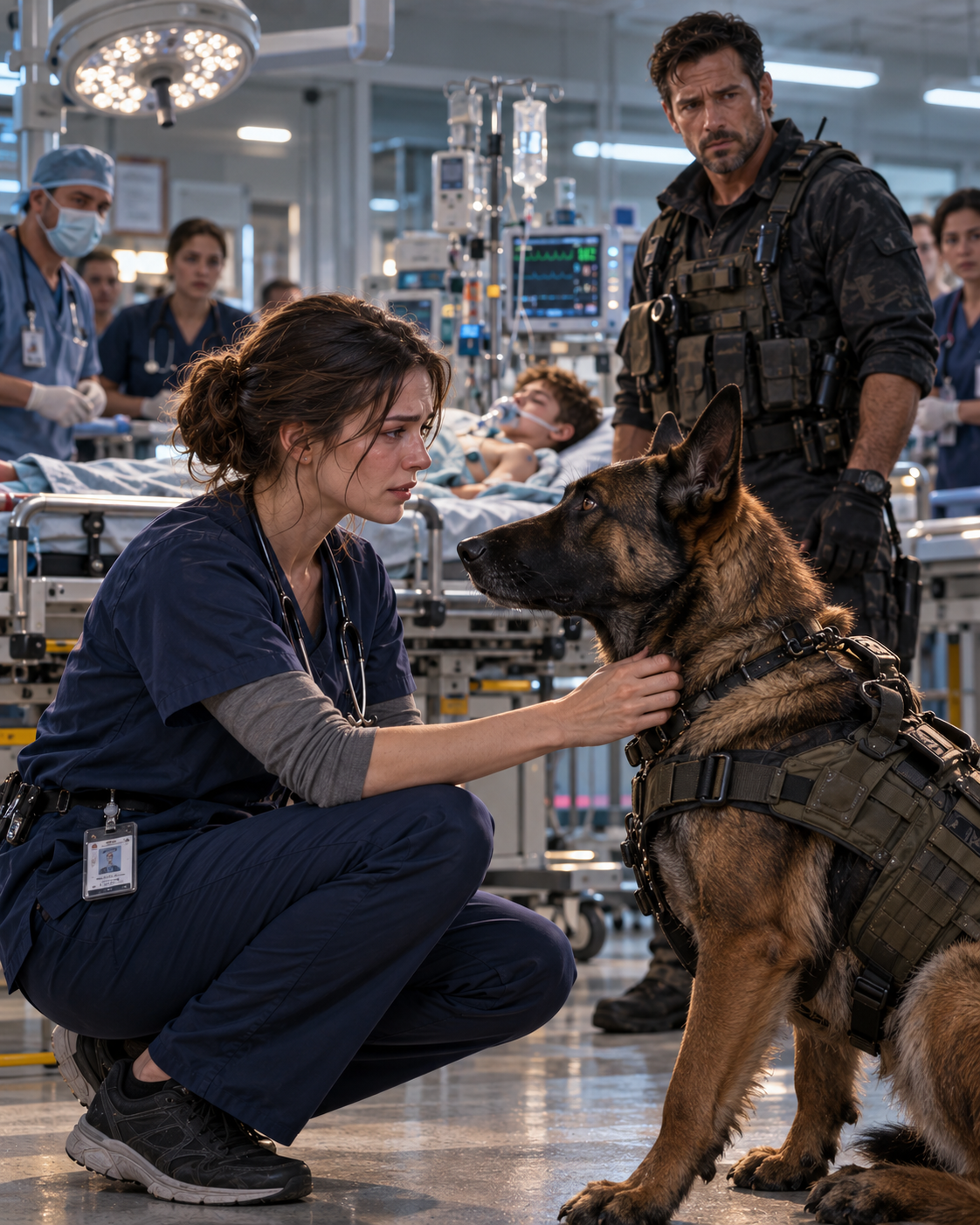
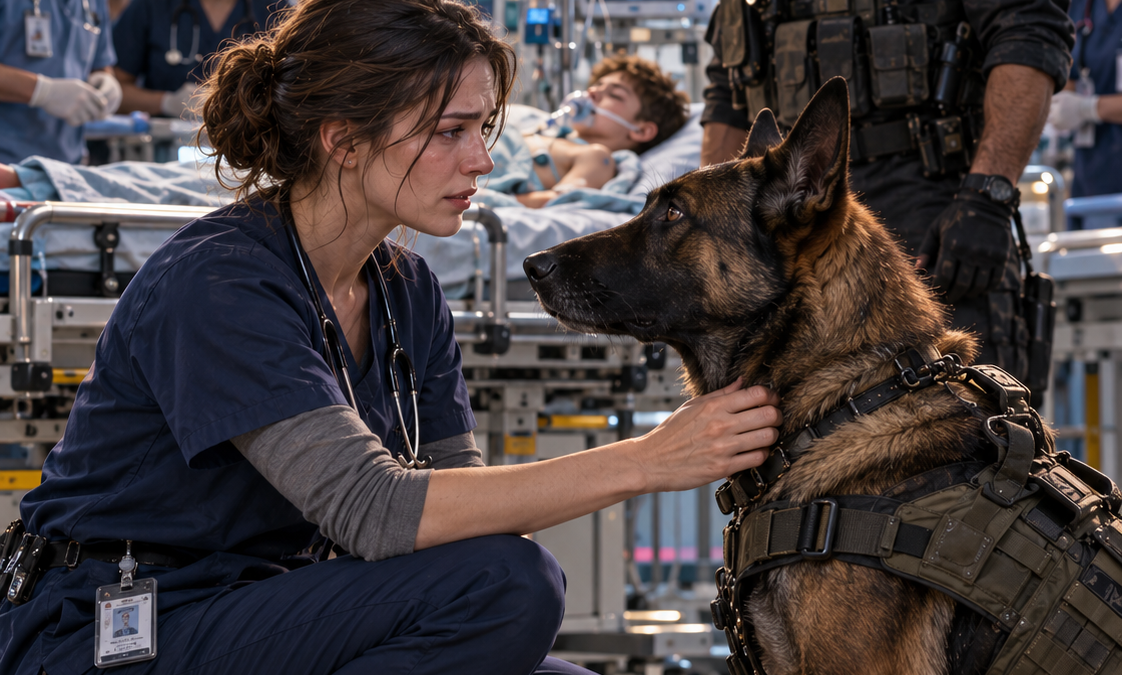
The military attack dog had already torn through two soldiers and sent a trauma surgeon scrambling over a supply cart to escape. It stood in the center of the emergency bay, a 100 pounds of Belgian Malininoa fury, blood on its muzzle, hackles raised, and nobody, not the handlers, not the MPs, not the decorated Navy Seal captain standing 10 ft away with his hand on his sidearm could get within arms reach of it. Then a nurse nobody had ever paid attention to walked straight into the middle of that chaos.
Said two quiet words in a language that had no business coming out of her mouth, and the dog sat down like she’d flipped a switch.
The captain’s face went white.
The city of Morfield, Virginia had exactly one trauma center that served the surrounding four counties. and Havfield General wore that distinction the way a tired horse wears a saddle. Necessary, unglamorous, and permanent.
The ER operated at a controlled kind of chaos that its staff had long since stopped noticing. Gurnie rolled, monitors beeped, the PA system called codes in a flat automated voice, and the people who worked there moved through it all with the numb efficiency of people who had simply seen too much for too long.
Nurse Evelyn Marsh had worked the ER floor for 3 years, and in those three years, she had become the kind of person that institutions quietly depend on while loudly ignoring. She was 34, not particularly tall, with dark hair she kept pinned back in a knot that always had at least one strand working loose by midshift. She spoke when spoken to.
She charted her notes completely and on time. She knew where every piece of equipment in that ER lived, including the crash cartwheels that stuck on the left side and the defibrillator in bay 6 that needed an extra half second on the charge button.
She did not talk about herself, not where she was from, not what she did before nursing, not why she sometimes stood very still in the middle of the hallway for a few seconds with her eyes closed like she was running calculations. Her co-workers had stopped asking. Some of them had decided she was odd.
A few of them had decided they liked her quietly in the way you like something reliable and uncomplicated. Most of them had decided she was simply background.
Dr.Randall Hol had decided she was nothing.
Hol was the trauma chief at Havfield General and he ran the ER the way certain men run everything loudly with absolute confidence in his own judgment and very little curiosity about anyone else’s.
He was not incompetent. That was the frustrating part.
He was genuinely skilled, fast under pressure, the kind of surgeon who made the right call in the room more often than he didn’t.
But skill and decency are separate things, and Randall Hol had never felt the need to develop both simultaneously. Marsh, he said her name like it was a minor inconvenience every time. Did you pull the Cardanis chart or not?
Yes, Dr.Hol updated it at 6:15. The medication reconciliation is incomplete.
The pharmacy hold on his eloquist didn’t clear until 6:40.
I added the note. He looked at the tablet, looked at her, and handed it back without acknowledging that she was correct.
That was his signature move.
When he was wrong, he simply moved forward as though he hadn’t spoken.
No acknowledgement, no adjustment, just the same steady drum beat of a man who believed the people around him existed to absorb his mistakes. The other residents had learned to mirror him, not out of malice necessarily, mostly out of survival.
Dr.Petravoss was the worst of them.
She was second-year emergency medicine, sharp enough to know better, and she had understood early that the fastest path forward in Hol’s department was to agree with everything he said and locate a convenient subordinate when something went sideways.
Evelyn had been that subordinate four times in 2 years.
She’d stopped counting after that.
The morning of the incident started the same way most of them did. The ER was running three traumas, two of which were stable enough to manage down, and one, a 61-year-old man named Bernard Aaphor, who had arrived by ambulance at 5:47 a.m.with a dissecting aortic aneurysm, who was not. Evelyn had been the first person to flag the presentation.
She’d seen the pattern in the initial vitals, the differential blood pressure between his arms, the sudden onset of the chest pain, the way he described it as tearing rather than pressure.
She’d put a note in the chart, and flagged the attending.
The attending had been Voss, who had looked at the note, nodded in the non-committal way of someone who is going to decide this themselves, regardless of what anyone says, and ordered a cardiac enzyme panel without ordering the CT angagram. Evelyn had gone to Hol directly.
“I understand you have concerns about the workflow,” Hol said in the tone he used when he was telling someone their concerns were the problem.
“Dr.Voss is managing that patient.
If she wants your input, she’ll ask.”
The presentation is consistent with type A dissection. The window for intervention, Marsh, he said it flat.
What is your medical degree in? She had not answered that question.
She had gone back to the floor, documented her concern in the nursing notes with timestamps, and watched as Bernard Oafor’s blood pressure dropped 40 minutes later, and Hol came sprinting in to order the exact scan she’d flagged, catching the dissection with 40 minutes to spare before it would have been a
fatality.
He didn’t say anything to her afterward.
Neither did Voss. Evelyn charted her notes and went on to her next patient. three years of this, not every day, not every shift, but often enough that it had built up a kind of sediment inside her, something she stepped carefully around.
She had left one life to build a quieter one, and quiet was what she had chosen. She kept her head down. She absorbed the friction.
She did her job. It was working in the grim mechanical way that a thing can work without being good.
The morning it stopped working started with a patient named Marcus Tully, 22 years old, who came in presenting with chest pain after a minor car collision and turned out to have an undiagnosed cardiac condition that could have been catastrophic under the wrong intervention. Evelyn had flagged it.
She’d also inadvertently crossed Holt standing order on medication sequencing when the patients BP spiked, and she made a judgment call to hold the second dose pending the echo results.
She had documented her reasoning. The patient had stabilized.
The echo had confirmed her concern.
None of that mattered in Hol’s office at 11:15 that morning.
“You deviated from the treatment protocol,” he said.
He had the particular calm of someone who has decided the outcome of a conversation before having it without authorization.
“The patients pressure was climbing and the echo hadn’t returned yet.
I didn’t feel it was safe to You didn’t feel.”
He said it like she’d reported a superstition.
You’re a floor nurse, Marsh.
You don’t make those calls.
I documented everything in real time. The echo confirmed.
I’m not debating the outcome with you.
He folded his hands on the desk.
I’m telling you that you overstepped.
This is not the first time, and it’s not something I’m willing to continue managing.
He looked at her steadily. Pack your things. Effective end of shift.
You’re done here.
She looked at him for a moment. There was something that moved through her. She would not call it anger exactly, though anger was in it.
It was more like the feeling of recognizing something you’d been expecting for a long time without wanting to admit it.
She had been waiting for this.
She had known on some level that the way she’d been surviving this place was not actually survival.
If you’re terminating my employment, she said with a steadiness that seemed to surprise him slightly, I’ll need that in writing with specific cause documented.
He didn’t blink.
Human resources will be in touch. She stood up.
Then I’ll be on the floor until end of shift as you said.
She walked back to the ER. She had 4 hours left. She spent them doing exactly what she always did, managing her patients with complete attention, charting thoroughly, handing off cleanly.
She did not tell anyone what had happened. She did not look for sympathy. She collected her personal items from her locker in the small window between patient handoffs and put them in the canvas bag she kept there.
She was at the nurse’s station finishing her last documentation when the overhead PA crackled with a different kind of energy.
Not the standard tone, the emergency tone, the one that meant something outside the hospital’s normal operational vocabulary.
All available trauma personnel to the East Bay. Emergency air transport incoming.
Code Crimson. Code Crimson was not a standard designation at Havfield General.
It was a designation reserved for situations involving active federal or military coordination. Situations the hospital had a protocol for but had never actually used.
Evelyn heard it and felt something shift inside her that she couldn’t have explained to anyone who hadn’t experienced it.
A kind of heightened stillness, the same way a compass needle will tremble and then lock. She put her bag down behind the desk and went to the East Bay. The helicopter landed on the rooftop pad with 6 minutes of warning.
The coordination that came over the radio before it touched down was unusual. Not the standard EMS handoff language, but something more tur, more directional with military call signs being used where patient identifiers normally went.
The staff who heard it looked confused. Evelyn looked at the radio and absorbed it in silence.
They brought the patient down on the elevator, a boy, maybe 12 or 13, with the kind of wounds that come from something violent and precise.
He’d been hit by fragmentation based on the pattern.
His blood pressure was low and his breathing was shallow, and he had the look of someone who had been held together by field medicine during transport and was now at the edge of what field medicine could sustain. The team around him was not EMTs. There were four of them, all in tactical dress, all moving with the kind of coordinated efficiency that civilians mistake for military and actual military recognizes as special operations.
One of them was managing the boy’s airway.
Another was running the IV line.
The third had a hand on a rifle that he was keeping deliberately lowered, not because he’d forgotten it was there, but because he was choosing to project calm.
The fourth one walked slightly ahead, and he was the one who stopped when the dog moved. The animal had been in a transport kennel that had been placed against the East Bay wall.
Nobody had paid much attention to it in the initial chaos. It was a Belgian Malininoa, big for the breed, dark saddled with a tracking harness still buckled across its chest. Somewhere in the transition from helicopter to hospital, something had gone wrong with the latch mechanism, and the kennel door had opened, and the dog had come out.
It was not a pet. Anyone who looked at it for more than two seconds could see that it moved the way working dogs move.
Coiled, precise, with a kind of electric awareness that made the air around it feel different. And it was now standing between the incoming gurnie and everything else.
Head low, hackles fully raised, growling with a steadiness that was more frightening than noise. Get the handler, someone said.
Handler’s still on the aircraft, someone else said.
Then get it back in the kennel. Nobody approaches that dog, the man in front said sharply. He had the build and the bearing of someone who had spent a long time in difficult places.
You do not approach that animal without authorization. Hold your positions. His name, Evelyn would learn later, was Captain Darren Wilder, United States Navy.
His son was the boy on the gurnie. Two nurses had already backed against the wall. A firstear resident had moved behind the crash cart with a body language that suggested he was trying to become invisible.
One of the MPs who’d come in with the team had his hand on the telescoping baton at his hip and was doing the calculation of whether deploying it would help or make things substantially worse.
The dog’s growl deepened.
It turned its head toward the gurnie, toward the boy, and the sound it made changed. Not aggression, Evelyn recognized. Protective.
The dog was protecting the child. It had decided that everything in this room was a potential threat and it was not going to let any of it close. She understood that.
She had seen that logic before. Dr.Holt, one of the nurses, had found him.
The dog is blocking the bay.
We can’t get the patient to a trauma room.
Hol appeared at the edge of the crowd with the expression of someone who has encountered a problem that does not fit into any category he’s prepared for.
He looked at the dog. He looked at his staff. He looked at the military personnel.
Where’s the animals handler?
He demanded. Still securing the aircraft, Wilder said.
3 minutes.
We don’t have 3 minutes.
Holt looked at the dog, then at the MP. Can you?
I would not recommend that, sir, the MP said with the flatness of someone who knows what they’re talking about.
Holt looked around. His eyes landed on Evelyn with the expression of a man looking past something rather than at it. She was already moving, not quickly.
That was the thing people would talk about later.
She didn’t rush.
She moved the way you move when you don’t want to startle something, which is slowly and with your whole body communicating intention instead of threat.
She came around the edge of the gurnie cluster and walked toward the dog. Marsh Holt said sharply.
Watam, what are you doing?
She didn’t answer him.
Wilder had his hand up.
Ma’am, do not approach that.
She said two words. They were German. A specific compound.
The kind of thing that exists in a very narrow vocabulary used by a very specific group of people for a very specific purpose.
She said them quietly, the way you’d say something to someone who was already listening.
The dog stopped growling. Its head came up. It turned toward her with its whole body.
And something happened in the animals posture that everyone in the room could see but not name. A shift from combat readiness into something that looked astonishingly like recognition.
It sat down, not reluctantly, not after a second command. It sat the instant the words were out of her mouth, and it looked up at her, and its ears, which had been pinned flat with aggression, came forward. The room did not make a sound.
Evelyn crouched down. She let the dog move to her rather than moving to it.
It came to her immediately, and she did something then that made several of the medical staff exchange glances.
She didn’t pat it the way you’d greet a pet.
She checked it. She ran her hands along its harness with efficient practiced motions, checking for injuries, checking buckles and pressure points, doing something that looked like a post-mission assessment. The dog leaned into her hands.
“He’s got a laceration on the left flank,” she said.
She said it to no one in particular, or maybe to everyone. Not deep.
Needs to be cleaned. The patient, Holt said, finding his voice again.
Can we move the patient now? Yes, she said. She stood.
She put her hand on the dog’s harness, not gripping it, just contact.
He’ll follow me.
Let’s go.
They moved. The gurnie rolled.
The dog walked beside her, pressed close to her left leg. Not erratic, not pulling. Heel position.
Military heel. Trained behavior for a trained handler.
Captain Wilder watched her walk into the trauma hallway with his son’s gurnie and his unit’s dog, and his face did something complicated.
He was not a man who was surprised easily. He had been surprised. He followed.
The trauma bay came alive the way it only does when the situation is serious enough to override everything else. lines going in, monitors connecting, the rapid fire shortorthhand of people doing multiple things simultaneously. Holt was at the head of the gurnie trying to take control of the scene the way he always did, calling out orders, establishing his authority in the room by volume.
And then something started happening that he didn’t notice at first because he was too focused on the patient.
The resident stopped looking at him. Not dramatically, not all at once.
But when the first complication hit, the boy’s pressure dropped faster than expected.
His oxygen saturation following it down in the pattern that meant something was happening in the chest cavity. Holt made a call and the room hesitated. One beat too long, and then Evelyn said something.
She said it quietly, almost under her breath, not to anyone in particular. Tension numo, left side.
Dr.Voss looked at her, looked at the monitor, looked at the boy’s tracheal deviation that had developed in the last 40 seconds.
She reached for the needle. Voss, Holt snapped.
I didn’t.
She’s right, Voss said, and she performed the decompression.
The boy’s saturation climbed.
Holt’s jaw went tight.
He looked at Evelyn across the gurnie with something that had started as contempt and was curdling into something more complicated.
She wasn’t looking at him.
She was looking at her patient.
Her hands moved through the next 10 minutes with a speed and economy of motion that didn’t match a floor nurse.
When she cut the dressing away from the fragmentation wounds, she assessed them in a sequence proximal to distal severity graded that belonged to a triage protocol used in combat medicine. When she called out of the blood pressure readings, she translated them simultaneously into what they meant for fluid resuscitation, doing math in her head that the residents were reaching for calculators to replicate.
When a second drop hit and the room’s controlled chaos started to tip toward actual chaos, she put her hand flat on the gurnie rail raised her voice by exactly one level and said, “Listen up.
We have 2 minutes before his pressure bottoms out.
Here’s what we’re doing.”
And the room listened.
Holt’s voice came from somewhere over her left shoulder, and she registered it the way you register an obstacle.
Noted it, moved around it. Marsh, who authorized you to direct this?
Somebody authorized her,” Wilder said.
He was standing in the doorway of the trauma bay. He had not moved since Evelyn had walked in with his son.
He had watched every second of it. Holt turned.
“Captain, I understand your concern, but we have a protocol here, and this nurse is not in a position to “Your protocol,” Wilder said very evenly.
“Had my son dying 4 minutes ago?”
The room went quiet enough that the monitors were suddenly very loud. He looked at Evelyn.
She did not look up from what she was doing.
The boy’s pressure was stabilizing.
The fragmentation wounds were packed and dressed. The hemorrhage that had been the immediate threat was controlled. He was not out of danger.
He needed surgery soon, but he was no longer actively sliding.
Wilder watched her hands, watched the way she moved, watched the way the other medical personnel in the room had reorganized themselves around her without seeming to realize they’d done it.
the way water reorganizes around a stone. He was a man who had spent 20 years evaluating people under pressure.
And what he was seeing was not a floor nurse improvising. He had seen this before.
He knew what it was. He said one word, not loudly, under his breath, really in the direction of where she was standing.
A call sign, old format, specific structure, the kind that only existed in a particular operational context that most people in this room would not have recognized if they’d heard it clearly.
Evelyn’s hands stopped just for a moment, a fraction of a second.
Her body went very still.
The way it goes still when something reaches through everything you’ve built and touches something underneath.
Then her hand started moving again. She did not look up.
She did not turn around. She finished what she was doing with the same steady precision as before.
But Wilder had seen it, the pause, the recognition. He took one step further into the trauma bay and the expression on his face had changed into something that was not quite shock and not quite certainty but something that lived in between. The look of a man who has just found something he thought was gone for a very long time.
He took one step further into the trauma bay and Evelyn still didn’t turn around and the silence between them had the specific texture of two people who share a language that nobody else in the room speaks.
She finished packaging the last wound, stripped her gloves, and called out the handoff in a clear, flat voice. Pressures holding at 92 over 60. Two large bore IVs, left anticubital and right EJ packed right lateral chest, two fragments still in SYU.
Radiology is going to want a second look at the lower left quadrant before they take him up. He needs the O in the next 20 minutes or the stabilization starts working against us.
The surgical resident who’d been standing 3 ft away absorbing all of this wrote it down without being asked.
Hol was still in the room. He had not spoken in 4 minutes.
That was by Evelyn’s internal count the longest Randall Holt had gone without speaking in any clinical situation she had ever witnessed.
And it meant something was happening behind his eyes that he hadn’t yet decided how to handle.
He made his decision the way he usually did by going on offense. Marsh, he said it louder than the room required. Step outside now.
She looked at him for the first time since the trauma had started. Her face was neutral in the way that faces are neutral when the person behind them is doing a great deal of work to keep them that way.
The patient needs to go up to surgery, she said. The surgical team will manage that.
He gestured toward the door with the finality of someone who expects to be obeyed outside.
This is not a conversation I’m having in front of Dr.for Hol.
Wilder’s voice was not loud either.
It had the quality of something that didn’t need to be loud.
The nurse stays until my son is in the elevator. Hol turned.
He looked at Wilder with the expression of a man re-calibrating, not backing down exactly, but identifying which fight he was actually in.
Captain, I appreciate that you’re I’m not asking, Wilder said.
The room understood. The residents understood.
Even Voss, who was pretending to review the chart, understood. Holt put his hands in his coat pockets and stood very still. And in that stillness, there was something Evelyn recognized.
Not defeat, not yet.
But the first moment when a man realizes that the ground he’s standing on is not as solid as he thought.
They moved the boy to the O 12 minutes later. Evelyn walked beside the gurnie to the elevator, the dog still on her left side in that locked heel position, its tracking harness brushing against her scrub pants with every step.
She put her hand on the boy’s forearm before they wheeled him in just for a second, just contact, and he was unconscious and couldn’t register it, but she did it anyway.
The elevator doors closed.
She stood in the hallway and let out a breath she’d been holding since the helicopter landed.
Behind her, she heard Wilder’s footsteps.
She turned before he reached her, not because she was trying to control the interaction, but because she had spent a long time training herself not to let things approach from behind without seeing them coming first.
Old habit, the kind that doesn’t leave.
He stopped 6 ft away. He looked at her with the same expression as before, the one that lived between shock and certainty.
And for a moment, neither of them said anything.
You don’t have to do this right now,” she said quietly.
“No,” he agreed.
“But I’m going to.”
She looked at the floor, then back at him.
“Not here.”
He glanced around the hallway, staff moving in both directions, someone’s radio crackling, a door opening 20 ft away.
He nodded once.
“There’s a family room on this floor,” she said.
“End of the corridor.
Give me 5 minutes.”
She walked to the nurse’s station, signed over her remaining documentation to the oncoming shift nurse.
A woman named Priya, who had been watching all of this from a careful distance, and had the wisdom not to ask any questions, collected the dog’s leash from where she’d looped it around a cabinet handle and walked to the family room at the end of the hall.
It was small and aggressively beige with chairs that were designed to be sat in, but not to be comfortable.
There was a window that looked out at the hospital’s east parking structure.
The dog went with her without a command, settled beside the chair she chose and put its head on its forpaws. Wilder arrived 3 minutes later.
He closed the door and sat across from her and said, “Your name isn’t Marsh.”
“It is now.”
She said he accepted that. How long?
Four years. Four years.
He said it the way you repeat something when you’re doing arithmetic.
We looked for you for 8 months.
I know the official position was that you’d resigned your commission and declined contact.
He paused. I always thought that was wrong.
It wasn’t, she said.
I did resign. I did decline contact.
He looked at the dog.
The dog’s ears moved at his attention, but it didn’t raise its head.
Atlas recognized you in 3 seconds. Dogs are honest, she said.
Evelyn, don’t.
It came out more sharply than she intended. She adjusted.
I’m sorry.
I just I need you to not use that name here. He was quiet for a moment.
Outside, a cart rolled past in the hallway and someone’s voice carried through the door and then faded.
Okay, he said. What do I call you? marsh or nothing.
She looked at her hands. They were still steady.
She’d always been grateful for that, that they stayed steady even when the rest of her didn’t.
Your son is going to be okay. The surgery is straightforward. The fragments are superficial.
The hemorrhage is controlled. I know.
He leaned forward with his elbows on his knees.
I’m not here about that right now.
Then what are you here about?
I’m here because you were in the middle of a military helicopter transport corridor for joint special operations and you shouldn’t have been and the only way that makes sense is if someone put you here.
He watched her face. Or if you ran to the last place anyone would look. She looked out the window at the parking structure.
Morfield, Virginia has one trauma center for four counties, she said. I came here because it needed nurses.
That’s the whole story.
Is it? Yes.
He sat back. He was not a man who pushed.
That was something she remembered about him. He understood when pushing would close a door that patients might open.
He’d always been better at patience than most of the people she’d worked with.
Atlas was with Kevin’s unit, he said.
After you, after the transition, they reassigned him. He cycled through three handlers in 14 months.
He looked at the dog. None of them stuck.
She didn’t say anything.
He bit the last one, Wilder said. Not bad, but enough that the evaluation board recommended retirement.
He’s not a retirement dog, she said.
No. He almost smiled, though it was a complicated almost smile.
He’s not.
The dog’s tail moved once against the floor.
I brought him because Kevin asked me to, Wilder said. My son wanted the dog with him.
I don’t know if you know this, but Kevin has met Atlas exactly once.
Apparently, that was sufficient from Atlas’s perspective.
She looked at the dog.
Something moved through her face that she didn’t fully suppress.
A softness that wasn’t quite grief and wasn’t quite love, but was in the territory of both.
“He always liked kids,” she said.
The silence that followed had the specific texture of a conversation that is really about something else.
Then Wilder said carefully, “Tell me about the operation.”
Her chin came up, “Which one?”
“You know which one.”
She held his gaze for 3 seconds.
Then she stood up and she walked to the window and she looked out at the parking structure and she said, “There’s nothing to tell that isn’t already in the file.
The file is classified at a level that I had to call in two separate favors to access.”
He paused.
And it’s incomplete.
Files get incomplete. The afteraction report is missing the section on compromise. The section on how the network learned the route.
He kept his voice even. Evelyn Marsh, three of my people did not come home from that operation.
I have spent 4 years being told the afteraction was complete and I have spent 4 years knowing that it wasn’t.
She pressed two fingers against the window sill. The parking structure was full and the afternoon light was hitting the concrete at the angle that made it look almost warm.
I can’t help you with that, she said.
Can’t or won’t?
Both. He was quiet. If I could have helped, she said, I would have.
I tried.
She turned to face him, and there was something in her expression that wasn’t quite anger and wasn’t quite sorrow, something worn and old and very tired.
I tried for 6 months before I resigned. I filed the report.
I filed it twice. I told them what I knew about the compromise and who I thought was responsible.
And both times the file went up the chain and came back with redactions and a note that said the matter was under review. She let out a long breath. It was never going to be under review.
The people I named were too high up. Wilder absorbed that.
So you left, he said. I left. And the network still operating, she said flatly.
As far as I knew when I walked out, I had no way to know what happened after. I cut contact with everything.
They’re still operating, Wilder said.
We’ve been tracking a branch of it for 18 months.
That’s what brought Kevin into the situation he’s in.
He looked at her directly. He witnessed something during an extraction 6 weeks ago. Something that connects to the original network structure, to the people you named.
Evelyn went very still. He was supposed to be in protective custody during the debrief phase, Wilder continued. The transfer to medical was supposed to be routine.
Somehow it wasn’t.
She understood before he finished the sentence.
He wasn’t injured in the field.
The fragmentation injury is real, Wilder said. But it happened during the transport, not during the mission.
She turned fully away from the window. Someone targeted the transfer.
Someone knew the route, he said. Someone with access to joint special operations transport clearances. The room felt smaller than it had 5 minutes ago.
She looked at him.
Then bringing him here wasn’t random, she said slowly.
Havfield general was the nearest trauma center to the intercept point. Yes, which means whoever targeted the transport knows exactly where he is right now.
Wilder met her eyes. Yes.
She looked at the dog. Atlas had lifted his head and was watching her face with the focused, unblinking attention that working dogs reserve for the humans they have decided are in charge of them.
She looked back at Wilder.
“How many people know the boy is here?”
she asked.
“More than I’d like,” he said.
She nodded once. Her hands were still steady.
She noted that.
“I need to talk to your security chief,” she said.
and I need the layout of this building’s service access.
Do you have your team with you? Three outside, one with Kevin. Keep one on the O.
Move the others to the east and north service entrances.
She was already thinking through the building, its corridors, its choke points, the places where movement was predictable, and the places where it wasn’t.
The main lobby is a problem.
If someone is going to make a move before he’s out of surgery, the lobby is where they stage from.
Wilder looked at her for a moment. And then something shifted in his posture.
A small thing barely visible. The same shift that happens when someone who has been holding weight redistributes it, finding a better position.
Copy that, he said.
She left the family room ahead of him and walked back toward the nurse’s station, and the dog came with her, and the corridor looked exactly the same as it always did.
The fluorescent lights, the tile floor, the smell of antiseptic and coffee gone cold, and everything in it was different.
At the nurse’s station, Priya looked up at her and immediately looked at the dog and then back at her with the expression of someone who has decided that they are witnessing something they will be thinking about for a long time.
I need
the building security desk, Evelyn said. Direct line.
Priya handed her the phone without a word. She had 3 minutes with the security desk before Hol appeared.
He came from the direction of the administrative wing, which meant he had been in the administrator’s office, which meant he had been escalating through official channels rather than waiting, which was exactly the move she would have expected from him.
He was not the kind of man who let confrontations sit. Marsh.
He stopped at the edge of the nurse’s station.
I need you to tell me right now what you think is happening. She handed the phone back to Priya.
I’m coordinating with hospital security at the request of the military personnel accompanying the patient.
You’re a nurse, he said.
You were a nurse.
As of this morning, you’re not even that.
He looked at the dog. He looked at Wilder, who had appeared behind her.
He looked back at her.
This is not within the scope of whatever you think you’re doing.
Dr.Hol, she said, I need you to listen to me carefully because I don’t have time to say this twice.
She kept her voice flat and direct. There is a credible security threat to this facility and specifically to your patient in the O. I am coordinating with the military team and hospital security to address it.
When it’s resolved, I’ll be happy to let you terminate my employment in whatever format you prefer.
He stared at her. What threat?
What are you where is your administrator? Wilder asked him. Holt turned.
In his office. I just get him on the floor.
Wilder said, “Tell him Captain Darren Wilder, J A7 Operations needs 5 minutes.”
He pulled a card from somewhere and held it out.
“Now, please.”
Holt took the card. He looked at it. Something in his face shifted.
The particular shift that happens when a person realizes the coordinates they’ve been navigating by have just changed.
He left toward the administrative wing. Evelyn watched him go and felt nothing in particular about it.
There was no satisfaction in it, which surprised her slightly.
She had thought there might be, but there wasn’t.
There was only the task in front of her, which was clear, and the building around her, which she was now mapping in a different way than she ever had before. Atlas pressed against her leg. I know, she said quietly.
Me, too.
She spent the next 45 minutes doing something she was better at than she’d wanted to admit she still was.
She walked the building.
She did it in the pattern she’d been trained to do it.
Service corridor to main corridor, stairwells, loading dock, the places where a facility’s bones show through its skin.
She identified three entry points that the standard hospital security protocol did not adequately cover. She relayed them to Wilder.
He relayed them to his team.
The security chief, a former county sheriff’s deputy named Marcus, who had been doing hospital security for 11 years and had the look of someone who had hoped his biggest problems would be parking disputes, absorbed all of this with a kind of rigid calm that Evelyn appreciated.
He didn’t argue.
He didn’t waste time on disbelief.
He just said, “What do you need from me?”
And she told him, and he made calls. It was during the third of those calls that Voss found her. Voss came around the corner of the east service corridor with the particular energy of someone who has been building toward a conversation and has finally decided to have it.
She looked at the dog and then at Evelyn and then at the security radio clipped to Evelyn’s scrub pocket which was not hospital issue.
Wilders’s team lead had handed it to her 40 minutes ago and her expression was a complicated mixture of things.
They’re saying you identified a security threat.
Voss said. Yes.
To the boy in surgery. Yes. Voss stood there for a moment.
She was not a stupid woman. She had done stupid things and she had done them consistently. But the intelligence that should have prevented them was still in there.
Evelyn had always been able to see it and had always found it frustrating in the particular way that wasted potential is frustrating. The Tully patient.
Voss said, “This morning the medication hold.”
Evelyn waited.
“I saw your reasoning in the chart.”
Voss said, “The notes you put in before you flagged it.”
A pause.
“They were right.”
“I know.
I should have.”
Voss stopped, tried again.
“I didn’t back you up in Hol’s office.”
“No,” Evelyn said.
“You didn’t.”
Voss looked at the floor. She was not the kind of person who apologized easily.
Evelyn had learned that early and watching her try to do it now was uncomfortable in the way that watching someone do something genuinely difficult is uncomfortable.
I’m sorry, she said.
It was not a perfect apology. It was a real one. Okay, Evelyn said.
Voss looked up. Is there something I can do right now with whatever this is? Evelyn considered her.
Yes, she said. I need you to go back to the O floor and stay visible. If anything changes with the patients status, I need to know immediately.
And if anyone who isn’t hospital staff or the military team tries to access the surgical suite, you call this radio before you call anyone else.
Voss took the radio frequency she gave her, wrote it on her palm, and went.
The next 30 minutes were the specific kind of quiet that isn’t actually quiet.
It’s the absence of the thing you’re waiting for.
Evelyn moved between the posts she’d established with the security team, checked in with Wilders’s people at the service entrances, verified that the O was intact.
Atlas moved with her, unhurried, reading the space the way trained dogs read spaces, not reacting to everything, only to the things that mattered. She was in the main corridor, halfway between the east wing and the surgical elevator bank, when the radio on her hip clicked twice.
One of Wilder’s team at the North Service entrance.
Two individuals at the loading dock. Maintenance credentials.
Doc lead says he doesn’t recognize either of them and the work order number doesn’t match anything in today’s system.
She pressed the transmit button. Hold positions.
Do not engage.
I’m on my way.
She was moving before she finished the sentence. She came around the corner of the North Service corridor at a pace that was not quite running.
Atlas shifting into a higher gear beside her. both of them moving with the quiet coordination of something practiced.
She could see the loading dock entrance ahead, the wide doors, the concrete ramp, the afternoon light coming in hard from outside. Two men in maintenance coveralls, both carrying equipment cases that were the wrong shape for maintenance equipment. Both standing in a position relative to the dock entrance that was not the position of people who belonged there.
The closer one looked up and saw her. He looked at the dog and something crossed his face that Evelyn recognized.
Not fear of the dog specifically, but the specific recalibration of someone who has just realized the situation they’ve walked into is not the situation they planned for.
He said something in a low voice to the other one. Atlas went rigid beside her.
The second man’s hand moved toward the equipment case.
Don’t, she said.
Her voice did something in that moment. It was not loud.
It was not theatrical. It had the specific quality of a thing said by someone who has already made the decision that follows the word.
And everyone in the vicinity understood this, including the dog and including the two men in coveralls who had not expected to be standing in a hospital loading dock being told, “Don’t” by a woman in scrubs with a Belgian Malininoa locked onto them like a targeting system.
The second man’s hand stopped moving.
Wilder’s team lead appeared from the left side of the dock entrance.
But in the half second before he got there, before anyone moved, the first man looked at Evelyn with a very direct look and said quietly so that only she could hear it. Sentinel, not a question, not a greeting, a confirmation.
The kind you use when you’re checking a database and you found what you were looking for.
Her blood went cold.
They hadn’t come for the boy.
They’d come because the boy had led them to her.
Her blood went cold and the loading dock went quiet in the way that places go quiet when something has just shifted from potential to actual. And she had maybe 2 seconds before the situation moved in a direction that nobody was going to be able to walk back.
She made a decision. Atlas Bewahan.
The dog moved not forward sideways between her and the two men, body angled, weight forward on his front legs. the growl starting low in his chest and building into something that was less sound and more physical phenomenon, the kind of thing you feel in your sternum before you hear it with your ears. The closer man took an involuntary step backward and his heel caught the edge of the equipment case and he went off balance just slightly, just enough.