Nurse Was Humiliated in the ER—Then a Military K9 Did Something No One Expected (part 4)
Part 4
Francis Adler’s message had arrived before this one.
The scope assessment being proposed was almost certainly informed by a preliminary review that had already flagged the discrepancy. She sat with this for a while. The plant on the table needed water.
She could see that from where she was sitting, the soil at the base was dry, and the lowest leaves had the particular droop of a living thing that had been getting by on less than it needed for longer than was comfortable. She did not feel deceived.
She felt with some precision the specific sensation of a person discovering that the story they have been telling themselves was missing a chapter. not false, not wrong in its major movements, but incomplete in a way that changed the texture of the hole.
She had left military medicine believing herself to be a trauma nurse who had exceeded her scope under pressure and had lost a patient in the process. The record said she had been formally recognized retroactively as something more than that.
Someone had looked at what she did during that deployment period and had decided it warranted a different classification. She thought about Fielding, not about the medical sequence she had run that enough times.
She thought about what Ethan had told her about those 17 minutes, about what Fielding had used them for.
The reclassification didn’t change Fielding’s death.
Nothing changed that, but it changed the institutional record of who Sarah had been in that room. And the institutional record was going to arrive at Kesler Memorial in less than 24 hours, and the committee was already preparing to examine her scope of practice with information they believed they had, and that that was about to become more complete.
She picked up the device and called the number Aldrich had used. He answered on the second ring. You should have told me last night, she said.
I didn’t know last night, he said.
The cross reference triggered an automated deep record pull.
I didn’t see the classification until this morning.
Did you know about the reclassification before? A pause. I knew there had been a formal review of your assignment scope during the deployment period.
I didn’t know the outcome until this morning.
Did Ethan know? No.
Aldrich said he wouldn’t have been briefed on personnel administrative classifications for a non-team member.
Sarah looked at the window. The parking lot outside was catching early morning light.
What happens when the full record arrives at the hospital? That depends on what you want to do with it.
He said the classification is it’s unusual in the context of a civilian nursing role.
Francis Adler’s team is going to look at it and they’re going to have questions about scope.
about what you’re being asked to do here versus what you’re qualified to do.
I’m qualified to do what I’m doing.
She said, “You’re qualified to do significantly more than what you’re doing.”
He said, “That’s the question they’re going to ask.”
She was quiet for a moment. I need to think, she said.
“You have time.
” He said, “The record arrives tomorrow morning at the earliest.
She ended the call. She sat in the consultation room with the underwatered plant and the box of tissues and the particular silence of a space designed for difficult conversations.
And she thought not about strategy, not about how to present anything or manage any perception or position herself advantageously in the review process. She thought about the question that Agira had asked her the previous night outside surgical prep that she had not answered directly.
Does it change anything? She had said it changes what I was wrong about, which was true.
What she had not said, because she had not known it yet, standing in that corridor at midnight, was what changing what she was wrong about actually required of her. Required her to stop practicing medicine according to the version of herself that had existed after Fielding died. That version had been functional.
It had kept people alive, including Ethan Ror last night. But it had been built on a foundation of unfinished accounting, and the accounting was now finishing itself whether she participated or not.
She could let the record arrive and respond to it reactively, answer Francis Adler’s questions, undergo the scope assessment, exist passively inside a process that was going to happen around her, or she could arrive first.
She stood up.
She went to the director of nursing practic’s office on the administrative floor and knocked on the open door.
Francis Adler was at her desk with a coffee that had clearly been there for some time. The particular stillness of a beverage that had been forgotten rather than finished.
She looked up when Sarah appeared. Her expression did not register surprise, which told Sarah that she had been expected.
“Sit down,” Adler said.
Sarah sat.
“You read Aldrick’s message.”
Adler said. Yes.
And you’re here because you want to get ahead of the record arrival.
I’m here because you should know before it arrives that I didn’t know about the reclassification until this morning.
Sarah said, “I want that on record.
I didn’t withhold it.
I didn’t know.”
Adler looked at her for a long moment with the expression she had worn throughout the committee meeting. That concentrated, unhurried attention that had seemed like silence, but had been.
Sarah was now understanding a very active form of listening. I believe you, she said.
The scope assessment, Sarah said.
I’ll cooperate with it fully, whatever the process requires.
I know you will. Adler picked up her coffee, considered it, and set it back down.
Can I ask you something directly? Yes.
When you took this job, Adler said, “The night shift ER position.
What were you actually trying to do?”
The question was not what Sarah had expected, and she took a moment with it before answering because it deserved an honest answer. And the honest answer required locating something. She had not examined this directly in some time.
I was trying to keep working, she said without the weight of everything I’d done before.
She paused.
I thought if I practiced at a level that was contained, defined, if I stayed within clear boundaries and didn’t ask for more than the role offered, I could do the work I’m good at without having to carry the rest of it.
And did it work? Sarah thought about 18 months of night shifts and supply carts staged before anyone asked, and vital sign trajectories that she noticed before the monitors did.
She thought about Mrs.Puit and Marcus, the line cook, and every patient whose face she had read with the specific attention that came from training the scope assessment was going to find in her record. It worked well enough to be useful, she said.
It didn’t work well enough to make me something I’m not.
Adler nodded slowly. The working group Harlon mentioned the escalation culture review. She looked at Sarah.
I want to be honest with you about what that actually involves.
It’s not a committee assignment.
It’s a structural intervention.
We’re looking at how this hospital communicates across hierarchical lines in time critical situations.
How we train for it, how we evaluate it, how we create conditions where a nurse with your pattern recognition can say what she sees without calculating whether it’s going to cost her something.
I understand what it involves, Sarah said. The scope assessment, Adler continued, is going to find what it finds.
And what it finds is going to create pressure, institutional pressure to align your role more formally with your documented competencies. I want you to know that you have options about what that looks like.
It’s not a prescription.
It’s an offer.
Harlon said that. Sarah said, Harlon says a lot of things diplomatically.
Adler said, “I’m saying it plainly.
We would like to keep you at whatever level you’re willing to work, and we’d like the level you work at to be honest about what you bring into the building every time you badge in.
She paused. What that looks like is yours to decide.
Nobody is going to hand you a different job and tell you to be grateful.
Sarah looked at the window behind Adler’s desk.
Different view than the consultation room. This one toward the hospital entrance. The morning shift arriving.
The ordinary traffic of a medical institution in its daily rhythm. I need some time, she said. Take it, Adler said.
The record arrives tomorrow.
We don’t need your answer before then.
We don’t even need it the day after.
She finally picked up her coffee again. Committed to it this time.
Go home. Come back for your shift tonight.
Do your job.
The rest is a conversation we can have when you’re ready.
Sarah stood at the door. She stopped. She turned back.
The patient in Bay 2 last night, she said. Nadia Reyes. The STEMI.
Adler looked up. She was admitted in the afternoon as probable anxiety. Sarah said the initial workup missed the early presentation.
I want to make sure that case is part of the culture review, not for accountability, for training.
Women’s cardiac presentations are consistently underidentified at initial triage, and it’s a systematic issue, not an individual one.
Adler wrote something.
I’ll include it, she said.
Sarah went home. She slept for 5 hours, which was more sleep than she usually got between shifts, and she woke up at 2 in the afternoon with the particular clarity of a mind that had been given enough rest to finish a process it had been running in the background. She made coffee.
She sat at her kitchen table. She looked at her hands.
Her hands were the same hands they had always been. They did not look different because of what was in a military record.
They did not look different because of what had happened in a field treatment area 7 years ago or a trauma bay 12 hours ago. They were the same hands. They had always been capable of exactly what they were capable of.
The record was not producing that capacity. It was only describing it.
She had spent seven years treating her own competence as a liability. Not because she was unaware of it. She was not unaware.
She could not be unaware. It showed up every shift in how she worked. But because the last time she had been fully present in her own capacity, someone had died.
and the connection between those two things had calcified over time into something that felt like causation even when she knew it was proximity. Fielding had died.
She had been the person trying to prevent it. Those two facts were true and would remain true, and no amount of reclassification or committee review or information about what he had said in 17 minutes would change them.
But the third fact, the one she had been missing, the one she had been missing was that Fielding had also done something with those 17 minutes. And the fourth fact, which she had not allowed herself to hold properly until now, was that the reason he had those 17 minutes was her. She had kept him there.
She had done her job. The outcome was not hers to own entirely.
She had understood this intellectually for years. She was understanding it differently now.
Not as an exculpatory argument, not as something to deploy when the accounting became too heavy, but as a true thing, a fact, the same category of information as a vital sign or a fast exam finding, observable, documentable, real. She put on her scrubs.
She clipped her badge. She clipped the shears beside it.
She drove back to Kesler Memorial for her night shift and arrived at 6:38, which was 10 minutes before her start time. And she spent those 10 minutes walking the department in the particular way she always did and had always done, checking the thing she always checked, and the department looked back at her the same way it always had except that the people in it did not. Priya stopped her at the supply corridor.
How are you doing? She said.
I’m fine, Sarah said.
That’s not what I asked, Priya said.
Sarah looked at her.
I’m better than yesterday, she said.
That’s the honest answer.
Priya nodded. She looked like she wanted to say something else.
She said it.
Whatever they’re doing with the review and the credentials and all of it, you were good at your job before they knew any of that.
I want you to know that I knew it. I know you did, Sarah said.
Thank you. The shift started. At 7:15, Cassidy Whan appeared.
She was not working. She was again a dayshift nurse on a different schedule, but she was in the department, and this time she did not have a gym bag, and she was not heading somewhere else. She was waiting near the nursing station with the particular posture of a person who has decided to do something uncomfortable and is committed to doing it before they lose the commitment.
Sarah saw her and kept moving toward bay 6 where a new admission was waiting. Sarah, she stopped.
Cassidy said, I’m not going to take up a lot of your time.
She looked uncomfortable in the specific way of someone who has rehearsed something and is discovering that the rehearsed version doesn’t quite fit the actual moment.
I heard what came out of the committee meeting today and I heard about I heard more about what actually happened in Bay 4. She stopped.
I’ve been here two years longer than you.
I’m supposed to be the one who knows this department.
Cassidy. Sarah said, I made jokes.
Cassidy said, I made them because you were you’re calm in a way that I’m not.
And I told myself that meant you were limited because that was easier than thinking about what it actually meant. She looked at the floor briefly and then back up.
I was wrong.
I’d like to say that directly.
Sarah studied her for a moment. Cassidy was not performing this.
The discomfort was genuine, and the apology, though imperfect in its delivery, was the kind that came from actual reckoning rather than procedural necessity. I appreciate you saying it, Sarah said directly in person, she paused. The culture that made those jokes seem like a reasonable thing to do.
Is the thing worth examining. Not just between you and me, I know, Cassidy said.
I heard about the working group. I want to be involved.
Sarah was quiet for a second. Then be involved, she said.
That’s the most useful thing you can do with this.
Cassidy nodded. She left. Sarah went to basics.
The shift moved through its rhythms. A pediatric asthma case well managed.
A fall with suspected wrist fracture that turned out to be a clean break requiring ortho. A chest pain that was this time genuinely anxiety.
The workup confirmed. The patient discharged with follow-up. Sarah moved through all of it with the attention it required and the additional register of awareness she had stopped trying to suppress, noting patterns, filing information, being present in the full complicated way she was capable of being present.
At 9:40, Annayia Marorrow appeared in the department not working. The resident was between shifts and she came to the nursing station with a tablet in her hand and an expression that was cautious and purposeful simultaneously.
I’ve been thinking about what you said, she told Sarah about trusting what you see.
And I went back and looked at my last 30 cases. The ones where I felt uncertain and deferred to an attending without stating my uncertainty out loud.
She looked at the tablet. There are six cases where the clinical sequence suggests that if I had spoken up, the timeline would have been different.
Not necessarily the outcome.
I can’t know that, but the timeline.
Sarah looked at her.
I’m not looking for you to tell me I was wrong, Maro said.
I know I was in those cases.
I’m asking.
She paused.
How do you get to where you can say the thing without knowing whether it’ll land wrong?
It was the real question, not a procedural one, not a protocol one, the human one underneath all of it. How do you develop the willingness to speak when the cost of speaking is uncertain and the cost of silence is also uncertain and there is no formula that resolves the gap?
Sarah took a breath.
You don’t get to certainty first, she said.
That’s the mistake.
You keep waiting for enough confidence that speaking feels safe and it never feels safe enough because the situation that requires you to speak is almost always the one where safety is not available. She looked at Marorrow directly. You say the thing because the patient is in the room and the thing needs to be said.
That’s the whole calculation.
Maro was quiet for a moment. That sounds simple.
It is simple.
Sarah said simple isn’t the same as easy.
Marorrow looked at the tablet. Then she put it away.
I want to shadow you, she said. Not officially. Not as a supervised rotation.
Just I want to watch you work. You can watch me work, Sarah said.
But you have to tell me what you see.
Observation isn’t useful if it stays internal.
Agreed. Marorrow said.
She stayed. At 10:20, Harlon Voss appeared in the department with the particular quality of presence that administrative staff brought to clinical areas when they were not there officially slightly offregister, slightly alert to being somewhere that operated by a different logic than their usual environment.
He found Sarah at the station between patients. The record arrived early, he said. The processing completed at 10:00.
Sarah looked at him. Francis has reviewed it.
I’ve reviewed it.
He was holding it together with the institutional composure that was his professional tool, but she could see something underneath it that was not composure. Something that was trying to locate the appropriate register for what it wanted to say.
The classification forward surgical team clinical lead. He paused.
Sarah, that’s a physician adjacent operational role.
I know what it is.
She said, “The scope it authorizes, the independent clinical judgment, the procedures, the decision-making authority under operational conditions.”
He stopped.
“Do you understand what this means for your position here?
What we’ve been asking you to do and what you’re actually qualified to do are not they are not the same thing.
I’ve been doing what the job required.”
She said, “I’ve been doing it correctly within the scope I was hired to fill.
I haven’t exceeded my role.
I’ve She thought about how to say the next part.
I’ve worked carefully within the lines I was given.
Even when I could see further than the lines allowed, Harlon Voss looked at her. That, he said, is exactly what the working group needs to understand.
That a person with your capabilities spent 18 months carefully not exceeding the lines because the culture here didn’t create conditions where it was safe to.
He paused.
That’s not your failure.
That’s ours.
Sarah said nothing. The scope assessment, he said, in light of the record is going to recommend a formal reclassification of your role.
Not tomorrow. These processes take time and they take your participation and we will do it correctly.
But the direction is clear. He met her eyes.
This hospital wants to use what you actually are, not a limited version of it that you’ve been protecting everyone from.
The phrase landed in a particular way, protecting everyone from. She had not thought about it in those terms before. She had thought about protecting herself from the accounting, from the praise that felt obscene, from the attention that came with being recognized as more than background.
She had thought about staying contained because contained felt safe after the years of not being contained. She had not thought about the cost of that containment to the patients who had come through Kesler Memorial in the past 18 months and had been cared for by a version of her that was running at partial capacity on purpose. She thought about it now.
I’ll cooperate with the assessment.
She said I want it done right.
I don’t want the record to outrun what I can actually demonstrate now.
7 years is 7 years and I’ll need to demonstrate current competency, not just historical classification.
Agreed.
He said that’s the honest way to do it.
And the working group starts with the escalation culture.
She said before any reclassification, before anything changes about my role, the working group because the issue isn’t what I’m qualified to do.
The issue is what this institution does with people who see things that challenge the existing hierarchy.
That’s what almost killed Ethan Ror, not my credentials, the culture.
Harlon Voss looked at her for a moment.
You’re right, he said.
The working group first, he nodded once.
I’ll let Francis know you’ve agreed to the assessment timeline.
He left. Marorrow, who had been close enough to hear most of this, was looking at Sarah with the expression of someone watching a thing happen that they will be processing for a long time. How are you not?
She started, stopped, tried again.
All of this is happening and you’re still just working.
The shift isn’t over, Sarah said.
And there are patients in this department. But Maro, Sarah looked at her.
This is what I mean. The work is the thing.
Everything else is real and it matters and I’m not dismissing it.
But right now there are people in those bays who need someone paying full attention. The rest of it will be there when the shift ends.
Maro absorbed this. She straightened.
What do you need me to do? Bay has been quiet for 40 minutes and the patients last vitals were borderline for a repositioning check.
Sarah said, “Go look.”
Mara went. The shift moved on.
At 2:15 in the morning, in the particular quiet of a department between surges, Sarah was completing documentation at the nursing station when she heard footsteps in the corridor from the direction of the main hospital. Slow footsteps. The careful pace of someone who was upright and moving under their own direction, but was doing so with awareness of each step.
She looked up. Ethan Ror appeared at the department entrance.
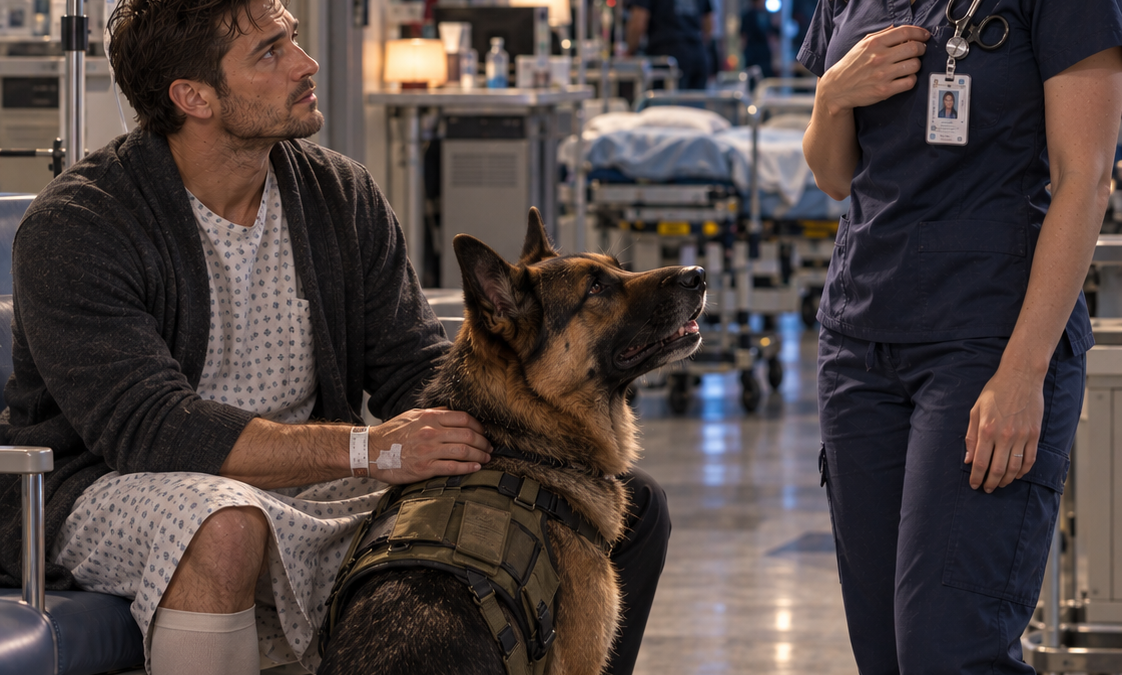
He was in a hospital gown and compression socks and a cardigan that his sister had clearly brought him. And he was pulling a portable ivoy pole with one hand and moving with the deliberate economy of a man who had been told by his surgical team that walking was therapeutic and who had taken this instruction seriously, perhaps slightly earlier than the team had intended.
His face was pale but resolved. Rook was beside him, moving at his pace, close enough to be available if the pace stopped abruptly. A floor nurse appeared behind them both, not alarmed, but with the specific expression of someone who had tried to discourage this and had been overruled.
He said he needed to stretch his legs. The floor nurse said to Sarah with the tone of a person documenting that they had fulfilled their professional obligation.
Sarah looked at Ethan. The surgical team recommended walking, he said.
In the general ward, she said, “Not in the emergency department at 2:00 in the morning.”
“The route took me this way,” he said.
She looked at the IV pole. She looked at his color, which was better than it had been yesterday, but was still the color of a man 36 hours out of abdominal surgery. She looked at Rook, who looked back at her with the air of an animal who had been involved in this decision and was choosing not to express an opinion about its wisdom.
“Sit down,” she said.
There was a family bench near the department entrance, the kind of furniture placed in emergency department waiting areas for the people who arrived alongside patients. Ethan sat.
Rook positioned himself on Sarah’s side of the bench, which was either coincidence or the dog operating on information unavailable to the humans.
I read what Aldrich sent, Ethan said about the record. He told you he works for me now loosely.
He looked at his hands. I have a consulting arrangement post separation. He keeps me informed about things that are relevant.
Is my military personnel record relevant to your consulting arrangement? No, he said. He told me because he thought I should know.
He looked at her. Forward surgical team clinical lead.
I didn’t know about the reclassification, she said.
I know. He told me that, too. Ethan was quiet for a moment.
During the deployment, the night your unit supported hours. I was semi-conscious for most of it, but I was conscious enough at intervals to hear the environment. He paused.
You were running that treatment area, not supporting it. Running it, making the calls, directing the team.
There wasn’t a physician present, she said.
The operational protocols authorized. Sarah, he said her name with a quiet directness that stopped the explanation. I know what the protocols authorized.
I’m not talking about the protocols.
I’m telling you what I saw from a gurnie in and out of consciousness while you were doing it.
He held her gaze. You knew what you were even then. You just stopped letting it take up space afterward.
She looked at the department floor. I stopped letting it take up space, she said.
Because the last time it took up space, someone died. And two people lived, he said. And two more were brought home because of what Fielding said with the time you gave him.
He did not say it with the warmth of someone offering comfort. He said it the way she had said things throughout this past 36 hours flat. Precise as fact.
That’s the complete record, not the version you’ve been running.
She was quiet. The dog knew, Ethan said. He looked down at Rook.
I didn’t know what he knew until you walked into that bay.
But he recognized something that was still there, even after you spent years trying to make it small. He paused.
You can’t make it small.
I’ve watched people try that.
It doesn’t work.
It just He gestured vaguely, which was the first imprecise thing she had seen him do. It occupies different space.
It doesn’t disappear.
Sarah thought about supply carts staged before anyone asked. About vital sign trajectories, she tracked with the systematic attention of someone who had been trained to read them in environments where being wrong meant something irreversible.
about the escalation she had made in Bay 4, which had required her to put the full weight of everything she was onto one clear clinical judgment and stand behind it, while a physician who outranked her publicly disagreed. She
had done it, not because she had finally recovered from the years of deliberate reduction, not because the record had been corrected or the committee had validated her or Ethan Ror had said the right thing at the right moment.
She had done it because the patient was in the room. Because the thing needed to be said, because some part of her that had never actually become small, that had only been housed in a smaller space, pushed to a lower register, kept in a locker at the bottom of her belongings, had recognized the moment and had shown up for it without waiting for permission.
“I know,” she said.
They sat in the quiet of the department entrance for a moment, the man on the bench and the nurse beside him and the dog between them. And it was not a comfortable silence exactly, but it was an honest one.
The silence of two people who had both been carrying the same night for 7 years from different sides of it and had finally arrived at the same room.
I’m going to be here for a few more days, Ethan said.
I know Rook is going to keep finding you. I know that, too.
He looked at her with something that was not quite a smile.
His face didn’t seem to produce full smiles easily, which she recognized as a trait of people who had spent a long time in environments where smiling required a specific reason.
But the expression in his eyes was warm, and it was direct, and it was the look of someone who had been in the same orbit as her for 36 hours, and had decided on the available evidence that she was someone worth knowing. Go back to your shift, he said.
Go back to your floor, she said. He stood.
He gripped the IV pole. He looked at her for one more moment. Sarah, she waited.
Thank you, he said. Not for last night. For the other night.
7 years ago. He paused.
I know you didn’t hear that then.
I’m saying it now.
She held the words for a moment. She had spent 7 years not wanting to hear it.
Not because gratitude was unwelcome, but because gratitude for something that had also ended in loss felt like a math she couldn’t make add up.
She had refused the addition. She was not refusing it now.
Take care of yourself, she said. Do the physical therapy correctly.
Don’t argue with the surgical team about the timeline.
I don’t argue.
He said you walked to the emergency department at 2:00 in the morning, 36 hours posttop. she said. Something moved across his face that was closer to a full smile than anything she had seen from him.
“I don’t argue about things that matter,” he said.
He turned and walked back toward the main corridor with the careful, deliberate pace of a man in recovery who was making the choice to recover correctly, and Rook fell into step beside him. And Sarah watched them go until the corridor turn took them out of sight. She stood in the department entrance for a moment in the 2:00 a.m.quiet.
Then she went back to work. Two weeks later, the first working group session was held in the third floor conference room. 14 people around a long table.
Nurses, physicians, a resident, two administrators, the director of nursing practice. Sarah sat near the middle, not at the head, not at the back. the middle which was where she had chosen to be because the middle was where the conversation lived.
Cassidy Whan was there. Anniiama was there.
Harlon Voss was there. Holt was not. His remediation was proceeding through a separate track and his participation in the working group had been assessed as premature until that process reached its midpoint.
The absence was correct. The room was not about Hol specifically.
It was about the conditions that had allowed Holt’s behavior to persist unchallenged and about what it took to change those conditions permanently rather than just addressing the incident that had made them visible.
Sarah had spent three evenings preparing for this session, not the content. She knew the content.
She had been living inside the content for 7 years in one form or another. She had prepared the way she prepared for any technically demanding situation, systematically without dramatics, locating the necessary components and assembling them in the order they would be needed. Harlon Voss opened the session and handed it to her.
She began. She talked about what it felt like to observe a clinical pattern that an attending had not yet seen and to calculate in real time the professional cost of saying it out loud.
She talked about the calculation not as a personal failure but as a systemic product. The calculation happened because the system had created conditions where it was rational. The goal was to change the conditions.
So the calculation was no longer necessary not to produce individual nurses who were brave enough to override the calculation on their own. She talked about Bay 4. She talked about it with the clinical specificity that the situation deserved and with the personal specificity that she had been avoiding for a long time and the room listened with the concentrated attention of people recognizing something true.
She talked about what the culture would need to look like for a nurse without her specific background to have made the same call. for a firstear nurse 3 months in with no operational medicine behind her and no record that was going to substantiate her judgment after the fact. That nurse needed to be able to say the thing and have it received as information, not as insubordination.
The system had to make that possible. Not because every nurse who raised a concern would be right.
They would not always be right. But because the cost of silencing a correct concern was Ethan Ror bleeding out on a trauma bay floor while a physician who outranked the person who saw it first checked his phone. The room was quiet when she stopped.
Marorrow said, “I have six cases I want to bring to this group and the conversation began.
It was not a clean conversation. It was disagreed with and complicated and occasionally someone said something that required push back and the push back was given. Harlon Voss said something at one point that Sarah corrected in front of the room and he accepted the correction with the equinimity of someone who had asked her to this table specifically because she would do that.
Francis Adler asked questions that had edges to them. Cassidy said something about her own behavior that was uncomfortable to hear and that the room received without turning it into more than it was a person being honest about a pattern she had participated in. The session ran 40 minutes over schedule.
Nobody left at the scheduled end time. Afterward in the corridor, Marorrow caught up with Sarah.
That was harder than I thought it would be.
She said, “It’s supposed to be.”
Sarah said, “If it isn’t hard, it isn’t changing anything.”
Marorrow nodded. She looked like she was processing the session the way Sarah processed clinical sequences systematically, filing each component, building toward a complete picture. Can I ask you something personal?
Sarah looked at her. Are you going to stay? Marorrow asked at Kesler.
with the reclassification, with everything that’s in your record.
Are you going to stay here or are you going to go somewhere that that she paused somewhere that’s more suited to what you actually are.
The question was honest. It deserved an honest answer.
I’m going to stay, Sarah said.
Not because Kesler is the most prestigious place I could be. Because this is where the work needs doing.
She paused.
And because what I learned in all those other environments, the thing I’m actually trained for is to be where the need is, not where the ceiling is highest.
Marorrow looked at her for a moment.
I want to be like you when I’ve been doing this as long as you have, she said.
Then she looked slightly embarrassed.
That sounded I didn’t mean it like I know what you meant, Sarah said.
She didn’t tell Maro that the version of herself she was observing was not finished being built.
that the working group would run for months and the scope assessment was still in progress and Ethan Ror was coming in twice a week for outpatient physical therapy and Rook had taken to waiting outside the ER entrance on those mornings until Sarah came out to say something to him which she was no longer pretending she didn’t do that the conversation she was still having with herself about what she had been and what she had cost herself in the years since and what it meant to pick those things back up without making them into a a
story about redemption or heroism was a conversation with no clean ending.
She didn’t tell her those things because Maro needed a picture of what steady looked like and Marorrow was not wrong that it was something worth learning.
She only said, “Keep asking the question.
Whatever you see in me, ask it of yourself.
That’s all it takes.
Just keep asking.”
Marorrow left. Sarah walked down the corridor toward the department for the evening shift.
The scratched black shears hung beside her badge the way they had hung every shift since the night Ethan Ror had come through the ambulance bay doors. Not on display, not hidden, just there beside the thing that said her name and her role and her place in this building, clipped together because they both belonged in the same place, and there was no longer any reason to keep them separate.
She passed the bay where it
had happened bay 4, occupied now by an elderly man with a kidney stone who was being managed by a third-year resident under Aguire’s supervision.
The bay had been cleaned and reset and used many times in the weeks since. The monitors were the same monitors. The bed rail was the same bed rail.
Nothing about the space remembered what had happened in it. The people did. She badged into the department and began her shift.
Somewhere in the building above her, Ethan Ror was in physical therapy, pushing himself at a pace his therapist was probably arguing with because that was who he was. Rook was with him or waiting outside the therapy room or navigating the hospital with the calm, systematic intelligence of an animal that had been in difficult environments and understood how to read them.
Somewhere in the administrative wing, the scope assessment was in its third week, and the results so far were saying the things that a complete military record and 7 years of night shift emergency nursing both said. And the picture coming together was not a surprise to anyone who had been paying attention.
Somewhere in the escalation working groups shared folder, 14 people’s notes from the first session were being compiled into a framework document that would eventually become training curriculum.
And in that framework, there was language that Sarah had said in a conference room that had started with the calculation happens because the system created conditions where it is rational and that Harlon Voss had marked as the thesis of the entire initiative. And here in the emergency department, where people came through the doors at all hours carrying what had happened to them, a nurse was beginning her shift by checking things that needed checking, noting what was accurate and what required attention, being present in the full complicated way she was capable of being present.
She had not become a different person. She had not recovered into some cleaner version of herself. She was still the person who had spent 11 years learning how to read a situation accurately and 7 years punishing herself for reading one situation correctly and having it end in loss anyway and 18 months being useful in a space that was smaller than what she was built for.
All of those things were still true. What had changed was simpler than transformation and harder than resolution. She had stopped using her own grief as a ceiling.
She had stopped calling it humility when it was actually subtraction. Taking away from herself things she had legitimately earned and then telling herself the taking was a form of honesty. Fielding was gone.
That was true and would stay true. She had been the person in the room when it happened. That was also true.
And she had kept him present long enough to do the thing that brought two men home. And she had not known that.
And now she did. And the knowing did not fix anything.
had just completed the record. The complete record was the one she could work from. The bay doors opened.
An ambulance backed in and a paramedic team came through the entrance at the pace that indicated something was developing and Sarah was already moving toward them because that was what the shift required and the shift was what she was here for. She did not look around to see who noticed. She did not calculate the cost of being visible.
She went toward the person who needed her and she brought everything she was and she did not apologize for the amount of
—END—
