Plus Size Woman’s Car Died Outside a Mafia Boss’s Estate—Then He Learned Who She Really Was
Plus Size Woman’s Car Died Outside a Mafia Boss’s Estate—Then He Learned Who She Really Was
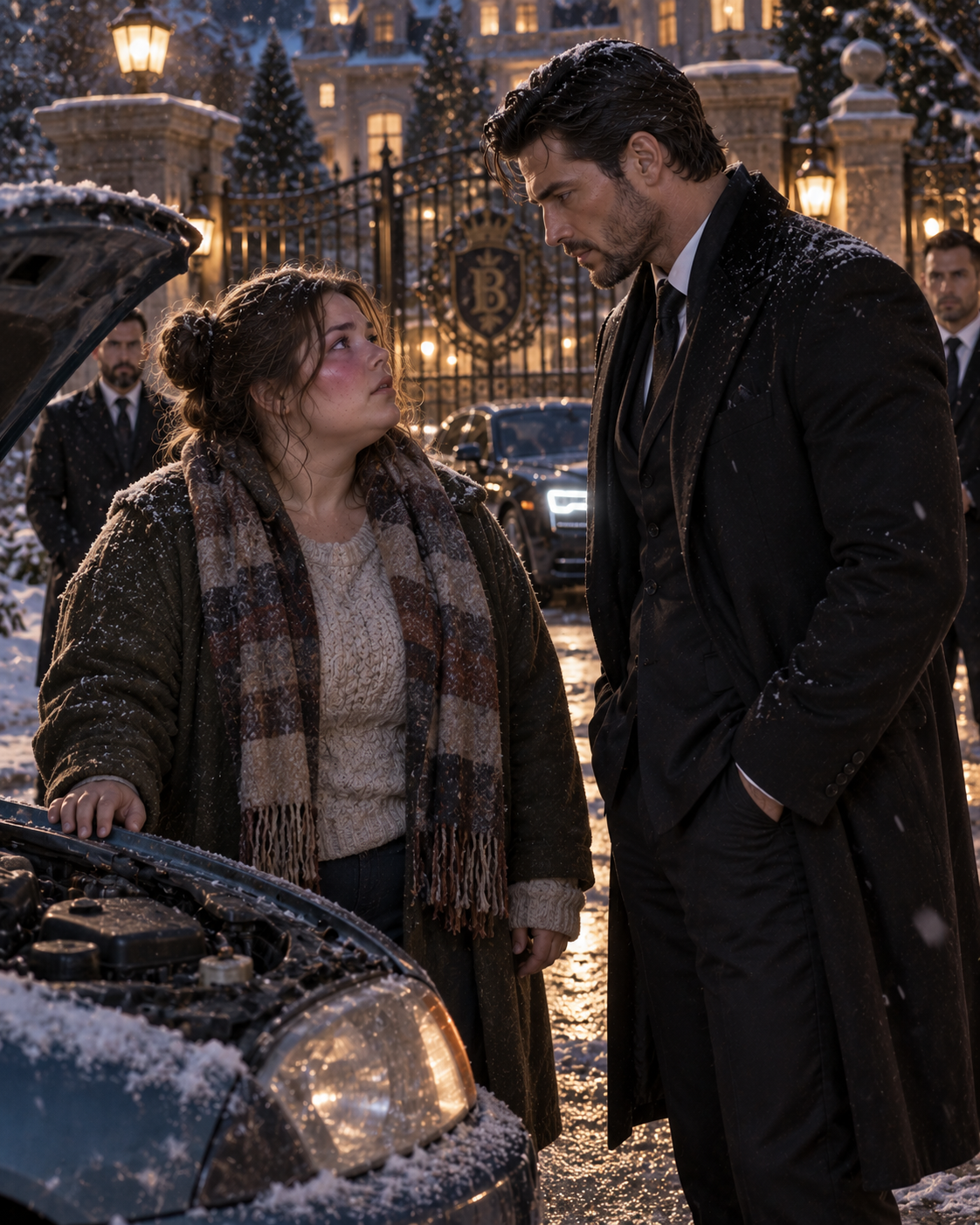
The fat woman everyone laughed at was the secret owner of the company that could destroy them all by morning. Thea Owens sat alone in her old blue car 3 days before Christmas Eve, watching smoke curl from beneath the hood while snow gathered on the windshield like the sky had decided to bury her quietly.
Her phone glowed on the passenger seat with a message from her mother that said not to be late this time, as if Thea had ever been allowed to arrive anywhere without being measured, corrected, or quietly forgiven for existing in a way her family found inconvenient. She read the message once, then turned the screen face down and listened to the engine tick angrily in the cold. Somewhere across town, her older sister was probably having champagne poured into a glass by someone who admired her.
Somewhere in her mother’s dining room, silverware was already being placed in perfect lines for the dinner that had been dressed up as a celebration, even though Thea knew exactly what it was.
A trial, a lesson, a public little kindness sharpened into a blade. Her mother had called that morning with the soft voice she used when she wanted to sound generous. Sandre Owens never yelled when she could wound more neatly with concern.
She had said the whole family would be there to celebrate Madison becoming chief executive officer of Bright Line Home.
And wouldn’t it be nice if Thea came dressed properly for once?
Then she had paused long enough for Thea to hear the real sentence walking behind the polite one. They also wanted to talk about her future.
Thea had stood behind the counter of her small bookstore, one hand resting on a stack of returned paperbacks, and smiled even though no one could see it. Her future.
Her mother said the words like Thea had misplaced it years ago, and the family had finally agreed to help her search under the couch cushions. Thea had almost told her the truth. Then she had almost said that her future had warehouses in six states.
freight contracts across the country.
Lawyers who answered before the second ring, and more money moving through shell companies than Sandra had ever imagined, while clipping articles about Madison’s success for the refrigerator.
But Thea said nothing. She only said she would be there. That was what she had done for years.
She had said little and let them think everything. Thea Owens, the quiet one, the heavy one, the one who opened a bookstore in a small town and called it a dream because she had failed at every bigger thing.
The one who drove a car with a heater that worked only when it felt emotionally ready. The one who wore loose sweaters, plain coats, and shoes chosen because they did not complain during long days on wooden floors.
the one who had no husband, no children, no bright career, no polished life to place on the dining table beside Madison’s accomplishments.
Sandra had built a whole version of Thea out of disappointment and served it to the family so often that everyone accepted it as fact. Thea had allowed it, not because it did not hurt.
It did. It hurt in small ways and old ways, and sometimes in ways so familiar they felt like weather.
But she had wanted to know something. She had wanted to know whether any of them would love her, without proof she was worth showing off.
The answer had taken years to arrive, and by now Thea could hear it, even in silence. She stepped out into the snow and lifted the hood. Steam rolled up into her face, carrying the bitter smell of burnt oil and metal that had finally given up pretending.
The private road beside the old club was empty, except for black gates, tall pines, and the glow of security lamps hidden in the trees. She had taken this route because the highway was backed up and because her car had coughed twice near the bridge, and Thea had not wanted to stall in the middle of traffic with someone honking behind her like humiliation needed a soundtrack.
So, she had turned down the narrower road, thinking she could nurse the car into town. Instead, the engine died beside a stone wall that looked old enough to have secrets and expensive enough to punish trespassers.
Thea leaned closer, pretending she knew what she was looking at. She knew companies.
She knew shipping routes, invoice trails, union negotiations, tax shelters, warehouse fires that were not accidents, and the exact kind of smile a desperate man wore before asking for a bridge loan he would never repay. She did not know engines.
Engines were rude little kingdoms of heat and tubes. She touched nothing.
That seemed wise. Behind her, the gates opened without sound.
She turned slowly. A black car rolled out first, then another. Their headlights washed over her, bright and cold.
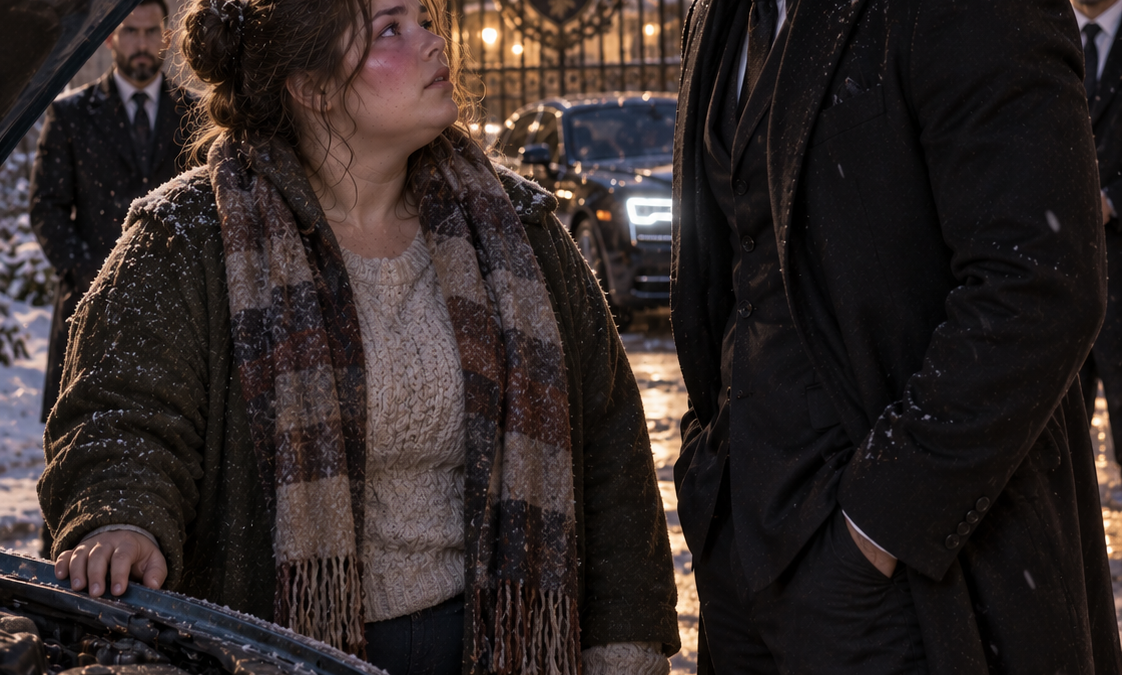
Thea stood beside her, smoking car in her thick gray coat, snow in her hair, one hand still on the hood, and had the calm, irritated thought that if she died tonight, her mother would still find a way to say she should have planned better. The first car stopped.
A
tall man stepped out from the back seat, wearing a dark coat that probably cost more than Thea’s entire vehicle.
He moved like a man who was used to doors opening, rooms quieting, and other people’s fear arriving before he did.
Two men followed him, both broad, both silent, both with the stillness of people who did not need to show weapons for you to know weapons existed. The man looked at her car, then at her, then at the open hood. His face was sharply handsome in a way that felt less like beauty and more like warning.
dark hair, dark eyes, clean jaw, no wasted expression. Snow landed on his shoulders and disappeared into the expensive wool. He did not seem cold.
Men like that never seemed cold. They seemed like the weather had signed some private agreement with them.
“You are blocking my road,” he said.
Thea stared at him for a second, then looked at the wide private road around her car. There was enough space for a parade, a funeral, and one very dramatic man in a coat.
“Your road has room to recover.”
One of the men behind him made a sound and then quickly pretended he had not.
The dangerous man’s eyes narrowed slightly.
“Do you know where you are?”
“Beside a broken car,” unfortunately, “This is private property.
I did not ask my engine to have a medical event here.”
His gaze moved over her slowly, not in the way men sometimes looked at Thea when they wanted her to understand that she had failed some silent test. This look was different, assessing, careful, almost curious. He took in the old car, the bookstore tote bag on the front seat, the practical boots dusted with roads salt, the cheap gloves, the hair she had pinned badly because she had stopped caring after the third bobby pin surrendered.
Most people saw those things and stopped looking. He did not. His attention paused on her face, and Thea had the strange feeling he was reading the blank spaces, not the obvious lines.
You are very calm for a woman alone outside Romano house after dark. He said that name landed softly, but it changed the air.
Thea knew Romano House. Not officially.
Officially, it was a private winter club for investors, old families, and men who liked to smoke cigars in rooms where no one could hear them lie. Unofficially, it belonged to Luca Romano, the kind of man whose name appeared nowhere and affected everything.
Logistics had taught Thea many things. One of them was that goods moved through the world because men like Luca allowed, taxed, protected, interrupted, or stole what other men thought they owned.
She had never met him.
She had signed documents around his influence, mapped routes around his territories, and once paid a very expensive consultant to confirm that none of Lark’s holdings drivers were accidentally carrying freight through a Romano dispute.
She had imagined Luca Romano older, louder, less handsome in a way that made the cold feel suddenly personal.
You are very dramatic for a man standing in the snow telling a stranger his driveway is famous,” she said.
The second guard looked away completely this time.
Luca Romano’s mouth did not smile.
But something near his eyes changed.
“You know my name.
I know many names. It keeps life festive. Then you should know better than to speak to me like that.
” I would, but my car is dead.
My mother is waiting to criticize my sweater. and I skipped lunch.
Your reputation arrived at an inconvenient time. For several seconds, there was only the soft hiss of the engine and snow landing on metal. Thea expected anger.
She had seen men with power respond badly to women who failed to be impressed. Some raised their voices.
Some smiled too much. Some moved closer to remind the room that size could become language. Luca did none of those things.
He only looked at her more carefully, and that was somehow worse because Thea was very good at being underestimated and much less practiced at being seen. What is your name? He asked.
Thea Owens. Why are you here, Thea Owens?
She pointed at the car. Because this small blue traitor brought me here and then chose peace.
This time, Luca did smile barely. It appeared and vanished so quickly she might have imagined it if not for the guard on his left who blinked as if he had witnessed an eclipse.
Luca stepped closer to the car and looked beneath the hood. The watched him from the side, ready to tell him not to touch anything just because the instinct irritated her, but he did not touch the engine either. He looked once, then turned to one of his men.
Call Enzo. Tell him to bring the tow truck.
Thea closed the hood with more force than necessary. No.
Luca’s gaze returned to her.
No. No, thank you.
You are refusing help. I am refusing mysterious criminal hospitality on a private road after dark. It is a healthy instinct.
You just called me criminal to my face. I said mysterious criminal.
There was a compliment inside. The guard on the right coughed into his fist. Luca did not look away from Thea.
Your engine is finished. My engine and I will have a private conversation about that. You cannot drive it.
I gathered that when it stopped driving. The nearest service station is closed. The next one is 30 minutes away in weather that is getting worse.
You are not walking. Thea folded her arms over her coat. That sounded dangerously close to an order.
It was an observation. Powerful men often confuse the two. The sentence came out more serious than she intended.
Luca heard the change. His eyes lowered for a moment, not in apology exactly, but in adjustment.
When he spoke again, his voice was quieter. Then allow me to make it a request.
Thea hated that this disarmed her. Men in her world negotiated because they wanted better terms.
Men in her family apologized only when witnesses were present. This man, this rumored monster in a tailored coat, had heard one boundary and shifted half a step back from it. Thea did not trust that, but she noticed it.
Noticing things was how she had survived long before she owned anything worth protecting. I have somewhere to be, she said.
A dinner? Her eyes narrowed.
That was a lucky guess. No, you looked at your phone when you said mother. Your face changed.
I did not say mother. You did without words. Thea looked at him then really looked and felt an unwelcome thread of recognition.
He noticed what people worked hardest to hide. So did she.
That was dangerous in business. It was worse in the dark. My family is having dinner, she said.
Technically, it is a celebration. Emotionally, it is a trap with cranberry sauce.
His mouth moved again. for you usually. And you were going anyway?
Yes. Why?
The looked past him toward the gates where warm light glowed through iron bars. It would have been easier to lie. She was good at lying by omission.
She had built an empire behind silence, one lawyer, one shell company, one signed acquisition at a time.
But something about the snow, the broken car, and the man’s steady attention made a smaller truth slip loose.
Because sometimes you keep going back to the place that hurt you to see if maybe one day it will recognize you. Luca said nothing. Thea regretted the sentence immediately.
It had too much blood in it.
Then he said, “And does it?”
She laughed once softly.
“Not so far.”
His phone buzzed. He glanced at it and his expression cooled. Whatever warmth had almost touched the air vanished.
One of his men stepped close and murmured something too low for Thea to hear.
Luca’s gaze moved toward the road behind her.
Sharp now. You said your last name was Owens.
Yes, Sandra Owens is your mother. Thea went still. That is a quick leap.
Madison Owens Clark is your sister. The air seemed to grow thinner. Thea kept her expression relaxed because she had practiced that in rooms full of men who thought a fat woman in a plain dress could not possibly be the owner unless she was bringing coffee to the owner.
You know my family. I know someone connected to them. Lucky them.
Gerald Hartman.
Thea’s face did not change inside.
Something clicked into place.
Gerald, chairman of Madison’s board.
polished hair, polished nails, polished lies.
Thea had seen him two months earlier in a private conference room under another name, sitting across from Lark’s Holdings legal team and pretending not to sweat when Thea asked why Bright Line’s warehouse numbers did not match its reported expansion.
He had not been told who she was. Few people were. The public face of Larks was a calm executive named Elise Mah, who could charm cameras and bore journalists at the same time.
Thea preferred it that way. She preferred quiet rooms, back doors, and signatures that moved more than speeches ever could, but Gerald had seen her briefly when she entered late, and everyone at the table stood. At the time, his eyes had sharpened.
Thea had not liked that. Now Luca Romano was watching her, and Thea understood that her dead car might not be the strangest thing this night intended to offer.
“What about Gerald Hartman?”
she asked.
“He came through my club an hour ago with two men who lied about their names.
They discussed Bright Line Home, debt coverage, a personal investment package, and a woman they called the ghost at Larks.”
Thea felt the cold more suddenly, not on her skin. under it. Luca noticed.
That means something to you. It means Gerald drinks too much near the wrong walls. Are you the ghost?
The smiled faintly. It was an old business.
Smile, smooth and useless. Mr.Romano, I run a bookstore.
Yes, he said, “And I am a humble club owner.”
Despite herself, Thea almost laughed. He stepped aside as another vehicle came through the gate.
This one larger with a tow rig behind it. The man driving had silver hair, a red scarf, and the bored expression of someone who had fixed many disasters and respected none of them. Luca gave him instructions in Italian, brief and precise.
Thea caught enough of the language to understand that her car would be taken somewhere warm, inspected, and not stolen, which was sweet in the way a wolf promising not to eat your sheep immediately was sweet. I still did not agree, she said. No, Luca answered.
You did not refuse this time. That is not the same thing.
It is close enough for Snow. She should have argued more. Instead, she glanced at the time on her phone and saw another message from her mother.
Everyone is waiting. Thea looked at it until the words blurred.
Everyone had never waited for her. They had waited to begin on her.
Luca looked at the screen without leaning close enough to read it. You are going to that dinner.
Yes, Gerald may be there. I know.
You should not walk into a room with a man who suspects what you are. Thea turned to him.
And what am I?
For the first time, Luca’s expression softened in a way so slight most people would have missed it.
Not what they think. The answer struck too close.
Thea looked away first.
By the time Luca’s driver took her toward her parents’ house, her car had been loaded onto the tow truck, and the snow had thickened into a soft white curtain.
Luca did not get into the car with her. He gave his driver the address, told him not to leave until Thea entered the house, and then stood by the gate with his coat open to the cold as if he belonged to it. Thea watched him grow smaller through the rear window.
She told herself it was nothing. A strange meeting, a useful warning, a rich criminal with good cheekbones and suspiciously decent manners.
Nothing more. But her phone buzzed once before the car turned onto the main road. Unknown number.
Do not sign anything tonight. Thea stared at the message.
Then another appeared. And do not eat anything Gerald hands you.
Thea typed back before she could stop herself. Bossy for a humble club owner.
The reply came almost instantly. Careful for a bookstore owner.
She tucked the phone into her coat pocket and looked out at the passing snow. Her heart was beating faster than it should have.
But fear was not the only reason. There was irritation there.
Curiosity, a small spark of something foolish and inconvenient, the kind of feeling Thea usually locked in a mental drawer because feelings made noise, and noise attracted people who wanted to use it.
Her parents’ house stood at the end of a long neighborhood street where every porch light wore a wreath and every window glowed with warm judgment.
It was the same house Thea had grown up in. though Sandra had spent years changing every room until it looked like a magazine had swallowed the memories. The old green shutters had been replaced with black ones.
The carpet where Thea had learned to read had become pale hardwood no one was allowed to scratch. The den where Grandma Pearl once kept tins of butter cookies had been turned into a sitting room with stiff chairs and no sitting.
Only the big maple tree in front remained the same. its branches heavy with snow, its trunks scarred where Madison and Thea had carved their initials as children before Sandra decided Girls with Ambition did not damage property. The driver opened the door for her.
Thea thanked him. He waited exactly as Luca had ordered. That irritated her enough to feel grounding.
She climbed the salted steps, smoothed her coat, and reached for the bell. The door opened before she touched it. Madison stood there in a cream dress, slim, glossy, and tired in a way makeup could not quite hide.
Her blonde hair fell in soft waves around her shoulders.
“Diamond earrings caught the light.
She looked like the kind of woman who had spent her whole life being admired and had mistaken the pressure for love.”
“Thea,” Madison said, smiling too brightly.
“You made it barely.
My car died.”
Madison’s eyes moved past her to the black car waiting at the curb.
That does not look like a tow truck. A stranger had mercy.
At Christmas, how seasonal. Thea stepped inside and let Madison kiss her cheek. The kiss landed near her ear, light and cold.
The house smelled of pine, roasted meat, cinnamon, and Sandra’s perfume.
Voices floated from the dining room. familiar voices. Aunt Elise laughing too loudly.
Uncle Dean explaining something he barely understood. Cousin Rachel talking about private school weight lists.
Her mother’s voice smooth as polished glass calling for someone to check whether Thea had arrived yet, because heaven forbid anyone sit down before the evening’s disappointment had been placed.
Madison helped Thea remove her coat, then paused when she saw the sweater beneath it. Dark green, plain, soft, comfortable. Mom wanted everyone in formal colors.
The sweater is green. Christmas survived. Madison sighed.
I am not starting tonight. Then pace yourself.
For half a second, Madison’s mouth twitched as if she almost smiled for real.
Then she looked away. Sandra appeared at the end of the hall wearing burgundy silk and pearls.
Her silver blonde hair arranged with the kind of care that suggested discipline could defeat time if applied properly. Her face lit up in a smile that would have looked loving to anyone who did not know where to check for knives.
Thea darling, there you are. Darling meant audience.
Hi, Mom. Sandra kissed the air beside her cheek. We were getting worried.
No one was worried, Grandma Pearl said from the sitting room. Some of us were hungry. Thea looked past her mother and felt warmth enter her chest.
Pearl Owens sat in an armchair near the fireplace, small and sharpeyed beneath a knitted purple shawl. At 84, she looked fragile only to fools.
Her white hair was pinned crookedly. Her cane rested across her lap like a royal staff.
She had one of Thea’s bookstore bookmarks tucked into the sleeve of her sweater.
Thea crossed the room and bent to kiss her grandmother’s forehead.
Hi, Pearl. Pearl patted her cheek.
You look cold. My car died.
Good. I hated that car.
You told me it had character. So do raccoons. Does not mean I want one in the driveway.
Thea laughed, and for a moment the house felt almost kind.
Sandra’s smile tightened.
Mother, please. I said please when I wanted bourbon before dinner and no one listened. Madison glanced toward the dining room.
We should go in. As Thea moved toward the long table, conversations paused and rearranged themselves around her.
It was subtle. It always was.
People smiled with their mouths first, then checked her body, her sweater, her shoes, her empty left hand, the absence of something impressive beside her. Thea knew the order.
She had learned it young. First they looked for change.
Then they looked for failure. Then they relaxed when they found what they expected.
Aunt Elise touched her arm. Thea, sweetie, the bookstore is still open every day except Sunday.
How brave. Physical books in this economy.
Words are stubborn. Uncle Dean chuckled. Still driving that blue thing?
Not currently. It declared independence.
Cousin Rachel leaned close to her husband and whispered poorly, “I told you she was funny.”
As if humor were a consolation prize. As if Thea had trained herself to be dry because anger would have made them call her bitter.
Sandra guided Thea to a seat near the end of the table between Pearl and her cousin’s teenage son, who looked relieved to have someone beside him who would not ask about college.
Madison sat near the head, glowing beneath attention. Her husband, Peter, hovered beside her with one hand on the back of her chair.
He was handsome, pleasant, and mostly decorative, the kind of man who smiled at whatever room he stood in and waited to be approved. Thea did not dislike him.
That was about as far as her feelings went. The tree stood near the front window, tall and perfect, covered in gold ornaments and white lights. Beneath it sat a pile of wrapped gifts.
One box caught Thea’s eye immediately.
It was long, flat, tied with red ribbon, and labeled in Sandre’s handwriting.
For Thea’s future.
Thea stared at it for one slow breath. Pearl followed her gaze. Ah, you knew.
I suspected. Your mother has been smiling like a banker all day.
Thea looked towards Sandra, who was directing someone to refill Madison’s glass.
What is in it?
Pearl’s fingers tightened lightly around her cane.
Something that thinks it is kindness.
That made Thea’s stomach settle into something heavier than dread.
She could handle insults. She could handle pity.
She could even handle Sandra’s favorite performance, the trembling speech about how hard it was to watch a daughter refuse to reach her potential, while Madison had fought so nobly for hers.
But kindness was more dangerous. Kindness came with witnesses.
Kindness demanded gratitude.
Dinner began with Madison’s promotion, as expected.
Sandra lifted her glass and spoke for several minutes about leadership, grace under pressure, family pride, and how Madison had always known how to rise. Everyone applauded softly. Madison smiled and lowered her eyes at the correct moments.
Thea watched her sister’s fingers press against the stem of her glass too tightly.
Madison was nervous, not shy, not overwhelmed, nervous. Thea filed that away.
Gerald Hartman had not yet appeared. That did not comfort her. So, Thea, Uncle Dean said after the first course, because peace had offended someone.
How is business? The table quieted with practiced casualness.
Thea cut into her food. Steady.
Steady is good, Aunt Elise said, using the voice people used for small children who had drawn a recognizable horse. Sandra smiled.
The bookstore is sweet, very sweet, though I do think at some point stability has to matter more than charm. I pay my bills.
Of course, darling, no one is saying you don’t try.
Thea felt Pearl shift beside her. Madison took a sip of wine. Mom.
Sandra widened her eyes. What? I am proud of both my girls in different ways.
Different ways. Madison got admiration.
Thea got patience. Peter cleared his throat. Bright Line may have some community outreach opportunities.
Literacy drives. Maybe could partner with local shops. That would be nice, Thea said.
Sandra brightened. Too quickly.
Actually, that leads into something we wanted to discuss later. There it was. Thea placed her fork down.
My future. A few people smiled awkwardly. Madison looked at her plate.
Sandra laughed lightly. You make it sound ominous. Does it come wrapped?
Silence. Pearl made a soft sound that might have been laughter or a cough depending on who intended to complain.
Sandra’s eyes flashed, then softened for the table.
We only want to help. You have been alone so long, honey. And that little store cannot be easy.
There comes a point when pride keeps a person stuck. Thea looked at her mother, then at Madison. Whose idea was it?
Madison opened her mouth, then closed it. Sandre answered for her. It was a family discussion.
That meant Sandre’s idea.
Madison’s reluctant signature.
Everyone else’s applause.
Before Thea could say anything, the front door opened.
Cold air slipped down the hallway, carrying men’s voices, and the sound of expensive shoes on Sandra’s pale floor.
Thea did not turn immediately. She watched Madison instead.
Her sister’s face changed.
Her posture straightened, but her eyes dimmed just a fraction. Fear did not always arrive shaking. Sometimes it wore mascara and sat up politely.
Gerald Hartman entered the dining room with snow on his black coat and a smile made for boardrooms. He was in his late 50s, smooth and silver, with a careful tan and a watch that wanted to be noticed.
Behind him came two men Thea recognized from photographs attached to Bright Line’s private debt reports.
Not relatives, not friends. Pressure in suits. Sandra, Gerald said warmly.
Forgive the delay. Sandra rose as if royalty had entered.
Gerald, we’re so happy you could still come.
Madison stood too quickly. I thought you were caught in the city. I was, Gerald said, kissing her cheek.
But one makes time for family victories. His gaze moved around the table.
Then it reached Thea. He paused for less than a second.
Most people would not have seen it. Thea did.
Pearl did too because Pearl’s hand tightened on her cane again.
Gerald smiled. And this must be Thea. Must be.
Thea said, his eyes remained on her face. I feel as though we have met.
Sandre laughed. Oh, I doubt that.
Thea runs a bookstore. Yes, Gerald said slowly. I heard.
Thea smiled back, small and harmless. She had learned long ago that being dismissed was not always an injury.
Sometimes it was camouflage. Gerald sat beside Madison. The room resumed breathing, but something had shifted.
Thea could feel it in the way Gerald’s attention returned to her between conversations.
Once while Sandra praised Madison’s leadership.
Once while Peter explained the difficulty of market transitions in a tone that suggested he had learned the phrase that afternoon. Once when Aunt Elise asked Thea whether she had considered online sales as if the internet were a rumor only Aunt Elise had recently confirmed.
Through it all, Gerald watched.
Thea’s phone buzzed in her lap.
A message from Luca.
Hartman left my club with men who are not on Bright Line’s payroll.
Thea kept her face still and typed beneath the table. He is here.
The reply came after a brief pause. Do not be alone with him.
Thea looked across the table. Gerald lifted his glass slightly, almost like a toast.
She typed back, “You keep giving orders.”
Luca answered, “You keep walking into rooms full of wolves.”
Thea almost smiled. Then Sandre tapped her spoon gently against her glass.
The room settled.
I know we have all been enjoying Madison’s wonderful news, Sandra said, her voice warm and trembling in the practiced way that made relatives lean in, but Christmas is also a time for family to gather around the people who may need a little extra care.
Thea looked at the box under the tree. Madison closed her eyes for one second.
Sandra continued, “Thea, sweetheart, this year we wanted to give you something meaningful.
Not another sweater, not another gift card, but a real opportunity, a chance to begin again. The room turned toward her.
Every chair became a witness. Sandra walked to the tree and lifted the long flat box as if it held salvation. She brought it to Thea with both hands.
The ribbon was satin. The paper was gold.
The tag still said future. Thea did not reach for it.
Sandra’s smile trembled.
Open it, darling,” Pearl whispered.
“You do not have to.”
But the whole room was waiting, and Thea knew this moment had already been rehearsed without her. If she refused, she would be ungrateful. If she hesitated, she would be difficult.
If she smiled, they would call it healing, so she took the box and placed it on her lap. It was heavier than paper should have been.
She untied the ribbon slowly. Inside was a folder.
Inside the folder was a contract. The read the first page, then the second.
She felt no shock, only a tired, almost tender amazement at how little they knew her.
It was an employment agreement with Bright Line Home, offering her an assistant position under Madison’s office.
Low salary, probationary period, development supervision, required relocation assistance, mandatory performance review after 6 months. It had been written by someone who wanted humiliation to sound like structure.
Sandra clasped her hands. Madison was kind enough to approve the role herself.
Madison whispered, “Thea, you would have benefits,” Sandra said quickly.
real ones, health, retirement, stability. You could close the bookstore before it becomes too much.
Madison could mentor you. You would have a proper office environment, a reason to dress a little more professionally, and maybe with routine and encouragement, other parts of your life might begin to change, too.
Other parts? Thea almost laughed. Her body had entered the room even when no one named it.
It always did. Aunt Elise dabbed her eyes.
This is beautiful, Sandra. Uncle Dean nodded. Takes courage to accept help.
Thea looked around the table. All those faces, all that soft approval. They thought this was love.
Or worse, they needed to think it was love because cruelty made them uncomfortable unless it came wrapped in concern. She looked at Madison. Did you write this?
Madison’s face crumpled slightly.
No.
Gerald’s legal team drafted it.
Mom thought Madison thought it would be good for you. Sandre interrupted.
We all did. Gerald spoke for the first time. Smooth as oil.
Bright Line believes in family values and sometimes talent develops late. Thea turned her eyes to him. There it was again.
That flicker. He was testing her.
He wanted to see whether the ghost would flinch under a cheap assistant contract in her mother’s dining room.
Thea closed the folder. I am not signing this.
Sandra blinked. No one said you had to sign tonight.
The signature line says tonight. A little stir passed around the table. Gerald smiled.
Only because the position opens quickly. It opens below my sister.
It opens near opportunity. No, Thea said softly. It opens inside a cage small enough for everyone here to feel generous while locking it.
The room went still.
Sandra’s face hardened beneath her smile.
That is a cruel thing to say. No, it is an accurate thing to say. Cruel would have been inviting me here to celebrate Madison and then presenting me with a contract designed to make my life smaller in front of the whole family.
Thea, Madison whispered.
Sandre’s voice sharpened.
You are embarrassing yourself.
That has always been the fear, hasn’t it?
That I would embarrass myself before you finished doing it for me.
Pearl made no sound, but Thea felt her grandmother’s approval like warmth beside her.
Gerald folded his hands. Perhaps this conversation would be better handled privately. Thea looked at him.
I doubt that. His smile thinned. Sandre rose from her chair.
Enough. You are hurt.
And when you are hurt, you become sharp. We are trying to save you from drifting through life alone in that little shop. Thea opened her mouth.
Then Pearl spoke. Sit down, Sandra. Sandra turned stunned.
Mother, I said, sit down.
The old woman’s voice was not loud, but it carried the authority of someone who had survived every person currently trying to manage her.
Sandra remained standing for another moment, then sat with visible restraint. Pearl looked at Thea.
That was not the only reason for tonight.
Thea’s heart sank.
Pearl. Sandra exhaled. Mother, please do not make this dramatic.
Oh, I did not make this family dramatic. I only lived long enough to watch it become theatrical.
Gerald’s eyes sharpened with interest.
Sandra placed her napkin beside her plate.
We have also had to make some practical decisions about mother’s house.
Thea’s blood cooled.
Pearl’s house, not the family house, not Sandre’s bright polished display case.
Pearl’s small yellow house near the river with old roses asleep under snow and shelves full of books Thea had brought her over the years.
the place where Pearl still kept mismatched mugs, wrote checks with a pen older than Madison’s marriage, and refused every security system because she said burglars deserved a challenge.
Pearl’s house was the only place in Thea’s childhood where quiet had not meant punishment.
“What decisions?”
Thea asked.
Sandre’s tone softened into performance again.
“Nothing final.
” Pearl snorted.
Sandra ignored her. The house is too much for her.
The stairs, the upkeep, the taxes. Madison and I have found a very practical residence with care options. A facility, Thea said.
A community. Pearl.
Did you agree to this? Pearl looked into the fire. They explained that agreeing would be easier.
Something inside Thea went silent. The room sensed it but misunderstood.
They thought silence meant she was overwhelmed. They had always mistaken her quiet for weakness because none of them knew what she had built in it. Thea turned to Madison.
You agreed to sell Pearl’s house?
Madison’s face was pale.
I thought it made sense financially. For whom?
Sandra snapped. Do not imply ugly motives. The house is aging.
Mother is aging. We are trying to do what is realistic.
And the money. Sandra looked offended. would be managed responsibly by you, by the family.
Thea almost stood. She could feel the weight of years pressing into that single moment.
The assistant contract was insulting.
Pearl’s house was something else.
This was not concern. This was consolidation.
Sandra was not only trying to decide Thea’s future.
She was trimming away every woman in the family who had not submitted neatly enough.
Pearl touched Thea’s wrist under the table.
Her fingers were thin but steady.
“Stay alert,” she whispered.
The front windows flashed briefly with headlights. Thea looked toward them.
A black car had pulled up across the street.
“Not the driver’s car from earlier.
Another one.
Luca.”
She knew it before she saw him. Gerald saw the car, too. His face changed so quickly, it almost satisfied her.
Almost.
A message appeared on Thea’s phone.
I am outside. Thea did not answer.
Gerald stood. Thea, may I speak with you for a moment? Sandra smiled with relief as if an adult had finally arrived to discipline the spare daughter properly.
That might be wise. Thea looked up at Gerald. Why?
His smile was perfect. I believe we may have mutual business interests.
There it was, not suspicion anymore. Confirmation knocking gently. Thea rose slowly.
Pearl’s hand slipped from her wrist.
Kitchen, Gerald suggested. The hallway, Thea said. Doors stay open.
His expression barely shifted. Of course, they walked out of the dining room under the attention of every relative pretending not to listen. The hallway was dimmer than the dining room, lit by the Christmas garland Sandra had wrapped along the banister.
Thea stopped near the old mirror by the stairs. She could see both the dining room and the front window from where she stood.
Luca’s car remained outside, engine running.
Gerald positioned himself between her and the family, not blocking her exactly. Men like Gerald rarely did anything exactly. They preferred the kind of pressure that could be denied later.
Miss Owens, he said softly. Or do you prefer the name you use at Larks?
Thea tilted her head. Bookstore owners have many hobbies. I saw you at the Veric meeting.
Lots of women are fat and quiet in conference rooms, Gerald. You will need to be more specific. His smile cracked for one sweet second.
There it was, the disgust beneath the polish. He did not like the word fat when she used it without shame.
It took a tool from his hand. You are clever, he said.
I have my days. You are also in a difficult position.
No, Gerald, you are. His eyes cooled.
Bright line is one of Lark’s holdings most important clients.
Was. The word landed between them like a glass dropped on tile. Gerald stared at her.
Thea kept her voice low. Your invoices are late. Your debt is hidden.
Your warehouse expansion is fake. Your board reports are painted over rot. and your personal investment package for Madison Clark is not leadership development.
It is a life raft for you built from her savings. Gerald did not move for a moment. Then he smiled, but the smile no longer reached anything human.
So it is true. The said nothing.
You own larks. I own many things and your family has no idea.
My family has ideas. Most of them are wrong. His gaze flicked toward the dining room.
Does Madison know Bright Line is near collapse? She knows what you told her.
She signed confidence statements. She trusted her chairman. That was her mistake.
Thea felt anger move through her. Clean and cold, not loud, not hot, the kind that kept records. Gerald leaned closer.
Here is what will happen. You will sign nothing tonight because that little job offer no longer matters.
You will keep Larks attached to Bright Line through the holiday quarter. Madison will sign the executive buyin after the board celebration. Your company will continue shipments long enough for us to restructure debt through personal investment and secondary collateral.
After that, Larks may do whatever it wants. Madison will lose everything.
Madison is ambitious. Madison is being used.
She is being promoted. You are dressing a cliff as a crown. His eyes narrowed.
Be careful, Thea. You have hidden very well, but hidden women are easy to reveal when the story is handled correctly. Imagine your family learning not only that you lied to them for years, but that you allowed your sister to stand on a sinking company while you watched from behind lawyers.
Imagine your mother understanding that every holiday, every birthday, every plea for help, you were rich enough to change everything and chose silence.
Thea’s throat tightened before she could stop it.
There it was, the one knife that could cut. Not money, not exposure, guilt.
Gerald saw it and smiled. Ah, there she is. A colder voice came from the front doorway.
You should step back before that smile becomes permanent. Gerald turned.
Luca Romano stood in Sandra Owen’s hallway with snow on his coat and murder kept politely behind his eyes.
Sandra hovered behind him, fluttering with confusion and social panic. The her mother said, this gentleman says he knows you.
Thea looked at Luca barely.
Luca’s gaze did not leave Gerald.
Enough. The hallway changed around him. It was ridiculous, really.
This was Sandra’s house.
Pearl’s cane rested in the sitting room.
A roast sat drying on the dining room table. Christmas music played somewhere near the kitchen. And still, the moment Luca entered, the house seemed to realize it had been pretending to be safe.
Gerald recovered quickly, but not completely. Romano, this is a family gathering. I noticed you chose it as cover.
Sandra made a small offended sound. Cover for what? No one answered her.
Thea stepped slightly forward. You followed him. Luca looked at her then.
I followed the men behind him.
And came inside a stranger’s house uninvited.
You did not answer my message. That is not an invitation.
No, he said, but Gerald’s hand was too close to your arm.
Thea glanced down.
Gerald’s hand had indeed been half raised, stopped in the air after Luca entered.
She had not noticed. Luca had.
That annoyed her. It also warmed some foolish part of her.
She immediately distrusted. I had it handled, she said.
I know. Then why are you here? His mouth almost curved.
Because I wanted to watch.
👉 [Tap here for the Next Part ] 👈