Rich Teen Spit On A Waitress —Seconds Later, 10 Hells Angels Rose Behind Him (part 4)
Part 4
Wrench made two phone calls, quiet, clipped conversations in which he used words like timeline and digital backup and chain of custody, with the precision of a man who’d been thinking about legal strategy longer than he’d admitted.
Shepherd sat alone at the counter with a cup of black coffee he never drank, his weathered hands folded around the ceramic, his eyes focused on something invisible and distant. Camden stood in the kitchen doorway and watched Eleanor.
She’d put on a clean blouse she kept in her locker for emergencies, white, pressed, the kind of blouse a woman wore to job interviews and funerals and moments that required dignity to be visible.
She’d combed her hair, applied lipstick, a small, precise act that took 10 seconds and changed her face from exhausted to resolute.
She looked like a woman preparing for a war she’d already been fighting for 4 years without knowing who the enemy was.
I’m sorry, Camden said.
Eleanor looked at him. For Frank, for the phone call no one returned.
For the money. For the spit.
His voice cracked on the last word. not from weakness, but from the structural failure of trying to contain too many apologies in a single sentence.
For all of it, Eleanor studied his face, the calloused hands, the bandaged palm, the stained apron he’d forgotten to remove, still tied over his soaked jacket like a second skin he’d grown without noticing.
“The apology I needed,” she said quietly, “wasn’t words.
It was you standing in that courthouse.”
She turned and walked back to the counter. At 5:00 a.m., Gideon stepped outside.
The rain had stopped. The sky was the color of iron, heavy gray, pressing down on the Montana landscape like a lid on a pot that was about to boil over.
The parking lot was wet.
The air smelled like cold asphalt and pine, and the distant, almost imaginary scent of snow that hadn’t arrived yet, but was coming.
10 motorcycles sat in a line, chrome gleaming with residual rain, engines cold, waiting. Gideon mounted his bike, turned the key.
The Harley’s engine caught with a sound that was half thunder and half heartbeat, the low, guttural roar that had been the soundtrack of his life for 20 years.
One by one, the other nine engines followed. The parking lot filled with sound, deep, resonant, the kind of sound you felt in your sternum before you heard it in your ears.
Camden stood beside Elellanar’s car.
He had no motorcycle, no leather vest, no membership in anything except the fragile, unnamed thing that had formed between him and these men over 22 days of grease burns and mopped floors and conversations held in the dark about the shape of the world and who was responsible for breaking it. Wrench pulled a spare helmet from his saddle bag and tossed it to Camden without looking.
Camden caught it. The weight of it surprised him.
Heavy, scratched, real in a way that nothing in his previous life had ever been.
“You ride behind me,” Wrench said.
“Hold on.
Don’t lean.
Don’t talk.
” Camden put on the helmet, climbed onto the back of Wrench’s bike.
His hands gripped the seat rail.
The engine vibrated through his entire body, through his bandaged hand, through his aching legs, through the apron still tied across his chest, through every cell that had been rebuilt by 3 weeks of work he’d never expected to do.
Eleanor followed in her car, a 17-year-old Honda Civic with 200,000 mi and a crack in the windshield that had been there since before Frank died.
She drove behind the formation with her headlights on and her hands steady on the wheel and a look on her face that wasn’t fury and wasn’t grief but something beyond both.
The expression of a woman driving toward the place where four years of unanswered questions would finally meet the man who was responsible for the silence. They rode toward town in formation. 10 bikes in a Honda Civic moving through the gray Montana dawn on roads that were still wet.
past fields that were still dark under a sky that looked like it was holding its breath. Gideon in front, Wrench and Camden behind him, Elias and Shepherd flanking. The rest spread across the highway in a V pattern that looked from above like the tip of a spear aimed at the heart of Milbrook.
The county courthouse appeared at the end of Main Street as the first light broke through the clouds. Greystone, white columns, American flag hanging limp in the windless morning. The building looked exactly like what it was, an institution designed to process the orderly resolution of disputes between civilized people who believed in the system.
It had not been designed for what was coming. The motorcycles pulled into the courthouse lot at 5:38 a.m., 22 minutes before the building opened. They parked in a row along the front curb.
10 bikes, chrome facing the street, engines cutting to silence in sequence like a countdown ending. Eleanor parked behind them, killed her engine, sat in the car for a moment with her hands on the wheel, staring at the courthouse steps through the cracked windshield. Then she got out.
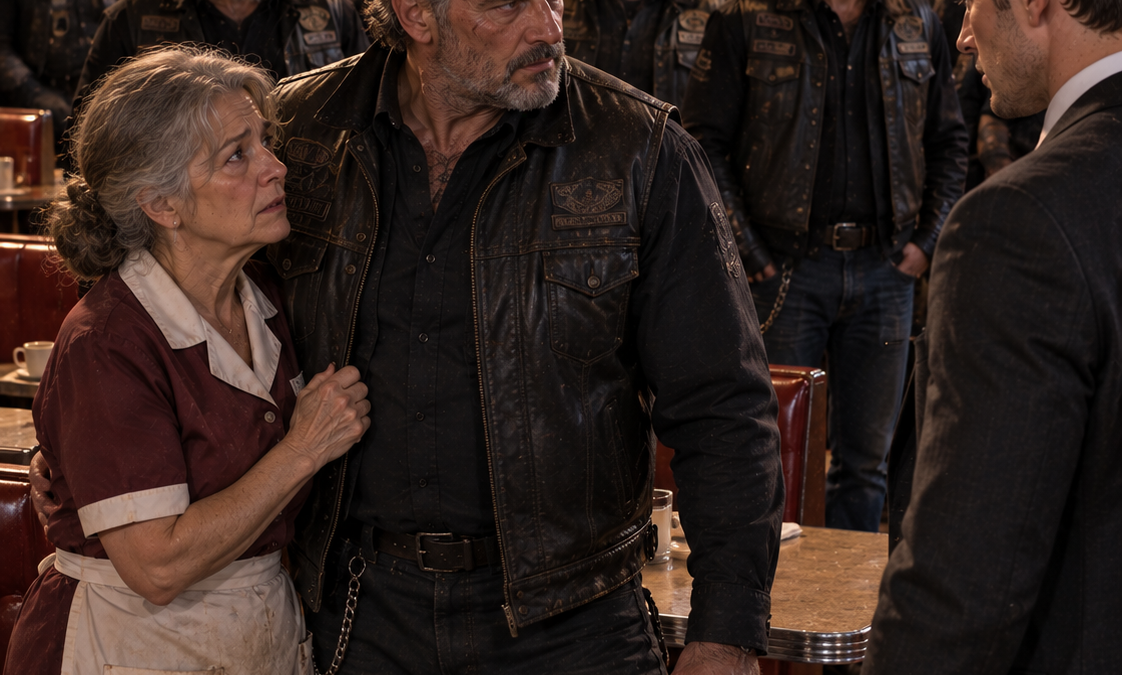
She walked to the front of the formation and stood beside Gideon, a 62-year-old waitress in a white blouse and a winter coat, standing next to a scarred veteran in worn leather in front of a county courthouse at dawn, waiting for the doors to open so they could burn down a senator’s empire with a flash drive and the truth.
Behind them, Camden stood on the courthouse steps with his bandaged hand in his pocket, touching the edges of the drive through the fabric. His heart was hammering. His mouth was dry.
His legs were shaking from the motorcycle ride and the cold and the fear and the absolute irreversible certainty that what he was about to do would destroy the last remnants of the life he’d known.
Two TV vans appeared at the end of Main Street. Then a third.
Wrench’s phone calls had worked.
The journalist Gideon had cultivated for 2 years were arriving.
cameras and microphones and the specific hungry energy of reporters who smelled something that couldn’t be buried.
Then a fourth vehicle appeared, black government plates, a suburban identical to the one from the parking lot. It stopped at the opposite end of Main Street. The engine stayed running.
The doors didn’t open.
And from inside the vehicle, Camden’s phone rang.
He pulled it out.
The caller ID showed a name he hadn’t seen in 22 days.
Dad. His thumb hovered over the screen.
Rain that had started again.
Light almost invisible, more mist than rain, settled on the glass between his skin and his father’s name.
Gideon turned and looked at him. Eleanor turned and looked at him.
10 bikers in scarred leather standing in formation on the steps of a courthouse in smalltown Montana at dawn turned and looked at a 24year-old kid in a stained apron with a bandaged hand and a flash drive in his pocket and his father’s name glowing on a screen that the rain was slowly blurring.
Camden answered the phone.
Don’t do this.
His father’s voice was stripped of everything.
No authority, no strategy, no performance. Just the raw scraped hollow sound of a man watching his architecture collapse in real time.
Camden, please don’t do this.
Camden looked at Eleanor. She was watching him. Her face was still.
Her eyes were dry. her trembling hands.
Those hands that had poured a 100,000 cups of coffee and wiped his spit from her own face and carried a 9-year-old granddaughter’s entire future on their broken joints were folded in front of her.
Steady.
I’m already doing it, Camden said.
He hung up. The courthouse doors opened at 6:00 a.m.Light spilled down the steps like an invitation. The TV cameras powered on.
Reporters moved into position.
The suburban at the end of the street didn’t move.
And Camden Royce, son of a senator, former monster, 22-day dishwasher, holder of a flash drive stained with his own blood, looked at Gideon Cross, looked at Eleanor Vale, looked at 10 men who’ taught him that strength wasn’t dominance, but presence, and began walking up the courthouse steps toward the doors, toward the light, toward the thing he couldn’t take back and didn’t want to.
Behind him, the
Iron Saints followed. Not as bodyguards, not as enforcers, not as the outlaw gang the world would try to paint them as in the headlines that would follow. As witnesses, as the men who stood up in a diner when nobody else would.
And Eleanor Vale walked beside Camden with her back straight and her white blouse bright against the gray morning, and her husband’s name beating inside her chest like a drum that had been waiting 4 years to be heard.
The courthouse swallowed them whole, and outside in the parking lot, the black suburban finally opened its doors. But by then, the cameras were already rolling, and the truth had already started moving.
And there was nothing left in Senator Royce’s arsenal that could stop what 10 broken men and one exhausted woman and one ruined boy had set into motion on the steps of a building that was for once about to be used for exactly what it was built for.
The flash drive connected to the federal records clerk’s computer at 6:09 a.m.Camden’s bandaged hand was shaking when he plugged it in, not from fear, from the irreversible weight of a gesture that couldn’t be undone.
The clerk, a woman in her 50s named Donna, who wore reading glasses on a chain and had worked in the Milbrook County Courthouse for 22 years without once encountering anything more dramatic than a contested property line, stared at the screen as the files loaded, and her face went through a transformation that Camden would remember for the rest
of his life. Confusion first, then recognition, then the slow, dawning horror of a person who was looking at numbers that represented stolen lives. These are federal fund transfers, Donna said.
Her voice had the careful, measured quality of someone trying very hard not to react to what they were seeing. Veterans healthcare allocations redirected to, she stopped, scrolled, stopped again.
These accounts aren’t on any registry I’ve ever seen.
Shell companies, Camden said, registered under intermediary names. The beneficial owner is Senator Camden Royce, Senior. Donna looked at him over her reading glasses.
Then she looked past him through the glass partition into the lobby where 10 men in leather vests stood in a loose formation facing the entrance and a 62-year-old woman in a white blouse sat on a wooden bench with her hands folded in her lap and her eyes fixed on the
floor. I need to make some calls, Donna said.
Make them. She did. Three calls in 12 minutes.
The first to the county registar, the second to the state attorney general’s office in Helena, the third to a number she read from a card she kept in her desk drawer, a card Camden noticed that was worn at the edges from handling, as if she’d been waiting years for a reason to use it.
By 7:15 a.m., the courthouse had changed.
Two investigators from the state AG’s office arrived in an unmarked sedan carrying briefcases and the specific expression of people who had been woken up early for something that justified the lost sleep.
They met with Camden in a small conference room on the second floor while Gideon stood outside the door with his arms crossed and his back against the wall, not guarding exactly but present in the way a foundation is present beneath a building, unseen, essential, carrying weight. Camden
talked for 90 minutes.
He talked about the flash drive, about the shell companies, about the routing numbers and transfer authorizations and the seven years of diverted funds.
He talked about his father’s study and the monogram stationer and the scotch and the threat not leaving as my son.
He talked about the FBI agents in the parking lot, about agent Mercer, about the surveillance that had been positioned not to investigate corruption but to contain it. And then he talked about Eleanor, about Frank Vale, 23 years of service, pancreatic cancer, a waiting list at a VA facility that had lost its funding because the money that should have sustained it had been siphoned through accounts that existed only on paper.
A phone call to the senator’s office, a woman who answered and took a name and a service number and promised someone would call back.
The silence that followed, the 11 weeks, the death. One of the investigators, a woman named Torres with closecropped hair and the focused intensity of someone who had built a career on the belief that systems could be repaired, stopped writing, set down her pen, looked at Camden.
“You understand that your testimony, combined with this evidence will likely result in federal charges against your father,” she said.
“Grand jury indictment, criminal prosecution, prison.
I understand.
and that you’ll be called to testify publicly under oath against your own father.”
“I know.”
Torres studied him.
The bandaged hand, the stained apron he still hadn’t removed, tied over a jacket that smelled like rain and motorcycle exhaust, and the industrial degreaser Eleanor used on the flattop grill.
He looked nothing like the son of a senator.
He looked like a line cook who’d been awake for 30 hours and had recently made a decision that would cost him everything he’d ever been given.
“We’ll need 48 hours to verify the financial records,” Torres said.
“Cross reference the transfer authorizations.
Confirm the shell company registrations.
If the evidence holds, and from what I’m seeing, it will, we’ll move to secure a federal warrant.”
“What about the FBI team?”
Mercer Torres exchanged a glance with her colleague. The glance contained an entire conversation about jurisdictional complications, about internal affairs investigations, about the specific bureaucratic nightmare of discovering that federal agents had been operating under the direction of the target they were supposed to be investigating.
That’s being handled separately, Torres said through channels that Senator Royce doesn’t control.
Camden nodded, stood up. His legs were unsteady. The kind of unsteadiness that came not from physical weakness, but from the sudden absence of tension.
For 3 weeks, every muscle in his body had been carrying a weight that he hadn’t fully understood until it began to lift.
The removal of it left him hollow, shaky, like a building after the scaffolding comes down, and you find out whether the walls can stand on their own.
He walked out of the conference room and found Gideon exactly where he’d left him, back against the wall, arms crossed, face unreadable.
“It’s done,” Camden said.
Gideon looked at him.
Those pale gray eyes that had seen everything, combat zones and funeral homes, and the inside of a foster care report about a son who wouldn’t look at him, studied Camden’s face with the same careful attention he’d given Eleanor’s trembling hands three weeks ago.
No, Gideon said quietly.
It’s starting.
He was right. The next 72 hours were a controlled demolition.
The state attorney general’s office verified the financial records in 36 hours instead of 48.
The evidence was, according to Torres, the most comprehensive documentation of public fund diversion we’ve seen in this state in two decades.
Every transfer was timestamped. Every shell company was traceable.
Every authorization carried the digital signature of Senator Camden Royce, Senior, applied with the specific carelessness of a man who had never imagined that the architecture of his corruption would be disassembled by his own son. The federal warrant was issued on Wednesday morning. By Wednesday evening, the story had broken.
Mara Chen at the Billings Gazette published first a 4,000word investigation that laid out the financial trail with the precision of an autopsy report. She named the shell companies. She named the intermediaries.
She named the senator. And she named the veterans who had died on waiting lists at facilities that had lost funding because of the diversions. 11 names, 11 service records, 11 families who had buried someone who should have survived.
Frank Vale was the third name on the list. David Kowalsski at the Helena Independent published 2 hours later focusing on the FBI angle. The surveillance team that had been deployed not to investigate the corruption, but to protect it.
Agent Mercer’s name appeared in the fourth paragraph.
By the sixth paragraph, the FBI’s internal affairs division had opened a formal inquiry.
By Thursday morning, every major news outlet in Montana had picked up the story. By Thursday afternoon, it had gone national. Senator Camden Royce Senior held a press conference at 4 p.m.on Thursday.
He stood behind a podium in his Helena office flanked by lawyers and delivered a statement that contained the words mischaracterization and political opponents and complete confidence in the legal process. The standard vocabulary of a powerful man attempting to reframe catastrophe as inconvenience.
It didn’t work.
The indictment came on Friday.
Federal charges, wire fraud, misappropriation of public funds, obstruction, 11 counts, one for each veteran whose name appeared in Mara Chen’s article.
The arrest was captured on camera.
Two federal marshals, not FBI, escorting the senator from his Helena office to a waiting vehicle while reporters shouted questions that he didn’t answer.
And photographers captured the image that would define his legacy.
a silver-haired man in a navy suit, hands at his sides, walking toward a car that wasn’t a Mercedes and a future that didn’t include the word senator.
The recovered funds totaled $23. 7 million over seven fiscal years.
Within 6 weeks, emergency allocations were approved to restore funding to four VA facilities across Montana that had been operating at reduced capacity.
The Hworth Clinic, the one Gideon had watched the senator’s office try to defund two years ago, received enough money to hire six additional staff members and eliminate its waiting list for the first time in a decade.
None of this was easy. None of this was clean. None of this happened without cost.
Camden’s family downed him formally through a legal notice delivered to the Red Lantern Diner on a Tuesday afternoon by a courier who looked deeply uncomfortable handing an envelope to a man wearing an apron.
The notice
terminated all financial ties, removed his name from the family trust, and revoked his access to every property, account, and asset connected to the Royce estate. The language was precise, clinical, and devoid of any word that acknowledged a biological relationship between the sender and the recipient. Camden read it standing behind the counter.
Then he folded it, put it in his apron pocket, and went back to clearing tables. Eleanor watched from the kitchen window. She said nothing.
But that evening, after the diner closed, she left a paper bag on the counter beside the coffee machine. Inside was a sandwich, turkey, lettuce, mustard wrapped in wax paper, and a note written in handwriting that trembled because her hands always trembled.
You’re not alone.
E. Camden ate the sandwich sitting at table 9 in the dark, empty diner with the neon sign painting red light across the walls, and for the second time in his life, he cried.
The first time had been at age seven when his mother had left and his father had told him that crying was a weakness that Royce men didn’t indulge.
He’d stopped then, sealed it, built 17 years of armor over the place where tears were supposed to come from.
Now the armor was gone, stripped away by grease burns and mop handles and the weight of a sandwich made by a woman whose husband had died because of his family. The tears came without sound, just water running down a face that had forgotten how to produce it.
Relearning the mechanism in real time, he wiped his face with the apron, washed the plate, locked the door, walked to the efficiency apartment he’d rented above a hardware store on the east side of Milbrook.
$400 a month paid from his diner wages, furnished with a mattress, a folding chair, and a lamp that buzzed like the ones in the Red Lantern.
It was the first home he’d ever earned.
6 months passed. The seasons turned the way they do in Montana, violently, without apology. Winter collapsed into a spring that was more mud than warmth.
Spring hardened into a summer that baked the highways and turned the fields golden. Summer cooled into an autumn that smelled like woods smoke and approaching frost.
The Red Lantern Diner closed on a Saturday in October. Not because of the scandal, not because of financial failure, because Eleanor Vale had decided that 11 years was enough.
She’d enrolled in nursing school at Montana Western in June, a decision she’d made sitting at her kitchen table at 3:00 a.m.after her last shift, staring at her hands and realizing that the tremor had stabilized once she’d stopped carrying the weight of a secret she didn’t know she’d been carrying.
The tremor wasn’t gone.
It would never be gone. But it had become manageable, then the way grief becomes manageable, not smaller, but more familiar, integrated into the daily architecture of a body that had learned to accommodate its own damage. She could hold a syringe.
She could take a pulse.
She could stand in a room with a sick person and provide the kind of care that she’d watched the system fail to provide for Frank.
and the knowledge that she was becoming the thing the system should have been was more healing than any therapy or medication or well-intentioned conversation about closure. Lily was 10 now. She was reading at a 7th grade level.
She played soccer with an intensity that suggested she’d inherited her grandmother’s stubbornness and her grandfather’s discipline.
She still slept on a mattress, but a real one now, with a frame, in a bedroom that had a door and a window and a bookshelf Eleanor had bought at a thrift store and painted white. Camden had two jobs.
He worked mornings at the diner until it closed, and afternoons at a nonprofit veterans outreach center in Milbrook that had been established with a portion of the recovered funds. He was studying social work through an online program at the University of Montana, completing coursework at night on a secondhand laptop that Wrench had rebuilt from salvaged parts and handed to him without comment or ceremony.
He was 25 years old. He had $1,200 in a savings account, a rented apartment, calloused hands, and a criminal record that consisted of a single misdemeanor traffic violation from a lifetime ago. His father was awaiting trial in Helena.
They hadn’t spoken since the phone call on the courthouse steps.
They would probably never speak again.
Camden didn’t know if that was grief or relief.
He suspected it was both, occupying the same space inside him the way Montana weather could be sunny and snowing simultaneously. Contradictory, confusing, and somehow completely natural.
The diner’s last night was a Thursday.
Of course it was. The Iron Saints arrived at 700 p.m.riding in from the highway in formation the way they had every Thursday for 3 years. 10 bikes, 10 men, engines cutting to silence in the parking lot one by one, like a countdown that ended with the sudden heavy presence of leather and chrome, and men who carried their histories in their posture.
The diner was full.
Truck drivers who’d heard it was closing and drove out of their way to be there.
the nurse who worked doubles at Milbrook General and had been eating pie at the counter since before Eleanor started. Carl, the 68-year-old veteran with the tremor and the coin purse with the bullet hole, sitting in his usual booth with two eggs over easy and wheat toast, counted out an exact change one last time. Eleanor worked the floor, not because she had to.
She’d hired a replacement three weeks ago, a young woman named Maria, who was efficient and kind and didn’t need to be trained because Eleanor had already trained her through six weeks of sidebyside shifts.
Eleanor worked because it was her last night, and this was her floor, and these were her people, and she wanted to carry the plates one more time.
Camden worked beside her, pouring coffee, clearing tables, moving through the room with the quiet efficiency of a man who had learned to navigate the diner’s geography the way a sailor learns the deck of a ship by feel, by rhythm, by the muscle memory of a 100,000 repeated motions.
At 9:00 p.m., Gideon sat down at table 9. He was alone.
Wrench was at the counter arguing with Elias about whether a 1987 shovel head could outperform a modern twin cam in cold weather, a debate they’d been having for 2 years and would continue having until one of them died or the sun burned out, whichever came first.
Shepherd sat at the far end of the counter with a cup of coffee. He was actually drinking for once, watching the room with the ancient, patient attention of a man who understood that some moments were worth witnessing without commentary.
Gideon’s coffee was black.
His hands were wrapped around the cup. His scar caught the neon light from the window and threw a shadow across his temple that looked like a river drawn on a map of terrain that had survived something catastrophic. Camden sat down across from him.
They hadn’t talked, really talked, since the courthouse.
The aftermath had been consumed by investigations and interviews and the mechanical process of rebuilding a life from scratch.
There hadn’t been space for the kind of conversation that required silence around it, the way certain chemical reactions require darkness to complete.
Now there was space. I called my son, Gideon said. Camden sat down his coffee cup.
The words landed with the weight of something that had been carried for 14 years and was finally being set on a table.
Last week, Gideon continued, I called the number I’ve had in my phone since he turned 18.
The number I’ve looked at every night for 6 years without dialing.
I called it. Did he answer? Voicemail.
Gideon’s jaw tightened.
The muscles worked beneath his skin, and the effort of the next sentence was visible. not in his face, which remained composed, but in his hands, which tightened around the cup until the tendons stood out like cables.
I left a message. 37 seconds. I told him I was sorry.
I told him I should have been there.
I told him I wasn’t asking for anything.
Not forgiveness, not a relationship, not even a response.
I just wanted him to know that I’d spent 14 years becoming the man I should have been when he needed me.
The diner’s sounds filled the silence between them.
The coffee machine, the low murmur of conversations, the clink of ceramic on ceramic, the buzzing of fluorescent lights that had been threatening to die for years and kept surviving out of what seemed like pure stubbornness.
“Did he call back?”
Camden asked.
“No,” Gideon paused.
“But someone else did.
A woman, his fianceé.
She said he’d listened to the message four times.
She said he wasn’t ready to talk, but he wasn’t angry anymore.
She said, Gideon stopped, breathed. The breath was audible, a sound that came from somewhere deeper than lungs.
She said he’d named his dog Gideon.
Camden didn’t speak.
There was nothing to say. The information existed in a space beyond language.
A man who hadn’t spoken to his father in 14 years, naming a dog after him, which was simultaneously the smallest gesture in the world, and the largest, because it meant the name was still spoken in a house that Gideon had never visited, attached to a living thing that was loved.
That’s why I pushed you, Gideon said.
Shepherd was right. I saw my son in you, not the way you were, the way you could be. the version that existed underneath all the damage your father built on top of you.
He looked at Camden with eyes that were clear, unguarded, the rarest expression Gideon Cross ever wore.
I couldn’t save my boy, but I could put a napkin in your hand and see if you’d pick it up.
I picked it up, Camden said. You did.
They sat at table 9 in the Red Lantern Diner on its last night. Two men separated by decades and damage and the specific complicated wreckage of fathers who failed in different ways.
One through corruption, one through absence, and between them on the scarred table surface stained by a million coffee rings, something that had been building for 22 days and 6 months and a lifetime reached its final shape. Not friendship exactly, not family exactly, something without a name.
the bond between a man who protected strangers because he couldn’t protect his son and a boy who destroyed his inheritance because a waitress showed him what real work looked like.
At 11 p.m., Eleanor turned off the flattop grill for the last time. The sound it made was small, a click, then a tick, then the slow cooling of metal that had been hot for 11 years.
She stood in the kitchen alone with her hand on the knob and listened to the silence that followed. It was a different silence than the ones she was used to.
Not the silence of exhaustion, not the silence of loneliness, the silence of completion, the sound a story makes when it reaches the period at the end of its last sentence.
She untied her apron, folded it the way she’d folded it a thousand times, in thirds, creased sharp, the fold lines worn into the fabric from years of repetition.
She set it on the prep counter beside the pairing knife she’d used to cut 10,000 onions and the salt shakers she’d filled every night and the coffee scoop that was bent slightly at the handle because Frank had bent it 20 years ago trying to use it as a bottle opener and she’d never straightened it because the bend was shaped like his grip and she wasn’t ready to lose that
too.
She walked out of the kitchen and into the dining room. The customers were gone.
The truck drivers and the nurse and Carl and the regulars who’d come to say goodbye had filtered out into the night, leaving tips that were too large and handshakes that lasted too long.
And the awkward, insufficient words that people use when they’re trying to say thank you for something that can’t be measured in language.
The Iron Saints remained.
They were gathered at table 9, and the booth surrounding it spread across the room the way they’d been spread across the room every Thursday for 3 years.
leather vests, scarred hands, coffee cups held too tight. The quiet weight of men who carried damage they never discussed in a space that had never asked them to explain it.
Gideon stood up.
He reached into the inside pocket of his vest, the pocket closest to his chest, the one where he’d carried the flash drive, the one positioned directly over his heartbeat, and pulled out something that wasn’t a flash drive.
It was a leather vest, not full club colors, not a patched in members cut. Something simpler, black leather, weathered with a single small patch stitched above the left breast pocket.
The patch was handsewn, the stitching slightly uneven, the thread a dark red that matched the neon sign outside. Three words in block letters, protector in training. The diner went quiet.
Gideon held the vest out to Camden. No speech, no ceremony, no explanation of what it meant or what it cost or what obligations it carried. The gesture was its own language, the language of men who had learned to communicate through actions because words had failed them too many times in too many hospitals, in courtrooms, and empty houses where the people they loved had stopped being.
Camden took the vest.
The leather was soft, broken in by someone else’s body, someone else’s rides, someone else’s weather.
It had history in it. Weight.
The kind of weight that didn’t come from material, but from meaning.
He put it on over his apron.
The apron strings hung below the vest’s hem.
The stained white fabric showed beneath the black leather.
The combination should have looked absurd, a line cook wearing a biker’s vest.
But instead, it looked like the most honest thing in the room, a man who was both things simultaneously. A worker and a protector. A servant and a fighter.
someone who had learned that the distance between pouring coffee and standing up for a stranger was shorter than anyone imagined. Wrench nodded once.
Elias raised his coffee cup an inch. That not a toast, just an acknowledgement.
Shepherd closed his eyes and breathed in through his nose slowly, deeply, the breath of a man who had just witnessed something he’d been waiting to witness.
Eleanor stood at the counter. She was looking at Camden, at the vest, at the apron beneath it, at the hands calloused, bandaged, rebuilt, that had once been used to humiliate her and were now being used to carry everything she taught him.
She walked to him, stood in front of him, reached up, and straightened the vest’s collar.
The way a mother straightens a child’s jacket before school, the way a woman adjusts the clothing of someone she has decided belongs to her in the only way that matters.
Not by blood, not by law, but by the choice to keep showing up. Frank would have liked you, she said. Not at first, but eventually.
Camden’s throat closed.
He nodded. It was all he could manage.
At midnight, Eleanor locked the Red Lantern Diner’s front door for the last time.
The key turned in the lock with a sound that was small and final and carried the weight of 11 years inside its click. She put the key in her coat pocket, stood on the front step, looked at the neon sign, the red lantern that had buzzed and flickered and died and come back to life and cast its red glow across this parking lot through every storm in every season and every terrible, beautiful, ordinary night that had happened beneath it. She reached around the doorframe and flipped the switch.
The red lantern went dark. For a moment, the parking lot existed in pure darkness. No neon, no fluorescent, just the distant glow of the highway and the cold white points of Montana stars appearing through breaking clouds.
Then 10 motorcycle engines started. The sound built from nothing to everything.
A deep rolling thunder that started as a vibration in the asphalt and grew into something you felt in your rib cage, your teeth, the hollow spaces behind your eyes.
10 Harleys idling in formation, their headlights cutting through the dark and parallel beams that illuminated the parking lot and the building and the woman standing on the step with a key in her pocket and a future she’d built from wreckage.
Gideon pulled out first, his bike rolled past Eleanor, and he looked at her. One look, steady, unguarded, the look of a man who had been protecting strangers his entire adult life because it was the only way he knew to survive the guilt of not protecting his son. And then he was past her, turning onto the highway, his tail light shrinking into the dark.
Wrench followed, then Elias, then Shepherd.
One by one, the Iron Saints rode out of the Red Lantern’s parking lot for the last time, each man passing Eleanor with a nod or a look, or the slight, almost invisible raising of two fingers from the handlebar.
The biker salute, the gesture that meant, “I see you without the burden of saying it out loud.
” The engines faded.
The highway absorbed them.
The sound diminished from thunder to rumble to hum to memory until the only things left in the parking lot were Eleanor’s Honda Civic, Camden’s borrowed truck, and the silence of a building that had spent 60 years being a place where tired people came to be seen.
Eleanor stood in the dark for a long time. Camden stood beside her. Neither spoke.
The wind came down from the mountains carrying the first real cold of October. Not winter yet, but the promise of it. The advanced guard of a season that would bury everything in white and force the world to start over.
Lily has a soccer game tomorrow, Eleanor said finally. What time? 10.
I’ll be there.
Eleanor looked at him. In the starlight, her face was silver and shadow. The face of a woman who had survived everything the world had thrown at her, not through strength or courage or any of the words people used to describe resilience, but through the simple, stubborn, unremarkable act of waking up every morning and going to work.
You don’t have to, she said.
I know. She nodded, walked to her car, got in, started the engine. The old Honda coughing to life with the mechanical reluctance of a vehicle that had outlived every reasonable expectation for its survival.
She pulled out of the parking lot, her headlights sweeping across the dark building one final time and drove toward town toward a one-bedroom apartment above a laundromat where a 10-year-old girl was sleeping on a real mattress in a real bed in a room with a door. Camden stood alone in the empty parking lot.
The diner was dark behind him. The neon sign was dead. The highway stretched in both directions.
East toward a past he’d dismantled.
West toward a future he couldn’t see.
Above him, the Montana sky opened into the kind of vastness that made human problems look like what they were. Small, temporary, survivable.
He untied his apron, folded it, set it on the step beside the locked door. the way you set flowers on a grave.
Not because the dead can see them, but because the living need to leave something behind. The vest stayed on. He walked to his truck, got in, started the engine.
The heater kicked on with a rattle that filled the cab with warm air that smelled like dust and old upholstery and the ordinary miracle of machinery working the way it was supposed to.
He drove toward town, toward his apartment above the hardware store, toward a morning shift at the Veterans Outreach Center and an afternoon studying social work and a soccer game at 10:00 where he’d sit in the bleachers beside a woman who’ taught him more about strength in 6 months than his father had taught him about power in 24 years.
And somewhere on the highway ahead of him, or behind him, or scattered across the frozen Montana dark in every direction, the Iron Saints were riding. 10 men on 10 motorcycles, engines rumbling through the cold night air, carrying their damage and their purpose and their scarred leather and their silence toward whatever broken person needed them next.
They weren’t heroes.
They’d be the first to tell you that.
Heroes existed in stories that ended with applause and gratitude and the satisfying resolution of a world made right. These men existed in the space after the story. In the ongoing, unfinished, never completed work of showing up for people the system had stopped seeing.
The highway was dark. The cold was real.
The engines were loud enough to feel in your bones and quiet enough to disappear into distance.
and Camden Royce, disowned son, former monster, dishwasher, protector in training, drove through the Montana night with a borrowed vest over a folded apron and calloused hands on a steering wheel and the first thing he’d ever built that couldn’t be taken away from him.
Not money, not power, not a name, just the knowledge that he’d stood up when it mattered, that he’d picked up the napkin.
that somewhere in a small apartment, a woman he’d once humiliated was sleeping without the weight of an unanswered question pressing on her chest for the first time in 4 years.
That was enough. That was more than enough.
That was everything.
—END—
