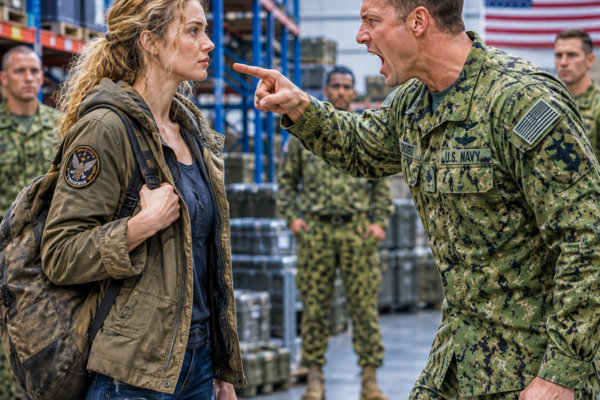
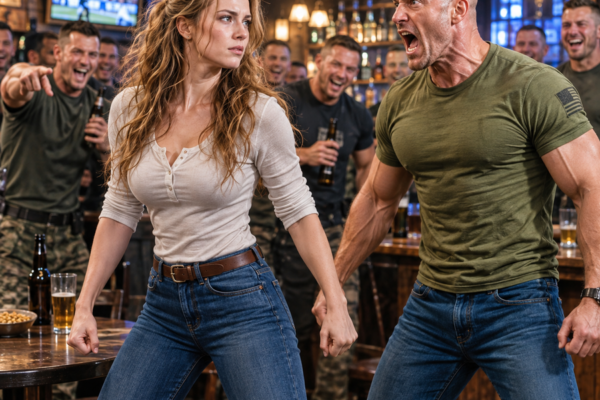
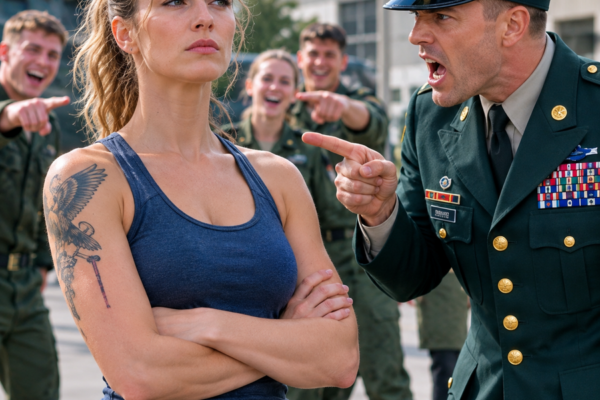
Rich Teen Spit On A Waitress —Seconds Later, 10 Hells Angels Rose Behind Him
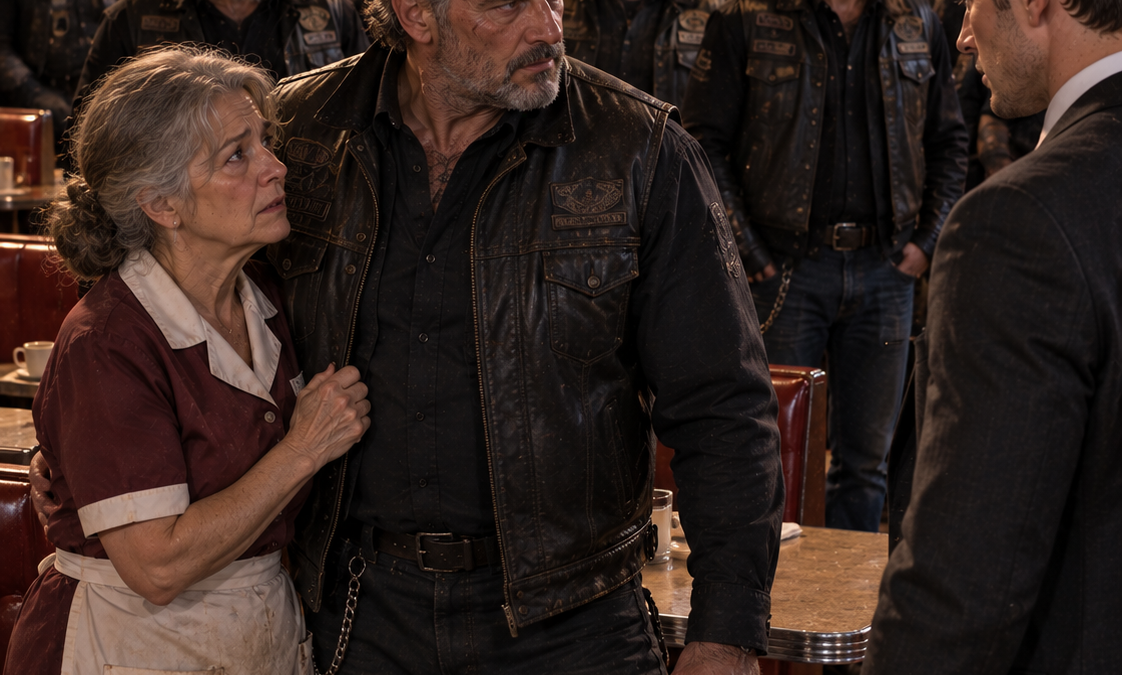
Rich Teen Spit On A Waitress —Seconds Later, 10 Hells Angels Rose Behind Him
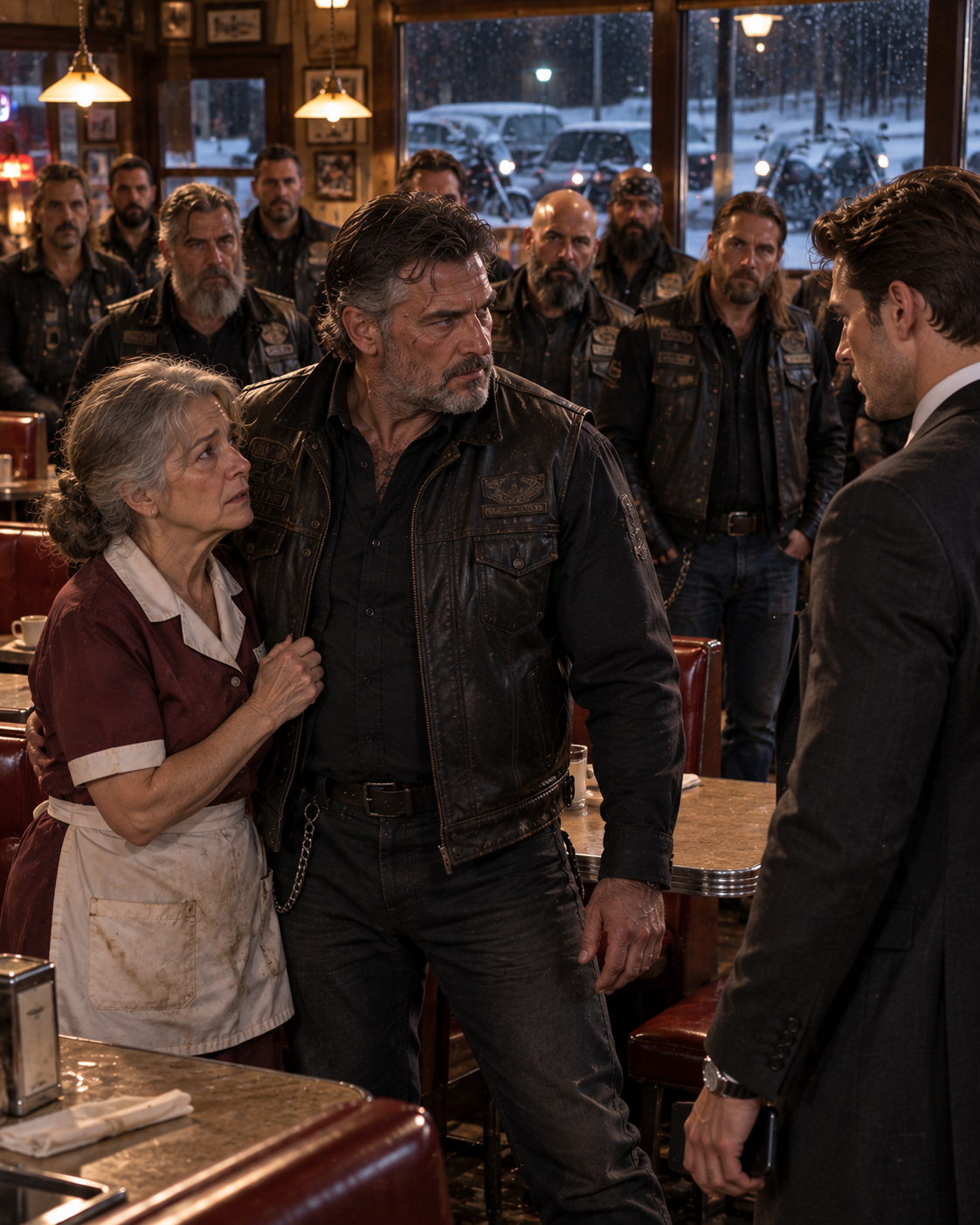
A 62-year-old waitress with swollen hands and no future left stands behind the counter of a dying diner in frozen Montana serving coffee to men who once killed for their country.
She doesn’t know that the senator’s son walking through her door tonight will spit in her face.
She doesn’t know that 10 bikers in scarred leather will stand up from their seats in a silence more dangerous than any bullet.
and she doesn’t know that the war about to explode inside this diner will uncover a secret buried so deep it connects the death of her husband to the most powerful family in the state.
Well, the Red Lantern Diner sat at the edge of nothing. 12 mi outside Milbrook, Montana, on a two-lane highway that ice had turned into a death wish by November.
The building was 60 years old, maybe older. Cracked vinyl boos with duct tape patches, a counter scarred by a million coffee rings, fluorescent lights that buzzed and flickered like dying insects trapped inside their own glow. The kind of place truck drivers found by accident and regulars kept alive out of habit.
or loneliness or both. Eleanor Vale had worked there for 11 years.
She stood behind the counter at 11:47 on a Thursday night, filling salt shakers with hands that wouldn’t stop trembling.
Not from cold, not from fear, from something deeper. The slow erosion of a body that had been working too hard for too long without anyone noticing.
62 years old, 5’4, shoulders rounded from decades of carrying plates and problems that didn’t belong to her.
Her hair had gone silver 3 years ago all at once, like her body decided to stop pretending. She had a granddaughter at home.
Lily, 9 years old, sleeping on a mattress on the floor of a one-bedroom apartment above a laundromat that smelled like bleach and regret. Eleanor was raising her alone because her daughter had vanished four years ago. Walked out one Tuesday morning for cigarettes and never came back.
No note, no phone call, just an empty car seat and a child who stopped asking where mommy went. The debt was the kind that grew teeth.
Medical bills from her husband Frank’s final year.
Pancreatic cancer that ate through their savings before it ate through him.
A second mortgage on a house she’d already lost.
credit card interest compounding like punishment.
She owed more money than she’d earned in the rest of her lifetime, and she knew it.
She’d done the math on a napkin during a break six months ago, stared at the number, and then poured herself a cup of coffee and gone back to work because that’s what Eleanor did.
She went back to work.
The snow had started at sundown and hadn’t stopped.
thick, heavy, the kind of Montana winter that buried cars and killed cattle and made the highway patrol close roads without warning.
Through the diner’s front window, she could see the parking lot disappearing under white.
Four trucks, a sedan with a cracked windshield, and at the far edge, lined up like a military formation, 10 motorcycles caked in frost and road salt. The Iron Saints.
They came every Thursday night. Had for three years since their chapter relocated from somewhere in Wyoming.
Nobody talked about. 10 men, ages ranging from late30s to mid60s.
All veterans, all carrying damage that didn’t show on the surface, but leaked out in the way they held their coffee cups.
Too tight like the ceramic might try to leave. The way they sat with their backs to walls and their eyes on doors.
the way conversations between them happened in fragments, half sentences, nods, silences that held more meaning than most people’s speeches.
Eleanor didn’t know their full stories.
Didn’t need to.
She knew the language of broken men because she’d been married to one for 31 years.
Frank had come home from his service different, not violent, not angry, just quieter, like someone had turned the volume down on his soul and never turned it back up.
He’d sit on the porch for hours watching nothing.
And Eleanor would bring him coffee and sit beside him without speaking because she understood that sometimes presence was more valuable than words. The Iron Saints reminded her of Frank. Dangerous on the outside, safe on the inside.
The contradiction that most people couldn’t understand.
Their leader sat at table 9.
Gideon Cross, 58 years old, 6’2 with the kind of stillness that made crowded rooms go quiet.
His face looked like it had been carved from something harder than bone. Deep lines, a jaw that clenched even when he smiled, eyes that were pale gray, and saw everything without appearing to look. His leather vest was worn almost white at the shoulders.
Patches faded from years of weather and wear. A scar ran from his left temple down past his ear, disappearing beneath his collar like a secret that kept going.
He’d been army two tours.
Then something classified that nobody in the club discussed. He came back and found his wife had died in a car accident while he was overseas.
Found his teenage son had been placed in foster care and beaten so badly he’d spent 3 weeks in a hospital.
By the time Gideon tracked the boy down, his son wouldn’t look at him, wouldn’t speak, wouldn’t acknowledge that the man standing in front of him was his father.
That was 14 years ago.
Gideon hadn’t spoken to his son since.
He didn’t talk about it.
None of them talked about the things that had broken them. But those fractures were visible in everything they did. The way they rode too fast in bad weather.
The way they drank coffee instead of liquor because half of them were recovering from something.
The way they overtipped Eleanor by 300% and pretended they didn’t notice.
Tonight, Gideon was watching her hands.
He’d noticed the tremor 6 weeks ago, watched it worsen.
noticed she’d started gripping the coffee pot with both hands to keep it steady, that she’d switched from carrying three plates to two, that she paused between tables to breathe through something, pain, exhaustion, fear, all three.
He’d said nothing.
Gideon was the kind of man who gathered information before he acted, who understood that offering help to a proud woman too early was the same as insulting her. But he was keeping count, logging every wse, every catch in her breathing, every time she leaned against the counter when she thought no one was watching.
Someone was always watching. At table three, Noah Hris, the club called him wrench, was rebuilding a carburetor on a napkin. 51.
Former Marine mechanic who’d lost two fingers on his left hand to an IED outside Fallujah and never mentioned it.
He could strip a Harley engine blindfolded and reassemble it in the dark. He could also read people the way he read machines, listening for what was grinding, what was loose, what was about to break.
Wrench had noticed Ellaner’s hands, too.
At table 6, Elias Cain sat alone with a medical textbook propped against a sugar dispenser. 44.
Former Army combat medic who’d held 17 men while they died and remembered every single one of their last words.
He worked at the VA hospital now, 12-hour shifts for pay that wouldn’t cover rent in most cities.
He drank black coffee and read about trauma surgery, the way some people read novels, for comfort, because at least on the page, the patient survived.
Elias had noticed Eleanor’s breathing patterns.
And at the end of the counter, a man the club called Shepherd sat motionless with his hands wrapped around an empty cup. 64.
the oldest member, former chaplain’s assistant who’d lost his faith in a field hospital and found something else.
Not belief, but purpose.
He didn’t preach.
He didn’t quote.
He just listened with the patience of a man who’d heard every confession a human being could make and decided none of them were unforgivable.
Shepherd had noticed Eleanor’s eyes.
The way the light in them had been dimming for months, slowly, like a candle burning down to nothing in a room nobody entered. They all saw it. None of them said it.
That was the Iron Saints way. They protected in silence, acted without announcement, and never made their care feel like charity.
Because these men understood something most people never learned.
The worst kind of suffering wasn’t pain.
It was pain that nobody acknowledged. The clock above the counter read 11:52 when headlights swept across the parking lot. Eleanor looked up.
The vehicle was wrong for this place and this hour. A black Mercedes AMG, brand new chrome, gleaming even through the falling snow. It pulled into the lot too fast, fishtailing on ice before stopping diagonally across two spaces.
The engine cut.
The headlights stayed on for a long moment, pointing at the diner’s front door like accusation.
Something in Eleanor’s stomach tightened.
The door opened and cold air rushed in, carrying snowflakes and the smell of expensive cologne that didn’t belong anywhere near this building.
A man stepped inside.
Young, mid20s, tall, lean, wearing a cashmere overcoat that costs more than Eleanor’s annual salary.
His hair was styled with the kind of precision that required a mirror and 45 minutes of self- worship. His shoes were Italian leather.
His watch caught the fluorescent light and threw it back like a weapon. Camden Royce.
Eleanor didn’t know his name yet, but she recognized the type.
She’d served a thousand of him across her life.
Men who walked into rooms like they’d already purchased everything in them, including the people.
Men whose confidence was built on something other than competence. Men who looked at waitresses and saw furniture.
He scanned the diner with a smirk that tightened every muscle in Gideon’s jaw.
His gaze slid over the cracked booths, the coffee stained counter, the buzzing lights, and landed on Eleanor with the precision of someone selecting a target.
This is it,” he said to no one in particular.
His voice carried the specific breed of contempt that came from never having earned anything.
“This is the famous diner,” he was on his phone, had been recording since he walked in, holding it at chest level, angled at Eleanor, the screen’s glow reflecting off his eyes like something hollow.
“I’m driving through the absolute middle of nowhere,” he narrated into the camera.
“And I found this place.
Look at this. This is what real America looks like, folks.
Depressing, right?
Eleanor sat down the salt shaker, straightened her apron, walked toward him with the menu because that’s what she’d been doing for 11 years, walking toward people who didn’t see her and serving them anyway.
Evening, she said. You can sit anywhere you like.
He didn’t look at her, still recording.
Can I get like actual food here, or is it all grease and sadness? At table 9, Gideon set his coffee cup down. The ceramic touched the table without a sound.
“We’ve got a full menu,” Eleanor said, her voice steady, professional, stripped of everything except duty.
“The pot roast is good tonight.
” Camden finally looked at her.
“Really?”
looked. And something ugly moved behind his eyes.
Not anger, not cruelty, exactly, but the kind of bored malice that comes from a life where other people existed only as entertainment. How long have you worked here?
He asked. 11 years. 11 years.
He repeated it like a diagnosis. Doing this.
11 years. His phone was aimed directly at her face.
Now, what happened? What went wrong? The diner went still.
Not quiet. Still. The distinction mattered.
Quiet was the absence of sound. Stillness was the presence of something dangerous waiting to move.
Wrench’s hand stopped drawing on the napkin.
Elias closed his medical textbook.
Shepherd’s empty cup stayed frozen in his grip.
Nothing went wrong, Eleanor said carefully. I just work here. Sure, Camden laughed.
A short, sharp sound that had no warmth in it. 11 years pouring coffee in Montana, living the dream.
He turned the camera to scan the Iron Saints table. And these guys, what are they?
A biker gang? Do they come here to feel tough? Nobody at table 9 moved.
Nobody at table 9 needed to.
They’re regulars.
Eleanor said quietly. Regulars.
Camden smiled. Perfect. Regular people living regular lives in a regular dump.
He pocketed his phone and slid into a booth, putting his wet shoes on the vinyl seat across from him.
Get me whatever doesn’t give me food poisoning and coffee.
black, if you can manage that without shaking it all over the table.
He’d seen her hands.
He’d seen the tremor and aimed at it.
Eleanor’s face didn’t change.
11 years of serving difficult people had built a mask so perfect it could have been carved from stone, but beneath it, something cracked. A small, barely audible sound in the architecture of her dignity, like a beam shifting in a house that had been standing too long. She poured his coffee.
Her hands shook. A few drops spilled onto the saucer. Camden stared at the spill, then at her, then back at the spill.
“Jesus,” he muttered.
“They really don’t have standards out here, do they?”
At table 9, Gideon’s eyes hadn’t moved from the back of Camden’s head.
His breathing had changed.
Slower, deeper, the kind of controlled rhythm that combat veterans use to keep themselves from doing something they can’t take back.
The next 30 minutes were a slow motion dismantling. Camden sent back his food twice, complained about the temperature, complained about the portion, complained about the speed, called Elellanar sweetheart with a tone that turned the word into a slur, snapped his fingers at her like she was a dog, laughed when she stumbled on a wet patch near the kitchen door.
The other customers, two truck
drivers, a nurse finishing a double shift, an old man eating pie alone, watched with the specific helplessness of people who recognize cruelty, but didn’t know how to stop it.
They looked at their plates. They looked away.
They did what most people do when someone is being slowly humiliated in public. They hoped it would stop on its own.
It didn’t stop.
At 12:31 a.m., Camden stood up. He walked to the counter where Eleanor was refilling napkin dispensers. He placed his hands flat on the surface and leaned forward until his face was 18 in from hers.
His cologne filled the space between them like poison. You know what I think? He said loud enough for everyone to hear.
I think you’re the saddest person I’ve ever seen.
11 years shaking hands. This diner, this life. He paused, letting each word land like a stone dropped into still water.
You’re what happens when people give up.
Eleanor didn’t respond.
Her jaw was tight. Her eyes were wet, but nothing fell.
My father’s a senator, Camden continued.
State senator Camden Royce, Senior.
You’ve heard of him?
She hadn’t.
She didn’t follow politics.
She followed bus schedules and grocery prices and Lily’s school calendar.
He built three hospitals. Three? What have you built?
Camden leaned closer.
What’s your legacy going to be?
Coffee stains and a bad back? And then he did something that changed everything.
He gathered saliva in his mouth slowly, deliberately, theatrically, and spat directly into Eleanor Veil’s face.
The spit hit her left cheek and ran down toward her jaw.
She didn’t move.
For 3 seconds, nothing happened. The fluorescent lights buzzed.
The coffee machine gurgled. Snow tapped against the windows like fingertips asking to be let in.
Then 10 chairs scraped against wood simultaneously. The sound was like a weapon being chambered. The Iron Saints rose from their tables in unison.
Not fast, not aggressive, but with the kind of coordinated precision that came from years of moving together through situations where timing meant survival. Leather creaked. Boots hit hardwood.
10 men stood in a loose formation between Camden and the door, their faces carrying expressions that were worse than anger. They were calm.
Calm in the way that a loaded gun is calm. Calm in the way that the moment before a storm is calm.
The kind of calm that told you violence wasn’t off the table.
It was simply being held in reserve, waiting for a reason to arrive.
Camden’s smirk died on his face.
He’d grown up around power.
senators, lobbyists, donors, people who wielded influence like currency. But those people fought with lawyers and phone calls and press conferences. These men looked like they fought with their hands and had done it recently enough to remember how it felt.
Gideon stepped forward, not toward Camden, between Camden and Eleanor. The movement was slow, deliberate, protective.
He positioned himself like a wall made of leather and scar tissue and silence.
Wipe her face,” Gideon said.
His voice was low. Not a shout, not a growl, something quieter, something that lived underneath volume where real threat existed.
The voice of a man who had given orders in places where disobedience resulted in body bags. Camden blinked. Excuse me.
Napkins behind you. Pick it up. Wipe her face.
Then apologize.
Camden’s shock curdled into indignation.
The familiar armor of privilege reassembled around him.
“Do you know who my father is?”
“I know who you are,” Gideon said.
“That’s enough.
I’ll have this place shut down by morning.
I’ll have every one of you arrested.
You’re not listening.”
Gideon hadn’t moved, hadn’t raised his voice, hadn’t made a single threatening gesture.
And yet, the air around him had changed, thickened, like the temperature had dropped 10° in his immediate vicinity.
I didn’t ask what your father could do.
I told you what you’re going to do right now in this diner.
In front of this woman you just disrespected. Behind Gideon, the Iron Saints stood like monuments.
Wrench had his arms crossed, his damaged hand visible. The missing fingers, a silent testament to what these men had already survived.
Elias stood with the rigid posture of a man who’ triaged death and didn’t flinch anymore.
Shepherd hadn’t moved at all.
He simply watched Camden with the ancient unshakable patience of someone who’d seen every kind of cowardice the human heart could produce.
Camden’s eyes darted toward the door.
Wrench shifted slightly, not blocking, just adjusting, and the message was clear without a word being spoken.
You’re not leaving until this is handled.
The diner held its breath. Elellanor stood behind Gideon, trembling, not from weakness, from the overwhelming disorienting experience of being protected.
She couldn’t remember the last time someone had stood between her and harm.
Frank had years ago, before the silence took him, before the cancer took everything else.
Since then, she’d been the wall, the shield, the one who absorbed the damage so Lily wouldn’t have to.
But now, a man built from war and grief and leather was standing in front of her, and the relief of it hit her so hard she had to grip the counter to stay upright. Camden reached behind him, picked up a napkin.
His hand was shaking now, not from a medical condition, but from something he’d never experienced.
Consequence without escape. He turned toward Eleanor, hesitated.
“Don’t make it a performance,” Gideon said from behind him.
“Just do it,” Camden stepped forward.
His eyes met Eleanor’s, and for half a second something flickered in him.
Not guilt, not yet, but the first crack in something that had been sealed shut his entire life.
He raised the napkin and gently, more gently than anything he’d done in the last hour, wiped the spit from her cheek.
“Sorry,” he muttered.
Louder, Gideon said.
“I’m sorry.”
Eleanor looked at him, threw him, passed every expensive layer of entitlement and cruelty to the thing hiding underneath.
a boy who’d never been told no by anyone who mattered.
“I heard you,” she said quietly.
Then she turned away and went back to the napkin dispensers.
“That should have been the end of it.
A humiliation met with consequence. A lesson delivered, a story that the truck drivers would retell for years over bad coffee in other dying diners.
” But Gideon wasn’t finished.
He followed Camden toward the door. Outside, the snow had intensified, and the Mercedes sat under a white blanket that made it look like something being buried.
“You’ve got two choices,” Gideon said, blocking the exit.
“Not physically, just with presents.”
“Choice one, you walk out, get in your car, call your daddy, and in a week, this is a funny story at some fundraiser.
You never change, you never learn, and the next waitress you meet gets it worse.”
Camden stared at him. In choice two, 60 days.
60 days of what? This diner, real work, her rules.
Gideon nodded back toward Eleanor. No money, no connections, no rescue.
You show up at 6:00 a.m.and you don’t leave until she tells you to.
You learn what it costs to be a person nobody sees. Camden laughed.
It sounded like glass breaking.
You’re insane.
probably, but I’m not the one who just spat on a grandmother to feel powerful.
The words hit something.
Camden’s laugh died.
His jaw worked sideways. His hands baldled into fists at his sides.
Not for a fight, but for something else. Something that looked like the beginning of shame. And if I refuse, Gideon reached into his vest pocket and pulled out a phone.
On the screen was a video sh clear high definitionin shot from the Iron Saints table.
Camden spitting in Elellaner’s face.
The angle was perfect. The audio was pristine.
Every word he’d said was captured.
37 of my brothers across six states, Gideon said evenly. All with social media accounts, all with contacts in veteran communities, all with very long memories. But he paused.
Your father’s a senator.
How do you think this plays?
Camden’s face went white, not pale.
White, the color of a man watching his future rewrite itself in real time.
That’s blackmail, he whispered.
That’s leverage, Gideon corrected.
Same tool your family’s been using for years.
Doesn’t feel good from this side, does it?
The snow kept falling. The Harley engine sat silent under frost.
Through the diner window, Eleanor was washing dishes with her back to them, shoulders curved, moving with the mechanical precision of a woman who had cleaned up other people’s messes for so long, she’d forgotten she was also a person.
Camden looked at the video, looked at Gideon, looked at the diner.
“60 days,” he said finally.
The words came out hollow, defeated, stripped of every weapon he’d ever carried.
Starting Monday, Camden walked to his Mercedes without another word.
The engine started with a sound that didn’t belong to this place.
Too smooth, too expensive, too removed from everything that happened under this roof. The headlights cut through the snow and the car disappeared down the highway, tail lights shrinking into the dark, like two red eyes blinking shut. Gideon stood in the parking lot for a long time after, snow accumulating on his shoulders, watching the empty road.
Wrench appeared beside him, silent as always, and lit a cigarette that the wind kept trying to kill.
“He won’t come back,” Wrench said.
“He’ll come back.”
“How do you know?”
Gideon didn’t answer immediately.
He watched the snow erased the Mercedes’s tire tracks, covering the evidence that Camden Royce had ever been here.
When he spoke, his voice was quiet.
the voice of a man who’d learned to read the difference between a person who was cruel because they enjoyed it and a person who was cruel because they’d never been taught anything else.
Because he apologized, Gideon said, not well, not because he meant it, but he did it. Most people like him would have called a lawyer. He picked up the napkin.
Wrench exhaled smoke into the freezing air.
That’s a thin wire to hang hope on.
I’ve hung hope on thinner.
They stood together in the cold, two broken veterans watching the empty highway. While inside the Red Lantern diner, Eleanor Vale finished washing dishes and leaned her forehead against the kitchen wall and cried for the first time in 3 years.
Not from the humiliation, not from the spit, from the devastating bone deep relief of realizing she wasn’t invisible.
Someone had seen her. Someone had stood up.
And she didn’t know yet, couldn’t know yet, that the boy who’d spat in her face would walk through that door again on Monday morning.
That the 60 days ahead would nearly destroy him in ways his privilege had never prepared him for.
That the Iron Saints protection wasn’t just a one- night gesture, but the opening act of something far more dangerous.
Because what Eleanor didn’t know, what none of them knew, was that Camden Royce’s father had already received a phone call.
that the video was already spreading through channels that couldn’t be controlled and that Senator Royce wasn’t the kind of man who let his family be humiliated without retaliation.
The investigation had already been authorized.
The FBI file had already been opened and the Iron Saints, every member, every chapter, every secret they’d buried across three decades of protecting the people the system forgot were about to become targets of the most powerful political machine in Montana.
The war hadn’t ended in that diner parking lot.
It had just begun. Camden Royce showed up on Monday at 6:14 a.m.14 minutes late, which was by every measure that mattered in his previous life, practically early.
But Eleanor Vale had been standing behind the counter since 4:30, prepping the kitchen in silence, and she noted the time, the way a surgeon notes a first incision with precision and without sentiment. He stood in the doorway wearing a Northface jacket that cost $800 and boots that had never touched anything dirtier than a country club sidewalk. His face was wrecked.
Not from a fight, but from a weekend of something worse. Sleeplessness.
The bruised, hollowed look of a man who’d spent 3 days arguing with himself and lost.
His jaw was clenched so tight the muscles pulsed beneath his skin. The diner was empty. pre-dawn dark pressed against the windows.
The coffee machine hissed and popped in the kitchen.
The fluorescent lights hadn’t warmed up yet, casting everything in a sickly blue gray that made the room look like the inside of an aquarium.
Eleanor didn’t greet him.
She placed an apron on the counter, white, stained, frayed at the edges. The kind of apron that had absorbed a thousand spills and survived every single one.
“Tie it yourself,” she said, and walked back toward the kitchen.
Camden stared at the apron, picked it up, held it between his fingers like it was something biological.
He’d never worn one.
He’d never needed to.
Kitchens, in his experience, were rooms other people worked in while he waited for food to appear. He tied it wrong. The strings hung uneven.
He looked ridiculous and knew it. That was day one. By day four, Camden had burned his right hand on the flat top grill badly enough to blister.
He dropped a tray of mugs that shattered across the kitchen floor, and Eleanor had made him sweep up every fragment on his hands and knees without gloves while she timed him.
He’d been screamed at by a truck driver for bringing the wrong order.
He’d cleaned the men’s restroom twice because Eleanor inspected it with a flashlight and found a single streak on the mirror.
He hadn’t complained, not once, and that silence disturbed the Iron Saints more than anything he could have said.
Wrench came in on Thursday afternoon and sat at the counter watching Camden mop the floor near the front booths.
The kid’s movements were mechanical, aggressive, not the motion of someone working, but of someone trying to murder the floor with a wet rag on a stick.
His blistered hand gripped the mop handle, and the raw skin cracked with each stroke.
But he didn’t stop, didn’t wse, didn’t slow down.
He’s not learning,” Wrench said quietly to Gideon, who sat two stools down with his hands wrapped around a cup of black coffee that had gone cold 20 minutes ago.
“He’s surviving.
There’s a difference.”
Gideon watched Camden’s back.
The way the kid’s shoulder blades moved beneath the apron.
The way his neck stayed rigid, like he was carrying something on his head that would shatter if he relaxed. Give it time.
Time for what? for him to check the box and go home.
Wrench leaned forward, dropping his voice.
I’ve seen this before.
Boot camp martyrs. Guys who eat the punishment never break and walk out the other side exactly the same person they were going in.
Suffering isn’t transformation.
It’s just suffering.
You think I don’t know that?
I think you want to save something that doesn’t want to be saved.
The words landed between them like a dropped blade.
Gideon’s jaw tightened.
He stared at his coffee.
In the silence, the mop squeaked across the floor and the coffee machine exhaled steam and the wind outside pushed against the walls with the insistent mindless pressure of a Montana winter that didn’t care about human drama.
Maybe, Gideon said finally, but she’s watching him.
Wrench looked toward the kitchen window through the greasy glass. Eleanor was visible, standing at the prep station, cutting onions with a pairing knife.
her eyes tracking Camden’s movements in the reflection of the stainless steel shelf above her.
Not with warmth, not with forgiveness, with something more complicated. The careful attention of a woman deciding whether to invest her remaining energy in something that might not be worth it.
She sees something, Gideon said, or she’s making sure he doesn’t steal anything.
Gideon almost smiled. Almost. The expression moved across his face like a shadow and disappeared.
That night, the club held a meeting in the back room of a storage warehouse 6 milesi east of town. No sign on the building, no lights visible from the road, just 10 bikes lined up under a rusted awning and the smell of motor oil and cold concrete. The mood was bad.
Elias had received a call from a contact at the VA hospital. Federal agents had been asking questions about the Iron Saints. Not local cops, not state investigators, but FBI.
Specific questions, the kind that came with badges and subpoenas and the institutional patience to wait years for an answer.
They pulled our charter paperwork from Wyoming, Elias said, standing near the back wall with his arms crossed and his medic’s bag at his feet like he was expecting casualties.
They’re looking at bank accounts.
They’re looking at the charity funds.
They’re treating us like an organization under investigation, not like citizens.
Because we embarrassed a senator’s kid, Wrench said from the workbench where he was cleaning a spark plug with methodical precision.
That video went everywhere.
His father’s fundraising numbers dropped 9% in a week.
I checked. You checked fundraising numbers? I check everything.
You know that.
The room went quiet except for the sound of metal on metal and someone’s boot tapping against the concrete floor.
Shepherd sat in the corner, the oldest man in the room, his weathered hands resting on his knees.
He hadn’t spoken since the meeting started.
He rarely spoke first. He waited until the argument had exhausted itself, then offered the thing nobody wanted to hear.
The question, Shepherd said slowly, is whether the boy is worth what’s coming.
every head turned.
“We stood up for Eleanor,” Shepherd continued.
“That was right.
We confronted a man who was hurting someone. That was right.
But bringing him into the diner, holding that video over his head, turning this into a 60-day project,” he paused, choosing his words with the care of a man who understood that language could heal or wound.
That was Gideon’s decision, not the clubs.
And now the club is carrying the consequence. Gideon stood near the door, arms at his sides, facing the room.
His expression didn’t change.
It rarely did. But something shifted in the air around him. A tightening like a guitar string tuned one half step too high.
“You think I should have let him walk?”
Gideon said, “I think you made a choice based on what you wish someone had done for your son.
” The silence that followed was brutal.
Nobody moved. Nobody breathed loudly.
The sentence sat in the middle of the room like an unexloded round, and every man present understood what Shepherd had just done.
He’d connected Gideon’s decision about Camden to the deepest wound the man carried.
The son he’d lost, the boy he hadn’t been there to protect, the 14-year silence that aided him like rust on iron.
Gideon’s hands curled into fists, not aggressive, defensive.
the posture of a man protecting something inside himself that was too fragile to survive exposure.
Don’t, Gideon said quietly.
It’s already said.
Then unsay it.
You know I can’t.
The two men stared at each other across the cold room. Between them lay decades of shared pain.
Funerals attended together, hospital visits, nights spent sitting in silence outside each other’s houses because solitude was a luxury and loneliness was a disease.
and the difference between them was having someone who knew which one you were carrying. Elias broke the tension by clearing his throat with the subtlety of a man dropping a wrench into a metal bucket.
Whether Gideon’s reasons are personal doesn’t change the facts, Elias said.
The feds are asking questions.
We’ve got vulnerabilities.
The charity fund has irregularities. Not illegal, but the kind of bookkeeping mess that looks guilty under a microscope.
They want to build a case. they can build one from paperwork alone.
We’ve done nothing wrong, Wrench said.
Since when does that matter?
The question landed with the weight of every veteran in the room who’d watched the system fail them, betray them, or pretend they didn’t exist.
They’d all been on the wrong side of institutions that were supposed to protect them.
The VA that lost their records, the courts that dismissed their claims, the employers who thanked them for their service and then didn’t hire them.
These men had built the Iron Saints specifically because the structures designed to help them had collapsed first, and now those same structures were being aimed at them like weapons.
“We need to know what the senator knows,” Gideon said finally, “and what he’s planning.”
He looked at Camden’s empty seat, the stool near the counter where the kid sat during his breaks, eating toast, and staring at the wall with the thousand-y focus of someone rec-alibrating their entire operating system.
The kid might be our only way in or our liability. Shepherd said both.
Gideon admitted he’s both.
The meeting ended without resolution. The men filed out into the cold, mounted their bikes, and rode into the black Montana night in single formation, engines roaring through empty streets where the only witnesses were snow drifts and stray dogs. None of them spoke as they separated at the highway junction.
None of them needed to. They all knew the same thing. The ground beneath them had started to shift.
Back at the diner, the next two weeks became a war of attrition that neither Camden nor Eleanor acknowledged out loud. She gave him the worst jobs. Not out of cruelty, out of curriculum.
Scrubbing the grease trap at 5:00 a.m.when the cold made the fat congeal into something that looked and smelled like a failed science experiment. Mopping the walk-in freezer.
Hauling trash through the back alley where the wind hit so hard it felt personal. Restocking the dry goods from delivery trucks at dawn, 50 lb bags of flour that left his shoulders screaming and his hands white with dust. Camden did all of it.
His hands were the first thing to change. Within 10 days, the blisters had hardened into calluses.
The soft manicured fingers that had never gripped anything heavier than a cocktail glass were becoming something else. Rougher, thicker tools instead of accessories.
He noticed one night while washing them in the diner’s cramped restroom, holding them under flickering light, turning them over like he was looking at someone else’s property.
His body changed next. The lean gym sculpted physique built by personal trainers and protein shakes began reshaping itself around different demands.
His forearms thickened from ringing mops and lifting crates. His posture shifted from the entitled chestforward stance of a man expecting to be noticed to the curved forward-leaning posture of a man doing work.
But the deeper changes were slower, quieter, and more dangerous.
On day 12, a veteran named Carl came in at 3:00 a.m.He was 68, lived alone in a trailer park off Route 9, and came to the Red Lantern twice a week because it was the only place that was open and warm and didn’t require him to explain himself.
He had a tremor in his left hand worse than Eleanor’s.
He ordered the same thing every time. Two eggs over easy, wheat toast, black coffee. He never spoke except to say thank you, and he always left a $1.
50 50 tip counted out an exact change from a coin purse that had a bullet hole in it.
Camden was clearing the table next to Carl’s when the old man’s coffee cup slipped from his trembling hand and shattered on the floor.
Coffee spread across the tile in a dark puddle.
Carl stared at it and didn’t move.
Just stared. I got it, Camden said automatically. He grabbed a rag and knelt.
I used to be steady, Carl said. Not to Camden. to the air to the broken cup.
I used to have hands like a surgeon. 52 years.
Never dropped a damn thing. Camden stopped wiping.
Looked up.
Carl’s face was crumbling.
Not not crying, not falling apart, but eroding like a cliff face losing its shape to weather.
It couldn’t stop.
It’s just a cup, Camden said.
It’s not just a cup.
Camden understood.
For the first time in his life, standing in a puddle of cheap coffee on the floor of a diner that smelled like bacon grease and industrial bleach, he understood that objects could carry the entire weight of a person’s disappearing capability.
That a dropped cup could be a eulogy.
He finished cleaning, brought Carl a fresh cup, set it directly in Carl’s good hand, his right, and held it there for a second to make sure the grip was solid before letting go.
Carl looked at him. Really looked.
You’re that senator’s boy, Carl said.
Camden’s stomach contracted.
Yeah, I voted for your father three times.
I’m sorry.
He didn’t mean it as an apology for his father.
He meant it as an apology for the entire architecture of a system that let a 68-year-old veteran with a bullet hole in his coin purse count nickels for coffee at 3:00 a.m.in a diner that was falling apart.
He meant it the way a person means it when they suddenly see the shape of a building they’ve been living inside without ever looking at from the outside.