Security Threw a Quiet Nurse Out—Until a Navy SEAL’s K9 Revealed Her Secret (part 2)
Part 2
At 07:30, as the day shift began filtering in, she was at the nurse’s station writing up her last chart when the doors at the end of the hallway opened and she looked up.
Three people she didn’t recognize.
A woman in a dark suit carrying a leather case. Two men behind her, one in civilian clothes, one in a Navy uniform with the rank insignia of a lieutenant commander.
They stopped at the nurse’s station.
The woman in the suit looked at Emma with the specific look of someone who has been briefed on who they’re looking for and has found the right person.
Emma Carter. Yes, Emma said. Vivien Arlo, NCIS.
She opened the leather case briefly. credentials badge.
We’d like to speak with you about last night.
Do you have a private space available? Emma looked down at her chart.
She had maybe three sentences left to write. Give me 2 minutes, she said. Arlo nodded.
Emma finished the chart. She wrote it exactly the way she always wrote charts, precisely with the dates and times correct and the language clinical and the sequence accurate.
She’d learned to write that way a long time ago.
In a context where the chart was sometimes the only record that anything had happened, she signed it. She stood up and as she did, she looked down the hallway down toward trauma 1 where the night had started and saw through the narrow window in the bay door that the room was empty now.
The equipment cleared, the gurnie stripped and remade.
She thought about Cota’s eyes.
She picked up her things and followed Vivian Arlo toward the conference room. She had been expecting the conversation with NCIS.
She had been expecting it in the abstract, the way you expect things that you know are coming, even if you can’t see the specific shape of them.
What she had not been expecting was who was already in the conference room when she walked in. Foresight was there.
So was a woman in her 60s in a Navy captain’s uniform that Emma recognized from the photo the hospital kept in the administrator’s office.
Admiral Reeves, the regional Navy liaison, whose photo was there because Harborview had a trauma contract with the Naval Reserve Command.
Emma had seen that photo every time she’d passed the office and never once thought it was relevant to her.
But there was a third person, a man, civilian clothes, sitting at the far end of the table, mid-50s, with close-cut gray hair and a stillness that had nothing to do with being relaxed. He was looking at her when she came in and the way he was looking at her made her stop moving. She knew him.
Not from Denver, not from anything that had happened in the last 4 years from before. From a different name and a different role in a different part of the world.
He didn’t smile.
He nodded once the way you nod at someone when you have too much history to summarize with an expression. Emma sat down. Vivien Arlo set her case on the table and opened it.
She pulled out a folder. She was professional, methodical, not unkind. Miss Carter, she said, before we begin, are you aware that Dr.Victor Hail has filed a formal complaint alleging unauthorized medical practice and insubordination?
I assumed he would, Emma said. Arlo nodded.
And are you aware that this office has been in contact with Harborview’s board of directors since 5 this morning?
Emma hadn’t known that specifically, but it tracked What I’d like to do, Arlo continued, is go through the timeline of last night in detail, and I’d like you to be as specific as possible about your medical decisions and the reasoning behind them.
A pause. I also want to tell you before we begin that this room is not adversarial. We are not here to build a case against you.
We are here to build an accurate record. Emma looked at the man at the far end of the table.
He still hadn’t spoken.
“Who are you here as?”
she asked him directly. He considered the question for a moment.
Character witness, he said. His voice was the same as she remembered, low, unhurried, with the specific flatness of someone who had spent years in rooms where words had weight.
Emma looked at Arlo, then at Foresight, then back at the man. All right, she said.
Let’s start at the beginning.
She opened her mouth to begin, and at that precise moment, her phone buzzed on the table. She glanced at the screen.
It was a text from Denise. Short, no context.
Hail just walked out of the building with his personal items. The board chair is here. People are being called into offices.
Emma, whatever is happening, it’s happening now.
Emma read it twice. She set the phone face down on the table.
She looked at the room full of people who were there because of a night she hadn’t chosen and a life she’d tried to put behind her and a soldier whose name she now knew and a dog who had looked at her across a trauma bay and recognized something she’d spent four years pretending wasn’t there.
She took a breath. Petty Officer Vickers arrived at 0127 hours.
She began his initial presentation indicated a throughand through GSW to the left shoulder with suspected thoracic involvement. I performed a primary assessment and identified asymmetrical breath sounds with tracheal deviation consistent with tension pumothorax. She kept her voice level.
Outside the conference room, somewhere in the building, a door closed with the particular finality of a door that doesn’t plan to open the same way again.
She talked for 47 minutes.
She went through it the way she’d been trained to go through things, in sequence, with precision, without editorial.
She described what she’d heard through the stethoscope and what the numbers on the monitor had been doing and what the tracheal deviation indicated and why the timeline mattered.
She described the needle decompression and the angle correction and the amiiotarone and the cardiac conversion.
She described the second chest tube and what it had drained and why the first placement alone wouldn’t have been sufficient.
She did not editorialize about Hail. She described his actions the same way she described everything else, as events with clinical consequences.
When she said, “Dr.Hail ordered me to step back,” she said it the same way.
She said the oxygen saturation dropped to 89%. Both were data points. Both had consequences.
She let the record sort out which consequences belong to which category. Vivian Arlo took notes not on a laptop on paper in a small notebook with a pen. Emma noticed that it was deliberate.
Paper didn’t have metadata.
Forcythe listened without moving. The man at the end of the table whose whose name had not been offered and whom Emma had not asked to name himself because she already knew it and the room seemed to understand that sat with his hands on the table and watched her with the specific attention of someone who was confirming a thing they already know to
be true.
His name was Robert Gaines. He had been a senior logistics coordinator for a joint special operations medical support unit that did not appear on any organizational chart that a civilian could access.
Emma had worked under him for 2 years in three separate theaters before the unit was dissolved and she had walked away from all of it with a new last name and a nursing license and a very clear understanding of what she was and wasn’t going to talk about.
She had not expected to see him in Denver. She had not expected to see him anywhere.
When she finished her account, Arlo sat down her pen and looked at her notes for a moment. Miss Carter, she said, I want to ask you about something outside the immediate medical timeline. She paused.
Your prior service, specifically your role as a forward combat medic attached to JSOC medical support operations, is documented in sealed records that have been partially declassified for the purpose of this inquiry. Are you comfortable discussing that background in general terms?
The room had a particular quality of attention now, the kind where everyone in it is trying to look like they’re not waiting.
In general terms, Emma said your training included emergency thoracic intervention, cardiac life support in austere environments, and field surgical assist under combat conditions. Yes. And you left military service in 2021.
I separated. Yes. Can you tell us why?
Emma was quiet for a moment, not evasive, thinking, choosing the language that was accurate. The unit I was attached to was dissolved following a mission review. Several people separated at the same time.
It was structural. She paused and I was ready to leave.
Arlo nodded. She wrote something.
Did you disclose your prior service when you applied to Harborview Medical Center? I disclosed my nursing credentials and civilian work history. My military service was classified.
I disclosed what I was permitted to disclose, which Dr.Hail was not aware of. Dr.Hail was not aware of it. Arlo set down her pen again.
She looked at Emma directly. One more question and then I want to give Commander Foresight and Mr.and the others a chance to speak. She paused.
When you were removed from the trauma bay, when security walked you out of the building, what were you thinking? Emma looked at her.
It was not the question she’d been expecting.
She thought about it honestly about the parking lot in the cold and the phone buzzing in her hand. About the specific quality of standing outside a building while something important was happening inside it that you could have stopped if the person in charge had been interested in outcomes rather than hierarchy.
I was thinking about his pressure. She said it was 76 over 44 when I left the bay. I was doing the math on how long that was sustainable.
Arlo held her gaze. Not about your career.
No. Arlo nodded once. She wrote something final in her notebook and closed it.
Then Gaines spoke. He had a way of beginning sentences without preamble that Emma remembered.
No clearing of the throat, no setup, just words, as if the conversation had been happening in his head already, and he was simply opening a window into it. Emma Carter served with the 114th Joint Medical Support Element from 2017 to 2021.
He said she performed field thoricostomy procedures on 11 separate occasions in austere environments without surgical backup. She performed emergency cardiac interventions six times. Her record includes zero adverse outcomes from any procedure she initiated.
He stopped.
She is more qualified to perform what she performed last night than most boardcertified trauma surgeons who’ve never worked outside a hospital.
The room absorbed that.
Forsythe’s expression didn’t change, but something in his posture settled.
The suspension hail filed, Gain said to Arlo, is going to need to be addressed today, not this week. today. The board is already in discussion, Arlo said.
I’m aware of that.
Gaines looked at Emma. How are you doing?
It was such an ordinary question delivered in such an ordinary tone that for a second it almost knocked her off balance.
I’m tired, she said.
Yeah. He nodded. This is going to get worse before it gets better.
You know that. She did know that.
She’d known it since the voicemail in the parking lot.
Some part of her had known it earlier than that. when Cota looked at her across the trauma bay and she recognized the patch on the vest.
I know, she said. Gain stood up.
I need to make a call, he looked at Foresy. Give her access to the recovery unit.
She should be there when he wakes up. For nodded.
Gaines left.
He did it the way he’d always done things, without performance, without a closing remark, like he’d stepped out of a meeting to use the restroom and might or might not come back.
Emma had seen him do it in three countries and it had always had the same quality. She looked at Foresight. What happens now?
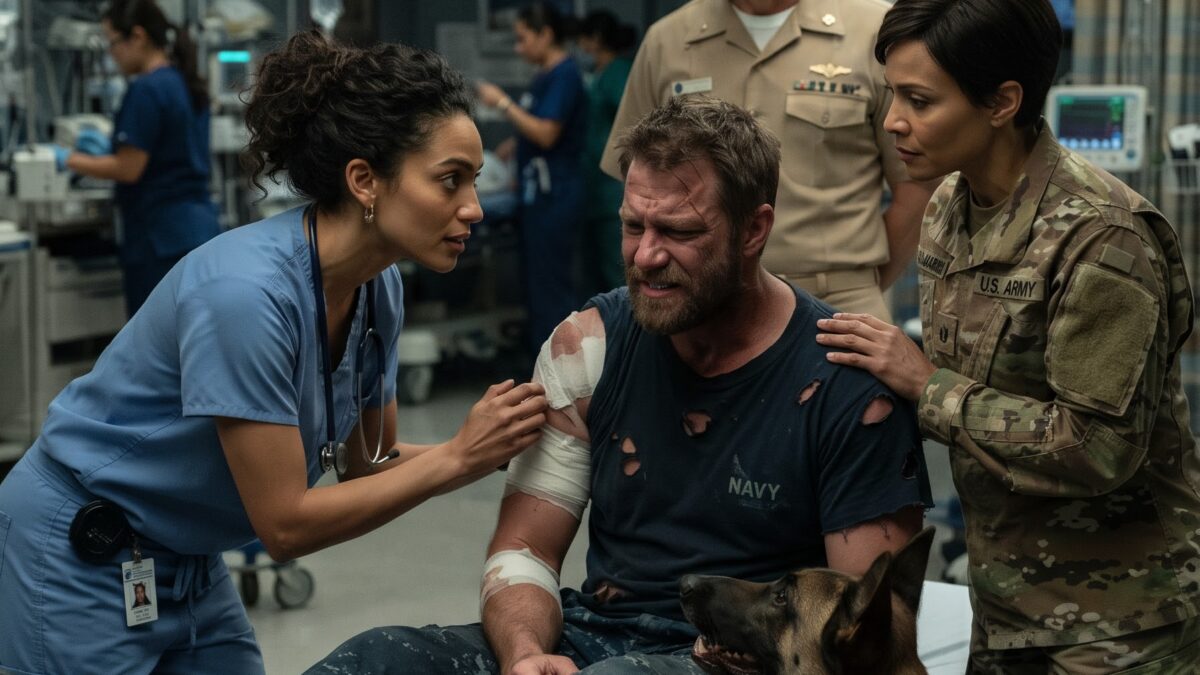
Now, Foresight said, you go see your patient. She went to the recovery unit. Vickers was in bed four, curtained off from the rest of the bay with a pulse ox on his finger and a nasal canula and two IVs running in his right arm.
He was awake, barely. the specific just surfacing from anesthesia kind of awake where the eyes are open but the processing is a few seconds behind. Cota was on the floor beside the bed, chin on pause, ears tracking every sound in the room.
When Emma came through the curtain, Cota’s head came up.
The dog’s tail moved once, twice, a slow, deliberate swing that was nothing like the anxious energy he’d shown in the trauma bay.
Recognition, not alert. She sat in the chair beside the bed.
Vicker’s eyes found her after a moment, gray, still slightly unfocused, but working on it.
“You’re the one,” he said.
His voice was rough from the intubation.
It wasn’t a question.
“I’m Emma Carter,” she said.
“I’m the ER nurse on shift when they brought you in.”
“Foright told me.”
He blinked slowly.
“Said you put the second tube in.”
“Yes.”
He looked at the ceiling. His chest rose and fell with the careful deliberateness of someone who has recently been reminded that breathing is a privilege.
“How bad?”
he asked.
“The lung is re-expanded.
You had a hemoththorax that the first tube didn’t fully reach.
VATS procedure cleared it. The shoulders a fractured clavicle and soft tissue damage.
They’ll probably pin it in a few weeks once you’re stronger.”
She kept her voice matter of fact. He was the kind of person who wanted information, not comfort dressed up as information.
Cota’s okay.
Cota’s been here the whole time.
He looked at the dog.
Something crossed his face that she didn’t try to interpret.
He kept going to you, Vickers said.
In the bay, Foresight’s guy told me.
He paused.
Cota doesn’t do that.
He’s well trained, she said.
Vickers looked at her sideways.
That’s not what I said.
She didn’t respond to that.
She checked his IV site, looked at the drip rate, checked the drainage output from the chest tube that was still in place and would stay in for at least another day. You were in, Vicker said. Not a question this time.
She looked at him. The way you move, he said.
The way you talked to me in the bay when I was in and out, that’s not nursing school.
I’m going to let you get some rest, she said.
Carter. She paused at the curtain.
Whatever they’re doing out there, he said with hail and the board and all of it, don’t let them make it small.
What you did last night wasn’t small.
She looked at him for a moment. Sleep, she said.
I’ll check on you in a few hours.
She went back to the floor. The day shift was fully underway now, which meant the ER had the particular controlled density of a weekday morning.
new patients arriving, overnight cases moving toward discharge or admission, the intersection of two staffing worlds with different tempos and different amounts of sleep. Emma moved through it in the strange dissociated way of someone who has been awake all night and is still technically working.
She saw a chest pain that turned out to be a panic attack in a 40-year-old accountant who’d been under deadline for 3 weeks.
She helped a dayshift nurse who was juggling four patients by taking the chart review on two of them.
She was doing ordinary things and the ordinary things felt slightly unreal the way they do when something large is happening in the background of your life and you’re trying to maintain the foreground.
At 10:15, Gretchen found her. The administrator on call was a short woman in her 50s with reading glasses pushed up on her head and the particular look of someone who had been on the phone for six consecutive hours and was not finished.
She appeared at Emma’s elbow outside bay 7 and said quietly, “The board wants to speak with you at 11:00 conference room B about the suspension about several things.”
She paused. Dr.Hail submitted his formal complaint at 0300 this morning.
The board received it. Another pause longer.
They also received a letter from Naval Special Operations Command at 08:30. Emma said nothing.
The letter was detailed. Gretchen said carefully.
Emma, I want you to know that I’m going to be in that room and I’m going to advocate for you.
What happened last night was she stopped herself. started again. Just come to the conference room at 11:00.
“Okay,” Emma said.
Gretchen left. Emma stood in the hallway outside bay 7 and looked at her own reflection in the small window of the bay door.
She looked tired. She looked exactly as tired as she was, which was more tired than she usually let herself look.
She thought about what Vickers had said, “Don’t let them make it small.”
At 10:45, she was washing her hands at the sink in the breakroom when Lily Huang came in. Lily stood in the doorway for a moment with her hands in her coat pockets.
And the look of someone who has rehearsed what they want to say and is no longer sure any of the rehearsal is right. I should have said something, Lily said when he told you to step back the first time.
I should have said something. Emma turned off the water and dried her hands.
You’re a resident 8 months out.
That’s not a reason.
That’s an excuse I’ve been telling myself.
Lily’s voice had something in it that sounded like it had been sitting on a pressure valve for several hours.
I saw what you saw on his chest and the trachea and the monitor. I knew. I just She stopped.
You followed the hierarchy, Emma said. Yes.
That’s what you’re trained to do.
It was wrong. Emma looked at her.
Lily was staring at the wall with the expression of someone who’d crossed a threshold in the night and was still in the room just past it, still getting her bearings.
“Write it up,” Emma said.
“Whatever you’re feeling right now, put it in the inquiry statement when they ask for yours.
Not as self- accusation, as an accurate account of what you observed and what you did and what you would do differently.”
She paused.
“That’s how it doesn’t happen again.”
Lily nodded. Her jaw was tight. and Lily.
Emma waited until the resident looked at her. You adjusted the needle angle.
A small silence. Yeah, Lily said that mattered. Lily left.
Emma stood in the breakroom for a moment and then went to find coffee that was good enough to be worth drinking. She made it to the board meeting at 10:58.
Conference room B was on the administrative floor. The kind of room that had been designed to convey institutional stability with a long table that probably costs more than Emma made in 2 months and framed documents on the wall that no one ever read.
Six people were seated when she arrived.
The board chair, a man named Philip Strand, who had the look of someone who’d built a career on being the calmst person in every room.
two other board members, Gretchen, Vivien Arllo, who was back with her notebook, and Foresight. She sat down. Strand clasped his hands on the table and looked at her with the specific expression of someone who is managing several competing institutional anxieties and is trying not to let any of them show on his face with full clarity.
Miss Carter, he said, thank you for being here.
I want to begin by saying that this board takes last night’s events extremely seriously.
She waited.
We have reviewed Dr.Hail’s complaint, the NCIS preliminary documentation, and the letter from Naval Special Operations Command.
He paused.
We have also reviewed 5 years of Dr.Hail’s staffing records, complaint files, and performance reviews, which the inquiry has requested as part of its broader examination.
That was new information. She kept her face neutral.
What we have found, Strand said carefully, is a pattern. He looked down at a document in front of him.
In the last 5 years, 14 nursing staff members filed internal complaints about Dr.Hail’s conduct.
11 of those complaints were dismissed without formal review. Three resulted in written warnings to the complainant rather than to Dr.Hail.
Emma sat with that for a moment. 14 people.
She had known she wasn’t the only one.
She hadn’t known the number was 14.
In addition, Strand continued, “We have identified three cases in the last 18 months where documentation suggests that Dr.Hail’s clinical decisions resulted in delayed treatment that led to adverse patient outcomes.
Two of those cases are already subject to ongoing liability review that was not brought to the full board’s attention in a timely manner.”
He said those last words with the careful flatness of someone whose lawyers had advised him on exactly how much to say. Miss Carter, he said, the suspension filed by Dr.Hail is rescended, effective as of this conversation.
Emma nodded, you will be paid for the hours you were removed from the floor, and this board is formally requesting that you remain available to assist with the NCIS inquiry as it continues.
I’ll cooperate fully, she said.
Strand looked at her for a moment.
He seemed like he wanted to say something that wasn’t in the document in front of him and was deciding whether this was the right room for it.
He decided it wasn’t.
Thank you, he said.
That’s all for now.
She stood to leave.
Miss Carter Foresight’s voice.
She turned.
He was looking at her with the same directness he’d used in the lobby at 4 in the morning.
There’s one more thing.
Vickers is asking for you. She went back to the recovery unit.
Vickers was more awake now. The anesthesia fog had thinned and he was sitting up slightly, not much.
The chest tube wouldn’t allow for more with his arms on the bed rails and the look of someone who had been lying flat long enough that even 5° of incline felt like a victory.
Cota was still on the floor, his ears moved when Emma came through the curtain.
His tail didn’t.
There was someone else in the room.
A woman standing near the window, late 40s, short gray hair, and civilian clothes that fit like they’d been chosen to not attract attention, but sat on her body with the posture of someone who’d worn a uniform for a long time.
She turned when Emma came in, and Emma looked at her and felt something she hadn’t felt in 4 years, the specific recognition of a face from a context that was supposed to be closed.
Major Denise Hartley. Formerly Major Denise Hartley, JSOC Medical Operations, 114th Element.
She had been Emma’s direct supervisor for the first 18 months.
“Hey, Carter,” she said.
Same voice, a little more gray than Emma remembered, but the same voice. Emma stopped moving. She looked at Vickers.
He watched them with the particular awareness of someone who understands that something is happening in the room that predates him.
You’re here because of gains, Emma said to Hartley.
Not a question.
I’m here because Dale called me at 0530 and told me what happened.
Hartley said she meant foresight.
And because I know you and I knew this was going to be the kind of morning where you handle everything correctly and don’t talk to anyone about how you’re actually doing.
Emma looked at her for a long moment.
I’m fine, she said.
Yeah. Hartley said.
I know what you look like when you’re fine.
This isn’t it.
Emma sat down in the chair beside Vicker’s bed, not because she was overwhelmed, because her body had been awake for 11 hours, and it seemed like a reasonable thing to do.
Cota put his head on her knee. She looked down at him. He looked up at her, those amber eyes, patient and direct, and not asking for anything except the fact of her presence.
She put her hand on his head.
He didn’t move.
He found you in the bay, Hartley said. Even in all that noise with all those people, he found you.
Dogs have good noses, Emma said.
He wasn’t smelling you, Vicker said.
His voice was rough but clear. He was reading you.
There’s a difference.
Emma didn’t answer.
She didn’t have a clean answer for that, so she let it sit.
The afternoon moved. She went back to the floor. She finished the tail end of her shift and then because there was no one to relieve her on two of her patients and because going home felt somehow less manageable than staying, she stayed for another 2 hours.
She saw a toddler with a forehead laceration whose mother was significantly more distressed than the toddler was.
She helped an elderly man who’d been waiting 4 hours understand that his paperwork had been misfiled.
And she went and found it and fixed it herself because the alternative was letting him wait another hour and that wasn’t happening.
She did the ordinary things. The ordinary things were the job.
At 15:40, she was in the hallway outside the nurse’s station when her phone buzzed.
She looked at it, expecting Denise or a shift reminder or something about the NCIS inquiry timeline.
It was a message from a number she didn’t have saved, but the area code was one she recognized.
Maryland, DC corridor. The message was four words.
Check your email tonight. She stood in the hallway with the phone in her hand and the fluorescent light overhead making everything slightly flat and overlarge the way hospitals look at 5:00 in the afternoon. She went to the breakroom and opened her email on her phone.
Most of it was routine shift updates, a union newsletter, a reminder about mandatory training due in April. But there was one email timestamped 1532. Send her listed as Navsuk HR correspondence.
Classified routing. Subject line blank.
She opened it. It was short, three sentences.
Records pertaining to your service with the 114th Joint Medical Support Element have been reviewed and partially declassified in connection with the current inquiry. A formal request has been submitted to restore your operational medical qualifications under the Naval Reserve Medical Auxiliary Program. Your response is requested by 800 Friday.
Emma read it twice. She set the phone on the table.
Outside the breakroom, she could hear the ordinary sounds of the hospital.
Monitors, footsteps, someone laughing at the nurse’s station, a PA announcement about a patient pickup, everything going on the way it always went on.
She picked up the phone and read the email a third time. They wanted her back.
not Harborview, the Navy, the reserve program, the part of the world she’d walked away from four years ago when the 114th was dissolved.
And she’d told herself, told herself clearly, deliberately without ambiguity, that she was finished with it.
She put the phone in her pocket and went back to the floor. She was three steps out of the breakroom when she heard it from down the hall, from the direction of the recovery unit.
a monitor alarm, not a routine alarm, the kind with a specific pattern she knew in the exact same way she knew the patterns of things she’d learned before this hospital, before this version of herself.
She was already moving before she knew she’d decided to.
She hit the double doors at a run, badge out, pushed through to the recovery corridor.
Bayour’s curtain was being pulled open by a recovery nurse who had the look of someone who’ just arrived at a situation that had changed in the 60 seconds since they’d last checked.
The monitor was showing a rhythm Emma recognized and the blood pressure was crashing and Vicker’s face had gone the gray color again, different from the earlier gray.
This one specific to vascular. What happened?
Emma said he was fine and then the recovery nurse gestured at the monitor. He sat up too fast.
the chest tube dislodged and his pressure just Cota was on his feet pressed against the far wall, tail low, watching vicers with locked focus. Emma looked at the chest tube. The dislodgement was partial.
The tube hadn’t come out, but the seal was compromised.
She could hear it, the wet sound of air tracking somewhere it shouldn’t be.
The plural space was repressurizing. He was retensioning. His whole face was tight with something that was trying not to be panic and not entirely succeeding.
Bickers, she said.
Her voice was the particular tone she’d learned for this specific situation.
Not loud, not sharp, just present, something to hold on to. Look at me. His eyes found hers.
I’ve got you, she said.
Stay still. Do not move your upper body. I need you to breathe shallow and slow.
Can you do that? He nodded small.
She was already reaching for the seal, already doing the assessment. She had maybe 2 minutes, possibly three if his military conditioning bought him the extra seconds before this became a situation with a different kind of outcome.
I need a thoricosttomy kit and I need it now, she said to the recovery nurse. 14 gauge and tell someone to get cardiothoracic on the phone, not page call.
The nurse was going. Cota made a sound from the wall. Low, not a bark.
a communication. Emma looked at Vickers and Vickers looked at her and the monitor screamed and somewhere behind her at the entrance to the recovery unit, she heard a voice she recognized.
Hail’s voice, loud and purposeful, saying, “I need access to that patient.
He is under my care, and I have the authority to Emma didn’t turn around.
She had 90 seconds.”
She had a patient whose chest was collapsing for the second time in 12 hours, a dog watching from the wall like a witness, and a man whose voice she would recognize anywhere trying to get through a door. She had the kit in her hand.
She had exactly what she needed, and she used it. The seal receded with a sound she felt more than heard, a small definitive click of pressure equalizing, and Emma held it in place with both hands while the monitor above her began its slow climb back toward readable numbers. 74 over 42 78 81.
She was aware of Hail’s voice still at the entrance to the recovery unit, louder now.
The words were getting cleaner as the alarm volume dropped and her own focus narrowed. He was saying something about patient authority and his position and the fact that no one had the right to supersede his clinical decisions on a patient under his care. And there was a particular pitch in it that she recognized not confidence.
The performance of confidence which was what confidence sounded like when it had stopped believing in itself.
She didn’t turn around.
Vickers, she said, “Pressure’s coming up.
The seal is holding.
Don’t move.”
He had his eyes on her.
They hadn’t left her face since she’d told him to find them.
He gave a small controlled nod. The nod of someone who has been trained to receive critical information under stress and respond to it without wasting motion. His color was coming back.
Still bad, but coming back. The recovery nurse reappeared at her elbow with the thorcosttomy kit, slightly out of breath.
Cardiothoracic is on the line.
Tell them I’ve receated the tube and the seal is holding.
Pressure is recovering.
Ask them if they want to move to a monitored surgical bed or if they’ll come down here.
The nurse went behind Emma. She heard the voice at the entrance shift register from loud to very quiet, which was its own kind of escalation.
And then she heard Foresight’s voice lower with the specific cadence of someone who is not raising their voice because they don’t need to.
She focused on the monitor. 86 over 57.
Vicker’s breathing was steadying.
The chest tube drainage was tracking again, appropriate color and rate. Cotto moved away from the wall.
He crossed to the bedside and put his head next to Vicker’s hand on the rail.
Vickers didn’t move his arm.
He just pressed his palm against the dog’s head.
a small deliberate contact and kept his eyes on Emma.
“You good?”
she asked him.
“Getting there,” he said.
His voice was rough, but even. The tube shifted when you sat up.
“It’s back in position.
You’re going to need to stay flat for the next 12 hours.
I don’t want you testing the seal again.”
“Uderstood.”
She straightened up and turned around. Hail was at the entrance to the recovery unit. He had his ID badge visible and his hands at his sides and the look of a man who had made a decision about how this was going to go and was still committed to it even though the room had not agreed.
For was beside him, not touching him, not blocking him physically, just standing in the space between hail and the interior of the unit with the quality of a weight that didn’t need to announce itself.
Two of Foresight’s people were behind him.
Not agents, the commander staff, the ones who’d been moving through the hospital since 0200 with the quiet purposefulness of people who were building a record.
Hail looked at Emma across the length of the recovery unit. She looked back.
She was holding a thoricosttomy seal in one hand. She had a patient behind her whose pressure was now 90 over 60 and climbing.
She was wearing the same scrub she’d put on 16 hours ago and her hair was escaping whatever she’d done with it at the start of the shift and she was aware of all of this and it didn’t seem particularly relevant.
“You need to leave this unit,” she said to Hail.
“This patient is he’s not your patient anymore.”
She kept her voice flat. Not hard, just factual. The board meeting was at 11:00.
Check your phone.
Something moved across Hail’s face.
It was brief, a kind of recalibration, the way a machine sounds when it’s trying to run a program on a system that’s no longer configured for it.
Then it was gone. And what replaced it was something more rigid, more deliberate.
Whatever the board decided this morning, he said, doesn’t change the fact that you performed an unauthorized procedure on a patient in my unit.
Commander Foresight authorized her assistance, said one of the staff behind Foresight. the same man who had said it in trauma 1 9 hours earlier. Still the same flat delivery, still the same absence of inflection that was itself a form of emphasis.
Naval authority does not supersede hospital clinical governance. Hail said when the patient is federal, foresight said quietly.
It does. The silence after that was the kind that has weight.
Hail’s jaw moved.
He was doing something with his expression that was meant to be composure, but was arriving as its nearest functional neighbor, which was endurance.
“This isn’t over,” he said to Emma.
She looked at him for a moment.
He seemed standing there like someone who had spent a long time being the largest thing in whatever room he was in, and was only now encountering the possibility that this was a contingent property of the rooms he’d been allowed into, rather than a fixed property of himself.
“I think it is,” she said.
and turned back to her patient. She stayed with Vickers until cardiothoracic came down at 1620. The surgeon was a compact Korean-American woman named Dr.Park, who reviewed the tube position on portable imaging, confirmed the seal, and told Vickers in the direct slightly impatient way of someone who has no interest in softening clinical reality that he had been remarkably close to needing to go back to the O and that he should consider lying still a reasonable life goal for the next 24 hours.
Vicker said, “Yes,
ma’am.”
with the specific tone of a man who has been given orders by competent people for most of his adult life and knows how to recognize one. Dr.Park looked at Emma on her way out.
“Good call on the seal,” she said.
“Fast,” she paused.
“Who are you exactly?”
“ER, nurse,” Emma said.
Park looked at her for a moment with the expression of a person deciding whether to press further. She decided not to.
Good, she said, and left. Hartley appeared at the curtain at 16:45.
She’d been somewhere in the building for most of the day.
Emma had seen her twice in the corridor, once on the phone, once in conversation with Arlo.
And now she had the look of someone who had finished a round of things and was checking on the one item that wasn’t on the list.
You should go home, Hartley said. I know.
I mean, tonight, not in an hour. Emma looked at Vickers.
He was asleep. Real sleep.
Not the earlier fog of anesthesia, but the deep flat sleep of someone whose body has been through significant physiological stress and has simply turned itself off. Cota was on the floor with his nose on his paws and one eye cracked open.
“I’ll go,” Emma said.
She went. She drove home through the early dark of a March evening in Denver, the Rockies invisible in the cloud cover, the highway loud with commuter traffic.
She stopped at a light on Kfax and sat there while the signal counted down and found herself thinking about nothing specific.
Not hail, not the email from Navsock, not the inquiry, not the sound of Vicker’s monitor, just the light and the traffic and the cold coming in at the edge of the car window.
She’d cracked 2 in because the air in the car felt too closed.
She got home. She made food she barely tasted.
She showered and sat on her couch and was asleep before she’d made any conscious decision about it.
She slept for 9 hours, dreamless, the particular deep nothing of complete exhaustion. She woke at 0630 to four missed calls.
Two from Denise, one from an NCIS number, one from Hartley, and a text from Gretchen that said, “Board called an emergency session, 9:00 a.m., please be here.”
She was there at 08:45. The conference room was more crowded this time, the full board. Seven members instead of the three from the previous meeting, Arlo and her partner Foresight Gains, who had apparently returned to Denver sometime overnight.
partly a man Emma didn’t recognize who turned out to be the hospital’s liability council and a woman from the state medical board’s oversight office there in an official monitoring capacity which meant that what was about to happen was going to be a matter of public record was there too he was seated at the far end of the table with his own council beside him a man in an expensive suit who had the look of someone paid to make bad facts look like complicated facts himself looked like he’d slept which was more than Emma had done before she’d
gone home.
His expression was the kind of blank that people construct carefully when they know they’re being watched.








