Single Dad Saved CEO Trapped Under a Car — Then He Disappeared Without a Trace. (part 2)
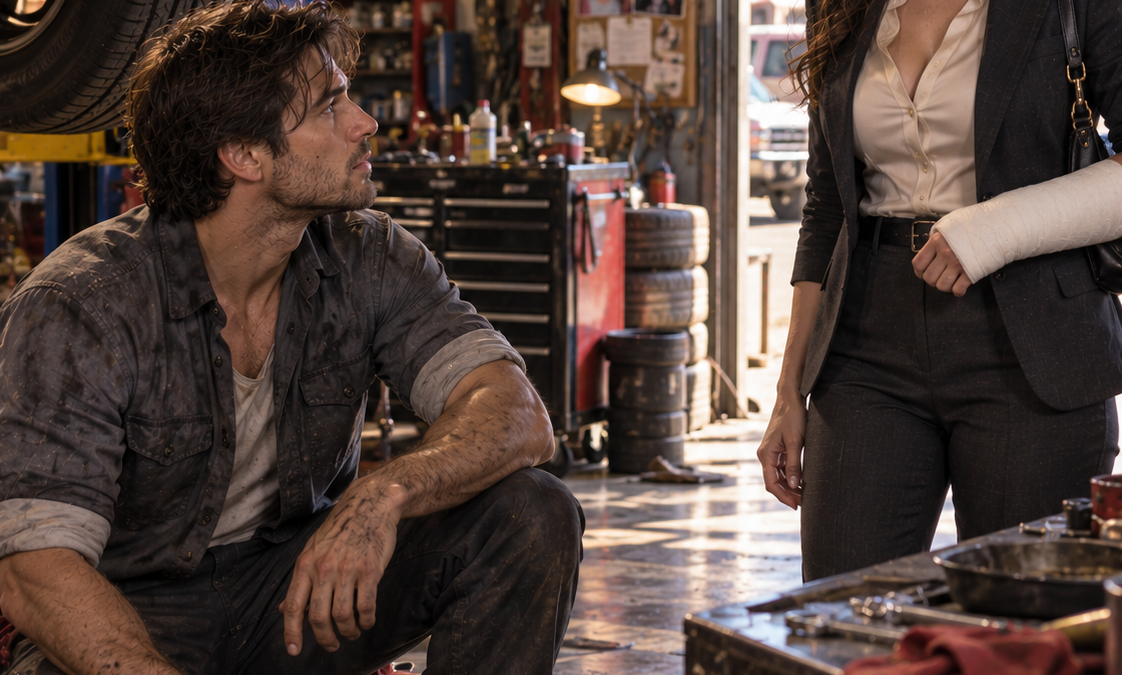
Part 2
Jordan was exceptional at finding things. He had once located a vendor who had gone entirely off the grid during a contract dispute by cross-referencing shipping manifests with utility records, a process that had taken him 4 hours, and that Emma still considered one of the most impressive things she had ever seen a person do with a laptop. He found nothing on Daniel Carter because Daniel Carter had apparently left no trace on the surface of that highway worth finding.
The highway patrol report listed him as unknown good Samaritan. Male approximately mid-30s.
Work clothing. Drove a late model pickup truck. Make and model unclear.
Direction of travel unknown after the scene. No license plate.
The patrol officer who had written the report had not gotten a plate because the truck had already moved when he arrived. The witness photos, which Jordan had tracked down through a combination of social media searching and direct outre out outreach to people whose plates had been captured by the highway patrols traffic camera, showed Daniel from various angles and distances, none of them close enough to be useful for identification.
A white man in a gray work shirt, dark hair, built like someone who used his body for actual labor rather than recreation. In every photo, he was in motion, moving toward the car.
In none of them was his face visible at the angle needed.
“There’s one partial,” Jordan said on the sixth day, spreading his findings across Emma’s desk in the Scottsdale office.
She was in a soft cast on her left arm and had overruled her doctor’s recommendation to take 2 weeks off by taking 4 days instead.
Highway Patrol dash cam. You can see him at the shoulder, but the resolution at that distance is about 8 pixels wide. Emma looked at the image, a figure, motion blurred, walking away from the scene toward a truck.
That was all. The floor jack, she said. You said the fire crew mentioned a floor jack.
Heavyduty hydraulic, the kind used for commercial vehicles, not something a civilian usually carries. Jordan paused.
Which means he either works in automotive or he’s someone who works on his own equipment.
He told me he was a mechanic, Emma said. Jordan looked up. He told you while we were under the car.
He said he’d been working on cars since he was three.
His uncle had a shop. She paused. He said his name was Daniel Carter.
He said he lived in Mesa. Jordan stared at her.
Emma, he said slowly. You have his name.
I have a name he gave me, she said. which may or may not be his full name and which I could not verify in the state I was in at the time. Jordan was already typing Daniel Carter Mesa, Arizona Automotive.
The search took 11 minutes and produced 47 results which Jordan systematically narrowed over the next 2 hours. Most of them fell away quickly.
Wrong age, wrong feel, business owner. The seventh result that remained after the first cut was a Facebook profile with minimal activity.
Last updated 14 months ago, profile photo showing a man with two children at what appeared to be a baseball game. The man in the photo was dark-haired, mid30s, wearing a gray work shirt. Emma looked at the photo for a long time.
That could be him.
She said the profile lists employment as Carter’s Auto Repair.
Mesa, Arizona.
Jordan said there’s no website for the business.
There’s a listing in the local directory with an address on East Maine and a phone number.
Emma looked at the address. Then she looked at the photo again at the man in the gray work shirt who had his arm around a small girl and was looking at something off camera with an expression of pure uncomplicated happiness.
Don’t call the number, she said.
Jordan pulled his hand back from his keyboard. Okay.
And don’t send anyone.
She kept looking at the photo.
I’ll go myself.
Jordan paused for only a second.
“When, when I know what I want to say,” Emma said.
That took longer than she expected. She went back to work.
The company didn’t slow down because its CEO had been in a car accident, which was simultaneously a source of professional pride and a fact that sometimes, in the quiet of her office at 7:00 in the evening, made her feel something she didn’t examine too closely.
There were contracts to review and a board call on Thursday and a personnel situation in the Denver ro office that required more of her attention than it should have and a hundred other things that were urgent in the particular way. That things in growing companies are always urgent, which is to say constantly and regardless of what else is happening. She worked.
She healed. She thought about Daniel Carter. She thought about him in the spaces between things.
In the 30 seconds while the coffee brewed and the 2 minutes while the elevator rose to the seventh floor and the 4 minutes she gave herself in her car before going into the building each morning. A habit she had developed years ago as a way of transitioning between the self who drove to work and the self who ran a company. She thought about what he had said about his son, about telling Marcus that the world runs on people who move when everyone else is standing still.
She thought about a father who held himself accountable to a 9-year-old’s understanding of what was right.
She thought about how rare that was, not the sentiment, which plenty of people expressed, the actual physical consequential living of it.
The rubber means it’s road, the version that looks like dropping to the asphalt on a dark highway.
She also began quietly, without directing Jordan to do it, to look into what a mechanic in Mesa actually made, what the cost of living was in that part of the valley, what it looked like to raise two children on one income without any of the cushions she had spent 5 years building for herself. What she
found made her sit very still at her desk for a long time.
The average automotive mechanic in Mesa, Arizona, made between 18 and $22 an hour.
A double shift, 11 hours, which was what Daniel had said he’d worked before the accident, would gross between $2 and $240 before taxes.
A babysitter at $12 an hour for an evening plus overtime would run between $70 and $90 of that. Rent for a house in Mesa with a yard, the kind of house where two kids could be kids.
was averaging around 1,800 a month in the current market. And that was before food, utilities, car maintenance, school expenses, field trip fees, baseball cleat. Emma sat with those numbers.
She had grown up solidly middle class, not wealthy, but comfortable in a household with two incomes and the particular texture of a life where things that were needed were generally obtainable. She had built her wealth herself, which gave her a specific kind of relationship with money. She knew what it felt like to not have enough, but she had escaped that feeling at 26, and had not returned to it.
Daniel Carter had not escaped it. Daniel Carter was living inside it every day and working two jobs, sometimes three, to keep it from getting worse. And he had still stopped on a Tuesday night and crawled under a car for a stranger and then had gone home to do the ATM math.
2 weeks after the accident, Emma was in a meeting with her CFO about Q4 projections when her phone buzzed with a notification from a news alert she had set up in the first days after the accident and then forgotten about. She glanced at it. The alert was for the search terms she had entered.
Good Samaritan Phoenix car accident highway. She picked up the phone.
The article was from the Arizona Republic. A small piece in the metro section.
The kind of story that got four column inches and a stock photo. It was about the rise of bystander effect in highway accidents. Using her accident as a reference point, the crash on the highway outside Phoenix, where a lone mechanic had intervened while others watched.
The reporter had gotten the story from the fire crew’s public log.
The article quoted the shift commander and the shift commander, when asked about the unidentified man, had said something that Emma read three times.
The shift commander had said, “Whoever he was, he brought his own equipment.
He had a floor jack under that frame before we got there. In 20 years, I have never seen a civilian do that.
He knew exactly what he was doing and he did it and then he left. I think about it sometimes. I wonder what kind of man does that.
Emma set the phone down. She looked out the window of her office at the Scottsdale skyline. I wonder what kind of man does that.
She knew the answer to that question. She had been 6 in from that kind of man in the worst 15 minutes of her life.
She had heard him talk about his kids and his babysitter and his yellow living room walls and the ATM on Chandler Boulevard. She had heard him explain in the most matter-of-fact possible voice that the world depended on enough people being willing to move.
She thought about what the shift commander had said, 20 years, and she had never seen a civilian do that. And Emma thought about the fact that a man with that quality of competence and that quality a character was running a small repair shop in Mesa, working three jobs, doing the ATM math on Tuesday night, and that nobody knew his name. Nobody except Emma.
She picked the phone back up. She called Jordan.
“I’m ready,” she said when he answered.
“Ready for what?”
Jordan said.
“To go find him,” she said.
“Clear my Thursday afternoon.”
Jordan was quiet for exactly 1 second. Emma, are you sure this is a good idea? You go to his shop.
No warning, no introduction.
You’re a CEO and he’s he’s the man who braced a car frame to keep it from crushing me and didn’t mention it.
Emma said he left before I could thank him. The least I can do is find him in person.
Another pause.
and if he doesn’t want to be found.
Emma thought about a man who had moved when everyone else stood still, who had been asked why and had answered simply because someone had to.
Then I’ll respect that, she said.
But I’m not going to let someone like him think nobody noticed.
Thursday afternoon at 2:00 in the afternoon, Emma Caldwell parked her car outside a small repair shop on East Maine in Mesa and sat in the car for 60 seconds, doing the thing she always did before a meeting that mattered. She thought about what she wanted to say.
She still didn’t fully know.
She got out of the car anyway. The bay doors were open.
She could hear metal on metal, the percussive clatter of work. There was a truck up on a lift in the first bay, a large commercial vehicle, and underneath it, visible only from the boots up, was a man on a creeper.
“Ema walked to the edge of the bay.”
“Daniel Carter,” she said.
The work sound stopped. The creeper rolled out from under the truck, and Daniel Carter looked up at her from the floor of his shop, wrench in hand, and for a long moment, neither of them said anything at all.
He was exactly as she had not quite been able to picture him in the dark under the car. She had assembled him from fragments, voice, hands, the particular quality of his calm. Seeing him in full daylight in his own space was like getting the key that made the fragments resolve.
He looked at her. Then he looked at the soft cast on her left arm.
“Emma Caldwell,” he said.
“You remembered my name,” she said.
“I remember most things,” he said.
He sat up on the creeper and set the wrench down.
And he looked at her with an expression she couldn’t immediately classify.
Not unwelcoming. Not entirely comfortable either. Something in between.
How’d you find me?
You told me your name, she said. And that you lived in Mesa.
He nodded slowly. I did. And my assistant is very good at his job.
Something moved at the corner of his mouth. Not quite a smile.
Close. Are you okay?
He said, and the way he asked it was direct and genuine, not polite, not performative. He actually wanted to know. Fractured radius, she said.
Six stitches, moderate concussion. I went back to work after 4 days.
He looked at her steadily. Your doctor probably said 2 weeks.
My doctor said 2 weeks. She confirmed. I compromised.
He studied her for a moment.
You shouldn’t be driving with that cast.
It’s my left arm.
I drive with my right Emma. I know, she said.
I know. She stopped.
She had prepared in the most general sense what she wanted to say. She had thought about it for 2 weeks.
And standing here in his shop with motor oil on the floor and the clutter of a working life around her and Daniel Carter looking at her from a mechanic’s creeper, she realized that none of the prepared versions were right.
So, she said the true thing instead.
I didn’t come here to offer you money, she said.
I want to say that first because I know how this looks.
CEO shows up at the mechanic’s shop.
I know what the obvious interpretation is. Daniel waited.
I came because the shift commander told a reporter that in 20 years she had never seen a civilian brace a car frame, Emma said.
And I didn’t know you’d done that.
You didn’t tell me.
Something in his expression shifted very slightly.
You didn’t need to know.
He said you needed to stay calm.
You addressed a structural problem and managed my psychological state simultaneously and you didn’t mention the structural problem.
The structural problem was handled, he said. No reason to discuss it.
Emma looked at him. What kind of person does that? She said.
He looked back at her. A person who fixes things, Daniel. Emma, she exhaled.
I came because someone like you shouldn’t be invisible, she said.
That’s the whole of it.
I came because I wanted you to know that I know what you did. The full thing, not just the part I was aware of while it was happening.
Daniel Carter was quiet for a moment. He looked down at the wrench in his hands, then back up at her.
I appreciate that, he said. And he meant it.
She could tell, but she could also tell it wasn’t the thing that mattered most to him.
What mattered most to him, she was beginning to understand, was never going to be whether someone else knew.
I also came, Emma said, because I want to understand something and I think you’re the only person who can explain it to me.
He raised an eyebrow slightly. What?
I’ve been running a company for 5 years.
She said, I have built something from nothing.
I have made a thousand decisions about people, about who they are and what they’re worth and what they’re capable of.
And I thought I was good at reading people. Daniel waited. And then I met you, Emma said.
In the worst 15 minutes of my life, and I realized I had been reading for the wrong things my whole career, the shop was quiet around them. Daniel Carter looked at her for a long moment.
Then he set the wrench down on the creeper beside him and stood up slowly, the way men who spend their days on their knees and their backs stand up like it costs something.
“You want some coffee?”
he said.
“I’ve got a machine in the back.
It’s not good coffee.”
Emma looked at him.
“Yes,” she said.
I would. And that was the beginning of a different kind of conversation.
The kind that neither of them had planned. In the back of a repair shop in Mesa on a Thursday afternoon, the woman he was protecting that would change the direction of both their lives in ways that neither of them could have mapped from where they were standing. But first, bad coffee.
Because some things start simply. The coffee was bad.
Emma did not say this.
She held the mug with her right hand and drank it and did not make a face, which was its own kind of effort because Daniel Carter’s coffee tasted like it had been brewed sometime the previous week and reheated several times since with complete indifference to what that process does to coffee.
Daniel watched her drink it. I told you he said you did.
She said it’s fine.
It’s terrible.
He said, I know it’s terrible.
I’ve been meaning to replace the machine for 8 months.
There’s always something else.
There’s always something else.
Emma filed that sentence away without appearing to.
It was the kind of sentence that told you everything about a person’s life if you knew how to hear it.
They were sitting in the small back office of the shop, which was less an office and more a room where paperwork went to be ignored. A desk with a computer that was at least 6 years old.
A filing cabinet with a drawer that didn’t close all the way.
A corkboard with invoices pinned to it. and a photograph of Marcus and Lily that had been printed on regular paper and tacked up at eye level, slightly crooked, the most important thing in the room.
Daniel had washed his hands, but there was still grease in the creases of his knuckles, the deep set kind that doesn’t come out with one wash.
Emma noticed because she noticed everything and because she had spent two weeks building a being a picture of this man out and now she was finally the frame and the details were landing differently than she had expected. He was not what she would have hired. That thought arrived in her head and she examined it honestly.
The way she had learned to examine uncomfortable thoughts directly and without flinching. If Daniel Carter had sent a resume to her company, she would never have seen it. It would have been filtered out at the first pass.
Wrong background, wrong education, wrong industry. She had systems for finding talent, sophisticated systems, and every one of them would have missed him completely. That fact sat in her chest like a stone.
Can I ask you something? She said.
You’re going to anyway, Daniel said.
Not rude, just accurate. How long have you had the shop?
6 years.
He said, “I took it over from my uncle when he retired.
He’d built it for 30 years.
Good reputation, solid client base. I thought I was inheriting something solid, but he wrapped both hands around his own mug.
But a reputation takes 30 years to build and about 18 months to lose when the economy shifts and three new chain shops open within 2 mi and start doing oil changes for $9.
98.”
He paused. I kept the quality.
I couldn’t keep the price, so I kept the clients who cared about quality and lost the volume.
And then I figured out that quality without volume is a very slow way to stay in business. Emma looked at him.
How slow?
Daniel met her eyes slow enough that I’ve been 6 weeks from closing for about 3 years.
The room was very quiet for a moment. 6 weeks, Emma said.
Sometimes eight, Daniel said.
Once it was 12 and I thought I’d turned a corner.
Then the compressor blew and the repair cost me the 12 weeks. Emma set down the bad coffee.
Daniel, don’t.
He said not hard. Not defensive, just clear.
I know what you’re thinking and I appreciate it, but that’s not why I told you.
I told you because you asked how the shop was doing, and I’m not going to lie to you about it.
That’s just where it is.
I’m not going to write you a check, Emma said.
That’s not what I came here to do.
He looked at her steadily. Then what did you come here to do? I came to understand, she said.
And I’m starting to.
Outside the office, the shop sounds had resumed. There was another mechanic working, a young guy named Teao, who Emma had seen briefly when she walked in, maybe 22, moving with the particular energy of someone who is still learning what his hands can do.
She could hear the impact wrench running in short bursts. You have one employee, Emma said.
Most of the time, Daniel said.
Tio’s been with me 2 years.
He’s good.
He’s going to be very good in about three more years if I can keep the lights on long enough to finish teaching him.
What happens to him if you close? Daniel looked at the photograph on the corkboard. Marcus and Lily baseball game.
The man with his arm around his daughter and his eyes somewhere off camera lit up about something he was seeing. He finds somewhere else.
