The Bleeding Boy Defended Biker’s Daughter — 200 Hells Angels Showed Up at Dawn (part 3)
Part 3
Silus’s eyebrows rose.
You have been busy. I have been motivated. Silas almost smiled.
Almost, but not quite. All right, let us talk to Decker. They brought Decker to the conference room at 10:00.
He had been in the hospital basement for most of the day, watched over by two of Silus’s most trusted men.
His face was bruised from the fight at the diner. His wrists were zip tied behind his back. But his dead eyes were still dead, still empty, still measuring everyone in the room like a predator, calculating the odds.
Marin sat across from him. She laid out his options with the cold precision of a lawyer presenting evidence. Option one, Decker refused to cooperate.
In that case, he would be handed over to the FBI along with the flash drive and the video of the cleaners. He would be charged as a co-conspirator in attempted murder, conspiracy racketeering, and a dozen other federal crimes.
25 to life minimum. Option two, Decker cooperated. He called Blackwell.
He told him that he had the girl in the flash drive, that the situation was under control, that Blackwell needed to come to the sawmill at midnight to collect his property in person. In exchange for his cooperation, Marin would recommend leniency to the FBI, a reduced sentence, protective custody, a chance at something resembling a life. Decker listened.
His dead eyes did not change, but something flickered behind them. Fear maybe, or calculation. the gears of survival turning.
“Why should I trust you?”
Decker asked. His voice was flat, oily.
“Even now, it made Marin’s skin crawl.”
“You should not,” Maron said.
“But you should trust the math.
If you do not cooperate, you go to prison for the rest of your life.
If you do cooperate, you might get out in 10 years, maybe less.”
Decker was silent. The seconds ticked by. Then he laughed.
The same cold, dry sound she remembered from the diner. All right, princess. You win.
Give me a phone. Marin slid a burner phone across the table. Decker made the call.
It took less than 3 minutes to convince Blackwell that the situation was under control. The girl was contained. The flash drive was secure.
All Blackwell had to do was come to the sawmill at midnight and collect his property. Blackwell agreed.
Marin ended the recording she had been making of the call. More evidence, more documentation. Another nail in the coffin.
Decker smiled at her with his dead eyes. You are good at this, he said. Too good for a little princess playing gangster.
Marin stood up from the table. I am not playing. She walked out of the room without looking back.
At 11:00, the convoy left the hospital. 20 motorcycles running dark, their engines muffled as much as possible. They took the back roads avoiding Route 9, avoiding anywhere they might be spotted by Whitford or his deputies.
Marin rode in a van with Colton Hendrickx. She had insisted on being there. Silas had argued she had won.
This was her operation. She was going to see it through.
The old Pinewood sawmill sat on a high bluff overlooking the Dashuites River fork, a skeletal ruin of rusted corrugated metal and rotting timber that had been surrendering to the Oregon elements for two decades. The main warehouse was a vast cathedral-like space. Two stories of open floor beneath a lattice of steel catwalks and overhead beams.
The roof was half gone, stripped away by winter storms letting in the sky and the rain. Marin arrived at 9:40, hours early. She walked through the abandoned building with a flashlight mapping the space in her mind.
Catwalks, machinery positions, blind spots, choke points. She identified positions for six high-intensity construction lamps, each capable of throwing 14,000 lumens.
She calculated sight lines. She marked positions for the nomads with their beanag loaded shotguns.
Colt watched her work with something approaching awe. Where did you learn this? He asked.
Marin did not look up from the map she was sketching on a piece of scrap paper. I have been watching my whole life. I just never had a reason to use it before.
By 11:30, the trap was set. The nomads were in position hidden behind machinery and in the shadows of the catwalks. The flood lights were rigged in the rafters, wired to a single switch that Marin would hold from her position 30 ft above the floor.
Each man carried a shotgun loaded with beanag rounds. Each man also carried a sidearm with hollow points in case the world stopped listening to good intentions. Silas took his position at 11:50.
He stood alone in the center of the warehouse, a solitary figure in the vast dark space lit by a single work lamp that cast his shadow across the debris like a sund dial marking the final hours. Decker sat tied to a chair behind him, gagged and bruised. A prop in the final act, Marin climbed to the catwalk.
The metal rungs were slick with rain and rust. She crouched behind the railing, the flood light switch in her left hand, her phone in her right.
She looked down at her father standing alone in the dark. If this went wrong, he would be first in the crossfire. The fear was there, cold and real and pressing against her chest.
She pushed it down, locked it away. There would be time for fear later. Right now, there was only the plan.
Colt’s voice crackled in her earpiece.
Two SUVs approaching. Black Cadillac Escalades, armored, military grade.
Marin’s stomach dropped.
She had planned for four men, maybe five, not armored vehicles and professional soldiers. Hold positions, she whispered into her radio.
Nobody moves until I say. The Escalades rolled into the loading bay like herses, dark and deliberate. They stopped 20 yards from where Silas stood.
Six men stepped out. Not street criminals, not thugs like Decker and his crew. These were private military contractors.
They moved with fluid lethal economy, checking corners, scanning darkness, suppressed carbines at the low ready, night vision goggles at top their heads. Professionals, the kind of men who had done this a 100 times before. Then Desmond Blackwell stepped out.
He was a disappointing figure. Small, slight, wearing a charcoal wool overcoat that probably cost more than Lenor Ren made in 6 months. thin hands, wire rimmed glasses, the fidious manner of a man who viewed the world as a series of transactions.
He held a black umbrella over his head, fussy, and precise, even in a ruin.
“You are not Decker,” Blackwell said.
His voice was bored, annoyed, like he had been called away from something important to deal with a minor inconvenience.
“Decker is indisposed,” Silus rumbled.
“I am the father,” Blackwell sighed.
He checked his cuticles. The biker. I was hoping to avoid all this.
It is so theatrical. He gestured to his men with a lazy wave. The casual, dismissive gesture of a man ordering a drink at a restaurant.
Kill him. Find the girl.
Find the drive. Burn the building.
I have a flight to catch. Six rifles rose.
Six red laser sights converged on Silus’s chest.
Marin’s hand tightened on the switch.
Now, she said, she threw the switch. The warehouse exploded with light.
84,000 lumens erupted from the rafters like the wrath of God. The warehouse transformed in an instant from darkness to blinding white.
Six construction lamps, each capable of illuminating a football field, poured concentrated light directly downward onto the killing floor where Desmond Blackwell and his mercenaries stood. The effect was immediate and devastating. The mercenaries had adjusted their eyes to near total darkness.
They had been operating on instinct and training their pupils dilated, their night vision goggles, ready to deploy at the first sign of trouble. The wall of light that hit them was physically painful. Two stumbled backward, hands flying to their faces.
One dropped to a knee, his carbine swinging wildly. Another ripped off his night vision goggles, which had caught the reflected glare and turned into instruments of additional disorientation. Marin watched from the catwalk, her hands still on the switch, her heart hammering against her ribs.
The plan was working for exactly 3 seconds. The plan was working perfectly. Then the mercenaries adapted.
These were not street criminals. These were not thugs who had learned to fight in bar brawls and back alleys. These were combat veterans men who had served in war zones where adaptation meant survival and hesitation meant death.
Their training kicked in through the shock, overriding pain and confusion with muscle memory and discipline. Two of them dropped behind the armored escalades and began returning fire. Controlled aimed bursts.
The suppressed carbines made a sound like angry whispers, sharp cracks that echoed through the vast space and sent sparks flying from the steel machinery. The nomads moved from their positions, emerging from behind rusted equipment and shadowed corners. Hrix came around a massive band saw housing his shotgun up and fired two bean bag rounds at the nearest mercenary.
The rounds caught the man square in the chest and he went down hard, gasping. The wind knocked out of him, but the mercenaries were spreading out, finding cover, turning the ambush into a firefight.
A burst of suppressed fire stitched across the catwalk railing 10 ft from where Marin crouched. She threw herself flat, pressing her body against the wet metal, grading her phone, skittering across the catwalk and disappearing through a gap in the railing.
Below her, chaos unfolded. Briggs, the former Marine Corps sniper, was advancing along the east wall when a round caught him in the thigh. She heard the cry of pain saw him go down.
Saw him drag himself behind a steel column with blood soaking through his jeans. His jaw was clenched, his hands pressing against the wound, but he was still moving, still fighting.
Silas charged a mercenary who had come around the escalade.
240 lbs of fury propelled by a lifetime of violence and a father’s rage.
He lowered his shoulder and hit the man like a freight train, slamming him into the armored vehicle hard enough to dent the reinforced panel, but the mercenary fired as he was being hit.
A round tore through Silas’s leather cut and carved a furrow across his left shoulder.
Blood sprayed in a dark ark. Silas roared not in pain but in anger. He grabbed the stunned mercenary by the tactical vest and hurled him into the concrete floor with bone cracking force.
Marin watched her father fighting bleeding and felt the plan slipping away from her. This was not supposed to happen. The lights were supposed to blind them long enough for the nomads to move in and end it quickly.
Beanag rounds, zip ties, no casualties. But Briggs was bleeding.
Silas was bleeding. And two mercenaries had found cover behind a concrete pillar near the loading bay, laying down disciplined fire that had Colt and two other nomads pinned behind a rusted bandsaw housing. The situation was stuck.
A stalemate in a fight that needed to end fast. Marin looked around desperately. The catwalk gave her a view of the entire warehouse floor, but it also made her a target.
If one of the mercenaries looked up, if they realized she was the one controlling the lights, she would be dead in the seconds. Then she saw it.
The two mercenaries behind the concrete pillar were directly below her position on the catwalk. They were focused on the nomads in front of them, trading fire, keeping their attention on the threats they could see. They did not know she was above them.
Marin crawled along the wet metal grading, moving slowly, silently, keeping her body low. The catwalk grown softly under her weight, but the sound was lost in the chaos of the firefight below. She reached the nearest flood light.
The housing was hot, radiating heat through the metal casing. She grabbed it with both hands, ignoring the burn and twisted. The beam swung across the warehouse wall and hit the two mercenaries full in the face from their unprotected flank.
They flinched. One raised his arm to shield his eyes. A half second opening.
Colt came around the pillar like a landslide, closlining the first mercenary with a forearm that dropped him instantly.
Hendrickx was right behind, swinging his baton against the second man’s weapon arm, then his knee, then the side of his helmet.
The mercenary crumpled. Silence descended on the warehouse. The fight was over.
Less than 90 seconds from start to finish, but it had felt like an hour. Marin scrambled down the catwalk ladder, her hands slick with sweat and rust.
She hit the warehouse floor at a run, her boots splashing through puddles of rainwater that had leaked through the ruined roof. Briggs, she said into her radio. Status through and through.
Colt’s voice came back steady despite the chaos.
Miss the artery. He is going to make it, but he needs a hospital.
Now get him out. Take the van.
Go. Two nomads were already lifting Briggs between them, carrying him toward the loading bay.
He was conscious, his jaw clenched against the pain. One hand raised in a fist as he passed the other men. A salute, still fighting, the nomads returned the gesture as Briggs disappeared into the darkness outside.
Marin watched him go and felt the weight of command settle into her bones. She had ordered men into a fight. One of them was bleeding because of her plan.
That weight would never fully lift. She would carry it for the rest of her life, but she did not have time to dwell on it.
Not yet. She turned to find her father.
Silas was standing over Desmond Blackwell, who had not run, had not fought, had simply stood beside his Escalade in paralyzed disbelief as his entire security team was dismantled around him. His expensive overcoat was spattered with rain and concrete dust. His wire rim glasses were crooked on his face.
His umbrella lay forgotten in a puddle. He looked like a man whose world had been rearranged without his permission.
Silas grabbed him by the collar of his overcoat and lifted him off his feet. Blackwell tried to speak. His voice came out as a squeak.
“You cannot do this.
I have immunity. I have files.
I know people.”
“Shut up,” Silas said.
Not loudly, just final. He dragged Blackwell across the warehouse floor through the loading bay doors out into the rain.
Marin followed. The night air was cold and wet and smelled of pine and rotting wood.
The rain had not stopped. It streamed down in silver sheets, catching the glow of the work lights inside the warehouse and turning the world into a study in gray and shadow. Silas dragged Blackwell to the edge of the bluff.
The Dash’s river fork churned 80 ft below, swollen by days of rain.
The water was dark and fast and merciless. The sound of it rose up through the darkness, a constant churning roar that seemed to come from everywhere at once.
The drop was sheer. Rocks jutted from the cliff face at irregular intervals. Anyone who went over would hit them on the way down, and if they survived the fall, the current would finish the job.
Silas pushed Blackwell to the very edge. The smaller man stumbled, his expensive shoes slipping on the wet grass.
He caught himself at the last moment, his arms windmilling, and looked down at the black water below.
“Please,” Blackwell said.
The word came out thin and high, stripped of every pretense. The naked sound of a man who had finally encountered something his money could not fix.
“Please, I can pay you anything.
Name a price,” Colt appeared at Silas’s side.
He looked at the river, then at Blackwell, then at Silas.
“River is deep,” Colt said quietly.
“Current is fast.
Nobody would ever find him.”
Silas stood at the edge of the bluff. Rain streamed down his face, mixing with the blood that was still seeping from the wound on his shoulder. His beard was plastered to his skin.
His eyes were dark with a fury that Marin had never seen before. He looked at the man who had sent killers after his daughter. The man who had ordered a 16-year-old girl brought in or killed over a flash drive.
The man whose greed had put a knife in the side of a 17-year-old kid who was guilty of nothing except courage. He thought about the river.
He thought about how easy it would be. One push, a shortfall, the cold water and the current.
No body, no trial, no lawyers, no appeals, just gravity in the river and the rain washing everything clean. The old Silus would have done it. The man he had been 5 years ago, 10 years ago, would not have hesitated.
Blood for blood, the books balanced with a body. That was the code.
That was the way the world worked when you lived outside the lines. One push, that was all it would take.
Then he heard the footsteps behind him. Light footsteps, quick and sure, splashing through the puddles.
Marin appeared at the edge of the loading bay. She was soaked, her short hair plastered to her forehead, her face pale in the rain.
She had a cut on her palm from the flood light housing. Blood was running between her fingers mixing with the rainwater, dripping onto the muddy ground. She walked toward her father.
She did not run. She did not shout. She walked with the measured deliberate pace of someone who knew exactly what she was about to do and exactly why.
She stopped 3 ft from the edge. Daddy. Silus did not look at her.
His jaw was locked. His muscles were rigid.
The rain ran into his eyes and down his beard. Daddy, look at me. He turned his head just enough to see her.
Marin met his eyes.
the boy in that hospital,” she said.
Her voice was steady despite the rain, despite the cold, despite everything. He did not kill anyone. He did not break any bones.
He did not throw anyone off a cliff. He walked into a fight with armed men carrying nothing but a dish rag.
And he won.
Not because he was stronger, because he wouldn’t better.
He was better than them. And he was better than this. She gestured at the scene around them.
the bluff, the river, the weeping man at the edge. If you throw him off that cliff, you prove every person who ever called you a thug, right?
Every cop, every prosecutor, every reporter who said the Steel Angels are just criminals with motorcycles. You prove them all right.
Silus’s grip on Blackwell’s collar tightened.
His knuckles were white. And you prove Callum wrong, Marin continued. You prove that standing up, doing the right thing, bleeding for a stranger, none of it matters because in the end, the biggest fist wins.
In the end, the man with the most muscle gets to decide who lives and who dies. And if that is true, then what Callum did was pointless.
He almost died for nothing. Silas stared at her. His eyes were burning.
Not from the rain, from something deeper, something tearing through walls he had built over decades. He ordered them to kill you.
His voice was raw, broken in places he did not know could break.
He sat in his car and said the words, “Kill her like you were nothing.
Like my baby girl was a line item on a ledger.”
“I know,” Marin said, her voice cracked just slightly.
But she held his gaze.
“And that is why this has to go to court.
That is why the world has to hear those words. Not in a river, not in the dark, in a courtroom, on the record, where it counts. She took a step closer.
Close enough to touch them. If you do this, I lose you.
Not because you go to prison. Because I will never be able to look at you the same way again.
Her voice broke completely now. Tears were mixing with the rain on her face.
And I just got you back, Daddy. I just started seeing the man I used to believe in. The man who built something real, who lived by a code, who protected people who could not protect themselves.
She reached out and put her hand on his arm, the arm that was holding Blackwell over the edge. Do not take that away from me. Please, went thee.
The silence between them was absolute. Even the rain seemed to hold its breath.
Silus looked at his daughter, the girl he had raised, the girl he had protected, the girl who had run away from everything he had built because she wanted to be more than a princess in a kingdom of chrome and leather. He looked at Blackwell, whimpering at the edge of the cliff.
He looked at the river, dark and hungry and waiting. He released his grip.
Blackwell collapsed onto the wet ground, gasping, curling into himself like a child waking from a nightmare. His expensive coat was ruined.
His glasses were gone, fallen into the mud. He wept without sound, his body shaking.
Silas stepped back from the edge. He turned away from the river and faced his daughter.
The rain ran between them like a curtain.
“Call the sheriff,” Silas said.
His voice was quiet now, drained, the voice of a man who had just fought the hardest battle of his life and won by not throwing a single punch. Tell him we have a present for the FBI. Marin pulled out the prepaid phone that Cole had given her to replace the one she had lost on the catwalk.
She dialed the Portland FBI field offic’s 24-hour tip line.
She identified herself. She described the moneyaundering operation. She listed the contents of the flash drive.
She gave the coordinates of the sawmill. She told them to send a team quickly. She answered three questions.
She hung up. 20 minutes, she said.
Maybe less. Silas nodded.
He looked at Colt. Get the men ready to move.
We are gone before the feds arrive. Colt hesitated. What about him?
He nodded toward Blackwell, still curled on the ground. Marin walked over to the fallen man.
She reached into her pocket and pulled out the flash drive. the small black rectangle that had started all of this.
She crouched down beside Blackwell. He flinched away from her, his eyes wide with terror. Marin pulled a strip of duct tape from her jacket pocket.
She had brought it for securing evidence. She had not expected to use it like this.
She pressed the flash drive against Blackwell’s forehead and taped it in place.
Hold still, she said. Would not want it to fall off. She stood up and stepped back.
Blackwell lay in the mud with the flash drive taped to his head, rain streaming down his face, surrounded by the ruins of his empire. Six mercenaries were being zip tied and loaded into the escalades.
Decker was still in the warehouse, bound to his chair, waiting for the same fate. Marin looked at the scene and felt something she had not expected. Satisfaction.
Not joy, not triumph. Just the quiet, exhausted satisfaction of a job done right.
“All right,” Silas said.
Let us go. The Steel Angels moved out.
20 motorcycles fired up in a rippling wave of thunder. The nomads piled into the van with the wounded Briggs already on the phone with a doctor in Portland who would be waiting when they arrived.
The Escalades would be left behind along with their cargo of bound mercenaries and evidence. Marin climbed into the van with cold. She was soaked and exhausted, and her hand was still bleeding from the cut on her palm.
But she was alive and Callum was alive and Blackwell was going to prison. She leaned her head against the cold metal wall of the van and closed her eyes. The drive back to the hospital was quiet.
The rain had finally stopped by the time they arrived, leaving the world clean and washed and smelling of pine. The first hint of dawn was touching the eastern sky, turning the clouds from black to gray to pale silver.
Marin walked into the hospital lobby at 6:14 in the morning. Lenor Ren was waiting for her. She looked like she had not slept.
Her eyes were red. Her hands were wrapped around a paper cup of coffee that had long since gone cold. But when she saw Marin, something in her face changed.
“Is it over?”
Lenor asked. Marin nodded.
“It is over.
They have Blackwell in custody. The FBI is processing the evidence right now.
The men who hurt Callum are going to prison for a very long time.”
Lenor’s eyes filled with tears.
“Thank you.
Do not thank me, Marin said. Thank your son. He is the one who started all of this.
He is the one who stood up.
Lenor reached out and took Marin’s hand.
The one that was not bandaged. You finished it, Lenor said. That matters, too.
They stood together in the quiet lobby.
Two women bound by a boy’s courage in a night that neither of them would ever forget.
Then Dr.Ashford appeared in the doorway. He looked better than he had 2 days ago. Less exhausted, less worried.
There was something in his face that Marin had not seen before. Hope. His vitals stabilized overnight.
Ashford said, “We are reducing the sedation.
He should be waking up within the next few hours.”
Lenor made a sound that was somewhere between a saw and a laugh. She pressed her hand to her mouth.
Can we see him? Marin asked.
Ashford nodded. Room 304.
He is not conscious yet, but he is breathing on his own. That is a good sign. Marin and Lenor walked to the elevator together.
They rode up in silence, watching the numbers climb. Second floor, third floor.
The doors opened onto a corridor that Marin had walked a dozen times in the past 2 days. Room 304 was at the end of the hall. The door was open.
Sunlight was streaming through the window, casting golden rectangles across the white sheets and the white walls. The monitors were still beeping, but the rhythm had changed. Stronger, more regular.
the rhythm of a body that was healing. Callum Ren lay in the bed, his face peaceful, his chest rising and falling with breaths that were his own. Marin pulled a chair close to the bed.
She sat down, she took his hand, and she waited. He woke at 9:17 in the morning.
The first thing Callum saw was the ceiling. White acoustic tiles dotted with tiny holes lit by sunlight instead of fluorescent panels. The second thing he noticed was the beeping softer now more distant.
The third thing was the pain still there but muted wrapped in cotton by the drugs flowing through his IV. He tried to move. His body protested immediately.
Easy. A voice soft, urgent, familiar in a way he could not immediately place.
Do not try to move. You have got about 40 stitches in a missing spleen. The doctor said you are supposed to lie still for at least another week.
Callum blinked. He turned his head slowly, carefully, and saw her.
Marin was sitting on the wide window sill, one knee pulled to her chest. She looked different from the girl who had walked into the diner four nights ago. The oversized leather jacket was draped over a chair, cleaned, but still carrying a faint shadow of rust brown that no amount of detergent could fully erase.
She wore a gray hoodie instead, soft and worn. Her short hair was pulled back. Her stormcloud blue eyes were fixed on him with an intensity that made the room feel very small.
“You are okay,” Callum said.
“It was not a question.
It was the first thought his brain produced. The thought that had been frozen in place since the moment the world went dark on the diner floor.
” “Yes,” Marin smiled.
It was the first genuine unguarded smile she had allowed herself in days.
“I am okay.
Because of you, did I win?”
Callum’s voice was a dry crackle.
It hurt to speak. But the corner of his mouth turned up. Marin let out a breath that was half laugh, half sobb.
You won. You held the line and the cavalry came. They are gone.
Callum, Decker, Blackwell, all of them. The FBI has them.
It is over. Good.
Callum’s eyes drifted shut for a moment, the exhaustion pulling at him.
That is good. Another voice warm and breaking with emotion. Callum opened his eyes again.
His mother was there. Lenor stood beside the bed, her hand pressed to her mouth, tears streaming down her face. She had not slept in 4 days.
She had barely eaten. She had worn a path in the lenolium between the waiting room and the ICU.
But in this moment, with her son’s eyes open and focused, she looked like a woman who had just witnessed a miracle.
“Hey, Mom,” Callum said.
Lenor collapsed forward, wrapping her arms around him as gently as she could, pressing her face into his shoulder. Her body shook with spies that she had held back through days of terror in prayer.
“My boy!”
Her voice was muffled against his hospital gown.
“My brave, stupid, wonderful boy!”
Callum winced at the pressure on his side, but he did not complain. He held his mother with his free arm and let her cry.
After a while, the door opened. The air shifted the way it always did when Silas Hartley entered a space.
Not because he was loud, because he was a force. And forces do not need to announce themselves. He was not wearing his cut today.
Just a dark t-shirt that strained across his broad chest, heavy denim jeans, and his left arm in a sling from the shoulder wound. But he could not hide what he was.
He filled the doorway like a wall. His beard was the color of iron filings.
His arms were mapped with ink that told decades of stories. He carried a motorcycle helmet in one hand and a small paper bag in the other.
Callum’s eyes widened.
“You are him,” he rasped.
“The dad I am.
” Silas’s voice was quiet, almost reverent, as if he were entering a church.
He walked to the bedside, his boots barely making a sound on the lenolium. He looked down at the bandages, the tubes, the fragility of a 17-year-old kid who had never been in a fight before, the one that nearly killed him. Silas extended his hand.
It was massive, engulfing callums completely. But he did not squeeze.
He held the boy’s hand with a gentleness that seemed impossible for a man that size.
“You saved my world, son.”
His voice was thick with an emotion he had spent a lifetime suppressing. There are not words for that. There is not enough money in the world to pay for that.
You gave me back my daughter. Callum looked at the big man.
He felt the calluses on his palm. The rough geography of a life lived with fists and handlebars. I just could not let them take her, he murmured.
He had a knife. She was scared.
It was not right. No.
Silus agreed. It was not right. And most men would have run.
Most men would have hid.
He released Callum’s hand.
You stood up. Silas reached into his pocket and pulled out a set of car keys.
He placed them on the bedside table. My boys went by your house, he said. We saw the Taurus in the driveway.
Transmission was shot. Head gasket was blown. Callum winced.
Yeah, I was saving up. It is fixed.
Silus’s voice was matter of fact, as if he were commenting on the weather.
New transmission, new engine, new paint. We even fixed the AC.
It runs better than the day it rolled off the lot. Callum stared at him. The car.
The car he had been trying to fix every Saturday for eight years. The car his father had left behind like a broken promise wrapped in rusted metal.
Fixed running whole. Then Silas reached into his other pocket and pulled out a second set of keys.
Heavier. The key fob bore the silver shield of Harley-Davidson.
I figured a young man who stared down a knife deserves something with a little more soul. Silas said something that understands the wind.
He placed the keys in Callum’s palm.
There is a 2024 Iron 883 Sportster in your garage. Matt Black custom exhaust.
Paid in full. Insurance and registration handled.
Callum looked at the keys in his hand. His throat was tight.
His eyes were burning. I cannot accept this, he whispered. You are not accepting a gift, Callum.
Silas’s tone shifted from warm to solemn.
You are accepting a tribute. He looked at Lenor, who was watching from the other side of the bed, her eyes wide with disbelief.
We set up a trust in your name this morning, Silus said. Full ride.
Tuition books, housing, engineering school, medical school, whatever you choose. The Steel Angels are picking up the tab.
Lenor covered her mouth with both hands. A sound escaped her that was somewhere between a gasp and a prayer.
Mr.Hartley, you do not have to. I do. Silus cut her off gently.
His voice was firm but kind. He bled for my family, Mrs.Ren.
My family will sweat for his. That is the code. He turned back to Callum.
You are family now, kid. You understand? You have brothers in every state.
You ever have trouble, you ever feel unsafe, you ever need anything at all, you make one call and we answer. Callum looked at his mother. She was radiant.
Her exhaustion and grief had been transformed into a pride so fierce it seemed to fill the room with light. He looked at Marin, still sitting on the windowsill, watching with a smile that reached her eyes for the first time since they had met. For the first time in his life, Callum Ren, the invisible boy from Pinewood, the background character in his own story, felt seen.
He felt valued. He felt like he mattered.
“Thank you,” Callum whispered.
Silas stepped back. He gave the boy a sharp, respectful nod.
“The kind of nod a commanding officer gives a soldier who has proved himself under fire.”
“No,” Silas said.
“Thank you.”
He walked toward the door. He paused in the frame, looked back at Marin, and something passed between them. A question asked and answered without words.
Then he walked out his boots, heavy on the lenolium, leaving the door open behind him. Marin sat with Callum for a while after her father left. Lenor had gone to call her sister to share the good news, to cry happy tears into a phone in the hallway.
The room was quiet except for the beep of the monitors and the distant rumble of engines beginning to stir in the parking lot below. They are leaving, Palamas, looking toward the window.
Yeah, back to the road. Back to their lives and you.
The question hung in the air like a held note. Marin looked out the window at the sea of chrome and leather assembling in formation below.
She could see her father’s road king gleaming black in the morning sun, waiting at the head of the column.
She could go with them. She could ride home back to Reno, back to the clubhouse, back to the life she had been born into.
Her father would welcome her. The club would celebrate.
She would be the president’s daughter again, shielded, protected, untouchable.
Or she could choose something else. I am not going with them. Marin said quietly.
Callum looked at her. I am going to stay here for a while. Help your mom while you recover.
Get my feet under me. She paused.
I’m going to enroll in school, finish my diploma, apply to college.
College. Callum Blanked.
For what law? Marin said the word and it felt right in her mouth, solid and true, like a key turning in a lock. I spent my whole life watching people solve problems with fists and money and fear.
I want to learn how to solve them with words, with evidence, with the law. She looked at him and there was something luminous in her expression, a clarity that came not from desperation but from conviction.
You changed something, Callum. You did not throw a punch. You did not pull a weapon.
You stood in front of a girl with a dish rag and said no. And that was enough. That was more powerful than 200 motorcycles stood motorcycles.
She smiled. I want to spend the rest of my life being that kind of powerful.
Callum was quiet for a long moment. Then he smiled. A real smile.
Wide enough to crease his pale cheeks and make the pain in his side feel very far away. Law school.
He said, “That is going to make your dad’s head explode.”
Marin laughed. A real laugh, sudden and bright and surprised.
The laugh of a girl who had forgotten she was capable of it.
“He will survive.
He is tough.”
A knock at the door, soft. Colt stood there holding a black leather vest. He handed it to Marin without a word and walked away.
She brought it to the bed and held it up so Callum could see.
It was not a full member’s cut.
It was highquality leather, clean and new, without the patches and rockers that marked the full member. But on the left breast, a single patch was stitched in white thread against the black leather, protected by the steel angels.
“My dad left this for you,” Marin said.
She draped it over the back of the chair beside Callum’s bed.
“Wear that and nobody anywhere will ever touch you again.”
From the parking lot below, the sound began to rise. It started as a low rumble, like the first tremor of an earthquake, vibrating through the walls and the floor and the glass.
Then it grew, building in layers, engine after engine joining the chorus until the sound was a living breathing force that shook the pictures on the walls and made the water in the pitcher on Callum’s bedside table tremble.
200 engines roared to life in unison. Marin walked to the window and looked down. The formation was perfect.
three a breast stretching back through the parking lot and onto the street. A river of black and chrome flowing toward the highway.
At the head, her father’s road king rumbled with deep, unmistakable authority.
She placed her hand against the glass. She could feel the vibration through her palm, through her bones. Silas did not look up.
He did not wave. He kicked his bike into gear and the column moved. 200 machines rolling in perfect formation.
their pipes singing a song that the town of Pinewood would talk about for generations. They rolled down Elm Street, past the hospital, past the diner that was still closed behind yellow police tape, past the hardware store in the barber shop in the church. They turned onto Route 9 and headed for the highway.
The sound of their engines faded slowly like thunder rolling away after a storm. Marin watched until the last tail light disappeared beyond the ridge. Then she turned back to the room.
Callum was watching her. His eyes were heavy with exhaustion, but they were warm.
“You really are not going,” he said.
“No.”
Marin sat back down on the windowsill. She pulled her knee to her chest.
“I am done running, Callum.
I am done hiding.
I am done being someone else’s story.”
She looked out the window at the empty road, at the quiet town settling back into its ordinary rhythm, at the pale October sun climbing above the ridge and spilling golden light across the valley. This is where I start my own.
The legend of pinewood spread the way all gray stories do. in whispers at first, then in louder voices, then in the kind of fullthroated telling that happens in diners and barber shops and around campfires when the night is long and the audience is willing.
They told the story of the boy who stepped between a girl and a knife with nothing but a dish rag in his own two feet. They told the story of the girl who called an army but commanded it with her conscience.
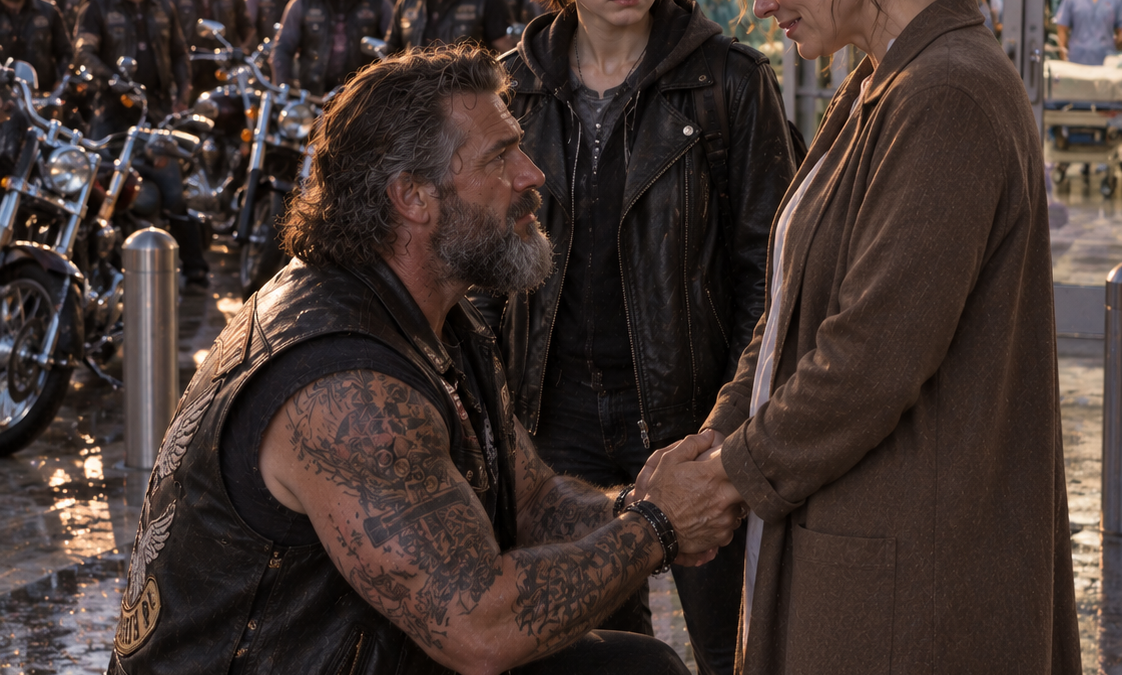
They told the story of the father who knelt before a cleaning lady and chose the law over the river. and they told the story of the night that 200 engines shook a town awake and reminded it what thunder sounds like when it comes to answer courage.
Callum Ren made a full recovery. He graduated from Pinewood High School with honors.
He enrolled in engineering school at Oregon State on the Steel Angel Scholarship and he graduated at the top of his class. He eventually opened his own restoration shop in Portland specializing in classic American muscle cars and vintage motorcycles. The matte black iron 883 Sportster sat in the front window of his shop for years polished and gleaming.
A reminder he never needed to explain to anyone. The Ford Taurus his father had left behind ran for another 100,000 mi before Callum finally retired it to the back of the shop. Not because it was broken, but because it had done its job.
It had taught him that some things are worth fixing. Even when the world tells you to give up.
Marin hardly finished high school in Pinewood. She graduated validictorian. She went to college at Stanford, then law school at Berkeley.
She passed the bar on her first attempt.
She never wore the leather again, but she kept a photograph of her father in her office next to a framed menu from Rosy’s Diner, the one with the coffee ring stain and the ketchup smear that might have been ketchup and might have been something else.
She specialized in federal prosecution. And in her first year as an assistant district attorney, she helped bring down a corruption ring that spanned three states.
The flash drive had been the first domino. She made sure it was not the last.
Up. Detective Raymond Witford was among the 19 law enforcement officers indicted in the federal sweep that followed the Blackwell case. He pleaded guilty to 12 counts of public corruption and was sentenced to 14 years in a federal penitentiary.
He never set foot in Pinewood again. Briggs, the former Marine sniper, recovered fully from his leg wound.
He rode with the Steel Angels for another decade before retiring to a cabin in Montana with a German Shepherd named Buckshot in a view of the mountains that stretched all the way to the horizon.
He never talked about the sawmill, but on certain nights when the wind was right and the stars were out, he would sit on his porch and listen to the silence, and he would remember the sound of a 16-year-old girl’s voice crackling through a cheap radio.
the word that saved a dozen lives. Now, Silas Hartley continued to lead the Steel Angels for another decade.
He never spoke publicly about what happened in Pinewood. But those closest to him noticed a change after that October. He was quieter, more deliberate.
He still commanded with authority, but the authority had shifted from the gravity of a man who could destroy to the gravity of a man who chose not to. He visited Pinewood once a year, always in October, always alone.
He would park his Road King outside Rosy’s Diner, which had reopened under new management with a fresh coat of paint and a working neon sign, and he would sit in the booth where Callum had served coffee to a girl with storm cloud eyes.
He would drink his coffee black and leave a $100 tip on the table. He never explained why.
He did not need to. Desmond Blackwell was convicted on 47 federal counts, including moneyaundering, conspiracy, corruption of public officials and ordering the attempted murder of a minor.
He was sentenced to life without parole. In his sentencing hearing, the judge noted that the evidence against him was among the most comprehensive and cleanly documented he had ever seen. He did not know that the documentation had been managed by a 16-year-old girl standing in a hospital quarter over two disarmed assassins calmly dictating chain of custody protocols to a man with a scar from his ear to his chin.
Lenor Ren quit her second job. She did not need it anymore.
She spent her mornings tending a small garden in her backyard and her afternoons volunteering at the hospital where her son had nearly died and been reborn. She never fully understood the world that had descended on her town that October, the chrome and the leather and the men who knelt before her and called her son a hero.
But she understood the result. Her boy was alive. Her bills were paid.
And a girl named Aron Marin brought flowers to her kitchen table every Sunday afternoon and called her ma’am.
And never once let her forget that Callum’s courage had meant something.
They remained close for the rest of their lives. Callum and Marin bound by a Tuesday night in October when the world revealed itself in the starkkest possible terms. Good and evil, courage and cowardice, the choice to stand or the choice to look away.
They never became more than friends, though the people of Pinewood speculated endlessly. The truth was simpler and more profound than romance.
They were two people who had seen each other at their most vulnerable and their most brave. And that kind of seeing creates a bond that does not need a name. It just exists, steady and true, like the heartbeat of a cardiac monitor, counting the moments of a life that almost ended but did not.
The story of Pinewood reminds us of something important. It reminds us that heroes do not always wear capes or carry badges.
Sometimes they wear greasy aprons and drive broken down sedans. Sometimes they are 16-year-old girls who choose the law over the fist, the courtroom, over the river, the hard right over the easy wrong.
It reminds us that true bravery is not the absence of fear. It is the decision to stand your ground when every nerve in your body is screaming at you to run. And most of all, it reminds us that loyalty, real loyalty, the kind that bleeds and bruises and holds the line, is a currency more valuable than all the gold in the world.
In room 304, where a cardiac monitor once counted the fragile heartbeats of a boy who refused to back down, the memory of courage lived on. Not in the chrome and thunder that shook the valley. Not in the flash drive that brought down an empire, but in the quiet, unshakable truth that one person standing up at the right moment can change everything.
The thunder had rolled. The storm had passed.
And in its wake, two lives began again, stronger than before. Forged in the fire of a single night when a boy with a dish rag proved that the bravest thing in the world is not the willingness to fight.
—END—

