They Searched a Single Dad’s Backpack—Then Froze at the Medal No One Knew Existed (part 2)
Part 2
Some of them, Ellison said. One of them has been trying to find the team for years.
He’s the reason we were able to verify the operation as quickly as we did.
He had documentation that the team didn’t records he’d kept privately for decades because he believed exactly what your father believed that someone needed to have the proof.
Daniel stared at him. Who is he? His name, Ellison said, is going to surprise you.
He slid a single sheet across the table. Daniel looked at it. He read the name.
He read it again. He set the paper down and looked up at the ceiling for a moment.
The way a man looks up when he’s trying to keep his composure and needs gravity to help him do it.
Then he looked at Ellison. This man has been looking for the team for 18 years and nobody connected them. Nobody was looking in the right direction.
Ellison said the record was buried too deep and the people who knew were too scattered. And frankly, the people who had an interest in keeping it buried were still in positions where they could prevent the connections from being made.
Were. Daniel said, he caught the past tense.
Were. Ellison confirmed.
Some of them are dead. Some are retired.
Some are old enough that what they’re protecting is more habit than genuine threat.
He paused. The landscape has changed.
Enough to do something. That depends, Ellison said carefully.
on how far you want to take this and how much you’re willing to put your name on.
The room waited. Daniel looked at Raymond Husk, who was looking back at him from the end of the table with eyes that had been carrying something heavy for four decades and were now perhaps considering what it would feel like to set it down.
He thought about his daughter making circles with her pencil. He thought about grilled cheese and homework and the ordinary Tuesday evenings that his father had bought with his silence.
He thought about the cost of that silence. My father, Daniel said slowly, kept quiet for 40 years.
He made a choice to protect me and I understand that choice and I don’t condemn him for it.
He looked at Ellison, but he also kept that metal. He hid it in the bottom of a bag and gave it to me and told me to keep it moving and told me that someday someone would find it.
He did both things at the same time. He stayed quiet and he kept the evidence. He paused.
That tells me something about what he actually wanted. He wanted it to survive until it was safe enough to surface.
He just couldn’t be the one to surface it.
He looked around the table. I can be the one, he said.
That’s why he gave it to me.
Not because I was the safest person to hold it, because when the time came, I’d be the one willing to walk it into the light.
Nobody spoke for a moment. Then Raymond Husk said very quietly.
Robert always said his boy was good people.
And for the first time since he’d walked through the door of the Holloway Federal Technology Campus 3 days ago, Daniel Carter felt something loosen in his chest.
Not release, not yet, but the beginning of release. the first millimeter of a knot that had been tied for three years that had really been tied for 40.
“All right,” Daniel said and turned back to Ellison.
“Tell me what we’re looking at, all of it, and then tell me what you need from me.”
Ellison nodded and reached for the stack of folders, and the real work began. Over the next six days, Daniel learned things that his father had never told him.
Things Robert Carter either hadn’t known or had chosen to protect his son from or had simply carried alone.
Because some weights don’t transfer cleanly from one person to another, they have to be absorbed gradually in pieces the way your body absorbs cold.
He learned that the 1981 operation had a name. once a code designation that had been systematically removed from every document it appeared in over the course of about 3 years in the mid 1980s.
The removal had been ordered from high enough that it didn’t require explanation and didn’t generate a paper trail.
It just happened the way things at that level happened quietly and completely and without anyone below a certain clearance ever knowing to ask why. He learned that two of the people extracted during the mission had gone on to become figures of some significance in their respective countries which was why the mission had been buried.
Not because it had failed but because its success had created complications. Acknowledging the mission would have meant acknowledging the relationships that made possible and those relationships existed in a context that the official history of that period was not constructed to accommodate.
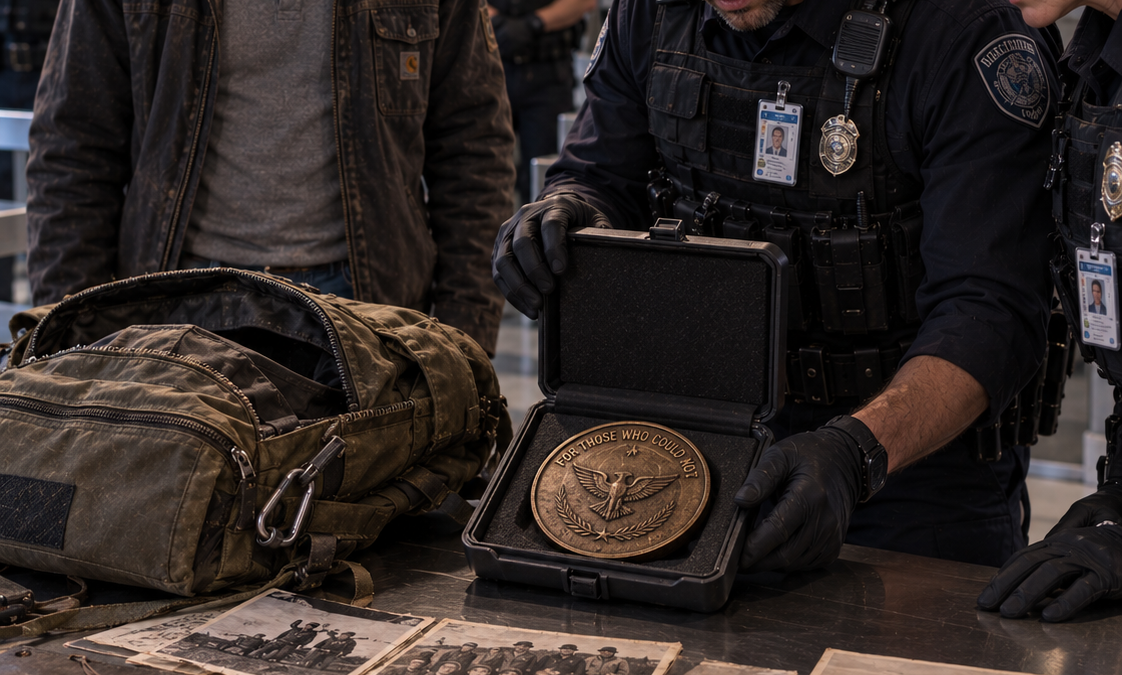
He learned that the medals, the eight small bronze circles with five words on them, had been made by a man named Gerald Fitch, who had worked in procurement for the unit and who had died in 1999 at the age of 61, and who had left in
his private papers, which his family had kept in boxes in a basement in Maryland for 30 years.
A single handwritten note that said, “Eight men went in.
Eight men came back. They were never thanked. This is what I could do.
That note was in the folder Ellison gave him on day four, and Daniel read it three times before he could put it down.
Gerald Fitch had made eight medals and put them in eight backpacks and never told anyone he’d done it.
He’d gone home and kept his own silence for 13 years, and then died of cancer without ever knowing if his gesture had meant anything to the men who’d received it.
Daniel thought about that a long time. He thought about all the people in this story who had done something important without anyone watching. Gerald Fitch making metals in private.
His father keeping one in a hidden pocket for 40 years. Raymond Husk in whatever house he was living in, carrying what he knew and saying nothing because saying something felt too dangerous and saying nothing felt like the only way to stay alive. and a man named Clifford Boone in a nursing home in Tennessee talking to himself at night about things that nobody around him understood.
On day five, Daniel drove to Tennessee.
He didn’t tell Ellison he was going.
He told Emma he’d be back by Sunday, arranged for her to stay with their neighbor, Mrs.Alvarez, who had been Emma’s unofficial backup grandmother since she was two, and got in his truck and drove 7 hours west and south into the part of the country where the hills roll long and the towns are small and the people have the specific quality of patience that comes of from living somewhere that the rest of the world doesn’t pay attention to.
The nursing home was called Pinewood Gardens, which was the kind of name that tried to soften an institution into something it wasn’t.
But Daniel wasn’t there to judge the name.
He was there because Clifford Boon’s daughter, Patricia, had agreed to let him come after a phone call that had lasted 45 minutes and had involved Patricia crying twice and Daniel waiting through both times without rushing her.
Patricia Boon was 53 years old and had her father’s eyes, which were sharp and still and the color of river water.
She met Daniel in the parking lot, which told him she’d been watching for him, which told him she was more nervous than she’d sounded on the phone.
“He has good days and bad days,” she said as they walked toward the entrance.
“Today is a good day, but he tires fast, and when he tires, he gets agitated.
If I signal you, we stop. Okay.
Okay.
He doesn’t know you’re coming.
I didn’t tell him because I didn’t know how to explain it and I didn’t want him to spend the night working himself up about it.
That’s fine.
She stopped walking and looked at him. Mr.Carter, before we go in, can I ask you something? Yes.
Is any of what you told me on the phone actually going to amount to something? Because my father has been. She stopped, pressed her lips together, started again.
He has been waiting for something to happen his entire life. Something to acknowledge what he was part of.
I watched him wait. I watched it take things from him.
His peace, his ability to trust people, his marriage. She looked at Daniel directly. If this is going to be another dead end, I need to know now before I take you in there and let him think something is finally changing.
Daniel looked at her. He could have made it comfortable.
Could have said, “I’m not sure yet.”
or “We’re working on it.”
Or any of the careful, non-committal things that people say when they’re managing expectations and protecting themselves from being wrong.
He said, “It’s not a dead end.
I don’t know exactly how far it goes or how fast, but it’s real.
The people I’ve been talking to have the authority to do something, and some of them want to.
Your father’s name is going to be said out loud to people who matter.
I can promise you that. She held his gaze for a long moment.
Searching it the way people search a thing when they’ve been disappointed.
Times enough times that trust has to be earned through eye contact before it can be earned through action. Then she nodded and she led him inside.
Clifford Boon was 73 years old and sitting in a recliner near the window with a fleece blanket over his lap and a baseball game on the television that he wasn’t watching.
He was thin in the way of people whose bodies have been using them up from the inside.
But his posture in the chair was still deliberate, still the posture of a man who had once known exactly where his body was in space at all times and couldn’t entirely unlearn it even now.
He looked at the door when Patricia opened it. He looked at Daniel behind her.
Something shifted in his face.
“Pop,” Patricia said quietly.
“There’s someone here to see you.”
“His name is Daniel Carter.”
“His father was Robert Carter.”
Clifford Boon’s eyes didn’t leave Daniel’s face.
For a moment, he didn’t speak.
Then he said in a voice that was soft, but hadn’t lost its edges entirely.
“Robert Carter’s boy.”
“Yes, sir,” Daniel said.
He was aware that this was the second time in a week he’d said those exact words to a man who had known his father in a way that almost no one else had.
“Come here,” Clifford said.
“Come closer.
These eyes aren’t what they were.”
Daniel crossed the room and pulled the visitors chair close and sat down. Clifford looked at him for a long time.
Looking for Robert in there, Daniel thought.
Looking for the man he’d known in the face of the sun.
The way old people sometimes did with the children of people they’d lost.
How long ago did Robert pass? Clifford asked. 3 years ago.
A slow nod. Was he okay at the end?
He was okay, Daniel said. He had people around him.
He wasn’t alone.
Something in the old man’s shoulders shifted.
A very small release as if that answer had been a weight he hadn’t realized he was holding.
Good, Clifford said. Good.
And then after a pause. Did he keep it?
Daniel knew immediately what he meant. Yes. The old man exhaled a long breath.
I kept mine too. Wrapped in a handkerchief in the bottom of a box in my closet.
40 years. He shook his head slowly. I used to take it out sometimes and look at it at night.
I didn’t want Patricia to see.
He glanced at his daughter, who was standing just inside the door with her arms folded and her eyes bright.
I thought if she saw it, she’d ask questions.
And if she asked questions, I’d have to lie.
And I was so tired of lying.
You don’t have to lie anymore, Daniel said.
Clifford looked at him. Things are moving, Daniel said. I found people who can do something with the truth.
It’s going to take time.
I won’t pretend it’s going to be fast, but it’s moving.
Your name is going to be in this.
Raymond Husk’s name.
My father’s name.
Clifford’s jaw worked.
His eyes were dry, but only barely. Raymond, he said.
Raymond’s still alive.
He is. I met him 4 days ago.
He’s the one who told me where to find you.
The old man made a sound that was not quite a laugh and not quite a sob, but something that contained both and the 40 years behind them. He pressed one hand over his eyes briefly, then brought it down.
Tell him, Clifford said, and his voice had dropped to something barely above a murmur. Tell him Cliff says hello. Tell him Cliff has been thinking about him.
I’ll tell him, Daniel said.
They talked for 47 minutes. Clifford about the mission in more detail than Daniel had ever heard from his father. Operational details that Daniel had been told in fragments over years assembled now into something coherent and whole.
He talked about the eight men, their roles, the specific moments where things could have gone wrong and didn’t because every person on that team was exactly where they needed to be and did exactly what they had been trained to do.
He talked about the three who had died.
He talked about Eddie Marsh the way Raymond had with the specific grief of a man who’d never been allowed to grieve publicly carefully.
Precisely still angry after four decades. He talked about the night they got back.
The eight of them standing in a parking lot somewhere he wouldn’t specify.
Not celebrating, not debriefing, just standing together in the dark because none of them wanted to separate yet. Because once they separated, it was over. Once they walked to their separate cars and drove to their separate lives, the thing they had been together was gone.
And the silence would close over it like water over a stone, and the world would keep moving without knowing what had happened in it. Raymon said something.
That night, Clifford said he was quieter now, the energy of the conversation beginning to cost him.
Patricia caught Daniel’s eye from the doorway and held up two fingers.
“Two more minutes,” he said.
“Boys, I don’t know if anyone will ever know what we did tonight, but we’ll know.
And that has to be enough.”
Clifford looked at his hands. I believed him when he said it. I believed it for a long time.
But it gets harder to believe as you get older, as the people who knew start to disappear.
As the world moves on and you’re still carrying something that nobody else can see, he looked up at Daniel.
Does Raymond still believe it? That it was enough?
Daniel thought about Raymond Husk sitting at that conference table.
The steadiness in his voice, the weight he was clearly still carrying, but also something else, something that had been present the moment Daniel walked through the door and said, “Yes, sir.
I’m Robert Carter’s son.”
I think Daniel said carefully that Raymon believes it was enough, but I also think he’d like for it to be more.
Clifford Boon nodded slowly. Yeah, he said.
Me, too.
Patricia was at Daniel’s elbow then, gently, and he stood and said, “Goodbye.”
And Clifford held his hand for a moment longer than a handshake before releasing it. And Daniel walked back out through the doors of Pinewood Gardens into the Tennessee afternoon with something sitting in his chest that was heavy and light. At the same time, the particular feeling of a thing that has been invisible becoming visible, of a truth that has been silent, finally beginning to find its voice.
He sat in the truck for a while before starting it.
He pulled out his phone and called Raymond Husk’s number, which Ellison had given him with Raymon’s permission.
Raymond picked up on the second ring.
Clifford says, “Hello,” Daniel said.
Clifford has been thinking about you. A silence on the other end of the line.
Then Raymond Husk’s voice, quieter than it had been in the conference room, stripped of the composure that a room full of official people required.
How is he?
He’s tired, but he’s okay.
He remembered everything. He talked for almost an hour. Did he?
Raymond stopped. Started again. Did he seem at peace?
Daniel thought about the old man’s hand holding his.
The not quite law, not quite sub, the 40 years in his eyes. Not yet, Daniel said.
But I think he’s closer than he was this morning.
Another silence.
Carter Raymond said, “Your father made a good choice.”
“With you?”
Daniel looked out through the windshield at nothing in particular.
“I’ll tell you when I believe that.
You don’t have to believe it for it to be true.”
Daniel started the truck.
I’ll be back in touch, he said.
Things are moving. I know, Raymond said.
I can feel it. After 40 years, I can finally feel it.
Daniel pulled out of the parking lot and pointed the truck east toward home, toward Emma, toward the small town and the small garage and the ordinary life that was quietly in the spaces between Tuesday mornings and Thursday afternoons and long drives to Tennessee, becoming something else, becoming the end of a very long silence. And somewhere behind him in a room with a baseball game on a television and a fleece blanket over a chair and 40 years of waiting still in the air, Clifford Boon closed his eyes and rested for the first time in a long time with something that might with a little more time become peace.
Daniel got back to Caldwell on a Sunday evening with 7 hours of highway behind him and a mind that wouldn’t sit still.
Emma was at Mrs.Alvarez’s house next door.
And when he knocked, she came to the door already in her pajamas with her hair halfb braided and a book tucked under her arm. And the way she looked at him, just looked at him, not running to hug him immediately the way she had when she was smaller, but standing there with those steady eyes taking in whether he was okay made something in his chest do something complicated. You okay, Daddy?
Yeah, he said.
I’m okay.
better than when I left. She considered that. Did you do something important?
He thought about Clifford Boon’s hand holding his about Raymond Husk’s voice on the phone saying after 40 years.
I can finally feel it. I went to see someone who needed to be seen.
Daniel said that’s all.
Emma nodded like that made perfect sense, which it did to her because she was 9 years old and hadn’t yet learned that most people didn’t think of visiting strangers as an explanation unto itself.
He thanked Mrs.Alvarez carried Emma home on his back. Even though she protested she was too old that got her into bed and sat on the edge of her mattress in the dark for a few minutes after she fell asleep.
The way he sometimes did when the world had been a lot and the quiet of her breathing was the only calibration he trusted. His phone rang at 11:47 p.m.Ellison.
I know it’s late.
Ellison said before Daniel could say anything, but you need to hear this tonight. Daniel got up and walked to the kitchen and stood at the counter in the dark.
Go ahead.
We found something in Gerald Fitch’s papers.
The family let our team go through the boxes today. Most of it was what we expected.
Correspondence, supply records, some personal journals, a pause, the kind of pause that had weight behind it. But there was a second document handwritten like the note about the medals.
Different date, 1987, 6 years after the mission. What kind of document?
A list, Ellison said. Names, eight columns.
Each column has a first name and a set of initials. And next to each name, a date, and a single word.
Daniel’s hand tightened on the phone.
What word? Different words for different names.
Most of them say safe. One says relocated. Two say lost.
And one Ellison stopped.
One says, “Watching.”
The kitchen was very quiet. Watching, Daniel repeated. We think it means Fitch believed someone on the team or connected to the team was being monitored actively.
In 1987, 6 years after the operation, “Which name is next to that word?”
Another pause longer this time, Robert Ellison said. Initial C.
Robert C. Daniel set the phone down on the counter and stood there with his hands flat on the surface and his eyes closed and breathed through it. Breathe through the image of his father going about his daily life in 1987, which would have been Daniel calculated fast.
The year Daniel was 11 years old. The year his father coached his little league team and drove him to school every morning and sat across from him at the dinner table every night. The year that looked from the outside exactly like a normal year in a normal family.
The year someone was watching his father. The year his father knew someone was watching and said nothing. Continued nothing.
Made breakfast and drove to work and came home and sat at the dinner table and did not the 11-year-old across from him that their ordinary life had surveillance built into it. He picked the phone back up.
Carter.
Ellison’s voice was careful.
I’m here.
His voice was level. He made it level.
Does this change what we’re doing?
No.
But it tells us the burial wasn’t passive.
It wasn’t just seal the records and hope nobody looks.
Someone was actively managing the silence, actively monitoring the people who knew. For how long?
We don’t know yet.
Fitch’s document is from 19987.
But Fitch died in 1994.
There’s no way to know if the monitoring continued past what he observed.
“My father was careful until the day he died,” Daniel said.
“That’s not the behavior of a man who believed he’d stopped being watched.
That’s the behavior of a man who assumed he always might be.”
I know. So, this has been active suppression, not just bureaucratic burial. Yes.
which means someone or someone’s had an ongoing interest in keeping this quiet.
And that interest lasted decades. Yes, Ellison said again.
And some of those people, he stopped, might still be alive, Daniel finished. Carter, I need you to understand something.
What we’re doing now, moving forward with this, it’s not without risk.
The landscape has changed, like I said, but changed doesn’t mean cleared.
Daniel thought about the hidden compartment at the bottom of the backpack.
His father’s voice saying, “Keep it moving.
Don’t put it anywhere that stays in one place too long.”
40 years of calibrated caution. I understand the risk.
Daniel said, “Do you?”
Because you have a daughter. It landed exactly where Ellison intended it to land.
“Daniel felt it, let himself feel it, didn’t flinch away from it.”
“My father had a son,” Daniel said.
He chose the son. And I understand that choice. But his son is standing here now.
40 years later, making a different one because the people who didn’t make it home don’t have children to protect them anymore.
Somebody has to be willing to stand up for the ones who aren’t here to stand up for themselves.
A long silence. All right, Ellison said.
Then here’s what you need to know for tomorrow.
Tomorrow came with a cold that had moved in overnight. the kind of October morning that had teeth.
Daniel dropped Emma at school at 7:30, told her he loved her, watched her walk through the doors, and disappear into the building, and sat in his truck for 45 seconds before pulling out. He was at the federal building by 8:15. Ellison was already there.
So was the precise haircut woman, whose name Daniel had learned was Dr.Lena Marsh not related to Eddie Marsh Daniel had asked and she’d confirmed without visible discomfort the confirmation of a professional who’d long ago stopped being surprised by the coincidences of institutional work.
There was also a new face, a man in his early 60s, heavy set with the specific quality of someone who had spent decades in rooms where things were decided and had grown accustomed to being the one who decided them. His name was given as Whitmore.
No first name offered, no title clarified, which told Daniel something about his level and something about how this meeting was being structured. Whitmore looked at Daniel the way men at a certain level look at people who are useful to them assessing. Not unkind, but with the specific impersonality of someone who deals in outcomes rather than people.
Mr.Carter Whitmore said, “I’ve been briefed on the situation.
I want to ask you some questions directly and I’d appreciate direct answers.
That’s how I work.
Daniel said, “You went to Tennessee without informing Ellison.
I went to see a man who was running out of time. I made a call. That kind of independent action creates complications.
Clifford Boon talked to me for 47 minutes.
He told me things he hadn’t told anyone in four decades.
That conversation is on my phone recorded with his permission and I can give you a copy this morning. Daniel looked at Whitmore steadily.
Would that conversation have happened faster if I’d waited for authorization?
Whitmore studied him. No, probably not.
Then the complication is manageable.
Something shifted in Whitmore’s expression.
Not quite approval, but a recalibration.
The list in Fitch’s papers.
Whitmore said the word next to your father’s name.
Watching. Yes.
You’re not surprised.
My father lived like a man who expected to be watched.
I’m not surprised to learn he was right.
Daniel paused.
I’m angry, but I’m not surprised.
The anger is understandable, but I need to know if it’s going to be a problem.
Daniel looked at him. My father was monitored for years, possibly decades.
Men he served with died in circumstances that weren’t accidents.
The mission they risked their lives on was erased. He spent 40 years of his life carrying that alone in silence to protect his family.
He held Whitmore’s gaze.
I’m angry.
That’s appropriate.
But I know the difference between anger and recklessness. My father taught me that, too.
Whitmore held his gaze for a moment. Then he nodded once.
The nod of a man who has tested something and found it solid.
Then let me tell you what we’ve confirmed in the last 12 hours, Whitmore said.
He opened the folder in front of him.
What followed was 2 hours of information that Daniel absorbed the way he’d been trained his whole life in the particular way his father had trained him without ever naming it as training piece by piece systematically without letting the emotional weight of any single fact collapse his ability to
receive the next one.
The 1981 operation had been authorized at a level that bypassed normal oversight channels. This was not unusual for the period.
Whitmore explained with the careful neutrality of a man describing something that was documented fact without rendering a judgment that wasn’t his to render in this room.
What was unusual was the specific mechanism used a verbal authorization chain that left almost nothing written which was itself a choice not an accident. Three of the men who had died in the years following the operation had been listed in a separate internal document, not as team members, but as former consultants whose contracts had been concluded. The language was institutional, bloodless, and deliberate.
It described their status without acknowledging what they’d done.
It erased their connection to the mission, even in the documents that acknowledged they existed. Eddie Marsh, the man Raymond and Clifford had both described as the one whose death they get, had filed an inquiry with a federal agencies 18 months before his death at 34.
The inquiry was about compensation, not recognition, not acknowledgement, just the practical matter of whether the work he’d done ti entitled him to certain protections that had been verbally promised and never formally provided.
The inquiry had been routed, rerouted, delayed, transferred to a department that didn’t technically have jurisdiction over it, and 43 days after the final transfer, Eddie Marsh had died of a heart attack.
The inquiry had been closed without resolution, 2 weeks after his death. The notation on the file was four words. Matter resolved.
File closed. Daniel read that notation three times. He set the paper down.
the person who wrote that notation, he said. Do you know who it was? Dr.Marsh slid another page across the table.
A signature, a name below it, Daniel looked at the name.
He didn’t recognize it.
Is this person still alive? He asked. Yes, Whitmore said.
He’s 81.
He’s been retired for 20 years.
He lives in Maryland. Does he know this is surfacing? Not yet.
Are you going to tell him? Whitmore looked at Daniel carefully. That depends on what we decide this process looks like.
There are different ways to approach this. Some of them involve notifying people who were part of the suppression.
Some of them don’t, at least not initially.
What’s the difference in outcome?
The difference, Whitmore said, is between a quiet correction and a public accounting, he paused. A quiet correction means the records are amended.
The men are formally recognized through appropriate channels and the matter is resolved administratively relatively fast, relatively clean, very private and a public accounting longer messier. More painful for more people including people who are very old and in some cases very ill. He looked at Daniel directly and significantly more meaningful.
The room was quiet for a moment. Raymond Husk and Clifford Boon, Daniel said.
Have they been asked which they want? No, Ellison said from his end of the table. We wanted to have this conversation with you first.
Why me?
Because Whitmore said you’re the one who brought it forward and because both of the surviving team members have through separate channels in the last 48 hours indicated that they want to work through you.
They trust you. They trusted your father.
That trust transferred. He looked at Daniel levely.
That puts you in a position of some significance in how this proceeds. Daniel thought about that the weight of it and this responsibility of it and the specific loneliness of being the person in the middle of a thing this large while also being at 7:30 this morning. The man cutting the crusts off a sandwich and watching his daughter walk through a school door.
Then I need to talk to them before we decide anything. He said both of them together if possible.
Clifford Boon’s health doctor.
Marsh said then we go to him. Daniel said Raymon comes to Tennessee.
We do it there.
We sit with Clifford in whatever room he’s comfortable in and we have the conversation in person the way it should be had.
He looked at Whitmore. Can you make that happen?
Yes. Then make it happen.
this week if possible. Whitmore looked at Ellison. Something passed between them that Daniel read as agreement.
Thursday, Whitmore said, we can make Thursday work. Thursday again.
Daniel thought about the fact that his father had also made the most important decisions of his life on Thursdays.
Something he’d mentioned once without explaining.
Something Daniel had filed away without knowing why. He filed this away, too.
Wednesday night, Ellison called with a development that changed the shape of everything.
Daniel was in his garage working late on a transmission rebuild for a truck that belonged to a man named Pete Kowalsski, who needed it back by Friday, and who Daniel had promised he’d deliver on time because Pete was dealing with enough already without his truck failing him, too.
The work was meditative. His hands knew what they were doing, and his mind could move around while they did it. he answered on the second ring with his phone wedged between his shoulder and his ear and a torque wrench in his right hand.
We found one of the extracted personnel, Ellison said. Daniel set the wrench down.
Which one? An American.
One of the three.
His name isn’t in the file you saw.
His entry was among the fully redacted ones. A pause.
His name is Senator Arthur Gavins. The name hit Daniel like a change in air pressure.
Senator Arthur Gavins.
He’d seen that name in newspapers, on television, a US senator for the last 22 years.
Before that, a congressman. Before that, a businessman.
Before that, according to Everything Public, a foreign service attaches who had worked in various international postings in the late 1970s and early 1980s. A foreign service attaches working abroad in the early 1980s who came home.
He was one of the people they extracted, Daniel said. Yes, we believe so.
The timeline matches, the posting matches, and there are gaps in his official record during the period of the operation that are consistent with the kind of gap you’d have if someone was detained somewhere they shouldn’t be and then quietly returned.
Does he know about the team? About the eight men?
We don’t know.
It’s possible he was never told who brought him out.
That was the protocol.
The team didn’t identify themselves to the extracted personnel, but he’s been a U senator for 22 years.
Daniel said he has access to things resources.
If he’d wanted to find out, maybe he tried.
Maybe he was told there was nothing to find. Maybe he accepted that because he had reasons of his own to not pull on certain threads.
Ellison’s voice was careful.
or maybe he’s known something and has been waiting for someone to come to him with the rest of it.
Daniel leaned against his workbench. His hands were still greasy from the transmission work.
He looked at them. Ellison, he said, if Senator Gavins comes forward and says publicly that these men saved his life.
Yes, Ellison said.
That’s exactly what it means.
That’s not a quiet correction anymore.
No, Ellison said it isn’t.
Have you contacted his office? Not yet.
I wanted to brief you first and Whitmore is going to want to manage this carefully because a sitting senator, former senator, Daniel said he retired 2 years ago. Former senator, yes, but the implications are still significant.
The political dimensions alone.
I don’t care about the political dimensions, Daniel said.
A pause.
I know you don’t, but they exist whether you care about them or not.
Would he talk to me? Daniel said before the official process man-to-man would he take that meeting?
I don’t know why.
Because Raymond and Clifford are going to need to know this before Thursday. If Gavins is willing to come forward, if the man whose life they helped save is going to say their names out loud, they deserve to know that before they have to decide anything about how far to take this.
A long pause on Ellison’s end.
Carter, he said, “You understand that you’re asking me to move faster than this kind of thing normally moves.
I understand that Clifford Boon has maybe a year.”
Daniel said, “And I understand that Raymond Husk has been sentence with this for four decades.
And I understand that my father carried that medal to his grave without ever knowing whether anything would come of it.”
His voice was even, but only barely.
So yes, I’m asking you to move faster because the people this is about don’t have the luxury of institutional timelines.
Another silence. Give me until morning, Ellison said.
He called back at 6:43 a.m.Gavins will meet with you, he said. Friday.
He wants to do it at his home in Virginia. He said. Ellison paused and Daniel heard something in that pause that made him go very still.
He said he’d been expecting a call like this for a long time.
Daniel closed his eyes. There it was again.
That sentence in different forms from different people.
Raymond Husk’s face when Daniel walked through the door.
Clifford Boon’s hand holding his at the end.
Gerald Fitch’s note.
This is what I could do.
and now a former senator in Virginia who had spent 22 years on public life without ever saying publicly that he’d once been in a place he shouldn’t have been in danger he shouldn’t have faced alone and that eight men he’d never been allowed to thank had walked in and brought him home.
He’d been expecting the call.
👉 [Tap here for the Next Part ] 👈
