They Searched a Single Dad’s Backpack—Then Froze at the Medal No One Knew Existed (part 4)
Part 4
Ellison’s team would continue working through the official verification process, locking down the documentary evidence in a form that could withstand challenge.
Dr.Marsh would reach out through academic and archival channels to find anything else in Fitch’s papers or related collections that could corroborate the timeline.
and Daniel would find Margaret Marsh Holloway.
He drove out of Gavin’s driveway at 6:15 with Raymond in the passenger seat and the October darkness already fully settled and the headlights cutting through it.
And for a few miles, neither of them spoke.
Then Raymond said, “He’s a good man.”
“Yeah,” Daniel said.
“He’s been carrying this a long time, too.
Everyone in this story has been carrying something a long time.”
Raymond was quiet for a moment. Does that ever make you angry?
How long it took? How long all of this sat there buried and everybody just kept living their lives around it?
Yes, Daniel said without hesitation. Yes, it makes me angry.
It makes me angry every time I think about my father sitting at the dinner table with me when I was a kid.
And I didn’t know I couldn’t see it.
I thought he was just a quiet man. But he was carrying all of this every single day.
and he couldn’t put any of it down because putting it down meant putting me at risk.
His hands tightened slightly on the wheel.
So, yes, I’m angry, but you’re still doing it.
Yeah, why? Daniel thought about Emma asleep down the hall.
He thought about the specific quiet of an ordinary evening and what it was worth and what it cost. Because the anger is about the past, he said, and the work is about the present, and those are different directions. I can be angry about what happened and still choose what happens next.
He paused. My father taught me that too. Not in so many words.
But he taught me.
Raymon didn’t respond immediately.
He looked at the road for a long time.
Then he said quietly, “Robert Carter was the best of us.
You said that before.
I know it’s still true.”
They drove. The highway carried them east and north, back toward the ordinary life that was no longer the container of something secret, but the anchor of something real, the thing that made everything else matter.
The kitchen and the child and the small town and the work that kept the hands busy while the mind carried what it needed to carry.
Daniel’s phone buzzed.
He didn’t look at it while he was driving.
When they stopped for gas an hour later and Raymond went inside for coffee, Daniel picked it up.
A text from a number he didn’t recognize different from the one Ellison used.
Different format entirely. The text was six words.
I knew Gerald Fitch. We should talk.
Daniel stood at the gas pump in the October dark and read those six words three times.
Gerald Fitch, the man who had made the medals, the man who had put them in the backpacks, the man who had died in 1994 with a handwritten note in his papers that said, “Eight men went in.
Eight men came back. They were never thanked.
This is what I could do.”
Gerald Fitch had been dead for 32 years, but someone who knew him was still alive and that someone had Daniel’s number.
He looked at the text. Then he looked at the dark highway stretching out in both directions. Then he looked at the door of the gas station where Raymond was visible through the window, paying for two coffees with the deliberate movements of a man who had survived four decades of silence and was still standing.
He typed back, “Who are you?”
The response came in 11 seconds.
Someone who’s been waiting to pitch what Gerald started.
He left more than the note. Mr.Carter.
He left instructions and I’ve been waiting for the right person to give them to.
Daniel stared at the screen. The gas pump clicked off.
He didn’t move.
Raymon came out of the gas station with two cups and looked at Daniel’s face and stopped walking.
“What?”
Raymond said. Daniel held up the phone.
Raymon read the texts. He read them again. He looked up at Daniel.
Gerald left instructions. Raymon said it was not a question.
It was the sound of something falling into place. A piece of a puzzle that had been faced down for 32 years suddenly turning over. Gerald left instructions.
Daniel confirmed. They stood there in the October dark at a gas station on a Virginia highway and looked at each other.
And what passed between them was the specific feeling of a thing that has already been large getting larger. A story that was already about more than any of them had known when it started opening up another door, revealing another room, insisting that what they thought was the edge of it was not the edge at all.
Daniel typed one more message. When and where?
The reply came immediately.
Sunday, I’ll come to you.
Send me your address. Daniel looked at Raymond.
Raymond said, “Send it.”
Daniel sent his address. He got back in the truck.
Raymond handed him his coffee. They pulled back onto the highway and drove east into the dark. And neither of them spoke for a long time, not because there was nothing to say, but because some things are big enough that you need to let them ride beside you in silence for a while before you try to make them into words.
40
years ago, a man named Gerald Fitch had done the only thing he could do for eight men who would never be thanked. He had made something small and placed it in their hands and hoped it would find its way. He had also left something else behind.
And now, 32 years after Gerald Fitch had of cancer at 61, without knowing whether any of it had mattered, the thing he’d left behind was about to arrive at Daniel Carter’s door on a Sunday morning.
The story was not ending. It was still opening.
and Daniel Carter, mechanic, single father, keeper of a dead man’s promise, drove east through the Virginia night and understood for the first time that what his father had given him was not just a medal and a mission.
It was a beginning.
The woman who arrived at Daniel’s door Sunday morning was 74 years old and drove herself alone from Richmond in a 12-year-old Buick that she parked with precise efficiency at the curb in front of his house at exactly 9:00.
Her name was Eleanor Fitch Warren, Gerald Fitch’s younger sister.
Daniel had not known to expect a woman. The text had given nothing away. No name, no relation, just the certainty of someone who had been holding something for a long time and had finally identified the right hands to give it to.
He’d told Raymon the night before, and Raymond had back from his motel at 8:30 and was sitting at Daniel’s kitchen table with a cup of coffee when the knock came.
Emma was at Mrs.Alvarez’s again.
Daniel had made that arrangement the moment he’d gotten home Saturday night, not because he thought there was danger, but because he understood instinctively that whatever was about to happen in his house needed to happen in a space that wasn’t also a 9-year-old’s Saturday morning.
He opened the door and Eleanor Fitchw Warren Lud looked at him with eyes that were sharp and unhesitating and had clearly already decided.
Before she arrived exactly what she was going to do, she said, “You look like someone who’s been carrying something too long.”
Daniel said, “Come in.
” She walked into his house with a canvas bag over one shoulder, sat down at his kitchen table across from Raymond without introduction, looked at Raymond for about 3 seconds, and said, “You were one of them,” Raymond said.
“Yes, ma’am.”
She nodded. The nod of someone confirming something they already knew.
“Gerald described you once.
Not by name.
He didn’t know your names, but he described the team the way you describe something you can’t stop seeing, even after it’s gone.
She set the canvas bag on the table.
He said, “There were eight men who moved like they’d been built for exactly that moment, like the universe had constructed them specifically to be in that place at that time doing that thing.”
She looked at Raymon steadily. He never forgave himself for not being able to do more for you.
Raymond said nothing for a moment. His jaw was tight.
“He did more than he knew,” he said finally.
“He knew exactly what he did,” Eleanor said.
He just didn’t know if it was enough.
She put her hand on the canvas bag.
“That’s why he left this.
” She opened the bag.
Inside was a metal box, not unlike the one Daniel’s father had kept, but larger, darker, the kind of box that had been made to last.
chosen specifically because permanence mattered to the person who chose it. She set it on the table between them.
Gerald worked in procurement for 15 years. She said he saw things.
He knew things that weren’t in any official record because the official records had been adjusted.
She said the word with a precision that made clear it was the charitable version of what she actually thought. He started keeping his own records in 1998. A year after the operation, he understood even then that what had happened was going to be buried.
And he decided Gerald was a quiet man, but he was not a passive one.
He decided that burying something didn’t have to mean destroying it.
It just meant putting it somewhere that required the right person to find it. She looked at Daniel. He left me specific instructions, not when he was dying years before that.
He gave me this box in 1989.
And he told me, “Elanor, someday a man is going to come to you or someone is going to lead you to a man, and when that happens, you’ll know because of the metal.”
He said, “If they know about the metal, they’re the right person.”
She paused.
“When your contact reached out to me Friday, they mentioned the metal.
” “So, here I am.”
Daniel looked at the box.
“What’s inside everything?”
Eleanor said. Gerald spent 12 years building it, copies of operational documents he had legitimate access to in his procurement role requisitions. Supply orders, equipment manifests the kind of paperwork that by itself looks like nothing, but in context proves the operation existed.
Personnel movement logs from the relevant period and his personal journals. She paused.
Gerald kept journals from 1998 until the year before he died. 40 pages a month on average. Everything he observed, everything he suspected, everything he could document from inside the system that was burying what those eight men had done.
Raymond leaned forward. His hands were flat on the table. Did he know about the deaths?
Raymond said. Eddie Marsh.
The others. Eleanor looked at him.
Yes. He documented what he could.
He had access to certain internal communications through his clearance level and when Eddie Marsh filed his inquiry in 1951 1985, Gerald flagged it internally and tried to route to someone who would act on it. Her voice stayed even, but something under that was not even at all.
He was told to stop directly in writing which he then added to this box because he understood that a written order to stop was it self-evidence. The room was very quiet. He was told to stop.
Daniel said and he stopped. But he kept the evidence. Gerald understood that there are different ways to fight.
Eleanor said he didn’t have Raymon’s kind of courage.
He couldn’t walk into dangerous places and bring people out.
But he could document. he could preserve.
He could refuse to let the truth be entirely destroyed, even when he couldn’t make it heard.
She looked at the box. He called it his other mission. His whole adult life.
This was his other mission. Raymon picked up the box.
He held it in both hands for a moment before opening it. Daniel watched his face.
Watched the stillness that was Raymond Husk’s response to things that moved him too deeply for movement.
Then Raymond opened the box. The journals were stacked neatly, the way Gerald Fitch had apparently stacked everything precisely with the discipline of a man who took seriously the idea that organization was a form of respect for what was being organized.
14 notebooks numbered on the spines and small neat handwriting. On top of the journals was a sealed envelope written on the front in the same neat handwriting. To whoever finds this, the truth was never lost.
It was only waiting. Raymond held the envelope.
He didn’t open it.
Did you read it? Daniel asked Eleanor.
No, she said. Gerald told me not to. He said it was for the person who came to claim what was inside the box.
She looked at Raymond.
I suspect it’s for you or for someone like you.
Raymond turned the envelope over in his hands. He looked at Daniel.
Daniel said, “Open it.”
Raymond opened it. He unfolded the single sheet inside and read it. His face was completely still.
He read it twice. Then he set it flat on the table and pressed one hand over it and closed his eyes for a moment. What does it say?
Daniel asked quietly. Raymond opened his eyes. He picked up the letter and read it out loud.
To the men who went in, he read. His voice was steady, each word landing clean and clear. I worked in a building where the truth about what you did was deliberately destroyed and I was not powerful enough to stop that destruction and I have lived with that inadequacy every day since one teens in 981.
What I could do I did. What I could keep I kept.
I hope that whoever reads this is reading it because the time has finally come to say out loud. What was done in silence.
I hope the men who deserve recognition are still alive to receive it. I hope the ones who are not are remembered by name.
You are not forgotten. Not for one day.
Not by me. Gerald Fitch 989. Raymon set the letter down.
Nobody in the room spoke for a full minute. Then Ellaner said very quietly. He meant every word.
I know he did, Raymon said.
Daniel looked at the 14 journals, at the stacked documents beneath them, at 40 years of one quiet man’s refusal to let the truth die even when he couldn’t make it live.
He thought, “Gerald Fitch, you made eight medals and kept 14 journals and chose the right person to give them to, and you died not knowing any of it would matter, and it is going to matter.
It is going to matter more than you were alive long enough to see.”
He pulled out his phone and called Ellison. Ellison picked up on the first ring.
We have Gerald Fitch’s documentation, Daniel said.
All of it.
12 years of records, personal journals, and a written order directing Fitch to cease routing Eddie Marsh’s inquiry.
He paused.
This is what we’ve been missing.
This is the piece that makes it complete.
A silence on Ellison’s end.
the specific silence of a man recalibrating the size of what he’s dealing with.
How soon can you get it to me?
Ellison said, “Tomorrow morning.”
But Ellison, I need something from you first. What timeline?
Daniel said. I need to know how fast we can move now because we have two old men who have been waiting for 40 years and one of them might not have another 40 days.
Another silence. Give me 24 hours to talk to Whitmore and review what you have.
Then we’ll give you a timeline.
24 hours, Daniel said. Not a minute more. He hung up.
Eleanor was watching him.
You’re not what I expected, she said.
What did you expect?
I don’t know exactly.
Someone more institutional, someone who moved more carefully. She paused. Gerald would have liked you.
I would have liked Gerald, Daniel said. And he meant it completely.
The 24 hours Ellison had asked for became 18. He called at 11:00 Monday morning.
And when Daniel answered, Ellison’s voice had a different quality than it had carried in any of their previous conversations.
More certain, more weighted with what it was about to say.
The documentation from Fitch’s box, Ellison said, combined with what we’ve already compiled and with Senator Gavin’s materials is sufficient.
Whitmore has cleared a formal review process.
It’s going to happen.
Daniel sat down on his front steps.
He didn’t know he was going to sit down until he was already sitting.
When? He said 3 weeks.
That’s the realistic timeline for processing the documentation, notifying the relevant oversight bodies, and preparing the formal record amendments.
A pause. There will be a formal ceremony, small, not public in the sense of a press conference, but not administrative either.
The right people in the room, a record created that cannot be quietly reversed. Gavins Daniel asked.
He’s confirmed he’s going to speak.
Raymond and Clifford, we need Clifford’s formal agreement and we need to assess what participation is feasible given his health.
But yes, if he’s physically able, he will be there.
And the families, Eddie Marsh’s sister, the families of the others who died.
We’re working on locating them.
The sister, Margaret Marsh Holloway. We found her.
She’s been contacted through a preliminary channel.
She wants to come. Daniel pressed his hand flat against the wood of his porchstep.
Felt the grain of it, the solidity of something real and ordinary under his palm.
Ellison, he said, the man in Maryland, the one who signed the order on Eddie Marsh’s inquiry.
Yes, he gets notified this week before the ceremony. Not as a warning, as a courtesy.
He’s 81.
Whatever he did, he’s going to have to live with the public record.
But he deserves to know it’s coming before it arrives.
A pause.
That’s more generous than many people in your position would be.
It’s what my father would have done, Daniel said.
Three weeks moved faster than three weeks usually moved.
Daniel went back to work Pete Kowalsski’s truck, a lawnmower engine for a retired school teacher named Mrs.Gity, a break job on a minivan that belonged to a family with four kids who couldn’t afford the dealer prices.
He cut crusts off Emma’s sandwiches and helped her with her homework and sat on the edge of her bed at night and listened to her breathe and thought about legacy and what it costs and what it’s worth.
He called Raymond every 2 or 3 days. Kulkid.
Raymond had driven back to Kentucky and was doing what Raymond apparently did when he needed to prepare for something spending time in his garden, which was November Brown, and put to bed for the winter, but which he walked through anyway in the mornings because he said it was the place where his mind went quiet enough to think. Patricia called him from Tennessee 4 days before the ceremony.
“Daddy wants to know if you’re going to be there,” she said.
Her voice was careful, the voice of a daughter managing the hope of someone she loved.
I’ll be there, Daniel said.
Raymond too will drive down together. A pause.
He’s been different, Patricia said.
Since you first came, since you told him things were moving, he sleeps better. He eats better.
I don’t know exactly what you gave him, but it’s She stopped.
Thank you, she said. Whatever happens at this ceremony, whatever comes next. Thank you for going to see him.
He deserved to be seen,” Daniel said.
That’s all.
The day before the ceremony, Daniel drove to his father’s grave.
It was a simple marker in a small cemetery in Caldwell, Virginia, a flat stone with Robert Thomas Carter’s name and dates, and nothing else because his father had specified nothing else.
No verse, no epitap, no summary of a man whose complexity could not be compressed into stone-carved phrases, just the name and the years. Daniel stood there for a long time. He was alone.
He’d left Emma with Mrs.Alvarez again and driven the 40 minutes to the cemetery in the early November morning with the trees bare and the ground cold and the particular quiet of a place that holds more than it shows.
He didn’t speak out loud.
He wasn’t that kind of man.
And his father hadn’t been either.
But he stood there and he said everything anyway in the interior way that fathers and sons sometimes communicate.
The way that doesn’t require sound because the channel between them doesn’t run through the ears.
He said, “I found them.
Pop Raymond and Clifford and Arthur Gavins and Elanor Fitch and Gerald’s 14 notebook.
I found all of it. You hid that medal in exactly the right place and gave it to exactly the right person. And I know now that you knew what you were doing when you did it.
I know you were scared. I know you made the same calculation every father makes. And you chose me over the mission.
And I am not angry about that anymore.
I understand it now in a way I couldn’t before.
Emma, he paused, felt the weight of what came next.
He said, “Your name is going to be in the record.
Robert Thomas Carter, not as a mechanic, as what you actually were, as the bravest man on the team, which is what Raymond called you and what Clifford confirmed and what I believe with everything I have. The world is going to know your name.
Not all of it, not the whole world, but the right parts of it, the parts that matter. He stood there a moment longer.
Then he said, “I’m going to go finish it now.
I’ll tell you how it goes.”
He drove home and picked up Emma from Mrs.Alvarez’s and made dinner and they sat together at the kitchen counter and she told him about something that had happened at school that had made her laugh and he laughed too genuinely.
The way you laugh when you’re not performing contentment but actually feeling it.
After she was in bed, he sat in the living room and looked at the space on the bookshelf where the metal case used to sit before it had been taken into official custody. The space was still there.
He hadn’t put anything in it.
He wasn’t sure he was going to.
He thought about what the space would hold eventually. Not the metal. The metal would be part of the official record now.
Formally documented and protected in a way that a hidden compartment in an old backpack could never protect it.
But something something that marked what had happened in this ordinary house, in this small town, when a man who repaired engines and packed school lunches and carried 40 years of his father’s silence had finally found the right door to walk through.
He didn’t know yet what that would look like.
He thought he’d know when the time came.
The ceremony was held on a Tuesday, another Tuesday, which Daniel noticed with the private amusement of a man who had started paying attention to witch which day of the week things happen on. It was in Washington in a room inside a federal building that was formal enough to carry the weight of what was happening without being grand enough to make it feel like theater. Whitmore was there, Ellison was there, Dr.Marsh and the other people from the original conference table, three members of a congressional oversight committee who had been briefed and who were present as witnesses and as the institutional embodiment of a record that was now going to be corrected.
Raymond Husk sat in the front row. He was wearing a dark suit that fit him well.
The suit of a man who didn’t own many suits but owned this one and took care of it.
Clifford Boon was there in a wheelchair with Patricia beside him holding his hand. He was thin and tired looking, but his eyes were sharp. And when he caught Daniels across the room, he nodded once with everything in it.
Margaret Marsh Holloway was there.
She was 63 and had her brother’s build and her brother’s eyes.
And when Daniel introduced himself, she held his hand in both of hers and said, “Eddie used to say that the right thing to do is always the hardest thing to do.”
He said it like it was a reason to do it anyway. She paused. Thank you for being willing to do the hard thing.
Arthur Gavins was there standing near the front of the room in the specific way of a man who has spent 22 years in rooms where important things happened and understands how to stand in them without diminishing what’s happening.
When he saw Raymond, he crossed the room immediately and they stood together for a moment in a way that didn’t require observation or for description.
It was a private moment that happened to be in a room full of people and everyone in the room understood to let it be private.
Eleanor Fitch Warren sat near the back with Gerald’s canvas bag on her lap.
Even though the contents of the bag were already in official hands, she’d brought it anyway.
Daniel thought he understood why. The formal part of the proceeding took 40 minutes.
Documents were presented and acknowledged. records were formally amended and certified. The names were read out loud, all eight of them, including the three who were dead, into a room full of people with the authority to make those names permanent in the record that would outlast all of them.
Eddie Marsh’s name was read, and Margaret Marsh Holloway pressed her lips together and closed her eyes, and her shoulders shook once quickly, and then she opened her eyes and straightened and looked at the front of the room with the steady grief of someone who had been waiting 63 years to hear their brother’s name said in a room where it counted.
Robert Carter’s name was read, and Daniel felt it land in his chest.
It’s like something finding the place it had been looking for.
And Arthur Gavin stood. He spoke for 11 minutes without notes.
He spoke about 1981 and about 9 days in a room where he had stopped believing anyone was coming and then people came. He spoke about what it had meant to his life not in the abstract but specifically practically in the way that a man who has spent two decades in subc can trace the specific downstream consequences of having his life returned to him at age 29. He named the legislation he had worked on.
He named the people he had been able to help because he was alive to help them. He named his children and his grandchildren.
And then he said, “None of that exists without eight men who did something that no one was required to do.
Eight men who went in without official protection and without official acknowledgement and brought people out and came home and were made to disappear. And three of those men are dead in circumstances that this record now formally notes were inconsistent with what was owed to them.
And two of them are in this room today. He looked at Raymond. He looked at Clifford.
Raymond Husk, he said. Clifford Boon, Robert Carter, Eddie Marsh, Gerald Fitch. In his own way, he paused.
You were not forgotten. Not by me.
Not for one day in 40 years. And as of today, you are not invisible. The room was completely silent.
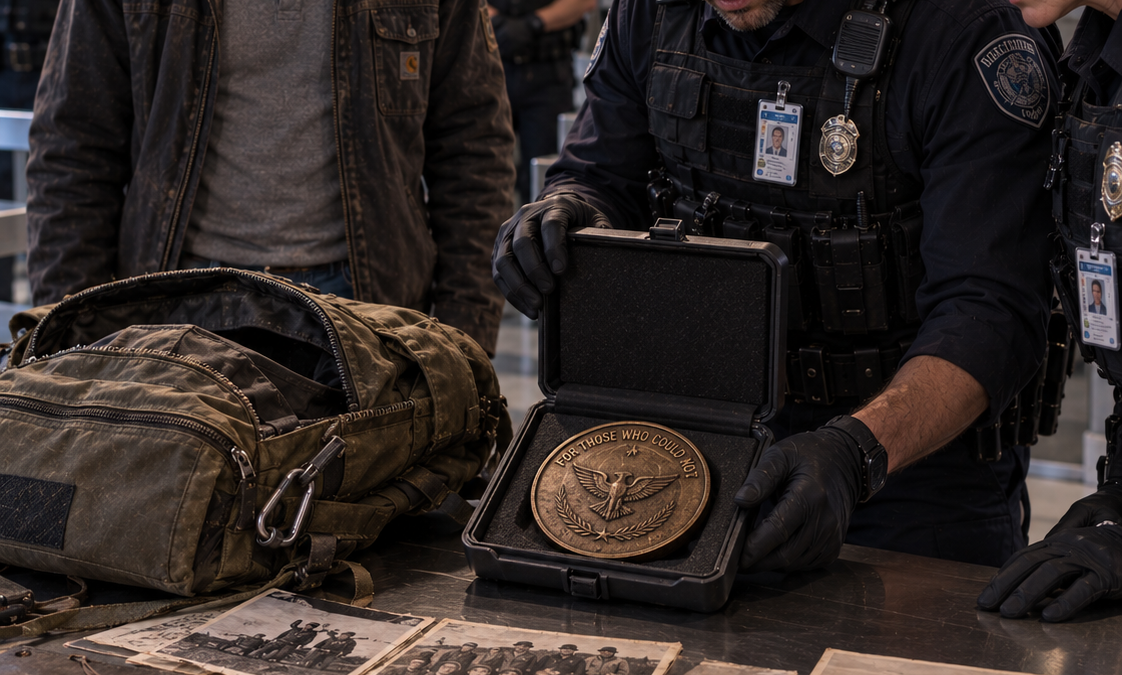
Then Raymond Husk, 72 years old, former operative keeper of 40 years of silence, did something that Daniel had not expected and that he would never forget. He reached into the inside pocket of his dark suit jacket and took out a small bronze medal, oxidized, almost brown, 3 in across. He held it up so that the light caught it and the five words on the face were visible to anyone who looked.
For those who could not, he held it up for 10 full seconds, not performing it, not making a speech about it, just holding it up, saying with the gesture alone that this existed and they had carried it, and now the world was going to know. Then he put it back in his pocket and Patricia sitting beside her father with his hand in both of hers looked at Clifford and Clifford was crying not quietly fully. The way a man cries when he has been holding something back for so long that the release of it is physical structural the whole body involved.
40 years of silence coming out through his eyes in a federal building in Washington on a Tuesday morning with his daughter’s hands around his.
Daniel did not look away.
He watched Clifford cry and he thought about his father in a hospital bed saying, “I need to tell you something in case I don’t come out of this.”
He thought about Gerald Fitch putting metals in backpacks and going home alone. He thought about an 11-year-old boy who thought his father was just a quiet man. He thought it was never just silence.
It was love carried in the only form available to men who weren’t allowed to carry it any other way.
It was the shape that love takes when the world closes every other door. After the formal proceeding, when the room had loosened into the quieter conversations of people processing something large, Daniel found himself standing near the window with Raymond.
Raymond was holding a cup of coffee that was getting cold.
He was looking at the room at Clifford talking to Margaret Marsh Holloway at Eleanor Fitchw Warren holding Gavin’s hand and saying something that made him bow his head at Patricia laughing at something her father had just said with the full body laugh of someone releasing attention she’d carried so long she’d forgotten it was tension.
“How do you feel?”
Daniel asked. Raymon thought about it.
He didn’t answer quickly, which was how Raymon did everything.
Not slow, but considered, he said, not in a bad way.
The way you feel after you’ve been carrying something heavy for a very long time and you finally put it down.
Like you have to remember how to stand without the weight of it. Daniel nodded. What happens now?
Raymond said, “For you, I go home.”
Daniel said, “Pick up Emma from school.
Make dinner.
Go back to work tomorrow.”
He paused. Same as before. Is it the same?
Daniel thought about the space on the bookshelf. The old backpack in the closet returned to him last week with the hidden compartment empty and the case no longer inside it. The worn canvas, the repaired stitching, the carabiner clip on the main zipper.
No, he said not the same, but close enough that Emma won’t notice.
Which is exactly right. Raymond looked at him.
Your father would be proud of you.
I’m going to stop being surprised when people say that.
Daniel said, since apparently everyone who knew him thought so, he paused.
I just hope he’s right.
He is, Raymon said simply. He was right about everything else.
2 days later, Daniel went back to work.
Pete Kowalsski’s truck had developed a new problem, a coolant leak that hadn’t been there during the transmission rebuild.
The kind of thing that happens with old vehicles. One problem solved, revealing another. Daniel found it at 9:30 in the morning and called Pete to explain.
And Pete said what people always said when their truck needed more work than expected. And Daniel listened patiently because that was part of the job, too.
Not just p the mechanical work, but the human work of sitting with someone’s frustration without adding to it.
He worked through until 2, then drove to school and picked up Emma.
She climbed in the truck and threw her backpack in the back and said, “How was your day?”
“Good.
Fixed a truck.”
“Almost.
Found another problem.
That’s kind of like your whole job,” she said.
Finding the next problem. He looked at her. 9 years old and already onto something that took most people a lifetime.
“Yeah,” he said.
“But that’s okay as long as you don’t mind looking.”
She considered this with great seriousness. Do you mind looking?
He pulled out of the school parking lot onto the familiar road that ran through the small town where he’d built his life.
Past the diner where he had breakfast sometimes on Saturdays.
Past the hardware store where he knew the owner’s name.
Past the elementary school and the library and the garage with his name on the sign that he’d paid for one letter at a time over 3 years.
“No,” he said.
“I don’t mind looking.”
Emma nodded like this was the correct answer to a test she’d been administering.
When they got home, Daniel opened his front door and stopped.
On the small table just inside the entry, where he sometimes left his keys and mail, was the metal case, the matte black case that had sat at the bottom of an old backpack for 3 years, and before that in a clot father’s house, and before that in Robert Carter’s hands on the day his son had come to collect what had been left for him.
Ellison had returned it. No note, just the case placed where Daniel would find it when he got home, which was exactly right. Emma came in behind him and saw him looking at it.
“What’s that?”
she said.
He picked it up, held it the way his father had held things that mattered, not tightly, not loosely, but with the specific grip of a man who knows the value of what’s in his hands, and also knows that value isn’t about possession.
Something your grandfather kept for a long time, he said, and then kept for me to keep. Emma looked at the case. Can I see?
He opened it.
The metal caught the afternoon light the way metal does when it’s been in the dark and is suddenly brought out with a kind of relief, almost as if light is what it had been waiting for all along.
Emma leaned in and read the words on the face of it, moving her lips slightly the way she did when she was reading something she was taking seriously. For those who could not, she said.
She looked up. What does it mean? Daniel looked at the medal.
He thought about Raymond holding it up in that room in Washington. He thought about Gerald Fitch going home alone after putting eight of them in eight backpacks and hoping.
He thought about his father saying, “Keep it close.
Keep it moving. And when someone finds it, tell them everything.
It means Daniel said that some people did something important and other people made sure it wasn’t forgotten.
He looked at his daughter. Both of those things matter equally. The doing and the remembering.
Emma looked at the metal for a long moment. Are we the ones who remembered, she said. Daniel felt something happen in his chest that was complete and quiet and needed no name.
Yeah, he said we are. He put the metal back in its case. He carried it to the bookshelf and set it in the empty space that had been waiting for it.
The space he hadn’t filled because he’d known without knowing how he knew that the right thing would come back to fill it when the time was right.
He stepped back and looked at it.
The matte black case on the plain wooden shelf in a mechanic’s house in a small town in Virginia.
Not in a museum, not behind glass, not in a vault or an archive or the kind of protected storage that important things get put in when the world wants to honor them from a distance. Here, visible in the house where a 9-year-old girl did her homework at the kitchen counter and asked good questions and looked at things with eyes that already is how to see what mattered. The greatest heroes, Robert Carter had believed, were the people who did what needed to be done without waiting for the world to notice.
Who carried responsibility in silence because silence was the cost of the ordinary life they were protecting. Who put metals in backpacks and journals in metal boxes and truths in the hands of the next generation and trusted had to trust because there was no other option that the right person would find them at the right time.
Robert Carter had chosen his son. His son had found Raymond and Clifford and Arthur Gavins and Elellanar Fitch and Margaret Marsh Holloway and a formal record that now said permanently and irrevocably that eight men existed and did something extraordinary and their names were real.
And Daniel Carter went to make dinner, and Emma sat at the counter doing her homework, making small deliberate circles, and her tongue pressed to the corner of her mouth. And the metal sat on the shelf in the light where anyone who came through the door could see it.
Not as a secret, not as a burden, as a promise kept and the proof that some truths are strong enough to survive 40 years of silence. Patient enough to wait for the right hands and permanent enough that once they are finally spoken out loud, nothing in the world has the power to make them disappear again.
—END—