They Set Up a Rookie Nurse With a Deaf Mafia Boss—Then Her Hidden Skill Saved His Life (part 2)
Part 2
The monitor down the hall was beeping again, the ed regular one nobody had silenced. And outside the window, Philadelphia was doing its one 0. A m thing the particular dark and light of a city at its quietest and least quiet simultaneously, and neither of them moved for a while.
Then he signed, “Every person I have let close has eventually become a liability, a pressure point, something that could be used against me or lost in the process of protecting me.”
His hand was steady, but the steadiness was deliberate.
“I know what you are becoming in this room.
I know what I am allowing.”
“What are you allowing?”
she signed. A long pause.
“I try every night to send you away,” he replied.
“Every night I fail,” she looked at him.
Maybe stop trying, she signed. He looked at her hands, then at her face.
That is exactly what I’m afraid of, he replied.
Graham Straoud arrived the next evening without warning and with the specific energy of a man who had been awake for 36 hours and was running on bad coffee and worse information. Elodie was in the corridor checking a supply cart when she saw him come off the elevator with two other men.
She didn’t recognize different from the previous ones.
Harder-faced moving with the deliberate economy of people who assessed every room they entered before they entered it. Graham saw her. He stopped.
“Is he awake?”
he said.
“He’s resting.
I need to speak with him.
He’s been resting for about 40 minutes.
His body needs ma’am.”
Graham’s voice was not unkind, but it was not interested in the sentence she was finishing.
I need to speak with him now, please. She looked at the two men behind him at their hands, their posture, the way they had positioned themselves relative to the elevator and the stairwell door. She stepped aside.
Graham went in. The two men stayed in the corridor, and Elodie remained near the supply cart and did not move because something in the way Graham had looked at her, not threatening, but measuring a sound like green woodsplitting. The way a person measures your deciding the weight of had settled into her chest and was sitting there with a particular heaviness.
She heard nothing from behind the closed door. 4 minutes later it opened and Graham came out and his face had changed. Not dramatically, just tighter, tired in a different way.
He stopped in front of her. He wants you in there, he said.
She went in. Ronin was sitting up. IV line pulled slightly from where he had moved too quickly and his expression was the full shutter version.
She had learned to read it that version. It looked like nothing. It was actually the face of a man processing something rapidly and giving nothing away while he did it.
She fixed the IV line. He let her. What happened?
She signed. Conrad has made a public move. His hands were very controlled.
He called a meeting with people from my organization. my people without my knowledge. He paused.
He told them that I am compromised, that I cannot lead, that the hospital stay is not temporary. Another pause.
He told them he has a doctor’s assessment, suggesting my injuries are more serious than reported.
Elodie stared at him.
That’s not true, she signed.
Your injuries are serious, but you are not.
I know they’re not true.
He held her gaze. But Conrad has a doctor who will say they are.
A bought opinion is still an opinion if enough people want to believe it. She sat down.
How bad is it? Two of the three men Conrad contacted have already responded.
He paused favorably. She understood what that meant.
Who was the third? He looked at her steadily. Graham.
She looked at the door. Graham just came in here to tell you. He said no.
She signed. Yes. Is that good or bad?
It depends entirely. Ronan signed on whether he is telling me the truth.
The room was very quiet. Can you tell? A pause.
Not yet, he signed. And that uncertainty is new. I have known Graham Straoud for 11 years, and I have never before been uncertain about him.
What does that tell you? That either he has changed, Ronin replied, or I am no longer capable of seeing clearly in here. He stopped.
I don’t know which is worse.
She thought about that, about the specific damage that being inside four walls does to a person who has spent their entire life operating from movement and control and the ability to see all angles. About the compound vulnerability of serious physical injury, plus enforced stillness, plus the knowledge that people outside those walls were making decisions about your future in real time.
You’re not losing your ability to see clearly, she signed.
You’re seeing a situation with incomplete information which is different.
He looked at her. How is it different? Because unclear vision is a you problem.
She said incomplete information is a situation problem.
You can’t fix unclear vision by getting more data.
You can work around incomplete information. A pause.
What would you do? He signed.
If you were me right now. What would you do?
She hadn’t expected the question.
It landed differently than she anticipated. Not rhetorical. Not the setup for a point he was already going to make.
An actual question. She thought about it honestly.
I’d figure out what I actually know.
She signed not what I suspect. Not what I fear.
What I actually know for certain.
And then and then I’d build from there.
He looked at her for a long time.
He’s the only person, he signed slowly, who has given me a straightforward answer since I came through those trauma doors.
Everyone else is managing you, she said.
I don’t work for you.
I don’t owe you a managed answer.
No, he signed.
You don’t.
He looked at his hands. That he signed is the problem. She waited.
Because it means I listen to you, he signed. And because I listen to you, people have started to notice that I listen to you. He paused.
and in my world being someone that Ronin Whitlock listens to is not a safe position. The floor dropped slightly beneath her.
She had known it in the peripheral way. You know things you are not ready to examine directly. She had seen it in the way Graham had looked at her in the corridor.
In the way the two men behind him had noted your position and filed it. She had felt it at the edges of every interaction on the floor.
the way the staff who found the situation amusing had slowly stopped finding it amusing and started finding it something else.
“Am I in danger?”
she signed. He held her gaze.
He did not answer immediately. In the time that it took him not to answer, she understood that the answer was yes, and that he had known it before she did, and that this was what had been sitting behind the full shutter expression when she walked in.
“Conrad’s people have been watching this floor,” he signed finally.
I have confirmation of that as of an hour ago. They know your name.
They know your schedule. He stopped.
They know you are the person I communicate through. Her hands were steady.
She was proud of that. What does that mean? It means you are no longer invisible.
He signed. And in a conflict of this nature, people who are visible and connected to me have two outcomes. He paused.
Either they are leverage or they are a message. She held his gaze.
Which am I right now? He sended leverage.
Conrad doesn’t send messages until he’s certain he’s winning.
He’s not certain yet.
And when he is, the question sat in the air between them.
Ronan’s jaw tightened in the specific way it tightened when he was holding something back that he didn’t want to hold back, but was going to regardless.
Request assignment, he signed.
Tonight, tell them it’s personal.
They won’t push you for a reason.
It doesn’t have to.
No, she signed. He stopped. No, she repeated.
I heard you. The answer is no, Elodie. It was the first time he had used her name.
The first time she had seen it in his hands. It had a different weight than she expected.
You don’t understand what Conrad is capable of.
He signed. Maybe not. But I understand what it looks like when someone is trying to make a decision for me because they think they know better.
She held his gaze.
and I’m telling you clearly that this one is mine to make.
He stared at her. Why? He signed.
Why would you? Cuz you matter, she signed.
And I don’t leave things that match her to me.
Because they become difficult. She paused.
That’s not something I’m willing to learn how to do.
He looked at her for a very long time. His hands were still. Then, very slowly, very carefully, as if he were doing something that cost him something real, he reached toward her, and his fingertips came to rest against her jaw.
Not a grip, not a hold, barely a touch, and his eyes were closer and more open than she had seen them, and she was not afraid, which surprised her, because she had expected to be.
Every person I’ve let close, he signed with his free hand, has paid for it.
Then maybe she replied, “You were letting the wrong people close.”
His hand fell. He looked at the window. Then a sound.
Not in the room.
In the corridor outside, a sharp, muffled exchange of voices rising and then cut off abruptly, followed by the kind of silence that isn’t the absence of sound, but the replacement of normal sound with something wrong.
Ronin heard it the same moment she did.
Not the sound he couldn’t hear it, but her reaction to it.
He watched her face and read what was on it, and the full shutter version slammed down like a door.
Eld crossed to the room’s window the door and looked out.
Two men she didn’t recognize were at the nurse’s station.
Not patients, not family members, not anyone who belonged on this floor at 11:52 at night.
We’re talking to Dean Huxley who was behind the station with the expression of a man who had just realized the thing he found entertaining for the last odd four days had stopped being entertainment.
And one of the men was showing him something on a phone and Dean was shaking his head and and the other man had moved slightly to the left in a way that positioned him between Dean and the elevator. She turned back to Ronan.
There are two men at the nurses station. She signed.
They don’t belong here.
He was already sitting up fully. Ivy line be damned. Description.
He signed. She gave it quickly. His face went through something in about half a second.
A rapid internal calculation. The kind that happens when information clicks into a pattern that was already half assembled. Get out of this room, he signed.
What? Go back to the station.
Stay visible.
Don’t react to them.
His hands moved fast and precise.
If they see you come out of here calm, they’ll assume you don’t know anything.
If you stay in here, they’ll assume you’re being hidden.
What are they here for? Confirmation, he signed.
They’re here to confirm I’m still in this room and assess the floor layout.
He paused, which means Conrad is moving to the next stage.
What’s the next stage?
He looked at her. His hands were still outside.
She could hear Dean’s voice again, higher now, with the specific pitch of someone working very hard to sound normal.
She looked at Ronan. He looked at her.
And in the silence between them, without either of them saying it, the last possible pretense that this was a situation she could step back from dissolved completely, quietly, and without ceremony. The way things end when they have already been over for a while, and everyone has simply been waiting for the moment to catch up. She was in it now.
She had been in it. She understood since the moment she signed back. She walked out of his room at 11:54 p.m.with her hands loose at her sides and her face doing the thing she had learned to make it do in trauma situations.
Present, calm, belonging exactly where it was. The corridor felt different than it had 20 minutes ago.
Not visibly. The lighting was the same flat institutional white. The monitor down the hall was still beeping its irregular beat, but some something in the air had shifted the way.
Air shifts before weather, a pressure change too subtle for the eyes, but immediately legible to the body.
The two men were still at the nurse’s station.
Dean was behind that counter, both hands flat on the surface, which was his tell Dean Huxley put his hands flat on surfaces when he was trying not to let them do something that would give him away. She had watched him do it during a family confrontation in the ICU two months ago.
She recognized it now. She walked toward the station at her normal pace. Not fast, not slow, the pace of a nurse returning from a patient room with nothing remarkable to report.
The nearer of the two men turned when she was about 8 ft out.
He was mid-40s, unremarkable face, the kind of build that read as regular until you noticed the way he’d distributed his weight, slightly forward, slightly ready.
His jacket was dark and fit wrong across the left shoulder in the way that things fit wrong when there is something under them. Evening, he said. Evening, Elodie said, and moved around him to reach the chart rack.
He didn’t step out of her way immediately.
Just a half second lag. Deliberate enough to be a statement.
Brief enough to be deniable. She pulled a chart. Busy night, he said.
They’re all busy nights.
She opened the chart without looking at him. Can I help you find someone?
Visiting hours ended at 8.
We’re here to see a patient.
Whitlock. Ronan Whitlock.
Mr.Whitlock is resting. She kept her eyes on the chart.
You can check with the front desk in the morning about visiting hours.
We’re close friends of his.
I’m sure you are.
She closed the chart.
He’s resting.
Front desk. Morning. The second man had moved while she was talking to the first one.
She registered it in her peripheral without tracking it directly.
He had drifted two steps to the right, which uh put him at an angle that covered both her position and the door to Ronan’s room simultaneously.
It was a casual movement. It was not casual, Dean said from behind the counter with the voice of a man holding himself together by the specific effort of his entire personality.
I already explained visiting hours, gentlemen. We do take patient rest seriously on this floor. The first man looked at Dean, then back at Elod.
Tell him Marcus came by, he said.
I’ll pass that along, Elod said.
He held her gaze for exactly 2 seconds longer than was socially normal. It was not a threatening look. That was the thing about it.
It was an assessing look, precise and brief, the kind that takes a photograph and files it. He was memorizing her face.
Then he nodded once and walked to the elevator. The second man followed without looking at her, which was somehow worse than being looked at.
The elevator doors closed. Elod set the chart back in the rack. Dean exhaled so sharply it was almost a word.
What? He said was that. Visitors, Elod said.
Go document the interaction. Time, description, what they asked for. Do it now before you forget the details.
Dean stared at her. Elodity now Dean. He sat down and started typing with the energy of a man who has just decided that being thorough with documentation is the safest available activity.
She turned and walked back to Ronan’s room and did not let her hands shake until the door was closed behind her.
He read her face before she reached the bed.
They’re gone.
She signed for now. His jaw was set.
Marks.
That’s who he is.
Conrad’s logistics man.
He doesn’t come himself unless Conrad wants eyes on confirmation.
Confirmation of what?
That I’m still accessible.
He paused. That the floor is manageable. She understood what that meant.
She wished she didn’t.
He looked at me. She signed. He was memorizing my face.
Ronan’s expression did something controlled and cold.
I know.
You knew they’d do that, I suspected.
He looked at the door. I hoped I was wrong.
She sat down. Her legs were steadier than she expected, which she filed as a small and specific piece of good news. What does Graham know about this?
She signed.
I’ve told him Marcus came.
He’s making calls.
He paused. The question is whether those calls go where I intend them to go or somewhere else.
You still don’t know if you can trust him.
No. She looked at her hands. then at his ronin.
She waited until his eyes met hers.
“How long do we have before this moves from surveillance to something else.
He held her gaze at the rate Conrad is moving,” he signed.
“48 hours, maybe less.
The number sat in the room.”
“Then we need a plan,” she said.
He looked at her for a moment with that expression she had come to recognize, the one that was not quite surprise, but was the thing adjacent to surprise.
The thing that happened when she said something that moved in a direction he hadn’t fully anticipated.
We he signed. Yes, she replied.
We the plan such as it was required. Graham. Ronin was clear about that and equally clear about what it meant.
He was going to have to decide without certainty whether to trust a man he had known for 11 years and was no longer sure of. He was going to have to make that call from inside a hospital room with two gunshot wounds and incomplete information.
and the knowledge that getting it wrong had a specific and irreversible consequence. He made the call at 2 0 a.m.Graham arrived at 2:31 alone this time, and he came in with the particular quality of a man who has been awake for too long doing things he cannot talk about and has arrived somewhere he needs to be honest.
He stood at the foot of the bed and looked at Ronin, and then he looked at Elodie. And then he looked back at Ronin with an expression that had shed the managed professional layer and was showing something underneath it that was older and more tired.
“Conrad contacted me again tonight,” Graham said.
2 hours ago.
Ronan’s hands moved.
LOD translated without being asked. What did he offer?
Graham’s mouth tightened.
Operational authority over the Northern Distribution Network. Permanent with full autonomy.
He paused. He was very specific about the numbers. And I told him to go to hell.
Graham said it flatly. I want that on record.
I told him no. I told him why. And I told him that if he moved against you while you were in this hospital, he would not enjoy what came after.
Ronan looked at him.
Elodie watched Ronan’s face.
He was reading Graham the way she had seen him read rooms, not the surface, the structure under it, the loadbearing elements. Why are you telling me this tonight?
Because Marcus Fel was on this floor 2 hours ago, Grahams said.
And that means Conrad isn’t waiting anymore.
He’s done with the approach phase.
He looked at Elodie briefly. And because your nurse here is now a visible part of this situation, and she deserves to know that, too. She has a name, Ronan signed.
Elod, Graham said. I know.
He paused.
I’m sorry you’re in the middle of this.
I’m not in the middle of it, she said.
I’m standing next to someone who is.
That’s different.
Graham looked at her for a moment with the expression of a man recalibrating something. Fair enough, he said quietly. He turned back to Ronan.
Conrad has two men inside the hospital. Not on this floor yet, but in the building.
I have confirmation from a source I trust. He paused.
There’s more.
Say it. Graham looked at the floor for one second.
Just one, then back up.
The doctor’s assessment he used to tell your people you were incapacitated.
He said it wasn’t bought.
It wasn’t fabricated.
He stopped. It was written by someone with access to your actual chart. The room went very still.
Elodie felt something cold move through her chest.
Someone on this floor gave Conrad’s people your real medical information.
Graham said.
The assessment was accurate, detailed, specific enough that it couldn’t have come from observation.
It came from someone who read your chart.
Ronan’s face showed nothing.
Absolutely nothing. But his hands flat on the bed, pressed down slightly into the surface, the only physical tell she had ever seen from him. And she recognized it now as what it was, the contained, ferocious effort of a man keeping himself from reacting the way every instinct in him was demanding.
He looked at Elodie. She already knew what the look meant.
She was the one who had access to his chart. She and every other nurse and physician on the floor, but she was the visible one.
The one Marcus Fel had memorized. The one Graham Strad had looked at twice when he walked in.
She held Ronan’s gaze steadily.
It wasn’t me, she signed.
He held her gaze for three full seconds.
“Then I know.”
Graham said, “We don’t think it was you.
For what it’s worth, Conrad’s people already had information from this floor before you were assigned to this room.
The access predates you. She exhaled.
Who Ronan signed. Graham looked at the door and back. Mallerie Crane has been on this floor for 19 years.
She has access to everything, and she has a brother who owes Conrad Bellamy a significant amount of money. He paused. We think Conrad called in the debt.
The name landed in the room and everything rearranged itself around it.
Elod thought about Mallalerie’s coffee cup and her warning voice and the 19 years behind her eyes and the specific way she had said, “It’s a warning, not concern.
” She thought about the ease with which Mallerie had assigned her to this room.
uh the setup that everyone including Elodie had read as casual cruelty, but which had actually been something more structured and deliberate, not a joke, a placement, a person positioned close to the patient whose chart was already being read. She thought I was never the butt of the joke. I was the cover for the person who was already there.
Her hands were very still in her lap.
Does she know the full scope of what she’s enabling?
She signed. Graham answered before Ronin could.
Probably not.
Conrad doesn’t show people the full picture.
He shows them the part they need to see to say yes. She needs to be removed from the floor. Ronan signed tonight without knowing why.
If she knows she’s been identified, she’ll warn Conrad.
That’s an HR matter, Elodie said.
That’s a phone call.
Graham said, “Do you have a charge nurse or administrator you can reach?”
She thought about it about the call she would have to make.
about what she she would say and what she couldn’t say and the specific gap between those two things.
Yes, she said. Can you do it without explaining everything?
Ronin signed. She thought about Helen Marsh, the night administrator, who had been running this hospital for 15 years and had the specific quality of a woman who understood that there were times when the thing being said and the reason for saying it were two separate and unconnected matters.
I can do it, she said. She made the call from the supply room across the hall at 2:48 a.m.M. Helen Marsh answered on the third ring with the alert voice of someone who had trained herself to wake fully immediately because the calls that came after midnight were never small.
Helen, it’s Elodie Mercer.
I need to flag something. I have a concern about a potential patient privacy breach on the floor, and I think it needs to be addressed tonight.
I know that’s who, Helen said.
Elod paused.
I’d rather not say on the phone, but I think it warrants pulling someone off the floor for a secondary assessment of chart access.
If I’m wrong, I’m wrong.
But give me the name, Helen said. A beat.
Mallerie Crane. Silence on the line. Not the silence of surprise.
The silence of someone filing something that has just confirmed a suspicion they already had.
I’ll handle it, Helen said.
I’ll have her pulled before the next round.
It’ll be framed as a scheduling adjustment.
Thank you, Elodie.
Helen’s voice shifted slightly.
Is the patient on your floor in immediate danger? She thought about Marcus Fell in the elevator.
About two men somewhere in the building she couldn’t see.
I don’t know, she said.
Possibly.
I’m calling security.
Please, Elod said. Yes.
She hung up. She stood in the supply room for 10 seconds with her back against the shelving and the smell of antiseptic and clean linen around her and she breathed carefully fully.
The way she had learned to breathe in the worst moments of the trauma bay when the situation was beyond the point where panic was useful and the only thing that served anyone was the particular discipline of staying inside her own body. Then she went back across the hall.
The next 3 hours were the specific kind of quiet that is louder than noise. Graham left at 3:15 with instructions she had translated and a plan that Ronin had laid out in rapid precise detail who to call in what order, what to say and what not to say. He left with the look of a man who had made a decision about which side of something he was on and had stopped second-guessing it, which was either reassuring or the most wellexecuted performance she had ever seen.
She didn’t know which.
She suspected Ronan didn’t either, and that the not knowing was its own form of damage.
Mallerie disappeared from the floor at 3:40 a.m.Elodie didn’t see it happen.
She heard from Dean, who had the shaken quality of someone who had been absorbing too much information for too many hours, that Mallerie had been called to administration and had not come back. Dean said it with wide eyes and a voice that had lost its usual performative edge and was just human now.
Just the voice of a person trying to process something they didn’t have a frame for.
What is happening on this floor? He said not really a question.
I don’t know all of it.
Elodie said, but you know some of it. Some? He looked at her.
Are we safe? She thought about the two men in the building. Security has been notified.
She said stay at the station.
Don’t let anyone through without ID and a patient name.
And if you see anything that feels wrong, this whole night feels wrong. Anything that feels more wrong than it currently does, she said. Call me first, then security.
He nodded with the energy of a man grateful to have instructions.
She went back to Ronan’s room.
He was not lying down. She had expected him to be had expected the accumulated hours and the blood loss and the sustained physical tension to have pushed him toward at least a horizontal compromise with the recovery his body was demanding.
Instead, he was sitting fully upright with his chart open in his lap, reading his own medical records with the focused expression of a man conducting reconnaissance.
You can’t, she started aloud, then signed.
You cannot be reading your own chart right now.
I’m looking for what was taken, he signed without looking up.
Ronan, two minutes. She sat down and let him have 2 minutes. In the silence, she watched his face move through the pages, not reading the way most people read medical documents with the half comprehension and slight anxiety of someone processing unfamiliar language.
He was reading it the way he had read the trauma bay when he came in, systematically, structurally, identifying what mattered. After 90 seconds, he closed the chart. The shoulder wound details, the specific tissue damage, vascular involvement.
He paused. That level of specificity requires someone who read the surgical notes, not just the admission record. Mallerie had access to the surgical notes.
He looked at the window. She gave Conrad a picture of exactly how compromised I am.
Not just physically. She would have documented my communication method. the ASL who I communicate through.
She held his gaze. Me, Yui confirmed. The word sat there.
She had understood it before.
Intellectually, the way you understand something that hasn’t fully arrived yet.
Now it arrived.
She was not incidental to Conrad’s awareness of the situation.
She had been documented, included, filed under the category of things that could be used.
“How angry are you?”
she signed. He looked at her.
“Zero.”
He paused. At myself considerably.
Why at yourself? Because I knew the risk of allowing you to become visible and I allowed it anyway.
He stopped. Because I let something matter before I had secured the situation.
You can’t secure everything.
I used to think I could, he signed. That was the purpose of not letting anything matter. She looked at him.
How’s that working for you?
She signed. He looked back at her and something in his face did the thing it had been doing incrementally across four nights the gradual, reluctant, apparently involuntary process of opening, not softening.
He was not a soft man, and she didn’t think he ever had been.
Something more accurate than that, something like the difference between a room with no windows and a room with the blinds drawn. The structure was the same, but there was light coming through the edges.
He reached toward her. His hand came to rest over hers.
Not a sign, not communication, just his hand over hers, warm and heavy with the specific weight of deliberate choice. She turned her hand over, his fingers closed.
She thought, “This is either the most honest thing I have done in a long time, or the most reckless, and I am genuinely not certain those are different things.
” Then the corridor outside went wrong.
It happened in sequence, quickly enough that the sequence only became clear afterward. First, the lights in the corridor dimmed without going out a flicker.
2 seconds returning.
Second, Dean’s voice, high and wrong, cut off mid-sentence.
Third, the absence of the monitor beeping, which had become come in the background a constant she hadn’t known she was tracking until it stopped.
Ronan felt her hand tense. He was already reading her face.
“What?”
he signed. She crossed to the door.
She looked through the window. Dean was behind the station with both hands flat on the counter and his face the color of chalk. Standing across from him were two men not Marcus Fel.
Different men with the specific quality of people who had come to do something rather than observe something.
One of them was holding Dean’s phone.
The other was looking at the whiteboard behind the station where patient room assignments were written. He was looking at room 7. She turned back.
Ronin was already up.
Not standing, he couldn’t stand fully.
His leg wouldn’t hold it.
She could see the effort of the attempt in the locked line of his jaw and the way his weight distribution was already compensating. He had his ivy line in his fist, not disconnected, pulled taut with the movement away from the pole.
“They’re here,” she signed.
“Two of them at the station.”
His expression did not change. How close to the room?
30 ft.
They’re looking at the room board.
He looked at the door, at the window in it, at the angle of visibility.
They don’t know the exact room, he signed.
Not yet. The board has a last name, not a number.
How long? 30 seconds, maybe less.
He looked around the room with the rapid systematic quality she recognized from the first night exits, positions, options, and she watched him reach the same conclusion she was reaching, which was that the options were limited, and the time was shorter than either of them wanted, and the gap between what should be possible and what was actually available was significant. He reached up and pulled
the IV line free from his arm. not gently.
The way you remove something when the only relevant consideration is speed. A bead of blood appeared at the insertion site.
She grabbed gauze from the bedside table and pressed it to his arm without being asked. Wheelchair, he signed. Corner now.
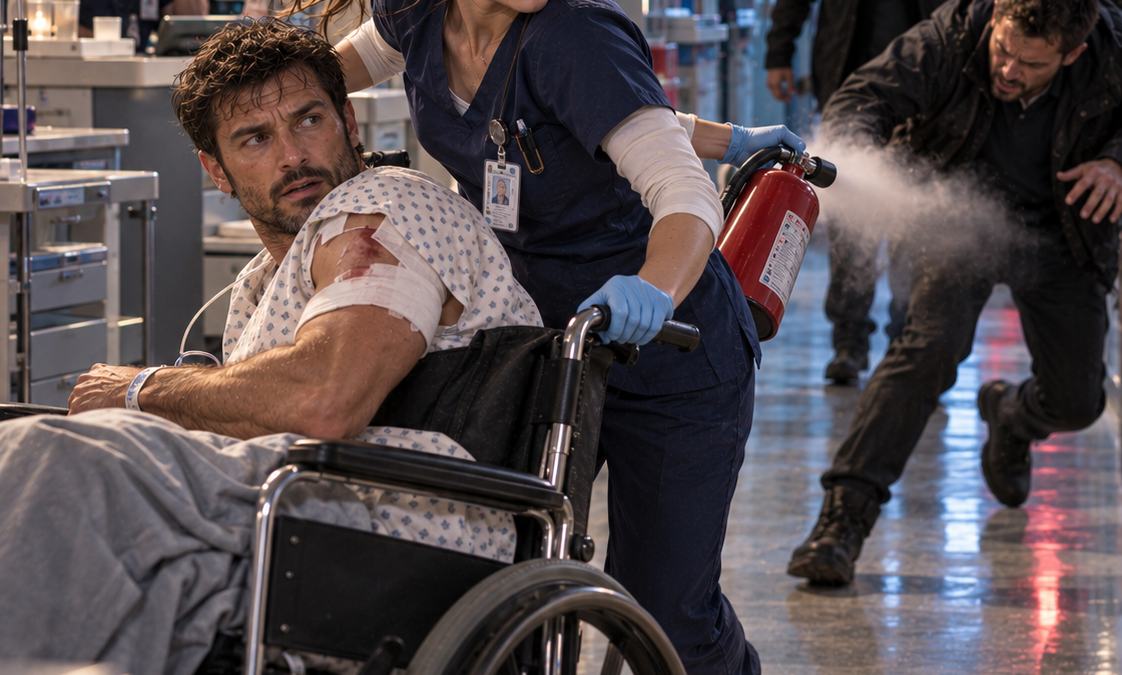
She crossed the room in four steps and grabbed the wheelchair that had been folded against the wall for 3 days while he refused it. She unfolded it.
You’re getting in this and you’re not arguing with me, she signed.
I wasn’t going to argue, he signed.
She helped him into it, not carefully, not the way she would move a patient in a normal situation, but fast, functional, his weight transferring to the chair with a controlled fall that was half her grip and half his. And she could feel in the way his shoulder moved the exact cost it was extracting from him. She positioned behind the chair.
She looked at the door. She looked at him.
He looked back at her over his shoulder with an expression that had no managed quality in it at all. No shudder, no control, nothing withheld. Just the specific look of a man who has just understood something he cannot undo.
If this goes wrong, he signed. None of it is your fault.
It’s not going wrong, she said.
She reached past him and pushed the door open.
The corridor at 4 11:00 a.m.was washed in the institutional light, and the two men who were not supposed to be on this floor were turning from the nurse’s station, and the nearer one’s hand was already moving toward the left side of his jacket.
And Elodie Mercer, 24 years old, 8 months a nurse, 4 days into something she had no name for, pushed Ronin Whitlock’s wheelchair out into the corridor, and made the fastest calculation of her life.
The fire extinguisher was mounted to the wall beside the stairwell door 12 ft to her left. The elevator was 40 ft to her right.
The stairwell was beside the extinguisher. She turned left. The first man reached them when she was 6 ft from the stairwell.
He grabbed the wheelchair handle from behind a hard pull, intending to stop the momentum, and she felt it in her shoulders. The sudden arrest and she did not stop moving.
She let the wheelchair’s momentum convert into a a pivot, spinning the chair sideways, and in the space that created, she grabbed the fire extinguisher off the wall with both hands.
The man was moving toward her when she brought it across. She did not aim for his head.
She aimed for his knee, the way she had been taught in a self-defense class four years ago by an instructor who said, “People protect their heads.
Nobody protects their knees.”
It connected. He went down, not out. Down one leg buckling.
The movement interrupted the forward pressure gone for two seconds. 2 seconds was what she had.
