They Set Up a Rookie Nurse With a Deaf Mafia Boss—Then Her Hidden Skill Saved His Life (part 4)
Part 4
Ronan’s expression did not change.
His hands did not move. Graham said Voss reached Aldridge at 8:39.
He didn’t.
He wasn’t required to do anything beyond deliver a message.
The message was enough. He looked at Ronin carefully. Aldridge made his own choice.
The math on his situation was very clear and Voss made sure he understood it completely.
That’s all.
Elodie looked at Graham.
She thought about what that’s all contained and decided she was going to let it contain it.
Conrad Ronan signed. She translated. Federal agents made contact at 901.
Graham said he’s in a federal building right now.
His lawyers are already there, but the documentation on the phone is is it’s comprehensive.
This isn’t something he walks out of today.
He paused. Or probably in the foreseeable future. The room was quiet.
Then signed something slowly with the specific quality of a man saying something he has been working toward for a long time without knowing it.
Elodie said, “He says, “Is it finished?”
Graham looked at him. The Conrad situation. Yes, he said.
He stopped. He looked at the floor briefly and then back up. The other thing is going to take longer.
There are processes, people who need to be accounted for.
The organization has parts that don’t just stop because the man at the top decides to stop them.
He paused. But if you mean, is the immediate danger finished?
Yes. For now, yes.
Ronan looked at the window. Outside the morning was fully established now the light flat and bright and the river visible in the distance catching it the way it always caught it indifferently.
He signed one more thing. Elod translated quietly.
He says thank you.
Graham looked at him for a moment with an expression that was difficult to categorize something between relief and grief and the particular tenderness of people who have been through too much together and have arrived somewhere they didn’t entirely plan.
Don’t thank me, Graham said.
I almost cost you this. Ronan looked at him.
He signed.
You didn’t.
I was uncertain when I should have been certain.
Uncertainty isn’t betrayal, Ronan signed.
I know the difference. Graham was quiet for a moment. Yeah, he said finally.
Okay. He picked up his jacket from the chair where he had draped it sometime in the early hours.
I’ll handle the next steps.
You should, he looked at Elodie. Someone should make him sleep.
I’ve been trying, she said.
Good luck, Graham said. And there was something almost human at the edge of it, almost light.
The ghost of a tone that belonged to a different kind of morning. He went out. The door closed.
The room was very quiet. Elodie looked at Ronin.
Ronan looked at his hands. Then he looked at her. And what happened in his face in the following moment was not dramatic.
It was not the kind of thing that would read from a distance or translate easily into language. It was small and internal and completely real.
The specific expression of a man who has been holding something at a controlled distance for a very long time and has just in the silence after the storm allowed it to be close. She moved to the edge of the bed.
She sat down. She did not say anything.
His hand came up and signed slowly, “It’s over.”
Yes, she replied. Are you all right? She thought about the fire extinguisher and the stairwell and the phone call to Helen Marsh and the conversation with the disconnected line in the south corridor and the 11 minutes of redressing a shoulder wound that should not have been open again.
Ask me tomorrow, she signed.
Today I’m still running on whatever tonight was.
Something moved in his face, not quite a smile, the thing adjacent to it that she had learned to recognize as his version of one. He signs in, and the word in his hands had a weight that was not just about tomorrow. She looked at him.
Sleep, she signed.
Right now, that’s what happens next.
He looked at the window.
I don’t sleep easily.
I know. Sleep anyway.
He looked at her. Will you stay?
She looked at the chair, at the clock, at the morning light on the window and the sound of the hospital moving into its day outside the door. She should go home. She had been on shift for 14 hours and off shift for two more, and her body had been making increasingly direct representations about what it required, and there was nothing clinically requiring her presence in this room.
And the professional version of herself had a list of reasons that going home was the correct choice.
She pulled the visitor’s chair to the side of the bed.
Nate, she sat down.
I’m here, she signed.
He looked at her for a moment with the open expression. Then he closed his eyes.
She watched his breathing even out over the following minutes slowly with the particular difficulty of a body that has been at high alert for days and doesn’t trust the deescalation immediately.
She watched the tension in his jaw loosen by degrees. She watched his hands flat on the bed gradually release the subtle grip they had been maintaining without his awareness.
He slept. She sat in the chair and watched him sleep and thought about nothing in particular for a while, which was the closest thing to rest available to her in that moment.
And outside the window, the river kept doing what rivers do. The hospital processed what had happened. The way institutions process things slowly, systematically with the particular organizational anxiety of an entity that has had something happen within its walls that falls outside its prepared categories.
Helen Marsh called EOD at 10:30 that morning after EOD had gone home and slept for 6 hours and woken up feeling like someone had pressed reset on a machine that had been running at unsafe temperatures. I need you to know, Helen
said without preamble, that what you reported about Mallalerie Crane has been substantiated. She will not be returning to the floor.
A pause.
I also need to tell you that your conduct during last night’s incident has been flagged for administrative review, not disciplinarily.
I want to be clear about that.
It’s a documentation process required when nursing staff are involved in a security event.
I understand. Elodie said what you did last night. Helen said and then stopped.
Elodie waited. Was not in any manual, Helen said.
I’m not sure whether it was the bravest thing I’ve heard happen on this floor or the most reckless.
Both probably, Elodie said. Another pause. Both.
Helen agreed. Come in for the review Thursday.
Bring your incident notes a beat and get some rest before then. She hung up.
Elod sat on the edge of her bed with the phone in her lap and looked at the wall of her apartment, which was the particular off-white of a rental that nobody had repainted in years, and she thought about Mallerie Crane and a brother with a debt debt and 19 years of a job that had started as something and become something else. and she felt the complicated sadness of a situation where the villain was also a person who had made a bad choice under pressure that she could almost if she was honest understand almost.
She thought about her brother Slitus who had lost his hearing before he could properly remember having it and had built a life anyway, a good one, a full one, a life where the absence of a sense had simply rearranged the architecture of how he moved through the world rather than diminishing the world itself. She thought about calling him.
She almost did. Instead, she went back to sleep. Ronan was moved to a private room on the sixth floor there the following day.
Not because his condition warranted a change, but because the seventh floor had become in the quiet institutional language of administrative decisions, a location associated with a security event, and moving the patient was the cleaner option. The new room had a better view of the river.
Elod noticed it when she came in on her next shift. The angle of the window different, the light different, the river visible in a longer line than it had been from the seventh floor, a wider strip of silver brown water.
In the late afternoon, Ronan noticed her noticing. He signed better view. Much better, she agreed.
She did his assessment. His shoulder was closing correctly.
The surgical resident had confirmed no suture separation, which she had known, but was glad to have officially confirmed. His leg wound was progressing normally. His blood pressure had stabilized.
His vitals were, in the clinical language of charts and documentation, unremarkable, which in this context was the highest possible praise. She sat down after the assessment and looked at him.
He looked back. They had not in the day since the morning of the resolution spoken about anything that had happened in any sustained way.
Not because either of them was avoiding it, she thought, but because some things need a little time to solidify before you can handle them directly. The way concrete needs time before it can hold weight. Graham told me something today, she said.
He waited.
He said, “You’ve started talking to people about the organization, about what comes next.”
Yes, he signed. What does that look like? He was quiet for a moment.
His hands moved slowly with the deliberateness of someone choosing precision over speed. The violent operations close, he signed. Not transferred, not sold, closed, he paused.
The people in them get options.
Some of them will take them, some won’t.
The ones who won’t are no longer my problem to manage.
and the legitimate businesses separated fully.
Professional management oversight that isn’t me.
He paused.
I’ll remain involved, but as a principle, not of what I was.
He stopped. It takes time. 6 months, possibly a year for all of it.
These things don’t unwind quickly.
She looked at him. Are you ready for that?
A year of unwinding something you spent 20 years building? He held her gaze steadily.
I’ve been ready, he signed since the night I admitted it to myself in this building.
He paused.
The problem was I didn’t have anything on the other side of it.
There was nothing to move toward, just the absence of what I was leaving. And now she signed. He looked at her.
Now I have a direction. She felt the weight of that settle in her chest.
Not lightly, not easily, but solidly. The way things settle when they are true. And you know they are true.
She said, “I’m not going to pretend I know exactly what this is yet.”
“Neither do I,” he signed.
“But I’m not walking away from it because it’s complicated.”
“I know,” he signed.
“That stopped surprising me around the second night.”
A pause. It started terrifying me around the third. She looked at him.
“Good,” she said.
He almost smiled. The real version this time, fuller than she had seen it.
Not the ghost of it, not the adjacent thing, but the actual shape of it. briefly, genuinely, in the way that things that have been away for a very long time are awkward when they first come back and then become gradually simply present. She had a feeling she was going to see it more often.
Mallerie Crane’s administrative review concluded 3 weeks later.
Elodie read the summary in the breakroom on a Tuesday afternoon between shifts a single page. Between shifts a single page, the language precise and institutional and almost entirely stripped of the human situation.
It was describing patient privacy violation, unauthorized disclosure of protected medical information, termination of employment effective immediately, no mention of Conrad Bellamy, no mention of the brother, no mention of the debt that had made a tired woman with 19 years of a
career decide that one compromise was manageable. El sat with the page for a moment, then she put it in the recycling bin and went back to work.
She thought about Mallalerie for another week after that in pieces on the drive home in the break between patient rounds once at 3 0 0a.
When she woke up and couldn’t immediately get back to sleep, she thought about what it takes for a person to get to the place Mallerie had gotten to.
The accumulation of small erosions, the particular loneliness of a job that asks everything and gives back the satisfaction of having helped people who are mostly too sick or scared to say thank you. The specific vulnerability of a family debt in the hands of some of someone who understood exactly how to use it. She did not forgive Mallerie.
She did not think about forgiving Mallerie. She thoughts about understanding her, which is different, and which she found she could do partially at an angle, in the way you can look at something very bright by looking just to the side of it.
She did not communicate any of this to anyone. She filed it where she filed the other things from that week in the specific interior space where the experiences that have changed. You go to become part of the structure rather than the furniture.
You don’t take them out and examine them often, but they hold the walls up.
Dean Huxley came to find her on the Thursday of the second week. He appeared at the door of the break room with a coffee and the expression of a man who has prepared a speech and is now reconsidering whether to give it. Hey, he said.
Hey, she said. He came in. He sat down across from her.
He put the coffee on the table. I wanted to say something, he said. She waited.
I handled that whole situation badly. He said from the beginning when Mallerie set you up with the room.
I knew what she was doing.
I didn’t think it was going to be anything serious.
I thought it was just he stopped.
That’s not a good enough reason.
I knew it was unkind and I went along with it. She looked at him and then when those men showed up at the station, he said and I he looked at his coffee.
I didn’t do anything useful until it was already almost too late.
You were the one who told me to document it. You were the one who handled the whole thing and I was just standing there being useless.
You called security, she said after. Still counts, she said.
He looked at her.
I’m sorry, he said for the beginning part, the setup part.
She looked at him for a moment at the genuine discomfort in his face, which was not performed Dean Huxley was not subtle enough to perform discomfort this specifically. It was real and it had clearly been sitting with him for 2 weeks and she thought about what it costs a person to go find someone and say the thing that has been sitting with them and she thought that cost was worth acknowledging.
Okay, she said.
That’s it.
What else do you need? He blinked.
I don’t know.
He said I thought there might be more of a I don’t know.
A process. I accepted the apology.
She said that’s the process.
She picked up her coffee.
Don’t do it again.
I won’t, he said very quickly.
Very sincerely, she believed him. Ronan was discharged on a Wednesday morning, 3 and 1/2 weeks after he had come through of the traumadors at 11:47P with two gunshot wounds and nobody in the building who could understand him.
The discharge was quiet. No visitors in the waiting room, no cars visible from the front entrance.
A sound like green woods, nothing that would have communicated anything to anyone watching, and Graham had arranged it carefully to ensure that watching was not something anyone who shouldn’t be was able to do.
A car came to the side entrance.
Two of Graham’s people flanked the exit.
Elodie was not on shift. She came anyway.
She was in the room when the attending physician signed the discharge paperwork and went over the recovery instructions. Wound care, physical therapy, referral. The shoulder needed supervised rehabilitation for at least 8 weeks.
No significant physical exertion. Follow-up in two weeks.
The attending spoke to Ronan directly, having learned over 3 and 1/2 weeks the particular rhythm of speaking to someone who reads lips and signs simultaneously. And Elodie sat in the chair and watched the interaction with the specific feeling of someone who is present at something that marks a boundary between one kind of time and another.
When the attending left, they were alone. Ronin was dressed, which was the first time she had seen him in actual clothes since the trauma bay dark jacket, clean shirt, the particular way that clothes sit on a person who normally inhabits them with authority and is currently restricted in his movements. He looked like himself.
He looked less like a patient and more like the man Graham had described over the course of several conversations, the man who controlled rooms, who built things, who made decisions that moved through a city in ways most of the city never traced back to their source. He also looked tired and thinner than he should be.
a sound like green wood splitting and like someone who had been through something significant and was carrying it visibly in the set of his shoulders and the slight new lines around his eyes. He looked real. She stood up.
He looked at her.
She signed, “How does it feel?”
“Strange,” he replied.
“Everything outside this room feels far away.
” “Like a thing I remember rather than a thing I’m going back to.”
“You’re going back to a different version of it,” she said.
“That’s not the same as the one you remember.”
He held her gaze. No, he signed.
It’s not.
Will you come? He signed.
To the house.
When you’re ready.
Not today. Not.
I’m not asking for today.
But when you’re ready, I want you to see it without all of this between us.
She thought about the photograph Graham had mentioned once briefly, the house overlooking the Delaware, the view of the water, the the thing Ronin had built with money that had come from a life he was in the process of leaving.
She thought about whether a place could be honest if the life it was built on wasn’t.
She thought he is changing the life. The place is just a place.
Yes, she signed. He looked at her.
You don’t have to.
I said yes, she replied. I meant yes.
He was quiet for a moment. Then he signed carefully.
I want you to know something. Before I go, she waited.
I know what I’m asking of you is not simple, he signed.
The life I’m moving away from doesn’t disappear because I’ve decided to move away from it.
There are going to be people who remember what I was situations that carry the weight of what the organization was.
I can’t clean that completely.
I can only choose differently going forward. I know, she signed.
It might be complicated for you. Professionally, socially, he paused.
I don’t want you to walk into something without seeing it clearly.
She looked at him. Ronan, she signed.
I’m a trauma nurse.
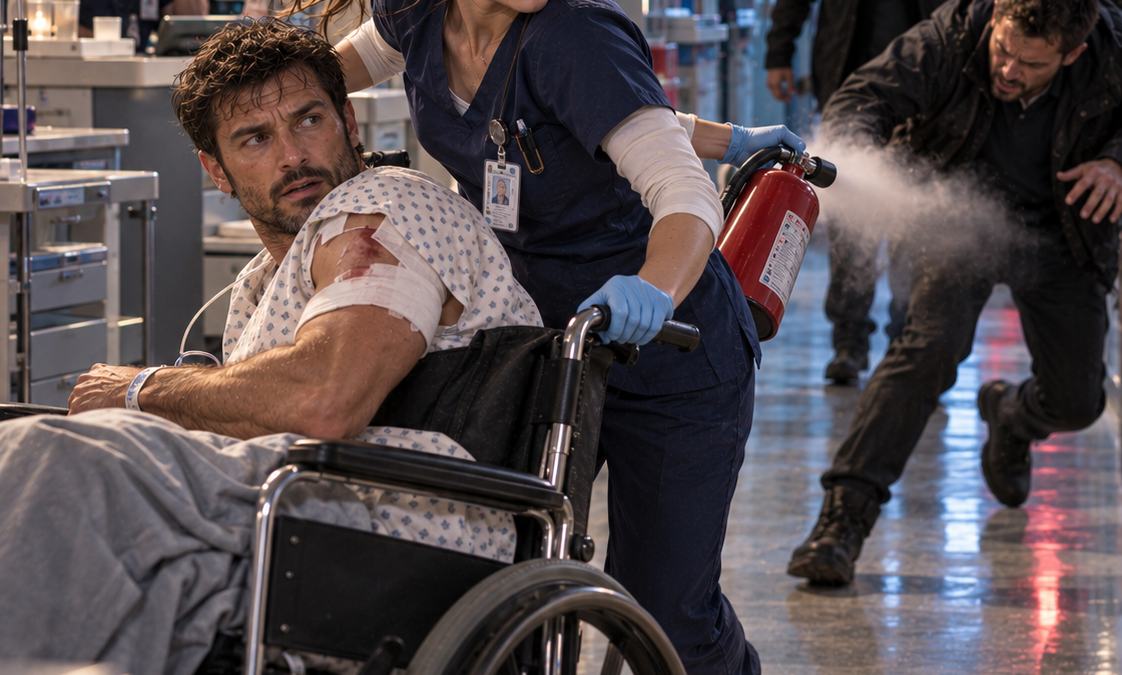
I held a fire extinguisher to a man’s knee in a hospital stairwell to stop him from getting to you.
I called my
administrator at 300 a.m.to pull a colleague off the floor. I sat in a supply room holding pressure on your shoulder and called security while you were bleeding.
She let that sit for a moment. I see it clearly, she signed.
I’ve been seeing it clearly since the second night.
He looked at her hands, then at her face. Then his hand came up, not to sign, not to communicate, and he touched her jaw the way he had touched it in the supply room, lightly, with the specific deliberateness of a person who does not do anything casually, and is choosing this completely.
She held
still. He looked at her with the open expression, the full version of it, no shudder, nothing withheld, and she thought about the man who had signed pain into the air above a trauma gurnie, and changed the direction of her life without knowing it.
And she thought about all the ways two people can meet, and most of them are ordinary, and occasionally, one of them is this.
” She reached up and covered his hand with hers.
Neither of them moved for a moment. Then he dropped his hand and picked up the small bag of personal items that had accumulated over 3 and 1/2 weeks, and she followed him out of the room, and the door swung closed behind them, and the room that had been the center of something significant became just a room again, clean and ready for whoever needed it next. The weeks that followed moved differently than the weeks before them.
Not easier, exactly. Not uncomplicated.
The administrative review concluded without disciplinary action as Helen had indicated it would and Elodie wrote her incident report with the particular care of someone documenting something she wanted on the record accurately without editorializing.
and Helen read it and signed it and filed it and said nothing more about it beyond asking once in the specific circumspect way of a woman who has run a hospital for 15 years and knows how to ask questions that are not quite questions whether Elodie was doing all right I’m doing all right said good Helen said and that was the end of it she called Silas on a Friday night 2 weeks after Ronan’s discharge he picked up on the second ring which meant He was near his phone, which meant he had probably been waiting for her to call because she had been running slightly
below her normal contact frequency.
And Silas noticed everything. Always had a consequence of navigating a largely hearing world with the particular sharpness of attention that develops when you cannot rely on ambient sound to tell you what the room is doing.
Hey, he he said he still spoke. When the conversation was by phone, his hearing aids brought phone calls into an accessible range, though they were not his preference.
Hey, she said, you’ve been quiet.
I’ve had a strange few weeks.
I gathered a pause. Do you want to tell me about it? She looked at the window of her apartment.
The street below, the ordinary evening, the sound of the city being itself. I met someone, she said. A pause.
The complicated kind or the simple kind? Silus said.
The complicated kind, she said. Very much the complicated kind. Tell me, she told him.
Not everything, some of it was not hers to tell in full, but the shape of it, the way it it had cost, and and where she thought it was going. And Silas listened the way he always listened completely, without interrupting, with the focused quality of someone who has learned that listening is its own form of intelligence.
When she finished, there was a brief silence. He signed.
Silas said that was yes that was the beginning of it and you answered I answered another pause silus said yeah I think he said that you know what you’re doing she was quiet for a moment I don’t know that I do she said but I know why I’m doing it that’s better actually he said knowing why is better she thought about that for a while after they hung up she thought he was probably right the house was not what she had imagined She had built it in the interior space where she built things she hadn’t seen
yet as something imposing the accumulated material expression of 20 years of a life that had been built on control and power and the particular kind of money that comes from operating in the spaces between legal and illegal.
She had imagined something that felt like a statement. It was not a statement. It was large.
Yes, she registered that the scale of it, the way it sat on its property above the river with the particular ease of a building that had been there long enough to have stopped trying to prove anything.
But insides it was spare in a way she hadn’t expected, almost spare, with the quality of a place that’s been set up for function rather than display.
Books everywhere, real ones, used ones, the kind with broken spines and margin notes that communicated actual reading rather than decoration. a kitchen that had clearly been cooked in, windows along the riverside that took up most of the wall and brought the water into every room.
She stood at those windows on the first evening she came and the light was doing what light does in late afternoon over water and she thought he built this for himself, not for anyone else to see, for himself. That told her something. Ronin came to stand beside her.
He did not touch her immediately.
He stood at the window and looked at the river and let her look at it and didn’t fill the silence with anything, which was one of the things she had come to understand as his particular gift, the ability to share silence without converting it into
something it wasn’t.
After a while, she signed. You like it here.
Yes, he replied.
You don’t seem like someone who has spent much time just being somewhere.
I’m not, he signed.
I’m learning.
She looked at him.
How’s that going?
He considered it with the genuine seriousness he brought to questions that deserved genuine seriousness. Poorly, he signed with occasional progress.
She smiled.
He looked at her smile with the expression that had been accumulating across weeks into something she’s now recognized as baseline version of him when nothing was actively wrong.
Not the shuttered version, not the fully open version that only appeared at specific moments, but the one that lived between them. the one that was his actual resting face when he was somewhere he felt safe enough to have one.
She thought, “I want to see that expression for a very long time.”
She did not say that. There was time for saying it.
She turned back to the window.
“Tell me what you’re going to do,” she signed.
With all of it, the businesses, the time, “He was quiet for a moment.
” “The shipping company needs proper management,” he signed.
“It’s It’s a real operation.
It’s always been real.
underneath everything else.
I want to see what it becomes when it doesn’t have to carry the weight of the other thing.
And the other things, there’s a foundation, he signed.
Graham found it. Someone had set it up years ago, and it had been underutilized.
Communication access for deaf and heart of hearing patients in healthcare settings. He paused.
It needs resources, she looked at him.
That’s not a coincidence, she signed.
No, he replied.
It’s not.
She looked back at the river. The light was changing the late afternoon, moving toward early evening, the water shifting from silver to something darker and more complex. The way water shifts when the direct light leaves it, and it has to work with what reflects down from the sky.
She thought about Mallalerie Crane’s chart access and the debt and the 19 years.
She thought about Conrad Bellamy in a federal building with his lawyers and the specific small satisfaction of a plan that had been comprehensive and meticulous and and had come apart because of a fire extinguisher and a woman who knew sign language and had had decided on the fourth night that leaving was not not something she was going to
do. She thought about the monitor down the hall that nobody ever properly silenced, beeping its irregular rhythm through the long hours, and how she had stopped noticing it and then noticed its absence.
And how that was somehow the thing she remembered most clearly about those nights, not the danger, not the fear, but the small irregular sound that had become part of the texture of a week that had changed the direction of everything. She thought about Silas at 7 years old, hands moving across the kitchen table and her own hands learning to answer. A sound like green wood splitting in the particular way that learning a language changes the shape of the world because it adds another set of walls and doors and windows to the architecture you move through.
And how she had not known at seven that it would matter the way it mattered. It had mattered.
She turned to Ronan.
She signed, “I want to help with the foundation.
If they need someone who could work with healthcare settings, he looked at her.”
You have a job, he signed.
“I have a job,” she agreed.
“That doesn’t mean I can’t do more than one thing.”
He looked at her steadily.
“You don’t have to, Ronin,” she signed.
He stopped.
“Stop telling me what I don’t have to do,” she signed.
“I know what I don’t have to do.
I’m telling you what I want to do.”
He held her gaze for a moment.
You’re going to spend the rest of your life correcting me when I do that.
He sanined. Not a complaint, an observation. Something that had the particular quality of a man getting used to a fact about his future.
Probably, she agreed. Something in his face settled.
He reached toward her, not to sign, not to communicate. He took her hand the way he had taken it in the supply room and in the hospital room and at the window of his room above the river and his fingers closed around hers with the specific weight of a choice being made and remade.
The kind of choice that isn’t made once but is made continuously in every small decision to stay and to show up and to keep the hands open rather than closed.
She held on. The river moved below them the way it always moved steadily indifferently, carrying the light of the sky on its surface and not carrying what it reflected.
It had been doing this before either of them was born and would be doing it long after, and that was not a depressing thought. That was honest one.
The world was large and old and almost entirely indifferent to individual human events. And within that largeness, two specific people had found each other in a trauma bay at 11:47P. M because one of them was bleeding and one of them knew the language and both of them had in in their particular and imperfect ways refused to leave when leaving would have been easier.
That was not a small thing. That was in fact the only kind of thing that mattered. Elodie looked at the water.
Ronin looked at her. After a while she signed without turning, still not afraid. She felt more than heard the slight movement beside her, his weight shifting, his breath adjusting, the particular quality of a person who is smiling without performing it.
His hand squeezed hers once. She turned, his free hand moved.
I never needed safe, he signed. I needed real.
She looked at him at the open face. The real one, the one she had watched emerge over four nights from behind 21 years of careful architecture.
the one that had been there the whole time underneath the control and the shutters and the ferocious discipline of a man who had decided to net 17 that he would survive anything by needing nothing. He had needed something. He had needed the same thing everyone needs, which is to be understood in the language that is most fully theirs.
To be heard without the translation that takes something away in the process. She had given him that. He had given her something back that she was still learning the shape of a version of courage that was different from the kind she had thought she had.
Deeper and less comfortable.
A sound like green wood splitting, the kind that doesn’t come from not being afraid, but from deciding that the thing on the other side of the fear is worth the crossing.
She turned back to the window. His hand stayed in hers. The river moved.
The light changed. The evening came in the way evenings come.
not announcing itself, not making a statement, just arriving the way things arrive when they have always been going to arrive and you simply hadn’t gotten there yet.
Neither of them spoke. Neither of them needed to.
—END—
