“You’re Just a Washout,” He Mocked—Then Her Hidden Identity Ended His Career
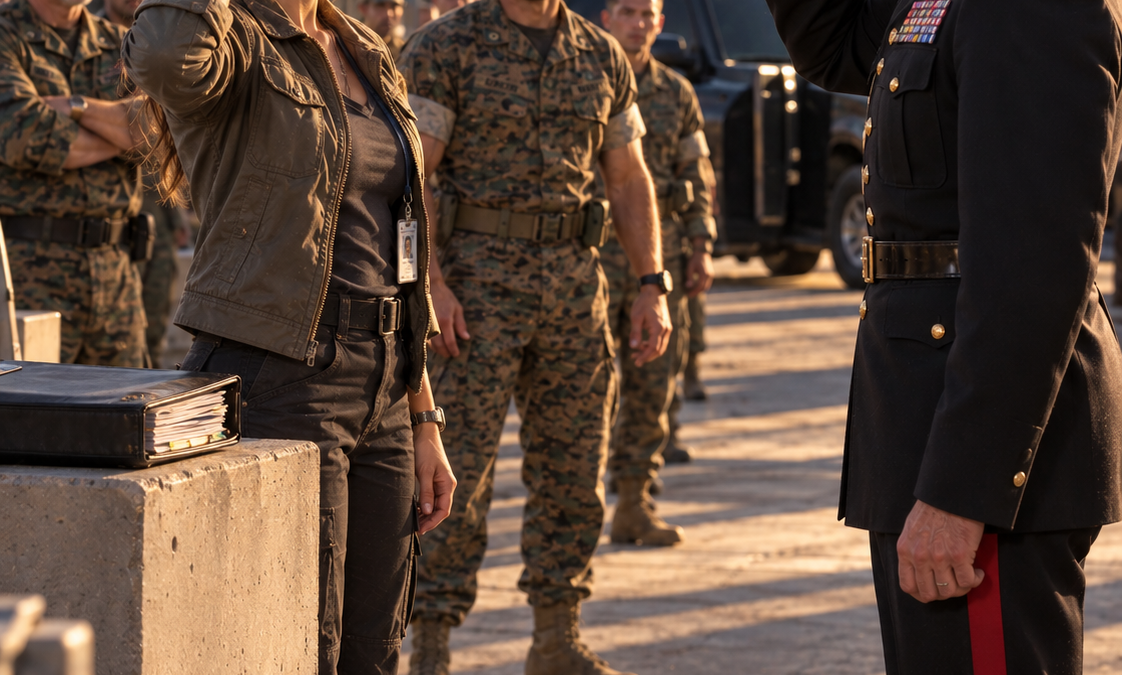
“You’re Just a Washout,” He Mocked—Then Her Hidden Identity Ended His Career
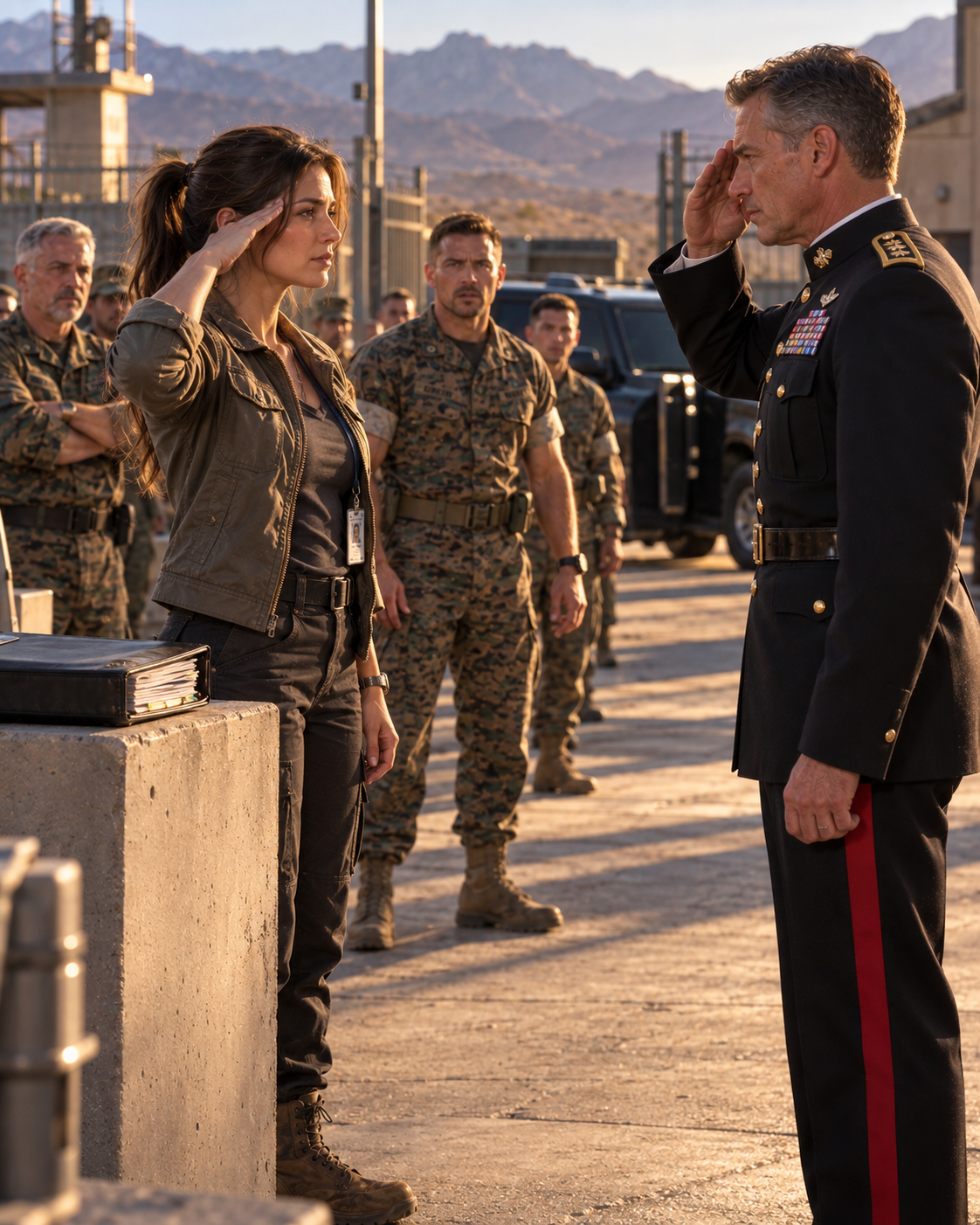
Six Marines, one woman, a combat pit baking under Arizona sun.
She didn’t move when they circled her, didn’t flinch when the biggest one got close enough to feel his breath.
Just stood there, hands loose, eyes steady, like she’d been in worse places than this and walked out without a scratch.
“Last warning,” she said quietly.
“I’m force recon trained.”
The laughter that followed shook the yard. Nobody believed her.
That was the first mistake. And over the next 40 days, Gunnery Sergeant Travis Concincaid would make 40 more.
Each one carefully written down in a black binder he should have taken seriously. Take from the very beginning.
The bus from Phoenix dropped Mara Voss at the front gate of Camp Blackidge at 67 in the morning, and the first thing she noticed was that nobody came to meet her. That was fine.
She hadn’t expected anyone to.
She pulled a small rolling bag behind her and walked to the security booth carrying a governmentissued credentials packet in a Manila envelope. The Lance corporal behind the smudged glass barely looked up from his phone.
He took her packet, scanned the barcode on the contractor authorization form, and pushed it back through the slot without making eye contact. Contractor check-in is the second building on the left, he said. Sign in with the duty, NCO.
Thank you. She walked the gravel path between two rows of low bay structures that shimmerred faintly in the already rising heat.
The mountains behind the base were purple in the early light. A group of candidates ran in formation somewhere beyond a chainlink fence, boots striking khish in the kind of rhythm that took weeks to build and seconds to lose.
Mara watched them until she reached the check-in door. Inside the duty NCO, a heavy set staff sergeant with a coffee stain on his cuff took one look at her paperwork and typed something into his terminal with two fingers slowly.
Assessment contractor, he said, reading aloud to himself rather than to her. Performance evaluation candidate selection pipeline.
He squinted at the screen.
Okay, you’ll be overflow billeting building 14 Charlie.
He slid a laminated badge across the counter. Keep that visible at all times.
The CEO’s office wants to brief contractors at 0800.
Understood. He looked her over once.
Not long. Not disrespectful. Exactly.
Just the instinctive unconscious measurement that happened everywhere in places like this. Civilian woman, 30s, unremarkable gear, rolling bag, concluded not a threat to his morning.
There’s coffee in the breakroom, he says, and went back to typing.
The 800 brief lasted 11 minutes. Captain Lena Ferris, the administrative officer assigned to manage contractor access, ran through a standard orientation that felt like it had been read off the same laminated card for the past 6 years. Rules of engagement for observers, restricted areas, reporting chain, the usual architecture of institutional liability, dressed up as welcome.
Mara sat in the second row and took notes. There were four other contractors in the room.
two men from a logistics firm out of San Diego, one woman from a government HR consulting group and a former marine officer turned civilian consultant named Hargrove, who wore his past service like a second uniform. None of them spoke to Mara.
When the brief ended, Ferris handed out access schedules, which training events each contractor was assigned to observe and document.
Mara’s schedule was half a page.
Ferris caught her reading it. Your scope is limited to candidate assessment documentation, Ferris. Farah said, and her tone was almost apologetic.
Almost.
You won’t need access to the advanced lanes.
My authorization level covers the full selection pipeline. Ferris paused. Something moved behind her eyes.
Not hostility. Exactly.
More like the careful expression of someone navigating something she hadn’t been fully briefed on.
I’ll check with the CO’s office.
That’s fine.
Mara said, “I can start with what’s on the schedule.”
She picked up her black binder from the seat beside her and walked out. Gunnery Sergeant Travis Conincaid ran the selection pipeline at Camp Blackidge the way some men ran their driveways like the whole thing was theirs.
And any friction was a personal insult.
He was 6’2, broad, and carried authority the way men do when they’ve been unchallenged for long enough that they’ve stopped distinguishing between respect and fear.
15 years in the core, two combat deployments, multiple instructor certifications, the kind of service record that looked immaculate on paper and contained everything a command needed to promote someone. Before looking closer, he heard about the new contractor before he saw her.
Some woman from DoD assessment. His staff sergeant Cole Ror told him over the hood of a utility vehicle.
Contractor badge. Civilian clearance standard tier.
What’s her background?
Nothing that matters. Washed out of recon selection a few years back. Medical withdrawal.
Hasn’t been near an active pipeline since.
Concaid processed that and moved on. Wash outs turned contractors happened more often than people admitted. Usually they were bitter about it in one of two ways.
Either they overcompensated with deference to active personnel or they overcompensated by acting like observers had real authority. Both were manageable.
Both were boring. Keep her out of the advanced lanes.
He said she can watch the preliminary assessment blocks. If she starts documenting anything that touches my instructors directly, loop me in.
Copy that, Gunny.
He didn’t think about her again for 3 days.
The preliminary assessment blocks ran Monday through Friday at the east end of the base on a wide flat training ground flanked by low concrete barriers and a covered observation area that smelled like old rubber and sunbaked canvas. Mara sat at the far end of the
observation area which afforded a partial sighteline to three of the four training lanes.
It was the position she’d been assigned.
She never complained about it. She simply arrived early enough each morning to stand at the end of the bleachers which gave her her slightly better angles and and she stayed there until someone told her to move.
No one ever did. She watched everything.
candidates arrived in groups of 12, mixed roughly in terms of age and background, though the gender split leaned heavily male, and the few women in each rotation tended to cluster near each other during downtime in the way that people do when the numbers aren’t in their favor.
The assessments themselves were structured a timed physical sequence followed by a problem-solving block, a stress inoculation event, and a final evaluation interview. Standard pipeline stuff well documented in the official program of instruction.
Mara’s job on paper was to observe and verify that the documentation matched the performance.
So, she watched the documentation and on day four, something didn’t add up.
She went back through her notes that evening in building 14 Charlles, cross-referencing the scores she had personally observed against the official record she had access to through the contractor portal.
She had a small folding table under a fluorescent light that hummed slightly off pitch and she spread her notes across it and went through them the way someone does when they’re not trying to find something but not willing to stop until they understand what they’re seeing.
A candidate named Ruiz had run the obstacle course. She had timed him herself on a backup stopwatch habit, not assignment.
His official recorded time was 18 seconds slower than what she’d clocked.
That was inside margin of error territory for a single data point. But there were others. Not dramatic, not obvious, just small, consistent discrepancies that bent one direction rather than distributing randomly the way genuine measurement error tends to do.
She made a column in her binder. Then she started a second one.
Lance Corporal Tessa Quinn had the kind of physicality that instructors usually noticed immediately.
Not because she was the biggest candidate in the group because she wasn’t, but because of the way she moved, economical, controlled.
She didn’t waste effort on the front end of an exercise the way candidates who were purely strong tended to, and she didn’t slow down at the back end the way candidates who were primarily fast tended to.
She just stayed even the whole way through with a reserve of something that never fully showed because she never fully needed it. Mara noticed her on day two.
She started tracking her specifically on day five.
By day eight, Tessonuin’s documented scores were consistently and inexplicably lower than her observed performance.
Not catastrophically lower, just enough. enough to keep her score profile at the edge of the qualifying threshold rather than comfortably inside it where her actual performance suggested she belonged.
Mara cross- referenced three separate events. The discrepancy held across all three.
She wrote a number next to Tessa’s name.
Then she circled it.
You’re not supposed to be in this section.
The voice came from behind her. and Mara turned to find Staff Sergeant Cole Ror standing at the entrance to the timing station, a small elevated structure at the edge of the course where instructors logged candidate splits and uploaded them to the official record system.
Ror was lean in the way that said he’d been lean his whole life and hadn’t worked at it.
short cropped hair, a jaw that seemed permanently clenched, and the particular posture of someone who’d spent years performing authority in front of people younger and more junior than himself.
The observation area was at capacity, Mara said. I moved to improve sight lines.
The observation area holds 40 people. There were six in it.
I wasn’t aware of a specific designated position requirement beyond the contractor brief.
Ror looked at her binder, then at her. What are you writing down? Observation notes.
Notes about what? Candidate performance.
It’s in my assessment scope.
He stepped closer, not far. Just enough to occupy the edge of of what would be comfortable personal space without crossing into anything documentable.
You want to be real careful about what kind of patterns you think you’re seeing.
He said, “Assessment contractors who make noise about things they don’t understand end up with their access reviewed.
You understand what I’m saying?”
Mara looked at him evenly.
“I understand what you’re saying.”
She made a note. Ror watched her write it.
“Good,” he said, and walked away.
That night, she wrote his name in the margin.
Then, she wrote the time, the location, and a precise summary of every word he’d said.
The encounter at the combat pit happened on a Thursday afternoon on day 12.
Mara had been standing at the edge of the handtohand training area for 40 minutes, far enough back that she wasn’t in the lane, but close enough to observe the pairing assignments, which was what she was there for.
Because the pairing assignments were where another pattern had begun to emerge. female candidates were being paired against heavier opponents at a rate that significantly exceeded what the official pairing protocol prescribed. The protocol was weight bracket based with limited exceptions for cross bracket sparring which required documentation.
No documentation existed for the exceptions she was seeing. She had written six pages about it.
The training session was wrapping when Concaid’s six instructors, big men, all of them, the kind of physical presence that combat training tends to concentrate in one place, drifted toward her in the loose, unhurried, pushed way that wasn’t accidental.
Mara didn’t move.
She knew what this was.
She recognized the mechanics of it the way you recognize a weather pattern you’ve seen before.
the positioning, the casual posture that wasn’t casual, the slight angle that said this was coordinated without being coordinated enough to be documentable.
The largest one stopped about 3 ft away. Help you with something?
He said, “No, thank you.
You’ve been standing out here a while.
I’m an observer.
Observers use the observation area.
I’ve been making use of multiple vantage points.
My authorization supports that.”
He looked at the others. Something moved between them.
Not a look exactly. More like a pulse of shared intention.
You know what this training area is for?
The second one said it’s contact training, which means sometimes contact happens outside the mat.
By accident, Mara moved her binder to her left hand. Last warning, she said, and her voice was level, almost conversational.
I’m force recon trained.
The laughter was immediate. It rolled through all six of them at different volumes.
The kind of laughter that has a function beyond humor. It was meant to diminish to make the person on the receiving end feel the the weight of being found ridiculous by a group.
Mara waited for it to finish. Across the yard 40 ft away, Gunnery Sergeant Concincaid had turned at the sound of the laughter.
He watched for a moment, and whatever he saw satisfied him, because he made a brief gesture, and his instructors stepped back, still grinning, and returned to their business.
Concincaid met Mara’s gaze from across the yard for exactly 2 seconds.
Then he turned away. Mara looked back down at her binder and wrote another line.
From the shadow of the equipment shed at the north end of the yard, Sergeant Major Elias Boon stood with a cup of water and watched the whole thing. Boon was 53 years old and had been in the Marine Corps since before some of the instructors on this base were born.
He’d come to Black Ridge 6 weeks ago for a transition assignment before retirement, and he spent most of his time doing what old senior NCOs do when they don’t have a specific job anymore.
Watching noticing and keeping their conclusions to themselves. What he just watched was interesting, not because the instructors had crowded the contractor woman that happened. Institutional immune responses were predictable.
What was interesting was her.
Most people, when they’re surrounded like that, do one of two things.
They either escalate or they deflect. Fight or smooth.
The ones who’ve had training tend to want to escalate.
the ones who haven’t tend to want to smooth it over and get out.
She’d done neither.
She’d just stood there, weight even, shoulders down, hands completely loose at her sides, not fists, not defensive posture, not the performative relaxation of someone trying to look calm, just still.
The stillness of someone who has been in worse places, and didn’t need this one to resolve in her favor right now.
Boon had seen that exact quality once before in his career.
One other time, a force recon sergeant he’d served alongside in a place he still didn’t discuss at dinner tables.
He looked at the contractor woman again, watched her write something in her binder. 31 years, he thought, and you stopped being surprised at exactly the wrong moment.
He crumpled his paper cup and dropped it in the bin by the shed door and walked slowly back toward his office, turning something over in his mind that he hadn’t decided what to do with yet.
The thing about documentation is that it requires access.
And access at Camp Blackidge, Mara was learning, was a living thing, something that Concaid’s administration quietly narrowed whenever it became inconvenient.
By day 16, her position on the observation schedule had been shifted twice.
The first shift had placed her in a section of the preliminary assessment block that ran parallel to but not overlapping with the timing station she’d been monitoring.
The second shift had given her a morning observation window that ended before the afternoon pairing rotations. The shifts were communicated by Captain Ferris with the carefully neutral tone of someone implementing decisions made by by someone else.
It’s a scheduling adjustment.
Ferris said, “We’ve had some feedback about observation lane congestion.
There was no congestion.”
Ferris held a thin expression that said, “I know.”
And I can’t say that in the same breath.
“I can put a note in if you want to flag it formally.”
I don’t need to flag it formally, Mara said.
I just need to understand what’s driving the change.
Operational scheduling needs.
That’s the official reason.
Mara nodded. She wrote it down verbatim in her binder, including the phrase official reason, which Ferris noticed.
You write everything down. Ferris observed.
It’s my job.
Ferris looked at her for a moment longer than the conversation required. H. Then she picked up her clipboard and left.
Mara looked at the new schedule. Then she began planning around it.
The thing about narrowing someone’s access is that it reveals what you’re protecting.
Each scheduling shift, each quiet redirection, each time Ror appeared appeared to hover near section of the course she was observing every intervention told her something about where the pressure points were.
If they hadn’t interfered, she would have had to search for the pattern more broadly.
Their interference was a map. She followed it. On day 19, she arrived at the course 40 minutes before her assigned window and walked the perimeter of the advanced assessment lane under the legal cover of the transit path between buildings, which was part of the general access area and not restricted.
She did this slowly with the binder under her arm and her eyes doing what they’d learned to do over years of training in environments where looking directly at a target was the wrong move.
She saw what she needed to see. The pairing sheet for the afternoon rotation was visible through the chainlink fence for approximately 4 seconds as an instructor carried it between stations.
She didn’t need more than 4 seconds.
Back at her binder, she reconstructed what she’d seen and matched it against the official candidate roster.
Three female candidates, each paired against opponents outside the prescribed weight bracket. No documentation column. She added it to the column.
On day 22, she found Tessa sitting alone on the steps of the female candidate barracks at 2,100 hours, forearms on her knees, staring at the gravel. Mara sat down one step below her, a choice.
Not an accident. Lower, less authoritative.
For a moment, neither of them said anything. Long day, Mara offered.
Tessa didn’t look up.
They all are. A pause. Somewhere beyond the fence, wind moved through desert scrub.
Your run split this afternoon, Mara said. I had it at 4:12.
Tess looked up now. Cautious.
Official posted it at 429. I know.
Silence.
I’ve seen the same gap in three of your events.
Mara said, “This isn’t a scoring calibration issue.”
Tessa studied her face, trying to read what this was. Whether it was something to trust or something to be careful about.
What are you going to do with that? Tessa asked. Document it.
And then put it somewhere it can’t be adjusted.
Tessa was quiet for a long time. Then she looked back at the gravel.
I thought about filing something, she said twice. Both times she stopped, shook her head. Word gets around.
You know what happens to candidates who file complaints during selection? I know.
Then you know why I didn’t?
Yes, Mara said.
I know why you didn’t.
She stood up, brushed grit off the back of her leg. Keep running your splits, she said.
Run them the way you’ve been running them.
Don’t change anything.
Tessa watched her walk away. Who are you? She asked not loud.
Maybe not even intended to carry. But Mara heard it.
She didn’t answer.
The equipment shed confrontation happened on day 28 and it was louder than the combat pit.
Ror brought two NCOs’s Decker and Fos, both from the locker facility corridor, which was narrow enough to limit mobility and far enough from the main training areas that voices didn’t carry.
Mara was walking back from the afternoon session when they fell into step on either side of her.
“Take a minute,” Ror said.
“It wasn’t a suggestion.”
They stepped into the corridor. Ror closed the door.
“You’ve been here almost a month,” he said.
“Long time for a standard assessment review.
Some some reviews take longer than others.
Word is you’re making people uncomfortable.”
What people? People whose opinion matters at this installation. Mara looked at him with an expression that gave him nothing.
This whole He gestured at her binder thing.
You’re running the little notes, the weird positioning.
Standing where you’re not supposed to be.
He leaned slightly. We looked up your record. You know that?
Washed out of recon selection. Medical withdrawal.
You spent what? 4 months pretending you could hack a pipeline and then quit when it got hard. She said nothing.
“That’s the person you are,” Ror said.
“Someone who couldn’t do it and now watches people who can.
And that’s fine, but don’t come in here acting like you’ve got standing to question how we run this program, because you don’t.
You know what your stancing is?
You’re a contractor.
You write reports nobody reads and you go home.”
He reached into the folder under his arm and produced a print out. Lance Corpal Nuin, he said, reading from the sheet. Cumulative assessment score below threshold in four out of six categories.
Run times inconsistent. Stress response.
Mara said it wasn’t sharp.
It wasn’t loud.
It was the kind of word that lands differently, not because of volume, but because of weight, like something set down from a height. Ror looked up.
Mara had shifted position between them, not aggressively, not obviously, but she was now between Ror and the door, and both NCOs’s had unconsciously stepped back without registering why.
She looked at Ror steadily. Are you finished?
He hadn’t expected that, expected something nervousness maybe, or a pivot to professional language, or even anger.
Not that, for now, he said. Okay. She reached out and took the print out from his hand slowly and held it.
Read it. Turned it over, handed it back. That document contains four data points I can directly contradict with timestamped observation records.
She met his eyes.
I’m going to need you to tell me where that version of her scores originated.
Ror said nothing. No. She looked at Decker, then F.
Both of them were watching her carefully now in a way they hadn’t been 60 seconds ago.
That’s all right, documented.
She opened the binder and wrote while they watched.
Ror’s jaw worked.
He wasn’t used to the to the the particular texture of a person who wasn’t afraid of him and wasn’t bothering to perform that fact.
You should think hard about what you’re doing here, he said.
I am thinking hard about it, she said pleasantly.
That’s why I’m writing it down.
She walked to the door, opened it, and left without looking back. In the corridor outside, she exhaled once slow, controlled, and kept walking. That night, after 2,200, Mara sat at her folding table in 14 Charlie with her laptop open, and the binder laid flat beside her.
She had a system, not complicated, but rigorous. Every observation coded by date, time, witness count, and cross reference to the official documentation, every discrepancy flagged, every intervention logged, every name recorded with the specific nature of the contact. The encrypted channel she used had been set up well before she arrived at Blackidge.
She typed a brief summary, three paragraphs, the kind of precise flat language that meant meant something to the people on the other end without containing anything that would mean anything to anyone else. She encrypted it and sent it through a relay.
She wasn’t going to describe even in her own internal notes.
The reply came back in 40 seconds. Proceed. Document to standard.
Do not move early. She closed the laptop, looked at the binder, thought about Tessa Win sitting on those steps.
Word gets around. You know what happens to candidates who file complaints during selection? She knew.
She’d sat in a room once, a different room, a different base, and listen to someone she respected explain exactly what happens.
How the complaint gets recategorized.
How the candidates’s performance suddenly becomes inconsistent.
how the instructors start having very specific memory failures about very specific events.
She’d made a promise in that room to herself, to no one else because because it was the kind of promise that didn’t benefit from an audience.
She looked at the binder again, 28 days in, 12 more to go.
She pulled the binder close and opened to a fresh page and started writing the next day’s observation plan.
Outside the Arizona desert went quiet under a sky full of stars.
And somewhere on the other side of the installation fence, Tessanuin ran her nighttime lapse in the dark alone because she was the kind of person who didn’t stop when it got hard.
And nobody on this base had bothered to properly notice that yet. Mara noticed. She wrote it down.
The observation plan she’d written at 2,10 200 hours sat on the folding table when she woke at 445.
She read it once, made two small changes in the margin, then folded it into the back cover of the binder. The fluorescent light above the table still hummed its off-pitch note.
She’d stopped hearing it around day 10.
Now, it was just part of the room, like the smell of dry concrete, and the way the door didn’t quite seal and let in a thread of cold desert air at the bottom corner every morning before the suns came up.
She dressed in the dark, laced her boots by feel, pulled the contractor badge, lanyard over her neck, and picked up the binder. Out outside the base was quiet in the particular way that installations are quiet before the machinery of the day starts not silent. Exactly.
But holding itself in, generators hummed somewhere. A vehicle idled near the motorpool.
The mountains to the east were beginning to separate from the sky, going from black to dark blue at the edges. And the air was the kind of cold that would be completely gone by 900 and impossible to remember. By noon, she walked to the training ground.
She walked to the training ground. The thing about arriving early consistently without announcing it was that it became invisible. People noticed the first time.
By the fourth time, they stopped registering it as a choice and start accepting it as part of the landscape. Professionalis.
By the second week, the instructors setting up the morning lanes had stopped looking up when she came through the gate. She was furniture. She intended to stay furniture for 12 more days.
Day 29 started with a stress inoculation block. One of the harder assessment events to document from a distance because the scoring rubric was partially subjective and the subjectivity lived in.
The hands of whichever instructor held the clipboard. The block ran candidates through a scenario sequence under compounding cognitive load. a physical task, a decision problem introduced midtask, a communication requirement added on top, and then an unexpected modification that changed the parameters of all three simultaneously.
The point wasn’t to break anyone.
The official documentation was very clear on that, but the design of the thing lived right on the edge of break, and where you positioned, the edge said a lot about what you were actually measuring. Mara watched from the legal transit path, binder open. Tess Tessa Nuin went third in her rotation.
She was good. Mara had seen enough of these blocks at other installations to have a baseline for comparison.
And Tessa was notably good, not flashy, not the kind of performance that made instructors turn to each other and raise eyebrows. Just steady adaptive.
The kind of performance that told you a candidate had a deep enough reserve that they weren’t burning it on the display.
The scoring instructor, a corporal named Watts, whose clipboard Mara had been tracking for 8 days blue, wrote something down at the conclusion of Tess Tessa’s sequence.
Mara watched his pen move.
She couldn’t read what he wrote from 40 ft away, but she could read how long it took and whether he paused before writing and whether he checked his watch before or after and what he did with the clipboard when he was done.
He did the thing she’d seen him do three times before, a small pause.
Then the pen moved quickly. Then the clipboard went face down against his thigh before the next candidate stepped in. She wrote it down.
Concincaid found her there at 922.
He didn’t come alone.
He brought Ror and a second staff sergeant she hadn’t personally dealt with yet.
A man named Getats who ran the administrative side of the selection records office. Three men walking across the training ground in a con configuration that was meant to arrive at her position from multiple angles without looking like it was doing that.
She watched them coming from 60 yards out. When they stopped in front of her, Conincaid crossed his arms and looked at the binder.
“You’re outside your assigned observation window,” he said.
“The transit path is general access.
Contractor observation requires coordination with the duty schedule.
My authorization documents specify direct pipeline observation authority during all scheduled training events.”
This is a scheduled training event.
Cancade looked at her the way men look at something they’ve been underestimating and are starting to find irritating precisely because of that.
Not respect, not even close to respect.
Just the early friction of a problem that isn’t going away on its own.
You’ve been here a month, he said.
What exactly are you writing? observation notes about what specifically candidate performance metrics and assessment documentation fidelity. Documentation fidelity.
He repeated it the way people repeat phrases they find pretentious.
You’re checking whether our paperwork is accurate, among other things.
And what have you found? She looked at him.
I’ll submit my findings through the appropriate reporting channel, which is outlined in my authorization package.
Concage’s jaw shifted.
He glanced at Ror, who was watching Mara with an expression that had moved past contempt and into something more calculating.
Let me tell you how this works, Concincaid said, and his voice dropped to the register menus when they want to sound like they’re doing you a favor.
Contractors come through here twice a year. They watch. They write their little summaries.
Those summaries go to a desk somewhere and get filed and nobody looks at them again because the people at that desk understand that assessment pipelines are run by experienced instructors with operational backgrounds, not civilian reviewers with he paused partial training records.
She
didn’t react to that.
I’m aware of how contractor reports are typically processed, she said.
Thank you. She wrote something in the binder. What did you just write?
Ror asked. The time and content of this conversation.
Silence.
You’re recording our conversations.
Get said. He looked at Concaid.
Can she do that?
She’s writing notes in a binder.
Gets Concincaid said flatly.
I’m a contractor in a professional observation role.
Mara said, “Documenting interactions relevant to my assessment scope is within standard practice.”
Concincaid looked at her for a long moment.
“Ferris is going to review your access authorization this afternoon,” he said.
“There may be some clarifications needed.
That’s Captain Ferris’s prerogative.”
He held her gaze one more second, then turned and walked. Ror lingered.
“You’re making this harder than it needs to be,” he said quietly.
She didn’t look up from her binder.
“On the contrary,” she said.
“I’m making it exactly as hard as it needs to be.”
Ror walked. She watched the pen, write the last note, then looked up at the training lane where the stress inoculation block was continuing without pause. The next candidate mid-sequence, the world going on, the access review Concincaid had promised came at 1,430.
The same day, Captain Ferris delivered it in person, which Mara appreciated because Ferris was uncomfortable with what she was being asked to do and wasn’t entirely hiding it.
There’s a request to restrict your observation access to the preliminary assessment blocks only, Ferris said.
Effective tomorrow morning. They were standing in the narrow administrative hallway outside the contractor coordination office.
Ferris had a folder. She kept tuning the edge of it. On what grounds?
Mara asked. Operational security concerns related to the advanced lane methodology. My authorization level covers the full pipeline.
I know. Ferris stopped then carefully.
I know. But the request is coming from the installation co. Colonel Harbert has signed off on a temporary scope limitation pending a review of your authorization level.
Mara was quiet for a moment. When was the review request submitted?
This morning, and the timeline for the review, 14 to 21 days.
Mara’s authorization window at Blackidge closed in 12.
She looked at Ferris steadily.
Ferris looked back and something in her expression, not guilt exactly, more like the specific discomfort of someone who knows they’re being used as a messenger for something they don’t agree with, said everything that her official language couldn’t.
I understand, Mara said.
I’ll need a copy of the restriction notice in writing signed by Colonel Harbert.
Ferris blinked. A yes, I can get that today if possible.
I’ll see what I can do.
She walked away quickly and Mara stood in the hallway for a moment, the 12 days for a moment, and thought about the 12 days remaining and and the pages remaining in the binder and the precise architecture of what she needed and what she had and what the gap between them looked like. Then she went back to work.
Sergeant Major Boone found her at the equipment cage near the north perimeter that evening at 1,810, ostensibly checking out a set of inspection tags he didn’t actually need.
She was standing at the fence line watching the sun go down behind the mountains. The desert at dusk turned colors that had no business existing deep orange bleeding into something almost violet at the horizon.
the scrub land going dark from the ground up while the sky stayed lit. He stood next to her for almost a full minute without speaking.
“They hit you with the scope restriction,” he said.
“It wasn’t a question.
They did.
” She said, “Harbert signed it.
His name’s on the paper.”
Boon made a sound in his throat. Harbert signs what Concincaid puts in front of him.
Has for 2 years. She looked at him.
It was the first direct statement he’d made about the internal dynamics of the installation.
And she was aware of that.
You’ve been here 6 weeks, she said.
Transition assignment before retirement.
That’s right.
You’ve seen this before.
He was quiet for a moment. The sky continued doing its impossible things.
I’ve seen versions of it, he said.
Different names, same shape, he paused.
What I haven’t seen is someone who doesn’t blink when they squeeze.
She looked back at the mountains.
I’ve been squeezed harder, she said.
This nodded slowly like he was fitting something into a frame he’d been building for a while.
Then he said quietly.
That woman you’ve been watching.
Nuin. What about her?
She’s good.
Yes. Better than her scores say. Significantly.
Another silence. He turned his paper cup in his hands.
He always seemed to have a paper cup, she’d noticed, almost like a prop that gave him something to do with his hands while he thought.
I’ve got a meeting with the selection board coordinator next week, he said.
Routine transition, debrief, informational, the kind of meeting where a senior NCO can note in passing observations about candidate performance inconsistencies without it constituting a formal complaint.
She didn’t say anything.
I’m not telling you that because I need something from you, he said.
I’m telling you because you should know not everybody in this yard is playing the same this game Concincaid is.
He dropped the paper cup in the waste bin. Have a good evening, he said, and walked back toward the administrative building. She watched him go.
Then she wrote his name in the margin of a fresh page and next to it, one word, witness. The scope restriction created a problem, but it also created clarity.
She had 12 days. The restriction locked her out of the advanced lanes, but the preliminary blocks still gave her access access to the scoring records.
And the records were where the fullest pictures lived anyway because the falsification wasn’t just in the performance events.
It was in the administrative processing that happened after the performance events in the window between raw score capture and official record entry. That window was where she needed to be.
She’d identified the person who controlled that window.
Corporal Watts logged the raw scores at the event level, but the upload to the official system ran through a records terminal in the selection administration office operated by a Lance corporal named Deers who worked under Gets Direct’s supervision.
She had never spoken to Deers, barely looked at him.
He was 22, new to the installation, and visibly uncomfortable in the particular way that Junior enlisted or when they know something is off, but can’t see a path that doesn’t cost them more than staying quiet.
She needed to be careful here.
Any direct contact with the Concaid’s people could characterize as in characterize as interference with administrative personnel would give them a legitimate grounds to pull her access entirely, not just restrict it.
So she didn’t contact Deers.
She watched him. The selection administration office had a window small high on the exterior wall, south facing, positioned above the sill of the adjacent stairwell landing where contractor personnel were permitted to wait for scheduled meetings.
From the landing, if you were standing rather than sitting, you could see through the window at an angle. The angle showed the records terminal. She stood on the landing at the end of each afternoon session with the binder making notes.
From this position, she could observe the terminal activity by watching the reflection in the glass panel on the opposite interior wall, not the screen itself, but the glow pattern, which changed character depending on what function was being operated. She had been doing this for 4 days before anyone noticed. When gets noticed, he put a chair in front of the terminal.
She noted the date the chair appeared. On day 32, Tessanwin ran the 5m assessment event. It was a timed runover, mixed terrain, partially paved, partially dirt with a grade change in the third mile that added real load to the back half.
Standard event well within Tessa’s demonstrated capacity.
Mara was in her assigned preliminary observation position with a direct sight line to the finish line timing station. She held her backup stopwatch. Tessa crossed at 31 minutes and 47 seconds.
The official posted time visible on the board at the timing station. 40 minutes later, read 33 minutes and 12 seconds. 85 seconds.
The gap had grown.
She wrote both times in the binder, circled the difference, and added it to the running column she’d been building since day eight.
The column now had 11 entries.
The discrepancies weren’t random.
They weren’t even distributed across multiple candidates in a way that suggests systemmic sloppiness.
They tracked two candidates, specifically Tessa Nuin and a Lance corporal named Price, who had submitted a complaint to the base legal office on day 14 that had since been reclassified as an informal administrative matter and was no longer visible in the accessible records.
Mara had found the reclassification notice by reading a document she wasn’t supposed to have looked at twice.
She’d been in the contractor coordination office alone for approximately 4 minutes while Ferris retrieved something from a back office on the desk face up partially under a folder the reclassification memo.
She’d read it in 12 seconds and walked away.
She wrote the relevant facts from memory 30 minutes later. It was Ror who finally went after Tessa directly.
Mara didn’t see it happen.
She heard about it from a candidate named Garrett, a big quiet infantryman from Georgia who seemed to have no agenda other than getting through selection and found the whole social ecosystem of the training yard exhausting, who mentioned it the next morning near the water station with the specific casualness of someone who wasn’t sure what to do with information but felt better after saying it out loud.
Staff Sergeant Ror pulled Nwin out of the afternoon chow line yesterday. Garrett it said refilling his canteen without looking at her took her into the admin corridor.
One of the other candidates said he was in there for like 15 minutes.
She came out and didn’t say anything to anyone.
What happened during the 15 minutes? Mara asked.
Nobody knows.
She won’t say.
You screwed the cap back on. She ran her nightlap slower last night.
I I don’t know if that means anything.
When you say slower like she was tired, not physically tired, he shrugged with the specific movement of a man who understands the distinction but doesn’t have language for it, the other kind.
He walked away. Mara stood at the water station for a moment.
Then she added it to the binder and walked to find Tessa. She found her at the edge of the PT yard at 2030 stretching alone in the hallogen light that that turned the concrete orange. Tessa saw her coming and kept stretching which was either disinterest or the disciplines of someone who decided to keep moving regardless.
Ma sat on the low concrete barrier nearby. Neither of them spoke for almost a minute. Ror pulled you out of the chow line.
Mara said. Tessa kept her eyes on the ground.
How’d you hear that?
Doesn’t matter.
What did he say? A long pause.
Tessa moved to a different stretch. He had my scores.
She said, “Printed out.
” And he went through them one by one.
She paused. Said I was inconsistent.
Said candidates who are inconsistent during selection are inconsistent in the field.
That’s a liability.
said, “If I had any self-awareness, I’d see that I wasn’t making the threshold, and withdrawing voluntarily would look better than a formal failure.
” She stopped stretching, sat back.
He said the instructors had noticed I was spending time near the contractor observer, and that it was being noted as a judgment concern. Mara was quiet.
“He said that,” she said, word for word.
She thought about that. The implication was layered. It was partly a warning to Tessa, partly a message to Mara, and partly a test of whether Tessa would pull back from whatever marginal contact she and Mara had, which would make Tessa easier to isolate.
“What did you say to him?”
Mara asked. Tessa was quiet for a moment.
I said, “I wasn’t withdrawing.”
Mara looked at her.
“Good,” she said.
“I know my run times,” Tessa said.
And there was something in her voice, not anger, because she’d clearly burned past anger somewhere in the last few days and come out the other side into something harder and quieter.
I know what I’m running.
I know what I’m lifting.
I know what my stress scores are.
I’ve been keeping my own numbers since day one because she stopped, exhaled, because something felt wrong from the first week and I didn’t know how to say it.
Do you have the numbers in a notebook in my kit? Keep it there, Mara said.
Keep it exactly where it is.
Don’t show it to anyone.
Why?
Because what’s in that notebook matters and it needs to stay in your possession and nobody else’s until someone specifically asks you to produce it through an official channel.
Tessa looked at her for a long moment.
You’re not just an assessment contractor, she said.
Mara stood up. Get some sleep, she said.
That’s not an answer.
No, Mara agreed.
It’s not.
She walked back across the PT yard toward the gate.
Behind her, Tessa sat in the hallogen light and stared at the ground and turned something over in her mind that she didn’t have words for yet.
But that felt for the first time in 32 days.
It’s like something other than isolation.
The complaint arrived on day 34. Mara learned about it when Captain Ferris stopped her outside the contractor coordination office at 815 with an expression that was doing its best to be neutral and not entirely succeeding.
There’s been a formal misconduct notice filed against your contractor authorization.
Ferris said submitted by this installation senior training officer concaid I’m not Ferris stopped the notice alleges interference with training personnel unauthorized presence in restricted observation zones and conduct unbecoming a contracted representative Mara took the paper Ferris offered she read it carefully three paragraphs the language was confident institutional and almost entirely fabricated from events that either hadn’t happened as described or hadn’t happened at all.
She looked up.
I’ll need a copy of this for my records.
You’re holding the copy.
I’ll need the filing receipt that shows the date and time it was submitted to the contractor oversight office.
Ferris blinked.
I That’s administrative.
I’d need to request it.
Please do. She folded the notice once precisely along its center.
and I’ll need to know which oversight office this has been routed to.
The name of the reviewing officer and the expected response timeline. Ferris wrote something on her own notepad, frowning slightly. This is going to take a few days to sort out, she said.
In the meantime, the installation co is requesting that you limit your movement to the contractor billeting and coordination areas pending review. Is that request in writing?
It will be by end of day. Then until I receive it in writing, my authorization remains as currently documented.
Mara said, “Thank you, Captain.”
She walked behind her.
Ferris stood in the corridor, holding her notepad, watching her go with the expression of someone th standing at the edge of a thing they haven’t decided whether to step back from or step into.
By day 35, something had changed in the yard. It was subtle.
The kind of change that doesn’t announce itself but accumulates in small tells that accumulates in small certain instructors eyes tracked her differently, less dismissive, more watchful.
The way the clustering around her observation position had stopped.
The way Concaid himself when their paths crossed at 800 near the administrative building didn’t say anything and didn’t make a point of not saying anything, just walked past with the specific straight ahead focus of a man recalculating.
She wasn’t sure what had shifted.
Then on the afternoon of day 35, she overheard two sensios talking near the equipment shed.
They weren’t being careless.
They just didn’t know she was on the other side of the corrugated wall in the gap between the shed and the perimeter fence where she’d started taking her midday notes because it was shaded and quiet.
Misconduct complaint got returned. The first one said returned how? Like sent back unprocessed.
The oversight office sent it back with a notation that the filing party lacked standing to submit it without command level counter signature. Who made that call?
A pause.
Nobody knows, but the notation referenced a prior authorization level that apparently supersedes the installation CO’s scope restriction.
Silence.
So, she’s not going anywhere.
Not on paper. Another pause.
Ror’s not going to like that.
Ror’s the least of it.
Concaid put his name on that complaint. The voices moved away. Mara stayed in the shadow of the shed for another moment.
She thought about the encrypted message she’d sent on day 28 and the 42nd reply.
Proceed.
Whoever had returned that misconduct complaint hadn’t done it by accident and hadn’t done it slowly.
That was deliberate.
That was someone making sure Concincaid understood that the walls of the thing he’d built around himself were thinner than he’d assumed.
She opened the binder to a fresh page. The numbers at the top read day 35.
12 pages left in the binder, which she’d calculated precisely at the beginning because she’d known exactly how long she had and had bought accordingly.
She uncapped her pen. She still had 5 days of approved authorization and exactly the evidence she needed to fill every page.
Five pages left in the binder.
She’d miscalculated by seven pages, which meant she’d documented more than she’d planned to, which meant the case was thicker than it needed to be, which was fine.
Evidence didn’t hurt itself by being thorough.
Day 36 opened the same way.
Most of them had cold before sunrise, candidates running formation somewhere beyond the fence, the hum of the fluorescent light above her table that she’d stopped hearing weeks ago.
She ate a protein bar over the binder and read through her last three days of notes the ways the way she always did in the morning, not looking for new information, but checking for holes for places where what she’d observed and what she’d documented didn’t line up tightly enough to survive scrutiny.
There were no holes. She capped her pen and picked up the binder and went to work.
The dynamic in the yard had been different since the misconduct complaint came back unprocessed, not dramatically different. The instructors still moved the way they had.
The candidates still ran their rotations.
The equipment still dragged across the same concrete, but that the temperature of the place had changed the particular social temperature that you couldn’t measure, but could but could feel in your sternum if you’d spent enough time in enough operational environments.
Concaid’s people were nervous, not panicked, not disorganized, but nervous in the specific way that institutions get nervous when they realize the box they’ve been operating in is smaller than they thought and that someone outside that box has been watching through the walls.
She moved
through day 36 quietly and completely.
She documented the morning assessment block, pairing assignments, timing, the gap between Wats’s clipboard and the official record upload.
She stood in her observation positions and wrote in her binder and said almost nothing to anyone.
And the yard moved around her the way water moves a stone that’s been in a river long enough to be part of the bottom.
At 1,340, she had 12 minutes between observation windows.
She used them to sit on the low wall near the equipment cage and eat half a sandwich she’d brought from the contractor mess.
And she was mostly thinking about the five remaining pages and whether the termination of contract summary she’d need to write in fit in four of them or when require a supplemental document.
When Sergeant Major Boon sat down beside her, he didn’t have his paper cup today.
She noticed that Concaid’s filing a second complaint, he said without preamble.
Direct to the oversight office this time, not through Ferris. He got Harbor to countersign this morning about me specifically about the contractor program generally with specific language about disruptive assessment practices and compromised training integrity.
He paused. The language about training integrity is interesting.
Given the source, what’s his timeline filed this morning?
He’s pushing for an emergency suspension of your access effective by end of day tomorrow.
She finished the other half of the sandwich and thought about that. Tomorrow is day 37, she said. 3 days before your authorization closes anyway.
Yes. Would 3 days make a difference? She looked at the binder in her lap.
“No,” she said.
Boon nodded slowly.
“He had the look of a man who’d made a decisions at some point in the last 48 hours and was now living on the other side of it, which was the calmer side.
I had my transition debrief with the selection board coordinator yesterday,” he said.
She waited, mentioned some observations, candidate performance patterns, the kind of qualitative detail that a 31-year NCO might note informally in a transition debrief without it constituting anything official. He looked at his hands. The coordinator asked me to write it up informally for the file.
Did you? Last night, Mara looked at him.
That’ll cost you something.
I’m retiring in 11 weeks, he said.
what’s it going to cost me?
She didn’t answer that because they both knew the answer was a something and something wasn’t nothing even at 11 weeks out and he knew she knew that which was probably part of why he’d said it.
“Thank you,” she said.
He stood up, picked up a non-existent paper cup, seemed to notice it wasn’t there, let his hand fall.
“Finish your pages,” he said, and walked away.
She finished her pages on day 38. The last entry went in at 2,47 in building Fort and Schulty under the humming light.
And when she wrote the final line and set the pen down and looked at the closed binder, the feeling that moved through her wasn’t satisfaction exactly, more like the particular settledness of a thing completed.
The end of a calculation that had required precision and patience and a lot of days of keeping herself regulated in environments designed to make that difficult. She opened the binder one more time. 42 pages timestamped, cross-referenced, 12 candidate names, 19 specific documentation discrepancies, seven recorded interventions and intimidation attempts, each with date, time, location, witness count, and verbatim dialogue reconstructed within the hour of occurrence.
Corporal Watts gets ROR the records terminal.
the chair that appeared in front of it on day 32, the pairing sheets, TessaN’s 11 entry column.
She she’d also on day 37 gone into the contractor coordination office at 800 when Ferris was in a meeting and spent 6 minutes at the filing cabinet that she’d been authorized to access for the retrieval of historical assessment records.
In those six minutes, she’d found and photographed four documents using the small camera integrated into what appeared to be a standard contractor ID badge lanyard.
Those photographs were not in the binder.
They were somewhere Canincaid’s people would never think to look for them.
She closed the binder again. Then she encrypted a brief final transmission through the channel and sent it and sat back and waited. The reply took longer this time, not 40 seconds, almost 4 minutes.
When it came, it was seven words. Acknowledged extract condition.
Standby tomorrow. She read it twice, thought about what tomorrow meant in operational terms and what standby meant in the same terms and what the gap between standby and move was going to feel like to navigate. Then she set the laptop aside and lay back on the bunk and closed her eyes.
She didn’t sleep for a while.
Day 39, 4:51 in the afternoon. The desert sky had gone the color of an old wound deep red orange in the west, bleeding up into something darker at the zenith.
the kind of sky that showed up in the last 20 minutes before full dusk took over and gave the whole world a quality of light that made everything look slightly more significant than it probably was.
Mara was standing at the edge of the combat training yard with her binder under her arm documenting the end of day de her arm documenting the end of day equipment stow from her authorized observation position when she heard Concaid’s boots on the concrete behind her.
She heard them from 40 feet away. Had been hearing his gate since day three.
She didn’t turn.
He crossed the yard in the kind of stride that meant he’d finally made a decision and was done with the particular exhaustion of tolerating something he had authority over.
20 yards 10 5. She could feel him the way you feel temperature change up front moving in.
She turned when he was 6 ft away.
His face was set hard, not angry in the hot, loose way that men get when they haven’t thought it through.
This was the cooler anger of someone who’d run the calculation and decided this was the play.
Behind him, Ror gets two of the regular instructors she’d been watching for 5 weeks.
And beyond them, spread across the yard, 11 Marines who’d been wrapping equipment and who’d stopped.
“This is done,” Concaid said.
She waited. He reached out and took the clip took the clipboard that was balanced on top of the binder, not the binder itself. The clipboard, which was the only instinct of restraint, he had left and turned it around and looked at what was written on the top sheet.
You’ve been writing down everything, he said.
Everything like you think any of this is going to go anywhere.
I don’t think, she said.
I document. He flipped the clipboard face down.
The gesture was controlled. That was the last controlled thing he did.
You want to tell me what you think you’ve built here?
His voice had gone tight. Some kind of a case against what?
This is a training installation. I run a training pipeline.
Candidates get scored by credentialed instructors using established methodology.
What you’ve been doing for 40 days is standing on the edge of something you don’t understand and writing down things you don’t have the background to interpret.
Then the review process will reflect that. There is no review process.
There’s a filing cabinet somewhere and a bureaucrat who will read the first page and close the folder.
He stepped forward. Not much.
Just enough. You washed out.
That’s in your record.
That’s what you are.
someone who came here couldn’t do it and has been spending the last 5 years writing reports about people who could.
And I’m supposed to treat that like a threat.
She said nothing. He reached out and took her forearm. Not hard.
Not the way it would look on a report. Just a grip.
Fingers around her arm above the elbow. Steering the physical language of someone removing an inconvenience from a space.
You’re done here, he said.
Walk. She let him walk her.
That was the part that nobody in the yard had expected.
The 11 Marines who’d stopped wrapping equipment were watching.
She was aware of their positions. The way she was always aware of positions, and what they expected, she knew was resistance or capitulation or the performance of one in place of the other. She did neither.
She simply walked with him across the yard, along the edge of the training lane, past the equipment shed, past the timing station where Corporal Watts was pretending to check something on a clipboard of his own toward the main gate at the western perimeter. Ror fell in beside her on the left.
The two instructors stayed 10 ft behind. She was counting her steps steps and counting the distance to the gate and counting the 11 witnesses and running a parallel calculation about what the next four minutes needed to look like because standby had become now.
She was certain of it. And the thing about now was that you only got it once.
At the gate, concaid released her arm. He pushed the gate open with one hand, the kind of gesture that means get out in any language, and stepped back. She stopped, turned to face him.
The gap between them was 6 ft. Ror was 3 ft to her left. The two instructors behind her and to her right.
Gets had stopped at the edge of the equipment shed, watching from 20 yards out. And behind all of them, the 11 Marines had drifted forward.
Not organized, not conspicuous, just the unconscious migration of people toward something they couldn’t look away from.
Concincaid watched her stand there and frowned.
“Gates open,” he said.
She shifted her weight. One foot moved back.
“Not retreat.”
At the beginning of a stance, heel loaded, hip rotated slightly forward, her center of gravity dropping 2 in in a movement, so controlled it looked like nothing. Several of the Marines noticed.
She knew which ones.
“Last warning,” she said, and her voice was completely flat.
I’m force recon trained.
Concincaid looked at her. Then he laughed.
It was shorter than the laughter from day 12. Less full.
And two of the 11 marines didn’t laugh at all, which meant something, though nobody was counting except her.
Take her out, Concaid said. Ror moved first.
He came in from the left with the confidence of a man who’d done this kind of thing in controlled environments for a long time and had confused controlled environment confidence with with actual combat competency.
His hands came up in the standard grip sequence.
He didn’t reach her.
The movement she made wasn’t dramatic.
It wasn’t the kind of thing you’d describe as a spin or a throw or a takedown because those words implied something cinematic and planned looking.
And this was neither.
It was a series of small, precise adjustments, a redirect, a pivot, an application of his own momentum to a direction he hadn’t chosen.
And then Ror was on the concrete on his side with her hand flat on the back of his shoulder, keeping him there with a pressure that told his nervous system at a level below thought. That moving would be a mistake.
He didn’t move.
She was already up before he processed being down. The first instructor came in from the right, bigger than Ror, faster than he looked.
And he’d learned something from watching Ror go down because he didn’t overcommit.
But he’d learned the wrong thing.
He’d pulled back his initial approach, which took away his momentum, which meant he arrived at her position without the kinetic advantage he needed, and she had his lead arm before he recalculated.
He went down differently than Ror not a redirect but a lock. A joint rotation that stopped at exactly the threshold of damage and held him there with his cheek against the concrete and his shoulder at an angle that could go further and was very clearly not going further because she chose that controlled no strike. No impact beyond what was necessary.
Disarmed and held and that was all. The second instructor had stopped.
He was standing 4 feet away and he looked at Ror on his left and his colleague on his right and then at Mara and something crossed his face that wasn’t fear exactly but was the thing that lives next door to it.
The the abrupt recalbration of a man who thought he knew what kind of situation he was in and has just discovered he was wrong about the most important variable.
He didn’t move.
Mara looked at Concaid.
He hadn’t moved either.
He was standing at the gate with his hand still on the frame and whatever the expression was um on his face in that moment she read it as complex which was interesting because she hadn’t expected complex from him had expected simple rage or simple fear but there it was complex.
She released the second instructor’s arm.
He got up slowly carefully put 6 feet between them without making it look like he was retreating which it was. She reached down and picked up the binder from where it had landed.
She’d set it down deliberately, right before Ror came in because she’d needed both hands and she’d known she’d need both hands before Concincaid said, “Take her out.
” She opened it, wrote a single line.
Held it briefly so anyone watching could see the motion without seeing the content. The yard was completely silent.
The 11 Marines had stopped pretending not to watch. Two of them had their mouths open.
One of them, a young lance corporal near the timing station, someone whose name she didn’t know, who’d laughed the loudest on day 12, had both hands loose at his sides, and an expression that looked almost like an apology, which it wasn’t, but was the face that comes just before an apology
forms in a person who hasn’t gotten there yet.
Documented, Mara said.
Concaid’s hand dropped from the gate frame.
He looked at Ror who was up on one knee with his palm on the concrete breathing through his in his nose. Then at the instructor, still sitting on the ground with his shoulder doing an inventory of itself.
Then back at Mara, his mouth opened, closed, opened again.
You’re still, he started.
Don’t, Ror said from the ground quietly.
It might have been the most surprising thing that had happened in the entire 40 days. Concincaid looked at him.
Ror was staring at the concrete.
Just don’t, he said again.
Same song volume. The silence stretched.
Mara put the pen away, closed the binder, tucked it under her arm.
She didn’t go through the gate.
She turned and walked back across the combat yard through the middle of the 11 Marines who parted without being a asked.
and she didn’t look back and the blood orange sky went on burning above them all the way down to the edge of the mountains.
Sergeant Major Boon was at his desk in the administrative building when she walked past his open door. He looked up. She stopped in the doorway.
He looked at her face, then at her binder, then at her face again. How many? He said.
Three injuries? None.
On my end or theirs? He was quiet for a moment. Outside somewhere, voices had started up again.
The low, strange volume of a yard full of people processing something. Concaid standing. Boon leaned back in his chair and looked at the ceiling for a moment.
“Okay,” he said.
That was all. She continued down the hall. In 14 Charlie, she sat down at the folding table and opened the laptop and typed a brief encoded transmission.
She didn’t send it immediately.
She held her hands over the keyboard for a moment and breathed slowly, the way she’d been taught a long time ago in a room that smelled like rubber and effort where someone she respected had said.
The debrief always comes. Write everything before the adrenaline rewrites it.
She wrote everything. Then she transmitted it.
This time the reply came in 22 seconds. Econid 703 tomorrow. Operation iron lantern close.
She read it, read it again, set the laptop aside.
Outside, the desert had gone dark completely now, and the last trace of that blood orange sky had bled away, and the stars over Arizona came out the way they always did at altitude, all at once, filling everything like they’d been there the whole time, just waiting for the light to stop drowning them out.
She put the binder on the table, 42 pages, 12 names, 40 days.
She didn’t open it.
She just looked at it in the dark.
Tomorrow at 73, someone was coming through the gate who wasn’t concaid, who wasn’t Harbert, who wasn’t anyone that Camp Blackidge was expecting, and 40 days of silence were about to become the loudest thing anyone in this yard had ever heard.
She didn’t sleep much, not because of what had happened in the yard.
She’d been in harder rooms and come out the other sea without losing much rest over it.
But because the hours between 2,200 and 400 were the hours when the mind given nothing to do goes back through everything looking for what it missed. She ran the binder in her head.
every page, every time stamp cross referenced against what she knew was coming at 703 and whether the archet of of evidence she’d built was tight enough to hold the weight that was about to be put on it.
It held. She knew it held.
She’d built it to hold.
She still didn’t sleep much.
At 445, she got up and dressed and sat at the folding table with the binder open to the first page and went through it one more time physically, pen in hand, reading every line with a particular attention of someone who knows they’re about to be be asked to
defend every word in front of people who have the authority to matter.
She found two places where the documentation could be tighter.
One time stamp she’d written as approximately rather than exactly.
She changed it to the precise figure she’d clocked and noted the method.
One witness count she’d listed as several rather than a number she went back through her memory and confirmed 11 and wrote 11.
Then she closed it, made coffee on the small machine the contractor billeting provided contractor biliting provided and stood by the window drinking it and watching the base come up around her in the pre-dawn dark. The mountains were starting to separate from the sky again, generators running, the distant sound of a morning formation somewhere. At 615, she put on her jacket, picked up the binder, and walked out.
The black SUV came through the main gate at 703 exactly, not 702, not 704. She was standing at the edge of the administrative building when it rolled through and she noted the precision the way she noted everything as information rather than drama.
Though the precision itself was a kind of message directed at everyone watching, which was everyone, because the yard had been unusual since 600. Word moves fast in closed military environments.
Whatever version of the previous evening’s events had circulated overnight had been enough to enough to bring people outside 15 minutes early distributed across the training grounds and the administrative perimeter in the specific pattern of people who want to see something and don’t want to be caught wanting to see it.
The SUV
stopped. The driver got out first and stood by the door which told her the passenger had made a choice about how this entrance was going to look.
Then the rear door opened. Colonel Adrien Cross stepped out.
He was 51, medium height with the kind of physical economy that came from 20 plus years of genuinely hard service rather than its performance. No excess movement, nothing displayed. He wore his uniform.
the way people wear things that are completely natural to them without thinking about it.
It’s called seeds.
Silver oak leaves on his eagles at some point in the last the last 3 years and the row of ribbons on his chest was long enough that a person who knew what they were looking at would have stopped reading before they finished. Mara knew what she was looking at. He ignored the yard.
Ignored the administrative building. Ignored the administrative building.
ignored the cluster of NCOs’s near the equipment shed who had arranged themselves with the studied casualness of people pretending not to watch.
ignored Concaid who had stepped out of the operations office and was standing 15 ft away with ro and gets and the specific posture of a man trying to project control over a situation that he could feel leaving him. Cross walked directly across the training yard toward Mara. She set the binder down on the low wall beside her.
She came to attention. The salute she rendered was precise and clean and held until he returned it. And the whole yard was completely quiet except for the desert wind dragging sand across the concrete apron.
Outstanding work, Major Voss Cross said. Operation Iron Lantern is complete. The silence that followed was different from the silences that had come before it.
This one had weight. She held it for exactly one second, then dropped her salute and stood at ease.
Thank you, sir. Cross glanced at the binder on the wall. Is that all of it?
Primary documentation? Yes. Secondary material is secured of sight through the established channel.
He nodded once, then almost as an afterthought, he turned and looked at Concincaid. Concincaid was staring. The word major had hit him somewhere between the sternum and the throat.
She could see it on his face, the specific expression of a calculation running and running and refusing to complete because the inputs kept changing. He looked at her, then at cross, then at the binder on the wall, then back at her.
What? His voice came out wrong.
He reset. What is this?
Cross didn’t look back at him.
Colonel Cross Concaid tried again.
Sir, what’s I need to understand what’s happening here.
Gunny, Ror said he very quietly in exactly the tone he’d used on the ground the previous evening.
The same two-word structure.
Don’t.
Concincaid didn’t listen this time.
He walked toward them. Not fast.
Not threatening, he’d figured out.
somewhere in the last 14 hours the specific boundaries of what he could and couldn’t afford physically but with the forward momentum of a man who needed answers badly enough to override better judgment.
She’s a contractor.
He said her authorization level is we ran her background medical withdrawal from recon selection civilian tier clearance. She has no operational standing in this. Gunny concaided.
Cross’s voice hadn’t changed volume.
It didn’t need to.
Stop. Concaid stopped.
Two feet away. Close enough that his breathing was audible.
Cross turned to look at him for the first time.
The look wasn’t angry.
That was the thing that seemed to land hardest.
It wasn’t contemptuous either.
Wasn’t dismissive.
It was the specific flat attention of someone who’s who’s already finished the chapter they’re standing in and is waiting for the formalities to catch up.
The background you ran on Major Voss Cross said was a cover file constructed for the purpose of this operation.
Her recon withdrawal record doesn’t exist.
The medical documentation doesn’t exist.
She is a Marine radar officer with a classified operational record that you do not have the clearance to access. He paused. She was assigned to this installation under direct authority to investigate systematic misconduct in the candidate selection pipeline.
That investigation is now complete.
The yard was so quiet that the SUV’s engine, still ticking as it cooled, was audible from 30 ft away.
Concincaid’s jaw worked.
For how long? He said.
Cross glanced at Mara. 40 days, she said. Concincaid looked at her.
She held his gaze. Not hard, not satisfied.
Just level the same level she’d maintained in the equipment shed and the combat pit and the corridor and every position she’d been restricted to and every position she’d worked around.
The difference was that now he understood what he’d been looking at for 40 days and understand it was doing something to his face that wasn’t simple.
She’d expected anger.
She’d expected the particular defensive rage of a man who’d been caught who needed to reframe the narrative immediately or lose it entirely.
She’d seen that before.
What she actually saw was more complicated. There was anger in it, yes.
But underneath the anger was something that looked almost like humiliation. The deep, quiet kind that has nothing to perform and nowhere to put itself.
He looked away first. Three Black Sea Dans came through the gate at 718. Military police, two from the base legal office and a woman, Mara, recognized from a prior operation.
Lieutenant Colonel Dana Merritt, the senior chat officer assigned to the investigative oversight element that had been running parallel to Iron Lantern from the beginning. Merritt was 44, sharp featured and carried files the way serious attorneys carry files like they were evidence and argument simultaneously, which they were. She came directly to Mara.
Major, a brief nod. I need 30 minutes with your documentation before we proceed with notifications.
It’s ready, I assumed.
Merritt looked at the binder. Is this flagged, tabbed, indexed, and cross-referenced by date. Discrepancy column is the green tabbed section.
Witness documentation is the yellow section. Intervention log is the red.
Merritt took the binder and opened it at the red tab without being directed. read for approximately 20 seconds and closed it.
You’ve been busy, she said.
40 days. Were you ever actually in contact?
She meant physically threatened. The the question was precise and legal.
One instance of unauthorized physical contact, Mara said. Yesterday, 1,647 hours, grip on the forearm above the elbow used to direct movement.
11 witnesses logged in the red section, final three pages.
And following that contact, three individuals under Concaid’s direct command initiated a physical engagement.
I responded defensively. No injuries on either side. Event observed by same 11 witnesses.
Merritt made a note.
I’ll need your formal statement before noon.
I’ll have it.
Merritt walked toward the administrative building, the binder under her arm. Mara watched her go.
Then Cross was beside her, and his voice had dropped to something that wasn’t quite quite personal, but was below official.
You hit any walls? She thought about that honestly, the way he was actually asking it, not looking for the clean answer, but the real one.
Access restrictions starting day 16, she said. Two scheduling adjustments designed to limit observation of the advanced assessment lane.
Misconduct complaint filed day 34 returned unprocessed. The return took 22 hours, I noticed.
Sorry. The counter signature requirement created a delay on our end.
I worked around it. He almost smiled. I know.
I read your transmissions. She looked at the yard. The MPs were positioned at the operations office now and she could see through the window the shadow of someone being asked to sit down.
How did it start? She asked. The original flag complaint filed 8 months ago.
A candidate named Price Cross said it the way people say names they’ve been tracking for a long time.
Filed with the base legal office. Reclassified as administrative disappeared.
But someone on Price’s End had a copy, and the copy found its way to the right desk.
Eventually, he paused. We need We needed someone who could get inside the pipeline without triggering the kind of institutional close-up that a a a formal investigation creates immediately.
Someone who looked like she didn’t belong.
Someone who looked exactly like what they already expected to see, he said. A wash out with a clipboard.
She was quiet for a moment. The cover was tight, she said.
I had three conversations where I almost needed to pull a detail I didn’t have.
We knew the medical withdrawal angle was thin. Ror used it twice. The second time I let him finish the whole speech.
Cross looked at her. Did you enjoy that little bit?
She admitted. He did smile this time briefly. Then it was gone.
You’ll need to do the formal debrief be before you leave the installation.
Merritt’s team will run.
It could take most of today. Understood.
And Voss, he paused. The thing yesterday at the gate, she waited.
11 witnesses, he said, all of whom are going to be interviewed. Yes, sir. Walk me through your decision on that.
She thought about how to say it accurately, which was different from how to say it well.
He’d run out of administrative options, she said.
The misconduct complaint failed.
The scope restriction hadn’t moved me.
My authorization was closing in 3 days on its own, so he didn’t need to wait long, but patience wasn’t working for him anymore.
He needed a visible removal to reestablish his authority over the yard. He paused.
I assessed that forcing the physical engagement in front of witnesses was lower risk to the operation than an administrative removal that Harbert might have signed before Merritt’s team arrived.
lower risk cross repeated. The documentation was already complete.
The secondary material was already secured. The only remaining variable was whether the physical record of how they operate was going to be witnessed by enough people to make the covered stories impossible.
He was quiet for a moment. You let him grab you, he said.
I let him walk me to the gate, she said.
There’s a difference.
Three people ended up on the ground. Two. The third stopped.
Another pause. The marine who stopped? Cross said.
Name?
I don’t have his name.
He was positioned right rear. Young Lance Corporal Rank based on insignia. He stopped when he saw the first two go down.
She paused.
He was also one of two who didn’t laugh when I warned them.
Crossfiled that somewhere. All right, he said. Get cleaned up.
Merritt wants you at 900. She picked up her jacket from the low wall and turned to go.
“Vos,” she stopped.
“40 days is a long time to be the only person in a yard full of people who know what you actually are,” he said.
She didn’t answer immediately.
Thought about the fluorescent light above the folding table.
The off-pitch hum she’d stopped hearing by day 10.
the protein bar breakfasts and the careful angles and the 6 minutes at the filing cabinet and Boon’s paper cup and Tessanwin on the steps at 2,100 with her forearms on her knees and her eyes on the gravel.
It wasn’t the longest I’ve done, she said.
She walked toward the administrative building. The formal notification process took the rest of the morning.
Concincaid was notified first in the operations office by Merritt with two MPs present and a Jaji captain taking record.
Mara wasn’t in the room.
She didn’t need to be.
She sat in the contractor coordination office. Ferris had quietly vacated it and left a full pot of coffee, which Mara read as the closest thing to an apology the situation was going to produce from that direction, and wrote her formal statement in the flat, precise language that legal proceedings required. She wrote for 2 hours without stopping.
When she came out, Ror was sitting in the hallway outside these operations off the operations office with his elbows on his knees. The two MPs stood nearby.
He saw her come out of the coordination office and looked at her.
And the look was complicated in a way she hadn’t expected from him, not the calculating expression she’d cataloged from the corridor confrontation.
But something roar, something set had lost its professional surface. She stopped. He looked at the floor between his boots.
How long did you know? He said before you had enough.
Day eight, she said.
He made a short sound that wasn’t quite a laugh.
Then times, he said. Then times, she confirmed.
He nodded slowly, kept looking at the floor. I told him to slow down, he said.
6 weeks ago. Told him the gap was getting too big, that it was going to show.
He paused. He told me the contractor reviews were administrative, that nothing ever came from them. She looked at him.
I’m not telling you this because I want credit for it, he said.
I know how it looks. I know what I did. Another pause.
I just I I didn’t think it was going to go this far.
She thought about the corridor, the printed sheet with Tessa’s falsified scores.
The 15 minutes he’d put Tessa through in the admin hallway, the way Tessa’s nightlapse had gone slower afterward, the other kind of tired.
It went exactly as far as it needed to,” she said.
She walked past him down the hallway. Merritt ran the debrief at 1,100 in a conference room that smelled like old whiteboard, marker, and recycled air.
Cross was present, but didn’t lead.
Two additional officers from the oversight element sat in. A court reporter ran transcript. It was thorough.
Merritt went through the binder page by page, not all 42, but the key sections, the ones where the pattern was most documented and the discrepancies were most precise.
She asked about methodology, about sources, about the six minutes at the filing cabinet, which she’d clearly already known about and wanted on record from Mara’s account rather than inferred.
The photographs taken on day 37.
Merritt said, “What did they show?
four internal documents. The first was a pairing assignment sheet for the week of day 12 through day 18, which showed the preassigned brackets before the official bracket was posted.
The official bracket changed at a rate inconsistent with legitimate lastminute adjustments. She paused. The second was a draft score report with handwritten modifications, the same report, two versions, neither of which matched the final official record exactly.
The third was an email chain between Gats and an administrative sergeant at the records terminal that referenced quote running the usual corrections on a specific candidate set. Who was the candidate set?
Nwin and Price.
The court reporter’s keys stopped for half a second, then resumed.
And the fourth document, Merritt said, a memo unsigned, dated 7 months ago, outlining a complaint from a female candidate, not Price, different name.
I don’t have it that had been processed at the installation level rather than forwarded to the oversight office as required.
The memo was in the active records file, not archived, which means someone had accessed it recently. Merritt wrote something.
Who accessed it? Based on the access log visible on the corner of the page, I had approximately 4 seconds with the document.
The last access timestamp had Get’s terminal ID.
The room was quiet.
Cross was watching her from the far end of the table with the specific expression of someone listening to a briefing go exactly the way they’d hoped it would go, which was careful satisfaction that he was keeping off his face, but not entirely managing.
Major Voss Merritt said the physical incident yesterday. The formal record will reflect that you responded to an unauthorized use of force in an operationally justified manner. However, I want to ask you directly at any point during that incident.
Was there a risk of it going beyond what was necessary? She thought about that honestly. Ror came in faster than I expected.
She said his setup was better than his follow-through.
If he’d been two steps quicker, it would have looked different.
Different. Different how? More contact.
Still controlled, but more. She paused. The second one, the instructor who stopped, I had assessed him as lower risk going in.
If he hadn’t stopped when he did, it would have gotten complicated.
Complicated? I would have managed it.
It would have been less clean. Merritt looked at her over the legal pad.
You had the physical situation planned beforeQincaid made contact.
I’d assessed the range of probable outcomes.
Yes. From when?
She thought about it accurately.
When I saw his face at 20 yard and knew he’d made a decision, she said Merritt wrote something and from the angle Mara was sitting, she could read the first word premeditated.
and then Merritt underlined it and drew a small arrow pointing to what appeared to be the word justified and that was all. The debrief ran until 1,340. Harbert was a different problem.
Not because he’d been actively involved in the falsification.
Merritt’s preliminary review suggested he hadn’t been that his role had been the worst one of knowing something was wrong and choosing the the specific ignorance of not looking but because he was a colonel with a command record and two deployments and the institutional instinct to protect
himself the moment the walls started coming in.
He’d asked for counsel before speaking to Merritt, which was his right.
But he’d also at 8:30 that morning come to find Mara.
She was in the contractor coordination office writing her statement when he knocked on the open door. He was in uniform, chest up, and the expression he brought into the room was the carefully assembled dignity of a man who understood he was in trouble and had decided to meet it on his feet. She looked up.
Colonel.
He came in, didn’t sit, stood across Atusk with the hands clasped behind him in a way that might have been parade rest and might have been something he needed his hands to do.
I didn’t know the full scope of it, he said.
She kept her pen on the paper but didn’t write.
I want to be clear about that.
He said the complaint restriction I signed what was put in front of me because Concaid said it was a contractor coordination issue and I didn’t push back the way I should have.
He paused.
That’s on me.
I know that. She looked at him.
You also signed the scope restriction on my access.
She said, “Day 16.
” Concincaid said it was an operational security matter.
Yes, I know how that sounds. How does it sound to you, sir?
He was quiet for a moment. It was a real question, and they both knew it, and he was deciding whether to treat it as rhetorical. It sounds like I let a man I trusted tell me what was happening in my own installation instead of going to see for myself.
He said and that’s the truth of it.
She held his gaze. The candidates affected by this pipeline.
She said price the others. They ran the same events you signed off on the score sheets for. They passed.
The documentation says otherwise. His jaw tightened.
I know. Do you, sir?
Because what happened to them didn’t happen in Concaid’s head.
It happened on your installation. It happened in your pipeline. His hands shifted behind his back.
I know, he said again. Quer, she looked back at her statement.
I’d recommend speaking with Lieutenant Colonel Merritt, she said fully.
Without the protective instinct of a man who didn’t directly participate, she picked up her pen.
The ones who covered it are in as much trouble as the ones who did it. The ones who cooperate fully are in a different category. He stood for another moment.
Then he nodded, a short real nod, not the official kind, and walked out. She watched the door for a moment after he left. Then she went back to writing.
At 1, for 120, she was standing outside the administrative building, drinking water from a canteen when Boon found her. He had his paper cup back.
She noted that with something she wasn’t going to call fondness, but wasn’t going to call nothing either.
“How’d the debrief go?”
he said.
“Fine, merit’s good.”
“She is.”
He turned the cup in his hands. The afternoon light had gone flat and white, the way Arizona afternoons do. After the morning drama of the sunrise and before the evening drama of the sunset, just hot plain light with nowhere interesting to go.
New one know yet? He asked.
No.
Merritt’s team will notify affected candidates through the chain.
Probably tomorrow.
She’s going to need a minute with it.
I know. He nodded. Looked at the mountains.
Your cover. He said the recon withdrawal. Yes.
How long have you actually been in? She looked at him.
He held up a hand slightly, not demanding, just curious in the way old NCOs’s get curious about operational details.
The professional interest of someone who’s been in long enough to find good craft genuinely interesting.
Long enough, she said. Raider, she drank her water.
He accepted that one thing’s been sitting with me since yesterday.
He said when Concincaid grabbed your arm, you let him walk you to the gate. Yes, you had 11 witnesses behind you. You could have responded right then.
I could have.
Why didn’t you?
She thought about how to say it accurately. Because at the gate, they had to open it, she said. Which meant they had to make a choice to move me out of the installation rather than just move me across the yard.
That’s a different act, different intent on the record, she paused.
and the gate is visible from the main perimeter road. He blinked.
Additional witnesses, he said. Three vehicles passed on the road in the 2 minutes we were at the gate.
One of them was civilian. Two were based transport.
Drivers and passengers. She paused. Documented.
Boon looked at her for a long moment. Then he shook his head slowly, not in disagreement, in something closer to the reluctant appreciation of a man who can recognize operational craft when he sees it and even when it slightly unnerves him. 11 weeks, he said.
I’ve got 11 weeks before I’m out.
I know. Feels like not enough and too long simultaneously.
That’s what I hear.
She said he finished his paper cup, dropped it in the bin.
Whatever Merritt writes about your debrief today, he said I’d read it.
She looked at him. I wrote mine up this morning before the SUV came through.
He said selection board coordinator signed off on it 645.
Um, it’s in the file.
She hadn’t known the timing.
She felt something move in her chest. Small, not dramatic, but real.
Thank you, she said.
I didn’t do anything.
You wouldn’t have documented anyway.
No, she agreed. But you did it before I did.
He looked at her for a moment.
Then he gave her the short real nod that she’d seen Harbert try to replicate an hour ago and hadn’t quite managed.
He walked back toward the administrative building. She finished her water. Somewhere across the installation in the female candidate barracks, Tessenwin was finishing her afternoon physical block, running the same splits she always ran, holding the same steady pace, operating in the dark about what the morning was going to bring.
40 days of documentation sat in a binder in Meritt’s briefcase.
Tomorrow, Tessenwin was going to open an envelope, and the world that had been telling her she wasn’t enough was going to have to start explaining itself.
The envelope sat on Tessa Witzbunk for 11 minutes before she opened it.
She’d come back from the morning physical block at 740, still breathing hard from the final sprint interval, sweat drying in the desert air before she’d even reached the barracks door.
The envelope was on her bunk when she got their standard military manila.
Her name typed on the front, a J office return address in the upper left corner that she didn’t recognize.
No one had told her it was coming. No one had said anything to her that morning except the zual call and response of a training yard that was running its routines while something large moved underneath them like a current under flat water. She sat on the edge of the bunk and looked at it, pulled off her gloves, set them on the foot locker, looked at it some more.
The barracks was empty, everyone else still on the course or at the equipment cage, and the silence had the specific quality of a place that’s usually full of other people’s noise, now suddenly just hers.
She opened it. The document inside was four pages.
dense legal language in the first two, the kind she had to slow down for and read twice to extract the actual meaning. By the end of the first page, she understood the broad shape of it.
By the end of the second page, she understood the specifics. The third page was a table, two columns, her name at the top.
Left column, official recorded scores event by event across the full assessment period. Right column independently documented scores for the same events sourced from a contact track observation record, authenticated and entered into the formal investigation file. She looked at the gaps between the columns, looked at them for a long time.
Then she turned to the fourth page, one paragraph, official language, but clear. Her candidacy was being formally reopened.
Her scores were being reassessed using the independently documented performance data.
She was required to report to the selection coordinator’s office at 1,000 hours for a formal notification briefing.
The process was expected to take approximately 2 weeks. She was not to discuss the contents of this envelope with other candidates until after the briefing.
At the bottom, a signature block, Lieutenant Colonel Dana Merritt, and below that, in a separate line that wasn’t part of the official format, but had been added manually.
Three words that weren’t standard legal language, “Your times were real.”
Tessa sat on the bunk for a while.
She wasn’t crying.
She was something else somewhere in the geography between relief and and exhaustion and anger that hadn’t finished resolving yet and something that didn’t have a clean name.
That was just the feeling of a door opening that you’d stopped believing was actually a door.
She put the document back in the envelope, sat with it on her lap. Then she looked out the small high window of the barracks at the strip of Arizona sky. visible above the perimeter wall, pale blue, cloudless, the kind of morning sky that gives nothing away.
And she let herself breathe all the way out for what felt like the first time in 40 days.
Maraha was in the JG coordination office at 830 when Merritt came in carrying cups of coffee and the expression of someone who’d been up since 430 and was running on function rather than energy.
She set one cup in front of Mara without asking. Nuin got the envelope.
Merritt said, “How do you know?”
“Because at 748, she came to the front desk of the legal office, asked to speak with someone, was told the briefing wasn’t until 1,000, said thank you, and left.”
Merritt sat down.
That’s someone who wanted to say something and was disciplined enough not to say it until the appropriate channel was open.
Mara drank the coffee.
What’s the timeline on the rest of the candidate notifications?
She said 12 affected candidates total. 11 besides Nwin envelopes go out today. Briefings staggered through the next 3 days.
Merritt opened a folder. Some of them are going to be complicated. Two candidates withdrew voluntarily during the assessment period.
One was formally failed and has already separated. Those cases require additional process before reassessment can happen.
But it will happen. It will happen.
Merritt confirmed. All 12.
Mara set down the coffee cup. Price, she said. Price is the separated candidate.
Formal failure on record already civilian.
Merritt’s expression didn’t change, but something behind it did.
His case goes to the inspector general’s office in addition to the reassessment process.
the reclassification of his original complaint, the one that started all of this.
That’s a separate investigation.
Different investigators, different chain, she paused.
It’ll take longer, but it’ll happen.
Will he know why?
He’ll receive a formal notification that his complaint has been reopened and the reclassification is under review.
She paused. Whether that notification comes with the full context of Iron Lantern depends on classification decisions above my level.
Mara thought about Price, a name in her documentation, a column entry, a complaint that had found its way to the right desk eventually, and from there to a cover file and a contractor badge and 40 days in the Arizona desert. He filed the complaint. She said he kept a copy.
Without that, none of this starts. I know, Merritt said. Make sure whoever writes his notification knows that.
Merritt held her gaze. I will, she said.
Concincaid’s formal relief from duty came through official channels at 1,100.
She wasn’t there for it.
She was in the debrief room reviewing transcript pages with one of Merritt’s Jag captains when it happened and she knew about it only because at 1,115 Merritt came into the room with the clipped efficiency of someone crossing an item off a list and said Concaid’s been relieved.
Ror suspended pending formal proceedings. Gets has been restricted to administrative duties pending the records investigation.
The Jag captain made a note.
Mara kept reading the transcript page she’d been on.
Harbert, she asked. Administrative review separate board. Merritt sat down.
He cooperated fully this morning. His JAG council advised against it. He did it anyway.
A pause.
I’m not sure what that means for him ultimately.
Could go different ways. He came to see me yesterday.
Mara said before he asked for counsel. I know.
He told me Merritt’s expression moved through something.
He said you told him to cooperate fully.
I told him there were different categories for people who did and didn’t.
He said you told him the ones who covered it were in as much trouble as the ones who did it. She paused. Is that true legally speaking?
I have no legal training.
Mara said, “I’m an infantry officer.”
Merritt looked at her. Right?
she said as in the corner of her mouth moved in a way that she didn’t let become anything.
The JAG captain kept writing. The instructors came through in sequence.
Watts the score logger cooperated immediately and extensively and within his first 20 minutes with Merritt’s team had produced a handwritten account that covered 14 months of data manipulation and named three additional personnel who hadn’t been in Mars documentation because their involvement had been peripheral enough to stay below her observation threshold.
Mara added those three names to a supplemental page and gave it to Merritt. Deers, the records terminal operator, was harder.
He was 22 and clearly scared not of the investigation, she thought, but of the specific fear of a young enlisted person who’d been asked by someone with authority over his career to do something he knew was wrong and had done it because the path of refusal looked worse than the path of compliance.
That fear had its own architecture and it wasn’t the same as guilt.
And Merritt’s team was experienced enough to know the difference.
He got a separate process.
The two instructors from the gate, the one who’d gone down and the one who’d stopped were interviewed separately.
The one who’d stopped, she learned later, had given a complete account without being pressed.
His name was Lance Corporal Garrett V, and he was 23 years old.
And when he was asked why he’d stopped when the others hadn’t, he said according to the transcript because she warned us twice.
The first time on day 12 and again right then. And the second time she said it, she sounded different.
She didn’t sound like someone hoping we’d believe her.
She sounded like someone who already knew what was going to happen next and was giving us a choice about whether to be part of it. Mara read that transcript line at 1,600 in the coordination office.
She read it twice. Then she turned the page and kept going.
Tessa’s 1,000 briefing last 45 minutes.
Mara wasn’t present for it.
She’d been asked by Merritt whether she wanted to be and she’d said no, not because she didn’t care about the outcome, but because she understood that the briefing needed to be between Tessa and the institution.
not between Tessa and her and that conflating those two things would make the outcome about something other than what it should be about. At,5 she was walking between the Jaggy coordination office and the contractor billetting when she heard boots on the concrete path behind her moving at a pace that was faster than the path usually warranted.
She turned. Tessenwin stopped 6 ft away.
She was in PT gear still, the envelope from the morning in her left hand, and she’d clearly been moving at a controlled run and had slowed to a stop here because she’d spotted Mara through the fence gap between buildings.
They looked at each other.
Tessa’s eyes were dry.
Her jaw was set, but there was something around the edges of her expression that was working hard to hold to hold the shape it was in.
And Mara recognized the effort because she’d made similar efforts in different rooms and knew what it cost.
The briefing said you were the assessment contractor.
Tessa said that’s what they called you.
The assessment contractor who documented the irregularities.
Yes, that’s all they told me about you.
That’s the appropriate level of information for a candidate briefing.
Tessa looked at her processing something. Were you ever actually a contractor? She asked.
Mara held her gaze. No, she said.
Tessa absorbed that. Looked at the envelope in her hand. Then back at Mara.
The line at the bottom of the document, she said.
The one that said, “I know which line.
Did you write that?”
Mara was quiet for a moment. Yes, she said.
Tessa’s jaw tightened.
Not with anger. with the specific physical effort of a person keeping something inside that wants to come out.
My run split on day 32. She said 412. Correct.
They posted 429. I know.
I knew they posted 429.
I knew it wasn’t right.
And I thought she stopped swallowed once. I thought I was losing my mind.
You know, because when the number doesn’t match what you did and the number is official and you’re not, you start to think maybe you miscounted.
Maybe you’re misremembering.
Maybe you’re not as good as you thought you were.
Mara looked at her steadily.
You weren’t misremembering, she said.
Tessa pressed her lips together. I know that now, she said.
Quiet. Neither of them spoke for a moment.
A vehicle moved somewhere on the far far side of the installation and wind came through and moved the dust around the path and went on.
“What happens to my candidacy?”
Tessa said she’d shifted back to the practical, which was where people go when the emotional register gets too high, not avoidance, just the need for solid ground.
Formal free assessment using independently documented scores. Selection board review.
The process takes approximately two weeks from notification.
You’ll be contacted through official channels at each stage.
And if the reassessment says what we both know it’s going to say, then the selection board makes a determination.
Tessa looked at her.
Are you telling me I’m going to qualify?
I’m telling you your documented performance qualified you.
What the board does with that is the board’s function, not mine.
But Tessa, she said it simply, “Your times were real.
The rest of it follows from that.”
Tessa stood there for another moment. Then she nodded one of those real nods.
The kind that means something has landed and settled and doesn’t need any more words around it.
“Thank you,” she said.
Mara shook her head slightly.
“Keep running your splits.”
Something crossed Tessa’s face that might have been the beginning of a smile.
It didn’t fully arrive, but it was close enough.
She turned and walked back the way she’d come, still at pace, the envelope under her arm.
Mara watched her go. She packed building 14 Charlie at 1,700.
It didn’t take long.
She’d arrived with one rolling bag, and she was leaving with one rolling bag, and the room looked the same as it had on day one, except for the slight indentation in the mattress, and the ring left by her coffee cup on the corner of the folding table, and the fact that the fluorescent light still hummed its off-pitch note to an empty room.
She stood in the doorway for a moment after she was done. Looked at the table, the chair, the small window that showed a square of wall and a strip of sky.
40 days of early mornings and late nights and protein bars, and the accumulated discipline of a person running a long operation in a place that didn’t know what she was, surrounded by people trying to remove her from a truth she’d been sent to find.
She turned off the light and closed the door. Cross was waiting by the SUV at 1,730.
She put the rolling bag in the back and stood beside the vehicle in the late afternoon sun, which had gone from brutal to bearable in the way that Arizona sun does around this hour, like it’s finally tired of being itself.
Clean out? He asked. Nothing left.
He looked at the installation around them for a moment. the flat buildings, the training yards, the perimeter fence with the mountains behind it going purple again in the late light. The records investigation will run 3 to 4 months, he said.
You may be called back to testify. I know.
Merritt’s team will handle primary proceedings.
Your documentation is the foundation. He paused. All 13 falsified records.
six compromised instructors, including the three Watts identified this morning. The reclassification of prior complaints, the pairing manipulation going back 14 months. He was quiet for a moment.
That’s a solid 40 days work.
It was 42 pages, she said. I miscalculated by seven. I know.
I read them. All 42?
Twice? He said the green tabbed section twice. She absorbed that.
He looked at her with the direct attention of someone who doesn’t need to say things in big ways to mean them.
Voss, when this settles, it’ll take time to settle.
There’s a program development assignment.
Designing evaluation methodology for selection pipeline oversight.
Someone who’s been inside a broken pipeline and knows what it looks like from the ground level would be valuable.
She looked at him. Is that an order or an offer?
It’s information.
He said, “You’ve got time before you need to do anything with it.”
She nodded.
One thing she said, “Say it, Price.
The candidate who originally filed when his notification goes out, whoever handles it, at whatever classification level they decide is appropriate.
I want it to say enough that he understands his complaint is the reason this happened, not just that it’s been reopened, that it mattered.”
Cross held her gaze.
I’ll make sure of it, he said.
She picked up her rolling bag. Then she stopped.
The Lance corporal who stopped, she said. V.
I saw the transcript. He made a decision in 3 seconds with real consequences attached to it.
She said that’s the kind of thing that should go somewhere in a file where someone who makes promotion decisions can find it.
Cross looked at her for a moment.
I’ll make sure of that, too, he said.
She put the bag in the vehicle. The drive out of Camp Blackidge took 4 minutes.
She watched the gate pass in the side mirror and then the perimeter fence. And then the installation was just a cluster of low beige buildings getting smaller in the desert.
And the road ahead was straight and flat the way desert roads are running out toward the mountains with nothing between here and there except scrub and sky.
She didn’t look back after the first 30 seconds.
The Marine Raider facility was 6 hours northeast and she arrived before midnight. The drive had been quiet.
Cross had work to do and she’d had nothing to say.
And the silence between them was the comfortable kind that comes from shared operational understanding and mutual respect.
For the other person’s need to be in their own head.
She signed sign signed in at the gate, drove to the building that had been hers for three years, and parked. The training bay attached to the building was dark and empty at this hour.
She went in anyway, not for a reason exactly, just the pull of a familiar space after 40 days of unfamiliar ones. She hit the lights and they came up slowly, the way institutional lights do, and the smell was rubber and chalk and the particular compound of effort that builds up in training spaces and never fully leaves.
She set her rolling bag down against the wall, stood in the middle of the empty bay. The ceiling was high. Her footsteps echoed slightly.
Equipment stood in organized rose weighted vests, dummy rifles, the suspension system in the corner, the floor mats worn smooth in the middle from years of contact training.
She’d been in this room the morning she’d gotten the iron lantern assignment.
Cross had called her here specifically, stood in this specific space with a cover file in his hand and explained what they what they needed and why and what the risks were.
and she’d she’d said yes before he’d finished the second sentence because that was the kind of operation she’d been waiting to run for 3 years and they both knew it.
She looked at the mats and she sat.
Then she sat down on the bench along the wall, the wooden bench that had been there longer than she’d been in the core and would probably be there longer than she would, and unzipped the rolling bag and took out the black binder.
She set it on the bench beside her, opened it. The pages look different now than they had at the folding table in 14 Charlie. Same words, same timestamps, same columns and flags and witness counts.
But the context around them had changed.
They weren’t active documentation anymore.
They were a record, a completed thing. The difference between a weapon loaded and a weapon that had already fired.
She turned to the section she didn’t have cross- referenced anywhere.
The section that wasn’t part of the formal documentation because it wasn’t evidence of misconduct.
It was a photograph.
She’d put it in on day one before she’d driven to Blackidge tucked inside the back cover like a bookmark she didn’t need to keep finding because she always knew where it was.
Six people in the photograph taken in a place she wouldn’t describe.
three years ago. Everyone in it looked about 15% less put together than they were, which was always what operational photos looked like real instead of staged.
She was on the far left. The woman next to her was grinning at something off camera.
The man beside her had his eyes half closed because he’d blinked at the wrong moment and they’d taken the photo anyway because there wasn’t time to retake it.
Two of the six people in the photograph she still worked with, two had transferred, one she didn’t talk about.
She looked at the photograph for a while, not sentimentally.
She wasn’t particularly built for sentiment, but with the honest attention of someone taking stock of what a thing cost and whether the account still balanced.
It balanced.
It had balanced every time she’d checked, which was fewer times than people who didn’t know her would expect and more times than people who thought they knew her would believe.
She closed the binder.
3 weeks later, Tessa Dwin’s formal reassessment results came through the selection board.
She opened the results alone in the same barracks she’d been in for 43 days.
on a Tuesday morning when the desert outside was already going warm and the rest of the candidates were at morning formation. The document was two pages. Selection board determination, candidate performance review, formal evaluation based on independently documented assessment data, cross-referenced against program of instruction standards.
Bottom of page two, one word in a box, qualify. She sat with it for a long time. Then she got up, made her bunk with the precision that 43 days of selection had locked into her hands, picked up the document, and went to morning formation.
She didn’t tell anyone that morning, not because she was afraid to, but because she needed a few more hours of carrying it alone before it became something she shared with anyone else.
Something that was just hers in the space between what had been done to her and what she’d done anyway, and what was now on paper, saying it had mattered.
In the afternoon, she called her mother.
The call lasted 11 minutes and she didn’t cry until minute 8, which was longer than she’d expected to make it.
Mara learned about Tessa’s qualification through Merritt’s formal notification summary, which arrived in her secure inbox 6 days after the board determination.
It was one line in a status update that covered 12 candidate reassessments, cross referenced at to the primary investigation file. She read the line, noted it, moved to the next item in the summary.
She’d been asked that morning to review the preliminary framework documents for the pipeline oversight methodology assignment.
Cross had mentioned the documents were dense and needed significant work and she had opinions about most of them which she was annotating in the margins with the specific focus of someone who’d been inside a broken version of the thing being designed and had 42 pages of documentation about why it broke.
She annotated for 2 hours. At 1,400, she stopped and made coffee and stood at the window of her office, small window, good sighteline to the training yard, and drank it and thought about nothing specific for approximately 4 minutes, which was the closest thing to rest.
She allowed herself on working days.
Her phone showed one message from a number she didn’t have saved, but the area code placed it roughly in the Phoenix metropolitan region.
This is Tessa Nuin. I got your contact through the legal office.
I don’t know if I’m supposed to have this.
I got qualified. I wanted you to know.
I don’t know what else to say, so I’ll just say that.
Mara read it twice, set the phone down, picked it up, typed. I know. Good.
Keep running. Sent it.
Set the phone face down on the desk and went back to the framework documents.
Concincaid’s formal proceedings concluded 4 months after the investigation closed.
She wasn’t present for them.
She was in a different state running a different evaluation and she knew the outcome through the same institutional channels. She always got operational outcomes.
A a summary notification in a secure file reviewed during a Tuesday morning status check. Relief of command. Administrative separation pending.
Loss of retirement grade suspended court marshall proceedings initiated. Gets restricted duty pending adjudication.
Five of the six compromised instructors received formal corrective action. The sixth Watts received a separate process in recognition of his cooperation and the extent of his disclosure. Harbert letter of reprimand retained reduced to a non-command assignment.
The board had apparently weighed his full cooper cooperation against the severity of his institutional failure and landed somewhere in the middle which was unsatisfying in the way that institutional accountability often is real but incomplete. Meaningful but not everything it should be.
She read the summary once, closed it, opened the framework document she’d been working on, and went back to the section on independent score verification methodology, which was the part she cared most about because it was the part that was the whole point, the mechanism that would make it harder for the next concaid to run the same play in the same yard for the same 14 months against the next Tessa Newuan.
She worked on it for the rest of the afternoon. Sergeant Major Boon retired on a Friday in late November.
Small ceremony.
She wasn’t there.
She hadn’t been invited and wouldn’t have expected to be, but cross mentioned it in passing during a briefing.
And she noted it the way she noted things that mattered without requiring a visible response. A week after the retirement, she got a letter.
Actual paper, actual envelope, handwritten address. It took her a moment to place the name in the return address and then she understood. Insides one page.
The handwriting was the deliberate kind of someone who doesn’t write by hand very often but has decided this specific thing should be written by hand.
Major Voss. I spent 31 years watching people confuse authority with capability. You reminded me what the second thing actually looks like.
I’m glad I wrote up the selection coordinator report.
when I did and not 6 weeks later when it would have been too late to mean anything. Good luck with whatever the next thing is.
It’ll probably be harder than Black Ridge.
I suspect you’ll handle it the same way.
Ebo Boon, Sergeant Major, USMC.
She read it twice, folded it once along the center, put it in the back of a new binder, the one she’d bought when the black one was full, which had fewer pages cuz she was still in the early stages of the the pipeline oversight assignment and hadn’t generated much yet.
She put the letter behind the last page, left space in front of it for whatever came next. Late in December, on a morning when frost had come down from the mountains and left a thin white wedge on everything, she went into the training bay before 500 and ran her own assessment sequence.
Not because anyone required it, not for a record or a file or a program of instruction, just because there was a version of herself she maintained independently of what any assignment or operation required. And that version needed work.
the same way the operational version did and on the same schedule. She ran the sequence in the empty bay in the cold and the half dark and when she was done she was breathing hard and her left shoulder felt the way it always felt after the suspension sequence slightly wrong.
Not painful, just the old reminder of a thing that had happened in a place she still didn’t discuss at dinner tables.
She sat on the wooden bench, breathed down, looked at the empty bay, the worn mats, the equipment in its rows, thought about Tessa Nuin, who was somewhere in this country right now in a different bay on a different base, running her own sequences with scores that matched what she actually did. Thought about Price, who had gotten his formal notification 6 weeks ago.
She’d confirmed it through Merritt’s office and whose complaint had been officially acknowledged as the originating action for the Iron Lantern investigation, which had been the specific language she’d asked Cross to make sure was in the document and which was thought about the 11 Marines in the yard.
The ones who’d stopped first, the ones who’d stopped when Ror went down.
Garrett V who’d made a decision in 3 seconds.
Some of them had probably told the story by now in barracks, in mesh halls, in the particular currency of operational anecdotes that moves through closed military communities like water through sand. That was fine. Stories move.
That’s what they do.
She stood up, picked up her jacket from the bench.
The binder was on the floor where she’d set it when she came in.
The new one with the letter in the back. She picked that up, too. walked to the bay door, hit the lights.
The training bay went dark behind her, and she stood in the doorway for a moment with the cold December air coming in from outside, and then she walked out into it.
She’d spent 40 days being invisible so that the truth could become visible.
That was the whole job. That was all it had ever been. The binder under her arm, the cold at her face, the mountains somewhere out there in the dark holding their distance.
The way mountains do patient, solid, entirely indifferent to whether anyone noticed them.
She’d noticed.
She always did. The most dangerous person in any room is rarely the loudest one.
It’s the one who came prepared to wait and who documented everything while everyone else was too busy laughing to pay attention.

