“You’re Not Gone Yet.” Nurse Held a Brain-Dead Mafia Boss’s Hand—Then He Opened His Eyes (part 3)
Part 3
He stopped.
Chose words with the care of someone who doesn’t do this often.
It wasn’t the situation.
It wasn’t gratitude.
I’m not someone who confuses those things.
I didn’t think you were, but I need you to know it anyway.
He held her gaze steadily.
Because where I’m going today is the kind of place where people want to believe you said the true things before you left.
The room was quiet.
You said them,” she said.
He nodded once. He reached up and touched her face the same way he had the night before the backs of his fingers. One motion deliberate and held.
Then he dropped his hand and stepped back and picked up his jacket from the chair. At 1:15, Roman and Grant left. Viven stood at the window and watched the car pull away, and her face had the look it had in the hospital.
When Roman’s eyes first opened, the look of someone who has been holding something for so long that the possibility of setting it down is more frightening than continuing to hold it.
Clare stood beside her. Neither of them said anything.
The afternoon passed in pieces. Carver called at 1:50 to confirm Roman had arrived at the pier location.
He was Kurt, professional, the voice of someone managing multiple channels simultaneously.
He said he’d call with updates when he had them.
He called at 217.
Something’s happened, he said.
Clare gripped the phone. What?
The meeting Vincent came with more people than agreed. Four additional men on approach.
Roman’s team is contained at the pier.
There’s been there’s been a physical confrontation.
His voice was controlled but moving faster than usual. Grant is upright.
I can’t confirm Roman status yet.
My unit is 30 seconds out. His status, she said.
I don’t have eyes on him right now.
Carver, 30 seconds, he said.
I’ll call you.
The next 4 minutes were the longest 4 minutes of Clare Whitmore’s life, and she had spent 4 minutes waiting for lab results on a patient she knew was septic.
And for 4 minutes in a hospital parking lot after getting a call about her father, so she had a reference point for this kind of time. and she understood that these four minutes were worse.
Viven was on her own phone across the room, upright and rigid as a loadbearing wall. Clare did not sit down.
She stood in the center of the living room and looked at the window and understood for the first time completely what it meant to be a person on the outside of a situation they could not affect what it meant to have reached the end of what competence and courage and showing up could do and to be standing in the remaining space where the outcome was simply going to be what it was going to be. She had put herself between him and the syringe.
She had told him he wasn’t gone yet.
She had kissed the scar above his eyebrow and said, “Come back.”
She had done everything available to her, and now she was standing in a room in the West Village, waiting for a phone to ring. It rang at 223.
She answered before the first ring finished.
“He’s upright,” Carver said.
A sound. His voice was different now, still controlled, but with something underneath it that sounded like a man who had just watched something happen that he had not been certain he would be watching from the perspective he was watching it from.
Roman is upright.
He’s been stabbed.
Left side trunk.
I don’t know depth yet.
My people are with him now. Grant is uninjured.
Vincent Calderon is dead. Clare closed her eyes. Opened them.
How bad is the stab wound?
I can’t tell you that yet.
Is he conscious? Yes, he was talking when I last had eyes on him. I need to get to him, Miss Whitmore.
I am a nurse, detective. I need to get to him.
Tell me where. A pause. My unit is bringing him back to the building, Carver said.
Faster than the ER right now given traffic. I have a physician on route. A pause.
He asked to be brought back. He asked to be brought back. She was already moving.
Viven was behind her, coat in hand, and they went to the elevator without speaking. and the elevator took the 12 seconds it always took, which was 12 seconds too long.
The car came through the building’s private entrance at 2:31.
Clare got there before the doors opened. Roman came out supported by Granas left outside, which was not the side that was bleeding, but was the side Grant could support without applying pressure to the wound.
And he was upright in the specific way of someone who is upright through an act of sustained will rather than structural integrity. His shirt was dark on the left side with blood that had spread during the ride, and his face was the color of old concrete, and he was conscious. He saw her immediately.
His eyes found her the way they had found her in the hospital room when he’d first woken up directly without searching, as though he’d known exactly where she’d be standing.
“I said I’d try,” he said.
His voice was rough and strained, and the words cost him something. and she crossed the distance between them and got her hand against his side to support him on the right. And she felt the warmth of the blood through the fabric and felt him lean into her slightly.
Just slightly, just enough.
You’re bleeding through the jacket, she said.
I know. How long ago? 40 minutes.
He paused. Each breath was careful. It went in below the rib.
She ran a clinical assessment in her head in 3 seconds. the speed, the location, his color, his consciousness, the fact that he was upright and talking. Not the lung.
Probably not the lung, but deep enough and wet enough that 40 minutes of transit without intervention was minus inside, she said, working on it, he said. She got her arm around him.
They moved toward the elevator. She was aware of Vivien behind them, of Grant on the other side, of the physician Carver had said was on route, who was not here yet, and needed to be here faster.
She was aware of the blood soaking through to her palm, and of the way Roman was breathing shallow, controlled the breath of someone who has been managing pain for 40 minutes by refusing to let it become the most important thing. In the elevator, he leaned more heavily against her.
“Vincent had a knife already in his hand when we shook,” he said.
He never intended.
Don’t talk, she said.
I need to You need to not lose more blood, she said. Tell me later.
He was quiet. The elevator moved.
He was looking at the elevator doors, but she could feel his pulse at his side faster than she’d like, but present and consistent, and each beat was its own argument against the outcome.
Everyone had been building toward since a car crash 12 days ago. She pressed her palm more firmly against the wound. He made a sound that was not quite a word.
I know, she said. Hold on. The doors opened.
The living room was different now. The physician had beaten them up. A woman named Doctor Yun.
Yun Sun, who was already laying equipment on the coffee table with the efficiencies and accustomed to working in suboptimal environments.
She looked at Roman’s side when they came through the door and began issuing instructions in the low rapid voice that Clare recognized as the medical register she herself used when the situation had moved past deliberation into action.
They got him to the couch. Clare stayed.
Nobody asked her to leave. Nobody was going to ask her to leave. She positioned herself where she was useful and stayed there.
And as doctor Yun worked, and Roman kept his eyes fixed on some middle distance, with the concentration of a man willing his own physiology to cooperate, she kept her hand on his arm, not clinically, not with any professional justification, just present, just there, because she had been there before in a hospital room at 1:00 in the morning, and it had mattered then. She had to believe it mattered now.
Across the room, Vivien stood at the window. The city moved below. Roman turned his head.
His eyes found Clare again. His hand, which had been flat on the couch cushion, moved across the fabric and found hers. The grip was weak, weaker than the hospital, weaker than any version of this she had experienced before, and that weakness was its own kind of terror.
But it was a grip. His fingers closed around hers and held.
Dr.Yun worked for 41 minutes. Clare counted them the way she counted everything in clinical situations, not obsessively, not with anxiety, but with the baseline precision of someone whose profession had trained her to understand that time was information. 41 minutes meant the wound was serious enough to require sustained intervention, but not so catastrophic that intervention had given way to something else.
41 minutes meant Roman was still on the couch and not in the back of an ambulance, which was either a good sign or a dangerous calculation, and she was not yet sure which.
She stayed at his arm the entire time, not in the way, not obstructing Yun’s work.
She had positioned herself at his right side, away from the wound, and she kept her hand on his forearm and watched his face while Yun worked on his left side because his face was the most reliable data source available to her. his color, his breathing, the quality of his consciousness, which remained present throughout Eyes Open, tracking, occasionally tightening around the corners when Yun hit something that cost him. He did not make much sound.
She would learn later that this was characteristic of him, not performanceism, for its own sake, but the product of years in environments where sound was a liability. His body had learned silence the way other bodies learned other things. At the 38 minute mark, Yun said the blade missed the kidney by approximately 2 cm.
Nobody responded to that immediately. It nicked the muscle layer at the posterior wall, Yun continued with the flat precision of someone reading findings rather than delivering them.
There’s significant bleeding from a small vessel that I’ve addressed.
No organ perforation that I can identify in this setting, but he needs imaging to confirm. She looked up. He needs a hospital.
No, Roman said. His voice was quieter than it had been in the car, but clearer, which meant either the pain was becoming manageable, or he was working harder to sound like it was.
That wasn’t a suggestion, Yun said.
I heard it, Roman. Yun sat down the instrument she was holding with a deliberateness that communicated something.
I can stabilize you here. I cannot treat you here. The sound like greening.
The difference between those two things is the difference between recovery and a complication that becomes something uh I cannot manage in a living room. He looked at the ceiling.
Give me an hour, he said. For what?
There are things that need to happen in the next hour before I go anywhere. Yun looked at Clare. Clare understood the look.
It was the look medical professionals give each other when a patient has made a decision that is medically inadvisable. And the question being passed between them is whether anyone in this room has sufficient influence over the patient to override it. She looked at Roman.
1 hour, she said, and then you go. He looked at her. 1 hour he agreed.
Yun finished the stabilization in silence. She packed the wound, secured it, issued instructions to Grant, issued instructions to about monitoring in the tone of someone who understood Grant was not a medical professional, but was also clearly the most reliable person in the room for executing specific tasks reliably.
She left a phone number and said she would return in 90 minutes, whether anyone called her or not. When she slept, the apartment had the quality of a space that has been the sight of a serious thing and is now in the interval after it quieter than before, rearranged by what happened in it.
Grant went to the kitchen. Vivien sat in the chair across from the couch and looked at her brother with the look she had been wearing since the elevator. The look of someone who has run the worst version of this moment in their head so many times that the actual moment has a surreal quality, a slight displacement as though reality is slightly offset from the position they had prepared for it to occupy.
Roman turned his head and looked at her. Tell me, he said. Viven looked at her hands.
Grant took care of the pier, she said. The four men Vincent had positioned on approach.
They’re she paused.
They’re not a problem.
the building position handled before you left.
We told you the rest of Vincent’s people.
Viven was quiet for a moment.
Vincent’s death creates a succession problem.
She said he has a younger brother, Paulo, who has been managing the financial side of the Calderon operation for 3 years. Paulo is not Vincent.
Paulo has spent the last 3 years trying to reduce the organization’s exposure, not expand it.
The intelligence from our source inside suggests Paulo has been actively opposed to what Vincent was doing with you. She looked up. Paulo reached out through an intermediary 2 hours ago.
Roman said nothing. He wants to talk.
Viven said not to you directly through lawyers.
He’s proposing a formal separation.
The Calderon organization withdraws all active operation against the Aldridge organization and its associates permanent documented with legal structures that create consequences for violation. She paused.
He’s offering to supply the federal investigators with Vincent’s operational records covering the last four years.
Everything, the crash, the hospital compound, Halverson, Marcus’ recruitment.
another pause. In exchange for a parallel cessation from our side, the room was quiet. Roman looked at the ceiling.
He wants to be done, Roman said. He wants to be done, Vivien confirmed.
He’s been wanting to be done for 3 years.
Vincent wouldn’t allow it.
Roman was quiet for a moment. Tell the lawyers yes, he said.
Vivien looked at him. Roman, tell them yes, he said again.
and tell them I want the federal package delivered to Carver directly, not through intermediaries. I want a name attached to it. Paulo Calderon on the record cooperating, he paused.
If he’s willing to do that, then it’s done.
Viven absorbed this.
That’s not how you’ve handled these situations before.
She said carefully. No, Roman agreed.
It isn’t.
He did not explain further. Vivien looked at him for a long moment.
the look of a sister who’s managed her brother’s life for 20 years and is watching him make a decision that is outside the pattern of every decision she has built her management of him around and then she picked up her phone.
Clare had been sitting on the far end of the couch close enough to have heard everything far enough to not be in the middle of it. She watched Viven leave the room with the phone at her ear and watched Grant reappear briefly in the kitchen doorway to confirm something with a look before disappearing again. And then the room was just her and Roman and the afternoon light coming through the south windows at the low angle of a day that was running out.
Roman turned his head toward her. You heard all of that, he said.
Questions? Many, she said later.
He almost smiled. The same almost as before the architecture of it present. The surface not quite there.
There’s something I need to do in the next hour.
He said before Yun comes back. What?
I need to call Carver.
Carver knows you’re I need to call Carver about something specific.
He paused. The breathing was still careful but steadier now that Yun had addressed the vessel. I need to make a statement, a formal one, about the organization, about what it is and what it has been and what I intend to do with it.
He turned his head to look directly at her.
I’ve been thinking about it since the pier in the car while Yun was working.
Another pause.
The truth is, I’ve been thinking about it since I woke up in that hospital room and understood what had been done to me.
She looked at him. What does the statement say?
She said, “It says that I’m cooperating with the federal investigation into the Calderon organization and its intersection with my own.”
He held her gaze.
It says that I’m providing full documentation of the criminal operations of the Alderidge organization over the last decade in exchange for an agreement regarding my own prosecution that my lawyers have been to drafting since last week.
The room was very quiet. Since last week, she said since 2 days after I woke up.
She absorbed this.
You’ve been planning this since you came back.
She said, I’ve been considering it since I came back.
He looked at the ceiling.
6 days of being conscious inside a body that everyone believed was a corpse does something to your perspective on what you’ve been doing with the time you were given before that.
He paused.
Couldn’t get out of it while I was in it.
There were too many people depending on the structure, too many obligations I couldn’t simply walk away from without consequences for people who hadn’t made the same choices I had.
I understood that. But I also understood lying there that I had been using those obligations as the reason for 20 years.
And at some point the reason becomes the justification and the justification becomes the identity.
And I couldn’t.
He stopped. He turned his head toward her again.
I heard you. He said that night. You told me about your life.
The shoes, your father, the coffee machine.
And you weren’t performing.
You were just telling the truth because there was nobody there to perform for. He looked at her steadily.
I haven’t lived like that for a very long time.
I had forgotten it was an option. The afternoon light was doing something specific to the room that particular late day quality that makes things look simultaneously more vivid and more temporary as though the light is aware.
It’s running out.
Clare looked at him. If you do this, she said carefully, what happens to the organization? The people in it.
The criminal operations separate from the legitimate businesses. The people in the legitimate side keep their jobs, their positions. The criminal side, he paused.
Some of those people will face consequences.
I can’t prevent that.
What I can do is provide enough information about the Calderonas that the investigative focus shifts significantly toward them, which is where the more serious violence has been. He looked at her.
It won’t be clean.
Nothing about it will be clean. People I made commitments to will feel those commitments were broken.
Some of them will be right.
And you’re doing it anyway.
I’m doing it anyway.
She looked at his face at the palar still sitting in it, at the scar above his eyebrow, at the specific quality of his eyes that she had first noticed in in a hospital room at 1 in the morning when they had been closed. And she had talked to them anyway.
Call Carver, she said. He called Carver.
She listened to the call from the far end of the couch and heard Roman’s voice move through the conversation with the specificity of someone who had prepared what he was going to say and was now saying it, not reading it, but delivering it in the way of a man who had spent 20 years communicating decisions to people and understood that the clarity of the delivery was part of the decision itself.
He used the word cooperate. He used the word documentation. He used the word voluntary twice with a precision that suggested his lawyers had told him that word mattered.
Carver, on the other end, was quiet for longer than he usually was.
When he spoke, what he said was, “I’ll need this in writing within 24 hours.
You’ll have it within 12,” Roman said.
He ended the call. He lay with the phone on his chest and looked at the seal scene, and the expression on his face was not relief. It was something more complicated than relief.
the expression of someone who has put down something heavy and is experiencing simultaneously the lightness of not carrying it and the stranges of the absence.
That’s the first step, he said.
Not to her specifically to the room. How many steps are there? She said enough, he said.
A significant number, a pause, years probably. The legal architecture of dismantling something that took 20 years to build is not simple.
My lawyers have a process. The federal agreement has terms.
There will be periods where I’m not sure it will hold and periods where it does, but you’re committed to it.
He turned his head.
I’m committed to it, he said.
She nodded once. She stood up.
You’re going to the hospital now, she said.
Yun isn’t Roman.
She said his name with the same precision Viven used it, and she watched something in his face respond to it. Not submission, but recognition.
the recognition of his name in someone’s mouth as a thing that carries weight rather than just identification.
You have a wound that nicked a vessel 2 centimeters from your kidney. You have been horizontal on a couch for an hour following a physical confrontation while already 2 weeks out from pharmacological coma and you have just made a phone call that your body did not have the resources to spare for. She looked at him steadily.
You are going to the hospital. You are going to get imaging and you are going to do this because you just committed to a significant number of steps that require you to be alive and functional to complete them. He looked at her.
That’s a practical argument, he said.
It’s the only kind I have right now.
He called Grant. They took him to Meridian, which was the specific irony of returning to the building, where 12 days ago someone had tried to finish killing him. The admitting process was different.
This time, Viven had called ahead. Yun had faxed preliminary notes and there was a suite waiting on a different floor from the 42nd, a floor where the security detail that Carver had arranged was already positioned. Clare came with him.
Nobody asked her whether she was coming. She simply came and nobody indicated. This was unexpected which told her something about how quickly the last 3 days had rearranged the way the people around Roman related to her presence.
The imaging took 90 minutes. The results confirmed what Yun had found and what Roman had privately known to significant muscle damage.
The nicked vessel addressed but requiring monitoring. No organ perforation. The attending physician used the word fortunate twice in a way that suggested he was understating something considerably.
Roman was admitted. The room was not the 42nd floor, but it had the same south-facing window, and in the early evening light, with the city doing its insomniac thing below, it had the same quality as the room where all of this had started, that specific hospital quiet that is not peaceful, but is a kind of stillness, the stillness of a
place outside of time, where normal life is suspended and things are permitted to be only what they are.
Clare sat in the chair beside the bed. Roman looked at her. This is where we started, he said.
Different floor, she said. Same chair position. She looked at the chair.
He was right. Are you going to talk to me all night? There was something in his voice that was new, not lighter, exactly, but different from the controlled precision he usually operated with.
Something that had been there underneath it, and was now, in the specific exhaustion and chemical aftermath of surgery prep, and the sustained physical and psychological effort of the last 4 days, closer to the surface. Probably not all night, she said.
You actually need to sleep this time. Last time I slept, someone tried to inject potassium chloride into my IV. Last time you slept, I was watching, she said.
Same applies. He was quiet for a moment, Clare.
Yes. What happens after this? He said, not anxiously.
with the genuine curiosity of someone who has dismantled the structure around which they organized their life and is now looking at the cleared ground with something between apprehension and relief. She looked at him.
You recover, she said properly this time. Not 40 minutes on a couch and then and then your lawyers do what lawyers do. And Carver does what Carver does.
And Paulo Kalderone delivers what he agreed to deliver. She paused.
And you figure out what the legitimate businesses look like when they’re not functioning as cover for the other things.
That part I know how to do, he said. The businesses were always real. The shipping is real.
The construction is real. I was a businessman who made choices about what else to be.
He paused. I can unmake the choices.
Can you? She said. Not challenging.
An actual question. He considered it. Not perfectly.
He said, “I can’t unwind 20 years in a legal document.
There are things I’ve done that documentation doesn’t touch people who were harmed by decisions I made.”
He looked at the ceiling.
“I’m not telling you it becomes clean.
I’m telling you it stops getting dirtier,” she absorbed that.
“It stops getting dirtier,” she said.
“That’s the honest version,” she looked at him.
“The honest version,” she said, “is the one I need.”
Something shifted in his face.
“I know,” he said.
I think I’ve known that since a hospital room at 1:00 in the morning.
3 weeks after Roman was admitted for the second time, Clare returned to Meridian Private Hospital as a working nurse, not the 42nd floor.
She had requested a different rotation, which the charge nurse had processed without comment, either because she didn’t know anything or because she knew everything and had decided that the details were outside her professional scope.
Phyllis, who
knew everything about everyone on staff and had the specific wisdom of a woman who had been a charge nurse for 22 years, simply handed Clare the first chart of the night shift and said, “Welcome back.”
The work was the same. The fourth floor had the same lenolium, the same soft beeping, the same particular quality of nighttime in a hospital where the world outside had dimmed but the building had not. She did her rounds.
She charted vitals. a sound like Greenwood splitting.
She talked to a 71-year-old man named George who couldn’t sleep and wanted to discuss baseball.
And she told him she’d find out if the Knicks had won, which made him laugh in the way people laugh when a nurse gets something gently wrong.
She was good at this work. She had always been good at it.
She was a better nurse than the financial circumstances of the last 2 years had given her space to remember. And the return to the floor had the specific quality of returning to something true about herself. Not the desperate night shift arithmetic of overtime and debt management and exhaustion, but the actual core of it, the part that had made her choose this in the first place before choosing it became its own kind of trap.
She went home at 7 in the morning.
Roman’s apartment in the West Village, which been his, and was now also so, hers in the gradual and unremarked way that spaces become shared when two people stop pretending they’re operating in separate orbits.
She had not moved in formally. There had been no conversation with the specific content of moving in.
Her sneakers were next to his expensive shoes by the door, and her coffee mug was on the second shelf, and her books had been filling the spaces between his books for 3 weeks, and the territory between formally and actually had dissolved at some point without announcement. He was awake when she came home. He was always awake before her.
Now, the recovery had changed his sleep patterns, or maybe the 20 years before the recovery had changed them, and the 6 days of pharmacological suspension had simply made the change visible.
But he slept in 4-hour intervals, and was reliably awake by 6, regardless of when he’d gone to sleep, was at the kitchen table with coffee and documents when she came through the door, and he looked up with the specific quality of attention he gave things when they entered a room full, without the partial register.
her awareness that most people used. Good shift, she said.
It was not a question. It was a statement of how she was carrying herself. George, she said, baseball.
He’s 71 and has opinions about the designated hitter rule.
And and I told him I’d find out about the Knicks.
Roman looked at her.
That’s a different sport, he said.
He laughed. She dropped her bag by the door.
How are you? Better than yesterday.
That’s not specific enough.
The wound sight is less uncomfortable than it was at this time yesterday morning. He said my range of motion on the left side is approximately 70%. I walked six blocks this morning instead of 4.
You walked six blocks before 7 in the morning.
I couldn’t sleep after 4.
She went to the coffee maker and poured a cup and stood at the counter and looked at him across the kitchen. He was in a gray t-shirt and the particular state of early morning that people only show in spaces they feel safe in.
Not unckempt, not diminished, just unperforming, just himself. She thought not for the first time that this was the version of him she had met first before she knew what he was before anyone told her what she was supposed to be looking at. She had met this version in a hospital room at 1:00 in the morning when all the other were unavailable, and she had talked to him honestly, and he had heard her, and the thing that had grown from that specific starting point was something she had no clean category for, but recognized as real in the way she recognized the difference between a patient who was breathing and a patient
who was beginning to breathe for themselves.
She recognized it as the real thing. Carver called that afternoon.
He called Roman’s phone and Roman put it on speaker on the kitchen table, which was how their conversations worked now, not because Roman had decided to include her, but because he had stopped operating in compartments where she wasn’t present, and the not to see was itself a decision.
The federal agreement was finalized. The language Carver used was careful and procedural and moved quickly through the parts that were administrative before reaching the parts that mattered, which were these.
The documentation Roman had provided covered 12 years of organized criminal activity, implicated 43 individuals across three organizations, including the Calderon operation, and had been received by the federal investigators as substantively complete in a way that rarely occurred with voluntary cooperation.
Paulo Calderon’s package
had arrived 3 days ago and was in Carver’s word extensive.
The terms of Roman’s agreement required a formal guilty plea to two charges selected from the documentation in a way that his lawyers had negotiated with precision and a suspended sentence contingent on sustained cooperation and compliance.
No prison monitored significant financial penalties, ongoing obligations to the investigation for a period of 3 years. Roman listened to all of it without speaking. When Carver finished, Roman said the two charges.
Racketeering, one count. Criminal conspiracy, one count.
A pause. Tell the prosecutor I accept, Roman said.
Carver was quiet for a moment.
I’ll relay that, he said.
Roman. He paused in the way he paused when he was about to say something outside his professional register.
I’ve been doing this for 23 years.
This doesn’t happen this way.
I know, Roman said. I mean that as Carver seemed to decide something. Take care of yourself.
Working on it, Roman said. He ended the call.
The kitchen was quiet. Clare looked at him across the table.
Two charges, she said. Two charges, he confirmed.
My lawyers worked for a week on the selection. There were many to choose from.
He said it without self-pity, without the need for her to respond to it in any particular way. Just the plain statement of a true thing.
She looked at him. Okay, she said. He looked at her.
“That’s your response,” he said.
“What response did you expect?”
“I don’t know,” he said honestly.
“Something more, Roman.
” She set her coffee down.
“You plead guilty to two federal charges this afternoon.
That’s significant.
It’s real.
I’m not going to minimize it,” she held his gaze.
“And it’s also the first step out of something that would have ended with you dead on a pier in Gowanas or back in a hospital bed with someone trying to inject your IV.”
She paused. Both of those things are true at the same time.
You’re allowed to let them both be true.
He looked at the table. Then he looked at her.
I’m not sure I know how to do that, he said.
I know, she said.
You’ll figure it out.
The weeks that followed had a texture that neither of them had the right words for immediately, but that both of them recognized as something they had not had before. Ordinary things.
Roman’s recovery continued in the way recoveries continue when a person stops fighting them gradually imperfectly with setbacks that required adjustment and adjustments that required patience and patience that was for Romans specifically a skill he was building from incomplete raw material.
He had been a man who operated at full capacity or not at all and the interval between those two states was unfamiliar territory. He did not navigate it gracefully. There were days when his frustration at his own limitations expressed itself as silence that filled a room like weatherweather and days when the silence broke into something sharper and directed at the nearest available person, which was usually Clare.
She did not manage him the way Vivien managed him. She did not absorb the sharpness or redirect it or give him space from it. She gave it back, not cruy, not with the intention of escalating it, a sound like Greenwood splitting, but with the directness of someone who had decided at some point in the last month that the version of him she had committed to was not the version that needed management and who intended to keep saying so.
They argued occasionally about things that were partly about the surface issue and partly about the larger thing underneath the adjustment, the change, the specific difficulty of becoming a different version of yourself after 20 years of being certain about who you were. He was not easy. She had not expected easy.
She had not wanted easy. She had wanted real and real was what she had. Her parents came to dinner in the fifth week.
A sound there, walked into the West Village apartment and looked at everything with the thorough and unapologetic assessment that she had always applied to every environment her daughter occupied and said nothing for the first 3 minutes, which was long enough that Roman, who was in the kitchen managing the end of a meal he had cooked, because he had informed Clare 2 weeks ago that he cooked, and she had informed him that she did not,
and they had arrived at an arrangement, looked at Clare with an expression that asked whether the silence was positive or negative. Clare made a gesture that meant wait.
Her mother sat down at the kitchen table.
She looked at Roman, who had come out of the kitchen to meet her and conducted the specific assessment that her mother conducted of every significant person in her daughter’s life, prolonged, transparent, entirely without social pretense.
Roman held it without looking away, which Clare suspected was the right answer, even if he didn’t know why.
Her mother said, “You cooked?”
Yes, Roman said. What did you make?
Brazed short ribs, rice, roasted carrots. Her mother looked at the table.
Clareire doesn’t cook, she said.
I’m aware, Roman said.
She never learned, her mother said. I tried.
She’s very good at other things.
Roman said. Her mother looked at him.
Then she looked at Clare.
Then she sat down and unfolded her napkin, which was the specific gesture that in Clare’s mother’s mother’s language meant the evaluation was complete and the result was satisfactory.
Her father was having a clear day. They happened less frequently.
Now, the kidney disease had a progression that was what it was, and the treatments managed what they could manage, and some days were clearer than others. This one was clear enough that he talked about baseball for 20 minutes and asked Roman-ointed questions about his opinions on designated hitters and free agency and Roman answered with the specificity of someone who had either done rapid research or actually knew things about baseball.
And either way, the effect was the same. Her father liked him. Her mother had decided she could work with him.
After dinner, her mother found Clare in the kitchen while Roman and her father finished talking in the living room. Her mother did not ask how she was or say anything leading. She looked at the kitchen and looked at the coffee mug on the second shelf and looked at the sneakers by the door which were visible from the kitchen angle.
He’s not simple, her mother said.
No, Clare said. Neither are you. I know.
Her mother looked at her. Are you happy? Clare thought about the question, not performing thinking about it, but actually taking the moment to locate the honest answer and inspect it before delivering it.
Not always, she said.
Not in the way that’s easy.
But yes. Her mother nodded once. She picked up her coffee cup.
That’s the right kind, she said.
And that was all she said about it.
The foundation took shape over the following months in the way that things take shape when the person building them is being careful and has learned something about the cost of building things without thinking about what they’ll require to maintain.
Clare’s idea, originally a way to use the financial settlement from the federal agreement, the portion that Romans lawyers had structured as going towards something documentable and public rather than simply into penalties toward families navigating long-term medical costs without the resources to absorb them.
The specific thing she knew about, the specific gap that had shaped the last 3 years of her life before a rainy night and a hospital suite on the 42nd floor. Roman hired the right people to make it real.
She guided the shape of what it should do not the legal or financial architecture but the actual substance the what it which she understood better than any lawyer or administrator could have because she had been the person it was for. It was not clean.
The process of establishing it involved negotiations and legal filings and a period in which it was unclear whether the federal agreement’s terms would permit the financial structure they needed and a period in which it became clear.
But the tax implications were different from what had been projected.
A sound like Greenwood splitting and a period in which the first family they helped had a complication that the foundation’s initial framework hadn’t accounted for and they had to revise the framework.
It was not clean, and it was not fast, and it was not the version of the story where things resolve into obvious goodness. But it became real. 6 months after the pier, Romans stood on the rooftop of the West Village building.
On an evening in late October, when the city below had a specific quality cooler, the light lower the streets with the particular energy of a city entering a season, Clare was beside him. He reached into the pocket of his jacket and took out a ring, white gold. simple, a ring that she would learn later, had belonged to his mother, which made the simplicity of it mean something more specific than simplicity alone.
He held it in his palm and looked at it and then looked at her. He was not a man who made speeches. She knew that about him.
She had known it since a hospital room where his first words to her had been about her father’s kidneys and her shoes.
And his conversation since then had operated in the same mode precise without excess saying the thing and not the version of the thing that was designed to perform feeling. I had two lives, he said.
The first one I built out of the wrong materials.
I knew they were wrong and I built it anyway because I had convinced myself there wasn’t a different option.
He paused. He looked at the ring in his palm.
The second one started in a hospital room where someone sat beside me all night and told me the truth about her life when she thought I couldn’t hear her.
He looked up. I heard her.
Clare looked at him.
I don’t know whether you were the reason I came back.
He said, “I’ve thought about that question more times than I can count.
I don’t know the answer.”
He paused.
But I know you’re the reason I want to stay.
He held out the ring. She looked at it.
She looked at his face at the scar above his eyebrow that she had pressed her lips to on a night when she didn’t know if she would see him again, at the specific quality of his eyes that she had first cataloged in the dark when they were closed.
And she had to decided on no evidence that would have satisfied anyone that they were not yet gone. She took the ring.
Yes, she said he exhaled. It was a small sound, almost nothing, but she heard it.
They married in the spring in a small chapel in the Hudson Valley where the trees were just beginning to do what trees do in April tentatively incrementally with no drama. The guest list was short enough to fit in a room that did not require a microphone, which was the point.
Viven stood beside Roman. Grant sat in the third row on the right side in the only dark suit Clare had ever seen him in, and he sat with a particular stillness of a man who had decided that what was happening in front of him deserved his full attention.
Clare’s mother cried.
She had told Clare she would not cry, and she cried anyway, which was something Clare had expected and had chosen not to predict aloud because some things are better allowed to arrive as themselves. Her father was having a difficult day. The disease did not pause for weddings.
The progression was what it was, and the morning had been hard, and there had been a point 2 hours before the ceremony when Clare had been in the back room with him while he struck with where he was and why, and who the people outside the door were,
and she had sat with him in that the way she sat with hospital patients present patient, not asking the moment to be different than it was. Then, near the beginning of the ceremony, something shifted.
It happened. the way clarity happened on the good days without announcement without a specific cause she could identify.
Her father’s face changed the confusion behind his eyes resolved for a moment into recognition the way a channel clears and he looked at her.
He looked at her in her dress at the small cluster of people at Roman standing at the front of the chapel and he understood what he was seeing. He looked at her.
“There she is,” he said quietly.
Her mother took his hand. Clare looked at him from where she stood and the moment had the specific quality of a gift that you understand immediately is not glass that it is the moment itself complete and you receive it as it is rather than asking it to be larger.
She walked down the aisle.
Roman’s vow was short.
He had told her he would keep it short and she had told him she did not need long and he had said I owned half a city and didn’t own a morning.
She gave me one.
I’m giving her the rest.
That was all. That was everything. The years after did not unfold simply.
The legal obligations continued for the agreed three years and were completed. The legitimate businesses required sustained attention to restructure without the infrastructure that had supported them through less legitimate means, and there were quarters that were difficult and quarters that were less difficult.
Roman was not a man who had become simple by becoming better. He was still the man who filled a room with his silence when he was frustrated and who made decisions at a pace that occasionally left people scrambling and who had at his core the specific kind of confidence that comes from having survived things and sometimes expressed itself as an assumption that his read on situations was correct when it was only likely.
He was still difficult. She was still direct.
They argued about things that mattered and things that didn’t.
And the arguments that mattered were real arguments, not performances of conflict, but the actual friction of two people with fully formed selves occupying the same space and caring about the outcome. The foundation grew.
It was real and imperfect and required her to learn things she hadn’t known about nonprofit structures and grant cycles and the specific politics of healthcare advocacy.
And she learned them.
She she hired people who knew what she didn’t and learned from them and retained the authority over the shape and purpose of the work because because that was the part she had come from.
She still worked shifts at Meridian, reduced now, but regular. She had not wanted to stop entirely, and Roman had not suggested she should because he had understood since a hospital room at 1:00 in the morning that the work was not separate from who she was, but was one of the primary sites of who she was. and you did not ask someone to vacate a primary sight of themselves.
George on the fourth floor had recovered and gone home. Phyllis had retired in February and then come back in March because retirement had not suited her, which Phyllis had predicted and everyone else had known without saying.
One night in the winter late, snow coming down over the city, the specific silence that snow brings to New York, which is the only kind of quiet the city offers. Voluntarily, Clare stood at the window of the home she shared with Roman and looked down at the streets.
A bus moved between the buildings. She watched it go.
She thought about the woman she had been 3 years ago standing in the rain outside Meridian with a cracked phone screen, doing the arithmetic of which overtime shifts would cover which expense, too tired to dream about anything except getting through the night. That woman had not been broken.
She wanted to be clear about that in her own accounting. She had not been waiting to be saved. She had been doing what she did, which was showing up, which was the thing she had always done and would keep doing regardless of what changed around it.
She had shown up to a hospital suite on the 42nd floor. She had shown up for a man whose chart said he was already gone. She had made a judgment call based on evidence that was that was thin and instinct that was not thin at all.
And she had been right. and being right had cost her things and given her things and rearranged the shape of her life in ways she could not have predicted from any position she had occupied before that night. Roman came up behind her.
He put his arms around her waist. She leaned back slightly.
“You’re awake,” he said.
“I’m awake.”
He looked out the window over her shoulder at the snow coming down.
“What are you looking at?”
he said. She watched another bus disappear between the buildings. Its light soft and diffuse in the snow.
the difference,” she said.
He held her. Outside, Manhattan continued once, everyone in a hospital room on the 42nd floor had looked at a man in a bed and seen what the chart told them to see. Clare had looked closer.
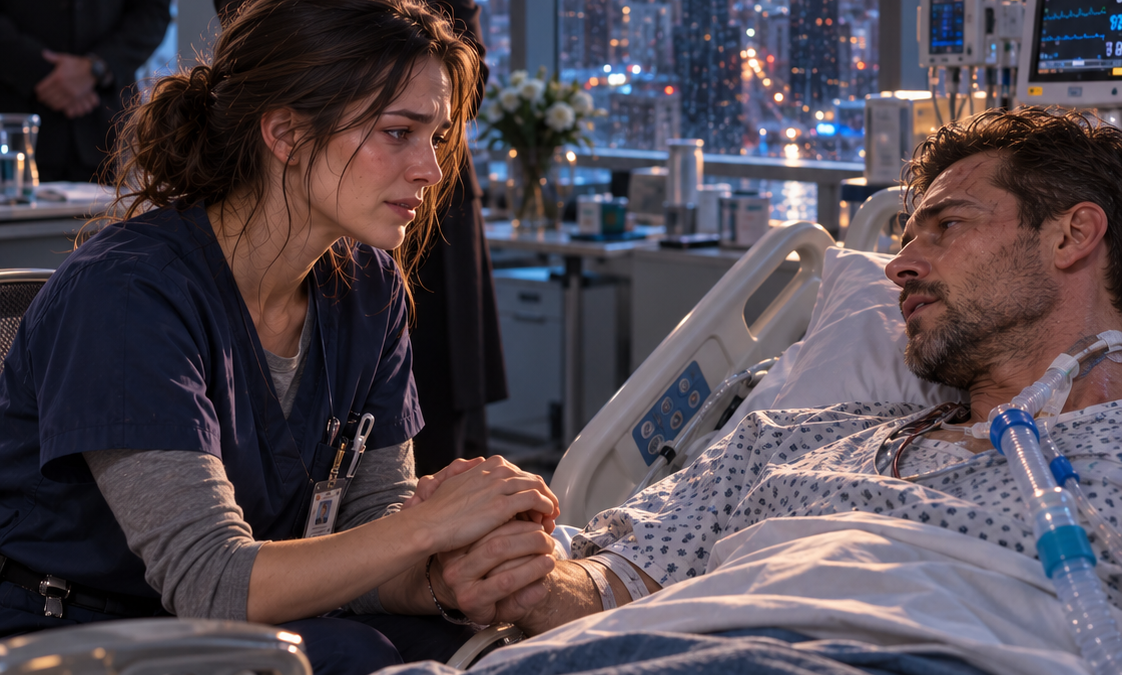
She had reached across the bed rail in the middle of the night when there was no reason to, and every reason not to, and she had taken his hand, and she had told him the truth things about her life because he was the only one there. and she was too tired for anything else.
And she had said the simplest thing available, “You’re not gone yet.”
He had come back. And in helping him find his way back to life, in choosing every time the choice was available, to stay rather than to leave, to look closer rather than accept the official version, to say the true thing rather than the easier one, Clare Witmore had found her way into a life that was hers.
Not the life she had planned. Not the life she had been surviving toward. The real one.
The one that started when she took his hand.
—END—