“You’re Not Gone Yet.” Nurse Held a Brain-Dead Mafia Boss’s Hand—Then He Opened His Eyes
“You’re Not Gone Yet.” Nurse Held a Brain-Dead Mafia Boss’s Hand—Then He Opened His Eyes
The syringe was already in his hand before Clare even turned around. She had her back to the door checking vitals, writing numbers down, doing what nurses do at 1:00 in the morning when a floor is quiet and the only sound is the soft mechanical rhythm of a vent later.
She hadn’t heard him come in, hadn’t heard the door, hadn’t heard anything at all until she registered the shift in the air, that specific wrongness of someone standing close behind you who was not supposed to be there.
When she turned, the man in the white coat was already moving toward the IV line. His face was calm. That was what stopped her breath first, not the syringe, but the calm.
The total deliberate calm of a man who had done this before and expected to do it again before mourning. Her patient lay motionless in the bed between them, brain dead, the chart said, already gone, the neurologist said. But Clare Witmore had been sitting beside this man for 4 hours, and something in her would not accept that.
Something in her kept watching his chest rise and fall with a steadiness that didn’t match the verdict.
She put herself between the stranger and the IV line. Who are you?
The calm broke. He lunged.
The rain had been falling since 6:00. Clare Whitmore noticed it the way she noticed most things at the end of a double shift distantly.
The way you notice a song playing in another room when you’re too tired to identify it.
She was standing at the nurse’s station on the seventh floor of Meridian Private Hospital trying to get the charge nurse to sign off on her overtime hours before the system locked her out for the night.
Her feet hurt. Her back hurt worse. She had been awake for 19 hours and she still had eight more to go.
“Sweet 4205,” said the charge nurse.
A compact woman named Phyllis, who never wasted words after midnight. She slid a chart across the counter without looking up. Long-term monitoring neuroase.
Your primary for the shift. Clare picked up the chart. Read the name.
Read the diagnosis. Brain death protocol observed, not confirmed.
Families disputing the findings. Somebody upstairs wants around the clock eyes on him until the ethics committee meets on Thursday.
Phyllis finally looked up.
You’ll be fine.
He’s not going anywhere.
Clare looked at the room number again.
Suite 4,25 was on the 42nd floor, the hospital’s VIP tower, where the rooms cost more per night than Clare made in a week.
She had floated up there twice before in 3 years.
once for a city councilman after a stroke and once for a hedge fund manager’s wife who had overdosed on something she wasn’t prescribed.
She took the chart, took the elevator, did not ask questions because nurses who ask questions at 1:00 in the morning tend to get assigned worse things than monitoring a brain deadad patient in a luxury suite. The 40on floor had a different quality than the rest of the hospital. Queer, warmer, the lighting was softer.
The carpet in the corridors was real carpet, not lenolium, and it absorbed sound in a way that made the whole wing feel slightly unreal, like a hotel that had decided to install ventilators. Outside room 4,205, a man was sitting in a chair.
He was large, not just tall constructed, the way people get when they have spent serious decades in serious gyms or in environments where being physically formidable is a professional requirement. He wore dark clothing and had his arms folded across his chest.
His eyes tracked Clare before she was halfway down the corridor. She stopped in front of him with the chart under her arm.
I’m the night nurse for this room.
He looked at her for a moment without speaking. Then he looked down the corridor in both directions, looked back at her, and stood up. Badge.
She showed him her ID. He studied it the way someone studies a document they actually intend to remember, not the way people glance at badges to be polite.
Then he knocked twice on the door, opened it just wide enough to speak through, and said something low that she couldn’t catch.
A woman’s voice answered.
He pushed the door open and stepped aside. The room was large by hospital standards, which meant it was small by the standards of whoever was paying for it.
A hospital bed dominated the center, surrounded by monitors. Florida sailing windows on the far side showed Manhattan spread below. Lights in every direction, wet and fractured by the rain, the cities looking exactly like itself, even at this hour, which was the thing Clare had always found both exhausting and oddly comforting about New York.
It never stopped, even when everything else did. A woman stood at the window with her arms crossed, looking out.
She turned when Clare entered.
late 40s expensive clothes worn the way people wear them when they haven’t thought about what they put on because thinking about clothes is not their primary problem.
Dark hair eyes that measured everything they landed on. The kind of face that had once been striking and was now something more complicated, hard in some places, scored by fatigue and others held together by what looked like pure determination.
You’re the night nurse.
Clare Whitmore. Yes, Vivien Aldridge. The woman did not move from the window.
His sister. She tilted her head toward the bed. I want to be contacted immediately if anything changes.
Anything. His breathing, his color, his monitors.
I don’t care what time it is.
Of course.
If any physician comes into this room tonight, any physician at all, regardless of what they say or who sent them, you don’t let them touch him until I’ve been called.
You understand? Clare understood that something was off.
Not in the obvious way, not the way that set off immediate alarms, but in the quieter way she had learned to recognize over seven years of nursing, where the situation in front of you doesn’t quite fit the shape of its official explanation.
Brain death monitoring didn’t usually come with a guard at the door and a sister issuing instructions about unauthorized physicians.
I understand, Clare said. Vivien looked at her for one more moment, really looked.
The kind of look that was an assessment rather than a greeting, and then gathered her coat from the chair beside the bed. His name is Roman, she said.
He’s 42.
He was in a car accident 6 days ago.
I’ve read the chart.
The chart, Viven said.
Doesn’t tell you everything.
She paused at the door.
Don’t let anyone in.
Then she was gone. The large man outside Grant Clare would learn later pulled the door closed behind her and Clare was alone with Roman Aldridge. She stood beside the bed and looked at him.
He was, she thought, not what she had expected.
She was not sure what she had expected from a man whose chart described profound neurological suppression and whose family could apparently afford an entire floor of Manhattan’s most expensive private hospital.
But the face on the pillow was not it. He looked, for lack of a better word, unfinished, like someone had interrupted him mid-sentence. Late 40s in the chart, but the face read younger in some ways, and older in others, jaw sharp even in unconsciousness, a long healed scar above one eyebrow, two days of dark growth on his face, because nobody had shaved him or nobody had wanted to.
Strong hands, a bruise still yellowing along the left side of his face from the crash. He was breathing. That was what she kept coming back to.
He was breathing with a steadiness that the monitors confirmed, and she had seen brain death presentations before, had monitored them during her ICU rotation years ago, and this did not look like that. Not exactly.
She charted his vitals, adjusted the monitoring cuffs, checked the IV line, the placement, the flow rate. She did the work methodically because that was how she got through long shifts, one task at a time.
Don’t let the weight of the whole thing sit on you at once.
just the next task and then the next. When the work was done, she pulled the chair closer to the bed and sat outside the rain intensified against the windows.
Manhattan swam below in moving light. She sat with him for a while in the quiet and then because she was exhausted because she had been awake for 19 hours because sometimes the only way to survive a long night shift is to talk to the nearest available person even when that person cannot talk back.
She started talking. Not about him, about herself. I had a patient last week, she said not loudly.
The way you’d speak in a library who coded three times in 4 hours and came back all three times.
And I thought at some point that has to mean something. Like the universe is making an argument.
She looked at the monitors.
I’m not sure what the argument is, but it keeps making it.
Roman did not respond. His chest rose and fell. Clare shifted in the chair.
My dad’s sick, she said.
has been for about 2 years.
It’s his kidneys and the treatment is expensive in the way that health care is expensive when your insurance decides that what you need is in a gray zone.
So, we pay out of pocket for the parts that matter most and my mom cuts everything else and I work extra shifts. She looked down at her hands.
I’m not telling you this because I want sympathy.
I just It’s a long night and you’re the only one here.
The rain against the glass, the soft, consistent sound of the ventilator.
She talked for a fala about nursing school, about how she had originally wanted to be a veterinarian before the cost became impossible, about the specific quality of loneliness that comes from working nights in a city that always looks busy
from a distance, but but feels empty when you’re actually inside it at 3:00 in the morning.
She talked about small things. The coffee from the seventh floor machine that tasted like burned paper.
The fact that she had been wearing the same pair of shoes for 2 years because she hadn’t had a week where replacing them made sense financially.
She was not performing. That was the thing.
She was just filling the silence the way people do when they’re too tired for pretense.
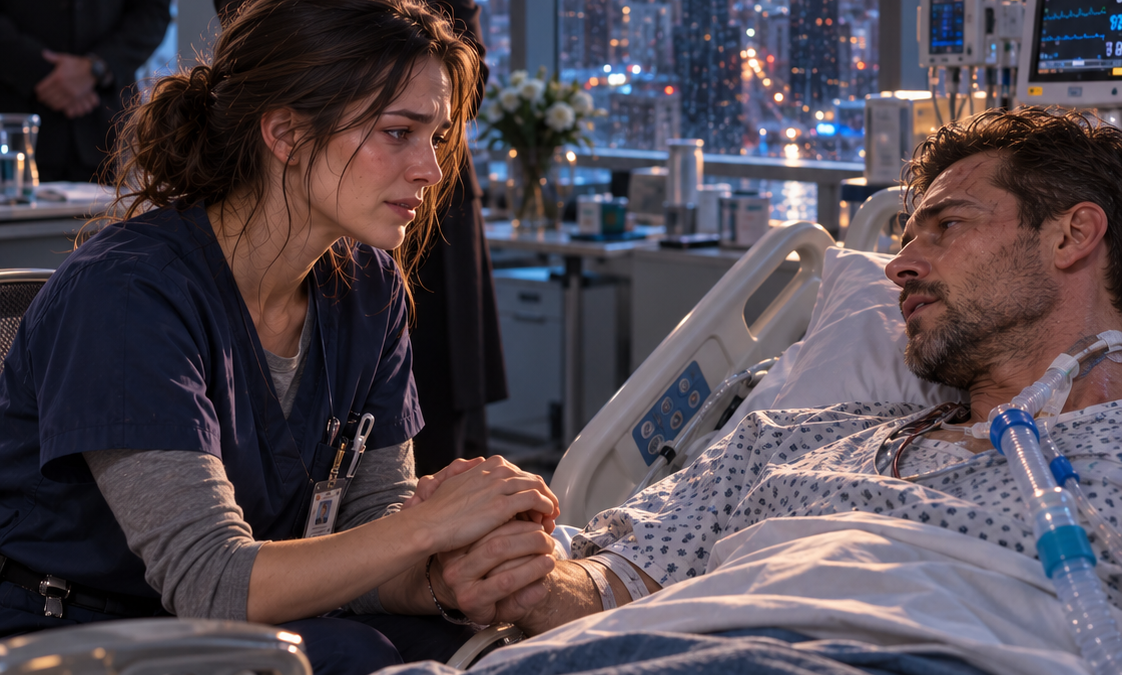
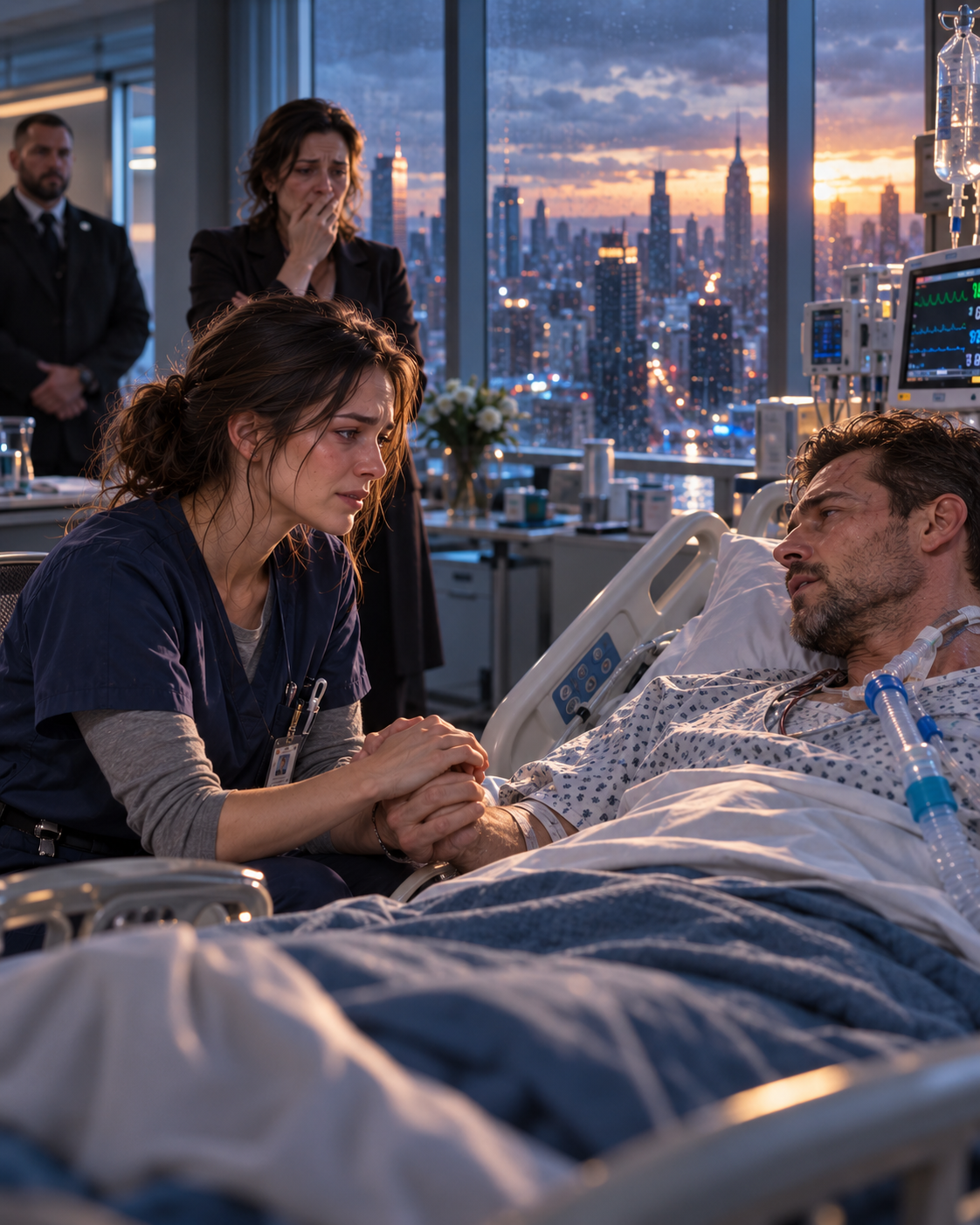
At some point, she reached over and rested her hand on top of his. It was not a romantic gesture.
It was the same instinct that made her straighten blankets and adjust pillows the s the nurse’s baseline reflex to offer contact when nothing else is available.
You’re not gone yet, she said quietly.
I don’t know why I keep thinking that I don’t think you’re gone, she sat back.
The monitors hummed shortly after 1:00 in the morning. The door opened. Clare looked up.
A man in a white coat came in with a tablet under one arm and walked directly toward the IV stand with the efficiency of someone who belonged there. He had a hospital ID badge clipped to his lapel.
He was already reaching for Roman’s IV line.
The ID badge was wrong. Clare was on her feet before she had consciously decided to stand. The badge was wrong, not visually, but in terms of which department it listed.
Neurology attending physicians at Meridian used a specific badge format. The laminate color was different. She had seen it every shift for three years.
E. And the difference was small.
The kind of small that you would miss if you weren’t paying attention.
If you weren’t standing 4 ft away in good light with nothing else to look at.
Stop. The man looked at her. What are you adjusting?
She said. Sedation titration. His voice was even.
Completely even. Ordered by Dr.Marsh.
He’s not receiving sedation.
A pause. Brief but real. Who are you?
She said. The calm left his face. He moved faster than she expected.
One step, his hand coming up with a syringe she hadn’t seen him draw from his coat pocket.
And Clare did two things simultaneously that she had not planned. She stepped backward into the IV stand with her full weight, sending it clattering sideways across the floor, and she screamed, not a frightened scream, a loud operational scream, the kind that carries through walls. The door came open so fast she felt the air pressure change.
Grant crossed the room in three steps. What happened next was brief and violent, and Clare looked away from most of it.
When it was over, the man in the white coat was face down on the floor with Grant’s knee in the center of his back, and the syringe had rolled under the bed.
Clare was shaking. She pressed her back against the wall beside the window and focused on breathing until her hands stopped. She called Viven.
She called security. Then she crossed the room and picked up the syringe with a gloved hand, held it under the bedside light. The label read potassium chloride.
The dosage was not a therapeutic dosage. There was nothing therapeutic about it.
She set it down carefully and looked at Roman.
if she had not turned around, if she had been in the bathroom or charting at the desk with her back to the door, or if she had been the kind of nurse who didn’t look closely at badges because she was tired and it was late and it had been a long shift.
Detective Miles Carver arrived 40 minutes later, which was fast for Manhattan at 2 in the morning, and the speed of it told Clare something even before he opened his mouth. He was a compact man with gray at his temples and the practiced unhurriedness of someone who had been to too many crime scenes to hurry a at any of them anymore.
He took Clare’s statement in the corridor while paramedics attended to the restrained man inside.
He was going to inject potassium chloride directly into the IV. Clare said she had said it twice already to security and to the first officer who arrived, but she said it again because it was the kind of thing you kept saying until it felt real. At that concentration, it would have caused cardiac arrest in under a minute.
It would have read as organ failure on a brain death case. Nobody would have questioned it, Carver said.
Not a question. No, nobody would have questioned it.
He wrote something in his notebook. Then he looked at her directly. Miss Whitmore, I need to tell you some things about the man in that room.
She had already suspected some of it.
Not the specific she was a nurse, not a crime reporter, but the shape of it, the bodyguard at the door, Vivian’s instructions about physicians, the speed with which Carver had arrived, the way everyone who had come near this room operated like they were managing something larger than a
family’s grief over a brain damaged relative.
Carver told her about Roman Aldridge. He told her carefully the way experienced detectives tell civilians things.
Giving them enough to understand the danger without giving them enough to become a liability. Roman was not a legitimate businessman who happened to have enemies.
He was the primary controlling figure behind a criminal organization that had spent the last decade consolidating significant portions of New York’s underworld.
Moving through legitimate shipping and construction and real estate the way money always moves when it needs somewhere clean to go, but rooted in something that was very much not clean. The Aldridge organization had been in a sustained low-grade war with a rival family called the Calderones for 3 years. The car crash 6 days ago had not been a car crash.
The man who stopped tonight, Carver said, gave us a name before the lawyers got to him. He works for the Calderones.
They paid a physician inside this hospital to sign off on the brain death determination. Roman was never brain dead.
Ms.Whitmore. Someone suppressed his neurological function with a compound that mimics coma while leaving certain baseline functions intact. then had a doctor certify him as gone while the family was too overwhelmed to question it.
Tonight was supposed to be the last step. He goes into apparent organ failure. Case closed.
Clare stood in the corridor with her arms crossed and listened to this and felt the specific kind of nausea that is not physical. The kind that comes from understanding something you would have preferred not to understand.
He’s been lying there for 6 days.
She said conscious in there somewhere.
We don’t know.
Possibly the neurologist we trust is assessing him now. She looked at the closed door of room 4,205. And they know I stopped it.
Yes. So they know my name. Carver met her eyes.
He didn’t soften it.
Yes, they do. He told her about police protection options. He used careful language and the tone of a man who genuinely wanted to help, but also genuinely understood that the help he could offer had limits.
She listened. She nodded in the right places.
When he finished, she thanked him and went back into the room.
Grant looked at her when she came in just looked with the kind of expression that contained a question he wasn’t going to voice.
She ignored it and went to the chair beside the bed and sat down. The room had been straightened. The IV stand was upright.
The syringe was in evidence packaging somewhere. Roman lay exactly as he had lain boy for except now the door had two officers outside it and the situation had been labeled definitively as what it actually was. Clare looked at his hands.
She thought about what Carver had said about 6 days of lying there while the world arranged his death around him about a physician signing a document that said he was already gone. About the particular loneliness of being trapped in your own body while someone argued over whether to let you die or help it along.
She had spent four hours talking to him about her father’s kidneys and the coffee machine on the seventh floor.
She reached over and took his hand.
If they come again, she said, they’ll have to come through me.
She was not being heroic. She was being honest, which was different. She was a woman who had just spent her night shift discovering that her patient was alive inside.
A diagnosis designed to bury him. And the thing she felt in response was not fear well.
It was fear. She was not stupid, but underneath the fear was something older and more durable. She had not become a nurse because it was a safe career.
She had become one because she could not stand watching preventable harm occur and do nothing. This was preventable harm. She would do something outside.
The rain was beginning to slow. The monitors around Roman continued their steady rhythmic documentation numbers ticking upward and downward in the normal ranges.
his lungs doing what lungs do when someone hasn’t given up on them yet.
Clare rested her head against the side of the chair and closed her eyes just for a moment, which was the kind of thing you told yourself was not sleeping, even when it was. She did not dream. She was too tired to dream.
At 5:46 in the morning with the first grace of David beginning to appear the at the edges of the Manhattan skyline, Clare was half asleep in the chair when she felt something, a pressure against her palm, faint, unsteady, but deliberate. She opened her eyes.
Monitors were still reading normal ranges, but something in the room had changed.
a quality of the air, a difference in the sound of the ventilator, something she couldn’t name precisely, but that her body registered before her mind caught up.
She looked at their joined hands.
Roman’s fingers had curled slightly around hers.
It might have been involuntary. Reflex. Spasm.
She knew all the explanations that the rational part of her training would immediately produce. She sat with those explanations for exactly 3 seconds. Then his heart rate rose.
Not dramatically, not the sudden spike of a code, not anything that would trigger alarms, just a slow, purposeful increase, four beats above his baseline. Then six, then settling at eight higher than where it had been all night.
His chest rose, then it rose again, slightly differently, slightly more, with a small variance in the rhythm. That meant something.
That meant specifically that the mechanism doing the breathing was not only the ventilator. Roman Aldridge took a breath of his own. It was small.
It was ragged. It would not have convinced any physician in the world that the man was recovering.
But Clare had watched 400 patients breathe over 7 years. And she recognized the difference between a body that was being ventilated and a body that was beginning to breathe for itself.
And that difference was everything. She pressed the call button.
She pressed it twice, which was the code for come now, not come when you have time. M.
And then she looked at Roman’s face and she waited.
And across the Manhattan skyline, the first light of morning pushed through the clouds like something that had been trying for a long time to get through and finally had. The first person through the door was not a doctor. It was Viven.
She came in at a near run, coat still on, hair not right, which told Clare she had not been home, had been somewhere close, waiting. The way people wait when they know a situation is not stable enough to sleep through.
She stopped at the foot of the bed and looked at the monitors and and then at her brother’s face and the expression that crossed her own face was one Clare recognized from years of delivering impossible news.
The look of someone who had already prepared themselves for the worst and now did not know what to do with something else. What happened?
Viven said not a question, a demand for sequence. His heart rate elevated on its own. Approximately 12 minutes ago, Clare said there was a change in respiratory effort.
He initiated a breath independent of the ventilator. It was brief, but it was real.
Viven’s eyes moved to Roman’s hand to the slight curl of his fingers around Claire’s.
He moved his hand. Yes.
Viven sat down in the nearest chair with the abruptness of someone whose legs have simply decided they are finished holding the weight. She put both hands over her mouth and stayed that way for a long moment. The neurologist arrived odd minutes later.
Dr.Anita Seo, small and deliberate, who walked in with the specific energy of a person who was already recalibrating everything she thought she knew about the patient in this room. She did not apologize for her speed or her disheveled state.
She went directly to Roman, began her assessment, and did not speak for 4 minutes. Clare stood by the window and watched. Co checked pupilary response.
Left eye minimal constriction, but constriction. Right eye same slightly more pronounced.
She ran a reflex test along Roman’s sternum that Clare knew was designed to provoke and Roman’s jaw tightened fractionally, but it tightened.
Co straightened up. Who declared this man brain dead? She said, and her voice was flat in the way that clinical voices go flat when they are covering something much larger.
Dr.Halverson, Vivien said from the chair 3 days ago. Halverson is not on call tonight.
No. Who authorized his access to this floor? Nobody answered.
The silence in the room had a particular quality. The quality of a question that everyone present already understood was larger than it appeared.
That pulled something dark up behind it when you looked at it directly. The looked at Clare.
You noticed the change? Yes.
You were with him the entire shift. From midnight, wrote something.
Looked at the monitors again. Looked at Roman. His neurological functions have not been absent, she said carefully.
They’ve been suppressed.
There is a meaningful difference. Whoever assessed him as brain dead either made an error I find very difficult to defend or they did not make an error at all.
The room absorbed that.
Viven’s hands came down from her mouth slowly.
Say that again. She said the presentation is consistent with profound pharmacological suppression of neurological activity, not with irreversible neurological failure.
Seio’s voice did not waver.
He was not brain dead. He was made to appear brain deadead. The sound Viven made was not a cry.
It was something shorter and harder than that. Something that came from a place beyond grief from the territory past it where grief becomes something combustible. I want Halverson found.
She said tonight that’s not my department.
Co said. No.
Viven said it’s mine.
Grant, who had been standing at the door through all of this, shifted his weight. Clare watched him do it. There was nothing subtle about the movement.
It was the movement of a man receiving an order through a look, which was how people like Grant and people like Vivian communicated when they did not want specific said out loud. Clare noticed. She filed it.
She was very good at filing things. By 7:00 in the morning, the floor had the controlled chaos of a situation that multiple entities with competing interests were all trying to manage simultaneously. Two more police officers had arrived.
A hospital administrator appeared briefly and then disappeared again when it became clear nobody was interested in his perspective on liability.
Detective Carver came back with a second detective Clare hadn’t met and they spoke with Viven in the core for Twitty for 20 minutes while Clare stayed inside with Roman and Co ran more assessments.
At 7:34 Roman’s eyes opened, not fully, not in any cinematic way.
His left eye opened approximately halfway and then closed and then both eyes opened to slits and the light from the window hit him. He turned his head slowly with visible effort like moving through something thicker than air away from the window.
Roman Seo’s voice was precise and level.
Roman, can you hear me? His mouth moved.
Nothing audible came out. The ventilator was still doing partial work, and he was still fighting against the residual suppressive compound in his system, and the effort of basic vocalization was clearly enormous.
But his mouth moved with intent, not the random motion of a reflexive system cycling through patterns, but the specific shaped intent of someone trying to form a word. The looked at Clare. Clare stepped closer to the bed.
She was not sure why. professional instinct maybe, or the fact that she had spent the night talking to him, and some some irrational part of her felt it made her more readilable to him than the others. She leaned slightly closer to the bed rail.
Roman’s eyes at slits moved to her.
They stayed there, not randomly, not with the unfocused drift of recovering sedation. They found her face and stayed.
“Hey,” Clare said quietly.
It was a stupid thing to say.
“She said it anyway.
His right hand moved. the same hand she had been holding. He turned it palm upward on the blanket.
Clare looked at made a small gesture with her head that meant what she knew it meant. Clare put her hand in his.
The grip was weak, barely there, the grip of someone working with 10% of their normal strength, but it was a grip, deliberate pressure. His fingers closed around hers, and his chest rose with what was unmistakably a different kind of breath than the mechanical ones. deeper his Viven standing at the foot of the bed pressed the back of her hand to her mouth.
Grant looked at the wall.
The monitors registered the changes in realtime heart rate, climbing to a sustained new baseline, respiratory drive increasing, the ventilator’s contribution to each breath decreasing measurably.
Roman Aldridge was coming back, not all at once, not cleanly, but unmistakably. The morning moved in pieces after that.
Seio ordered blood work for compound analysis. Carver ordered a formal security detail on the floor.
Viven made phone calls in the corridor that Clare was not close enough to hear, but could read by posture alone the tight-shouldered, low-voiced calls of someone issuing directions to people accustomed to receiving them.
By nine, Roman had been extated his respiratory drive strong enough to sustain him independently, which Coacterized as remarkable, and Clare characterized as something she had known since 2:00 in the morning, even when she hadn’t had the clinical evidence to back it up.
By 10, he could speak, barely. His voice was rough and strained, and he used it sparingly.
The way you use something you’re not sure will hold, but he used it.
The first thing Roman Aldridge said to Clare Whitmore was not romantic. It was not profound.
It was delivered at roughly 20% of a normal speaking volume, interrupted by two long pauses, and it was this. Your father kidney disease.
She stared at him. You heard that?
He looked at her steadily. His eyes were clearer than they should have been given everything.
Darker than she’d expected.
Somehow, though, she couldn’t have said why she’d formed any expectation at all.
I heard he said sort of it. Another pause. Effortful.
Not all. In and out.
How much is in and out? Enough.
His eyes moved to the window and something in his expression changed. Not softened exactly, but shifted like a calculation being revised.
You talked about your shoes.
Clare thought about the 2-year-old sneakers she’d mentioned to a supposedly unconscious man at 2:00 in the morning and felt something between embarrassment and something she couldn’t name yet.
I didn’t think you were listening.
I wasn’t supposed to be anywhere, Roman said.
I was listening anyway. Carver came in at 10:40. He sat across from Roman with his notebook and the careful patience of a man who understood that the person he was interviewing had been through something that most people did not surv.
He asked questions. Roman answered them slowly in the abbreviated way of someone measuring each word against the energy it cost.
Yes, he had suspected the accident was not an accident. No, he had not been able to communicate anything from inside the suppressed state. Yes, he had been aware intermittently incompletely of people in the room, voices, presence.
No, he would not be discussing the specifics of his organization with a detective without attorneys present. Carver did not push on that last point. What he did say before he stood to leave was this.
You understand that the people who tried to finish this tonight will know it didn’t work.
I understand, Roman said.
And Miss Whitmore is now connected to that failed attempt by name, by face, by the fact that she’s been in this room.
Roman’s eyes moved to Clare, who was standing near the door.
Something happened in his expression, something that had the shape of guilt, though Clare suspected it was not a look Roman Aldridge produced easily or often. I know, he said. Set.
I’m telling you both.
Carver said so that both of you understand the situation clearly. He left.
Roman looked at Clare for a long time. You should go, he said finally.
I’m still on shift for another 3 hours after your shift.
And go where? She said it evenly, not combatively. An actual question.
He did not have an answer for that, which seemed to frustrate him. She could see at the specific frustration of a man accustomed to having answers, accustomed to being the one who resolved situations, confronted with a situation he had not created and could not currently resolve.
I have people who can I’m not asking your people for anything, Clare said.
I don’t know your people, Viven.
I don’t know Viven either.
I met her at midnight. She crossed her arms.
I appreciate that you’re worried.
I think that’s actually I think that’s probably new for you.
worrying about someone outside your immediate situation.
And I’m not being cruel about that.
I’m just noticing it.
But I’m not going to make decisions about my safety based on a conversation we’re having while you’re still on the back end of pharmacological coma.
He looked at her.
That’s a reasonable position, said slowly.
Thank you.
It won’t protect you.
I know. She met his eyes.
I’ll figure it out.
She left when her shift ended at noon. A sound like green wood splitting.
She took the subway home because she always took the subway home because the cab fair from Midtown to her apartment in Washington Heights was money she didn’t have in her regular budget.
And she was too tired to recomputee her budget right now. She stood on the platform. She stood on the platform with her bag over one shoulder and her eyes on the far end of the tunnel where the train would appear, and she thought about everything Carver had told her.
A sound like green wood splitting.
And she thought about Roman’s voice saying she had talked about her shoes.
and she thought about the syringe of potassium chloride that had been 12 in from a man’s IV line.
She was not panicking. She had moved past panic somewhere around 4 in the morning and into the specific state of alertness that comes after panic, the one that is simultaneously clearer and more brittle. Her apartment was on the fourth floor of a building that had a buzzer that sometimes worked.
She took the stairs because the elevator had been unreliable for 6 months and the super had given up pretending otherwise. Fourth floor, apartment 4C, two rooms and a bathroom and a kitchen that was really just the end of the living room with appliances at it. She unlocked the door.
She knew before she pushed it open. The deadbolt had been relocked.
Whoever it was, they were professional.
They hadn’t left it obviously unsecured, but the door had a resistance when she opened it.
that was different from normal, a different weight to the air behind it, and Clare stood in the doorway for a moment without going in. Then she went in.
The apartment looked untouched. That was the first thing. Nothing overturned, nothing ransacked, nothing that would have read as a burglary to anyone looking quickly.
Whoever had been here had been neat, which was somehow worse than mess would have been because it meant they were methodical. It meant they took their time.
She checked the bedroom, the bathroom, the kitchen. Then she saw the kitchen counter. A single dried black rose stem stripped of its leaves laid across the counter beside her coffee maker.
No note, no message of any kind. None was needed. Clare stood in her kitchen and looked at the black rose prickle and understood exactly what it was.
had heard Carver mention the Calderon’s symbolism in his briefing that morning, had absorbed it with the rest of the information without knowing she would need it this quickly.
You’re next.
That was what it said. That was all it said. She picked up her phone and called Carver.
He answered on the second ring.
Someone’s been in my apartment, she said.
They left a black rose on the counter. A pause. Are you inside right now?
Yes. Get out right now.
Don’t touch anything else.
I’ll have a unit there in 8 minutes.
She was outside on the sidewalk in under 90 seconds. Bags still on her shoulder.
The specific unreality of standing outside your own home because someone dangerous has made it unsafe settling over her like weather. The Washington Heights street around her was conducting its normal Saturday afternoon business. Bodeas, strollers, a group of teenagers sitting on a stoop arguing about something and none of it touched her.
She stood in the middle of all of it and felt entirely separate from it. Her phone rang. Viven.
Detective Carver contacted me. Viven said.
She sounded exactly as she had sounded at midnight, which was composed and direct.
Uh, but now there was something underneath it that hadn’t been there before.
Something tighter. Are you all right?
I’m standing on the sidewalk outside my building.
I need you to listen to me.
I need you to not make any decisions in the next 10 minutes that you can’t reverse.
Can you do that? Clare watched a pigeon land on the bodega awning across the street and decide almost immediately that it had made a mistake.
I’m listening, she said.
Vivien gave her three options. The first was formal police protection a detail relocated safe house coordinated through Carver and the department.
Viven described it honestly, viable for days, possibly weeks, but dependent on institutional resources that had limits and bureaucratic timelines that didn’t match criminal timelines.
The second was disappearance. New identity, new location, people Viven knew who handled exactly this kind of transition.
Clean, effective, permanent.
You leave New York and you don’t come back and your old name becomes a person you used to be.
The third option, Viven presented more carefully.
Roman’s residence in the West Village was Vivien said the most secured private address in New York City outside of federal facilities, not because of the address or the building.
Those were unremarkable on the surface, but because of what was inside and around it. Staff systems Grant and the people Grant trusted.
It was, she said, the one place in the city where the Calderonas would need to escalate to enact open war to touch someone. An open war had costs they were not currently positioned to absorb.
“You’re inviting me to move into your brother’s house,” Clare said.
“I am.
We met at midnight.
I know.”
He was unconscious for that entire meeting.
“I’m aware, Viven.
” Clare pressed her fingers against her eyes.
“This is not a normal offer.”
“No,” Vivian agreed.
“It isn’t.
Nothing about today has been normal, and the people who put a rose on your kitchen counter are not operating inside normal parameters, either.
I’m not asking you to trust us entirely.
I’m asking you to make a practical decision about the next 72 hours.
Clare thought about her parents. Her father dialysis three times a week, her mother driving him in the car.
Clare helped pay to keep running. She thought about what a black rose on a kitchen counter implied about people who knew where she lived and therefore knew where her parents lived.
“My family,” she said.
“My parents,” a pause.
“Already handled,” Vivian said quietly.
“What does that mean?”
It means they are no longer at their home address. It means they are somewhere comfortable and secure and your mother has been told it is a precautionary measure connected to something at the hospital. Another pause.
I moved them an hour ago. I should have told you immediately.
I’m telling you now.
The mix of emotions that moved through Clare in the following seconds was complicated enough that she couldn’t have untangled it quickly.
Relief, fury at not being consulted, gratitude she didn’t want to feel.
And underneath all of it, something that recognized with the cold clarity that sometimes arrived when she was pushed past the point of pretending that Viven had done the right thing, even if the process was wrong. You moved my parents without asking me, Clare said. Yes, without telling me.
Yes. Why?
Because I knew you would say you needed to think about it.
Vivian’s voice was level.
And I didn’t have time to wait for you to think about it.
Clare looked at the street.
Somewhere in this city, her father was in a different building than the one she’d left him in yesterday.
Somewhere in S cities, a man she had spoken to for one night through the bars of a hospital bed rail had just told her she had been his only tether back to consciousness. And somewhere someone had walked into her apartment and laid a black rose on her counter with the patience of people who were not in a hurry because they were certain of the outcome.
I’m not agreeing to anything yet, Clare said.
I know. I have questions. You can ask them when you get here.
She didn’t agree immediately.
She made Carver confirm that her parents had been located and were secure before she agreed to anything.
She insisted on speaking to her mother directly, a brief call in which her mother complained about having been asked to leave with only 2 hours notice and said the place she was in was perfectly nice but small and had she remembered to water the plant on the window sill, the small cactus, because it didn’t need much, but
it needed something.
Clare said she would figure out the cactus. Her mother said she sounded tired.
I’m okay, Mom.
You sound tired,” her mother said again, because that was what her mother did, which was to say the accurate thing twice as if the second repetition might land differently.
She took a car Vivien sent. Not a flashy car, a dark, ordinary car driven by a man who introduced himself as Dany and said nothing else for the entire ride, which was either professionalism or personality. And Clare was too tired to determine which.
The West Village building was not what she’d expected, which was probably the point.
No gates, no obvious guards at the entrance, a brownstone that looked like every other brownstone on the block, except for the quality of the locks, and the fact that when the elevator opened onto the top floor, Grant was standing there looking like a man who had been standing in rooms being professionally large his entire life and intended to continue doing so. He looked at her. She looked back.
“You could try saying hello,” she said.
Something shifted in his face, nearly imperceptible. She had the strong impression it was not something that happened often.
Hello, he said better. The apartment was large.
She noticed it in pieces the way you notice spaces when you’re too overwhelmed to take them in whole high ceilings.
Windows that looked south toward the river. Furniture that was expensive without performing expensiveness.
books which surprised her. Not decorative books arranged by spine color, but books that had been read left at angles on surfaces, a few open face down on the coffee table.
Vivien was at the kitchen counter. Roman was not there.
He’s resting, Vivien said before Clare could ask.
Seo wanted him transported here rather than kept at the hospital. Quer more controllable.
She looked at Clare with the look she had been using since midnight. the one that assessed and calculated simultaneously.
Do you want to eat something?
I want to understand what I’m doing here.
You’re safe here.
That’s a description of where I am, not an explanation of what I’m doing.
Viven sat down the coffee cup she’d been holding.
Sit down, she said.
I’ve been sitting down all Vivien said her name with a precision that stopped her.
Sit down, she sat. Viven sat across from her and folded her hands on the table and said, Roman wants to speak with you.
when he’s rested.
Tonight, probably. She paused.
He doesn’t usually ask to speak with people.
He usually decides things, and speaking with people is the mechanism of communicating those decisions.
What he’s doing right now is different.
Clare waited.
He remembers everything you said to him,” Vivien continued.
“All of it, the specifics.
He woke up in a hospital room knowing a woman named Clare Whitmore had sat beside him all night and told him things she probably hadn’t told anyone recently.
And he also woke up knowing that same woman had put herself between him and a syringe of potassium chloride. She looked directly at Clare.
For Roman, those are not small facts.
For any person, those wouldn’t be small facts.
Yes, Vivien said, “But most people don’t have the resources or the particular kind of guilt that makes them want to immediately fix what the small facts mean.”
Clareire absorbed this.
“He’s going to offer me something,” she said.
“He’s going to want to do something.
What form it takes, that depends on the conversation.
” Viven’s expression shifted slightly.
“I’m not asking you to like him.
I’m not asking you to trust him further than the evidence supports.
I’m asking you to give him the conversation because the sound came from down the hallway.
Both women stopped. It was not dramatic, not a crash, not a fall.
It was the sound of someone moving through a space with insufficient steadiness. The soft multiple contacts of a person using a wall for support rather than choosing to.
Clare was on her feet before Viven was.
She went down the hallway faster than she’d meant to, and found Roman six feet from the bedroom door, upright but barely, one hand against the wall and the other, not sure where to be.
He was in a hospital shirt that someone had traded for a gray t-shirt at some point, and he was pale in the way that people are pale after serious physical systems failures, and the effort on his face was of someone who had told his body to do something, and his body had agreed to do it, but was making clear it considered the terms unreasonable. He looked at her.
“I was coming to find you,” he said.
His voice was still rough.
“Still not all the way back.
You could have waited,” Clare said, and her voice came out more firmly than she’d intended.
“You were told to rest.
I’ve been horizontal for 6 days.
You were unconscious for 6 days, which is different.
” She was already assessing him the way she always assessed patients automatically, involuntarily, the way you can’t stop parsing information that your training has made you fluent in.
His color was poor but not alarming. His balance was bad but not dangerous. He was not in imminent distress.
He was, however, clearly doing something his body had not signed off on, and the expression on his face suggested he was accustomed to his body’s opinions not being the deciding vote.
“Come here,” she said.
She took his arm, not gently, practically, the way you handle someone who needs support rather than comfort. She steered him the six feet back to the bedroom doorway and into the room to the edge of the bed and made him sit.
He sat. He looked at her with something that was not quite surprise and not quite the absence of it.
You’re not gentle, he said.
I’m efficient, she said.
There’s a difference.
He almost smiled. Almost.
It didn’t quite make it to the surface, but the architecture of it was there.
She checked his pulse at the wrist without asking permission old habit reflex and it was faster than she’d have liked, but not dangerously so.
She looked at the por around his mouth. Made a judgment.
Talk, she said. From here, whatever you were coming to say, you can say it sitting down.
He was quiet for a moment. He looked at his own hands, which was not, she suspected.
Something Roman Aldridge did often looked at himself as though surprised to find himself present. I know what Vivien offered you. He said the three options.
She told you. She tells me things when she decides I should know them. A pause.
She didn’t tell me about your parents until an hour ago.
She moved them first. Told me later.
She knew I He stopped. She handles me sometimes.
I let her because she’s usually right.
She moved my parents without telling me. I know.
His eyes came up. That was wrong. The decision to move them was correct.
The process was wrong. You should have been contacted first. Clare looked at him.
Are you apologizing for your sister?
I’m saying what was true.
That was, she thought, a very particular kind of answer.
Not evasive, not sentimental, just accurate, offered without decoration, which told her something about how his mind worked that none of the chart, none of Carver’s briefing, none of Viven’s careful framing had told her.
“I heard you,” Roman said.
“When you said if they came again, they’d come through you.”
He was watching her steadily, and the way that she was beginning to recognize was simply how he looked at things fully without looking away. I need you to understand something. Tell me, the people who did this, he said, are going to come back.
Not tonight.
They’ll calculate, regroup, but they will come back.
And when they do, the most dangerous place in New York City is anywhere near me. He said it without self-pity, which made it worse somehow.
As a plain fact, you understand what I’m telling you.
You’re telling me to leave?
I’m telling you what the accurate picture looks like.
His jaw tightens slightly. What you do with it is your decision.
I don’t make decisions for people I’m not responsible for.
And am I someone you’re responsible for?
A long pause. Not yet, he said.
But I’m trying to figure out if I want to be.
The room was quiet. Outside somewhere below, a car moved through the West Village Street.
Clare sat in the chair across from the bed. The thing she was feeling underneath the exhaustion, underneath the practical terror of black roses and potassium chloride and apartments that had been searched by professional strangers, was something she recognized but did not quite have language for.
It was not attraction in any simple sense. It was more specific than that.
It was the feeling of seeing someone clearly, not the version of them that had been constructed by other people’s narratives, by a detective’s briefing or a sister’s management or a hospital chart, but the actual person behind all of that.
And finding that the actual person was someone she did not fully understand, but wanted to. That was, she thought, probably complicated.
She was too tired to determine how complicated. Get some rest, she said.
Clare. She had already started to stand.
She stopped.
Roman was looking at her with the expression he’d worn when he’d said, “Not yet.”
That particular quality of honesty that cost something that you could tell was not his default setting, but was what he defaulted to when the pretense required more energy than he had.
“While I was under,” he said, “I kept hearing you, and I kept thinking, whoever this woman is, she is telling the truth completely without trying to.”
He paused.
“I haven’t been around much of that.
She didn’t say anything.
“It’s not nothing,” he said.
“That’s all I’m telling you.”
She stood in the doorway for a moment.
“Get some rest,” she said again.
“We can talk when you’ve slept.”
She went back to the living room.
Vivien was at the window looking south, exa exactly where she’d been looking at midnight when Clare first walked into a hospital suite on the 42nd floor.
48 hours.
That was how long it had been since Clare had been a broke night shift nurse with a cracked phone assigned to monitor a supposed brain death case in the hospital’s luxury wing.
48 hours and someone had been in her apartment and her parents were in an undisclosed location. And a man who ran a criminal empire was lying 20 ft away in a guest bedroom trying to recover from 6 days of of medically induced near death. and he had told her in the plainest voice she had ever heard used for something that complicated that her honesty was not nothing.
She stood in the living room of Roman Aldridge’s apartment and felt the specific quality of a moment that is a threshold the kind you can step back from technically if you choose, but that you already know you’re not going to.
Then Vivien’s phone rang.
Vivien looked at the screen. The color went out of her face. Not all of it.
Not dramatically. Just enough that Clare, who noticed things, noticed it.
What? Clare said. Vivien turned the phone.
It was a photograph.
Clare’s mother standing at the window of whatever safe house Vivien had moved her to.
Photographed from outside the angle of the image indicating the photographer had been in the street or on a nearby roof. The photograph had been sent from an unknown number. No message.
None was needed.
Viven’s careful composure was still there.
But something behind it had shifted. Something that had been a managed situation an hour ago had just become something else. And they both knew it.
The Calderonas knew where her parents were. They had found them in under 4 hours. And they had sent the photograph not to threaten, but to demonstrate something far more dangerous than a threat capability.