A Dying Biker Reached A Cabin In The Snow — The Girl 20yo Inside Saved Him – Part 1
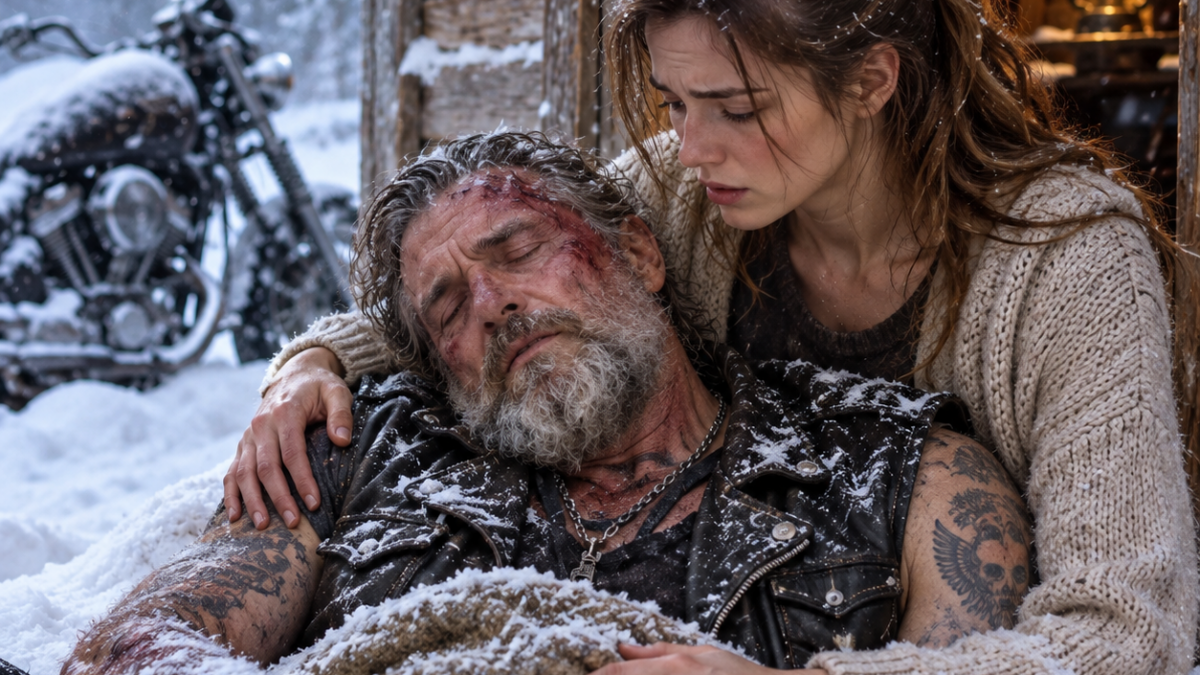
A Dying Biker Reached A Cabin In The Snow — The Girl 20yo Inside Saved Him
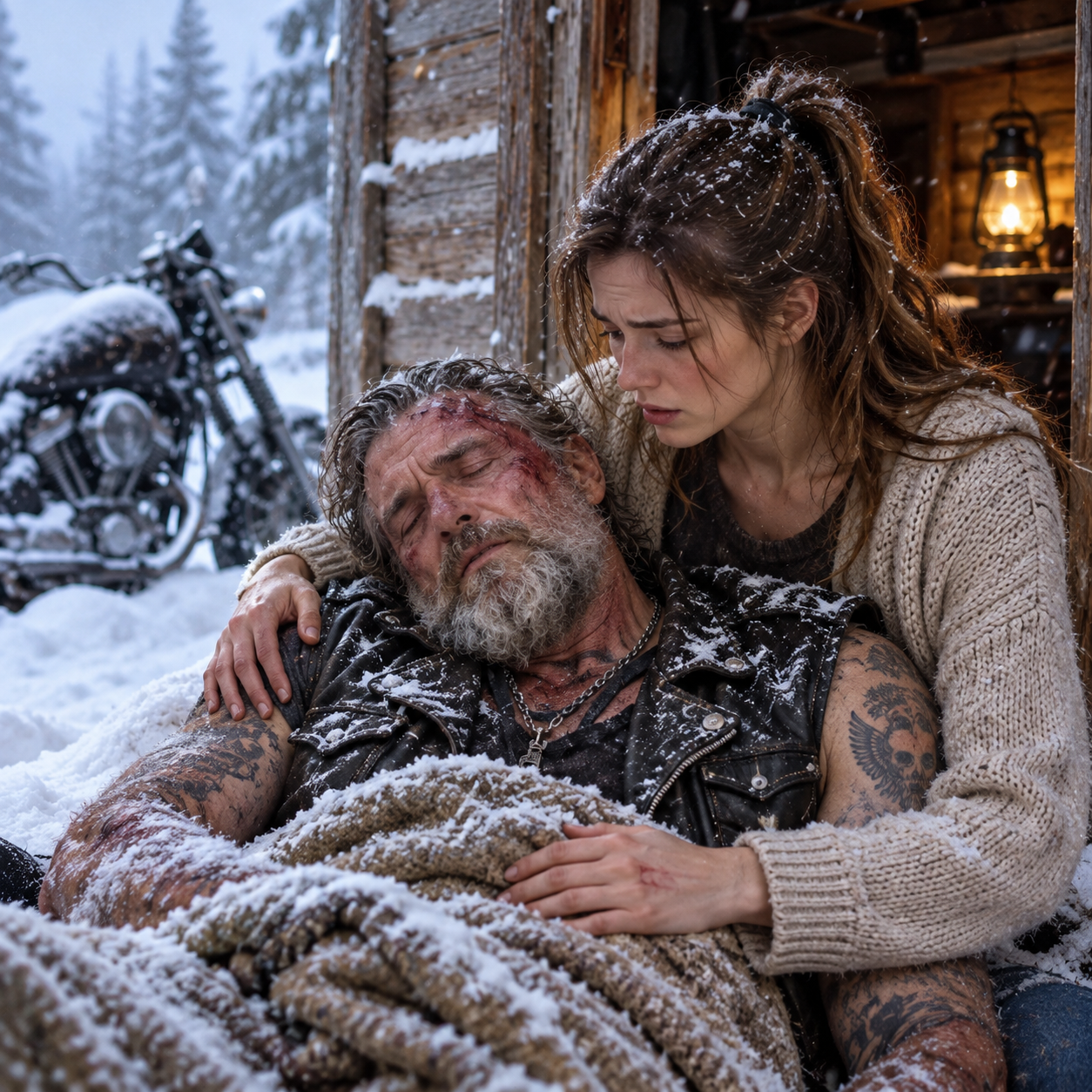
Don’t you dare close that door,” he rased, blood freezing on his lips.
“There are men behind me, and if they find me dead on your porch, they’ll find you, too.”
Emily Parker stood frozen in the doorway, 20 years old, alone in a mountain cabin in the middle of a Montana blizzard, staring at a stranger covered in blood and ice, who had just collapsed at her feet. She had two seconds to make a decision, and the wrong choice would cost them both everything.
The crash happened at 217 in the morning.
Not because Jackson Carter lost control. Not because he was drunk or tired or reckless. Jack had been riding mountain roads for 30 years.
He knew every curve, every ice patch, every slope that could swallow a man whole if he wasn’t paying attention.
The crash happened because someone wanted it to happen.
He felt it first in the handlebar, a shimmy that wasn’t natural, a pull to the left that should not have been there.
He had checked the bike that afternoon, checked it twice the way he always did before a long night run through unfamiliar terrain. The brake lines had been fine.
The tires had been solid. But somewhere between that afternoon check and 217 in the morning, someone had gotten to his bike.
Jack had less than 1 second to process that thought before the rear wheel locked and the machine went sideways on black ice.
He didn’t scream.
Jack Carter wasn’t the kind of man who screamed.
He just hit the guard rail, went over it, and fell. The bike went one direction, he went another.
And when he finally stopped rolling down the embankment and slammed into a frozen boulder, the only sound in the world was the howling wind and the distant creek of metal as what was left of his motorcycle settled into the snow. He lay there for a long moment, completely still, staring up at a sky full of nothing but black and white. Then he took one breath.
It felt like someone had driven a railroad spike through his left side. Ribs, at least two of them, maybe three.
He took another breath anyway, slower this time, controlled. He had been hurt before. Not like this, but close enough to know that panic was the real killer.
Panic made you move wrong. Panic made you forget to think. Jack pressed his right hand flat against the snow and pushed himself up.
It took three tries. By the time he was sitting upright, his left shoulder was screaming at him in a way that told him something in there was torn badly.
He could move the arm barely. He could feel his fingers, which meant no nerve damage.
Not yet. But every shift of weight sent fire shooting from his shoulder blade to the base of his neck.
He reached for his jacket pocket. Phone, no signal, not even one bar.
He turned it off to save battery and put it back. His eyes adjusted to the dark. He could see the guardrail above him bent and broken.
He could see the black scar on the road where the bike had gone sideways. He could not see any headlights.
He could not hear any engines. Not yet, but they were coming. He was sure of that much.
The men who had rigged his brake line weren’t going to leave anything to chance.
They were going to come back and check. And when they found the bike, but not the body, they were going to start looking.
Jack had maybe 20 minutes, maybe less. He had no weapon. His knife was still strapped to his bike buried somewhere in the dark below him.
His phone was useless. His shoulder was getting worse by the minute, and every breath he took through his ribs felt like inhaling broken glass.
He had two choices. He could stay where he was and wait for someone to find him. Or he could move.
He got to his feet. It took everything he had. His boots sank into the snow up to his midcfe.
And the wind hit him like a wall. He had ridden in cold before, but not like this.
This was the kind of cold that didn’t just touch your skin.
It got inside you, reached down into your chest and your gut, and started squeezing. He looked around trying to get his bearings.
He was in a valley. The road was above him and to his right. Somewhere to the north was a service road he had passed 20 minutes before the crash.
A dirt road that cut through the forest. He had noticed it only because there was a light somewhere up that road, a small one, the kind that came from a window. That was his only option.
He started walking. The first h 100 yards were the hardest thing he had ever done.
He was walking uphill through deep snow in the dark with two broken ribs and a torn shoulder in the middle of a blizzard that was getting worse by the minute. The cold was so sharp it had moved past painful into something almost abstract.
He could feel it without feeling it like it existed just outside the boundaries of his body. His mind stayed sharp.
That was Jack Carter.
Even bleeding, even half broken, the man’s mind stayed sharp.
He thought about the brake line. He thought about who had touched the bike that afternoon.
He thought about the folder he was carrying, the one zipped into the inner pocket of his leather jacket, pressed against his chest, right now slightly damp from the snow, but still sealed. That folder was the reason someone had tried to kill him tonight.
He had known the risk when he took the job. Two months ago, a man named Robert Crane had contacted the chapter through an old connection, a friend of a friend of a brother who had been out for 15 years.
Crane was a county record in a town called Ridgerest about 90 mi east of the Montana border.
He had stumbled onto something while processing a series of property transfer, a pattern of land acquisitions that shouldn’t have existed.
Tied to a company that had no real offices, no real employees, and no real business that anyone could identify. What it did have was a connection to a man named Victor Hail.
Victor Hail was the kind of man who didn’t exist in public records.
He existed only in the spaces between things in the shell companies, in the untraceable wire transfers, in the names that appeared once in an old court document and then vanished. What Jack had pieced together over two months of quiet, careful work, was that Hail was systematically buying up land across three counties, land that was sitting on water rights, mineral deposits, and access routes that would be worth hundreds of millions of dollars once a planned federal infrastructure project went through.
The project hadn’t been
announced publicly yet, but Hail already knew about it, which meant Hail had someone inside the federal government feeding him information.
And the families who owned that land, mostly old ranching families, people who had been there for generations, were being pushed out through a combination of forged documents, legal harassment, and what Jack had started to believe was outright intimidation and violence. Three families had left under suspicious circumstances. One of them involved a house fire.
The father had survived. His wife had not.
That fire was why Jack had taken the job. Not for money.
Not even entirely for the brotherhood. He had taken it because a man named Dale Briggs had sat across from him in a diner outside Missoula with burns on his hands and tears drying on a face too old to cry easily and asked him quietly if there was any way to get the truth out without getting killed for trying. Jack had said he would see what he could do.
He had done more than that. He had gotten the documentation, names, account numbers, land transfers, forged signatures, all of it organized and copied and now pressed against his chest in a waterproof folder that some very dangerous people very much wanted back.
I thought about Dale Briggs as he walked. He thought about that burned farmhouse. He thought about the way Dale had held his coffee cup with both hands.
Even though it was a warm day, the burns had never fully healed and his grip wasn’t what it used to be.
That thought kept him moving when his body told him to stop. He walked for 34 minutes by his internal count. He fell twice.
The first time he caught himself with his right arm before his face hit the snow. The second time he went down hard on his right knee and stayed there for almost a full minute, breathing through the pain, organizing himself before he got back up.
His left shoulder had stopped screaming and gone quiet, which he knew was not a good sign. Quiet pain was worse than loud pain.
Quiet meant the body was starting to give up on that argument and move on to something more serious. I had to find that cabin. Then he saw it.
Just a sliver of light through the trees, yellow and warm and impossibly still in the middle of all that howling white. He adjusted his direction and pushed toward it. And with every step, it got clearer.
A small cabin set back from what had once been a dirt road, but was now just an unbroken field of snow. Smoke was coming from the chimney.
The porch light was on a single bare bulb swinging in the wind. He made it to the porch steps.
He modded up the first step, the second.
He raised his right hand and knocked on the door two knocks hard because he wasn’t sure he’d be able to do it again if she didn’t answer.
Then his legs gave out. He hit the porch on his knees first, then went sideways, his right shoulder catching the wooden railing.
He got one hand down and stopped himself from going flat. He was kneeling on the porch, one hand on the railing, the other flat on the boards, and the world was tilting in a slow, nauseating way that told him he was running out of time. He heard the deadbolt turn.
He heard the door open. He looked up.
She was young. He registered that first.
young blonde wearing an oversized flannel shirt and holding a flashlight in one hand and something else in her other hand, a fire poker.
He realized she had come to the door armed, “Smart girl.”
She was staring at him with an expression that was equal parts terror and something harder, not quite anger, but something resolute, like she had already made a decision and was just waiting to see what he would do next.
“Don’t you dare close that door,” he rasped.
His voice came out rougher than he intended, cracked from the cold.
There are men behind me, and if they find me dead on your porch, they’ll find you, too.
She didn’t close the door.
She didn’t open it wider, either.
She stood exactly where she was, the flashlight beam steady on his face, her knuckles tight around the fire poker.
“Who are you?”
she said. Her voice was quiet, controlled, a voice that had learned not to show too much.
“My name is Jack Carter,” and he said, “I was in a crash about a mile and a half south of here.
I need to get inside. I need to use your emergency radio if you have one.
And I need He stopped, took a breath. His ribs objected strongly.
I need about 5 minutes to not be dead.
That’s all I’m asking.
She stared at him for three full seconds. Show me your hands, she said. He raised both hands, palms out, even the left one, which sent a flare of white hot pain from his shoulder to his fingertips.
He didn’t let it show on his face.
She looked at his hands. She looked at the blood on his jacket sleeve.
She looked at his face and whatever she saw there apparently answered something she was trying to work out because she stepped back and held the door open.
“Get inside,” she said, “and don’t touch anything.”
He got to his feet. It was not graceful.
It was barely functional, but he got up and walked through that door on his own two feet because Jackson Carter had never been dragged anywhere in his life, and he wasn’t starting tonight.
She closed the door behind him and locked it.
Sit down,” she said, pointing at the wooden chair nearest the fireplace.
“Before you fall down,” he sat.
The warmth hit him immediately, and it was almost too much.
His hands started shaking, which they hadn’t done outside because the cold had held them steady.
He pressed his palms flat against his thighs and breathed.
“How bad is it?”
she said. She was standing 6 ft away, watching him with that same careful measuring expression.
“Two ribs, probably three,” he said.
left shoulder. Nothing immediately fatal if it stays clean.
You said there are men behind you. I said there might be.
That’s not the same as might.
He looked at her.
She was watching him with those clear, direct eyes, and he realized she wasn’t going to let him soften anything.
She was young, but she wasn’t naive.
She was asking him a real question, and she wanted a real answer. There are men behind me, he said.
They think I’m dead.
When they figure out I’m not, they’ll be looking.
I don’t know how long that gives us.
Us? She repeated.
I didn’t mean to bring you into this.
You knocked on my door. Yes. She was quiet for a moment.
He watched her process it. The way she stood very still. The way her eyes moved without her head moving, scanning possibilities.
She was calculating. He recognized the pattern.
He’d seen it in men who were good under pressure.
He hadn’t expected to see it in a 20-year-old woman standing in a mountain cabin at 2:00 in the morning.
“What’s your name?”
he asked.
Emily,” she said.
“Emily Parker.”
“Emily,” he nodded once.
“I’m sorry about this.”
She set the fire poker down against the wall, not because she trusted him completely.
He could see she didn’t not yet, but because she had made a decision and was moving past it.
“Take off your jacket,” she said.
“I need to keep There’s something in that pocket you don’t want me to see,” she said.
It wasn’t a question.
“I’m not asking about the pocket.
I’m asking you to take off the jacket so I can look at your shoulder.
You can hold whatever’s in there in your lap if it makes you feel better.
He looked at her.
You’re observant, he said.
I live alone, she said.
You learn to read people fast when there’s no one else around to ask.
He reached his right hand across his body, unzipped the inner pocket, and pulled out the folder. He held it against his chest with his right arm while she helped ease the jacket off his left shoulder. Even with her being careful, it hurt badly enough that his vision went gray at the edges for a moment.
She made a sound. Not dramatic, just a short exhale. Your shoulder is dislocated, she said.
On top of whatever else is torn in there. I know.
I can try to reset it, but it’s going to hurt.
I know that, too. She moved to his left side, positioned her hands, and looked at him.
Ready? Just do it. She did it.
The sound was as bad as the pain. A deep wet pop that Jack felt from his neck to his wrist. And for about two seconds his vision went completely white and he heard nothing but a high thin ringing.
Then it cleared and the pain settled from a 10 down to a seven and he let out a long slow breath.
“God almighty,” he said very quietly.
“Better,” she asked.
“Better,” he said.
“Thank you.”
She was already moving, getting a first aid kit from somewhere behind him.
She came back with it and set it on the floor in front of him, kneeling down to look at the gash on his left forearm that he hadn’t even registered yet.
You have a lot of experience with injuries? He asked. My grandfather was a field medic in Vietnam, she said without looking up from the wound.
He lived here for the last 12 years of his life. He taught me everything I needed to know about being alone up here.
She paused. He died 2 years ago.
I’m sorry, Jack said.
He was ready, she said simply. He always said it was going to be a good death when it came. He was right.
She worked on the arm in silence for a minute. The fire crackled. The wind hammered the cabin walls.
Jack found himself listening past the wind the way he had learned to do years ago, filtering for sounds that didn’t belong.
Engines, voices, anything that moved with purpose instead of just chaos. Nothing yet. Can I ask you something?
Emily said, “You can ask.”
“Are you one of them?”
she said.
“The people chasing you.”
He looked at her.
“No.”
“Um, then what are you?”
“Oh, wow.”
I was quiet for a moment.
“I’m a biker,” he said, “I’ve been riding since I was 19.
I’ve been part of a brotherhood for 22 years.
We’re not what most people think we are.”
“I’m not most people,” she said.
“No,” he said.
“I’m starting to see that.”
“What’s in the folder?”
He looked down at it still held against his chest.
“Evidence,” he said.
against a man who has been destroying a family’s for money, property fraud, intimidation, a house fire that killed a woman and burned her husband’s hands bad enough that he can’t hold things right anymore.
Emily stopped what she was doing and looked up at him. The Briggs fire, she said. He felt the shift in the room before he could process why.
You knew about it. Dale Briggs went to school with my grandfather, she said. Her voice was different now, quieter and harder at the same time.
I met him twice when I was little. My grandfather told me what happened to his wife. She paused.
“You’re trying to get justice for Dale.
Trying to get the evidence to the right people,” he said.
Before Victor Hail’s people get to me first.
She held his eyes for a long moment. Something shifted in her expression, not softening exactly, but a kind of settling like something had clicked into place.
She went back to work on his arm.
“The radio is in the back room,” she said.
My grandfather built a hardwired emergency signal into the cabin 30 years ago.
It still works, but I don’t know who it reaches.
It reaches the right people, Jack said. If I can get the right message out. She tied off the bandage and sat back on her heels.
She looked at him.
What’s the message?
He almost smiled, not because anything was funny, because this girl alone in a mountain cabin in the middle of a blizzard had just offered to help him without knowing what it might cost her.
And the last time someone had done that for Jack Carter without asking what they’d get in return, it had been his father 29 years ago.
And the man had been dead for 25. Jack Carter is alive, he said.
That’s the message.
She nodded once, like it was simple, like it was settled. And then she heard it. She heard it before he did, which surprised him.
She went very still, her head tilted slightly to the right, and her eyes changed. Not wide, not panicked, just suddenly, completely focused. Engines, she said.
Jack heard it a second later. Low and distant coming from the south. Not just one, multiple.
He stood up without thinking about the pain. How many exits does this cabin have?
He said, front door, she said already moving toward the back room. Back window, root seller, trap door, under the kitchen rug. Root cellar connects to anywhere.
There’s a tunnel.
My grandfather dug it. It comes out behind the woodshed about 40 ft north.
Jack grabbed his jacket in the folder. Show me the radio first. They had maybe four minutes, maybe three.
Emily led him through the cabin without running. Quick, quiet, controlled.
She moved the way people moved when they knew a space completely. Every step certain, no hesitation. The radio was old but functional.
military grade hardwired to a power source that ran off a separate battery backup her grandfather had installed and she had maintained. She turned it on and handed him the transmit button.
“What frequency?”
she asked. He told her. She said it without blinking.
He pressed the button. This is Jack Carter.
Repeat, “Jack Carter alive.”
Eagle Cabin North Service wrote off Milearker 41, Highway 12. I have the material. I have a civilian.
We need brothers and we need them fast. He released the button, static, then a burst of something that might have been acknowledgment.
He couldn’t tell.
The engines outside were getting louder.
Is there anything in this cabin you can’t leave without?
Jack said. Emily was quiet for exactly 1 second. Then she went to the kitchen, opened a drawer, and took out a small metal box.
She tucked it inside her flannel shirt. No, she said. He looked at her.
She looked back at him. No fear.
or there was fear it was buried very deep under something much stronger. Root cellar, he said. She lifted the kitchen rug.
The trap door was underneath old iron handles, solid hinges. She pulled it open.
He could feel the cold air rising up from below. You first, he said. She went down without argument.
He followed, pulling the rug back as best he could from below, then lowering the door over their heads. It went dark outside above them through the frozen earth and the wooden floor.
He could hear the sound of motorcycles stopping. He could hear doors, voices, the creek of boots on the porch. He heard someone knock on the front door, not the way he had knocked, not desperate or exhausted, flat and hard.
A knock that expected to be answered and wasn’t asking.
Then he heard the door come open. Not unlocked, open.
The way a door opens when someone decides a lock doesn’t apply to them.
He put his hand out in the dark and found Emily’s arm.
He felt her tense, but she didn’t move.
She didn’t make a sound.
He held her arm and she held still. And neither of them breathed while the men above them moved through her cabin.
He counted voices, three, maybe four, moving methodically. He heard them check the back room.
He heard them move furniture. He heard one of them say very clearly through 6 in of wood and frozen earth. He was here, blood on the floor.
And then another voice, older and quieter and much more frightening for how calm it was. Check outside every building within a 100 yards and someone call hail.
Tell him the biker didn’t die in the crash.
Jack didn’t move.
He sat in the dark beneath the floor of that cabin, his ribs on fire and his shoulder still burning and the folder pressed hard against his chest.
And he thought about Dale Briggs in the fire and the woman who didn’t make it out.
And he thought about the girl beside him in the dark who had opened her door to a bleeding stranger at 2 in the morning because she was her grandfather’s granddaughter and her grandfather had been a man who believed you didn’t look away when someone needed help.
He thought about what it was going to cost her if they were found. He thought about the radio signal and whether it had gotten through. I thought about his brothers and how long it would take them to get to a mountain road in the middle of a Montana blizzard.
Then Emily’s hand found his in the dark.
Not reaching, not clinging, just steady, like an anchor.
She didn’t say anything.
She didn’t need to.
Above them, the boots moved toward the door of the cabin. And somewhere out on the highway, very far away, engines were already starting. They were in the dark for 11 minutes.
Jack counted every one of them. Not by looking at anything. There was nothing to look at.
He counted by feel by breath by the slow measured rhythm he had trained himself to keep when everything around him was coming apart. 11 minutes of boots moving overhead. 11 minutes of voices muffled by wood and frozen earth.
11 minutes of Emily Parker sitting completely still beside him in that root cellar, her hand resting near his without gripping, without shaking, without making a single sound that would get them both killed. He had been in tight spots before. He had been outnumbered, outgunned, and outmaneuvered more times than he could count over 22 years with the Brotherhood.
But he had never been underground in the dark with a 20-year-old woman he had known for less than an hour, listening to men tear apart her home, looking for him. The guilt of that sat in his chest harder than the broken ribs.
Above them, something fell. Glass maybe, or ceramic.
One of the men said something short and ugly, and the other one didn’t respond.
Footsteps crossed the kitchen floor twice. Then the back door opened and closed and the voices moved outside and it went quiet.
Not silent, the wind was always there, but quiet enough. Emily spoke first, barely above a whisper. Are they gone outside?
He said same volume. Not gone.
The woodshed is directly above the tunnel exit.
She said, “If they’re checking every building, I know.
We need to move or we need to stay.
It has to be one.”
He thought about it for 3 seconds. Moving meant the tunnel meant coming up in the woodshed meant possibly walking directly into someone doing exactly what the calm voice man had told them to do. Staying meant waiting for the search to either pass or close in.
And if they found the trap door, there was nowhere left to go. Tunnel, he said, but slow, no sound.
She was already moving. He felt her shift in the dark, felt her hand brush the wall of the cellar as she oriented herself. She knew this space.
She had been down here before enough times to move through it without light, which told him something about the life she lived up here, something about what her grandfather had prepared her for. The tunnel was low.
Jack had to stay bent almost double, which put pressure on his ribs that he absorbed without comment. He moved behind Emily, one hand on the dirt wall, feeling the cold get sharper as they went. The tunnel smelled like earth and old wood and something faintly chemical preservative maybe or the linseed oil her grandfather had used on the support timbers.
30 ft in Emily stopped. He stopped behind her.
She put her mouth close to his ear. Ladder up into the shed floor.
There’s a latch.
I go up. Check.
It’s clear.
Then you come. I go first, he said.
She pulled back just enough to look at him in the dark, which meant she couldn’t actually see him, but she was looking anyway.
You can barely lift your left arm. I go first, he said again. A pause.
Then fine, but if someone’s in there, you let me handle it.
You’re going to handle it.
You’d be surprised.
He believed her. He moved past her in the narrow tunnel.
Carefully, both of them pressing against the opposite walls to let him through and climb the ladder. Four rungs. He found the latch with his right hand, pressed his ear to the wood above his head, and listened.
Nothing moving, no voices. The wind coming through the gaps in the shed walls. He pushed the latch, lifted the hatch an inch, listened again.
Still nothing. He came up into the shed fast and low, getting his bearings in the dark.
The shed smelled like cut wood and axle grease. He moved to the main door and put his eye to the gap between the boards. Two men outside moving around the north side of the cabin, maybe 20 yards away.
One of them had a flashlight. Neither of them was looking toward the shed yet. He went back to the hatch and helped Emily up.
She came up quiet as smoke. Two men on the north side, he breathed, moving away from us.
We go south through the tree line. Stay low. She nodded.
He put his hand on the shed door. And then a phone rang, not his phone.
One of the men outside.
It rang twice and the man answered it and Jack heard enough of the voice to freeze where he was because the man’s voice changed.
The casual searching quality went out of it, replaced by something snapped to an alert. We got a signal pinged, the man said.
From a radio emergency band about 40 minutes ago. A pause.
Yeah, from the cabin. Another pause longer.
We’ll sweep it again.
He hung up.
Jack put his mouth against Emily’s ear.
They know about the radio. They know the signal went out. He felt her exhale against his jaw.
Does that mean your people are coming? She asked.
It means Hail’s people know my people are coming, he said.
Which means we’ve got maybe 30 minutes before this gets a lot more complicated.
She pulled back and looked at him. He could just make her out in the thin slivers of light coming through the shed walls.
She was thinking, calculating. He watched her do it.
There’s a ranger station, she said.
3 mi northeast through the trees. Old road not plowed, but I know it.
If we can get there before they figure out we’re not in the cabin.
Three miles in this weather with no gear.
“I have gear,” she said.
She turned toward the back of the shed and he heard her moving. Heard something shift and zip.
When she came back, she pressed something into his hands. A heavy jacket insulated, smelling like cedar and machine oil.
My grandfather’s, she said.
“It’ll fit.”
He put it on. The shoulder was agony.
He didn’t make a sound.
She was already pulling on her own coat.
A serious one proper mountain gear, not the flannel she’d had on before.
She had boots, too, not the indoor kind.
She’d come down to the root cellar already half prepared, he realized.
She had grabbed that metal box and her outdoor gear, and she had done it all in under 60 seconds while he was focused on the voices and the footsteps.
You’ve thought about having to run, he said.
She paused just briefly. Living alone on a mountain, she said. You think about a lot of things.
They went out the south side of the shed, staying low, moving in the shadow of the wall until they hit the treeine. The cold was brutal. Immediate a different animal from the cellar.
Jack felt his shoulder stiffened within seconds and made himself keep moving. Emily took the lead. She moved through the trees with the kind of certainty that came from years of walking the same ground.
And he followed her track, exactly stepping where she stepped, matching her pace.
She didn’t hesitate.
She didn’t second guess.
She just moved. behind them.
A shout went up.
He didn’t know if they’d been seen or if they’d found the open tunnel.
It didn’t matter.
Both had the same result.
“Run,” he said.
She ran. He ran.
His ribs screamed. His shoulder went from burning to something beyond burning.
Some register of pain the body uses when it’s running out of descriptive options.
He ran anyway. He ran because Emily Parker was running ahead of him in the dark and she had done nothing wrong except open her door to a stranger who needed help. And he was not going to let that be the reason her life ended.
They ran for 4 minutes straight. He was counting again. Not because it helped, but because it was what he did.
He counted. He measured. He turned chaos into numbers and numbers into something he could work with.
When she stopped, he almost hit her. He pulled up just in time, one hand catching a tree trunk to stop himself. She was crouched listening.
He crouched beside her. The shouts behind them had stopped.
“That was either good or very bad.
They stopped yelling,” she said.
“They’re communicating by phone now,” he said.
“Which means they’re spreading out?
They’re not chasing us.
They’re boxing us.
” “How many do you think there are?”
“I heard four voices near the cabin.
Could be more.”
He looked at her.
“You said 3 miles to the ranger station.
What’s the terrain?
downhill first, then flat, then uphill to the ridge. The station is on the ridge.
She paused.
There’s a creek crossing.
Not deep right now.
It’ll be frozen at the edges, but the center still runs.
We cross it fast and we move on.
There’s something else, she said.
Her voice was careful, not scared. Careful.
The ranger station has a landline.
It’s an old hardwired system the Forest Service never pulled out.
If it still works, call out, he said. Right. He looked at her, even in the dark, even in the cold, even with men.
Somewhere in the trees around them, trying to find them both. There was something in her face that was rock steady.
Not the steadiness of someone who wasn’t afraid.
The other kind.
The kind that knows exactly what it’s afraid of and has decided to keep moving anyway.
Let’s go, he said.
They moved. She set the pace and he matched it. Not running now a fast, steady walk that ate ground without burning them out.
She navigated by landmarks he couldn’t see, naming them quietly as they passed.
A split pine she called the double tree. A boulder her grandfather had called old man because of the way ice formed on it in winter. A dry stream bed that ran east and spring but was just a shallow channel now.
She talked while they moved. Not to fill silence.
There was nothing comfortable about this situation that needed filling. She talked because it helped him track direction and because talking kept her breathing steady and maybe because the sound of a human voice and all that cold and dark made the situation feel slightly less like the end of everything.
My grandfather bought at this land in 1978. She said cash.
He said the mountains were the only place he could sleep without his boots on after Vietnam. A pause. He put in the tunnel because he said you never built a life without knowing how to leave it if you had to.
I thought he was being paranoid. She stepped over something in the dark, smooth and automatic.
He was just experienced.
“Smart man,” Jack said.
“He would have liked you,” she said.
Then immediately, with a slight shift in tone, “Don’t make something out of that.
I just meant he respected people who didn’t quit.”
I didn’t say anything.
“You were about to.”
He almost smiled. Even now, even running through the dark from men who wanted him dead, there was something about this girl that could almost pull a smile out of him.
“Tell me about the evidence,” she said in the folder.
“What exactly is in it?”
He considered how much to say.
Not because he didn’t trust her at this point.
Trusting Emily Parker was one of the easiest calls he’d made all night, but because more information made her a bigger target if they were separated.
But she wasn’t asking out of curiosity.
She was asking because she was building a picture because she needed to understand what they were dealing with in order to deal with it. So he told her.
He laid it out clean and fast the way he’d been trained to brief.
No wasted words, no emotion attached to the facts, just a sequence of events as they had actually occurred.
hail and the shell companies, the land acquisitions, the federal project that hadn’t been announced, the connection to someone inside the government, the Briggs fire and the two other families who had been pushed out, the two months Jack had spent gathering documents that couldn’t be argued with account numbers, transfer dates forged signatures alongside originals from county records, one photograph of a meeting between a man on Hail’s payroll and a federal official whose name appeared on the project planning documents.
Emily listened
without interrupting. She kept walking, kept navigating, kept her pace exactly steady.
When he finished, she said, “How many families are still on that land?
The ones Hail hasn’t gotten to yet.”
“14,” he said, “across three counties.
And if Hail gets the evidence back and gets rid of you, 14 families lose their land.
Hail makes hundreds of millions, the people who helped him walk free, and Dale Briggs never gets a real answer about what happened to his wife.”
He paused.
That’s what’s in the folder.
She didn’t say anything for about 10 steps.
Then, “My grandfather’s land is in Cascade County,” she said quietly.
He stopped. She stopped too, turned to look at him.
“Emily, don’t.”
She said, “I’m not telling you that so you’ll feel worse.
I’m telling you because it means I have a stake in this, too.
It was my grandfather’s land and now it’s mine.
And if what you’re saying is true, then I’m probably already on somebody’s list, whether I helped you tonight or not.
He stared at her. She stared back.
That’s why you live up here alone, he said.
It wasn’t a question.
He was putting it together as he said it.
You’re not just grieving your grandfather.
You’re protecting the property.
You’ve been up here by yourself on purpose.
She held his gaze for a moment. He told me before he died that someone had been asking about the land.
And a man with a company name he didn’t recognize, offering twice what it was worth.
He said, “Don’t sell no matter what.”
He said, “If anything happens to me, you stay.
You hold it.”
Her jaw was set. So, I stayed.
Jack looked at this girl, this 20-year-old woman standing in the frozen dark of a Montana forest where with men hunting both of them, and felt something he hadn’t felt in a long time.
something close to awe. Your grandfather taught you well, he said. He taught me everything, she said.
Then she turned back to the direction they had been heading. Ranger Station is about 40 minutes out.
We should move. They moved.
The creek came up sooner than he expected.
Emily’s assessment was accurate, solid at the edges, running in the center, maybe 8 ft across.
She didn’t hesitate.
She stepped onto the frozen edge, tested it with one foot, then moved out. The ice held.
She got halfway across in the center current ran fast and black between ice shelves and she stepped over it in two long strides and reached back her hand without looking. He took it and crossed. His boot found the edge on the other side and the ice shifted a crack running out from under his heel.
And for one half second he felt himself start to go. Her hand tightened on his hard unexpectedly strong and he got his weight forward and there were a cross.
Thank you, he said. Ice always cracks under the last person, she said.
It waits for you to think you’ve made it.
He filed that away. They were on the uphill section now moving toward the ridge. The trees here were different.
Old growth big enough that the wind broke against them differently in longer lower surges rather than the sharp cutting gusts of the open ground.
Jack’s legs were working hard, compensating for the slope and the snow depth.
And his ribs were setting up a rhythm of pain that he was integrating into his movement. The way a runner integrates shin splints noted managed not stopped by. Emily was four steps ahead of him when she suddenly stopped and threw her right hand back palm flat.
Flat stop. He froze. She was listening again.
That slight tilt of the head, the absolute stillness. Then he heard it too, not behind them and heading to the right.
Someone moving through the trees trying to be quiet and not quite managing it. Heavy boots on crusty snow. one person moving parallel to their direction of travel.
Emily turned her head a fraction, meeting his eyes. He held up one finger. One person.
She nodded almost imperceptibly. Then she made a gesture with her hand that he recognized from old military descriptions. Go low, go slow, go left.
They went left, angling away from the sound, moving through the trees at a pace that was pure patience. One step, listen.
Another step, listen. The sound on their right continued moving at a normal walking pace, slightly faster than their crawl. He watched the gap through the trees.
A man in a dark jacket flashlight beam sweeping the ground ahead of him. The beam swung left.
For one second, it was pointing directly at where they would have been if they’d kept their original line.
Jack stopped breathing. The beam moved on. The man moved past them, maybe 15 yd away, still heading northeast.
They waited until the footsteps faded. Then Emily exhaled long and slow and looked at Jack.
And for the first time since she’d opened that cabin door, he saw something crack just briefly in her composure.
Not fear, it was past fear. Something roar. The bone deep realization of what they were actually in the middle of.
He was heading for the ranger station, she said. Jack had already arrived at the same conclusion.
They know about it, which means they know the area. She looked at him.
These aren’t random hired men, are they?
No, he said.
They’ve been here before.
They’ve done reconnaissance.
Probably. Yes. She pressed her lips together.
Okay. One word, but it carried the whole weight of her recalculating.
The ranger station is compromised.
We can’t use the landline if someone’s already there.
Where’s the next option?
She thought for exactly 3 seconds.
There’s an old Forest Service relay box about a mile east of the station.
My grandfather showed me it’s the backup for the Ranger Station radio system.
Hardwired relay doesn’t need a man post.
If I can access the panel, can you? My grandfather had the access code, she said. He made me memorize it.
She paused.
He said, “You never know what you’ll need when things go wrong.”
Jack looked at her. Your grandfather sounds like he was ready for everything.
He used to say, “The best thing a man can do for the people he loves is not pretend the bad things won’t come.”
She held his gaze. He was right about that, too. They changed course.
She led him east now across the fall line of the hill, a slightly more complex route that kept them in the heavier tree cover. He could feel the cold working on his shoulder, the brief warmth of movement, keeping it loose, but the sustained exposure stiffening the surrounding muscle, making the whole system feel like it was wrapped in something rigid and wrong.
He didn’t say anything about it.
They found the relay box mounted on a concrete foundation at the base of an old signal tower, buried in snow up to the access panel. Emily cleared the snow with her gloved hands, located the panel latch, and entered the code from memory.
8 digits, no hesitation. The panel swung open.
Inside was a radio relay system that looked like something from 1987, which was probably exactly what it was. was analog, hardwired, no satellite dependency, no digital encryption, no way to trace it by phone signal.
Her grandfather had what he was doing. She looked at him.
Same frequency. Same frequency, he said. She handed him the transmit key.
He pressed it. This is Jack Carter. Second contact.
Eagle cabin compromised. We are mobile eastern rgeline above mile marker 41. Hostile contact at least five personnel.
We have civilian with us. Cascade County land interest. Get that to Marcus.
He’ll understand.
He released the key. They waited.
The relay crackled. Then very clearly, a voice Jack Carter had not heard in 4 months broke through the static.
Low and deliberate like gravel settling. Jack, I copy. We are 40 minutes out.
Hold position or keep moving your call.
We’ve got eyes on the highway.
Three vehicles. Hail plates one ahead of us.
a brief pause.
“You got a civilian,” you said.
Jack looked at Emily. She looked back.
“Yeah,” he said into the transmit key.
“Young woman, she’s the one who found me.
She’s solid, Marcus.
Completely solid.”
Another pause.
Her grandfather’s land is in Cascade County.
That’s not a coincidence.
A longer pause from the other end.
Then Marcus said carefully, “Copy that.
40 minutes.
Don’t get dead.
” The relay clicked off.
Emily let out a breath. Your people, she said.
It wasn’t a question.
My chapter president, Jack said. Marcus Walker, been riding with him since 1994.
He sounds like someone who knows what he’s doing.
Best man I know at keeping people alive in bad situations. He looked at the relay box, then at her.
40 minutes. We need to stay mobile, stay covered, and stay quiet.
She closed the access panel. She turned to him and then without any preamble, without any softening of it, she asked the question she had probably been holding since the root seller.
My grandfather’s buyant, she said.
Is it specifically in Hail’s acquisition documents?
He met her eyes. Yes, he said.
She held that for a moment. Just held it in the way of someone absorbing a fact they already suspected but needed confirmed before they could move forward. He came to the cabin, she said.
Not Jack Hail’s people.
Last October, a man named Garrett said he represented a development company. He was very polite.
He offered 350 for land worth maybe 120. She paused.
I told him I wasn’t interested.
He said he’d be in touch.
Another pause.
He wasn’t polite about it the second time he came.
What happened the second time? She reached up and pushed back the collar of her jacket. Even in the dark, he could see the edge of something old, bruising, long healed along the line of her jaw.
Every muscle in Jack Carter’s body went still.
“He brought someone with him the second time,” she said very evenly.
“I had the shotgun my grandfather left me.
They left, but I knew they’d come back eventually.”
She let the collar go.
I’d been waiting honestly.
I just didn’t know it would come at 2:00 in the morning with a half-dead biker on my porch.

