A Dying Biker Reached A Cabin In The Snow — The Girl 20yo Inside Saved Him – Part 2
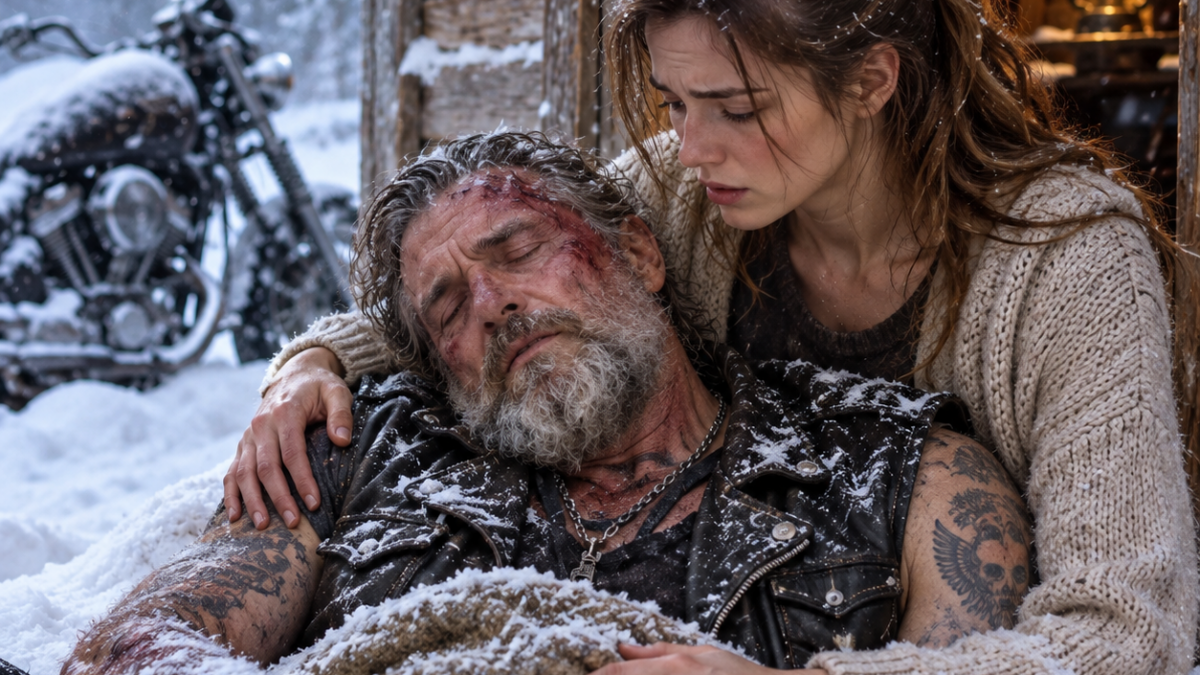
Jack’s voice came out quieter than he intended.
How long ago was that? 3 weeks, she said. He exhaled slowly through his nose.
You’ve been up here alone for 3 weeks, knowing they’d come back.
I’ve been up here alone for 2 years, she said.
The knowing they’d come back part is just the last 3 weeks.
He looked at her, this girl who had been holding a mountain alone, carrying her grandfather’s instructions like armor, waiting for something she couldn’t predict or prevent, who had opened her door tonight, not just out of compassion, but out of some deeper, stubborn refusal to be run off, who had treated his wounds and led him through the dark and crossed a frozen creek and remembered an eight-digit code under pressure without blinking.
“You should
have left,” he said, “gone somewhere safe.”
It was my grandfather’s rand, she said simply.
He asked me to hold it.
I’m holding it.
The wind moved through the trees around them. Somewhere in the dark behind them, men with phones and flashlights were searching for them both. Somewhere ahead, 40 minutes out, the brotherhood was coming.
And here in the cold between those two facts, a 20-year-old woman stood in front of Jack Carter looking like she had already accepted every possible outcome and chosen her ground. Anyway, I thought about Dale Briggs again, about what Dale had asked him in that diner if there was any way to get the truth out without getting killed for trying.
He was starting to think the truth was going to get out.
Not because of the folder he was carrying, not even because Marcus and 40 riders were 40 minutes out on an icy highway because of the kind of person Emily Parker’s grandfather had made her.
When this is over, Jack said, “I want you to talk to someone, a lawyer I trust, about your land, about what Garrett said about the second visit.
All of it.
It goes into the record alongside everything else in this folder.”
She looked at him.
“You think my account matters?”
“Direct victim testimony,” he said.
“Firhand account of intimidation and assault from an individual already documented in Hail’s acquisition files.”
“Yes, Emily.
It matters a great deal.
” She was quiet.
Then from somewhere south and below them came the sound of a motorcycle engine. One, two, then several at once rising together like something that had been distant for a long time and was suddenly very close. Emily turned toward the sound and in the dark, Jack saw something cross her face that he recognized.
Not relief, they were still in the middle of it, still with men somewhere in those trees. Still with 40 minutes to survive before anything resolved. But something loosened.
Some fraction of the weight she had been carrying alone on that mountain for 2 years shifted just slightly onto something larger than herself. Jack put his hand briefly on her arm. One second.
Then he dropped it.
They’re still 20 minutes out at least.
He said, “That’s the advance.
They’re pushing fast.
What do we do?”
“We stay moving.”
And he said, “We stay together.”
And when Marcus gets here, he stopped.
felt something he hadn’t expected to catch at the bottom of his throat.
Something that wasn’t tactical or calculated.
When Marcus gets here, I’m going to tell him that you are the bravest person I met on this mountain.
And that’s not a small thing.
I’ve met a lot of people on a lot of mountains.
Emily Parker looked at Jackson Carter for a long moment.
Then she turned back towards the dark and said, “Save it for when we’re out of the trees.
” And she started walking.
He followed. behind them.
The engines on the southern slope got louder and somewhere far ahead through the cold and the dark in the snow that had never stopped falling. 40 riders were pushing their machines to their limits on a highway made of ice because one of their brothers had sent out a signal and not a single one of them had considered not answering.
The mountain wasn’t done with them yet, but neither were they.
The engines on the southern slope went quiet, not gradually, all at once, like someone had reached out and switched them off. And the silence that followed was worse than the sound had been because sound you could track. Sound told you where things were.
Silence told you nothing except that something had changed and you didn’t know what.
Emily stopped walking. Jack stopped behind her.
They cut their engines.
She said, “I heard.”
Why would they cut their engines?
I didn’t answer right away because the answer required him to think through it fast and get it right.
Right.
Hail’s men were south and below them.
The Brotherhood was coming from the highway, also from the south, but from a different angle further down the mountain.
If Hail’s team had cut engines, it meant one of two things.
Either they had spotted the incoming riders and were repositioning to avoid a direct confrontation, or they had found something, a trail of track, a sound that told them exactly where Jack and Emily were, and they were going quiet to close a distance without being heard. Both options were bad, one was worse.
They’re repositioning, he said.
Or they found our trail. Which one?
I don’t know yet.
How do we find out without walking into them? He scanned the dark around them. They were on the eastern face of the ridge in heavy timber about 600 yd from where he estimated the relay box sat behind them and maybe half a mile from the ridge line above.
The ranger station was northeast. The approaching Brotherhood was south and closing.
They were in the middle of a shrinking triangle. We go up, he said. Get to the ridge line.
Higher ground. We see more. They have to climb to get to us.
And when Marcus comes over that ridge, he’ll have clear sight lines.
The ridge is exposed, Emily said. No tree cover.
I know. A pause.
She was working through the same calculation he was, and she arrived at the same place.
If we stay in the trees, they can close on us without us seeing them until they’re too close.
Right up it is, she said, and she turned and started climbing. The incline here was steep enough that they were using their hands as much as their feet, grabbing branches and exposed roots to pull themselves up.
Jack’s shoulder was a sustained disaster, but he kept pace, kept his breathing controlled, kept his focus forward and upward and on the back of Emily’s boots in front of him.
Halfway up, she stopped and grabbed his arm.
She didn’t say anything, she just pointed.
30 yards to their left, a flashlight beam was moving through the trees, coming from below, moving uphill, moving fast. One person moving with purpose.
Whoever it was had stopped pretending to be casual. Jack looked at the ridge line above them, maybe 200 yd, not close. He looked at the flashlight.
Closing.
“Don’t run,” he said.
Barely any sound at all. Steady pace lateral first put timber between us and that light, then angle up.
She was already moving, just in course, sliding left to right through the trees before cutting uphill again. He followed. The flashlight beam disappeared behind a cluster of pines, which meant whoever held it had lost their sighteline, which gave them maybe 60 seconds before the angle changed and the beam found open ground again.
They climbed steady and fast and not running because running on this slope in the dark meant falling. And falling meant stopping and stopping right now was not survivable. The flashlight reappeared further left this time.
Jack watched it in his peripheral vision while he climbed. The beam was sweeping more aggressively, now covering ground in broad arcs.
The person wasn’t tracking a specific trail anymore.
They were fishing.
That was better than following their exact steps, but it meant there were enough of them spreading out that individual tracking wasn’t necessary.
80 yard from the ridge. 60.
Emily crested first coming up over a broken rock lip onto the exposed ridge line and Jack was 3 seconds behind her.
The wind hit them both immediately hard and horizontal, completely different from the sheltered incline they’d been climbing out here.
The temperature dropped another 10° by feel alone, but they could see south down the long slope they just climbed. Flashlight beams moved through the trees. He counted four, maybe five.
They were spread wide which confirmed the flanking pattern not chasing directly boxing in and further south still on the highway but visibly closer headlights. A lot of them moving in a line there.
Emily said pointing. He saw it.
The headlights.
That’s Marcus.
He said how long. He judged the distance, the road conditions, the speed.
They appeared to be moving. 20 minutes, maybe 15.
We need to stay alive for 15 minutes on an open ridge with four flashlights below us, she said. Five, he corrected.
That’s not better, Jack.
I know. He scanned the ridge line. It ran northeast and southwest, narrow and wind scoured with rock outcroppings at irregular intervals.
Not cover exactly, but concealment. The kind of terrain that rewarded someone who knew how to use low ground without having any.
Then his eye caught something else. Emily.
He kept his voice completely flat. East end of the ridge, 40 yards. She turned.
A man was standing at the east end of the ridge line, not moving, not using a flashlight, just standing. Dark jacket, dark everything.
He had come up a different way, a road they hadn’t known about, which meant he was local or had spent real time on this mountain.
And either way, it meant he had been ahead of them this whole time, not boxing them in from below. Already above them, he was between them and any eastern escape route. Jack felt the situation compress into a very small set of options.
The slope behind them with four flashlights climbing, the ridge stretching southwest back toward the cabin, northeast blocked by the standing man. And below them, 15 minutes out the brotherhood.
He hasn’t moved, Emily said quietly.
He’s waiting.
He knows we see him, so he’s not trying to surprise us.
No, Jack said. He wants us to run southwest, back down the other side.
There’s someone there, too.
He felt her go very still beside him. They planned this, she said, the whole route. They knew about the relay box that sat in his chest like a stone.
Because she was right.
This wasn’t four men searching a mountain in the dark.
This was a coordinated pattern. And someone had mapped it in advance. And the only way to do that was to have someone who knew this mountain really knew it, not just had a map.
Emily, he said carefully. The man who came to your cabin, Garrett, do you know who he worked with locally? Did he mention anyone from around here?
She was quiet for two seconds. Then he came with someone the second time. Local man.
And I recognized him from town. Gary Demis. He does land surveys for the county.
He know this mountain. She turned to look at him and even in the dark in the wind, he could see it click into place behind her eyes.
He’s done the survey work on this entire ridge for the Forest Service.
He knows every trail, every route, every He’s the one standing at the east end, Jack said.
She breathed out once, sharp and short.
Then he knows we’re cornered, she said.
Yes. And he knows where the paths down are. Yes.
So he’s not going to chase us.
He’s going to wait.
Right.
Jack turned to look at her directly, which means we don’t run.
We hold this ridge right here.
We make them come to us on open ground where Marcus can see what’s happening when he gets eyes on the ridge.
She looked at the space around them, looked at the rock outcroppings, looked at the slope, looked at him. You want to use the ridge as a defensive position, she said.
It’s the only move left with what you have no weapon.
He reached into the inside pocket of the jacket she’d given him.
her grandfather’s jacket in his hand found something that hadn’t been there before.
He pulled it out, a folding knife, heavy-handled blade, probably 4 in. Military style, the kind that opened one-handed. He looked at Emily.
She almost smiled.
He said, “Leave it in the jacket,” she said.
“In case.”
In case. Her grandfather had packed a knife in a jacket pocket in a shed on a Montana mountain.
“In case someone needed it someday.”
Jack Carter held it in his hand and felt the weight of a dead man’s foresight and said nothing for a moment because there was nothing adequate to say.
“He sounds like he was remarkable,” Jack said finally.
“He was just practical,” she said.
“He’d say the same about you.”
He opened it the knife, set his feet, positioned himself on the ridge between Emily and the figure at the eastern end.
“Then he raised his voice, not shouting, carrying, deliberate.”
“My name is Jack Carter,” he said into the wind.
I know who you are, Gary, and I know you know what’s in this jacket.
You also know that two radio transmissions have already gone out and that the people those transmissions reached are about 10 minutes from the base of this ridge. Silence from the east.
Jack kept going.
Victor Hail doesn’t pay enough for this.
Whatever he’s promised you, it doesn’t cover what happens when 40 riders come up this mountain and find a county surveyor standing on a ridge where a civilian woman got hurt.
Think about that math. A long pause.
Then the figure at the east end of the ridge said, “I haven’t heard anybody.”
His voice was older than Jack had expected.
Tired in a way that wasn’t tonight tired.
The voice of a man who had been tired for a long time.
“Not yet,” Jack said.
“Keep it that way.”
Another pause. From below on the south slope, the flashlights had stopped moving. They were listening, too.
Everyone on this mountain was standing still and listening and the only sound was the wind and the distant growing pulse of motorcycle engines from the highway below getting closer.
Gary Deis said, “You don’t know what he has on me.
” Jack heard Emily draw a quiet breath beside him.
“Tell me,” Jack said.
“Nothing for a moment.”
“Then my son, he’s got my son in a situation I can’t get him out of.
Drug charged two years ago.
Hail’s people made it go away in exchange for for what I know about this land.
His voice cracked on the last part, not breaking down. The crack of something that had been held under pressure for too long.
I didn’t know about the fire.
I swear to God, I didn’t know about the Briggs fire until after.
Jack believed him.
He didn’t know exactly why, but he did.
Maybe because of the way the man’s voice sounded.
Not defiant, not calculating, just exhausted and ashamed.
Gary Jack said, “If what you’re telling me is true, there’s a way out of this that doesn’t end with you on this ridge waiting for things to go wrong.
But you have to make a choice right now.”
“What kind of choice?”
“The kind your son would want you to make,” Jack said.
“A very long pause.
The wind, the engines louder now, the flashlights on the south slope still not moving.
” Then Gary Deis walked away from the east end of the ridge.
He didn’t come toward them.
He walked north along the ridge line and then down the north slope, and they heard him go, his boots crunching in the snow until the sound faded. Emily let out a breath that had probably been held since the moment Jack had raised his voice.
“That was a risk,” she said.
“Everything tonight has been a risk,” he said.
He could have had weapon.
“He did have a weapon,” Jack said.
“A man who knows this terrain is always armed, but he wasn’t going to use it.
You could hear it in his voice.
You took his measure in 30 seconds.”
Less, Jack said. I took his measure in the first word he said. She looked at him.
What was the first word he said?
I Jack said when I told him he hadn’t hurt anybody, he didn’t say no or disagree or argue the framing.
He said I haven’t hurt anybody.
He was distinguishing himself.
That’s not a guilty man defending himself.
That’s a trapped man trying to make sure someone understands the difference.
Emily was quiet working through that.
You’ve done this before, she said.
talk someone down once or twice.
More than that, um, he didn’t respond.
Below the flashlights on the south slope started moving again, moving faster this time and not sweeping, moving in a direct line uphill toward the ridge. They had heard the exchange.
Whatever strategic patience they’d been operating on was gone, Jack counted.
Four beams moving hard. And from the south, from the highway and the lower slope, the motorcycle engines had become something you felt in your chest as much as heard a rumble that the mountain itself seemed to be conducting upward through the rock and the frozen ground.
They’re coming, Emily said.
About both groups. She meant both.
Yes, he said.
How close are Hail’s men?
3 minutes, maybe four. And Marcus, he listened to the engines, judged about the same.
She looked at him.
That’s not a comfortable margin.
No, he agreed.
She scanned the ridge around them, the same rapid practical scan she’d done at every decision point tonight.
Then she moved to the largest rock outcropping on the ridge, a broken, irregular mass of stone, maybe 5 ft high and wide, and positioned herself behind the southern edge of it.
If we’re holding the ridge, she said, “We hold it here.
It breaks the wind.
It blocks their sight line from below until they crest and it’s solid enough that if they have firearms.
Come here, he said. She moved to him immediately.
No argument. He positioned her behind the rock in the deepest angle of it where two faces of stone met. Then he stood to her left between the rock and the open ridge.
Knife open at his side.
Jack, she said, yeah, you’re putting yourself between me and them.
Yes, you’re hurt.
I know.
That’s She stopped.
Something moved in her voice, a roughness she controlled quickly.
“That’s not how this is supposed to work.”
“How is it supposed to work?”
he asked.
“You were the one who needed saving?”
she said.
“That was the deal.
You came to my door. I saved you.
That’s where it was supposed to stop.”
It stopped being that simple. When they drove those motorcycles up to your cabin, he said.
He didn’t look at her while he said it.
He was watching the slope below.
“You didn’t choose any of this, Emily.
You opened a door because it was the right thing to do and these people made it dangerous for you because of that.
So yeah, I’m standing between you and them because that’s what you do.
Silence from behind him for a moment. Then is this what the brotherhood is? She asked.
Not rhetorical, a real question. At its best, he said. Yeah, this is exactly what it is.
The first of Hail’s men came over the ridge 30 yards to the southwest.
He came up fast, clearly expecting the ridge to be empty, and pulled up short when he saw them. 2 seconds of full stop, his flashlight beam going to their faces.
He reached for something at his hip, and from below, from the south slope, from the road from somewhere that was still too far away and closing fast. A sound like thunder rose up the mountain.
Not thunder. 40 motorcycles running hard up a dirt access road, engines open, no longer making any attempt at subtlety.
The man on the ridge heard it. He froze. A second man came over the ridge to the southwest.
Heard the engines also froze a third further along. Jack watched them recalibrate in real time.
The math had changed for them in the span of 10 seconds. They had come up this mountain to take care of one injured man and a girl.
What they were hearing from below was not one man. What they were hearing from below was an answer to a question they had apparently not considered. You hear that?
Jack said loud enough to carry. Those are my brothers. every single one of them.
They’ve been riding for 3 hours in a blizzard because I sent out a signal.
That’s what happens when you mess with one of us.
He paused, let it sit. You want to be on this ridge when they get here, or you want to take your vehicles and drive back down to whatever Hail promised you and think about whether it was worth it. The three men on the ridge looked at each other.
Then the one furthest southwest turned around and went back the way he’d come.
The second one followed. The third one hesitated.
His flashlight beam stayed on Jack for a long moment, then on Emily, visible to his right at the rock. Jack watched his face. Not a young man, mid-40s, maybe face that had seen rough work.
Eyes that were calculating something more complex than the other two.
Hail’s going to want to know where you’re taking that evidence, the man said.
Hail out of things he’s not going to get, Jack said.
The man’s jaw moved.
Something working behind his eyes.
That folder you are carrying, if it’s got what I think it’s got, it’s got everything, Jack said.
The man nodded slowly, one deliberate nod.
Then he reached into his jacket, and Jack’s whole body tensed, and the man pulled out a phone, looked at it for a moment, and then said it carefully on a flat rock at the ridge line.
He looked at Jack.
There’s a name in there, he said.
Text thread from 2 days ago.
You’ll want it, he paused.
I didn’t know about the Briggs fire either.
He turned and walked back down the south slope. Jack and Emily stood on the ridge and listened to the three men descend. Listen to the sound of vehicle doors somewhere far below.
Engines starting the distinct sound of trucks reversing on a narrow road and the motorcycle engines rising to fill the space they left. Emily came out from behind the rock and stood beside Jack.
They stood on the ridge together in the wind and the cold and the dark and neither of them spoke while the sound of 40 riders climbing toward them grew from a distant rumble into something that resonated in the chest like a second heartbeat. She picked up the phone the man had left on the rock.
Looked at it, handed it to Jack without a word. He looked at the screen.
The text thread was open. He read the name at the top.
He read it twice because the first time he read it, he thought he’d misread it.
The second time he was sure he hadn’t.
The name was a federal name, not low-level, not a functionary or a clerk. The kind of name that appeared in news reports that stood behind a podium that had a title. The kind of name that explained how Victor Hail had known about the infrastructure project before it was announced.
The kind of name that made the whole operation make sense. the scale of it, the confidence of it, the willingness to burn a woman alive in her own house because she stood between hail in what he wanted. Jack held the phone and felt the weight of what he was holding.
The folder against his chest, the phone in his hand, a dead man’s knife in his jacket.
I thought about Dale Briggs in that diner.
Hands that couldn’t hold things right.
Eyes that had dried out long ago.
He thought about Emily’s grandfather telling his granddaughter to stay, to hold the land, to memorize the code for the relay box in case.
He looked at Emily. She was looking at his face, reading whatever was there.
It’s someone important, she said.
Yes. How important?
He told her. She was very still for a moment.
Then she said, “My grandfather used to say that the bigger the lie, the more people have to tell it with you.”
He was right about that, too. Jack said.
The first headlight came over the southern ridge line, then another, then four at once, then a dozen, then more than Jack could count in the time it took his eyes to adjust. Motorcycles coming over the ridge at a rolling pace, spreading out across the high ground, their engines dropping to an idle that still filled the whole mountain with sound. They stopped in a wide arc, and out of the middle of that ark, one rider came forward and stopped 10 ft from Jack Carter.
He cut the engine. In the sudden relative quiet, the wind seemed almost gentle. Marcus Walker pulled off his helmet.
He was a big man, Marcus, 53 years old with a full gray beard and the kind of face that had been through enough that it had stopped reacting to things that would shake most people loose.
He looked at Jack, took in the shoulder, the way he was holding himself, the jacket that wasn’t his.
He looked at the knife still open in Jack’s hand.
He looked at Emily, then he looked back at Jack. You look terrible, Marcus said.
I feel worse,” Jack said.
Marcus got off his bike. He crossed the distance between them in four steps and put both arms around Jack, careful of the shoulder, and held on for 3 seconds.
The kind of hold that didn’t need to say anything because what it was saying couldn’t be improved on with words.
When he stepped back, his eyes were steady again.
“The trucks went down the north access road about 4 minutes ago,” he said.
“I’ve got two groups following.
They’re not going to get far.
There’s a county surveyor named Gary Demis who went north on foot.
Jack said he needs to be found not harmed.
He’s going to cooperate.
Marcus raised an eyebrow. You worked out a lot tonight. Had help, Jack said.
He looked at Emily. Marcus Walker. This is Emily Parker.
This is her mountain. She kept me alive, got the signal out, navigated us here, and identified a key local informant while we were running for our lives.
Marcus looked at Emily for a moment. The same measuring look that Marcus always used. Not unfriendly, but thorough.
The look of a man who had spent 30 years deciding very quickly whether people were who they appeared to be. He put out his hand.
Emily shook it. Firm, direct.
Miss Parker, Marcus said, “Your grandfather’s land in Cascade County.
We know about the acquisition attempt.
That’s going into a federal complaint along with everything else.”
Emily didn’t react to the fact that Marcus already knew.
She just nodded.
It should,” she said.
Marcus looked at her for another second. Then he almost smiled almost because Marcus Walker did not fully smile easily.
“Jack’s right,” he said.
“Your mountain.”
He turned back to his riders and started moving through them, giving directions in the low precise way he had, and the brotherhood reorganized itself around the new information, the way it always had efficiently without drama. Each man knowing his piece of it, Jack and Emily stood together in the middle of that organized motion. She was looking at the riders around them.
Dozens of men in the dark engines idling, moving with purpose. She had spent 2 years alone on this mountain, and now it held more people than she had probably seen in months.
“Are you all right?”
Jack asked her. She considered the question genuinely.
“I’m cold,” she said.
“My cabin is probably damaged.
There are men running loose on my mountain who need to be dealt with.”
She paused.
“But yeah, I think I’m all right.”
He nodded. She looked at him sideways.
Are you? His ribs were broken. His shoulder was a wreck.
He had walked a mile and a half through a blizzard, crawled through a tunnel, climbed a ridge, and talked three armed men down from a confrontation they’d had every practical advantage in.
Getting there, he said, she reached over and adjusted the collar of her grandfather’s jacket, where it had been pulled sideways by the wind.
A small gesture automatic, the kind of thing done without thinking. She straightened it and pulled her hand back.
You’re going to need a doctor, she said.
I know. And sleep.
Yeah.
And probably someone to tell you that you can’t ride for at least 6 weeks with that shoulder.
I know that, too. She looked at him. Are you going to listen?
I thought about it honestly. Probably not entirely.
She made a sound that was almost not quite, but almost a laugh. The first real one of the night. It was short and surprised, and she pulled it back quickly, but it had been there.
“Okay,” she said.
And that one word, like so many of the things she had said tonight, carried more in it than it took to say. Marcus came back through the riders toward them, and behind him, two of the brotherhood were carrying thermal gear coats, blankets, a thermos of something hot.
One of them, a younger man with serious eyes, handed the thermos directly to Emily without being asked. She took it, wrapped both hands around it.
“Thank you,” she said.
“Thank you,” he said back.
And he meant it in the specific way of someone who understood exactly what had been done. and by whom? She looked at the thermos in her hands.
Her eyes were bright, not tears or not just tears, something fuller than that.
The particular fullness that comes when you have been holding something alone for a long time and something larger than yourself arrives and says quietly that you don’t have to hold it alone anymore.
She blinked it back. She straightened.
She handed the thermos to Jack who drank. And then she turned to Marcus Walker.
The folder he’s carrying, she said he needs to get it somewhere safe tonight.
Somewhere Hail’s reach doesn’t extend.
Already arranged, Marcus said.
And there’s a phone.
A man left it on the ridge. She nodded at Jack. The contact in the text thread.
It’s federal male level.
That needs to go directly to someone who can act on it before it gets buried. Marcus took that in.
He looked at Jack.
She’s not wrong, Jack said.
She’s clearly not wrong, Marcus said.
He looked at Emily. You have someone in mind. I know a federal judge.

