A Female Marine Saved a SEAL and His K9—His First Words Changed Everything – Part 1
A Female Marine Saved a SEAL and His K9—His First Words Changed Everything
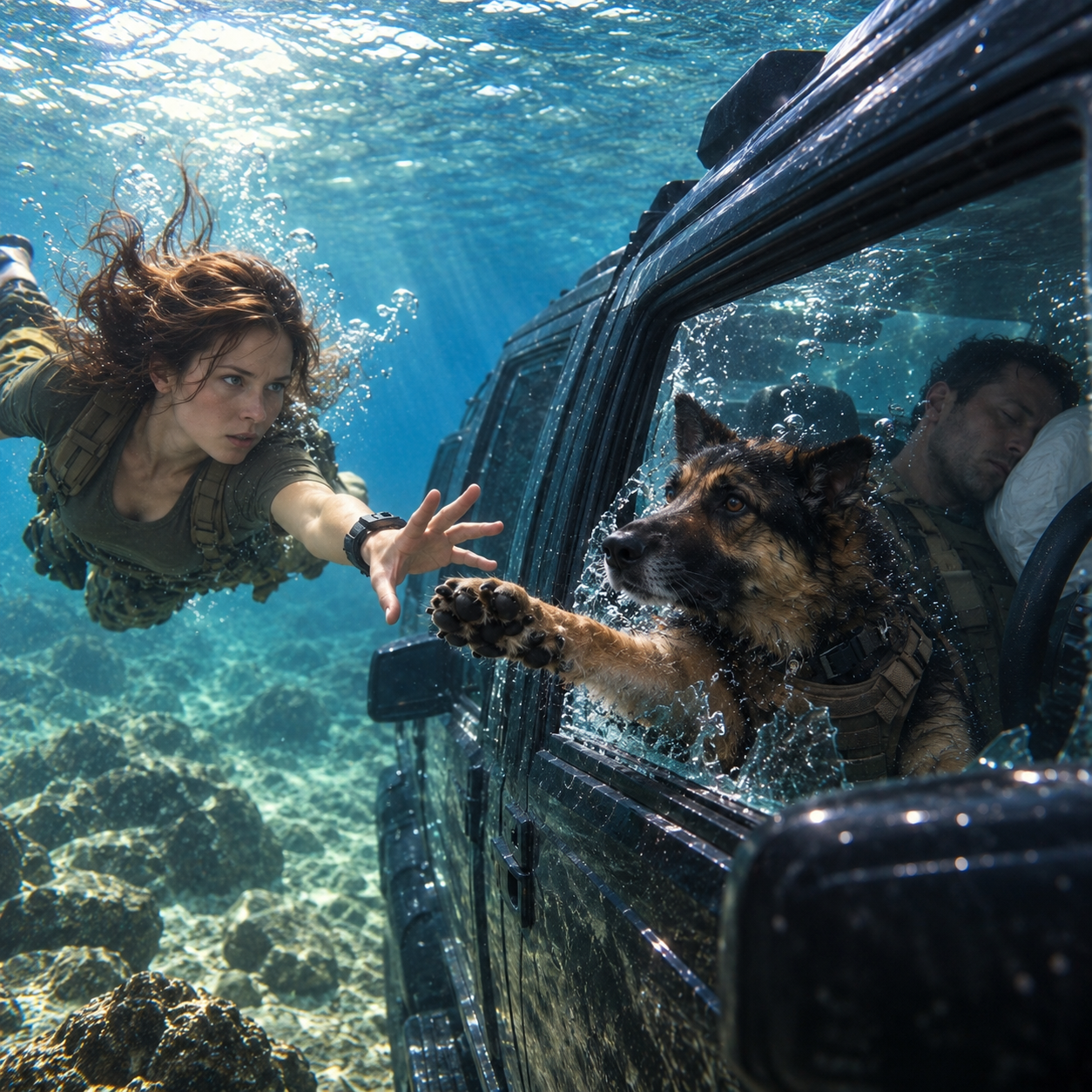
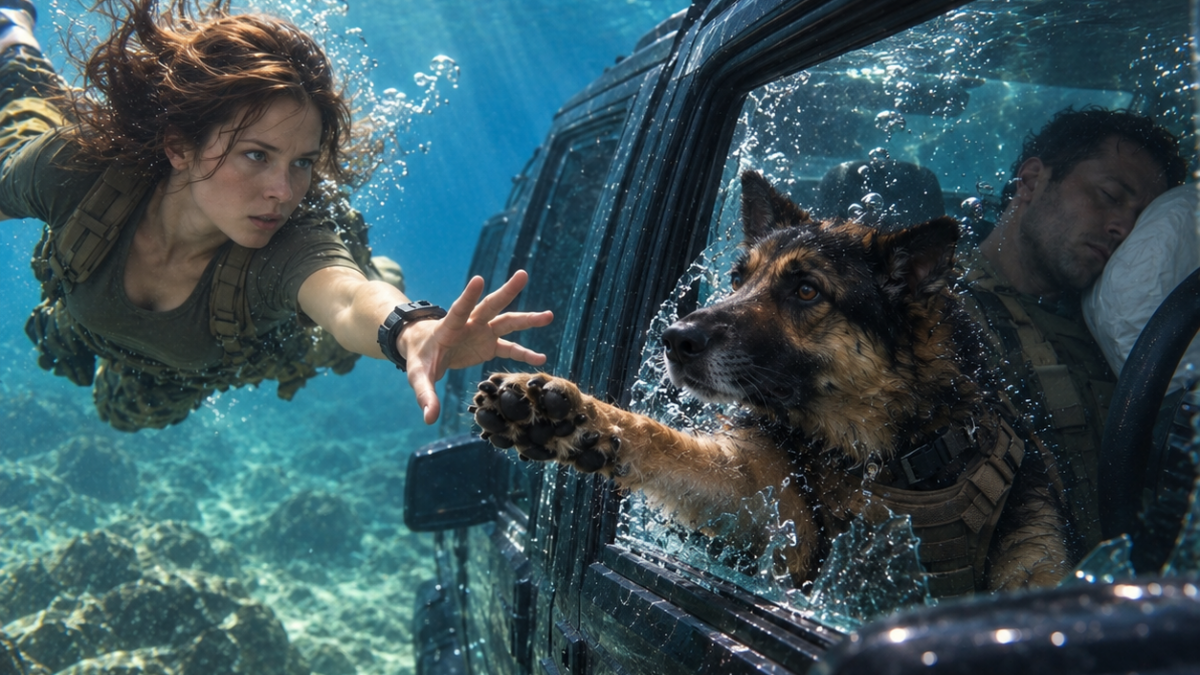
A female Marine saw a K-9 vanish beneath a bright Michigan lake. Seconds later, she discovered what the dog refused to leave behind.
She pulled a Navy Seal from a sinking SUV, but he never opened his eyes. Then, Keel began reacting to someone the entire town trusted. The clues seemed clear, yet the dog kept leading Rowan somewhere else.
When the seal finally moved, she leaned closer to hear his first words.
Morning sunlight made Silver Wake look newly washed.
Pinecovered hills rose beyond the blue water and white docks shown along the Michigan shoreline as if the night’s thunderstorm had polished them.
Rowan Hail knew better than to trust a beautiful surface. At 30, the marine had spent enough time around water to understand how quickly calm could become concealment. Her copper red hair was twisted beneath a faded cap and an olive drab t-shirt showed beneath her flotation vest.
She was home on leave volunteering at her family’s marina doing the quiet work that kept questions away.
Checking stormtossed safety boys alone suited her. The marina boat carried more than the law required. An emergency air cylinder, dive mask, line knife, glass hammer, rescue sling, and a compact electric winch.
Rowan had checked each item twice before leaving. Since a recruit had died during an underwater training accident under her supervision, twice had become her minimum. The inquiry said she had followed procedure.
Her memory said she had been seconds too slow. Near a closed maintenance ramp, two dark tire tracks cut through gravel and vanished at the water line.
Rowan throttled down. The barrier chain had been knocked loose, yet no vehicle stood on shore.
20 yards out, bubbles broke the lake surface in an uneven stream. She swept a handheld sonar unit over the side.
A blocky shape appeared beneath her, descending along the shelf toward deeper water, 25 ft.
Rowan radioed the marina with her location, requested emergency services, and secured the boat’s stern line to a marker post.
Then she fitted the mask, clipped the emergency cylinder to her vest, and went overboard. Cold closed around her skull. The lake swallowed the sunlight within 10 ft, turning green, then gray.
Below, an SUV rested nose down on the slope, its rear wheels barely touching stone. The rear window had already been shattered.
A sable German Shepherd filled the opening, his wet coat almost black, his broad muzzle dusted with gray, despite a body still powerful with training. A coyote brown harness marked him as a working dog. He twisted toward the front seats instead of swimming free.
Rowan pulled herself through the broken hatch. An unconscious man hung behind the inflated airbag trapped by his seat belt. He looked late 30s with close-cut dark hair, a hard angular face, and a pale scar crossing one eyebrow.
Blood drifted from his temple.
The last shrinking pocket of air pressed against the roof, and the dog braced his fore legs between the seats, forcing his owner’s mouth toward it.
The cabin groaned. A side window imploded with a flat, violent crack.
Silver bubbles exploded past Rowan’s face, and for one suspended second, she was back in the training tank, reaching through black water while someone stopped moving beyond her glove.
Then the shepherd shoved his shoulder under the man’s jaw.
Rowan moved.
She caught the dog’s harness and guided him through the rear opening.
He resisted until she pointed upward and pushed hard beneath his chest. The animal rose through the merc. Rowan followed long enough to see his head break the surface beside the boat.
He did not leave. He barked once sharply, then paddled in a tight circle and plunged his muzzle down at the precise point above the SUV. Rowan drew one breath from the cylinder and descended again.
Water now filled the cabin.
The man’s belt buckle had jammed under tension, so she cut the webbing, caught him before he folded into the footwell, and worked the rescue sling beneath his arms.
His size made the confined space unforgiving. She clipped the sling to the line she had brought from the winch, tugged twice, then kicked free of the vehicle. At the surface, the shepherd swam beside the unconscious man as the winch raised him to the stern platform.
Rowan climbed aboard and hauled the dog after them. The man had no pulse she could feel.
She tilted his head, cleared his airway, and began compressions.
“Come on,” she said between counts.
“You made it through the lake.
Now choose again.”
The shepherd crouched inches away, trembling, but silent.
His amber eyes never left his owner’s face.
Rowan delivered breaths and resumed compressions. Her shoulders burned.
The old count returned with cruel clarity. The count from the training pool, the count that had continued after hope, was gone.
The man coughed lake water and dragged in a thin broken breath. Rowan almost stopped from relief. Instead, she rolled him enough to drain his airway, covered him with the emergency blanket, and monitored the weak beat at his throat.
A metal identification tag beneath his torn shirt read alas vein. Tucked behind it was a Navy insignia.
The shepherd’s harness patch read keel.
Sirens approached from the road while a rescue helicopter beat toward them from the south. Rowan guided the boat to the ramp where paramedics took over.
Elias was tall and heavily built, though unconsciousness made him seem strangely defenseless. One medic cut away his watch to place an IV line and exposed a charred strip of orange reflective fabric snagged beneath its band.
Rowan removed it carefully and handed it over with his tags and wallet. The medic sealed everything in a clear property bag. The man directing the response introduced himself as Caleb Ror, Silver Wakes emergency management director.
He was in his early 50s, broad-shouldered, clean shaven with iron gray hair and the steady blue eyes of someone practiced at lowering other people’s panic.
He thanked Rowan, assigned cruise without raising his voice, and seemed to know every responder by name.
“You gave him a chance nobody else could have,” Caleb told her.
Rowan watched Keel instead.
The dog tolerated blankets and a veterinary check, even the helicopter’s screaming rotors.
But when Caleb extended a bare hand toward his neck, Keel became rigid, his ears flattened.
He backed into Rowan’s leg so quickly that she felt his spine strike her knee.
Caleb withdrew with an understanding smile. Long warning for him. It was a reasonable explanation.
Everything about Caleb appeared reasonable. The helicopter lifted with Elias inside.
Keel stood beside Rowan, tracking it until it became a dark speck over the pines. Then his head turned. Across the ramp, Caleb climbed into an orange striped rescue vehicle.
Keel’s breath shortened, and his claws scraped once against the concrete.
He had not feared the sirens, the uniforms, or the hands that had carried his dying owner away. He had feared only the touch of the man Silver Wake trusted to command them all.
Elias vein survived the flight, but survival was the only promise the hospital would make. Doctors placed him under controlled sedation to limit swelling in his brain while a ventilator supported lungs injured by lake water. He had fractured ribs, a spinal injury that still required imaging, and no predictable date for waking.
Dr. Lena Ortiz explained this to Rowan in the intensive care waiting area. She was a compact woman in her 40s with dark curls threaded by silver and a direct manner softened by tired brown eyes.
“The sedation is treatment, not evidence that he cannot wake,” she said.
“But when we reduce it, we still may not get an immediate response.”
“By the locked ICU doors, Keel lay with his nose pressed to the seam.
dry now. He was clearly a 5-year-old German Shepherd, sable along his back and tan at the legs, with the disciplined stillness of a trained soldier.
He had refused food, water, and every leash offered by animal control. When an officer approached with a catchpole, Keel rose, without barking, wait forward, making his answer unmistakable. Rowan stepped between them.
Give me the leash. Ke allowed her to clip it to his harness.
He followed because her clothes still carried Lake Water and Elias’s blood, not because they trusted each other.
Rowan understood the distinction. The microchip registry confirmed Keel had retired from military service and had been legally adopted by Elias.
His former unit could not send a representative immediately, and the only emergency contact in Elias’s file, an older ant, had died the previous winter.
Hospital staff needed the dog removed. Animal control needed a lawful custodian.
48 hours,” Rowan said as she signed the temporary care form.
“This isn’t an adoption.”
The officer, a patient young man with freckles, nodded. Keel watched the pen move as if signatures had consequences he understood. Rowan took him first to the ICU window.
Elias lay among tubes and monitors, his angular face swollen, a white dressing crossing his temple. The mechanical rise of his chest upset something in Keel.
A low sound gathered in the dog’s throat, neither growl nor whine.
He placed one paw against the base of the glass. Rowan had seen working dogs search rooms and vehicles, but this vigil was different.
Keel studied each nurse who entered Elias’s room, then returned his attention to the bed.
Duty gave his fear a shape. Watch the door. Locate the threat.
Wait for the command that never came. The ventilator alarm chirped.
Keel snapped his head toward the sound. every muscle locked and the hallway seemed to hold its breath with him. Then a nurse silenced the alarm.
The ventilator resumed its measured hush and Keel slowly lowered his paw. Rowan felt the paws inside her own ribs. Machines had made the same sounds after the recruits training accident.
She remembered standing wet beside a hospital bed, being told procedure and outcome were not the same thing. At her small cedar house behind the family marina, Keel stopped at the threshold.
Rowan loosened the leash. He could have entered, but he planted all four feet and searched past her into rooms that smelled of coffee, old pine, and one solitary person.
“I don’t want this either,” she told him.
“He did not blink.
Among the belongings released for the dog’s comfort, was Elias’s field jacket, dry because it had been recovered from the hospital property bag rather than the SUV.
” Rowan laid it inside the doorway.
Keel sniffed the cuff, stepped over it, and entered. He ignored the bed she made from folded blankets, and settled on the floor facing east toward the hospital 9 mi away. Police Chief Mara Witcom arrived near dusk.
Witcom was 56, tall and spare, with cropped white blonde hair and weathered features that made smiles look rare rather than unfriendly. She had served Silver Wake for three decades and disliked conclusions that arrived before evidence.
“No impact damage from another vehicle,” she said at Rowan’s kitchen table.
“No paint transfer, storm, bad road, lost control.
That’s the working theory.”
“The SUV was too far from the ramp,” Rowan replied.
“Momentum might explain it, but not cleanly.”
Wickham wrote that down.
“Working theory isn’t a verdict.”
Rowan mentioned Keel’s reaction to Caleb, then immediately wished she had not.
A frightened dog could respond to soap, fuel, posture, or a hundred invisible associations.
“Keep noticing,” Whitam said.
“Don’t start interpreting yet.
” When Rowan checked Keel’s harness for chafing, her fingers found a narrow auxiliary pocket sewn beneath the main strap.
Inside were a small brass key and half of a paper claim ticket stamped with the blue outline of the Silver Wake Ferry terminal. She set both on the table without trying the key.
Witcom photographed the items in place, sealed them in separate evidence envelopes, and recorded Rowan’s statement.
You did exactly right. That night, a local station led with the rescue. The anchor called Elias, a decorated Navy Seal who had lost control during the storm.
Video showed emergency lights at the ramp overlaid with the rising whale of Silver Wake’s outdoor warning siren.
Keel launched upright, his nails struck the floor like scattered coins. He stared at the television, lips drawn back, then turned toward the window as though expecting the sound to come over the trees.
Rowan muted the broadcast. Silence filled the room. She opened the video she had recorded before diving, then footage captured after returning to shore.
wind, rotors, engines, voices, not one siren. She listened again through headphones, marking every minute against the dispatch log Wickham had provided. The storm had damaged no outdoor siren circuits, and no test had been scheduled.
The absence was not a failure of Rowan’s memory.
It was measurable. Witcom answered on the second ring.
Rowan sent both clips and asked the station for the raw segment through the marina’s public safety contact.
By morning, a broadcast technician confirmed the siren had not come from any reporters field recording. It had arrived as part of an official media package supplied by the emergency management center.
The station had assumed it was authentic scene audio. So had everyone who watched.
Keel lay beside Elias’s jacket, awake, ears angled toward the distant town.
Rowan looked at the sealed receipt Witam had left for the key and torn ticket. Someone had not merely summarized an accident.
Someone with access to official records had added a sound that never occurred, giving Silver Wake a memory more convincing than the truth.
The state police raised Elias’s SUV two mornings later.
It emerged from Silver Wake, streaming black water, its windshield fractured, and its rear hatch window open like a dark mouth. Chief Witkim had obtained a search warrant before the recovery began.
A state evidence team photographed the vehicle on the barge at the ramp and again inside a secured public works bay. Rowan attended for one reason only to handle keel.
Witkim repeated the limit in front of everyone.
She doesn’t touch evidence.
She observes the dog. Every movement is recorded and timed. Sergeant Paul Denning supervised for the state.
He was a square-built man of 45 with a shaved head, a clipped mustache, and the unemotional patience of someone who trusted measurements more than testimony. Two cameras followed Keel as Rowan led him around the vehicle.
Technicians had already removed a waterproof map tube, a disposable phone, photographs of Silver Wake Dam’s discharge system, and two rectangular blocks packaged inside a military-style case.
A bomb technician determined the blocks were inert training charges. Their outer shells imitated real demolition material well enough to frighten anyone who saw them.
Staged? Rowan said when Denning asked what she recognized.
You’re certain?
I’m certain the presentation is theatrical.
Real material doesn’t need to announce itself this loudly.
She kept her hands behind her back.
That doesn’t tell you who staged it.
Latent prints on the case matched Owen Pike, a local forest activist known for confronting contractors at public meetings. Messages on the disposable phone appeared to connect an O with Elias.
Festival day. The crowd. Make the dam disappear.
Each fragment sounded worse when read alone.
Owen’s reputation supplied the missing story before investigators had earned one.
He had chained himself to logging equipment the previous spring and once called the dam project a grave with a ribbon around it. Those acts proved anger and persistence, Rowan thought, but neither proved murder.
Still, each old headline made the fragments on the phone feel less like fragments. Outside the bay, news alerts multiplied.
By noon, the man Rowan had pulled from the lake was no longer described first as a victim. He was an unconscious suspect, a Navy Seal whose skills made every map look like intent.
Caleb Ror faced cameras on the courthouse steps. His iron grey hair remained neat despite the damp wind.
He cautioned against condemning Elias without proof, praised Rowan’s courage, and offered to cover the injured man’s medical expenses through an emergency relief fund.
It was generous. It was public. It made questioning Caleb feel indecent.
Inside the bay, Keel approached the open driver’s door.
He sniffed the pedals, seat, and torn belt, then turned away. At the rear hatch, he froze.
His nose moved along the soaked carpet. He climbed in, ignored the case that had held the training blocks, and began clawing at the cargo floor. The scrape of his nails changed pitch.
Once rough fabric, again, bare metal. Keel stopped and stared at Rowan.
In the sudden quiet, water dripped from the chassis with the slow regularity of a clock. Rowan did not point or speak.
Denning ordered the cameras closer. A technician removed the carpet under a fresh warrant supplement and revealed six pale impressions where mounting brackets had recently been bolted through the floor. The marks formed two even rows.
The empty training blocks were too small and too light to require them. Denning photographed each hole beside a scale marker. Something substantial wrote here.
Six somethings. Witcom said. The disposable phone complicated that discovery.
One recovered exchange read, “Move all six before harbor lights.
” Another message from O said, “We do it when the crowd is committed.”
Elias’s reply read, “Then the dam disappears for good.”
No intact conversation surrounded those lines. The device held only selected exports with missing timestamps where replies should have connected them.
Denning logged the gaps, but said they did not make the surviving words harmless.
Rowan imagined those words shown beneath Elias’s service photograph, meaning could drown as efficiently as a man.
Remove enough surrounding sentences, and nobody saw it happen. Keel remained at the cargo bay. He pressed his nose to one bolt hole, sneezed, and pulled back.
Denning’s team swabbed the area for residue.
Rowan asked whether six real charges had been mounted there. That is one possibility, he said. Another is six tool cases.
Another is equipment unrelated to any crime.
We don’t promote possibilities until testing earns it.
The answer reassured her. Caleb entered the bay 10 minutes later and did the opposite.
Keel heard the emergency vehicle before it stopped outside. His head rose, ears turning toward the rolling engine note. He stayed quiet but shifted until Rowan stood between him and the opening bay door.
He wore an orange striped emergency jacket and carried authorization from the county to inspect damage connected to the closed ramp. He greeted every technician by title, then paused when he saw the exposed brackets. Something tightened beside his mouth before his expression smoothed.
“Media helicopter is circling,” he told a public works employee.
“Cover the rear compartment before they photograph sensitive material.”
The employee reached for a tarp. Not yet, Denning said. Scene photography is incomplete.
Caleb lifted both hands. Your scene. He stepped away with an apologetic smile, but one of the fixed cameras had captured his first glance, his quiet instruction, and the unfinished forensic work.
Witcom copied that segment to the restricted case file before he left.
“Could be concern about public panic,” she told Rowan.
“Could be,” Rowan said.
Keel watched Caleb cross the bay. He did not growl.
He lowered his body slightly and moved closer to Rowan’s leg.
Late that afternoon, laboratory screening found trace particles consistent with commercial blasting compounds around four of the bracket holes. A cargo specialist calculated from compression in the underllayment that six equal loads had been secured there for several hours. Afterward, all six had been removed.
The two inert substitutes had been placed loose inside the case much later. The discovery did not clear Elias or Owen. It made the apparent plot more serious.
Yet, it also broke the neat story presented by the vehicle. Whoever wanted police to find explosives had displayed two harmless replicas while hiding the fact that six heavier objects were gone.
Rowan looked through the bay doors at Silver Wake’s Bright Water.
Ke stood beside her, nose lifted toward the rescue garage across the lot. The dangerous cargo was no longer in the SUV. Someone had used the confusion of a rescue scene to erase where it went.
Owen Pike’s boat was found drifting near the Northshore with no one aboard.
By evening, his photograph appeared beneath the word wanted. He was 34, lean and sunbrowned, with shoulderlength black hair, a narrow beard, and weary gray eyes.
His public arguments against the dam expansion gave the town a motive it already understood.
Witcom obtained a warrant for Owen’s cabin.
She brought a forensic team and allowed Rowan to accompany them only as Keel’s handler.
Sergeant Denning recorded the arrangement before anyone crossed the porch. You observe, he told Rowan. The dog indicates we document and my people recover.
The cabin stood among cedars above the north inlet built from dark logs with a metal roof. Nothing showed forced entry. Inside, Keel caught a scent and pulled forward, not with panic, but recognition.
He passed the kitchen and stopped beside a military cot near the wood stove. After sniffing its blanket, he lay down.
Rowan loosened the lead. A dog hiding from danger would have sought distance or guarded the exit.
Keel rested his chin on his paws as if this cramped room belonged to a known refuge. The forensic team found evidence quickly.
A waxed jacket in the washroom bore a wide brown blood stain. Rolled dam schematics filled a canvas tube. Harbor Lights festival dates were circled in red on a wall calendar.
A damaged radio sat beside coils of rope and an empty space on a workbench suggested a tool had recently been removed. Each object seemed to complete the accusation.
Owen and Elias had planned sabotage. They had fought. Owen had injured him and vanished.
Outside, divers searched the inlet around Owen’s abandoned boat while deputies checked roads leading toward Canada.
The boat’s ignition key remained aboard, and a neatly folded rainshell lay beneath the seat.
Witcom noted both facts without interpretation. A fugitive might abandon them deliberately, and an abducted man would leave them just as easily.
At the hospital, Elias remained under reduced sedation without purposeful response. His silence allowed every object to speak for him.
A sharp burst of static tore through the cabin. Keel surged to his feet.
The damaged radio had come alive beneath a technician’s gloved hand, spitting half a syllable before dying again.
For a heartbeat, everyone stood still. Keel did not retreat from the device. He went to the door, looked back, then returned to the cot.
The movement felt less like fear than the memory of waiting for someone who had promised to return. Denning bagged the radio. Another technician photographed the rope.
“Possible restraints,” she said.
Rowan crouched without touching it.
“That’s a rescue harness knot.”
Denning looked over. The rope had been looped into a broad cradle, its pressure points padded with torn cloth.
“You’ve used one in water extraction.
You put this under the arms of somebody who can’t support himself.
Rowan indicated the knot with a capped pen held several inches away. If you tied a prisoner this way, he could step out. The blood pattern on the jacket raised a second problem.
Most staining spread across the front and left sleeve where someone might brace an injured person. Smaller drops led toward a shelf that held gauze wrappers and an open first aid kit. It looked less like an assault than treatment.
After one, preliminary DNA processing matched the major blood sample to Elias using the hospital’s reference swab.
A second, much smaller sample belonged to neither Elias nor Owen, though a database comparison would take longer. Rowan followed the major stain without crossing the evidence markers.
It began at shoulder height beside the door, continued in smeared drops to the cot, then ended near the opened medical kit.
Whoever wore the jacket had supported Elias’s weight across the room.
The pattern did not prove kindness, but it demanded movement. The assault theory had not explained. Witcom studied the cot where Keel had settled again.
A third person was bleeding here. Or carried blood in.
Denning cautioned. The messages still weighed against Owen.
Investigators read them in sequence. Make the dam disappear. Crowd committed by nine.
If you lose your nerve, everything is wasted. Their missing context left little room for innocence.
Owen’s disappearance and drifting boat made flight appear obvious.
Rowan felt doubt turn against Elias as well. She had entered Blackwater for a stranger. She had pushed past the memory of one death to prevent another.
If Elias had intended to endanger families at Harbor Lights, saving him had not been wrong, but it had become harder to hold without bitterness. Keel rose and crossed to a corkboard near the desk.
He sniffed a photograph that had fallen face down behind a crate. Denning retrieved it with forceps. The picture showed Owen and Elias beside a bus depot, both tired, both looking away from the camera.
Elias wore the same field jacket, now lying at Rowan’s house.
Keel stood between them, younger only around the muzzle. Writing covered the back in a firm hand.
Witkim compared it with Elias’s signed service paperwork before reading aloud.
If I don’t come back, trust the dog before the record.
No date, no explanation. It could have referred to anything.
Yet Elias had anticipated a record that lied, and he had trusted Keel to distinguish danger from safety. Rowan turned toward the shepherd.
Keel sniffed the forceps holding the photograph, then touched his nose to Owen’s image.
His tail did not wag. Trained dogs did not translate evidence into verdicts, but he showed none of the avoidance he had shown Caleb.
Whatever had happened here, Owen sent belonged to shelter, not immediate threat. At sunset, the laboratory called with an exclusion result on the smaller blood sample. It was not Owens.
A third person had bled in the cabin shortly before surfaces were wiped, and diluted traces led from the porch toward the first aid kit. Witcom did not clear Owen.
She ordered a wider search and kept the warrant active.
But the cabin no longer looked only like a conspirator’s hideout.
The rescue knot, Elias’s blood across the front of Owen’s jacket, Keel’s calm beside the cot, and an unknown attacker’s blood formed another possible story.
Denning reminded them that possibility cut both ways. Owen could have treated Elias after injuring him, and the third person could have been an accomplice. Witcom agreed.
She changed no public designation, but ordered the blood expedited, and the cabin’s exterior searched for tire impressions.
The investigation had not turned. It had merely stopped pretending the road was straight.
On the porch, Rowan watched Keel face the empty road. Owen might not have attacked Elias there.
The house everyone called a fugitive’s den might have been the place Elias was saved the first time.
By Friday morning, strings of white lanterns crossed Main Street and children painted wooden boats for the Harbor Lights parade. Silver Wake looked determined to celebrate. Caleb Ror stood on the courthouse steps beneath a blue sky, assuring reporters that the dam had passed every inspection and that no threat would interfere with the festival.
People applauded before he finished. Rowan watched from the edge of the crowd with Keel seated against her left leg. Caleb was built like an old dock piling, thick through the shoulders and weathered by years outdoors.
Silver threaded his close-cut hair, and a pale seam crossed his square chin. He remembered names, touched elbows when people spoke, and had the patient voice of a man accustomed to being obeyed without raising it.
Residents remembered him directing evacuations during the Red Pine fire, driving medicine through a blizzard, and standing waist deep in flood water to secure a nursing home generator. suspicion seemed indecent beside that history.

