A Former Navy SEAL Said, “No Woman Would Want Me”… She Whispered, “Then You Forgot About Me” – Part 3
Jack rubbed behind the dog’s ear.
He’ll sleep all afternoon and act like he did 12 hours.
Emily smiled. The conversation ended there. It did not need anything else.
When the shower passed, Jack helped Paul secure a better chain on the east gate. Emily drove the UTV back toward the house to call a client whose payroll she had promised to finish before evening. Jack watched the vehicle disappear behind the barn.
Only then did he realize something that had been true for most of the afternoon. When Emily told him where the ditch could be crossed, he had believed her. When she said the left trail led to the grove, he had followed.
He had not checked her judgment against Paul’s.
He had not gone ahead to make certain she was right. He had simply taken the information and used it. That was not how he treated children.
It was not even how he treated most adults until they had earned it. On the drive back to Northfor, Mako lay tired across the rear seat, his breathing slow and heavy from work he had not done in a long time. Jack kept both hands on the wheel.
The road was still wet in the shaded places, or the western sky had already opened into strips of clean blue. For weeks, Jack had been trying to reconcile the woman Emily had become with the girl he remembered. That afternoon, he had not needed to.
There had been no little girl in oversized boots beside him in the east pasture. There had only been Emily reading the land, making decisions, and doing her part.
Jack drove the rest of the way home quieter than usual. The old picture in his head was beginning to lose its claim on her.
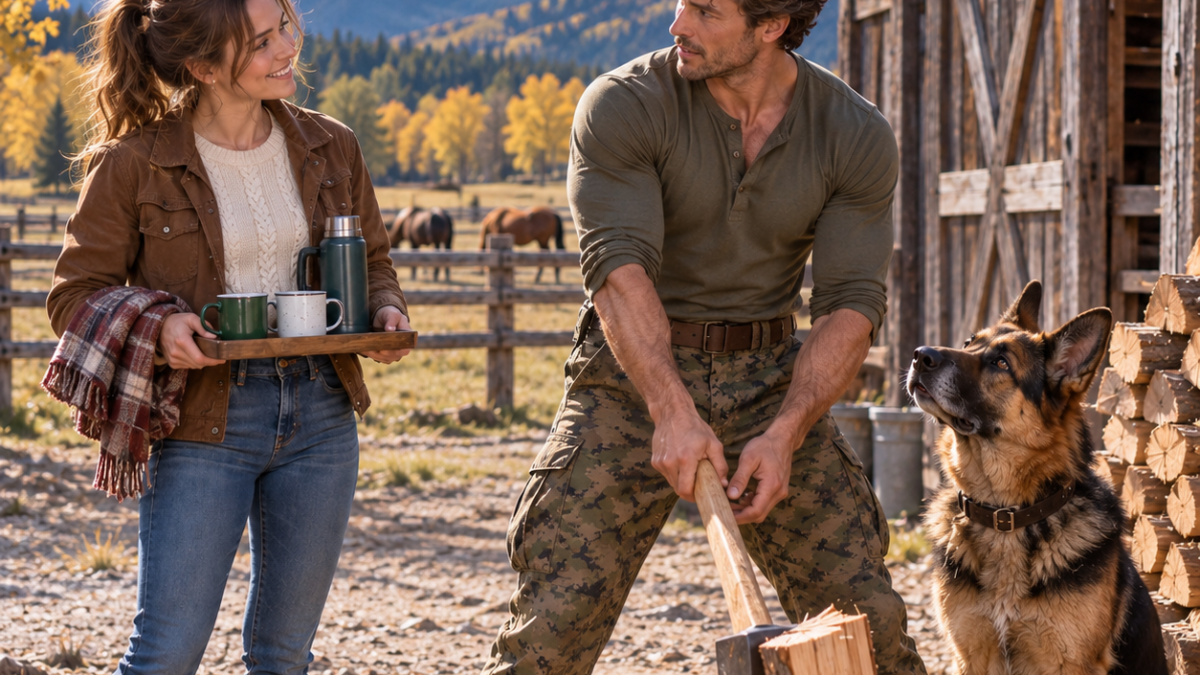
By the last week of October, the nights had begun arriving early enough that Jack measured his outdoor work against the light. He had spent most of the afternoon splitting firewood behind the barn, working through a stack of lodgepole pine he had cut and seasoned the previous year. The rhythm suited him.
Lift, place, swing, stack. There was no room in it for uncertainty, which made it more useful than he cared to admit. Mako had been asleep near the shed for nearly 20 minutes when his head came up.
The dog looked toward the driveway before Jack heard the pickup. Emily.
Jack knew the sound now. That bothered him less than it should have. Her truck stopped beside the barn and she stepped out carrying a cardboard coffee tray in one hand and the folder in the other.
She wore jeans, boots, and a brown jacket over a pale sweater. Her hair pulled back against the wind. Maker was already standing.
“You’re getting predictable,” Jack told him.
“Emily came around the front of the truck.
I was about to say the same thing about you.”
Jack rested the axe against the chopping block.
“That sounds threatening.
It’s bookkeeping.
We specialize in threats with spreadsheets.”
She handed him the folder. Inside were copies of several North Fork receipts she had sorted after Jack admitted reluctantly that he had probably filed two fuel invoices in a drawer containing veterinary records and a warranty for a chainsaw he no longer owned. He accepted the coffee next.
You didn’t have to bring this.
I know. The answer was deliberate enough that Jack caught it. Emily glanced at the wood pile, then at the second pile behind it, then at the smaller stack beneath the leanto.
You planning for winter or the collapse of civilization? Depends how long winter lasts. You have enough firewood to avoid human contact until March.
That’s efficient.
Mako sat beside Emily. She looked down at him.
At least one person here understands conversation. dog. Exactly.
Jack smiled despite himself and took a drink of coffee. For several minutes, the visit stayed easy. Emily asked whether the east gate at Harper Ridge had held after Paul replaced the latch.
Jack told her it would, provided Paul stopped inventing repairs that required three additional repairs. She mentioned a client who had finally located 6 months of missing receipts inside a tackle box. Jack suggested that might technically qualify as archival storage.
Then Emily grew quieter.
She leaned one shoulder against the side of the barn and looked toward North Fork’s house, its porch empty, the kitchen window reflecting the late afternoon light.
You ever think about not doing all this by yourself? Jack glanced toward her. All what?
She lifted one hand toward the ranch. everything. Jack looked at the wood pile, the barn, mako.
There were several answers available, most of them practical. Instead, he chose humor. Not many women are lining up to share a house with a man who talks to a German Shepherd more than people.
Emily looked at Mako. Mako listens. Exactly.
That earned the laugh Jack had expected for half a second. Then the conversation settled again and Jack felt the same instinct he used whenever a subject moved too close to something he had not decided how to handle.
He stepped back from it. No woman with any sense would want a man like me. He meant the sentence lightly, or at least he wanted to.
Emily did not smile. She looked at him long enough that Jack became aware of the axe handle still beneath his hand and the faint tick of cooling metal from the splitter beside the barn.
Then she said quietly, “Then you forgot about me.
” Jack did not move.
Mako lay down between them, completely uninterested in the fact that something had just become much more complicated. Emily, you heard me.
he had. That was the problem. Jack looked toward the wood pile, then back at her.
You know what you’re saying?
Her expression changed just enough to show that the question had irritated her.
I’m 26, Jack.
I know how old you are.
Then don’t ask me like I’m 12.
He let out a slow breath. Emily did not rush to fill the silence. That made it harder.
She finally looked down at the coffee cup in her hands. When I was a kid, I thought you were the most interesting person I knew. You came home with ridiculous stories you never finished, turned chores into missions, and treated me like I was capable of something even when I was 10 and mostly getting in the way.
A small smile touched her mouth.
That wasn’t love.
I was a child. Jack said nothing. When I came home after college, you were different.
So was I. Her voice stayed level.
I saw the way you took care of Maker when nobody was watching.
The way you fixed Dad’s south fence and never told him who did it.
The way you show up when somebody needs help and then act like it was nothing. She looked at him again.
That’s when it changed.
There was no grand declaration after that. Emily simply picked up her empty cup. I thought you should know.
Then she walked back toward her truck. Jack did not stop her. He also did not tell her she was wrong.
That proved to be worse. For the next 4 days, Jack became unusually productive.
He repaired a gate that had not yet failed. We organized hardware in the barn, sharpened chainsaw chains already sharp enough to work, and cleaned the truck cab twice.
He answered Emily’s messages when they were practical and avoided creating reasons to cross into Harper Ridge.
He was not ignoring her. Ignoring someone required less effort.
He was being careful. Too careful.
Emily noticed. On the fifth afternoon, Jack found her at Old Orchard Gate. She was standing beside the fence with both hands in her jacket pockets.
No apples, no folder, no coffee. Mako had come with Jack and stopped several feet away, apparently deciding this was not a situation improved by participation.
Emily looked at Jack.
You’re avoiding me politely.
I’m not avoiding you.
You’ve become very respectful of property lines.
Jack rested one hand on the gate. For once, humor would not do the work.
There are 14 years between us. I can count. I used to remind you to put boots on before you went into the barn.
I was 10.
That’s my point.
Emily’s face stayed calm.
No, Jack.
That’s your point.
He frowned.
You think I haven’t thought about it?
I think you’ve thought about nothing else.
That should tell you something.
It tells me you’re uncomfortable.
I am fine. The word was not angry. It was firm.
You’re allowed to be careful.
You’re allowed to decide you don’t want this.
What you don’t get to do is decide for me that I’m too young to know what I want.
Jack opened his mouth, then closed it. Emily stepped back from the gate. You spent a lot of years being responsible for other people.
I understand that, but I’m not asking you to be responsible for my choice.
She left before the conversation could turn into an argument. Jack remained by the gate with Mako until the light began dropping out of the orchard. That evening, he crossed to Harper Ridge.
Paul was on the porch repairing a leather halter beneath the yellow light over the door. He glanced up when Jack approached and moved a second chair out with his boot.
Jack sat. For a while, they talked about the east gate, then the tractor, then nothing. Paul knew how to wait.
Finally, Jack said. Emily told me how she feels. Paul kept working the leather.
I figured. Jack looked at him. How?
I’ve had 26 years of practice noticing my daughter.
Fair enough. Jack stared out across the dark field.
The age difference bothers me. Paul nodded once.
Okay, that’s all.
You want me to argue with arithmetic? Jack rubbed his thumb along the edge of the porch chair.
I used to look after her a handful of afternoons when she was 10.
That doesn’t disappear.
No. Paul set the halter down, but neither did the 16 years after that.
Jack looked over.
Paul’s voice remained quiet.
She runs her own business, makes her own money, helps me when I’m smart enough to listen, and ignores me when I’m not.
She doesn’t need my permission.
I’m not asking for it.
Good. Paul leaned back.
And she doesn’t need yours.
The words sack between them. Jack looked toward the Harper House, where one upstairs window was lit.
Paul picked up the halter again.
If you don’t want a life with her, tell her the truth.
She’ll deal with it.
Jack said nothing.
But don’t call fear respect, Jack.
They’re not the same thing.
On the walk back to North Fork, Jack heard that sentence several times. The ranch was dark when he reached it.
Mako met him at the porch, stretching before falling into step as Jack checked the barn out of habit. Fuel cans full, gates latched, feed covered, truck ready.
He had spent most of adulthood preparing for problems before they arrived. In the teams, that instinct had kept people alive. On the ranch, it kept machinery running, cattle contained, and winter from becoming harder than it needed to be.
He knew how to reduce uncertainty. He knew how to build contingencies.
What he had never learned was what to do with something valuable precisely because it could not be controlled. Emily was not a weather front. She was not a piece of equipment showing early signs of failure.