A Freezing German Shepherd Guarded a Bundle in Snow—What the Officer Found Inside Left Him Stunned – Part 1
A Freezing German Shepherd Guarded a Bundle in Snow—What the Officer Found Inside Left Him Stunned
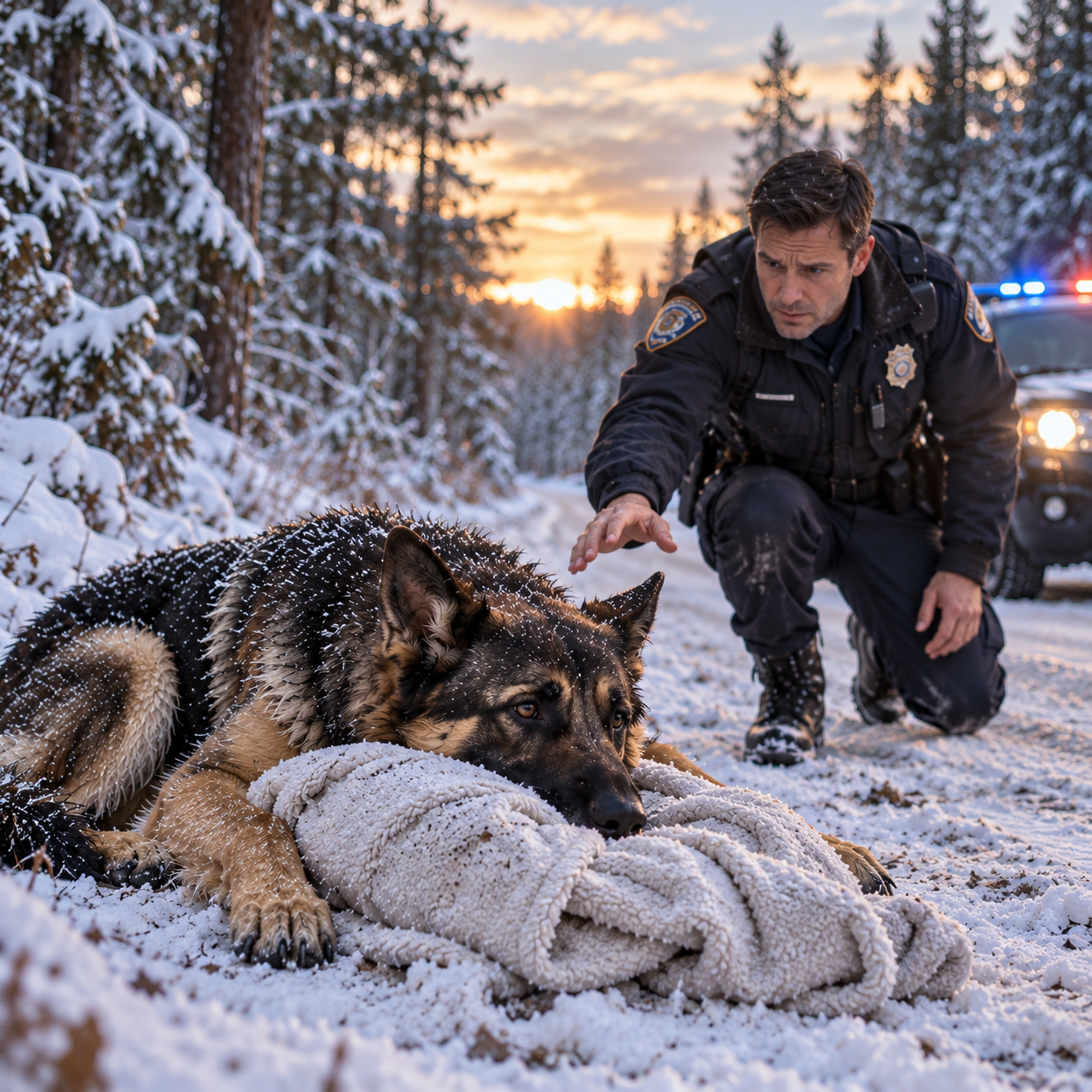
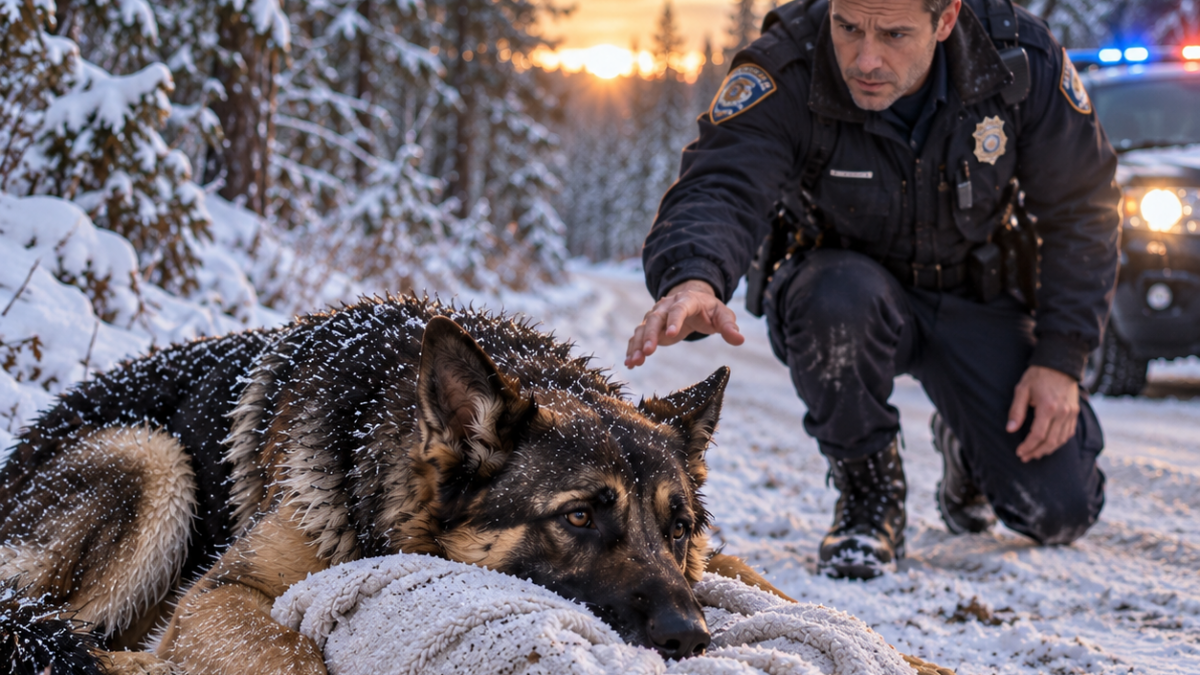
At 5:40 on a freezing November morning outside Berlin, New Hampshire, Officer Clark Dawson spotted a German Shepherd standing alone beside the snowy road. The dog was trembling, but it refused to move away from a dark bundle of cloth lying at its paws.
When Clark stepped closer, the shepherd blocked him, guarding the bundle with everything it had left. Then Clark pulled back one corner of the blanket and froze. Inside was a newborn baby, cold, weak, but still alive.
Clark rushed the infant toward the hospital, believing the rescue had already begun. But the dog knew something Clark did not.
At 5:40 on a bitter late November morning outside Berlin, New Hampshire, the first heavy snow of the season lay across the narrow forest road and the dark pine woods surrounding it. The storm had ended only a few hours earlier, leaving the countryside almost completely silent beneath several inches of fresh snow.
Officer Clark Dawson, 39, was driving slowly through the northern edge of his patrol area, checking for fallen branches and stranded vehicles before morning traffic increased. Clark had served with the Berlin Police Department for nearly 14 years. He was tall and broad-shouldered with short brown hair beginning to gray near the temples and a weathered, steady face that rarely revealed surprise.
Years of police work had taught him that unusual things often announced themselves quietly. That morning, the unusual thing appeared at the edge of his headlights as a dark shape standing beside the road. Clark initially thought it was a deer, but as he slowed the patrol SUV, the animal turned toward him, and the unmistakable outline of a German Shepherd emerged from the dim blue light.
The dog appeared about four years old, large, but noticeably lean beneath a thick black and tan coat. Snow clung to its legs, belly, and chest, and its body trembled from the cold.
Yet, it did not run toward Clark’s vehicle or retreat into the trees.
It remained beside a dark blue bundle lying partly in the snow. Clark stopped several yards away and watched through the windshield. The Shepherd shifted its position almost immediately, placing itself between the patrol SUV and the bundle.
That movement changed everything. It was not simply a lost dog standing beside something it had found.
The animal was intentionally guarding whatever lay at its feet. Clark notified dispatch that he was checking an unusual roadside situation, then stepped outside.
The cold reached through his uniform almost instantly. His boots sank into the untouched snow as he approached slowly, keeping his hands visible and his posture relaxed. The German Shepherd watched every movement.
Its ears remained raised, and although its legs shook badly enough for Clark to see from several yards away, it refused to leave. When Clark moved a little closer, the dog stepped directly in front of the bundle again. There was no charge, no snapping, and no attempt to attack.
A low warning came from its throat, weak rather than threatening, as though the animal barely had enough energy to make the sound. Clark stopped.
He had dealt with frightened dogs many times during his career, and this behavior felt different. Fear was present, certainly, but so was determination. The shepherd was not protecting itself.
It was protecting something else. Clark lowered himself into a crouch and waited. From that angle, he could see the dark blue material more clearly.
It looked like several blankets wrapped tightly around a small shape. Snow had begun collecting on the upper folds, while the area closest to the dog remained relatively clear, suggesting the shepherd had been moving around it repeatedly. Clark extended one unglloved hand toward the animal, but did not try to touch it.
The dog stared at him, breathing rapidly. Then Clark noticed a slight movement beneath the blankets. For a moment, he wondered whether the wind had shifted the fabric, but the surrounding snow was nearly still.
Another movement followed, smaller than the first. The shepherd immediately lowered its head toward the bundle and then looked back at Clark.
That single glance made the situation suddenly urgent. Clark moved only a few inches closer, allowing the dog to smell the back of his hand.
After several tense seconds, the shepherd’s posture softened.
It did not leave its position, but it stopped blocking Clark’s hand when he reached toward the edge of the blanket.
Clark quietly told the animal that he was there to help, then carefully pulled one corner of the fabric aside.
A newborn baby’s face appeared beneath the layers.
Clark froze for no more than a heartbeat before training replaced shock. The infant was wrapped in two additional blankets, one cream colored and another faded pink with a knitted cap pulled down over fine brown hair. Only the small face and one hand were visible.
The baby’s skin felt cold when Clark touched her cheek, but he could see faint movement around the mouth and chest.
She was breathing. There were no obvious injuries, but exposure alone could become dangerous quickly in temperatures this low. Clark opened the blankets only enough to assess her without allowing more cold air inside.
Beneath the layers, he found a small plastic bottle containing a little milk that had already gone cold, along with a neatly folded white cloth embroidered with a single capital letter A. Nothing about the arrangement looked careless. Someone had deliberately wrapped the infant, placed food beside her, and tried to protect her from the weather.
The German Shepherd lowered itself against the outer edge of the bundle, pressing its body close as though it had been sharing whatever warmth remained in its exhausted frame. Clark looked at the dog, then back at the child, and realized that without the shepherd standing visibly beside the road, the dark bundle might have disappeared into the snowy shoulder until it was too late. Clark immediately radioed dispatch and reported that he had located a living newborn exposed to the cold.
An ambulance was requested, but the nearest available unit was several miles away. While the hospital was considerably closer, Clark decided that waiting beside the road would waste precious time. He removed his heavy patrol jacket and wrapped it around the blankets, creating another barrier against the cold, then carefully lifted the baby into his arms.
The shepherd rose at once and followed so closely that its shoulder brushed Clark’s leg as they crossed the snow.
Clark placed the infant securely in the rear of the patrol SUV, using the emergency blankets kept inside, making sure the baby’s face remained uncovered and her position stable for the short drive.
When he turned to close the door, the shepherd stood directly behind him. Clark initially intended to leave the animal where responders could collect it, but the dog immediately looked past him toward the infant and tried to step forward. Its reaction was so clear that Clark reconsidered.
He opened the door wider. The Shepherd climbed inside without hesitation and positioned itself beside the bundled child.
The patrol SUV pulled away with the heater turned high. Clark drove quickly but carefully over the snow-covered road, conscious that a sudden stop could be dangerous for the tiny passenger behind him.
In the rear view mirror, the Shepherd never relaxed. It stood with its front paws braced near the edge of the seat, nose close to the blankets, watching every movement of the infant.
Once the baby made a faint sound, and the dog immediately lowered its head until its muzzle almost touched the outer layer of Clark’s jacket.
The sight stayed with Clark as the first buildings of Berlin appeared ahead. He had seen trained working dogs demonstrate remarkable discipline. But this animal had no police harness, no working vest, and no handler giving commands.
Whatever bond existed between the shepherd and the infant had been strong enough to keep the dog beside her through a freezing night. The hospital emergency entrance came into view several minutes later.
Two medical staff members were already waiting beneath the covered driveway after receiving Clark’s radio call.
He parked beside the doors, stepped out, and opened the rear passenger door. The German Shepherd immediately shifted closer to the infant as unfamiliar people approached. Clark reached down to steady the dog by its collar and felt something hard beneath the thick, damp fur around its neck.
A small metal tag had been hidden there, scratched from years of use and partly turned backward. Clark rotated it toward the bright hospital lights.
One word had been engraved deeply enough that even the worn surface could not erase it. Hartwell.
Clark looked at the name, then at the newborn lying beside the dog. Whatever had placed them on that frozen roadside, he understood now that their story had begun somewhere else.
The emergency department moved quickly once Clark carried the newborn through the doors. Warm blankets replaced the layers that had protected her on the roadside, and the medical staff began checking her temperature, breathing, blood sugar, and hydration, while Clark remained several steps away with the German Shepherd beside him. Dr. Meredith Sloan, 46, took charge of the examination. She was of medium height with a lean athletic build, dark brown hair pulled back neatly, and calm gray eyes that seemed to sharpen whenever the room became tense. She had the controlled manner of someone who had spent years making urgent decisions without allowing urgency to become panic.
After nearly 20 minutes, Meredith stepped away from the bassinet and told Clark that the infant had been dangerously cold and mildly dehydrated, but she had been found early enough to avoid serious harm. Her breathing was strong, her temperature was gradually improving, and there were no obvious injuries. Clark felt some of the pressure in his chest ease for the first time since he had pulled the blanket aside on the road.
Meredith also pointed out something Clark had already begun to suspect. The multiple layers of cloth and the warmth provided by the dog had probably made a significant difference. The German Shepherd, however, had no interest in being praised.
Once the baby disappeared into the treatment room, he planted himself beside the closed door and refused to move more than a few feet away. A nurse brought him water and a small bowl of food. He drank deeply and ate several hurried mouthfuls, then abandoned the bowl while food still remained and returned to the same place beside the door.
He lowered himself onto the polished floor, but his ears remained raised toward every sound coming from inside.
The behavior caught Clark’s attention more than the dog’s hunger did.
A stray that had gone without food long enough to become visibly thin would normally remain near a full bowl. Yet this shepherd treated eating like an interruption. When the baby made a faint cry from the other side of the door, his head lifted instantly.
Clark watched him for several moments and began reconsidering what he had seen beside the road. There had been blankets, a bottle, a carefully folded cloth, and a dog that had apparently spent hours guarding the child.
None of it looked like the work of someone who had simply discarded an unwanted baby and walked away. Clark crouched beside the shepherd and examined the metal tag again. Under the bright hospital lights, he could see details that the snowy roadside had hidden.
The word heartwell was engraved across one side. When he turned the tag over, he found a phone number and a second word scratched below it. Huck.
Clark said the name once quietly, and the dog’s reaction was immediate.
One ear tipped toward him, and the tail moved once against the floor. There was no doubt Huck knew his name.
Dispatch ran the phone number and the registration associated with the tag and within several minutes the information came back. The dog belonged to Mason and Elise Hartwell, residents of a rural neighborhood approximately 8 miles from where Clark had found the baby. More importantly, recent local records connected the Hartwell household to a newborn daughter named Anna.
The embroidered A on the small cloth no longer seemed mysterious. Clark looked through the glass toward the warmed bassinet and understood that he was probably looking at Anna Hartwell. Before leaving the hospital, Clark confirmed that Anna would remain under observation and asked whether Huck could stay nearby.
Meredith agreed, provided the dog remained outside the treatment area. Huck seemed satisfied with that arrangement.
He returned to the door, curled his body against the wall, and rested his chin on his paws while keeping his eyes open. Clark drove toward the Hartwell address as morning light spread across Berlin.
The storm clouds had begun breaking above the surrounding hills, but fresh snow still softened rooftops, mailboxes, and the branches of spruce trees lining the quieter residential roads. The Hartwell House stood at the end of a short driveway, a modest singlestory home with dark shutters, a fenced backyard, and a small porch partly buried beneath drifting snow.
Clark parked, approached the front door, and knocked several times while identifying himself as a police officer. No one answered.
The door was locked. The windows showed no movement, and the house appeared undisturbed from the outside. Yet several details suggested that no one had been home for some time.
Two days of mail remained uncollected. A delivery package sat beneath the porch roof with a dusting of snow along one edge and the attached garage was empty.
Clark was walking back toward the driveway when the neighboring door opened. Lorraine Bishop, 61, stepped onto her porch wearing a quilted maroon coat over her workclo.
She was short, slightly rounded through the shoulders, with silver streaked brown hair cut just below her ears and rectangular glasses that made her concerned expression even more noticeable. She had lived beside the Heartwells for 4 years and knew them well enough to recognize something unusual about a police vehicle in their driveway.
When Clark asked about Elise, Lorraine’s face tightened.
She had not seen her in nearly a week. Elise had given birth only a few weeks earlier, and although Lorraine described her as normally friendly and organized, she had become increasingly withdrawn after bringing Anna home. Her husband, Staff Sergeant Mason Hartwell, was serving overseas with the United States Army and had been away for several months.
Lorraine had occasionally brought food to the house, but during her most recent visit, Elise had thanked her through the closed door instead of inviting her inside. Clark asked when Lorraine had last seen Elise leave the property.
She thought for several seconds before remembering an early morning 3 days earlier. She had been preparing for work when she saw Elise loading the dark gray Subaru Outback. Anna was with her, bundled into an infant carrier, and Huck had jumped into the vehicle as well.
Lorraine remembered the moment because snow had already been predicted for later that day, and she had wondered why anyone would take a newborn toward the mountain roads with bad weather approaching. She had assumed Elise was visiting someone, or perhaps meeting family.
When Clark asked which direction the Subaru had gone, Lorraine pointed north toward the wooded roads outside town. She did not know the exact destination, though she recalled the Heartwells occasionally mentioning hiking and a place in the mountains they used when Mason was home.
The detail was vague, but it was enough to deepen Clark’s concern.
The more he looked at the quiet house, the less the roadside discovery resembled an abandonment. Elise had left home with Anna and Huck. Three days later, Anna and Huck had appeared together beside a forest road while Elise and the Subaru had vanished.
Clark documented the condition of the house, contacted dispatch to circulate the vehicle information, and asked that the department begin checking road reports and any recent calls involving a stranded Subaru. Before leaving, Lorraine asked whether Anna was alive. Clark told her only that the baby was safe and receiving medical care.
Relief passed briefly across her face, followed immediately by another question she did not need to say aloud. If Anna was safe, where was Elise?
By the time Clark returned to the hospital, the morning had fully brightened. He expected Huck to be asleep after food, warmth, and hours of exhaustion.
Instead, the German Shepherd lifted his head the instant Clark entered the corridor.
He rose from beside Anna’s door and stared directly at him.
For several seconds, neither moved. Then Huck walked toward the hospital entrance.
He stopped near the glass doors, turned, and looked back at Clark. When Clark remained where he was, Huck returned several steps, gave a low, impatient whine, and headed toward the exit again.
The movement was repeated with such purpose that Clark no longer saw a restless dog wanting fresh air. Huck was trying to lead him somewhere.
Huck stood near the hospital entrance with his body angled toward the glass doors, then turned back to Clark again. The movement was too deliberate to dismiss as restlessness.
Clark had already learned that the German Shepherd did almost nothing without purpose. On the roadside, Huck had guarded Anna. In the hospital, he had refused to leave the treatment room door.
Now with Anna safe, the dog seemed focused on something else.
Clark walked over, clipped a temporary leash to Huck’s collar, and led him outside.
The late morning sky over Berlin had cleared enough for pale sunlight to shine across the snow, though the mountain roads beyond town remained quiet and partially covered. Clark did not attempt to command Huck or force him to track anything.
He simply placed the dog in the rear of the patrol SUV and began driving north along the route Lorraine Bishop had described. For the first few miles, Huck remained alert, but still. Then, at a fork where one road continued toward a populated area, and the other climbed toward the mountains, the shepherd suddenly stood, pressed closer to the front barrier, and gave a low whine.
Clark slowed, turned toward the mountain road, and watched the dog settle almost immediately. The same pattern repeated twice more. At one intersection, Clark deliberately began moving in the wrong direction, and Huck became restless within seconds, shifting his paws against the floor and staring toward the opposite road.
Clark corrected course. The dog became quiet again.
It was not proof in the way a witness statement or license plate record would be proof, but it was enough to keep following. Clark radioed dispatch with his location and explained that Huck appeared to be reacting consistently to a particular route connected to the missing Hartwell vehicle. The road narrowed as they climbed.
Houses disappeared, snowbanks grew taller, and pine trees closed in on both sides until the patrol SUV seemed to be moving through a white corridor. Cell service weakened with every mile. Clark kept his speed low, scanning the shoulders for tire marks or anything that might have been overlooked after the storm.
Huck suddenly barked once from the rear compartment, then moved sharply toward the passenger side. Clark followed his gaze and noticed a narrow service road branching away from the main route, nearly hidden by fresh snow and overhanging branches.
Two old tire tracks disappeared into that road. They were faint, but visible where compressed snow had hardened beneath the storm. Clark stopped long enough to check them on foot, then returned to the SUV and eased onto the unplowed track.
The road was rough and barely wide enough for the vehicle in several places. Fallen branches scraped against the sides while deeper drifts forced Clark to slow almost to walking speed. After nearly 2 mi, a dark shape appeared between the trees.
It was a gray Subaru Outback sitting crookedly near the edge of the road, its right wheels buried in packed snow. Clark stopped several yards behind it and stepped out.
There was no major collision damage, only a front tire pushed into a drift and a bumper resting lightly against frozen brush. Snow covered the hood and windshield, making it clear the vehicle had been there throughout the storm. Huck became intensely alert the moment he saw it.
Clark checked the area before opening the Subaru.
The driver’s door was unlocked.
Inside, he found a baby bag on the rear floor containing diapers, wipes, spare clothing, and several formula containers. Two bottles of water lay beneath the passenger seat. A folded infant blanket rested in the back, and a small pharmacy bag sat in the center console.
The label carried Elise Hartwell’s name and showed medication prescribed after Anna’s birth.
Clark did not examine it beyond confirming ownership. The vehicle itself appeared to have run out of options rather than suffered an accident.
The fuel gauge sat on empty and the wheels were trapped deeply enough that Elise would not have been able to free the Subaru without assistance. Nothing suggested sudden violence.
Instead, the scene looked like a family trip that had gone badly wrong.
Outside, Clark studied the snow around the driver’s side.
Most tracks had been erased by the storm, but beneath the shelter of nearby trees, fragments remained. He found several compressed footprints leading away from the vehicle.
Some impressions were deeper on one side, as though the person had been carrying weight. Beside them were older dog tracks.
Huck pulled against the leash immediately when Clark stepped toward the treeine.
Clark looked back once at the Subaru, reported the vehicle’s location to dispatch, and requested that the information be logged before moving farther from the road.
Then he let Huck lead. The Shepherd moved quickly through the snow, but never disappeared ahead. Every 30 or 40 yards, Huck stopped and turned to make sure Clark was still following.
When the officer fell behind on a steep section, the dog waited beside a pine tree until Clark caught up, then continued. The behavior removed any remaining doubt that Huck knew exactly where he was going.
The route was not a marked hiking trail, though signs of occasional human use appeared beneath the snow. An old cut branch, a weathered post, a narrow gap between trees that seemed too regular to be natural. Clark used bright survey tape from his emergency kit to mark the path back while keeping track of the distance on his phone.
Nearly a mile passed before the forest began to open. A small cabin appeared between the trees. It sat in a shallow clearing beneath tall pines built from weathered logs darkened by years of snow and rain.
The roof carried a heavy white layer, one shutter hung slightly crooked, and an old stack of firewood rested beneath a leanto on the side. The building looked unused at first glance, but not abandoned completely. A narrow path had been disturbed near the porch.
Huck saw the cabin and surged forward so suddenly that Clark released the leash rather than risk pulling him backward. The German Shepherd ran across the clearing, bounded onto the porch, and began scratching urgently at the front door. Clark reached the steps a few seconds later.
He tried the handle locked. He called out, identifying himself as a police officer, and waited.
No answer came. He called again, louder this time, while Huck continued pawing at the door and whining.
Clark stepped off the porch and began checking the outside of the cabin. The windows were clouded with frost, and heavy curtains blocked most of the view. There were no obvious signs of damage or forced entry.
Then something above the roof caught his attention. A thin ribbon of smoke drifted from the chimney. It was faint, almost transparent against the pale sky, but it was there.
Someone had used the stove recently. Clark returned quickly to the front door. Huck had stopped scratching and was standing with his nose close to the gap beneath it.
His entire body had become still. Clark listened. For several seconds, there was only the soft movement of wind through the trees.
Then, a weak sound came from somewhere inside the cabin. Not loud enough to identify, but unmistakably human. Clark placed one hand against the door and leaned closer.
Someone was in there. The weak sound came from somewhere beyond the locked door, faint enough that Clark might have mistaken it for the settling of old wood if Huck had not reacted at exactly the same moment. The German Shepherd stopped scratching and stood rigidly with his ears pointed forward.
Clark called Elise Hartwell’s name again, identifying himself as a police officer, but no clear answer followed.
He moved along the porch until he found a side window whose wooden frame had warped with age. After forcing it upward far enough to reach the latch, he climbed carefully inside, crossed the small room, and opened the front door for Huck.
The dog rushed past him at once. Clark followed and immediately noticed that the cabin told a very different story from the one he had feared during the walk through the forest. Nothing had been overturned.
There was no broken furniture, no sign of a struggle, and nothing suggesting that another person had harmed anyone there. Instead, a small portable bassinet had been positioned near the wood stove, close enough to receive warmth without being dangerously near the heat. Clean diapers were stacked on a table.
Bottles had been washed and arranged beside a metal bowl. Baby clothes were folded into small piles, and several containers of formula had been placed together near the kitchen counter. The room was cold because the fire had burned down to a weak bed of embers.
Yet, everything around the empty bassinet suggested that someone had been trying very hard to care for a newborn. The dining table revealed even more.
Scraps of paper covered much of its surface, each carrying short reminders written in increasingly uneven handwriting. Some recorded feeding times and diaper changes.
Others reminded Elise to drink water, take her medication, wash bottles, or sleep when Anna slept. One page contained a simple list beginning before sunrise and continuing through the night as though Elise had been breaking each day into small pieces she believed she could manage.
Another note read, “You only have to get through the next hour.”
Clark stood over the papers for several seconds. He had spent most of the morning wondering how an infant had ended up beside a frozen road.
The cabin was answering part of that question without anyone saying a word. Anna had not been forgotten here.
Every corner of the room showed preparation, effort, and the growing exhaustion of a woman trying to keep control of a life that was becoming harder to manage. Huck moved toward the back of the cabin and began whining.
Clark followed him around the edge of an old couch and found Elise on the floor near the wall. She was 32, slender beneath an oversized gray sweater with long chestnut hair tangled around her shoulders and a tired face made sharper by dehydration and several days without proper rest. Her eyes opened when Huck pressed his nose against her arm, but it took several moments before she seemed able to focus on Clark.
An overturned cup lay near one hand, and a blanket had slipped partly from her shoulders. She was conscious, breathing steadily, and showed no visible signs of injury, but her weakness was obvious. Clark immediately radioed for a rescue team capable of reaching the cabin and reported that the missing woman had been found alive, suffering from exposure, dehydration, and severe exhaustion.
Then he knelt nearby and offered her small amounts of water rather than allowing her to drink too quickly. Elise barely seemed aware of the cabin around her until she noticed Huck beside her.
Her expression changed and the first thing she managed to ask was about Anna. Clark told her the baby was alive and being cared for at the hospital. The effect was immediate.
Elise closed her eyes and some of the tension left her face as if she had been holding herself together for only that answer. Over the next several minutes, while they waited for rescuers, she began explaining what had happened in fragments.

