A Navy SEAL Saved a Mother K9 in a Blizzard—Then 9 Puppies Changed His Life – Part 2
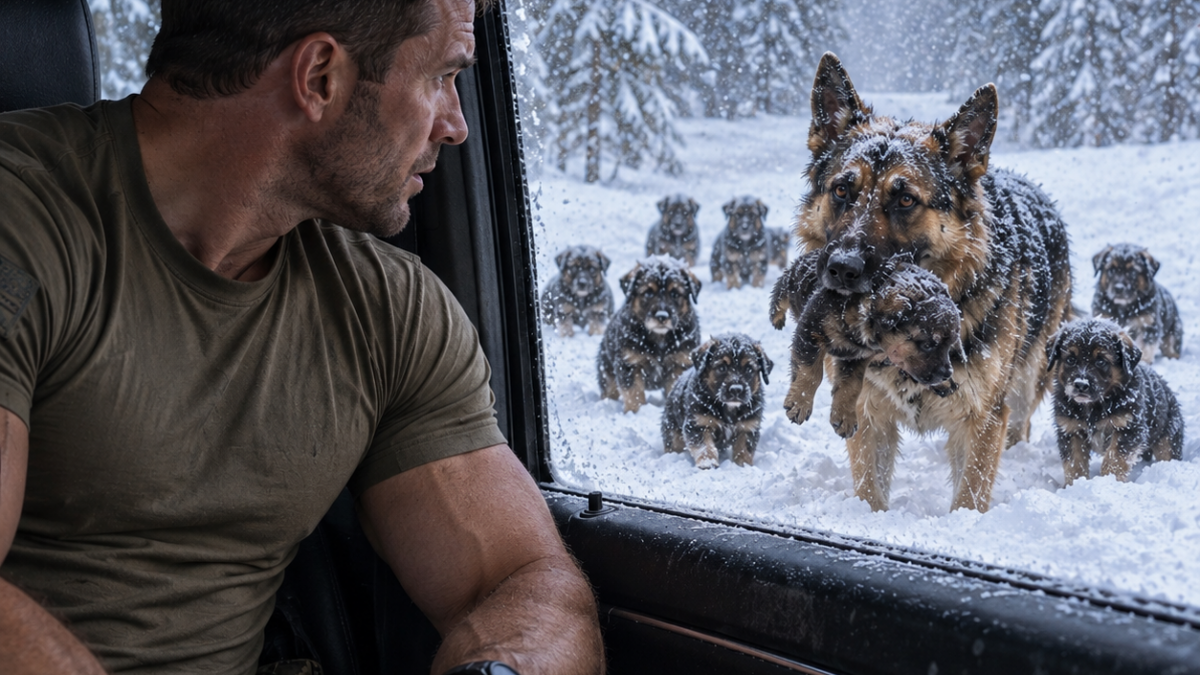
Mercy watched the closed door long after the truck left. Caleb looked down at Button at the nine warm bodies at the real estate folder still on the table. The offer deadline was Monday.
Today was Friday. He had 3 days to sell an empty life.
He had maybe less than that to prove this house was not the safest place Mercy had ever run from. Then his phone buzzed again. This message came from an unknown address with no name attached, only a single image.
It showed Mercy behind a chainlink fence thinner than she was now, looking toward the camera with the same amber eyes. Under the photo were six words.
Give her back before court decides. By noon, the storm had weakened into drifting flakes, but the house remained charged with the silence that follows a threat, the kind that makes ordinary noises sound like warnings.
The kettle clicked off and Mercy raised her head. A log settled in the stove and button startled against her chest. Nora set a spoon in the sink too quickly, then muttered an apology to the entire kitchen as if the puppies had voting rights.
Caleb stood at the table with his notebook open, phone beside it, and the real estate folder pushed so far away it was nearly hanging off the edge. Deputy Rachel Price had told him to preserve everything, take no further contact from Travis Hol unless necessary, and keep the dogs on the property pending review. She had a voice like clean gravel, steady and low.
The voice of a woman who had seen people confuse volume with truth, and was no longer impressed by it. She would open a temporary welfare file and contact animal control. Dr.
Leah Bennett sent the microchip number to two registries and a colleague who had once worked with regional canine teams.
Nora took over the stove with the authority of a field commander, though her strategy involved soup coffee and judging Caleb’s pantry.
You own three kinds of mustard and no crackers, she said. That tells a story.
It’s a short story, a lonely one.
Caleb did not answer because lonely was easier when nobody named it. Mercy watched from beside the quilts, eyes moving from Caleb to Nora to Leah and back to the door. She still had not fully rested.
Every time a puppy wriggled away, she nudged it back. Every time someone moved near the entrance, she lifted her head.
Caleb knew that kind of vigilance. It looked noble from the outside. From the inside, it was a room with no chairs.
Leah knelt to check buttons wrap again, moving slowly enough that Mercy allowed it.
“He is improving,” Leah said.
“Still needs restricted movement, which he will oppose because he has the self-preservation instincts of a biscuit.”
Button yawned and tried to bite the end of the stethoscope.
“My point,” Leah added.
Caleb wrote the update down. Norah watched him. You always make notes like that.
When facts matter, facts always matter.
Some people just don’t love them enough to invite them to breakfast.
Leah’s phone chimed.
She stepped into the hall, listened, and came back with her expression narrowed. The registry trail is messy. Inland K-9 search response dissolved after funding issues.
Daniel Pike, the handler listed, passed away 2 years ago. His wife Elaine may still live near Post Falls, but the number is old. I left a message.
Mercy’s ears came forward at Daniel’s name again.
This time, Grace Mercer saw it because Grace arrived in the doorway at that exact moment with snow in her dark hair and a backpack hanging from one shoulder. Caleb had not heard the car. That bothered him.
It also told him how tired he was. Grace stood 20 ft away, cheeks red from cold. 19 years old and trying very hard not to look like the girl who used to fall asleep on his couch during Fourth of July fireworks.
She had her mother’s brown eyes.
Caleb’s younger sister, Emily, had been gentler than anyone in the Mercive family had deserved, and illness had taken her with a quietness that still felt rude.
Grace had called Caleb twice after the funeral. He had returned one call 3 weeks late and spoken as if weather were a subject large enough to cover grief.
After that silence had done what silence does, it multiplied.
“Nora called me,” Grace said, her voice held steady by will alone.
She said you had 10 dogs in your kitchen. Norah raised one hand.
“I may have used the phrase emergency puppy situation.”
“You are in Spokane,” Caleb said because apparently his first instinct was geography.
Grace looked at him. It is a 90-minute drive in normal weather. Longer today.
I managed. You should have called.
You should have too for about 3 years. The sentence landed clean and flat.
Leah suddenly became very interested in her medical kit. Norah looked at the ceiling, possibly asking God for patience with emotionally constipated men. Caleb deserved that.
Mercy rose between the puppies and the new arrival. Grace saw the dog and every sharp edge in her face softened. She set the backpack down slowly, crouched without stepping closer and turned her body sideways.
“Hi, mama,” she said.
“You do not know me.
That is fair.
I barely know him lately either.”
Caleb closed his eyes for half a second. Norah made a small sound that might have been approval. Mercy studied Grace.
Button, who had no respect for dramatic family tension, began a determined crawl toward the newcomer. Mercy blocked him with her muzzle.
He tried the other side. She blocked that, too.
He placed his chin on her paw and glared at the room.
Grace’s mouth trembled into a smile despite herself.
“That one is trouble.”
“Button,” Caleb said temporarily.
Grace looked at him then, and for the first time since arriving, something warm and painful moved behind her eyes. You named a puppy Button.
Operational designation, of course. Leah cleared her throat gently.
Grace Norah says, “You are prevet.
First year, mostly prerequisites and realizing biology professors enjoy suffering. Good.
Wash hands.
You can help weigh puppies.”
Grace moved into the kitchen like a person entering an old room in her own memory and finding the furniture changed but the smell the same. She passed Caleb close enough that he could have touched her shoulder.
He did not. Cowardice often dressed itself as respect. They set up a small station with a kitchen scale lined by a towel.
Mercy allowed Grace to assist after the girl sat on the floor for several minutes and let the puppies come near without reaching. One by one, the pups were weighed, checked, and returned.
Grace spoke to them in a soft, nonsense voice that sounded so much like Emily that Caleb had to turn toward the sink and grip the counter. Leah saw.
Nora saw. Grace probably saw most of all and chose not to punish him with it yet.
When Button’s turn came, Grace supported his chest while Leah checked the wrap.
He’s brave, Grace said.
He’s offended.
Caleb corrected. That too.
Button licked Grace’s thumb, then sneezed.
Grace laughed, and the kitchen changed. Not healed.
Caleb was beginning to distrust that word, but opened a notch.
Leah’s colleague called back around 3.
Caleb put the phone on speaker. The woman, a former canine coordinator named Marcy Lang, remembered Daniel Pike, an inland canine.
She remembered a black sable female shepherd named Mercy who had worked search response in forest and winter terrain. Best nose in the program, Marcy said. Not flashy, just relentless.
Daniel used to say she could find a lost hiker or the sandwich in your glove box, and she considered both morally important. Grace smiled at Mercy. That explains the boot inspector.
Marcy continued. When Daniel got sick, the program was already failing. Dogs were placed out through approved handlers and fosters.
Mercy was supposed to go to a retired deputy near Athal, but I don’t know if the transfer completed.
Records scattered when the nonprofit closed. Elaine Pike kept some boxes, I think.
Do you have Elaine’s current contact?
Leah asked. Maybe an address. I will text it.
Please be careful. If someone is claiming breeding rights or sale rights, that does not sound like anything Daniel would have wanted.
Mercy had gone very still at Daniel’s voice through memory, though the name came from a stranger.
Caleb felt the old anger rise. Not hot, not useful yet. He set it down.
Anger could carry a man to the door, but it could not build a case that survived daylight. Rachel Price arrived near dusk in a county SUV dusted white from the road. She was in her early 40s with black hair tucked under a knit cap and a manner that made even Nora stop issuing instructions for nearly 10 seconds.
Rachel photographed Mercy from a respectful distance, documented the puppies, scanned the messages on Caleb’s phone, and took a statement from each person.
“She did not dramatize Travis.
She did not dismiss him either.
He has filed no formal claim yet,” Rachel said, but he called dispatch asking whether he could retrieve livestock from your property.
We corrected the word livestock.
Grace’s face tightened.
Caleb watched Mercy nose button closer to her belly.
If he comes back, Caleb asked, “Call us.
Do not engage beyond telling him to leave. I know you can handle yourself, Mr.
Mercer.
That is not the same as handling this well.”
Caleb looked at her for a beat, then nodded.
“Understood.
” Rachel’s gaze moved to the real estate folder.
“You selling?
Maybe.”
Nora snorted. Rachel ignored it politely. county may need a stable temporary placement if ownership is disputed.
That works better when the placement is not vanishing into escrow. There it was practical, not emotional.
Somehow worse, Caleb said, “I have until Monday.
” Grace looked at him sharply.
“You were going to sell the house?
The land house goes with it.
Were you going to tell me?”
He had several answers available. All bad. I did not think you wanted to say.
Grace stood very still.
This was grandma’s kitchen, mom’s kitchen.
I learned to make biscuits badly at that counter. Norah pointed a spoon at her.
They were terrible. We loved you anyway. Grace did not look away from Caleb.
You disappeared and then decided nobody cared about the place you left behind. He deserved that, too.
Mercy, sensing the room change, rose and stepped between them, not aggressively, simply placing her body across the line of hurt, as if hurt were another creature that might be hurted. Button tried to follow and tipped sideways into a towel.
Grace wiped her cheek with the back of her hand, half laughing and half not.
“Your dog is better at family conflict than you are.”
“Not my dog,” Caleb said.
Everyone in the room, including Mercy and her own severe way, appeared unconvinced. Rachel closed her notebook. Review in 72 hours if Mr.
Holt files documents. Until then, temporary protective hold here, provided Dr.
Bennett signs off and the site remains secure. Leah nodded.
I will. Rachel turned to Caleb. Secure means doors, windows, outbuildings.
If Mercy came from a property where she was confined poorly, she may attempt to move the litter. If startled, working mothers are problem solvers. Caleb thought of the old boat shop, the boarded windows, the gaps beneath the north wall.
I’ll check everything.
Grace picked up her coat.
I’ll help.
The words were not soft. They were not forgiveness.
They were better. They were participation.
Together, they moved through the property at twilight. The snow had stopped, leaving the world pale and rimmed in blue.
Caleb carried a flashlight. Grace carried a clipboard Leah had given her because prevet students apparently became official when handed a form. They checked the porch basement door mudroom window and the old shop.
Grace paused inside the shop, shining her light over dustcovered tools, boat ribs hanging from rafters, coffee cans labeled in her grandfather’s block letters.
You kept everything, she said. Mostly avoided it.
Same result from a distance. Not up close.
He had no answer. In the corner beneath a stack of tarps, they found a strip of black nylon caught on a nail. Caleb lifted it with two fingers.
A fragment of collar or harness worn at the edge with a faint smell of damp metal and dog. Grace photographed it. Neither spoke the story it suggested.
Safeelling meant respecting what they did not know and what nobody needed described. They bagged it for Rachel.
Back in the kitchen, Mercy sniffed the bag from 3 ft away and backed up, gathering the puppies behind her. That was enough.
Leah’s phone chimed with a text from Marcy Lang, then another.
She read them, face tightening.
Elaine Pike still has Daniel’s records.
She says Mercy was never sold. She also says if we found her with puppies, someone bred her without authorization after she disappeared from a foster chain. Caleb felt Grace beside him go rigid.
Norah whispered, “Lord have mercy.”
And for once, the phrase was not a habit.
Caleb looked at the shepherd at the tired mother who had carried one pup in her mouth and led nine more through a killing storm to a stranger’s window.
“We keep it about care,” Leah said quietly as if reminding everyone in the room how not to let outrage become spectacle.
“Care, documentation, placement.”
Caleb nodded. Care was something his hands could do even when his heart was late. Arriving outside, another text arrived on his phone from the unknown number.
No image this time, just a time and place. County Review, Friday, 9:00 a. m.
Bring the dog or lose her. Rachel, still near the door, read it over his shoulder and frowned.
He filed, she said. Grace looked from the phone to Mercy. Can he win?
Caleb looked at the real estate folder, then at the dog who had chosen his headlights because the world behind her had run out of mercy.
“He can make us prove he shouldn’t,” he said.
In the puppy pile, Button woke yawned, and placed one tiny paw on Mercy’s muzzle as if swearing her into court.
“The next day broke clear and hard.
The storm gone, but not forgiven. Snow lay over the lake road in smooth white shells, glittering under a pale sun that made the whole world look cleaner than it was. Caleb stood outside the old boat shop with a mug of coffee cooling in his hand and listened to melt water tick from the roof into the frozen mud below.
Inside the house, Mercy and the puppies were warm. Dr.
Leah had approved the kitchen for another day, but warned that the litter would soon become a traveling committee with teeth and no kitchen. However, Beloved was ready for that.
The old shop would be better if they could clear one room, seal the drafty north wall, set up washable flooring, and make a pen Mercy could inspect without feeling trapped. Caleb had built boat cradles, repaired docks, fieldstripped weapons, blindfolded, and once patched a generator with wire tape and language not suitable for church. Preparing a clean space for puppies should have felt simple.
It did not. Every tool in the shop carried a memory.
His father’s block handwriting on coffee cans.
His mother’s garden gloves on a shelf where she had left them before the lake took the last warm week of that summer.
Emily’s initials carved into the underside of a workbench when she was 14 and angry that nobody believed she could use a pocketk knife properly.
Grace’s height marks on the door frame the last one made when she was 15 2 years before sickness moved into her mother’s body and taught everyone how long a hallway could become at night.
Caleb set the coffee down and opened both shop doors. Cold light poured over the floor.
Grace came in behind him carrying a box of trash bags and a roll of painters tape. Norah says she is bringing breakfast, she said. Norah brought breakfast yesterday.
She says yesterday’s breakfast was field stabilization.
Of course, Grace studied the shop. This room could work if we move the lumber, the engine hoist, the broken cabinets, and whatever lives in those boxes. Mice memories.
Grace looked at him. Mice would be easier.
He nodded. That was true enough to count as a joke. They began with practical tasks because practical tasks gave grief somewhere to put its hands.
Caleb hauled scrap wood to one wall. Grace sorted towels, blankets, and supplies Dr.
Leah had left. They worked without the old ease at first, stepping around each other like people in a narrow aisle.
Then Grace passed him a roll of tape before he asked. He held a board while she marked a draft gap.
She found the box of electrical staples he would have spent 20 minutes pretending not to need help locating.
Around 10, Nora arrived with biscuits, eggs, a thermos of coffee, and an expression suggesting she had already revised the day’s schedule in her head.
“The diner is closed until 11:00,” she announced.
“Why?”
Caleb asked. Because I wrote family emergency on the sign. Grace opened the biscuit tin.
Our puppy’s family.
Norah looked at Caleb then tooured the house. Some family arrives with paperwork. Some arrives in headlights.
I do not argue with delivery methods. Caleb busied himself with a drill.
The first laugh of the morning came from Grace, and it was small, but it had roots. Dr.
Leah arrived shortly after with rubber mats, disinfectant, and a portable scale.
Deputy Rachel Price came by long enough to collect the nylon fragment from the shop and review Caleb’s notes.
She did not promise victory. Caleb appreciated that promises were too often made by people who would not have to stand under them when they cracked. Travis Hol filed a handwritten bill of sale.
Rachel said says he bought a female German Shepherd named Sadi from a man near Spirit Lake 8 months ago. No chip number.
Description is generic. He claims the pups were born on his property and that the mother escaped in the storm. Leah wiped her hands on a towel.
Mercy’s records if Ela Pike confirms them.
We’ll challenge that.
Challenge is not the same as settle, Rachel said. But it matters. Grace leaned against the workbench.
What happens to the puppies if he loses? County will require placement through approved homes or rescue partners, Rachel said.
If Caleb remains foster custodian, he can participate. Dr. Bennett can supervise medical clearance.
Caleb heard the word if. Everyone else did too.
The sale folder sat in the house like a quiet accusation. Norah lifted her chin toward the shop.
He remains. Caleb looked at her. I remain in the room currently.
Do not split hairs with a woman holding biscuits.
Rachel’s mouth twitched.
The moment did not solve anything, but it loosened the day.
By afternoon, the shop’s side room had been transformed from storage into something nearly hopeful.
The walls were scrubbed. Drafts were sealed with temporary foam and boards.
Rubber mats covered the floor. A low pen stood in the center with an open side so Mercy could enter and leave without feeling cornered.
Caleb installed a heat lamp high enough and shielded enough for safety, then checked the temperature three times because trust was not a substitute for a thermometer. When they carried the puppies in, Mercy came first.
She inspected the threshold, the mats, the corners, the pengate, the water bowls, the heater, and Norah’s boots.
Norah held still. I passed yesterday. Mercy sniffed again.
Continuing education, Grace said. One by one, the puppies settled into the warm bedding. Button, now steadier but still wrapped, immediately attempted to cross the pen like a man late for an appointment.
Mercy blocked him with one paw. He turned around and tried the opposite direction. She blocked him again.
He sighed so deeply that even Rachel, who had returned with a copy of the filing, smiled. The pale-chested puppy barked at a blue bucket.
The bucket did not respond. She barked again with more legal force.
“Supervisor has found opposition,” Caleb said.
Grace wrote the weights on a chart and drew a tiny star beside Button’s name before she realized Caleb could see.
“Temporary star,” he asked.
Operational star. She said he deserved that.
While the puppies settled, Leah’s phone rang.
She answered, listened, and her face changed in a way that drew everyone quiet.
“Ela Pike,” she said, then put the call on speaker after receiving permission.
The voice that filled the shop was older, thin at the edges, but steady. Elaine Pike had lived 30 mi west of Cordelane with her husband Daniel until cancer took him two years earlier. Daniel had trained Mercy for wilderness search response after the dog washed out of a stricter police program for what the evaluation called excessive independent decision-making.
Elaine laughed softly when she said it. Daniel said that meant she understood bad orders.
Mercy, lying beside the puppies, lifted her head at Daniel’s name.
Elaine heard the small movement through the phone and stopped speaking for a moment. When she continued, her voice had changed.
“Is that her?”
Caleb crouched near Mercy, holding the phone several feet away.
“Mercy,” Elaine said very gently.
“Find home,” Mercy rose, not fast, not startled.
She stood as if a sound from a former life had reached her across water. Her ears came forward.
She took one step toward the phone, then stopped and looked at Caleb, uncertain whether past and present could stand in the same room.
Caleb’s chest tightened.
He did not move.
“She heard you,” he said.
Elaine breathed in.
“Daniel always said she would know that command anywhere.”
Leah asked about records. Elaine had them.
training logs, veterinary records, photographs, transfer notes, and correspondence from the nonprofit’s final months.
Mercy had been placed with an approved foster after Daniel became too ill to work her. Then the foster died unexpectedly, and the paper trail had gone quiet. Elaine had written letters.
Some came back, others did not. I never believed Daniel would want her bred or sold.
Elaine said he wanted her safe. That was all.
Caleb looked at the litter. Safe had taken a long road. Elaine agreed to scan the records and bring originals to the county review if weather allowed.
When the call ended, nobody spoke for a while. The puppies slept under the hum of the heater. Mercy lay down again, but her head remained lifted, eyes on Caleb.
He had the uncomfortable sense that she had allowed him to witness something private. Grace broke the silence carefully.
She had someone who loved her.
“Yes,” Caleb said.
Then she lost him, too. The words were not aimed like a weapon, but they found him anyway.
He looked at Grace.
“Yes.”
Grace folded a towel slowly. Mom used to say you were the safest person she knew.
After the funeral, I thought maybe safe people leave when things get too real. Caleb could have defended himself with his own pain.
He had done that in silence for years, making his grief a locked building and calling it protection. Instead, he looked toward Mercy, whose whole body had been shaped by loss and still turned toward every small life that needed her. I was wrong, he said.
Grace waited. He forced the rest out because partial truth was just another hiding place.
I thought if I stayed, I would bring the worst of myself into the house. I thought distance was cleaner.
It was not clean for me. I know that now. Do you?
No cruelty, just the question. Caleb nodded once.
I’m starting to button woke and began chewing the corner of Caleb’s notebook through the pen bars.
Grace reached down and saved the notes. He disagrees with your process. He has been difficult since intake.
He is a baby. A difficult baby.
Mercy nudged Button away from the notebook and placed one paw over it as if preserving evidence. Grace laughed, then covered her mouth, not because the laugh was wrong, but because joy sometimes felt disloyal in rooms built by grief. Caleb understood that too well.
“You can laugh,” he said.
Grace looked up. He shrugged.
“I am told it remains legal in Idaho.”
Nora passing the doorway with coffee said barely in some counties. That evening, the evidence began to gather into shape.
Elaine emailed scanned records, Mercy’s chip number photographs showing the V-shaped tear in her ear, veterinary notes confirming she was not a breeding dog, training certifications signed by Daniel Pike, and the final foster transfer with no later sale authorization.
Rachel added Travis’s bill of sale to the packet.
The name Sadi appeared there along with the vague description and no identifying marks.
The seller’s signature was unreadable.
A second document Travis submitted claimed future litter rights, but it used a date from before Mercy had disappeared from the foster chain. Leah pointed this out without triumph.
That paperwork can come from fraud or foolishness, she said. County will decide what it proves.
Caleb built a timeline across the shop table using painters tape and index cards. Grace labeled medical events.
Nora wrote down phone calls. Rachel verified dates.
The puppies provided morale by wrestling with a towel and losing. After dark, Luke from the original story did not exist here. There was only Grace, 19, and too young to have become the family adult standing beside Caleb as they compared the storm warning time with the photo Caleb had taken on the road.
“You always do this,” she asked.
“Make timelines.”
When I am afraid of forgetting something important. Were you afraid when mom was sick? The room seemed to draw inward.
Caleb kept his eyes on the cards. Yes.
You looked empty. I was.
Empty. People can still be afraid. Grace swallowed.
I wish you had said that then. Me, too. Mercy rose suddenly, her ears locked toward the north wall of the shop.
Caleb stopped breathing for one second, then heard it too. A faint scrape beyond the boards, not from outside, but from the old storage passage between the shop and the covered lean to the puppies kept sleeping. Mercy stood body angled between the pen and the sound.
Caleb lifted a flashlight. Grace reached for the spare leash Leah had left, not to restrain Mercy, just to be ready.
Nora appeared in the doorway. What is it? Caleb held up one hand.
The scrape came again, followed by a tiny squeak from somewhere no puppy should be. He turned toward the pen and counted.
1 2 3 4 5 6 7 8 button nine. He counted again. Same.
Then he saw the pale-chested puppy supervisor standing near the water bowl with a strip of towel in her mouth, looking deeply innocent. The squeak came from beyond the wall again. Not a puppy, then.
Maybe wind, maybe a loose board. Mercy did not think so. Caleb moved closer and found a gap near the floor where the old paneling had shifted.
Behind it, in the dust, was a scrap of faded fabric caught on a nail. Not theirs.
Not fresh from this morning. He pulled it free with two fingers and saw part of a stitched label.
Holt Salvage.

