A Navy SEAL Saved a Mother K9 in a Blizzard—Then 9 Puppies Changed His Life – Part 5
Travis Holtz had been questioned about the note and the fabric label. He denied everything, but Rachel had obtained permission to inspect portions of his salvage yard connected to animal complaints from months earlier.
This is separate from Mercy’s custody, Rachel said.
But her case opened the door. Caleb looked at Mercy. She was awake, eyes half closed, listening to a world that kept asking things of her.
“Good,” he said.
After the call, he walked into the kitchen alone. The real estate folder waited on the table.
Monday’s deadline sat inside it with clean ink and no understanding of what had happened here.
He opened the folder and read the final offer again, and imagined luxury cabins where the shop stood.
Strangers drinking wine on a deck built over his father’s old dock.
No room for mercy.
No room for Grace’s summer internship.
No room for found pups or late night calls or Norah’s biscuits disguised as logistics.
His phone buzzed with a message from the buyer’s agent.
Final signature needed by 10:00 a. m. tomorrow.
Caleb looked through the window toward the shop. Mercy stood behind the glass, button at her feet.
Grace beside her with a clipboard, sunlight catching in all that black sable fur. For years he had believed the house was too full of ghosts to keep.
Now he wondered if ghosts were not asking him to leave at all. Maybe they had been waiting for him to open the door.
Monday morning arrived clear enough to make the lake look innocent. Sunlight spread over peree and long silver bands, and the snow along the dock railings softened into slow drops that fell one at a time, patient as a clock.
Caleb stood at the kitchen table with the real estate folder open in front of him. The signature line waited at the bottom of the final page.
It was such a small blank space for something large enough to erase a life. Outside, the old boat shop glowed with work lights, even in daylight.
Grace had gone out early to help Leah check the found pups and Mercy’s litter.
Norah’s truck was already in the drive because Norah considered time a suggestion when breakfast and emergencies were involved.
Deputy Rachel Price had called to say Travis Hol would not be allowed near the property while the investigation into his salvage yard continued. She offered no dramatic promises.
She said the process would take time. Evidence would decide what could be proven.
And the dogs in Caleb’s care were safe for now.
Safe for now. Once Caleb would have considered that phrase too fragile to trust.
Now he understood that most good things began exactly there. He picked up a pen.
The buyer’s agent had sent three messages since dawn.
The final offer was generous. More than generous.
It would clear the remaining medical debt from Emily’s illness, pay for repairs Caleb had postponed, and leave him enough to move somewhere smaller, somewhere clean of history.
A condo, maybe.
A place with no dock, no shop, no coffee cans labeled by his father, no doorway where Grace’s height mark stopped at 15.
A place that asked nothing. The pen hovered.
From the shop came a muffled bark, not Mercy’s.
One of the older found pups had discovered his voice and was using it on the water bowl. Caleb set the pen down.
Then he laughed quietly at first, then with enough force that it startled him. The water bowl bark continued brave and pointless. He closed the folder, took out his phone, and called the agent.
Mr. Mercer, she said too brightly.
I was hoping to hear from you. I am withdrawing from the sale. Silence.
Papers shuffled on the other end as if paperwork might rescue her. The buyer is prepared to move quickly.
Is this a negotiation issue? Caleb looked out the window. Mercy stood in the shop doorway, black sable coat bright where the sun touched it, watching Grace carry a clean towel with professional seriousness.
Button hopped behind them with his wrapped paw lifted and his confidence wildly outpacing his balance. No, Caleb said it is a life issue. The agent explained penalties, market timing, the rarity of lakefront interest, and the danger of letting emotion guide real estate decisions.
Caleb listened because she was doing her job.
When she finished, he said, “I understand.
Send the withdrawal paperwork.”
His hand was steady when he ended the call. The house did not erupt into music. No heavenly light broke through the ceiling.
The refrigerator hummed. The old clock ticked.
A puppy barked at a bowl and lost the debate. Some decisions changed everything while sounding like ordinary mornings. Caleb carried the folder to the wood stove.
He did not burn it. That would have been theatrical, and he had learned to distrust gestures that wanted applause. He placed it in a drawer with the other papers that belong to a past decision, then walked to the shop.
Grace looked up from the scale.
“You signed?”
she asked.
“No,” she stared.
“No, you did not sign yet, or no, you were doing the thing where adults make one syllable do too much work.”
“No, I am not selling.”
Nora, who was pouring coffee from a thermos, froze. Leah smiled before trying not to.
Grace’s face changed slowly.
Hope moving in like cautious weather. Because of mercy.
Because of mercy. Because of Button. Because of you.
Because of two mystery pups in a crate.
And Norah’s belief that biscuits are a municipal service.
Because this place is already being used for something better than waiting for strangers. Norah wiped her hands on a towel. That is the closest you have come to a speech.
I am proud and alarmed. Grace walked to him and hugged him without warning.
This time, Caleb did not freeze. He held her with both arms, careful and firm, and looked over her shoulder at mercy. The shepherd watched them, then lowered her head to nose button away from a roll of tape.
Some moments did not need to be witnessed by anyone but a dog. The next weeks did not become easy.
That was important. Happy endings that skip work are just advertisements. The county process moves slowly.
Ela Pike signed a formal statement supporting Mercy’s placement with Caleb and the remaining legal representative of the dissolved K-9 nonprofit confirmed there was no record of a sale.
With Leah’s medical recommendation and Rachel’s welfare report, Mercy’s adoption became official on a bright Thursday afternoon in a room smaller than the decision deserved.
Caleb signed his name beneath hers. Mercy did not understand the paper.
She understood perhaps the way Caleb knelt afterward and touched Daniel Pike’s old whistle to the new collar they had chosen together.
Soft leather, simple tag, no chain sound. Home, he said. Mercy pressed her forehead to his chest, then turned to count the puppies.
Official paperwork did not outrank motherhood. The nine puppies grew as puppies do.
First into warm handfuls, then into rolling arguments with paws.
They learned to bark at buckets, slippers, shadows, and once at Caleb’s reflection in a stainless steel bowl, which he admitted was reasonable.
Button’s paw healed steadily under Leah’s care, though his sense of personal destiny remained unsupported by physics.
supervisor, whose real adoption name would later become Annie’s, developed a habit of sitting on paperwork at the exact moment someone needed it.
Complaint department became Scout and took responsibility for announcing every visitor 6 seconds after Mercy had already noticed them.
The two older found pups went to a small rescue partner after Rachel’s investigation connected them to a broader neglect case in careful, lawful language.
Caleb did not need details. He needed to know they were safe treated and placed with people who understood that recovery was built with routine, not pity. He donated repairs to their foster kennels.
Anyway, Grace noticed the invoice on his desk and said nothing, which was her kindest form of accusation. Travis Holt did not vanish into a simple villain ending.
He faced consequences where evidence supported them and debts where his own choices had led him. Rachel later told Caleb that a larger network of improper animal sales was being reviewed across county lines.
She did not share what she could not share. Caleb did not ask for more.
The story was not about feeding outrage. It was about what happened after someone opened the right door at the right time and then kept opening doors when the weather cleared.
By late March, the old boat shop had a new name painted on a cedar board above the entrance. Mercy House K-9 Foster.
Norah disliked the first version, Mercer K9 Foster, because she said it made Caleb sound like a tax form with boots. Grace painted the letters herself in dark green with a small white paw print hidden inside the curve of the Y. Caleb pretended not to notice.
He noticed every day. Volunteers came in the practical sideways way communities often help when given a task specific enough to hold.
A retired carpenter repaired the north wall. The owner of the feed store donated bedding.
Leah arranged a monthly clinic for foster dogs and lowincome families.
Elaine brought Daniel’s training notebooks.
And once a week she sat in the shop with coffee while Mercy rested near her feet. Both of them honoring the past without trying to live there. Nora organized Saturday breakfasts that began as fundraisers and turned into a habit.
She made biscuits. Grace tracked donations and Caleb learned that accepting help did not make him less capable. It made the work possible.
The puppy placements began only after Leah cleared them and Caleb built a process that Grace called a military operation with baby pictures, applications, home checks, veterinary references, fenced yard review, daily schedule, emergency plan, follow-up
visits. Caleb color-coded folders. Norah gave him a red pen and then immediately regretted the authority suggested.
Mercy attended every meeting from behind a low gate, calm but attentive. Families were instructed not to rush her.
If she approached, they could offer a hand. If she did not, they could wait.
Waiting, Caleb told them, was not wasted time. It was how trust decided whether to stay.
The first family chosen was an older couple from Bonner’s Ferry who had lost their shepherd the previous year and still kept his leash by the door because they were not ready to put love away like a winter coat.
Mercy sniffed their hands then sat at the woman’s side.
The second was a park ranger who wanted a tracking companion and laughed when Scout barked at her bootlaces. The third was a widowerower who came with his adult daughter and said very little but sat on the mat for 40 minutes while Annie, formerly supervisor, climbed into his lap and fell asleep on his wrist. Caleb understood him.
Silence was not always absence. Sometimes it was a room waiting for something gentle enough to enter.
Each departure carried its own ache. Mercy walked every puppy to the vehicle. She sniffed the crate, the blanket, the hands, the tires if allowed.
Caleb gave each family a folder, a schedule, Leah’s number, and a small square of blanket that smelled like the litter.
Grace took photos. Norah cried and blamed Pepper. Mercy stood at the gate until each car disappeared, then returned to the pen and counted the new number.
8 7 6 Her world changed by subtraction and still it held. Caleb stayed beside her every time.
He did not tell her not to grieve. He had finally learned grief was proof something real had happened. Button stayed.
That decision surprised no one except Caleb, who maintained for three full days that he was evaluating long-term placement until Grace wrote Button Mercer permanent chaos on the care chart. Mercy approved by stealing the pen.
Buttons paw healed completely, but he continued to hold it up whenever he wanted sympathy, especially from Nora, who gave him bits of biscuit and claimed they fell accidentally. By April, Grace had arranged to spend the summer interning with Leah and living in the upstairs room she had once used during lake visits.
The first night she brought her suitcase in, she paused beside the door frame where her childhood height marks ended. Caleb stood behind her with a new pencil.
“If you want,” he said.
Grace looked at him for a long moment, then backed up to the frame. He marked her height at 19. The pencil line was small.
It changed the house more than any repair. Mom would laugh, Grace said.
She would say, “You are still shorter than you claim.”
Grace wiped her eyes with her sleeve. She would.
Caleb did not run from the sadness that entered with Emily’s name.
He let it stand there with them.
Then he said, “Tell me something she did that made you laugh.”
Grace smiled, surprised.
They talked for an hour in the hall while Mercy lay at the top of the stairs listening and Button tried to carry one of Grace’s socks with the semnity of a rescue mission.
In May, Mercy House received its first official temporary foster call. A senior shepherd whose owner had gone into the hospital and needed two weeks of help.
Caleb almost said the place was not ready. Then he looked around.
clean pens, stored food, medical supplies, volunteer schedule.
Grace labeling bins with handwriting that looked like Emily’s if Emily had been more bossy.
Norah’s coffee maker in the corner.
Mercy waiting near the gate, calm and alert. Ready did not mean fearless.
It meant prepared enough to begin. He said yes.
The old shepherd arrived trembling, confused by change, and mercy greeted him from the other side of the divider with quiet dignity. No pushing, no display, just presence.
By the second day, he was eating. By the fourth, he slept through the night.
Caleb sat outside the pen after lights out and understood something so simple he might have missed it if life had spoken louder. The house had not needed to be free of sorrow before it could shelter someone else. Maybe shelter was what sorrow became when love found tools.
The final puppy Scout left on a warm afternoon when the lake smelled of thawed earth and pine pitch. His ranger knelt to let Mercy inspect her pack. Scout barked once at Button, who barked back with the authority of a dog who owned nothing but believed otherwise.
Then the car pulled away. Mercy watched from the gate until the road curved out of sight. Caleb stood beside her.
Grace stood on his other side. Norah leaned against her truck, pretending to organize napkins.
Elaine held Daniel’s old whistle in one hand and smiled through tears.
Mercy returned to the shop, checked the empty pen, sniffed each blanket, then came back to Caleb, and leaned against his leg. Buttons squeezed between them because he considered emotional moments incomplete without him.
Caleb rested one hand on Mercy’s head and one on Button’s back.
The shop was quieter now, but not empty. There is a difference. That evening, after everyone left and the lake turned gold under the setting sun, Caleb and Grace sat on the dock steps.
Mercy lay under the kitchen window where Caleb had first seen her after the rescue and Button chased a moth with ambition unsupported by evidence.
“You ever think about that night?”
Grace asked. Caleb looked toward the road hidden by trees.
“Every day you saved them.”
He shook his head slowly. Mercy stopped the car. I just finally looked out the window.
Grace leaned her shoulder against his. It was the lightest pressure.
It held three years, an apology, a beginning.
In the distance, Norah’s truck rattled down the road, probably bringing something nobody had asked for and everyone would need.
The house lights glowed behind them. The shop door stood open.
Every gate was latched. Every dog was counted.
Caleb thought of Bishop, of Daniel Pike, of Emily, of all the love that had seemed lost because it no longer had a body in the room. Then Mercy lifted her head, amber eyes catching the last light, and he understood that love did not always come back in the shape you knew.
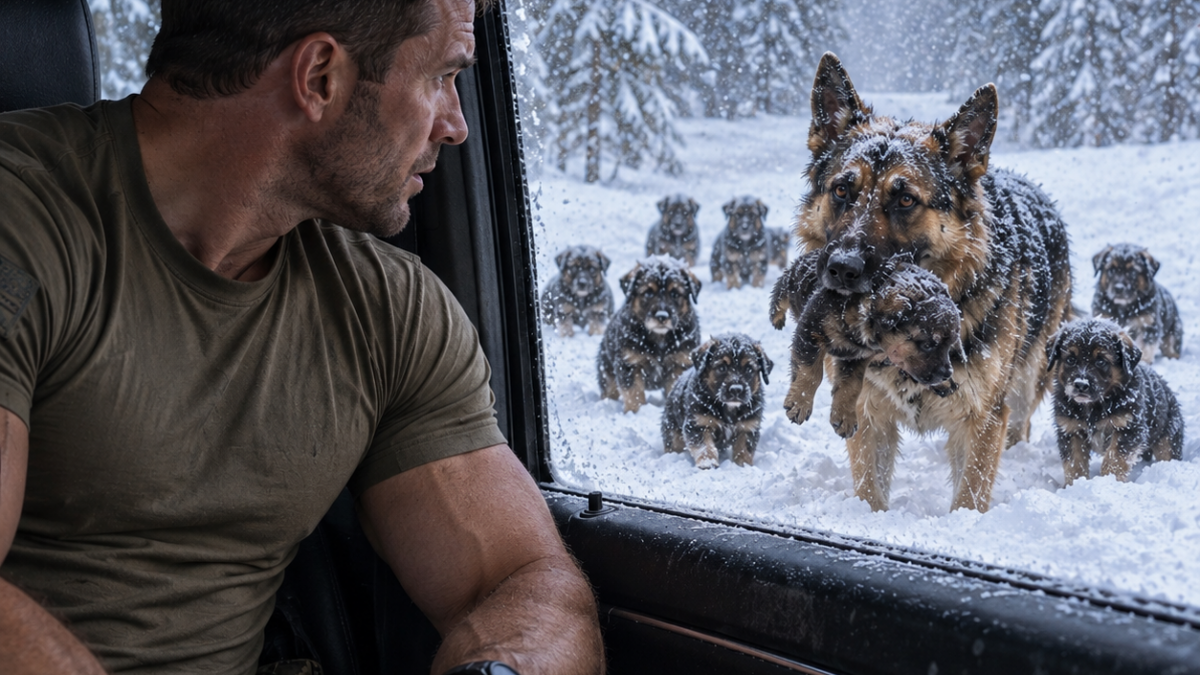
Sometimes it came through a fogged car window in a snowstorm, carrying one small life in its mouth, while nine more walked beside it, asking not for pity, but for room. Caleb had room, more than he had known, more than fear had told him. He opened his hand, and mercy came to it.
Night settled gently over Mercy House K9 Foster, and for the first time in years, Caleb did not listen to the silence as if it were something he had to survive.
He listened to Grace washing cups in the kitchen, Norah’s voicemail arriving with tomorrow’s list, buttons snoring under the bench, Mercy breathing at his feet, and the lake moving in the dark.
Everyone was home. Sometimes the help God sends does not arrive in the form we expect. It may come as a knock on the door, a neighbor with soup, a young woman willing to try again, or a tired mother dog standing in the headlights with everything she loves beside her.
Caleb thought an empty life would protect him from more loss. But love returned when he made room for another living soul.

