A Navy SEAL Stayed Awake for Five Motherless Dogs and Found His Daughter Again – Part 1
A Navy SEAL Stayed Awake for Five Motherless Dogs and Found His Daughter Again
After the spring flood, the Tennessee River glittered under a clean morning sky. But Cumberland Lock still groaned with broken branches, torn rope, and secrets caught in the furnace.
Anson Pike, a former Navy SEAL with a daughter he loved from a distance, was clearing debris when his old German shepherd, Rook, suddenly froze beside the rail. The towboats kept moving.
The workers kept shouting over the water. No one else heard it.
But Rook did. A thin cry slipped from a blue plastic crate wedged against the gate. Anson pulled it free and lifted the lid.
Inside were five tiny puppies, cold, hungry, and too young to understand why the world had forgotten them. Then Dr. Mara saw the first clue. This was no ordinary rescue. That crate had not just carried puppies.
It had carried a secret that would change Anson, his daughter, and an entire town forever.
By sunrise, the Tennessee River had turned the color of old coffee and church mud. It rolled past Cumberland Lock with the heavy patience of something that had carried too many secrets overnight.
Branches scraped against the concrete walls. A busted foam cooler spun in a slow circle near the service ladder. Rope, plastic jugs, a cracked fishing bobber, and the pale belly of a broken dock plank moved together in the current like a little funeral procession for things nobody would come looking for.
Anson Pike stood on the lock platform with his hood down and rain still dripping from the brim of his cap. He was 39, broad-shouldered, hard-built, and quiet in the way old machinery was quiet before it moved. His desert camouflage field shirt was faded at the elbows and shoulders, the tan and olive pattern dulled by years of sun, sweat, and river damp.
Beneath the open collar, a dark olive military t-shirt clung to his chest. A brass ring of lock keys hung at his belt, heavy enough to tap against his hip with every step.
The men who knew him in town called him dependable. They did not call him happy.
At Cumberland Lock, Anson operated gates, checked water levels, logged commercial traffic, cleared debris, and spoke mostly when a job required words. He liked work that answered in levers, gauges, and numbers. A gate was either open or closed.
A valve either held or failed. A vessel either had clearance or did not. People were harder.
Children were hardest. Rook knew this, though Rook had never needed language to understand a man. The old German shepherd moved beside Anson with a slow, steady gait, his black and tan coat darkened by mist, his muzzle silvered as if someone had dusted him with ash from a winter stove.
One ear stood sharp, the other carried a small notch along the edge. Around his neck hung a worn brown leather collar and a scratched brass tag. Lena had bought that tag.
Anson did not look at it often.
Looking at Lena’s name on the back felt too much like opening a door he had nailed shut with his own hands.
Six years earlier, while Anson was deployed overseas, Lena had gone into labor early. There had been complications. There had been phone calls routed through people with careful voices.
There had been a flight home that felt longer than any ocean mankind had ever crossed. By the time Anson reached the hospital in Knoxville, his wife was gone, and his daughter was asleep in a clear bassinet under a soft hospital light, haughty, tiny, red-faced, breathing, alive because Lena had given everything. Anson had stood beside that bassinet in a uniform that suddenly felt like a costume from a life he no longer recognized.
A nurse had asked if he wanted to hold his daughter. He had nodded. Because a man should nod at such a thing.
But when the nurse placed Hattie in his arms, the baby’s small weight had nearly destroyed him.
Not because she was heavy. Because she was not. Because something so little had survived a storm that had taken Lena, and Anson had not been there to shield either of them.
Since then, Hattie had lived with Lena’s parents, Maribel and Walter Keene, in Knoxville.
Anson sent money before it was due.
He remembered birthdays, shoe sizes, picture day forms, and the strawberry candies Hattie liked from the little store near her grandparents’ church.
He fixed broken toys and mailed them back wrapped in brown paper. Once a month, he made the drive to see her. He always arrived on time.
He always left too soon. And he never held her long when Hattie leaned against him. when her sleepy breath touched the side of his neck when her small fingers curled into his shirt without fear anson felt the old hospital room rise around him again the bright floor the quiet machines the empty place where lena should have been so he gave his daughter gifts not
weight He gave her promises, not arms.
He gave her a father who stood close enough to be seen and far enough not to break. Rook had watched all of this with the grave patience of an old king watching a foolish knight refuse his crown.
That morning, the river was still swollen from a late spring storm that had rattled windows across the Cumberland Plateau and torn loose half the forgotten things along the banks. The sky had cleared to a pale, washed-out blue. but the world below still looked bruised.
Water slapped the lock walls. Mud shone on the access road.
Somewhere beyond the trees, a towboat sounded its horn, low and mournful. Anson logged the first water level reading, checked the secondary gate controls, and moved toward the service rail to inspect the debris trapped near the auxiliary spillway. Rook stopped.
It was not the dramatic stop of a young dog catching a scent and lunging toward it. Rook was too old for theatrics.
He simply planted his paws, lifted his head, and stared toward the tangle of branches caught below. Anson took three more steps before he noticed.
What is it? he asked.
Rook’s ears angled forward.
The river answered with concrete thunder. Anson listened harder.
There were plenty of sounds after a flood. Wood knocking stone, water sucking through gaps, a loose chain tapping metal, Birds arguing in the sycamores. But beneath all that…
thin as a needle through cloth, came something else. A small sound.
Not quite a cry. Not quite a squeak. It was the kind of sound a man might miss if he still believed the world only spoke loudly when something mattered.
Rook gave one low whine. Anson set down his clipboard. Below the platform, half hidden beneath river grass and forked branches, a blue plastic storage crate had wedged itself against the service grate.
It tilted with the pull of the current, lit askew, one corner dipping and rising. Mud smeared its sides. A strip of clear industrial tape clung to the bottom seam like wet skin.
Anson grabbed the long debris hook from the wall rack and lowered it carefully.
The hook caught once on a branch, slipped, then snagged the crate’s handle.
He pulled slowly, jaw tight, boots braced against the slick concrete. The crate resisted. then came free all at once.
For a second, the current tried to take it. Rook barked once, not loud, not wild, but sharp enough to cut through the water noise. Anson hauled harder.
The crate bumped against the ladder, scraped the wall, and finally rose within reach. He knelt, grabbed the handle, and dragged it onto the platform. The smell hit first.
River mud, sour cloth. cold plastic, and something small and animal underneath. The lid had not been sealed tight.
A few air holes had been punched unevenly along one side, two of them half clogged with silt. Anson lifted the lid. Inside, five newborn small puppies lay tangled in a damp thermal blanket.
No, not newborn. Dr.
Mara would later tell him they were maybe 8 to 12 days old, old enough to have survived a few impossible hours, too young to survive much longer without help. Their eyes were not fully open.
Their ears lay soft against their heads. Their bodies trembled with the faint, uneven effort of staying alive. For one breath, Anson did not move.
Five bodies. Five mouths opening blindly. Five scraps of heat fading in a blue plastic box.
Rook stepped close and lowered his nose to the edge of the crate. He did not touch them.
He only breathed in, then looked up at Anson with those dark amber eyes that had watched him bury half his life without saying a word. Easy, Anson whispered, though he did not know whether he was speaking to the dog, the puppies, or himself. One of the puppies shifted.
The smallest one, little more than a dark bundle with a pale dot under its chin, pushed its head against Anson’s gloved finger and opened its mouth, searching.
The motion was weak. It was also absolute.
Need had no manners. It did not ask if a man was ready. It simply arrived, blind and shivering, and placed itself in his hands.
Anson’s throat tightened.
For a moment he saw Hattie’s newborn mouth moving in sleep beneath the hospital light.
He saw the nurse’s hands.
He heard someone telling him, gently, that Lena had asked for him before the end. He remembered the impossible cruelty of being loved by someone he had failed to reach in time.
He pulled his glove off with his teeth and touched the puppy’s side with one bare finger.
Warm, but barely. Come on, he said.
Then he was moving. He wrapped the damp blanket tighter, tucked the crate against his chest, and half jogged to the maintenance truck with Rook limping fast beside him, offended by age and determined to ignore it.
The brass keys at Anson’s belt struck his hip like a frantic bell.
Dr.
Mara Whitcomb’s clinic sat between a feed store and a boarded-up bait shop on a road that still carried puddles from the storm.
The sign out front read WHICOM Veterinary Care in peeling blue letters. A faded painted dog smiled from one corner of the sign with more optimism than the building had ever shown.
Mara was already in the back room when Anson came through the door. She was 52, compact and sturdy, with chin-length brown hair threaded with silver and a face that looked built to withstand nonsense. She wore teal scrubs under a canvas jacket.
and reading glasses hung from a cord around her neck. When she saw Anson holding the blue crate, she did not waste time asking the kind of questions people asked when they feared the answer.
Table, she said. Anson set the crate down.
Mara lifted each puppy with practiced hands, checking warmth, gums, breathing, belly, and reflexes. Her mouth pressed into a line.
Not dramatic, not hopeless, just serious. That frightened Anson more than panic would have. Rook stood at the foot of the exam table, ears forward.
River wash? Mara asked.
Caught at the auxiliary grate, Anson said. Crate was stuck in debris.
I don’t think it had been there long.
Good thing. She tucked a warm towel around two of the puppies. Few more hours in that condition, and this would be a different conversation.
Anson looked away. Mara noticed.
But she did not soften her voice into pity. That was one of the reasons Anson trusted her. Pity made him feel like a man standing in wet clothes in church.
They’re young, she said.
Eight to twelve days. Best guess. too young to be away from their mother, cold, hungry, stressed.
The smallest one is weaker than the rest. What do they need?
Heat. Formula.
Stimulation. Quiet. Monitoring.
Bottle feeding every two hours. Every two hours?
For how long? Mara gave him a look over the top of her glasses.
Long enough for you to regret asking. He almost smiled.
Almost. She checked the smallest puppy again, rubbing its side gently with a towel. They need someone through the night.
Around the clock, really.
Nora’s rescue is full past the rafters because of the flood.
She’s got kennels in hallways.
and a goat in her laundry room. A goat?
Don’t ask unless you want the story.
Anson looked at the puppies. Their mouths opened and closed in small, silent demands. Rook leaned his head against the edge of the table, as if reporting for duty.
I can call Knoxville, Mara said. Maybe somebody there can take them tomorrow. Maybe.
But tonight? They need hands.
Anson understood what she was not saying. His hands.
The room grew too quiet. He had carried men heavier than himself.
He had hauled rope in freezing rain.
He had held steel levers against the river’s pressure and never flinched.
But the thought of holding these creatures through the night opened a place in him he had spent six years boarding up. Mara, he said, and stopped. She looked at him then, really looked.
Not at the camo shirt or the old military posture or the broad shoulders that made people assume he was built for anything. She looked at the man under all that, the one who still stepped back whenever his daughter reached for him too trustingly. I know, she said.
He hated that she did. The smallest puppy moved again, mouth searching, head wobbling with pitiful determination.
Anson placed one finger near its cheek. The puppy pressed toward his warmth.
Rook gave a soft sound, not a whine this time, more like a sigh from the bottom of an old soul. Anson closed his eyes for half a second.
In every story men told about Courage, there was usually a mountain, a battlefield, a burning building, a river in flood. Nobody ever warned him that one day Courage might be the size of a closed-eyed puppy rooting against his finger. All right, he said.
Mara nodded once, as if she had expected nothing else but would never insult him by saying so. She sent him home with formula, tiny bottles, syringes in case one refused to latch, a heating pad with strict instructions, a stack of towels, and a handwritten schedule taped to a cardboard box. She demonstrated the angle of feeding twice.
Then she made Anson demonstrate it back.
You’re holding it like it’s a grenade, she said.
It’s smaller than one.
That is exactly why you stop holding it like one. He adjusted his grip.
Mara watched. Better.
By dusk, Anson’s cabin glowed against the wet Tennessee woods.
It was a plain place, built of dark logs and stubborn habits, with a porch that sagged slightly on one side and a kitchen table scarred by years of coffee cups, pocket knives, and unopened letters. Rainwater dripped from the gutters. Beyond the trees, the river moved unseen, talking to itself in the dark.
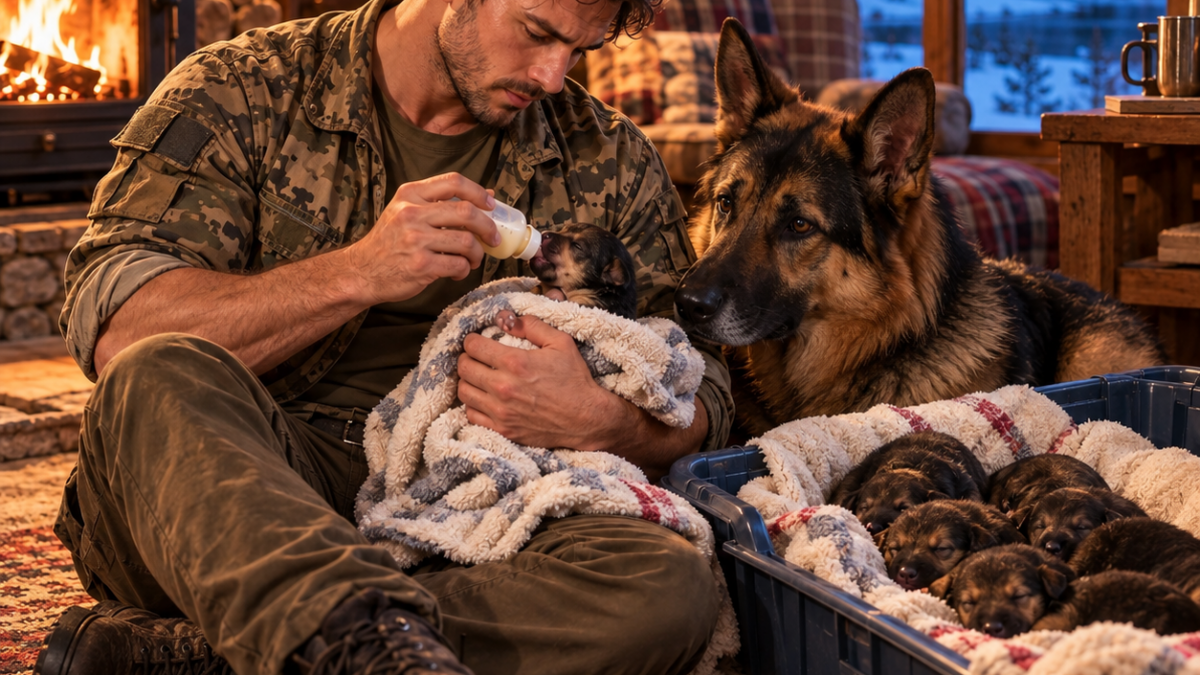
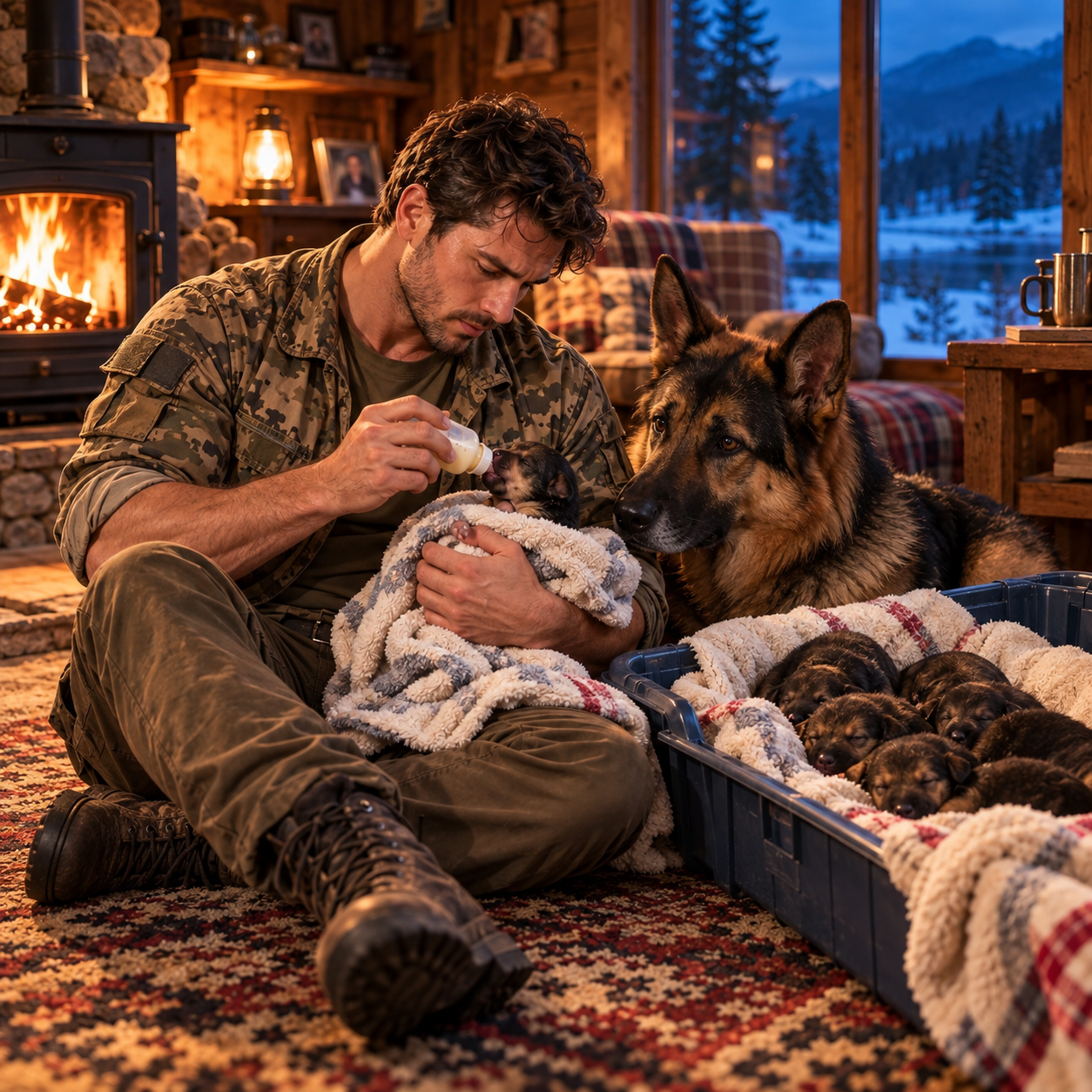
Inside, five puppies lay in a laundry basket lined with towels warm from the dryer.
The heating pad sat beneath one side only, per Mara’s instructions.
The formula can stood open on the counter.
A notebook lay beside it, the first page divided into columns by Anson’s ruler straight lines.
Time, puppy. amount, notes. He had not written names yet.
Names were dangerous. Names made room in the heart. Rook settled beside the basket, lowering his old body with a groan that sounded theatrical enough to earn him a look.
You volunteered, Anson said. Rook blinked slowly. The first feeding was chaos.
One puppy latched too eagerly and sneezed formula onto Anson’s thumb.
Another refused the bottle and complained in a voice too small to be taken seriously, but too determined to ignore. The third fell asleep halfway through.
The fourth somehow managed to get formula on Anson’s sleeve, the towel, and Rook’s paw.
Rook looked personally betrayed. Anson muttered an apology to the dog, then to the puppy, then to Lena, though he had not meant to say her name aloud.
The cabin seemed to hear it. Lena. For a moment, the room filled with her absence, the way a church fills with organ music.
Anson could almost see her leaning in the doorway, arms folded, smiling at the sight of him losing a battle to five creatures no bigger than work gloves. She would have laughed.
Not unkindly. Never unkindly.
She would have said, Anson Pike, you can swim through black water, but you can’t feed a puppy without redecorating the kitchen.
And he would have pretended not to smile. The clock above the stove clicked toward midnight, then one, then three. Each alarm dragged him out of a shallow half-sleep.
Each time, he warmed formula, checked towels, fed them one by one, made notes with handwriting that grew worse by the hour. Milk dotted his camo sleeve. His beard looked rougher.
His eyes burned. Once, he caught himself rocking slightly while holding the smallest puppy against his palm. He stopped when he noticed.
Then, slowly, he started again. Rook watched from beside the basket.
solemn as a guardian, carved over an ancient gate. Now and then his tail thumped once, just enough to remind Anson he was not alone in the watch. At 3.
17 in the morning, after the weakest puppy finally swallowed a little more than before, Anson sat at the kitchen table with the tiny body cupped in both hands. The cabin was quiet, except for the old refrigerator, the clock, and the soft breathing from the laundry basket. Anson looked down at the puppy.
You don’t know me, he whispered.
That’s probably in your favor.
The puppy stirred. He thought of Hattie asleep in Knoxville.
Six years old now. Old enough to draw suns in the corners of every picture.
Old enough to ask why he always stood up when she climbed into his lap. Old enough, soon, to stop asking.
The thought struck deeper than he expected. Anson bowed his head.
Outside, the swollen Tennessee River moved through the dark, carrying branches, mud. and the last of the storm toward someplace beyond his knowing.
Inside, under the yellow kitchen light, a former Navy SEAL sat with formula drying on his sleeve and a puppy no heavier than regret warming in his hands. He had arrived too late once.
The world had never let him forget it. But tonight, five small lives had come to him through floodwater and debris, asking for nothing grand.
No speeches, no medals. No promises a man could not keep.
Only warmth. Only milk. Only that when the clock rang, someone would rise.
Anson looked at Rook. The old German shepherd lifted his silvered muzzle, eyes calm as lanterns on a riverbank. All right, Anson said softly.
We stay. And when the next alarm sounded, he did.
By the third morning, Anson Pike no longer measured time by sunrise. He measured it by alarms.
Two o’clock.
Four o’clock.
Six. Warm the formula.
Check the towels. Weigh the smallest one.
Write it down. Change the bedding.
Rub tiny bellies with a warm cloth the way Dr. Mara had shown him.
Listen for any breath that sounded thinner than it should. The old kitchen clock still hung above the stove, but it had become mostly decorative, like a saint in a chapel nobody prayed to anymore.
The real ruler of the house was Anson’s phone.
shrilling every two hours from the scarred table, dragging him out of whatever shallow sleep he had fallen into. Rook hated the alarm.
The old German shepherd had developed a habit of opening one eye at the first note, staring at Anson as if the man himself had invented suffering, then sighing with the dignity of a retired judge forced to attend a children’s piano recital.
You filed the complaint yesterday, Anson told him at four in the morning. Rook blinked.
Still, he rose every time. He would lumber over to the laundry basket, lower his silvered muzzle, and count the puppies in his own quiet way. River, the loudest one, always found his voice first.
June, with the small pale flare at her chest, rooted patiently until the bottle came. Milo took to feeding with the seriousness of a man paid by the ounce.
Ash, the quiet one. preferred to press against warmth before eating, as if he needed to be convinced the world was still there. The fifth puppy remained unnamed, smallest, darkest, a pale dot beneath the chin.
Anson wrote small one in the notebook, because writing anything else felt like opening a door. The first page of the notebook had looked neat and military straight, columns, times, amounts, notes.
By the third day, his handwriting sagged like a fence after rain. Formula stains puckered the paper.
One corner bore the faint print of a puppy paw, earned during the six o’clock feeding when Milo had declared himself an explorer and stepped directly into the notebook.
Anson had almost cursed. Then he had laughed.
It startled him so badly he stopped mid-sound. Rook raised his head.
What? Anson muttered. He compromised official documentation.
Rook gave a single tail thump, which was not agreement so much as tolerance. Outside, the Tennessee River slowly returned to itself.
The floodwater pulled back from the banks in brown ribbons, leaving driftwood along the brush and mud shining on the low grass. Cumberland Locke still groaned with work. Barges waited.
Radio calls crackled. Gates moved with their deep iron patience. anson reported for his shifts with formula on his sleeve and sleep under his eyes then came home to the small kingdom of towels bottles and soft blind mouths he told himself this was temporary a few nights Maybe a week.
Someone else would take them soon. Someone better built for needing and being needed.
On Saturday afternoon, a car pulled into the wet gravel drive. Rook heard it before Anson did. The old dog rose from beside the basket, not quickly, but with purpose.
His ears lifted. His tail did not wag yet.
Anson looked through the kitchen window.
Maribel Keene’s gray sedan sat under the tulip poplar.
its tires carrying Knoxville road dust and spring mud. Maribel stepped out first, closing the door with careful restraint, as if even a car door could become an argument if handled too sharply.
She wore a navy coat and a pale scarf. Her silver blonde hair shaped neatly around her face.
Grief had not made her fragile. It had made her polished, like a stone worn smooth by a river that never apologized. The back door opened.
Hattie climbed out in a yellow raincoat, bright enough to shame the whole gray yard. She was six, small and serious, with honey-blonde hair tied slightly crooked and a face that held Lena in soft pieces.
The curve of her cheek, the blue-gray eyes, the habit of looking at a thing as if it might answer if treated kindly. Anson wiped his hands on a towel.
For one heartbeat, he was back in the hospital again. looking at a child who belonged to him and somehow seemed safer across the room.
Then Hattie saw Rook through the window. Her face changed, not into wild excitement. Hattie was not a wild child.
Her joy arrived like sunlight entering a room that had forgotten windows existed. Rook, she said when Anson opened the door.
The old German shepherd stepped onto the porch and lowered his head. Hattie wrapped both arms around his neck, burying her fingers in the thick fur behind his ears. Rook leaned his silver muzzle into her shoulder with a softness he reserved for very few people.
Anson stood aside. Hey, Bug, he said. Hattie looked up at him.
Hi, Daddy. The word always landed gently. That was the problem.
Maribel came up the steps behind her, carrying a small overnight bag, even though Hattie was not staying the night. Maribel always packed as if weather, hunger, boredom, and sorrow might all arrive uninvited.
Anson, she said. Maribel. There was no hug.
There had not been one in years. Not because either of them had forbidden it aloud, but because some doors, once closed quietly enough times, became walls.
Hattie stepped into the cabin and stopped. The laundry basket sat near the stove. Warm towels piled like a nest.
Five small bodies shifted inside, making squeaks so soft they barely qualified as sound.
Hattie’s mouth opened.
Oh, she whispered. Anson moved closer, ready with instructions.
Don’t touch too quickly.
Wash hands first. Sit down. Be careful.
They’re fragile.
But the words caught behind his teeth when he saw her face. Children, he had learned, could look at small, helpless things without flinching from what they required. Adults looked and saw work, risk, heartbreak, liability All the paperwork of fear.
Hattie only saw lives. Are they puppies? she asked.
Yes.
They’re so little.
They’re young.
Do they have a mom?
Anson felt Maribel’s gaze shift to him.
That question had weight. Not because of dogs.
Because every motherless thing in that room cast a shadow larger than itself. He crouched beside Hattie, though not too close.
even after six years he measured the distance between them like a man approaching a sleeping bird we haven’t found their mother he said carefully they were in a crate by the lock after the flood hattie looked into the basket River pushed blindly against June.
Milo yawned with absurd drama. Ash burrowed under the edge of a towel. The smallest one lay apart, breathing in tiny, visible efforts.
So who takes care of them? Hattie asked. Anson swallowed.
For now, he said. I do.
Rook settled beside Hattie as if to add his name to the duty roster. Hattie considered this. Then she looked at the smallest puppy.
That one is Pip. Anson blinked.
Pip? Yes.
Why Pip?
Because he’s tiny like a pip sound, like a baby bird in an angel’s pocket.
For a second, nobody spoke. Then Anson laughed. It was not a large laugh.
It came out rough and surprised, like an old hinge moving after years of rust. River startled at the sound and sneezed, a minuscule burst of outrage that made Hattie giggle and made Rook lift one paw as if reconsidering his faith in the household.
Maribel watched from near the doorway. Her face softened, then tightened again because softness was dangerous. Softness had once been Lena laughing in a kitchen, Lena dancing barefoot with a dish towel over one shoulder.
Lena telling Anson he would be a wonderful father because a man who spoke gently to old dogs could learn to speak gently to babies. Softness had not saved her.
Hattie reached toward the basket, then stopped and looked at Anson for permission. That undid him more than if she had grabbed recklessly.
Wash hands first, he said. She marched to the sink with great ceremony.
Anson helped her with the soap pump. Their hands almost touched.
His hand moved back before hers could rest against it. Maribel saw. She always saw.
When Hattie returned, Anson placed a towel across her lap and lifted Pip with both hands. He guided the tiny puppy into the valley of the towel.
Not into Hattie’s bare hands, careful to make it safe without making her feel untrusted.
Hattie stared down at Pip as if entrusted with a moon. He needs a crown, she said.
He needs about half an ounce of formula. After that, a crown.
Noted. You have to write his name in the book. Anson looked toward the notebook on the table.
The small one. That was what he had written.
A description, not a welcome.
He’s not official?
Hattie asked.
He’s fragile.
So? Anson had no answer ready for that.
Hattie stroked the towel beside Pip, not touching him directly.
If he has a name, he’ll know where to come back when he gets lost.
The cabin changed then. Not visibly.
The walls did not move. The rain did not stop ticking from the gutters. The river did not reverse its course.
But something inside Anson shifted one inch toward the light. He stood, crossed to the table, took the pen, and opened the notebook.
Under the next feeding line, he crossed out, small one. He wrote, Pip.
The name looked impossibly small on the page. It also looked like a promise he had not meant to make.
Maribel turned toward the window, pretending to study the yard. For the next hour, the cabin became awkwardly alive. Hattie drew stars on a sheet of paper for each puppy.
River got a wobbly blue star because he was loud like water. June received a yellow star with too many points.
Milo’s star was round, which Hattie insisted made sense.
Ashes was gray because quiet is a color. Pips was a green pea wearing a crown. Rook lay beside her chair, and twice his tail swept crayons off the table.
Hattie accused him of sabotage. Rook accepted the accusation with the grave silence of an innocent man framed by circumstance.
Anson made coffee for Maribel. She accepted it with both hands but did not sit right away. You look tired, she said.
I am.
That schedule can’t be good for you.
It’s not about me.
Maribel’s mouth moved slightly.
Not a smile. Not pain. Something between.
That sounds like something Lena would have said when she was about to do something stubborn. Anson looked down at his coffee.
Hearing Lena’s name from Maribel always felt like standing barefoot on church glass.
Beautiful in color. Sharp underneath. She was better at stubborn, he said.
She had more practice. For the first time that afternoon, the air between them did not feel entirely locked.
Then Hattie called from the floor, Daddy, Rook is eating the kingdom. Rook was not eating the kingdom.
Rook had placed one paw on the corner of Hattie’s chart and was pinning down June’s star with the full authority of age.
Rook, Anson said, release the kingdom. Hattie laughed so hard she had to hold her stomach. The sound entered the cabin and did not ask permission to stay.
Anson felt it move through rooms where silence had been nesting for years. It touched the sink.
The table, the old photographs turned face down in a drawer, the hallway where Lena’s rain boots still sat because he had never found the courage to move them.
Maribel looked at her granddaughter, then at Anson. The worry in her eyes remained.
But underneath it, something else flickered. A question, perhaps. Or the first thin edge of doubt about the story she had told herself.
That Anson’s house had become only a place of ghosts.
When it was time for Hattie to leave, she gave instructions as if transferring command of a small, unstable nation. Pip eats slow.
Don’t rush him.
Yes, ma’am.
River sneezes when you laugh, so maybe don’t laugh with the bottle.
I’ll control myself.
Milo is greedy. Documented. Ash likes Rook.
Most people do. And June needs a prettier star next time.
I’ll file the complaint with the artist.
She frowned. Daddy.
He held up one hand. Serious. Got it.
At the door, Hattie hesitated. For a moment, Anson thought she would hug him.
His body prepared the way it always did, not for impact, but for tenderness, which somehow frightened him more. Instead, Hattie reached into her pocket and handed him a folded piece of paper. For Pip, she said.
After she and Maribel drove away, Anson opened it. Inside was a drawing of a very small puppy wearing a crooked crown.
Above it, in Hattie’s careful, uneven letters, she had written, Pip has to remember his name.
Anson stood on the porch until the gray sedan disappeared down the road. Rook leaned against his leg.
She’s bossy, Anson said.
Rook’s tail moved once.
She gets it from her mother. That night, Hattie called before bed.
Maribel’s phone shook slightly in the little girl’s hands, giving Anson a view of one eye, half her forehead, and a ceiling fan.
Did Pip eat? she asked.
He did. How much? Anson checked the notebook.
A little more than last time. Read his name. What?
Read it from the book. Anson turned the phone toward the notebook.
Pip, no, you read it. He cleared his throat.
Pip, he said. Hattie smiled, satisfied, as if a law had been passed.
Over the next few days, her calls became part of the schedule. Not every two hours, but every evening. She asked for reports.
She corrected his bottle angle based on what she believed she saw through the screen.
She informed him that Pip’s crown should not be too heavy because royalty can get tired.
The house, against Anson’s will and better judgment, began to expect her voice.
Then Dwayne Tully came to Cumberland Lock. He arrived late on a cloudy afternoon when the river had lowered but still carried streaks of storm brown beneath the surface. Anson was checking a maintenance panel near the service office when a white pickup rolled into the lot and stopped too neatly between two muddy tire tracks.
The man who stepped out wore a clean beige field jacket, a pale blue shirt, brown chinos, and shoes that had somehow avoided the worst of the ground. He was in his mid-forties, narrow-faced, with slicked-back blonde-brown hair and a smile polished thin enough to cut paper.
Mr. Pike, he called.
Anson turned. Rook, who had been lying in the shade beside the office door, lifted his head.
That’s right.
Dwayne Tully. The man extended a hand. I represent Bright Mercy Animal Rescue in a recovery matter.
Anson looked at the hand, then shook it once.
Duane’s palm was dry.
Too dry, somehow. I understand you located a crate of juvenile dogs after the flooding, Duane said.
Anson’s face did not change.
Who told you that? Small towns are efficient, Dwayne smiled.
And transport incidents generate paperwork. He opened a black leather folder and removed several printed pages clipped together.
These animals were part of a lawful transfer. There was a mishap during route coordination.
They are property under a rescue transfer agreement, and I’m authorized to retrieve them.
Property, Anson repeated.
Dwayne’s smile flickered.
Animals, of course. I only mean in the legal sense. Rook stood.
Not fast. Not threatening.
He simply rose, old bones and all, and came to stand near Anson’s left side.
Duane glanced at him, then back at the papers. The agreement is quite clear, he continued.
If you’re holding the animals, even with good intentions, you may be creating liability for yourself.
Veterinary costs. Improper possession. Possible interference with transfer.
Nobody wants this to become expensive. Anson took the papers but did not lower his eyes yet.
You have identification?
Duane’s smile thinned further.
All relevant documents are there.
That wasn’t what I asked.
A pause. From the river came the deep metallic groan of a lock gate moving somewhere down the line, slow and ancient as a giant turning in sleep. Dwayne reached into his jacket and produced a business card.
It bore his name, a phone number, and the words, Transfer Recovery Consultant. No license number. No agency seal.
Anson slipped it behind the papers.
I’ll verify this, he said.
I’m afraid time is a factor.
It usually is when papers are thin.
For the first time, something unpolished moved across Dwayne’s face.
I’d caution you against making this personal.
Mr. Pike.
Anson looked at him then, fully. There were many things he could have said. Things from old training.
Things from old grief. Things a man says when another man assumes politeness means weakness. Instead, he folded the papers once and held them against his side.
No animal leaves my custody until Dr. Whitcomb verifies the condition, and the rescue claim is confirmed.
if the paperwork is valid you’ll hear from the proper people duane’s eyes slid toward rook the old dog stood still silent amber eyes fixed on him no growl no raised lip nothing that could be called aggression Only a patience that made dishonesty uncomfortable.
Duane looked away first.
I’ll expect contact within 48 hours, he said.
Anson nodded once. Duane returned to his truck, shoes still too clean, smile gone from the back of his head, even if it returned before he turned around. When the pickup left, Rook sat down.
Anson looked at the folder in his hand. Bright Mercy Animal Rescue.
The name sounded soft.
almost holy but anson had learned long ago that soft names could cover hard things that night the house seemed to listen differently at two a m the alarm rang anson rose from the chair where he had drifted off the papers from duane still on the table beneath hattie’s drawing the crowned puppy stared up from the page brave in green crayon rook followed him to the basket river stirred june tucked her nose into a towel milo gave a demanding squeak
Ash slept against Rook’s paw.
Pip lay small and warm in the fold of the blanket. Anson lifted him carefully, settled into the kitchen chair, and angled the bottle the way Mara had taught him and Hattie had inspected by video. Outside, the Tennessee River moved through the darkness, carrying moonlight in broken pieces.
inside a man who still could not hold his daughter longer than a few minutes held a puppy named by her hand and fed him one drop at a time the formula warmed the glass bottle pip’s mouth worked slowly Rook lay beside Anson’s boot, steady as an oath.
Anson looked at Hattie’s drawing again.
Pip has to remember his name. Yeah, he whispered.
The puppy swallowed.
Anson touched one finger lightly to the pale dot beneath Pip’s chin.
You remember it, he said. I will too. The blue crate sat upside down on the workbench in the lock maintenance shed, looking less like evidence than like something the river had chewed and spat back out.
Mud had dried along its corners in hard brown scales. A few strands of river grass clung to the handle. The lid, now leaning against a toolbox, still carried the sour smell of flood water and damp cloth.
under the harsh fluorescent light the crate seemed smaller than anson remembered that bothered him when he had pulled it from the debris at cumberland lock it had felt large enough to hold the whole weight of the morning Five lives. One impossible sound.
Rook’s sharp stare.
His own hands moving before his mind could protest. Now it was only plastic.
Plastic, mud, tape, scratches. And maybe a lie.
Anson stood over it, with Duane Tully’s papers folded in the pocket of his desert camouflage field shirt.
He had not slept much. The two-hour feeding schedule had turned time into chopped firewood, stacked in uneven piles across the day.
his eyes felt gritty formula had left a pale stain near his cuff the brass keys at his belt hung silent for once as if even they understood this was not a moment for noise rooke lay near the open shed door his old body stretched across a patch of sun The German shepherd’s silver muzzle rested on his paws, but his eyes followed every movement Anson made.
You think the crate is going to confess? Anson asked.
Rook blinked once.
That’s helpful.
The dog thumped his tail without lifting his head. Anson turned the crate slowly.
If Duane’s claim was true, the crate should have supported it.
A lawful rescue transfer. A transport mishap. Animals misplaced in the confusion after flooding.
It sounded tidy when spoken by a man in clean shoes. But rivers were not tidy. Neither were lies.
Anson took a putty knife from the bench and scraped carefully at the dried mud beneath the crate’s bottom rim.
He worked slowly, not wanting to damage anything that might matter later. Beneath the crusted dirt, a strip of clear industrial tape appeared, clouded with water stains.
At first he thought it was just packing tape, but then he noticed the straight edge of something under it. A plastic shipping pouch.
It had been tucked low, partly hidden beneath the crate’s bottom lip, the kind of place a man might miss if he looked only where the world expected labels to be.
Anson leaned closer. The pouch had taken water.
The paper inside had swollen and blurred, but several lines remained readable. Not whole answers.
Fragments. Enough to make the air in the shed tighten. A routing code.
The name of a federal pet transport company. A few final digits of a shipment number.
And one state of origin. Missouri. Anson set the putty knife down.
Outside, a towboat horn sounded on the river, low and long. Rook lifted his head. Missouri was not impossible.
Dogs were transported across states all the time.
but nothing in Duane’s papers had mentioned Missouri.
Bright Mercy Animal Rescue was supposedly local.
Duane’s story had been dressed in Tennessee mud, small-town urgency, and the soft language of animal welfare.
The label under the crate wore a different pair of boots. Anson took photographs from every angle, then again with a ruler beside the pouch. He wrote the visible letters and numbers in his notebook, careful not to guess at the missing parts.
Guessing was how men turned thin evidence into stories that pleased them. Anson did not want a pleasing story. He wanted the true one.
By late morning, he had the crate wrapped in a clean tarp in the back of his truck, and the five puppies settled in a warmed carrier on the passenger floor. Rook rode in the back seat, offended but watchful. River squeaked twice on the drive.
Milo complained louder. June slept.
Ash pressed into the towel. Pip lay smallest of all, wrapped in the corner Hattie had marked with a green thread from one of her drawings.
Dr. Mara Whitcomb was waiting at her clinic when Anson arrived.
She had the expression of a woman who had already had two emergencies, one bad cup of coffee, and no patience left for foolishness. Her teal scrub top had a tiny smear of something white near the pocket. Reading glasses hung from a cord around her neck.
You look worse, she said. Good morning to you, too.
I’ve seen better-looking men pulled from culverts.
Are they all right? Anson asked, nodding toward the carrier.
That’s a better question.

