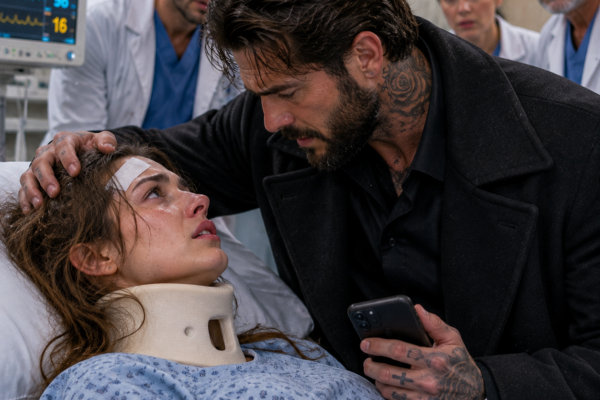
A Struggling ER Tech Smiled Once—The Mafia Boss Remembered Her When His Betrayal Was Exposed – Part 2

A few other people who had also sent somewhere they couldn’t leave until the work was done.
They took a booth in the back because Marcus required sightelines to the door, a fact Lily had simply accepted as part of the landscape of Adrienne’s existence the way you accepted weather.
She ordered eggs and coffee because it was the only combination that made sense for her body at this hour.
He ordered the same, which surprised her until she thought about it and decided it probably shouldn’t.
They talked about things she hadn’t expected to talk about.
He asked about Noah, not because he had information about Noah, which she would address shortly, but because she had mentioned him once when explaining why she’d left nursing school.
And Adrienne had apparently kept that and was curious now in the direct way that people with full power and no time for performance were curious specifically without decoration. She told him about the autoimmune diagnosis when Noah was 16.
The way it had reorganized everything, the timeline, the finances, the version of the future she’d been building carefully since their mother got sick.
She explained it without self-pity, which was the only way she knew how to explain it.
He’s doing well now.
She said his numbers have been stable since they adjusted the medication.
He’s at community college part-time.
Wants to go into physical therapy.
He’s 20.
20. Adrien turned his coffee cup. You were 22 when your mother died.
She went still. He had said it simply, not as a probe. the way you said a fact when it was relevant.
But it was a fact she had not told him, and the understanding arrived fully formed, not slowly, not gradually, but all at once, the way certain realizations preferred to arrive.
He knew because he’d looked.
She put her fork down.
“You ran a background check on me,” she said.
He did not look away.
“Yes, when after the first night, before I came back to the hospital.”
She sat with that for a moment. The eggs were getting cold.
She didn’t care about the eggs.
What did it include?
Standard financial picture, employment history, family, your mother’s death, the stepfather.
He paused at that word briefly in a way that told her the report had included things about the stepfather she had never mentioned to anyone in in a clinical setting.
Your education record, Noah’s diagnosis, the community college enrollment, my eviction.
Yes. She picked up her coffee and put it down again without drinking it.
So when you came back, she said, “You already knew about Noah, about nursing school, about the apartment.”
Her voice was even. She was keeping it even deliberately.
You walked into that consultation room knowing all of it.
“Yes, and you didn’t say so.”
“No, why not?”
he considered this.
“Because I needed to know what you would tell me without knowing what I already knew, whether the information would match.”
He held her gaze. It did.
That’s the investigative logic.
She said, “I understand the investigative logic.
I’m asking about the rest of it.”
The dinner. Asking about Noah. You already had the answers.
I had facts, he said, not answers. She looked at him.
I know your mother died and left you with a brother who needed care and a tuition you could no longer pay.
He said, “I don’t know what that felt like.
I don’t know what you gave up before the part that shows up in a report.”
He set his cup down.
Those aren’t the same thing.
The booth was very quiet. The late night restaurant sounds low music.
The sound of a conversation two tables over seemed very far away. Lily was not a person who cried at unexpected moments.
She had trained that out of herself a long time ago. Or maybe it had never been fully trained in.
But there was something in the precision of that distinction facts versus answers that touched something she hadn’t been keeping careful watch over.
she breathed.
“I don’t love that you did it,” she said.
“I know.
I understand why.”
In the context of She gestured vaguely at the situation, the shape of everything they were both sitting inside.
“I understand it.
I still don’t love it.
That’s fair.”
She picked up her fork. She ate some eggs that had gone slightly cold. Across the table, Adrienne waited with the particular patience of someone who had learned that some conversations needed room to land before they could continue.
The stepfather, she said finally flatly, because she wanted to know what he knew. What did the report say?
Financially volatile. Two civil suits both settled.
History of what the report called household instability. He paused.
I didn’t need more detail than that.
She nodded once slowly. Her mother had needed more. Her mother had needed more detail than that.
Her mother had needed it in the specific concrete unavoidable terms that came from living inside a situation until there was no more living to be done inside it. Lily had spent 3 years after the divorce. She was 12.
Her mother was finally out.
Noah was four and didn’t understand any of it watching her mother rebuild something functional out of what was left.
She had also watched her mother spend the last four years of her life in financial dependency on that rebuilt version of functional. And she had watched what happened when the person providing the stability pulled back. And she understood in her body, not just her mind, what large, generous gestures from men who had more power than you looked like from the inside.
She also understood that the man across from her was not that man. The distance between understanding something and feeling safe inside the understanding was the space she was currently living in.
and she was not ready to explain all of that and she suspected she didn’t need to.
You need to tell me when you have information about me, she said.
Going forward, I don’t want to be in a conversation finding out after the fact what you already knew when it started.
Agreed, he said. No negotiation, no qualification.
She ate more eggs.
Tell me something I don’t know about you, she said.
He looked at her. You have a file on me, she said.
That’s not a balanced situation.
Something in his expression shifted not quite humor, but the shadow of it. The suggestion that in a different configuration of things, humor was possible. What do you want to know?
Something true that isn’t in a press release.
He was quiet for a moment. Then my mother calls me twice a week. Every Sunday morning and every Wednesday evening.
She has done this since I was 23 and moved out of her house. and and she will do it until one of us is no longer able to.
Lily hadn’t expected that one.
What do you talk about? She took, he said. I listen.
She is 78 years old and has opinions about everything and a memory for the details of other people’s lives that makes me look careless by comparison.
A pause. She would like you.
Lily didn’t know what to do with that either.
She filed it. Does she know?
Lily asked. What you do?
She has known since I was 19, he said.
She told me then that she wished I’d chosen differently.
She has not mentioned it since. He turned the coffee cup again.
She keeps the Sundays and Wednesdays anyway. The simplicity of it landed somewhere specific. Lily thought about her own mother, the two years of stable ground before the cancer.
The version of her mother who made her laugh on bad days and called on the way home from work just to talk. and the way that version had stayed exactly who she was even while everything around her was becoming something impossible. She sounds like someone who decided early what mattered and has been holding to it ever since.
Lily said. Yes, he said.
That’s exactly what she is.
She walked out into the Philadelphia night 20 minutes later.
Marcus at a discreet distance, the air cold enough to make her wish she’d grabbed a heavier jacket.
Adrienne walked with her the half block to the corner where she’d get her ride share.
They stood on the sidewalk and she thought about how strange it was the size of him. The tattoos that were just visible at the collar and cuffs in the streetlight. A sound like the very specific world that traveled with him like a weather system and how little of that what she was actually paying attention to when he was in front of her.
The investigation, she said. Is it getting somewhere?
Yes, he said slowly. Marcus told me there are questions about the route, about who changed it.
There are. She watched his face.
The jaw tension was back different from the tension in the consultation room when he’d seen Caruso’s photograph.
More internal, more like something he was protecting himself from looking at directly. You think you know who it is?
She said.
He didn’t answer.
You don’t want it to be true, she said.
Still nothing. Adrien, he looked at her.
Be careful with that, she said.
Whatever you want the answer to be, be careful that it doesn’t change what you’re looking at.
He was quiet for a long moment, long enough that she thought he wasn’t going to respond.
Then the evidence points toward Marcus. She heard it and let it settle. Marcus, who was standing 40 ft behind them.
Marcus, who had answered her phone call and set up the meeting and had treated her consistently with the kind of grim professional respect that she’d found oddly reassuring.
Marcus, whose job was to keep Adrien alive, and who had, if the evidence held, done the exact opposite.
“You don’t think it’s him,” she said.
“I don’t know what I think.”
“Yes, you do,” she said.
“Otherwise, you would have already acted.”
He looked at her. Something in the look had a quality of recalibration like a man who was used to being the most observant person in most rooms and had just encountered evidence suggesting he might not be.
I need to look at this again. She said the timeline from that night.
There’s some She shook her head.
I’ve been trying to remember something.
The sequence when Marcus’s men were in the corridor when Caruso arrived.
I need to think about the order of it. Take the time you need. He said her ride was pulling up.
She reached for the door handle, then stopped.
The report, she said, “When you had me investigated,” she turned back to look at him.
“What did you expect to find?”
He considered this with a seriousness she appreciated, not reaching for a flattering answer, just actually thinking about it.
“Someone with leverage,” he said.
“Someone placed there.
Someone whose memory was convenient at exactly the wrong time.
And instead instead he said, “I found someone who had spent 6 years making everything work on not enough, who remembered a stranger’s face because she was paying attention and who smiled at herself in a hospital corridor on the worst financial night she’d had in a year.
” Lily held very still, the taxi idled at the curb.
“You understood what that smile was,” she said.
“Yes,” he said from the beginning she got in the car.
She looked straight ahead all the way home.
By the time she was inside the Kensington apartment, Noah’s sneakers by the door, the kitchen light left on the way he always left it.
She had turned the timeline over in her mind four full times and landed on the thing that had been bothering her without her being able to name it. The route change. Marcus changed the route.
His authorization was in the transport log, but the construction zone detourred the physical manipulation that redirected Adrienne’s vehicle that had to have been set up in advance before the route was changed, before Marcus had made any decision at all.
Which meant Marcus changed the route after someone had already set the trap. And if the trap was already set, then whoever said it had anticipated a possible route change and covered for it, which meant the route change had been used and that someone had known it was coming or engineered it. She sat on the edge of her bed.
Marcus didn’t set the trap.
Someone had used Marcus. Someone who knew Marcus well enough to predict or cause the specific decision Marcus made that night.
Someone close. She reached for her phone.
She typed Adrienne’s number and then held the phone and didn’t send it yet.
Because the thing that had just occurred to her, sitting in her not good apartment in Kensington with her brother’s light on in the kitchen, was that whoever had set this up well enough to use Marcus as an unwitting frame, had access to the kind of information that only someone inside
Adrienne’s closest circle would have, someone he trusted, someone he might even love in the way that people in his world had learned to love carefully.
and with one hand always near what you were protecting. She sent the message.
I think Marcus is innocent. I need to show you the sequence.
When can we talk? She put the phone down. It buzzed 40 seconds later.
Tomorrow morning, I’ll send the address.
Then, after a pause of about 30 seconds. Are you all right?
She looked at that for a while. The question was so simple it almost hurt.
Yes, she typed back. Go to sleep, she added.
His reply was a single period. She was not sure what it meant.
She thought it might mean “All right, but I’m glad you’re there.”
She turned off the light and lay in the dark and listened to the city outside and the specific quiet of a place that was hers. How however small and poorly lit and far from anywhere comfortable.
She was not all right exactly, but she was going to figure this out. That was close enough.
The address sent was a rowhouse in South Philly, not the financial district office. No lobby, no elevator, no men in the corridors, just a narrow street and a door opened before she knocked, which meant someone had been watching the block, which she had decided to simply be accept of the situation the way she accepted that the coffee at the hospital was never going to improve.
Inside was a kitchen table and a laptop, and printed documents spread in an order that suggested someone had been at this since before she woke up. Adrien was standing at the table.
He looked like he hadn’t slept, which put them on even footing.
“Show me the sequence,” he said without preamble.
She set down her bag and pulled out the notes she’d written at 2:00 in the morning on the back of a CVS receipt because it was the only paper she could find.
5 years of OVR work had given her a very specific relationship with documentation, the habit of recording timestamps without thinking about it. Not because protocol required it in every moment. But because time was the variable that answered most questions, she laid it out.
The construction zone detour had required physical setup cones, a rerouted lane, a secondary vehicle position to force Adrienne’s driver left.
That took time, 30 minutes minimum, more likely 45 to an hour of on-site work before Adrienne’s vehicle reached the zone.
She had looked up the route on her phone and estimated the logistics and written the numbers down.
Marcus’ route change was logged at 9:47 p.
m.
The construction redirect, based on the news reports description of the scene and the responding officer’s quoted arrival time, had to have been in place no later than 9:30.
He changed the route 17 minutes after the trap was already set, she said. At minimum, she watched Adrien read the numbers.
He was still, but not the same kind of still he’d been in the consultation room.
This was the stillness of someone absorbing something they’d partly already known and had needed someone else to confirm before they could trust themselves to act on it.
Marcus across the kitchen said nothing. His expression did not change. Someone fed him the route adjustment, Lily continued.
Someone who knew Marcus well enough, someone who knew Marcus to know what decision he’d make when he received a certain kind of information.
The route change wasn’t the plan.
It was window dressing, she paused. It was meant to be found.
Adrienne set down the papers. They needed a suspect already inside, Marcus says quietly.
First time he’d spoken.
His voice was even.
But something beneath it had the quality of a man who had spent weeks under the weight of other people’s suspicion and had just been handed back something he’d stopped expecting to get.
If I went down for this, the investigation stays internal, contained.
And you couldn’t disprove your own authorization, Lily said.
Because it was real. You did change the route.
You just didn’t know why you were doing it.
The room held that for a moment. Adrienne turned and looked at her.
She had known intellectually that clearing Marcus would matter to him. She had not anticipated the specific quality of what moved across his face, not relief exactly, but something older.
The thing that happened when a man discovered he had not been betrayed by the person he most feared had betrayed him. Thank you, he said.
Don’t, she said.
I just looked at the numbers. Lily, I mean it.
It’s not.
She stopped because he was still looking at her in that way and the kitchen was small and Marcus was pretending to study the wall.
You’re welcome, she said more quietly.
I’m glad I could see it.
Marcus to the wall said so am I.
The next three weeks were by any reasonable measure the most functional stretch of Lily’s life since she’d left nursing school.
The investigation had a new direction. Marcus had a new purpose.
The weight of the framing lifted off the investigation. Like a lid coming up something that had been sealed too long.
And suddenly there were avenues that had been blocked by the assumption of Marcus’ guilt that now opened back up.
Lily’s involvement was minimal by design.
Adrienne had kept his word about that much. Occasional calls, occasional questions, nothing that followed her into the ER or waited outside the hospital. And Adrien himself, she kept trying to find the word for what was happening between them and kept landing on something approximate.
A sound, not a relationship. The shape of the word was too settled for what they were, which was two people who had started as accident and were becoming something more deliberate without either of them having made a formal decision about it. Coffee twice more.
A late walk after her Thursday shift, the kind of walk that goes longer than either person planned because neither one calls an end to it. A phone call on a Sunday afternoon about nothing specific.
she had called him actually because she’d been sitting alone in the Kensington kitchen while Noah was at the library and a story on on the radio had mentioned the East Coast port negotiations and she’d thought without planning to think it, “I wonder what he thinks about that.
” She’d called before she could talk herself out of it.
He had opinions about the port negotiations, specific informed ones that surprised her with their complexity and then stopped surprising her because she was accumulating without meaning to an understanding that this man’s intelligence was not decorative.
He asked about her week.
She told him about the shift Wednesday, the elderly woman who’d arrived alone again, the same one from before, same chest pressure.
This time it was real, and how they’d gotten her stabilized.
And how Dr.
Brooks had held the woman’s hand while they waited on the cardiologist, a thing Lily had watched and thought, “That’s the part I want to do.
” The medicine and the handholding together, not just one.
“You should go back to school,” Adrienne said.
“I’m aware,” she said.
“Have you looked at the cost recently?”
“Yes, and and I’m working on it.”
She shifted the phone.
“I have a plan.”
It’s the plan.
The plan is I work more shifts. I put aside what I can. I apply for every grant and scholarship that exists, and I start part-time in the fall if the numbers hold.
She said it simply, not defensively. It was a real plan. It was a plan she had made herself.
It’ll take longer than if I just, she stopped.
If you had help, he said, “Then the fastest possible version,” she corrected.
“But I didn’t start this by asking anyone for help, and I’m not going to.”
He was quiet for a moment.
“I understand,” he said.
she had believed him.
The email arrived on a Tuesday, 3 days later, she was on her lunch break, sitting in the staff room with a sandwich she’d been eating in installments between patients.
When her phone showed a notification from Philadelphia Allied Nursing College, the program she’d applied to, the ones that accepted rolling part-time enrollment, the one whose tuition had gone up 14% since she’d last checked.
She opened it expecting a confirmation of her application status which she’d been waiting on.
Instead, it was a payment confirmation, full tuition.
First two years, paid in full by an anonymous donor via a private trust that the registars’s office had confirmed and thanked her for.
Lily read the email once, then read it again, slowly parsing each sentence the way she parsed an unusual set of vitals methodically, looking for the detail that changed everything. Anonymous doser, she put the sandwich down.
She sat with it for 2 minutes. Exactly. She whitched the clock, giving herself 2 minutes to feel whatever needed to be felt before she did anything.
What she felt was not surprise. What she felt was the particular complicated anger that came not from cruelty, but from someone doing something thoughtful in exactly the wrong way. The kind of anger that was harder to manage than simple anger because it required you to hold two things at once.
The fact that the intention was good and the fact that the effect was not. She picked up her phone.
She dialed Adrien directly. He answered on the second ring. Did you pay my tuition?
She said. A pause. one beat.
Enough of a pause that she had her answer before he spoke.
“Yes,” he said.
She pressed her palm flat against the breakroom table.
“You need to call the school,” she said, “and ask them to reverse it.”
“Lily, today, Adrien, I know you want to handle it yourself.”
“I know that his voice was careful, not combative.
That almost made it worse.”
The fact that he’d thought about it and done it anyway.
But I also know the numbers and I know what this would mean for your timeline.
and I know that the only reason you’re not already enrolled is money and I have money and that seemed sat me straightforward.
She said it seemed straightforward to you. Yes, because you were looking at a problem.
I was looking at a problem that I can solve. It is not your problem to solve.
She kept her voice level. The breakroom had two other people in it who had both become very interested in their food.
She didn’t care.
Do you understand the difference between seeing someone struggle and deciding to fix it because you can and asking someone whether they want to be fixed?
I You didn’t ask me.
I knew what you’d say.
Right.
She said, “You knew I’d say no, so you didn’t ask.”
A sound like green woodsplitting. The silence on the line had a specific quality.
Not the comfortable silences she’d started to get used to, but the kind that meant someone was encountering something they hadn’t fully prepared for.
I wanted to give you something, he said quietly. I know.
She closed her eyes for a second. I know you did.
That’s not the problem.
Then what is? She thought about how to say it.
She had been living with the answer to this question for most of her adult life, but she’d never had to put it in words for anyone because no one had ever had enough power to do exactly what Adrienne had just done.
“My stepfather used to pay my mother’s bills without her asking,” she said.
car payment, medical co-pays, he’d leave an envelope.
Grocery money, he was good at it. He remembered every amount. She paused.
And every 6 months or so, when something didn’t go his way, he’d sit down and remind her in detail what the list came to just so she understood the math.
The line was completely silent.
“I am not him,” Adrienne said.
He said it carefully, not angrily, not defensive, like a man who understood that careful was what this moment required.
I know you’re not, she said.
But you did the same thing. You solved my problem without my permission. And when I find out, which I always do, I am standing in a situation someone else arranged, which means the ground under my feet belongs to someone else, even if they never call in the debt.
She pressed her hand harder against the table.
I don’t want to stand anywhere that isn’t mine.
Another silence longer this time.
I’ll call the school, he said.
Thank you, Lily. He stopped, started again.
I understand why. I want you to know I understand why. She believed him.
She believed him completely, which was the part that made the next thing she had to say so hard to get out. I need a little distance for a while, she said. Not from the investigation.
That stays what it is, but the rest of it I need to step back. All right. Not forever.
I know. I just need to. She exhaled.
I need the ground to be mine again before I decide how much of it I want to share. He was quiet.
When he spoke, his voice was the same as always controlled, unhurried. But underneath it, there was something she had not heard in him before.
Something that had the texture of a man standing at the edge of something he’d already decided he wasn’t going to fight.
I won’t contact you, he said, unless it’s about the investigation.
Okay.
And the school I’ll handle the school, she said.
She ended the call. She sat in the breakroom with two people who were still extremely focused on their food, and she pressed her knuckles against her mouth for a moment, and then she stood up, put her phone in her pocket, and went back to work.
The nursing school called her 2 days later to inform her that the anonymous donation had been withdrawn per the donor’s request and that her application remained active and that she was welcome to submit her financial materials at any time.
She thanked the registar and hung up.
He hadn’t what meant that he’d called.
He hadn’t routed around her.
Hadn’t sent it again through another channel.
Hadn’t arranged a scholarship through a third party she couldn’t trace.
He had simply done the one thing she’d asked.
She sat with that. She did not call him. The investigation continued.
Marcus forwarded her two questions over the next week. She answered them and nothing more passed between them.
No different. No one noticed something was different.
He noticed the way he noticed everything sideways without making it a conversation by cooking dinner on a Thursday without being asked and leaving it on the stove and saying nothing about it.
She ate it and said, “Thank you.
” and he said, “Sure.”
And that was all. 3 weeks after the phone call, she got an email, not from Adrien, from the financial aid office at Philadelphia Allied, notifying her that her application for a need-based partial scholarship had been reviewed and approved.
A real scholarship, the kind that came from a board and a budget, and a pool of applicants that had nothing to do with a man in a dark coat and black and gray tattoos. She covered the rest from her own wages. The deposit was due in 2 weeks.
She could make it if she picked up one extra shift. She picked up the shift.
The day she paid the deposit herself, she sat at the kitchen table in Kensington with her laptop open and the confirmation on screen and Noah asleep in the other room, and she thought about what she’d said to Adrien.
I need the ground to be mine before I decide how much of it I want to share. She was thinking about sharing. That was new.
She picked up her phone. She opened a message to Marcus, not Adrien.
Not yet. She was not ready for yet.
And typed, “Is there anything new on the investigation I should know about?”
Marcus’ reply came within the minute.
“Yes, we need to talk.
Can you come in tomorrow?”
The person who set up Marcus is not who we expected. Mr.
Moretti says, “You should hear this directly.”
She typed, “I’ll be there at 10:00.”
She closed the laptop. Out outside, a siren moved down the street. police, not ambulance.
The pitch different, something she’d learned to distinguish without thinking about it the way she’d learned to distinguish heart rhythms, just from years of proximity.
It faded. The city went back to its ordinary noise.
Lily looked at the confirmation email, still opened on her screen. Her name, her enrollment, her deposit, hers. She thought about how Adrienne had not fought her, had not found a workaround, had heard no and accepted it completely in a way that she was only now beginning to understand was not as easy for him as it looked.
She thought about how that was not nothing.
She thought about the man’s photograph, Vincent Caruso, gray green eyes, and the frame around Marcus, and the thing Marcus’s message had just told her, not who we expected.
She had been operating under the assumption that the conspiracy traced outward from Adrien through people adjacent to him, through people with access, not who we expected. The only person that phrasing protected, the only answer that would make Marcus say it that way in that specific careful language was someone close enough to Adrien that finding it was still a wound even now, even after weeks of looking.
someone Adrienne trusted, someone inside. She thought about Julian Moretti.
She thought about the photograph associated with the shell company. She thought about Caruso thanking her by name and the specific chain of access that required.
And who in the Moretti organization had the financial sophistication to build a shell company and the personal proximity to know Marcus’ decision-making patterns well enough to use him as a frame.
and she thought about a dinner conversation she’d had with Adrien weeks ago.
Something he’d said about Julian in passing.
Just a sentence, just a fragment. Julian handles the money side of things.
He’s been doing it since before I took over.
She had not thought about it then. She was thinking about it now. Her phone was still in her hand.
She typed, “Tell Mr.
Moretti I already know who it is.
” She hesitated, then added, “And tell him I’m sorry.”
She put the phone down. She was not sorry it was discovered. She was sorry it was true.
Those were different things.
And she understood from the part of herself that had had spent years watching people absorb news that changed the architecture of everything they thought they’d known that there was a specific kind of grief that came from betrayal by someone you loved before you had reason not to.