An Old Woman Sold Her Dog for $5—What the Navy SEAL Did Changed Three Lives – Part 1
An Old Woman Sold Her Dog for $5—What the Navy SEAL Did Changed Three Lives
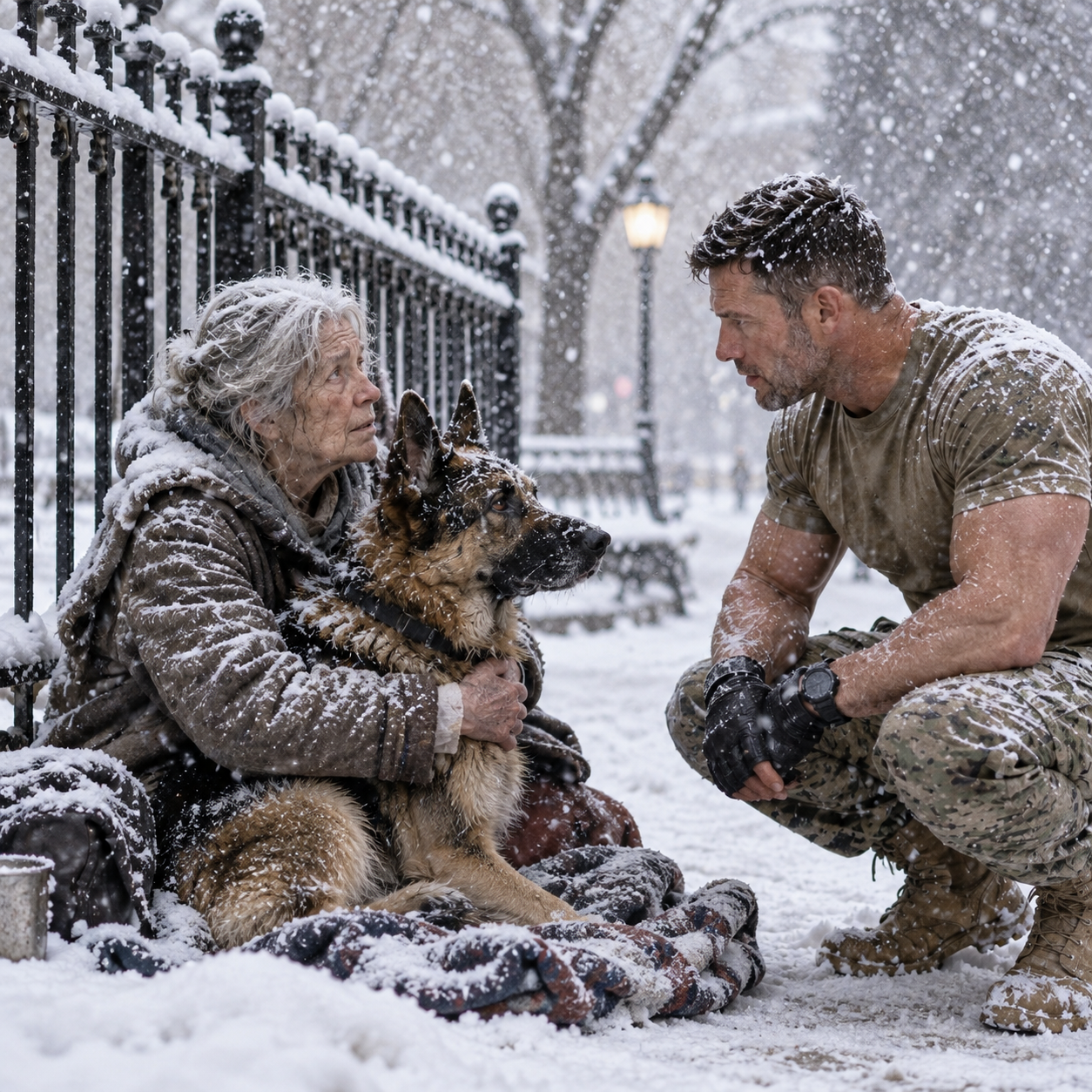
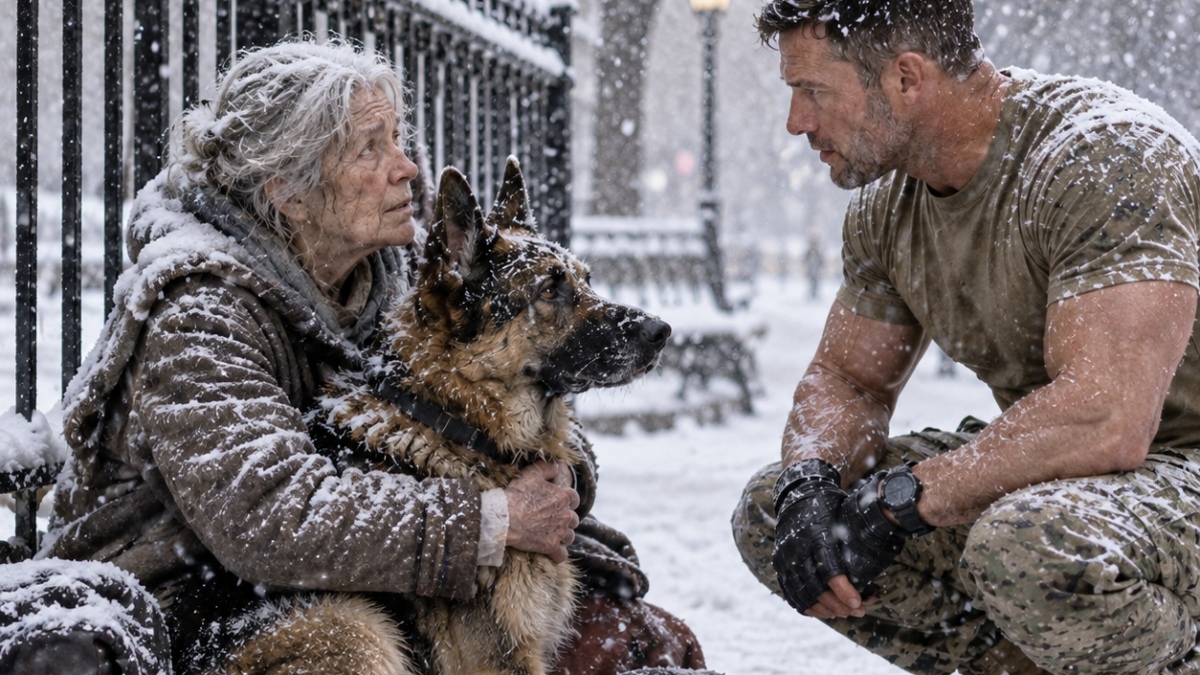
Years after a winter mission took his closest canine, former Navy Seal Nathan Cole was walking home through a duth white out when he saw an old woman under the bus depot awning holding a German Shepherd against the storm. A cardboard sign shook in her hands.
Dog for sale, $5. The dog rose before Nathan did, and the snow seemed to stop listening. Snow came down over Duth in heavy white sheets, thick enough to soften the hard edges of the bus depot, the pawn shop sign, and the line of parked cars slowly turning into rounded hills.
Lake Superior was only six blocks away. But that afternoon it felt close enough to breathe through the streets, sending a bitter wind up the avenues and under every coat that had dared to call itself warm.
Nathan Cole stepped out of Miller’s discount market with one paper sack against his chest and the other hooked in the crook of his elbow, careful not to let the milk crush the marked down bread.
At 41, he still moved like a man measuring distance without meaning to. Doorway to curb, curb to light pole, light pole to the narrow alley where snow collected in a waist high drift.
Some habits stayed after the uniform came off, even when there was no team behind him, no radio at his shoulder, no dog breathing beside his knee. He had been a Navy Seal once and a canine handler after that, which meant people sometimes expected the old stories to come out sounding sharp and glorious.
Nathan never told them that the sharp parts were mostly screams cut short by weather, and the glorious parts were usually a dog doing what men could not bear to ask of each other. His VA check had landed 3 days earlier.
Rent had swallowed most of it with the manners of a starving thing. The rest had become rice, beans, coffee, eggs, a small bottle of aspirin, and chicken thighs with a yellow sticker that said manager special. As if poverty sounded better when dressed like a sail, he tucked his chin into his field jacket and started toward the apartment building two blocks uphill from the tracks.
The snow squeaked under his boots. A city bus groaned at the stop near the old depot, its windows fogged, its wipers fighting a losing war.
Somewhere beyond the white air, a ship horn rolled low over the harbor. Nathan nearly missed the cardboard sign because the wind kept folding it against itself. It sat under the bus depot awning, waited at one corner by a cracked thermos, and held at the other by a gloved hand so thin the knuckles looked like pale stones.
Dog for sale, $5. The letters were written in blue marker that had begun to bleed where melted snow touched the cardboard.
Behind the sign, an elderly woman sat on a metal bench with her shoulders drawn tight, a burgundy wool coat buttoned wrong near the collar, a gray scarf wrapped twice around her neck, and snow gathered in her white hair like ash. Beside her, pressed close enough to share what little warmth remained, lay an old German Shepherd with a dark sable coat, a black saddle, and a silvered muzzle. The dog did not look for buyers.
He did not wag at the passing boots or whine at the cold. He watched. That was what made Nathan slow down.
A tired dog watched with fear. A hungry dog watched with hope. This one watched with responsibility.
Two young men stood too near the bench. The sort of too near that could be explained away if anyone asked and understood instantly by anyone who had ever been cornered.
One wore a puffy blue coat and clean work gloves. The other had a knit cap pulled low and a grin that kept trying to become laughter.
“$5,” the one in the cap said, leaning toward the sign.
“Ma’am, that leash worth more than the dog.”
The other laughed and nudged the cardboard with the toe of his boot.
“Maybe he comes with instructions like an old snowblower.
Pull twice and pray. The woman held the leash closer.
“Please do not touch him,” she said.
Her voice was polite.
“Too polite.
It had the old training of church basement and thank you notes in it.
The kind of politeness some people kept wearing even while the world used it against them.”
The German Shepherd lifted his head. Snow slid from the ridge of his back.
His ears rose, though the left one dipped at the tip, and Nathan saw the stiffness in the front leg when the dog gathered himself. Pain, then discipline. The dog stood anyway, slowly, carefully.
He moved between the woman and the men and lowered his head without bearing his teeth. No wasted threat, no theater, just a line drawn in cold air. Atlas, the woman whispered, one hand landing on his shoulder.
Her glove trembled. The man in the cap made a show of stepping back, then stepped forward again, enjoying the little circle of fear he had made.
Atlas, big name for a discount dog. Nathan stopped walking.
The paper sack creaked in his hands. For a moment, he told himself the same thing he had told himself for years when trouble appeared in public places. Keep moving.
Trouble belonged to the world, and the world had more of it than one tired man could carry. He had a cold apartment, a past due power bill, and knees that ate before storms.
He had no room for an old woman, a dog, or two fools who thought cruelty counted as entertainment if they kept their voices light. Then Atlas shifted his weight, favoring the injured leg, but stayed in front of her.
Nathan saw Ranger for half a second, not with his eyes.
Worse, he saw the black line of a canine’s back against snow, the lift of ears, the final choice a dog made because the man beside him had asked without speaking.
His hands tightened around the grocery bag until the bread flattened. The man in the blue coat reached toward the leash.
$5 means I can at least inspect the merchandise. Nathan set both bags in the snow beside a lamp post.
Nothing dramatic, just down. The eggs gave a soft clack inside the paper.
He walked toward the awning at a pace that did not invite argument and did not warn enough to be fair. The woman looked up first. Her face had the pale pinched look of someone who had been cold for hours and ashamed for longer.
Atlas turned his head a fraction, enough to register Nathan and dismiss him as not the immediate problem. Good dog, Nathan thought.
The young men did not notice him until he was already under the awning, snow melting on his shoulders.
That’s close enough, Nathan said.
His voice was quiet enough that the wind did not steal it. The man in the cap straightened, annoyed at being interrupted before his joke had finished becoming ugly. You buying him?
Nathan looked at the hand still hovering near the leash. No. The blue coat snorted.
Then maybe mind your business.
Nathan’s eyes moved from the man’s boots to his gloves to the phone clipped badly in his pocket.
He smelled cheap beer under winter green gum.
He heard the woman’s breath catch when the bus behind them hissed and pulled away.
The depot suddenly seemed emptier. The city muffled behind snow.
I said close enough, Nathan repeated. Atlas gave one low sound from deep in his chest.
Not loud, controlled. The old woman whispered his name again. More prayer than command.
The man in the cap looked from Atlas to Nathan, trying to decide which one made the better target. His grin thinned. Old soldier type, huh?
What are you going to do? Salute us to death.
Nathan did not move. I was hoping you were smarter than that.
The blue coat took a step closer and in the white blast coming through the open end of the awning, Nathan saw the moment before a bad choice became real. The wind shoved snow sideways through the bus depot awning, turning the space between Nathan and the two men into a pale, restless curtain.
Under the yellow depot light, every breath showed, rising and breaking apart before it could reach the roof. Nathan did not raise his hands. He had learned a long time ago that men looking for a fight often needed the other man to help them pretend they had found one by accident.
He gave them nothing useful. The man in the blue coat stopped a few feet from him, shoulders high, chin out, performing courage for his friend.
The one in the cap watched Nathan’s face and began to look less amused.
That one had better instincts. Not better character, but instincts would do in a pinch.
“You got a badge?”
Blue coat asked.
“No, then you got a problem.”
Nathan looked past him toward the corner of the depot where a black half-doome security camera sat beneath a crust of ice. Camera above the ticket window.
Another one outside the liquor store across the street. Bus driver saw you standing here when he pulled out.
If she asks you to back away and you keep crowding her, that is harassment of an elderly person in public. If you touch the leash, it gets uglier.
Blue coat blinked. Nobody liked hearing their stupid moment translated into paperwork.
The woman on the bench made a small sound. Not quite relief, not quite fear. Atlas stood without shifting, his silver muzzle pointed at the two men, his old body stiff from the cold, but his mind awake as fire.
Man, the one in the cap said, trying to laugh again and not quite reaching it. We were only talking.
Then talk from over there. Nathan nodded toward the snowbank near the curb. Plenty of room.
Whole city, actually.
Blue Coat’s eyes narrowed.
You always rescue strays.
Nathan’s jaw moved once, only when they stand in pairs, wearing gloves too clean for work.
The line landed strangely enough that the old woman looked down, and for one quick second, a smile tried to touch her mouth before shame chased it away. Blue Coat stepped forward again because Pride, once embarrassed, often tried to repair itself by becoming louder.
Atlas moved faster than Nathan expected. Not young dog fast, not clean, but decisive.
He put his injured leg down hard, lifted his head, and barked once. The sound cracked under the y awning, and bounced off the glass doors. A woman inside the depot turned from the vending machine.
The clerk behind the ticket window looked up. The man in the cap grabbed blue coat sleeve. Leave it.
I’m not scared of a grandpa dog.
Good, Nathan said. Then you will not mind leaving before he embarrasses you.
That did it. Not the warning, not the camera. The idea of being embarrassed by an old dog.
Blue coat’s face reened above his scarf.
And for one heated second, Nathan thought the man would swing.
Nathan measured the distance to the man’s wrist, the slick patch beneath his right boot, the metal edge of the bench.
He also saw the old woman’s hand tighten on Atlas’s collar, and he hated that she had to be ready for more.
The man in the cap understood the change in the room.
“Come on, Trevor,” he muttered.
“She’s not worth it.
The old woman flinched as if the words had touched skin.
Nathan’s eyes went to the man in the cap.
Say that again, and I will ask the clerk to save the audio, too. Silence.
The clerk had come out from behind the ticket window and stood with a phone in her hand, pretending to wipe the counter while missing every inch of it. Blue coat Trevor spat into the snow near the bench and backed away. Fine, keep the mud.
We know where she sleeps anyway. The other man gave him a hard look, but the sentence had already landed.
Nathan heard it. Atlas heard it. The old woman heard it in a way that made her shoulders fold inward.
The two men walked off into the snowfall, boots sliding on the salted sidewalk, their laughter returning in pieces only after they had put half a block between themselves and the awning. They did not look back until they reached the corner. Atlas was still watching.
Nathan waited until they turned out of sight before he crouched slowly and with his hands visible a few feet from the dog.
“Good boy,” he said.
Atlas stared at him with the solemn distrust of a retired judge. Fair. His name is Atlas, the woman said.
Yes, ma’am, I heard.
He is not a mut.
No, ma’am.
And he is not from men like that. Her voice shook on the last word.
Nathan looked at the cardboard sign lying against her boot. Dog for sale, $5.
The ink had begun to smear at the five, making it look like the number itself wanted to disappear. Is he for sale?
The question was gentle, but it still hurt her.
She touched Atlas’s head with two gloved fingers.
I thought if somebody decent bought him, then he would have a warm floor tonight. She swallowed.
I was not selling him like a chair. Nathan stayed crouched. His knees complained and he ignored them.
What is your name? Margaret Ellis.
She said it with the careful dignity of someone answering at a bank window. As if a proper name could keep life from becoming too messy.
Margaret, when did you last eat? Her eyes moved away.
I had tea this morning. Tea with what? The wind rattled the depot sign.
Atlas shifted closer to her leg. With hope mostly, she said, and then looked embarrassed by her own little joke. Nathan almost smiled.
Almost. And Atlas, he had half a roll.
The soft part, not the crust. His teeth bother him if it is too hard. Nathan glanced back at his grocery bags by the lamp post, already taking on snow.
There was not enough in them for generosity, but there was enough for obedience to the part of him that still knew an order when it came from conscience. Where are you staying tonight? Margaret pulled the scarf tighter.
My son said he made arrangements. Where?
I do not know anymore. That was the first answer that told the truth. Nathan stood and retrieved his groceries, brushing snow off the paper.
He kept his body angled so she could see the street, the clerk, the door, every way out. I have an apartment, small, not pretty.
Hot water works when it feels patriotic, but it works. You and Atlas can warm up, eat, use the phone.
Margaret shook her head before he finished. I cannot go home with a strange man. Good.
That made her look at him. That is still the right instinct. You can ask the depot clerk to take a picture of my ID.
She can text it to whoever you trust. You keep the key while you are there. You take the bed.
I sleep by the door. If you tell me to leave my own room, I sit in the hallway and make the neighbors uncomfortable. Atlas blinked once, unimpressed, but listening.
Margaret’s mouth trembled.
Why would you do that? Nathan looked at the old dog standing in the snow with one bad leg and all the courage in the county. Because he stood up when it hurt.
He paused.
and because you touched him before you touched your own coat.”
Margaret shut her eyes for a second. Snow blew under the awning and dusted the toes of her boots.
She was about to answer when tires hissed at the curb. A black SUV rolled slowly through the white out and stopped across the street.
The driver’s window lowered just enough for Nathan to see a square jaw, a clean wool coat, and eyes that found Margaret without surprise.
Mother, the man called over the wind. Get in the car. The snow thickened around the black SUV until the vehicle looked less parked than half erased, its headlights glowing like two dull coins through the storm.
Across the street from the Duth bus depot, the man behind the wheel kept the window down only a few inches, as if he wanted authority to travel farther than warmth. Margaret did not stand. Atlas did.
That told Nathan enough to make his spine go quiet. The man in the SUV smiled without softness. Mother, this is ridiculous.
Get in before you freeze.
He had a broker’s haircut, clean hands, and the tired anger of someone inconvenienced by another person’s suffering.
A woman sat in the passenger seat, partly turned away, a beige coat collar pulled up to her cheek. She looked at Margaret once, then down at her lap.
“Peter,” Margaret said.
One word, and the cold under it was not from the lake. Nathan stayed near the bench, but not between them yet.
If Margaret had been stripped of choices, he would not help by stealing another one.
“You know him?”
he asked quietly.
“My son?”
Her fingers moved on Atlas’s collar.
and Linda is with him. The woman in the passenger seat flinched at her name.
Peter’s eyes moved to Nathan.
They took in the worn jacket, the grocery bags, the boots, the old military posture. He did not like the sum.
Who is this? Someone who told two young men to leave your mother alone.
Nathan said that happened before or after she tried to sell the dog in a public place.
Peter’s voice sharpened with the practiced sorrow of a man who had rehearsed being misunderstood.
She has been confused lately.
We are trying to get her help.”
Margaret sat very still. People who were accused of confusion in public often learned that defending themselves only made them look more confused to strangers.
Nathan knew the tactic. He had seen versions of it in interrogation rooms, hospital offices, family courts. on daytime television playing above VA waiting room chairs.
“Are you confused, ma’am?”
he asked. Peter laughed once.
“That is not how it works.”
Nathan did not look away from Margaret.
“Ma’am.”
She lifted her chin. Snow had melted on her lashes.
“I know my name.
I know my birthday. I know that my husband Frank planted lilacs on the east side of our house because the wind killed the first two apple trees.
I know my son changed the locks last week and said the house had to be cleared for repairs. I know my daughter cried while looking at the floor.
Linda covered her mouth with one hand.
Peter’s face hardened.
She left out the part where she signed power of attorney because she could not manage the bills. I signed so you could pay the hospital and property tax, Margaret said. Not so you could sell my home.
The words were not loud, but the ticket clerk inside the depot turned fully toward the glass. Nathan heard the hinge in the moment, the place where private cruelty began attracting witnesses.
Peter heard it, too. He opened the SUV door and stepped out into the street. The snow caught in his dark hair and on the shoulders of his expensive coat.
“Mother, enough.
Give me the bag.”
Margaret pulled the canvas bag closer against her side. Atlas moved one paw forward.
His bad leg trembled, but he held.
“What is in the bag?”
Nathan asked.
“Nothing that belongs to him.”
Peter pointed at Nathan.
“This is a family matter.
Most bad sentences are.
Peter’s expression went flat.
You do not know what you are walking into. I know she is cold, hungry, and sitting under a bus depot awning with a $5 sign because her son is yelling from a heated SUV. That one found a home.
A man shoveling near the liquor store slowed down. The depot clerk held her phone higher.
Linda opened her door at last. She stepped out with her boots sinking into the curb slush, her face blotched with cold or shame. She was in her late 40s, pretty in a worn, tired way with eyes that kept asking permission from the air.
“Mom,” she said.
“Please, you were going to come back.”
Margaret looked at her daughter and for the first time, Nathan saw the old woman’s anger crack into grief.
You left me by the bus stop, Linda. Peter said Denise from the church was coming.
Denise Walker has not worked evenings in 3 years. Linda looked at Peter. Peter did not look back.
Get in the car, he said. The dog goes to animal control tonight. We will sort the rest tomorrow.
Atlas growled. It came low and old and full of winter. Peter stepped toward the bench anyway, one hand extended toward the canvas bag.
Nathan moved then, not fast enough to frighten Margaret, but fast enough that Peter stopped before he meant to. You touch her or the bag and this becomes simple.
Are you threatening me? Explaining gravity.
Peter’s mouth twitched.
You some kind of veteran hero. Nathan felt the word hit the place where Ranger used to live. Hero.
People loved that word because they could say it and walk away. No. Then what are you?
Nathan looked once at Atlas. Available. Linda made a sound that might have been a sob, but Peter cut across it.
Mother, if you leave with him, you prove everything I said about your judgment. That was clever.
Cruel, but clever.
Margaret’s hand tightened so hard on the leash that her glove creaked.
Nathan gave her space. You do not have to come with me.
You can stay inside the depot while the clerk calls police or adult protective services. You can ask the church for Pastor Eli. You can tell your daughter to sit with you without him.
But you do not have to get in that vehicle. Margaret looked at the SUV, then at Linda, then at Atlas. The dog leaned against her knee, not pushing, simply reminding her he was there.
“Only tonight,” she said, almost to herself.
Nathan nodded.
“Only tonight.”
Peter laughed, but it had lost its easy shape.
He pulled out his phone and pointed it toward Nathan’s truck, parked half a block away under a coat of snow.
Fine. I will know where to send the police when she comes to her senses.
Nathan picked up his grocery bags and offered Margaret his free arm without taking hers. She stood slowly and the pain in her knees crossed her face before she could hide it. Atlas stepped down from the curb with stiff dignity, nearly slipped, then recovered as if the sidewalk had behaved poorly.
Nathan heard himself huff once. Margaret glanced at him.
He does not like being laughed at. Then we have that in common.
Behind them, Linda whispered, “Mom, wait.”
Margaret stopped. Peter snapped.
“Linda.”
The daughter froze between her brother and her mother. A whole life of obedience packed into that one flinch.
Margaret’s voice softened.
“You know where the lilacs are.”
Linda’s face crumpled.
Nathan did not understand the sentence yet, but Peter did.
His eyes sharpened, and as Nathan guided Margaret and Atlas toward the truck, Peter took another picture, this time of Nathan’s license plate, with snow falling hard enough to make the flash look like lightning.
Night settled over Duth under a storm so thick the street lights looked wrapped in wool, and Nathan’s apartment building shivered each time the plow truck scraped past on the hill below.
The old brick place stood three stories high near the railroad tracks with a front door that stuck in wet weather, radiators that complained like unpaid actors, and a hallway smelling faintly of salt, onions, and somebody’s laundry soap.
Nathan reached his second floor door ahead of Margaret and Atlas, unlocked it, then froze for half a breath, as if remembering too late that the room was not prepared to be seen. It is small, he said, and I was not expecting company.
Margaret, who had been standing in a bus depot trying to sell her best friend for $5, gave him a look that was almost stern. Mr. Cole, I am past being impressed by furniture.
He opened the door wider. The apartment was not dirty that mattered. It was simply unattended by hope.
A cold coffee mug sat beside a stack of VA letters on the table. One boot leaned near the radiator. The other hid under a chair as if ashamed of its partner.
A folded sleeping mat rested behind a dented metal storage bin. The sink held two bowls, one spoon, and a pan that had once intended to be washed before life changed its mind. Nathan moved quickly, gathering papers, kicking the hidden boot into view, and clearing the chair with the embarrassment of a man whose loneliness had been caught wearing socks with holes.
“Sorry,” he muttered.
“I clean on Thursdays.”
Margaret stepped inside and looked around.
“Is today Thursday?”
“Not emotionally.”
The corner of her mouth lifted. It was small, but in that room it counted as a lamp. Atlas entered last.
He sniffed the threshold, the table leg, the radiator, Nathan’s boot, then Nathan himself, lingering at the knee with the old ache.
He seemed unimpressed by every decision in the apartment, but he did not object to the radiator. Nathan took that as a generous review.
He placed the spare key on the table in front of Margaret. This is yours while you are here.
Bathroom is through there. Window opens but sticks.
Fire escape outside it.
Building manager’s number is taped by the phone.
Door locks from the inside without a key. If you want me out, I sit in the hall.
Margaret looked at the key as if it were too heavy to touch. You say these things like you have said them before.
People listen better when they know where the exits are. She did not ask how he knew. That kindness too was a kind of intelligence.
Nathan turned the radiator valve until it hissed awake, then dragged the sleeping mat near the door. You take the bed.
Absolutely not.
Ma’am, do not ma’am me in that tone.
I have buried a husband, raised two children, and once drove through a blizzard with a casserole between my knees because Frank said the rescue crew needed hot food. I can sleep in a chair. Nathan looked at Atlas.
You hear that? She is difficult.
Atlas lowered himself near the radiator with a slow, careful fold of old bones and released a sigh that sounded like agreement. Margaret laughed once before tears could reach it. Nathan let the laugh be.
He washed the bowls badly but with speed, then unpacked the groceries. Rice, beans, eggs, bread, coffee, aspirin, and the chicken thighs lay on the counter like the full inventory of a kingdom with plumbing problems.
He cooked without ceremony. Rice in the dented pot, beans in the pan, one chicken thigh chopped fine and warmed with water for Atlas because old teeth deserved diplomacy.
Margaret noticed. Nathan pretended she did not. He can eat dry food if he must, she said.
He does not have to must tonight. Atlas ate near the radiator, slow and grave, pausing once to look up at Margaret as if asking whether she had eaten, too. Bossy, Nathan said.
He was trained by my husband, Margaret replied.