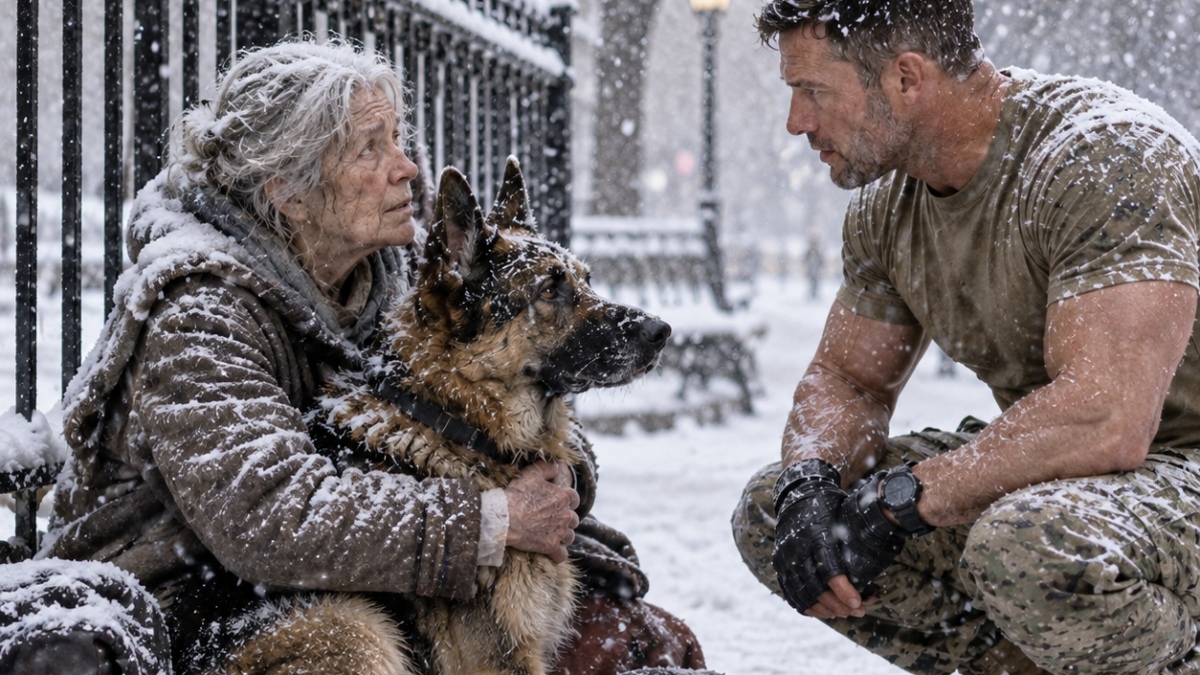
An Old Woman Sold Her Dog for $5—What the Navy SEAL Did Changed Three Lives – Part 2
Frank believed every creature should know its job, including the neighbor’s cat.
They sat at the table with mismatched plates. Nathan gave her more without making a display of it, and kept the smaller portion for himself.
She saw the open notebook by his elbow, the narrow rows of numbers written with military pressure. rent, power, phone, V, a copay, groceries, gas, laundry.
She looked away quickly, but not before understanding that this meal had cost him something. You should not have done this, she said.
Probably. That is not an argument. I am out of better ones.
Snow tapped the window in hard little grains. The radiator clicked and filled the room with reluctant warmth. Margaret ate with the manners of someone who had once set proper tables and now wanted not to look hungry in front of a stranger.
Nathan hated that. He looked down at his plate so she could stop defending herself from food. After a while, she told him Frank had died three winters ago.
That Atlas had belonged to both of them, but slept on her side after the funeral. That Peter used to be a sweet boy who brought injured birds home in shoe boxes until ambition taught him to call tenderness inefficient.
She spoke of Linda more softly, with anger tied up in worry. She always was afraid of storms, Margaret said. Even the ones indoors.
Nathan rinsed the plates while she spoke. When he turned off the faucet, the pipes knocked somewhere in the wall. The sound was small.
It should have been small. Instead, it opened a white room inside him.
Not a room, a ridge. Snow blown sideways under a black sky. A radio call breaking into static.
Ranger’s harness slick under Nathan’s glove.
The shape of his dog moving ahead because the trail was wrong and the men behind Nathan still had time.
He heard the crack again, felt the snow lift, saw nothing but white and red and rers’s body between him and the blast.
The apartment vanished.
Nathan’s fingers closed around the edge of the sink until the metal bit his skin.
He did not fall. He had learned not to fall. That was different from being present.
Atlas rose from the radiator. His bad leg shook, but he crossed the room without a bark.
He came to Nathan’s side and leaned shoulder against thigh, warm and solid.
Then the old dog began to breathe. In, out, in, out. not command rhythm.
Nathan’s eyes found the silver muzzle, the sink returned, the radiator, the snow at the window.
Margaret sitting very still at the table, both hands folded around the spare key.
“Ranger,” Nathan whispered before he could stop himself.
“Atlas did not mind the wrong name.
He only leaned harder.
Margaret’s face changed with understanding she did not yet have words for.
Outside, tires hissed through slush, and somewhere below the building, a vehicle slowed too long near the curb. Morning came gray and windbent over Duth with snow packed against the apartment windows and the fire escape wearing a white coat thick enough to hide the metal grading. Down on the street, plows grumbled like tired machinery from another century, pushing ridges of dirty snow toward the curbs, while the sky kept lowering more.
Nathan woke on the sleeping mat by the door with one hand under his jacket, and the taste of old fear still sour in his mouth. For 3 seconds, he did not know where he was.
Then Atlas snored near the radiator, a deep uneven rumble that sounded far too judgmental for a dog who had drooled on Nathan’s boot sometime before dawn.
The room returned gently. Margaret sat at the table in the borrowed wool socks Nathan had found in the back of a drawer, both hands around a mug of coffee gone pale with powdered creamer. Her white hair had dried in soft waves around her face, and the spare key lay beside her like a small promise she had not yet decided to trust.
She did not mention the night. Neither did Nathan.
Some mercies were made of silence. He stood slowly, knees objecting, and put water on for oatmeal he did not remember buying until he found the packet under the rice.
Breakfast is either maple flavor or the idea of maple flavor, he said. That depends how honest the box was.
Margaret touched the mug with one finger. Frank used to say oatmeal was what people ate when they wanted pancakes, but had made poor choices. Frank sounds like a man of education.
Atlas opened one eye at the name, then closed it again when no food appeared. Margaret smiled, and this time the smile stayed long enough to become sad. After they ate, she opened the canvas bag she had guarded all night.
Nathan did not reach toward it. He sat across from her and waited while she removed each item with the careful order of someone unpacking the last pieces of a life. A small pill bottle.
A photo of a younger Margaret standing beside a broad shouldered man in a rescue jacket. Atlas at their feet with no gray on his muzzle.
A folded church bulletin from Frank’s funeral.
Two envelopes stiff with damp. A copy of a power of attorney form. Property tax notices.
A letter from North Harbor Property Group printed on thick paper and using words like transition, upkeep, and opportunity in the way wolves might use table manners. Margaret moved the power of attorney with her palm. Peter said I was foolish to keep handling everything alone.
He was not wrong about the bills. After Frank died, there was the mortgage balance, medical things, furnace repairs. I forgot a payment once, only once.
But Peter spoke of it as if I had set the house on fire. Nathan read without moving the pages from under her hand.
You signed this 4 months ago. At the kitchen table, Linda brought poundake. Peter brought a notary.
She gave a small bitter laugh. That should have warned me. Nobody brings a notary with pound cake unless the cake is camouflage.
Did anyone explain what it allowed? They said bills, repairs, talking to the county if I was tired.
I was tired. Her eyes went to the window where snow chased itself against the glass.
Being tired is dangerous when someone else is holding a pen. Nathan felt that sentence settle in the room.
He thought of forms at the VA, of signatures made by men whose pain medication had outrun their patients, of how often the world asked wounded people to read fine print while bleeding. What happened last week? Margaret folded the funeral bulletin, unfolded it, then folded it again.
Peter said the porch was unsafe and the insurance company might cancel coverage. He said I should stay with Linda for a few days. Linda looked sick, but she nodded.
I packed clothes, Frank’s picture, Atlas’s medicine.
When we reached Linda’s building, Peter said there had been a change.
A church room was better, more supervision. Then he got a call, pulled over near the bus depot, and told me Denise Walker would come in 10 minutes.
She touched the edge of the cardboard sign Nathan had brought in and dried by the radiator. I waited 6 hours.
Nathan’s hands stayed flat on the table.
They wanted to become fists. He gave them a job instead, lining up the damp envelopes.
Why not call police and say what? My son is late. My daughter is frightened.
I signed papers I did not understand. I am an old woman with a dog and no proof that my own children did not mean well. Her voice did not break.
That made it worse. By evening, Atlas was shivering. A man at the depot said animal control might take him.
I thought if someone kind paid even $5, it would feel less like begging and more like I had chosen. Atlas lifted his head from the radiator and looked at her. Margaret looked back.
I know, she whispered. It was a terrible plan.
Nathan slid the letter from North Harbor closer. This says interior cleanout scheduled. Peter said it meant repairs.
It says tomorrow morning. The room changed. Margaret leaned forward.
No, that cannot be right. My things are still there.
Frank’s tools, the cedar chest, our wedding dishes, the quilt my mother made.
Nathan read the line again, hoping it would become less plain. It did not. North Harbor Property Group had scheduled a crew to remove occupant belongings before buyer walkthrough, pending final transfer.
pending final transfer. Not after, before. Do you have the original will?
He asked. Frank kept important things in a lock box. Peter said the key was missing.
Where is the lock box? In our bedroom closet, unless he moved it. Nathan stood and went to the window.
A black SUV idled across the street for half a minute, half hidden by blowing snow. Then it pulled away before he could read the plate. Margaret had seen it too.
“That was Peter’s car,” she said.
Her voice had gone flat. Atlas rose stiff and slow, and placed himself beside her chair. Nathan turned from the window, already reaching for his phone.
“Do you know Pastor Eli’s number?”
Margaret nodded.
“And Denise Walker?”
“Yes.”
Good. We start where people remember you before Peter started explaining you.
By late morning, the snow over Duth had become a public argument, shutting down side streets and turning the church steps on West 4th into a white ramp that Pastor Eli Monroe attacked with a shovel and a patience clearly borrowed from heaven. The church was small, red brick and stubborn, wedged between a closed hardware store and a laundromat whose neon sign blinked wash even when the power flickered. Nathan parked near the curb and came around to help Margaret down before she could protest.
Atlas went first, nose to the wind, then braced himself on the sidewalk with the solemn of a dog who had inspected worse conditions and found humans consistently underprepared. Pastor Eli looked up from his shovel.
He was a lean man in his 60s with a gray beard, wire glasses fogged from effort, and a knit hat that said Lake Trout Festival 2014.
“Margaret Ellis,” he said, and the way he said her name did more for her than any blanket could have.
“Not surprise, recognition, belonging.”
Margaret pressed one hand to her scarf. Eli. He came down the steps too fast for the ice, slipped, recovered by grabbing the rail, and pretended the whole thing had been a form of greeting.
I have been calling Peter since yesterday. He did not answer.
He answered once and told me you were resting.
Pastor Eli looked at Nathan, then at Atlas, then at the cardboard sign folded under Margaret’s arm.
His face went quiet. come inside. Warmth hit them in the entryway, carrying the smell of soup, old himnels, coffee, and wet wool.
In the fellowship hall, Denise Walker stood over a stockpot with a wooden spoon in one hand, and a phone wedged between her shoulder and cheek. She was a broad-shouldered woman with silver curls tied back, a flower smudge on one sleeve, and eyes that could count every lie in a room before anyone finished speaking. When she saw Margaret, she hung up without saying goodbye.
“Oh, honey.”
Margaret’s mouth tightened.
“Please do not owe honey me unless there is bread.”
Denise looked at the cardboard sign.
“There is bread, soup, and if I get 5 minutes alone with your son, there may be repentance.”
Denise, Pastor Eli warned mildly. I said may. Nathan liked her at once.
He did not say so. He was out of practice with liking people in public. Denise wrapped Margaret in a hug that somehow did not crush her and did not treat her like glass.
Atlas watched closely until Margaret’s hand came down on his head.
Then he sneezed once, showering melted snow on the fellowship hall floor.
“Bless you,” Denise said.
Atlas looked unimpressed by formalities. They settled at a long folding table while Denise brought soup thick with potatoes and chicken, soft bread for Margaret, and a bowl of warm water with shredded meat for Atlas.
Nathan stood near the wall until Denise pointed the spoon at him. Sit down, soldier.
Former the chair does not care. He sat. Margaret ate and the room let her eat without staring.
That was another mercy. Pastor Eli called the county recorder.
Denise called a retired attorney who volunteered with senior services and then a man named Harold Briggs whom Nathan knew from the VA building. Harold had been a Jag years before and had later become the person veterans found when paperwork had teeth.
He answered on the second ring. Nathan took the phone.
Harold, it is Cole. A pause. If this is about your benefits appeal, I told you to stop ignoring mail.
Different problem. You collect those? Apparently.
Harold listened without interruption while Nathan described the power of attorney, the cleanout letter, North Harbor Property Group, and Margaret’s night at the depot.
When he finished, Harold said, “Scan everything.
I will meet you at county if roads open. If they do not, we start by foam.
Tell Mrs.
Ellis not to sign, hand over, agree, confirm, or apologize for breathing.”
Nathan glanced at Margaret. He says not to apologize for breathing. Margaret lifted her spoon.
That may be difficult. I was raised Methodist.
Denise snorted. We will work on it. For the first time since the depot, the room breathed easier.
Margaret told them Frank had fixed the church roof one spring after a storm tore shingles loose.
Pastor Eli found the old maintenance ledger and read Frank’s name written beside the words, “No charge, just coffee.
” Denise remembered him carrying canned goods in both arms and telling jokes so dry it took people 3 minutes to realize they were jokes.
The memories steadied Margaret. They also changed the shape of the fight. She was not a confused old woman alone in snow.
She was someone with witnesses, history, and a dog who had begun to snore under the folding table like a small engine with moral authority. Nathan stepped outside to photograph the paperwork in better light near the vestibule window.
The storm stung his face the moment he opened the side door. He lifted the pages one at a time, phone steady, and sent them to Harold.
That was when Atlas appeared beside him. Nathan looked down.
I did not invite you. Atlas looked toward the parking lot. Nathan followed his gaze.
Between blowing curtains of snow, a man stood beside a gray pickup, phone raised toward the church windows. He was thick through the neck, wearing a brown work jacket dusted white, and when he saw Nathan looking, he turned away too quickly. Not a passer by.
Nathan took one photo before the man climbed into the truck. The plate was halfacked with snow, but not all.
Atlas growled quietly.
“You know him?”
Nathan asked. Atlas did not answer because he had standards.
Inside, Denise took one look at the photo and said, “Ray Turner.”
Margaret Spoon stopped halfway to her mouth. He works with Peter. Repairs, hauling, whatever Peter needs done cheaply.
Denise’s face hardened.
He was at the house last week. Pastor Eli moved to the window, but the pickup was already gone.
A minute later, Denise’s phone buzzed.
She opened a message from a friend who worked at the gas station across the street. It was a blurry photo taken through glass.
Ray in his truck, phone screen visible as he typed. The words were not perfect, but enough could be read. Old lady found dog still with her.
Denise placed the phone on the table. Margaret looked at it, then at Nathan. Outside, the church bell shifted in the wind and gave one dull note by itself, as if the building had decided to warn them.
The courthouse in downtown Duth stood under a sky the color of wet tin, its stone steps cut into narrow paths by shovels, and its flags snapping hard in the lake wind. By noon, the snow had eased just enough for traffic to crawl, though every car moved as if apologizing to the road.
Nathan drove Margaret, Atlas, and Denise in his old truck, while Pastor Eli followed in a borrowed van with a box of files from the church office because he had decided this was the sort of errand that required both prayer and documentation.
Harold Briggs waited inside near the recorder’s office.
a tall black man in a navy overcoat, thick glasses, and a scarf tucked with military precision. He looked at Nathan over the frames. You look terrible.
Good to see you, too. I assume the dog is the competent one.
Atlas sat beside Margaret’s leg and gave Harold one slow blink.
“Clearly,” Harold said.
Margaret offered her hand. Harold took it gently. Not the way people sometimes handled age as if it were made of old paper.
Mrs. Ellis, I am not your lawyer unless we make that official. But I know enough to say this.
Nobody gets to use your confusion as a shortcut. Unless a court has agreed you are confused.
Family does not count as court, even when they speak loudly. Margaret nodded, her eyes filled, but she did not cry.
Thank you. They spent the next hour at counters and conference tables gathering copies. The county clerk, a woman with silver glasses and a cardigan covered in tiny embroidered cardinals, pulled records and frowned so deeply the cardinals seemed concerned.
The deed had not transferred. A purchase agreement existed, but final closing had not occurred. A temporary authorization had been filed to permit inspection and emergency repairs.
The power of attorney was broad enough to wave like a flag in the hands of someone honest and broad enough to become a weapon in the hands of someone who was not. Harold read each line twice. Nathan watched Margaret watch him, her hands still in her lap, one thumb rubbing the place where her wedding ring had worn the skin smooth over decades.
Denise sat close enough to be useful and far enough not to crowd. Atlas lay beneath the table with his head on his paws, occasionally sighing whenever a printer jammed.
“This supplemental authorization,” Harold said at last, tapping one page.
“Did you sign it?”
Margaret leaned forward, her eyes narrowed.
“That is my name.”
“Is it your signature?”
She took the paper, held it close, then farther away. The room seemed to wait. No, she said.
The M is wrong. Frank used to tease me because my M looked like two hills and a fence. This looks like a bird fell in ink.
The clerk made a sound that was almost a cough and almost agreement. Harold slid the page into a folder. Good.
Not good, but useful. Nathan looked at the date. The supplemental authorization had been signed 2 days after Peter claimed Margaret had left the house voluntarily.
It approved removal of personal property for safety and sale preparation. Can they clean out the house tomorrow? Nathan asked.
They can try, Harold said. We are going to make trying expensive. He called adult protective services from the hallway, then legal aid, then a senior housing attorney whose voicemail sounded cheerful enough to be suspicious, but who called back within 7 minutes.
By then, Linda had arrived. She came in wearing the same beige coat from the SUV, snow melting in her hair, breath uneven from hurrying or panic.
She stopped when she saw Margaret surrounded by Nathan, Denise, Harold, Pastor Eli, the clerk, and Atlas. The scene clearly did not match the one Peter had given her.
“Mom,” she said.
Margaret stood. The movement cost her, and Atlas rose with her.
Linda looked at the dog, then at the floor.
“Peter said you were with a man from the bus station.
He said you would not answer your phone. My phone is in the house, Margaret said.
Because Peter took my purse when he changed the locks.
Linda’s lips parted.
He said, “You misplaced it.
” He says many things.
The daughter flinched. Nathan recognized the pattern now. Peter did not need to lock every door if he could train people to close them for him.
Margaret looked at Harold. May I speak to my daughter privately?
Of course. Harold nodded toward a small waiting area near the windows. But do not sign anything, agree to anything, or apologize for weather.
Margaret gave him a tired look. You and Denise have formed a committee. We prefer task force, Denise said.
Nathan stayed back while mother and daughter sat near the window. Atlas went with Margaret and settled in the patch of weak gray light. Linda cried before Margaret touched her hand.
Not loudly, not cleanly. The kind of crying people do when guilt has been packed too tightly.
Nathan could not hear everything, but pieces reached him. Peter said it was temporary. Peter said you needed supervision.
Peter said the house would bury us. I thought if I argued, he would cut me out, and then I could not help later.
Margaret listened, face still, heartbreak moving only in her fingers as they stroked Atlas’s ear.
“You left me in the snow,” she said.
Linda bent forward as if struck.
“I know.”
No excuse followed.
“That mattered.”
Nathan looked away. forgiveness, if it came, did not need an audience.
Harold returned with news. Legal aid would file an emergency notice that afternoon.
Adult protective services would open a case and the recorder’s office would flag the property for disputed authorization pending review.
It was not victory. It was a door wedge.
Sometimes that was enough to keep a house standing through the night. Linda came back to the table, pale but steadier. Peter keeps the lockbox key in his office, she said.
Top drawer under a false bottom in the desk organizer. He thinks nobody notices things if he calls them systems. Margaret closed her eyes.
Denise whispered something that sounded like a prayer and a threat sharing a coat.
Linda’s phone rang.

