Deputy Bullied Disabled Woman Alone — Until a Navy SEAL and K9 Arrived – Part 1
Deputy Bullied Disabled Woman Alone — Until a Navy SEAL and K9 Arrived
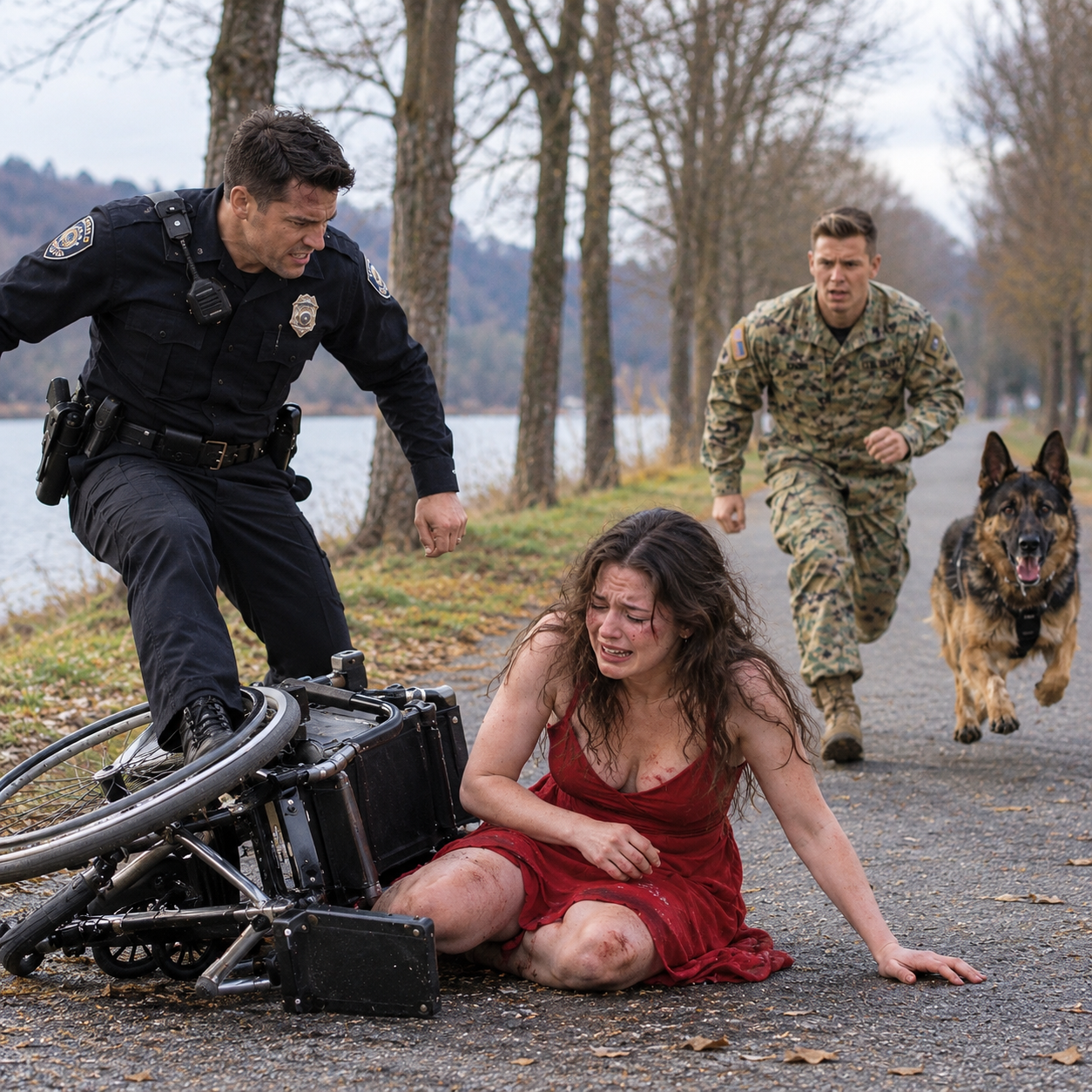
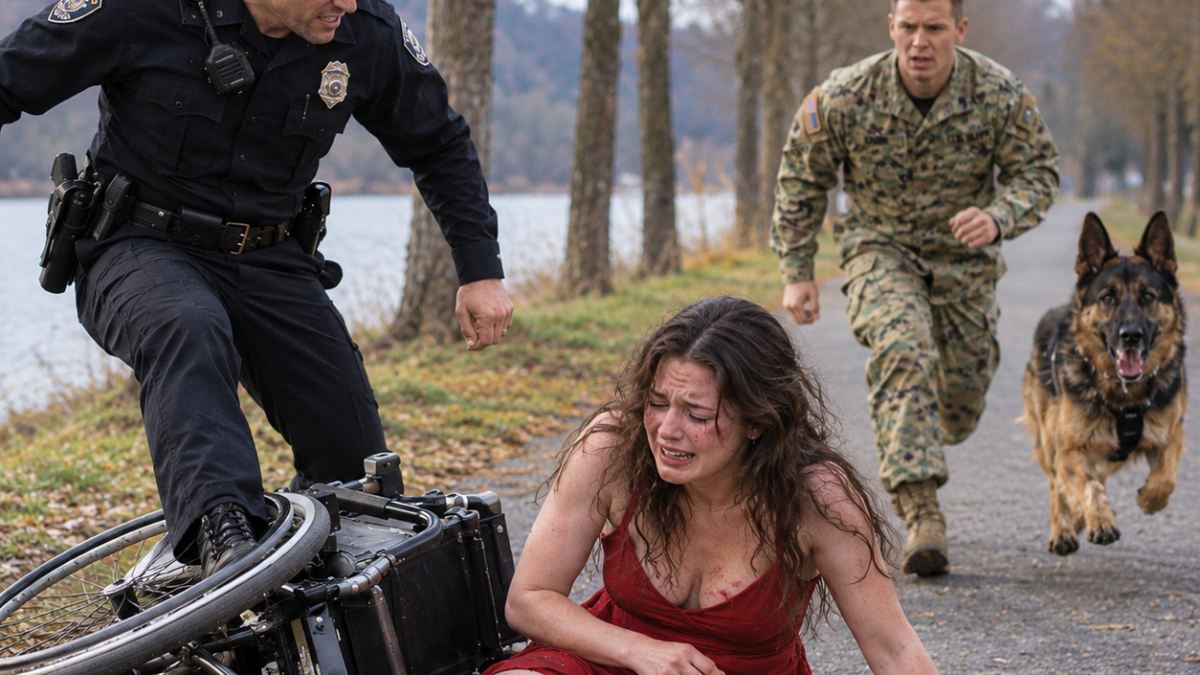
He did not ask. He did not warn her.
Deputy Ryan Cole grabbed the handles of Emily Carter’s wheelchair with both hands and wrenched her backward across the Kaggraville like she was a piece of furniture he needed out of his way.
Emily screamed at him to stop. He tightened his grip and kept going. The wheel hit a route.
The chair snapped sideways and Emily, a 27year-old disabled woman who had come to this lake alone to grieve her dead mother, was hurled onto the cold ground.
Cole looked down at her and said, “You brought this on yourself.”
He believed no one had witnessed it. He was wrong.
Emily Carter was still at the lake because going home meant facing the chair by the window, not her wheelchair.
the other chair, the brown armchair with the worn left armrest where her mother, Margaret Carter, had spent 18 months sitting with her coffee and her crossword puzzle and her particular way of humming under her breath when she was stuck on a clue. The chair was still positioned at exactly the angle her mother had last adjusted it. Emily had not touched it, had not moved it an inch.
Three weeks ago, she had walked up to it, placed both hands on the armrests, stood there for a full minute, making herself considerate, and then turned around and left it exactly where it was. Moving the chair meant agreeing her mother was not coming back.
Emily was not ready to agree to that, so she came to Mirror Lake instead.
four months of evenings, four or five nights a week, loading herself into her modified van and driving the three mi up the mountain road and rolling to the same spot at the water’s edge and sitting there until the light was fully gone.
She knew the park closed at dusk. She had read the sign every single time she rolled past it.
She told herself every single night that she would leave before dark. She never made it because those 20 minutes right before total dark when the water went still and the world went quiet and absolutely nothing reminded her of anything she had lost. Those were the only 20 minutes in any day when Emily Carter did not feel like she was drowning on dry land.
Her mother had died on a Tuesday morning in August. Not suddenly and not peacefully, which was the crulest part because the doctors had used the word manageable for a full year before the last 6 weeks happened. Emily had been her only caregiver, had managed every appointment, every insurance call, every medication adjustment from her wheelchair, which meant she had done all of it with twice the effort it would have taken anyone else and received half the recognition.
because people looked at her and saw the chair before they saw the daughter doing everything she could. When it was over, Emma Ellie had expected to feel something like relief mixed into the grief. That was what the book said, that caregivers sometimes feel a guilty freedom when the suffering ends.
She felt nothing like freedom. She felt like the last solid ground had crumbled and she was falling through open air with nothing to grab. The lake was not solid ground, but it was close enough.
She heard the gravel at 8:43. She had not looked at her phone in an hour, but she looked at it then, and that was the time on the screen. The sound was specific.
The compression of loose stone under vehicle tires on the service road that ran behind the north boundary of the park, a sound she had learned to distinguish from every other sound the park made at night, because 4 months of coming here after hours had turned her ears into instruments she had not known she was calibrating. She did not turn
around.
She pressed her palms to the wheel rims and told herself the same thing she always told herself when she heard a vehicle maintenance. A ranger doing a final pass.
Someone who would see her and say, “The park is closed.”
And she would say, “I know.
I was just leaving.”
And they would let her go. A door opened. Footsteps followed.
Steady, deliberate. The footsteps of someone who had already decided what was about to happen. They stopped 6 ft behind her.
Hey. Emily turned her chair to face the voice. Deputy Ryan Cole stood with his thumbs hooked in his belt and his weight on one hip and his face wearing the expression of a man confronting an inconvenience he planned to resolve quickly.
His uniform was county sheriff. He was broad-shouldered and probably 40 with the jaw of a man who had learned early that his size meant people moved out of his way and had been confirmed in that lesson often enough that he no longer questioned it. His eyes went to her wheelchair immediately, then back to her face, then to the wheelchair again.
Parks closed, he said. I know, Emily said.
I apologize. I was heading back.
Should have been heading back an hour ago.
You’re right, she said.
I’ll go now.
She put her hands on the wheels. She started to turn. Hold on.
ID, he said. Just that one word. ID.
Like he was holding out a hand for something he was already owed. Emily had learned in 27 years to feel the shift in a situation before it became visible.
Something about the air, the specific atmospheric pressure of a moment changing character. She felt it then.
She had been already complying, had already apologized, was already physically moving in the direction he wanted. And still the ID came out.
Still something else was required before she was allowed to leave. She did not comment on it. commenting on it at this stage cost more than it was worth.
She reached back into the bag on her chair and handed him her license without a word. Cole took it.
He studied it longer than necessary. He looked at her.
He looked at the wheelchair. He looked at her modified van in the parking area 20 ft away. He looked back at her.
You drove here alone?
He said, “Yes, sir.
Modified vehicle.
Hand controls by yourself?”
He said again. Not quite a question. more like a man working through an equation that was not resolving the way he expected.
By myself, Emily confirmed. He kept looking at the van. She knew what he was doing.
She had watched people do it her entire adult life. He was trying to fit the picture together in a way that made sense to him. Disabled woman alone after dark remote lake.
In his mental model, these pieces did not add up to anything normal. They added up to something requiring explanation. You live near here, he said.
Pine View Road, 3 mi. You come out here a lot. A few times a week, she paused.
She made the decision she always hated making. The one where she exchanged something private and painful for the basic decency. My mother passed away 2 months ago.
Coming here in the evenings helps me manage. Cole handed back her license.
He did not say he was sorry. He did not nod in acknowledgement.
The words landed on him and left absolutely no mark. Ordinance 14C, he said.
Park closes at dusk.
It’s 45 minutes past dusk.
I’m going to write this up.
Emily looked at him steadily. I was in the process of leaving. You were sitting at the lake when I arrived.
I turned around the moment you spoke. I provided my ID immediately.
I’ve cooperated fully.
The ordinance doesn’t factor in cooperation.
He said the park closed.
You’re here.
That’s the violation.
Then write the citation. Emily said something moved through his expression when she said it. Not anger exactly, more like a recalibration like he had expected her to argue or to plead or to apologize further.
And instead she had done something he found unexpectedly resistant. He pulled out his pad.
He wrote. He tore the slip free and held it toward her. She reached for it.
He held it for one extra beat. Not long.
1 second, maybe two. Just long enough that she had to close her fingers on it and feel the slight resistance before he released it.
Small, deliberate, unmistakable in what it was saying. People think rules in parks like this are optional. Cole said he was not writing anymore.
He was in a different mode now. The one where the authority explains itself to the person who has been found in violation of it.
They come out here after hours think it doesn’t matter.
It matters. I understand, Emily said.
Do you? He said.
She met his eyes. Yes, she said.
I do. The steadiness of it bothered him. She could see that.
The way his jaw made a small adjustment. The way his chin came up a fraction.
Then he stepped to the right. And then he stepped behind her. Emily heard him position himself at the back of her wheelchair and every muscle in her upper body locked.
She felt his hands close on the handles. Both hands full grip.
The kind of grip that was not offering. The kind that had already decided.
I’ll walk you to the parking area.
Cole said. His voice was pleasant again.
Helpful. The voice of a man performing a service. Please do not touch my wheelchair, Emily said.
She said it clearly. She said it with every ounce of steadiness she had left.
She was proud of that steadiness afterward because she had to fight for it. He did not let go.
It’s dark.
There are roots on the path.
I’m making sure you get out safely.
I have navigated this path four times a week for 4 months, Emily said. I am fully capable of managing it independently.
Remove your hands from my chair, please.
I’m just helping deputy.
She cut through the pleasant voice. Cut straight through it.
I am asking you directly. This is the second time I am asking.
Take your hands off my wheelchair. A beat of silence.
You’re being difficult, Cole said.
And he pulled, not gently, not incrementally. He pulled with the full confidence of a man who had decided the discussion was over. And his decision was the one that would be implemented.
He yanked the handles back and the chair moved with him.
And Emily’s hands flew to the wheel rims and she grabbed them and the chair moved anyway because he was behind her and she was trying to stop it from the front.
And physics does not negotiate. Stop, Emily said.
Stop the chair. Let go. Stop.
He did not stop. The front left wheel found the route at an angle, caught it on the underside of the rim, and the torque went sideways and upward simultaneously.
Cole was still pulling backward. The two opposing forces hit the chair at the same moment, and the chair obeyed both of them the only way it could. It went sideways and it went down.
Emily went with it. The ground hit her shoulder first, and the impact was solid and immediate, and took her breath. Her elbow struck the soil a fraction of a second later and the pain that came up her arm was the white hot specific kind.
That means the injury is real and will be worse tomorrow. Her blanket wrapped around the wheels. Her phone struck the dirt and skidded.
The chair tilted above her, one wheel rotating slowly in the dark. She lay still, not from shock, past shock. She lay still because she was doing what she had trained herself to do when things went wrong, which was to account before she reacted.
Shoulder bruised and screaming, but moving. Elbow bad.
Hip, okay. Head, okay. Chair damaged but not destroyed.
She was hurt. She was okay. Both of those things were true at the same time.
Then Cole spoke. You brought this on yourself.
Those five words.
Emily Carter lay on the cold ground in the dark with her elbow on fire and her shoulder throbbing and her dead mother’s face behind her eyes.
And she listened to a county sheriff’s deputy tell her that being thrown from her wheelchair was a consequence she had generated through her own actions.
She did not scream. She wanted to.
There was something enormous and molten in her chest that wanted out. something that was not just anger, but the compressed weight of 27 years of being moved without consent, managed without asking, assisted without permission, treated as a thing that needed handling rather than a person who had opinions about her own life.
It was all of that, every single
instance of it, loaded into this one moment, she held it. She held it because she knew with cold certainty that releasing it in front of this man would be used against her, would become the story, would become the reason she had caused the problem.
“I need assistance getting back into my chair,” she said.
Flat, controlled, two hands on a lid.
“You were the one being resistant,” Cole said.
“I am on the ground,” Emily said.
“I need to get back into my chair.
That is what I need from you right now.”
Cole crouched. He grabbed her upper arm.
the way you grab something you need to lift when you are not concerned with what it is without technique, without asking where or how. And he hauled upward. Emily pressed her teeth together and made no sound.
She got back into the chair sat. She tested the wheels.
Bent footrest, misaligned seat, but the wheels moved. She straightened herself by degrees.
The citation, she said. Cole blinked.
What the citation? You issued it. I want my copy.
I’m voiding it.
You handed it to me, Emily said. The document was issued and received. I want to know the specific procedural basis for voiding a citation that has already been issued and transferred to the recipient.
Cole stared at her. She stared back.
Damaged chair, bruised elbow, bruised shoulder, dark cold alone, not looking away. Go home, he said. The procedural basis deputy.
I said go home. I heard you.
Emily said, “I’d like the citation or the badge number or the code authorizing the void.”
One of those three. The silence lasted a long time.
Cole’s face moved through several things.
Then he said, “Have a good night.”
and turned and walked to his cruiser without looking back. The engine started. The lights came on.
Gravel moved under tires. The tail lights went red and then disappeared around the service road curve. And then there was nothing but dark and the sound of the lake.
and Emily’s own breathing in the cold air.
She sat very still. She did not move for a full minute. She was laying everything out in order inside her head.
Each element of the last 45 minutes because if she stopped cataloging and just felt it, the whole thing would arrive at once. And she did not know if she could carry the whole thing at once. She found her phone in the grass.
New crack in the corner of the screen. She held it and thought about Marcus, about Patrice, about calling someone.
But calling someone meant saying it out loud. And saying it out loud meant moving it from the version of tonight that was a bad night she would survive into the version that had a name that required decisions that was real in a way she was not yet prepared to make it real. She was still sitting there not calling anyone when the voice came from the north trail.
Ma’am, are you hurt?
Her head turned fast. He was standing at the trail head and he had not moved toward her. That was the first thing she registered.
He was maintaining distance, standing still, letting her see him fully before he did anything else. He was tall with the kind of posture that was not about height, but about years of being in situations where your body communicates something before your mouth opened. Dark jacket, hands at his sides and open, visibly open.
the position of someone who wants you to know what his hands are doing.
And at his left heel, perfectly motionless, sitting at rigid attention, without any visible command, was a German Shepherd with amber eyes that were already fixed on Emily’s face with an intelligence and a focus that felt less like animal instinct and more like deliberate choice.
“I’m okay,” Emily said.
The reflex, two words out before she could stop them.
“You don’t have to say that,” he said.
“Simple.
No pull in it. No, wait.
Just a door left open. Emily looked at him. I was running the North Trail, he said.
My K-9 partner and I. We worked the late hours most nights old habit. A brief pause.
I heard the vehicle come in on the service road. I heard the conversation. I heard you ask him not to touch your wheelchair.
He stopped. I heard you ask him twice.
Emily’s throat tightened around whatever she had been about to say.
And I heard you hit the ground, he said. The night held still.
What’s your name?
He said. Emily Daniel Hayes. He said it straightforwardly.
The way former military men often introduce themselves. Name first. Nothing attached to it.
Can I come closer? Ranger 2.
He’s a retired Navy Seal.
9. 11 years of ser.
He won’t approach unless you say it’s okay.
A Navy Seal.
The words landed somewhere in Emily’s chest.
Not because of what they meant about rank or service, but because of what they meant about the man standing in front of her, about his capacity to assess a situation, about what it meant that he had stayed on that trail and watched and waited and was now standing here. Okay, she said. Daniel Hayes walked forward with the measured economy of someone who had spent years moving through situations where how you moved mattered.
Ranger matched him step for step. No command exchanged.
The seamless synchronization of two beings who had operated in highstakes environments together long enough that they had stopped needing language. They stopped 3 ft from her chair.
Daniel Hayes crouched down. He put himself at her eye level deliberately, visibly without comment about it. He looked at her the way few people had looked at Emily Carter in recent memory.
Not at the chair. Not at what the chair represented, not at the problem she was or the accommodation she required.
At her. Can I look at the footrest?
He said yes. He looked first, eyes only, assessing before his hands moved anywhere near it. May I?
He said. Emily nodded.
His hands were large and they moved with the precise economy of someone who had fixed equipment in conditions where fixing it fast and fixing right were the same requirement. He tested the joint, assessed the alignment, applied careful pressure to understand the damage.
Forced out of alignment, he said. The joints intact.
Someone with the right tools can get this back to fully functional.
It’s not tonight, but it’s not destroyed, Emily said.
Okay. Ranger moved.
He had been at Daniel’s heel and then he was beside her wheelchair.
The transition so quiet she had not seen it happen. He was not crowding her, not demanding anything, just present, close, his large head at the level of her resting hand, his amber eyes on her face carrying that same expression she had noticed from across the trail, the one that was not animal warmth, but something more specific,
more intentional, understanding.
Emily reached out and placed her hand on his head. Ranger was warm and solid and utterly still.
He did not push into her hand or pull away from it. He simply received it and remained the way something immovable and safe remains. 11 years, Daniel said quietly, watching the dog.
Two tours in Afghanistan, one in Iraq.
He’s pulled men out of situations you don’t want to know about.
He paused. He reads people, not smells, not commands.
He reads them and he decided on you inside of 30 seconds.
Emily kept her hand on the dog’s head.
She felt the warmth move through her palm and into the cold parts of her arm and further.
“He’s going to say I fell on my own,” she said, not asking, telling Daniel what she already knew with complete certainty what had become clear to her while she was still on the ground.
He’s going to write whatever he writes, and it’s going to say, “I was uncooperative and felt trying to navigate the path and refused the assistance he offered.
” Daniel Hayes looked at her.
His face did not do what most faces did when someone told them something difficult. It did not soften into the cautious expression of someone calculating how involved they wanted to be. It did not shift.
It did not reconsider. It stayed exactly where it was, clear and direct and fully committed to this moment. I saw what happened, he said.
All of it. From the moment he put his hands on your chair to the moment you hit the ground to what he said when you were lying there. I have it.
Every word. Emily stared at him.
I served 22 years in naval special warfare.
Daniel said, “I spent two decades in situations where the difference between what actually happened and what someone with authority claimed happened could end lives.
I know exactly how that works.”
He paused.
“And I know exactly what to do about it.”
Emily felt something move in her chest. Not relief, because relief was too thin a word for what it was. It was the feeling of a weight that has been carried alone for so long you have forgotten what it felt like to put it down.
Discovering for the first time in a long time that there might be a place to put it.
They’re not going to care what you saw.
Emily said he’s law enforcement.
I’m a disabled woman who was in the park after hours.
That’s the story they’ll run with.
Then we make sure Daniel said that the story they try to run with is the one thing in this situation they cannot control. He said it quietly. No heat in it, no performance, just the absolute certainty of a man who had spent 22 years learning the difference between what could be moved and what could not, and who had gotten very good at moving what needed moving.
Ranger pressed his head slightly upward against Emily’s palm.
and Emily Carter sitting in a damaged wheelchair in the dark with a bruised elbow and a bruised shoulder and a cracked phone and a dead mother and a deputy who thought she was alone and powerless and finished. Felt the one thing she had not
let herself feel in a very long time. She felt like someone was standing with her, not for her, not above her, not managing her or handling her or deciding on her behalf what she needed with her.
And that made all the difference. Daniel Hayes did not move immediately after he said it.
He stayed crouched at Emily’s eye level, and the silence between them lasted just long enough for his words to settle into something real.
Then he stood, and when he stood, he pulled out his phone. And the first thing he did was not call anyone or type anything.
He turned on the flashlight and aimed it at the ground around Emily’s wheelchair.
“Don’t move the chair yet,” he said.
Emily watched him. He moved the light slowly across the soil.
He was looking at the ground the way someone looks at something when they know exactly what they are searching for. Methodical, patient, not rushed, even though the night was cold and the park was dark and they were both alone in a place they were not supposed to be. The route, Emily said.
I see it. He crouched again, this time at the front left wheel, and he studied the angle of the bent for relative to the root and the direction of the ground disturbance in the soil. He was pulling you northward toward the service road.
The route caught the left wheel and the force went sideways. He looked up at her.
That’s not a fall.
That’s a predictable mechanical outcome of someone applying force to a wheelchair without understanding or caring how wheelchairs work.
Emily stared at him. You can tell that from the ground.
I can tell that from the ground, he said. I spent two decades reconstructing exactly what happened in situations where everybody had a different version of events. You learn to read what the physical evidence says before you let anyone start talking.
He took photographs, methodical ones, the route, the wheel marks in the soil, the bent footrest, the disturbed ground where Emily had landed. He did not narrate what he was doing or explain each photo.
He simply documented moving around the scene with the quiet efficiency of someone who had done this in conditions far more complicated than a closed lake park on a Tuesday night.
Ranger sat beside Emily’s chair and did not move.
Emily watched Daniel work and felt something strange happening inside her. Not comfort exactly, something more active than comfort.
something that felt like the first solid footing she had found in two months.
“He’s going to say the photographs don’t prove anything,” she said.
Daniel didn’t look up from his phone.
“He’s going to say a lot of things,” he said.
“That’s fine.
Every word he says is going to have to hold up against what we put together tonight.
That’s the game, and he doesn’t know we’re playing it yet.”
Emily absorbed that.
“You said we,” she said.
Daniel looked up then.
“I did,” he said simply.
Ranger’s ear rotated toward the parking area.
Both of them noticed it. Daniel was on his feet before Emily could process what had happened.
Not fast in a panicked way. Fast in the way of someone whose body has learned to respond to information before the conscious mind finishes receiving it. He looked in the direction Ranger was facing toward the parking lot entrance.
And he was still and he was listening. Gravel tires again.
Emily’s stomach dropped.
He came back,” she whispered.
Daniel put his phone in his jacket pocket. He looked at Emily and his voice was very calm and very quiet.
“Let me handle the talking,” he said.
“You don’t have to say a single word unless you choose to.”
“Understood?”
Emily nodded. The cruiser rolled back into the parking area and stopped. The door opened.
Cole’s footsteps came across the gravel toward them.
And this time they were faster than before, less the footsteps of someone completing a task, and more the footsteps of someone who had been driving away, thought about something, and decided to come back and address it. He came around the edge of the path and stopped when he saw Daniel. The silence lasted about 3 seconds.
Cole looked at Daniel. He looked at Ranger.
He looked at Emily. He looked back at Daniel. Who are you?
Daniel Hayes. Daniels said I was running the North Trail when I heard the incident.
I came over to make sure Miss Carter was all right.
Cole’s eyes moved to the phone in Daniel’s jacket pocket.
The outline of it, the fact that it was there. You were on the trail, Cole said. North Trail.
Yes. Parks closed.
Cole said to everyone.
I’m aware, Daniel said.
I’ll accept whatever citation is appropriate.
But first, I want to make sure Carter’s chair is stable enough for her to reach her vehicle safely since the footrest was damaged in the fall.
Cole’s jaw moved.
She fell on her own. Daniel said nothing. The silence that followed was the specific silence of a statement that has been made to someone who knows it is false and is deciding how to respond to the falseness without flinching.
Daniel let the silence do its work. She refused assistance. Cole said.
She was navigating the path after dark and the wheel caught a route. H Daniel said. Cole looked at him.
You have something to say, I said. Daniel said pleasantly. I was agreeing that the wheel caught a route.
That part is accurate.
Something shifted in Cole’s face.
He was recalibrating.
He had returned to the park expecting to find a disabled woman alone who he could, if necessary, revise the night’s events with.
He had not expected to find a man standing at her wheelchair with the particular quality of stillness that Daniel Hayes carried. A stillness that communicated clearly and without aggression that this was not a situation that was going to be managed the way Cole was accustomed to managing situations.
I’ll need your ID as well, Cole said.
Of course. Daniel reached into his jacket and produced his wallet.
He handed over his license. He also, without comment, handed over a second card. Cole looked at it.
His expression changed.
Emily could not see the card from her chair, but she watched Cole’s face, and she watched something move across it that had not been there before.
Something that was recalculating faster now.
You’re a Navy Seal, Cole said.
Former, Daniel said. 22 years, retired 14 months ago.
Cole handed both cards back. He looked at Ranger. That a service animal?
Retired military working dog. Daniel said.
Ranger, 11 years of service. We run together most evenings.
Cole looked at the dog for a moment. Ranger looked back at Cole with the absolute expressionless focus of an animal that has been trained to assess threats in environments far more dangerous than this one and is doing exactly that right now. Cole looked away from the dog first.
Miss Carter needs to get to her vehicle, Daniel said.
I’m going to help her do that.
Is there anything else you need from either of us before we do?
Cole’s voice was different now.
Still authoritative, but there was something underneath the authority that had not been there when he arrived. A kind of structural uncertainty. The park is closed, he said.
But the statement did not land the same way it had an hour ago. Understood, Daniel said.
We’ll be out inside 5 minutes.
Cole stood there for another moment. He was making a decision. Emily could see it on his face.
the weighing of something, the calculation of how this played out in different directions.
Then he said, “Five minutes and turned and walked back toward his cruiser.”
He did not drive away. He sat in the parking area with his engine running. Emily looked at Daniel.
“He’s watching,” she said quietly.
“Let him watch,” Daniel said.
He was already moving to look at the footrest again.
“Watching is fine.
Watching means he’s thinking about this.
Thinking about this means he knows tonight isn’t over.
Emily looked toward the cruiser, the shape of coal behind the windshield, lit by the dashboard instruments. Watching them, she felt her pulse in her bruised elbow. Why did you show him the military ID?
She said, Daniel glanced at her. Because men like Cole do their math fast, he said. I needed him to redo his math tonight before he left this parking lot.
before he had time to drive somewhere quiet and write his version of events without knowing what we have.
“What do we have?”
Emily said, “Enough to start with,” Daniel said.
“Not enough yet.”
He crouched at the foot rest and made a careful adjustment, testing, applying measured pressure to the joint.
“Can you feel the difference?”
he said. Emily tested the footrest with her foot brace.
“It was not right, but it was better, less unstable.”
“Yes,” she said.
Good enough to get you to your van,” he said.
He stood and looked at her directly. Emily, I need to ask you something and I need you to answer it honestly.
Okay?
She said, “Is this the first time something like this has happened to you with law enforcement, with authority, with someone deciding you were a problem to be managed rather than a person to be spoken to?”
Emily looked at him for a long moment.
“No,” she said.
Daniel nodded slowly, not like he was surprised. Like he had asked the question already knowing what the answer would be and asking it anyway because he needed to hear her say it. Tell me about one other time he said.
Not tonight. A different time. She hesitated.
I’m not asking because I don’t believe tonight, he said.
I’m asking because I need to understand the full picture of what we’re working with.
Emily was quiet for a moment. The cruiser sat in the parking area with its engine running.
Cole was still back there watching.
Two years ago, she said, “I was at a pharmacy counter.
I’d been waiting 20 minutes.
A manager came out from the back and told me the accessible counter was on the other side of the building and I needed to use that one.
” I told him I had been waiting in line like everyone else, and I would like to be served where I was.
He called security. Daniel said nothing.
Security told me I was disrupting the store.
Emily said, “I was standing still in a line.
I filed a complaint. I never heard anything back.
Daniel took his phone out again. Tell me the pharmacy, he said.
The date if you remember it, the manager’s name if you have it.
Emily stared at him. Why? Because Deputy Cole is not going to be the easiest case.
Daniel said, “Cops protect cops.
I know how that works. I spent 22 years operating alongside federal agencies, and I know exactly how institutional protection operates.
The pharmacy incident by itself means nothing, but it’s a piece of a picture, and pictures require more than one piece.
Emily felt the cold air on her face, and she looked at Daniel Hayes and she said, “You’re going to help me fight this.
I’m going to help you document it.”
He said, “Fighting is your choice to make, but you’re not going to make that choice without having everything you need to make it the right way.
” Ranger pressed against the wheel of Emily’s chair and stayed there.
Emily told him the pharmacy.
She told him the date, which she remembered because it had been her mother’s birthday, which was why she had been at the pharmacy in the first place, picking up the birthday prescription for the woman who would be dead 14 months later.
Daniel typed it into his phone. Anything else? He said, Emily thought about it.
She thought about the hospital parking lot 18 months ago when a security guard had asked her three times whether she was sure she was at the right entrance. despite the visible handicapped placard.
Despite her telling him yes each time, she thought about the city council meeting two years before that where she had spoken during public comment and a council member had addressed his response to the man sitting beside her. Even though she was the one who had spoken, she thought about a hundred small moments that were not dramatic enough to report, not violent enough to call crimes, but that had accumulated in her bones the way water accumulates in stone.
wearing something down. A lot of things, she said. Then we have time, Daniel said.
He helped her get the chair positioned correctly for the path back to the parking area. He walked beside her, not behind her, not in front of her. Beside her and Ranger walked on her other side, and the three of them moved together toward the parking area while the cruiser sat there with its engine running and its occupant watching.
When they reached the van, Daniel stood back while Emily operated the lift.
He watched without hovering, without offering help she hadn’t asked for, without filling the air with commentary.
He just watched. The way someone watches when they want to understand something and are willing to be patient enough to let the understanding arrive correctly. When Emily was inside and the lift had retracted and she had the door open, she looked at him.
“You’re not going to be here tomorrow,” she said.
It was not an accusation. It was a statement of what she had learned about people who showed up at difficult moments. They showed up.
They were present. They said the right things. And then they went back to their lives because their lives did not include the aftermath of what had happened to someone else.
Daniel reached into his jacket pocket and took out a card. He held it up to her.
She took it. It had his name, a phone number, and below that two lines. Naval Special Warfare Command, retired.
Crisis documentation and witness support. Emily looked at the second line for a long moment. Crisis documentation and witness support, she read.
Something I’ve been putting together since I got back, Daniel said.
Helping people who end up in situations where what actually happened and what gets officially recorded are two different things. He paused.
Turns out there’s a lot of that.
Emily held the card. She looked at it and then looked at him.
“Is that what tonight was for you?”
she said.
“A situation to document.”
Daniel looked at her steadily.
“Tonight was a woman being thrown from her wheelchair by someone who was supposed to protect her.”
He said, “The documentation is just how we make sure it doesn’t get erased.”
Cole’s cruiser was still in the parking area, still running, still waiting to see what they did next.
Emily looked at the card one more time and put it in her bag. What do we do now?
She said, “Tonight you go home.”
Daniel said, “You write down everything you remember in the order it happened, not how you felt about it.
What happened, actions, words, sequence, timing, as specific as possible, time you arrived, time he arrived, exact words, exactly where your hands were when he grabbed the chair, exactly how you fell.
Can you do that?”
Yes, Emily said, “Send it to that number when you’re done.
Tonight if you can before you sleep and tomorrow,” she said.
“Tomorrow we find out who Deputy Ryan Cole is,” Daniel said.
“What his record looks like, whether tonight was an outlier or a pattern, because in my experience, men who are comfortable enough to do what he did to you tonight in a closed park alone with no witnesses they know about have been comfortable for a while.
” The engine of Cole’s cruiser changed pitch.
He was pulling out. Both Emily and Daniel watched the cruiser roll past them on its way out of the parking area.
Cole’s face was visible for a moment through the side window as he passed.
Looking at them, not threatening, not apologetic, just the face of a man who had decided something and was not ready to show what he had decided. The cruiser pulled out onto the road and its tail lights disappeared.
The parking area was suddenly very quiet. Emily let out a breath she had been holding for longer than she realized. It came out unsteady, which surprised her because she had thought she was holding herself together better than that.
Hey, Daniel said. She looked at him. The unsteady breath is allowed, he said.
You held it together for 45 minutes in a situation that would have broken most people. You asked for the citation. You asked for the procedural basis for voiding it.
You didn’t let him rewrite the story while he was still standing in front of you.
He paused. That was not small. Emily said nothing for a moment.
Then she said, “I don’t know why I asked for the procedural basis.”
“Because somewhere you knew it mattered,” Daniel said.
“Because you knew that making him respond to a specific legal question put him on the record in a different way than just telling him to stop.”
“He didn’t answer it.”
“No,” Daniel said.
He didn’t.
And that is also on the record. Ranger made a sound then. Not a bark, something quieter, lower, a sound Emily had not heard a dog make before.
He was looking at her.
He’s checking on you, Daniel said.
Emily looked at the dog. Does he do that often?
Only when he thinks it’s necessary, Daniel said.
Emily reached down again and put her hand on Rers’s head, and the dog pressed upward into it gently, warmly, with the same absolute steadiness he had offered her at the lake.
And Emily felt the tears she had been holding back all night arrive at the backs of her eyes with a force she was not going to be able to manage much longer. She did not let them fall. Not yet.
Not here. But she stopped fighting them quite as hard. My mother would have had a lot to say about tonight.
Emily said the words came out before she had decided to say them. Daniel looked at her. What would she have said?
Emily thought about it.
She thought about her mother’s face when she was angry about something unjust.
The particular way her expression went from soft to flint in under a second. The way she would say certain things in a voice, so quiet it was almost gentle, which meant she was at her most serious.
She thought about the time Emily had been 11 and a teacher had told her there were things she simply could not do because of her chair.
And Margaret Carter had driven to that school and sat across from that teacher and said in her quietest voice, “My daughter will tell you herself what she cannot do and you will listen.
” She would have said, Emily said slowly that the people who decide you are small are always the ones who are afraid of how big you actually are.
Daniel was quiet for a moment.
“She sounds like she was something.”
He said she was everything. Emily said she started her van.
Daniel stood in the parking area as the engine turned over and he raised a hand, not a wave, more an acknowledgement, and Ranger sat beside him with his amber eyes on the van. And Emily pulled out of the parking area and onto the mountain road and drove the three mi back to Pine View Road in the dark. She cried for the last two miles, not because she was weak, not because the night had broken her.
She cried because someone had seen what happened and believed it and was not going to let it disappear. She cried because a German Shepherd had pressed his head into her hand and stayed there. She cried because her mother would never know about this night.
Would never hear this story, would never get to say the thing she would have said. She pulled into her driveway and sat in the van for several minutes. Then she went inside.
She made tea she did not drink. She opened the notes application on her cracked phone and she began to write. She wrote for 2 hours and 17 minutes.
She wrote down every word she could remember, every action in sequence, the time the gravel sounded, the single word ID delivered like a debt being collected, the moment his hands closed on her handles, the exact phrase, “You brought this on yourself.”
She wrote the procedural basis question and the fact that he had not answered it and had instead told her to go home. She wrote the crack in her phone screen. She wrote the damaged footrest.
She wrote the bruise she could already feel forming on her elbow. And she wrote that she would photograph it in the morning before it faded.
She sent it to Daniel’s number at 11:43.
His response came back in 4 minutes. Three words.
This is enough. Emily looked at those three words for a long time.
She looked at the brown armchair by the window. In the low light of the apartment, it was just a shape, just furniture, just wood and fabric and worn armrests. It was not her mother.
It was not a conversation she could still have. It was not the soup with the right amount of salt. But tonight, for the first time in 2 months, Emily Carter looked at that chair and did not feel only loss.
She felt something harder than loss, something that had an edge to it, something that intended to go somewhere. She closed her phone and went to bed. She did not sleep well, but she slept.
And in the morning, Daniel Hayes made the first phone call. Daniel made the first call at 7:14 in the morning.
Emily knew this because her phone showed a text from his number at 7:13 that said, “Only making calls.
Stay near your phone.”
And then at 7:14, her phone rang with a number she did not recognize.
And when she answered it, a woman’s voice said, “Carter, my name is Sandra Okafor.
I’m a civil rights attorney.
Daniel Hayes asked me to call you this morning. Do you have 20 minutes?
Emily had been awake since 5:00. She had photographed her elbow in the bathroom mirror. The bruise fully developed overnight, a deep purple green that spread from the point of impact across the inner arm in a shape that told a clear story about how she had landed.
She had photographed her shoulder. She had photographed the damaged footrest on her chair.
She had done all of this before she made coffee, before she ate anything, because Daniel had told her to document before the evidence changed. And her body was already changing, already healing at its edges, and she was not going to lose a single day of what it looked like at its worst.
Yes, Emily said, “I have 20 minutes.”
Sandra Okapor spoke quickly and precisely. the way lawyers speak when they are assessing a situation in real time and have not yet decided whether it is viable, but are leaning toward yes. She asked Emily to walk her through the night in chronological order.
Emily did. She had the written account open on her cracked phone screen as she talked, and she read from it almost verbatim because Daniel had been right about writing it down immediately.
The words she had written at 11:43 were clearer and more specific than what she would have been able to produce this morning from memory alone. When Emily finished, Sandra was quiet for 3 seconds.
Then she said, “You asked him for the procedural basis for voiding the citation.”
“Yes,” Emily said, “and he didn’t answer.
He told me to go home.
” Another brief silence.
“Miss Carter, do you know what a formal complaint to the county sheriff’s department looks like?”
I know it exists.
Emily said, I don’t know what it looks like in practice.
In practice, Sandra said it looks like a document that gets filed, assigned a number, and reviewed by a supervisor who almost certainly knows the deputy personally. In a small mountain county, that review process is about as independent as a family dinner.
She paused.
Which is why we’re not starting there.
Emily gripped the phone. Where are we starting?
We’re starting with the state attorney general’s office, Sandra said.
Civil rights division.
Because what you’re describing is not a park ordinance dispute.
What you’re describing is a deputy who used physical force on a disabled woman who had clearly and repeatedly refused consent to be touched and then stood over her while she was on the ground and told her she had caused it herself.
That is an ADA violation, a Fourth Amendment issue, and potentially a criminal assault charge depending on how the DA reads the physical contact and the injury. Emily sat very still.
She had told herself the night before. In those two hours of writing, not to get ahead of herself.
She had told herself to document and send and sleep and see what morning brought. She had told herself that morning might bring nothing. That Daniel might be a man with good intentions and no actual leverage.
That the card with its two-line title might be a project that had never yet produced a result. Morning had brought a civil rights attorney.
Before 7:30, Miss Carter Sandra said, “I’m here.”
Emily said, “I’m sorry.
I’m processing.
Take your time.”
“No,” Emily said.
Tell me what I need to do. Sandra told her it took 14 minutes.
When the call ended, Emily sat at her kitchen table and looked at the list she had written on the back of an envelope. And she thought about her mother, who had always said that the thing about bureaucracy was that it was only impenetrable until you found the right door.
And then you just had to be willing to knock loud enough. She texted Daniel.
She called, “I’m in.”
His response came in under a minute. Good. I need you to meet me at 11:00.
I found something.
She typed back, “What did you find?”
Three dots appeared. Then, not by text.
11:00. Bring your documentation.
Emily looked at that message for a long moment. She put down the envelope with her list on it, and she looked at the brown armchair by the window, and she said out loud to the empty apartment, to the chair, to the memory that lived in it.
“Mom, I think something is happening.”
The chair did not answer. But for the first time since August, Emily did not feel like she was talking to a void. She got dressed and she drove to the address Daniel had sent.
It was a coffee shop on Main Street, the kind that had been there since before any of the newer establishments in town with thick wooden tables and the particular smell of a place that has been making the same coffee for 30 years. Daniel was already there when Emily arrived, seated at a corner table with his laptop open and a cup of coffee and Ranger lying under the table at his feet.
He stood when he saw her come through the door, which was the kind of thing men of his generation did that Emily had always found more comforting than anacronistic. And he waited while she navigated to the table before he sat back down.
“How’s the elbow?”
he said.
“Purple,” she said.
“I photographed it.”
“Good.
” He turned the laptop to face her.
On the screen was a document. Not a short one.
Emily leaned forward and read the header, and then she looked at Daniel, and then she looked back at the screen. It was a complaint history. Ryan Cole, badge number 4,471.
County Sheriff’s Department.
Where did you get this? Emily said. Sandra pulled it this morning.
Daniel said, “It’s public record accessible through the state law enforcement transparency database.
Anyone can request it.
Most people don’t know to,” Emily read.
She read slowly, and as she read, something settled in her chest that was heavy and clarifying at the same time. The kind of weight that comes not from despair, but from the opposite of surprise. Ryan Cole had three prior complaints filed against him in 7 years.
The first was from a man named Gerald Hutchkins, filed four years ago, alleging that Cole had used unnecessary physical force during a routine traffic stop. Disposition investigated internally. Insufficient evidence case closed.
The second was from a woman named Patricia Delano filed two years ago alleging that Cole had entered her property without a warrant and handled her in a manner she described as physically aggressive when she asked to see his authorization. Disposition investigated internally.
Deputy found to have acted within policy guidelines. The third was 11 months ago, filed anonymously, alleging verbal abuse and intimidation during a welfare check. Disposition complaint withdrawn.
Emily looked up from the screen. Three complaints, she said.
Three documented complaints, Daniel said.
In my experience, for every complaint that gets filed, there are between three and eight incidents that never make it to paper because people don’t know how to file because they don’t believe it will matter.
Because the person who hurt them is still out there wearing a badge and they are afraid. Emily looked back at the screen. Patricia Delano, she said.
The second one. I know.
Daniel said. She described the physical contact the same way I did.
Emily said handling. She used the word handling.
She did. Did Sandra see this? Sandra requested it.
Daniel said she saw it before I did. She called me at 6:45 this morning and told me to get you there at 11:00 because she wanted to look you in the eye when she explained what she was thinking.
Emily closed her fingers around her coffee cup.
Sandra’s coming here.
She’s parking, Daniel said, and looked toward the front window.
Sandra Okafur walked through the door of the coffee shop 45 seconds later. She was shorter than Emily had imagined from her voice, compact and quick moving in her early 50s with natural gray at her temples and the eyes of someone who had spent decades reading rooms and people simultaneously.
She shook Emily’s hand with a grip that was brief and firm and communicative.
The handshake of someone who did not waste the gesture. She sat down. She looked at Emily for a moment without speaking.
The assessing look of a professional who has heard a story over the phone and is now checking the person against the story to make sure they match. Whatever she found seemed to satisfy something.
You’re steadier than most people are the morning after something like this.
Sandra said, “I wrote it all down last night.”
Emily said, “Writing helped.”
“Good instinct,” Sandra said.
Daniel tells me that was his suggestion.
“It was.”
Sandra looked at Daniel briefly, then back at Emily.
“Here is where we are,” she said.
“You have a documented injury, photographic evidence, a damaged piece of medical equipment, a written account produced within 3 hours of the incident, and a credible eyewitness with no prior relationship to you, and no stake in the outcome.”
Against a deputy with three prior complaints, two of which involve physical contact with members of the public who subsequently said they felt they had no recourse. She folded her hands on the table.
Miss Carter, in 15 years of civil rights work, this is what we call a strong foundation. Emily felt her throat tighten. Strong enough to do something with.
Strong enough to make some people very uncomfortable, Sandra said. Whether it goes further than that depends on what we do in the next 72 hours.
What do we do in the next 72 hours? Emily said.
Sandra opened the folder she had brought in with her.
First, she said, we file a formal complaint, not with the county sheriff’s department, with the state attorney general’s civil rights division.
Simultaneously, we send a letter to the county sheriff himself, not his department, him personally, outlining the incident and the prior complaint, history, and our intention to pursue this at the state level. We give him 48 hours to respond.
She paused. Second, we contact Patricia Delano.
Emily looked up.
You think she’ll talk to us?
I think Sandra said carefully that Patricia Dano withdrew her complaint 11 months ago after it had been open for 6 weeks.
Complaints don’t usually get withdrawn because people decided they were wrong.
They get withdrawn because something happened that made people decide they couldn’t keep going.
She looked at Emily steadily.
I think Patricia Dano might feel differently about her situation if she knew she wasn’t alone in it.
The coffee shop had filled up around them while they talked. Emily was aware of it peripherally. The ordinary sounds of an ordinary morning in a small town.
Conversations and coffee orders and the door opening and closing. The ordinary world doing its ordinary things while she sat at a corner table with a retired Navy Seal and a civil rights attorney and looked at a complaint history that told her what she had expect but never been able to prove.
that what had happened to her was not random. That what had happened to her was not an isolated bad night with a bad officer. That it was a pattern and patterns had names and names had consequences.
What does he do when he finds out we’re filing?
Emily said. Sandra and Daniel exchanged a look.
It was brief. The kind of look that communicates something agreed upon in advance.
He’s probably already making calls, Daniel said.
Emily looked at him. What kind of calls?
the kind where he gets ahead of the story. Daniel said he went back to the park last night.
He saw me. He ran my name. I guarantee it because men like Cole always run names.
He knows I’m former military.
He knows I have standing as a witness and he knows that changes his position. He paused.
The question is whether he panics or whether he plays it calm. Which is worse?
Emily said. Panic. Daniel said without hesitation.

