Everyone Avoided the Former Navy SEAL at the End of the Road—Until a Woman Knocked on His Door – Part 1
Everyone Avoided the Former Navy SEAL at the End of the Road—Until a Woman Knocked on His Door
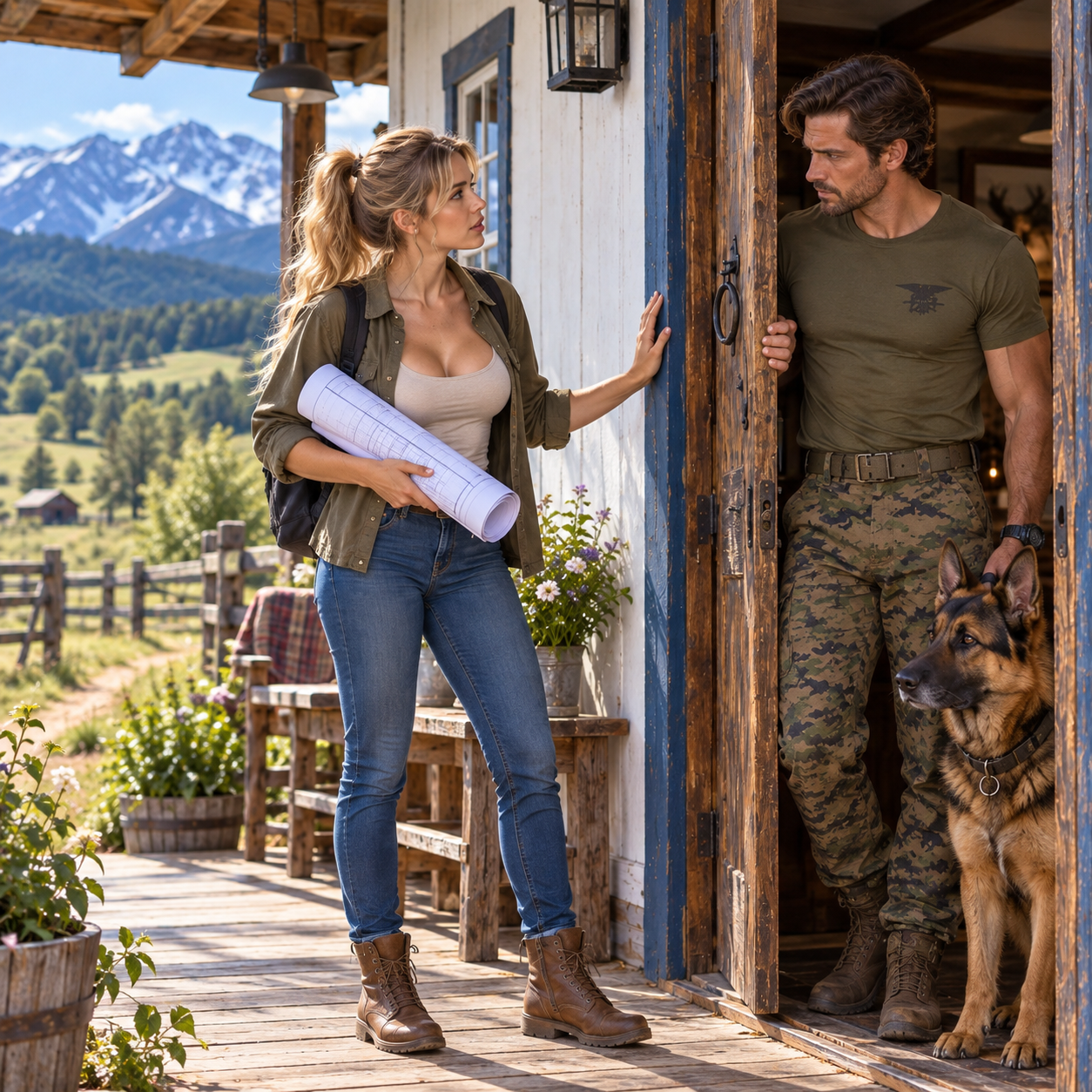
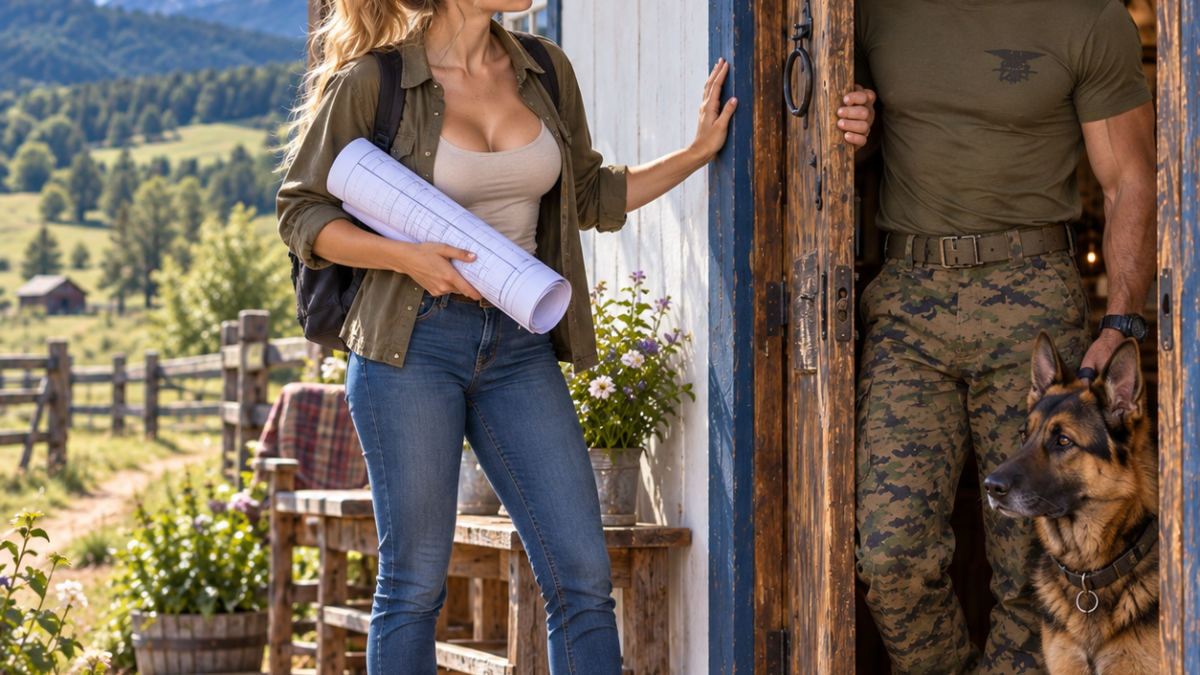
At the end of a road most people had learned to avoid lived Dylan Hartwell, a former Navy Seal who wanted no visitors, no favors, and no questions. His German Shepherd, Bod, was usually the only company he needed, and the people nearby had stopped trying to change that. Rachel Donnelly had heard the stories about him.
She had no reason to test them until an old irrigation channel left her family and several neighboring farms depending on permission from the one man least willing to give it. Rachel had been taught that every problem could be solved with enough knowledge and a good plan.
But the more Rachel pushed, the more she realized Dylan wasn’t protecting his land.
He was protecting something much deeper. And Rachel was about to find out why.
Late August made Grand Valley look both generous and tired. The peach harvest around Palisad was past its busiest stretch, but the orchard still held the smell of warm fruit, dust, and irrigation water moving through narrow ditches between rows. By midday, the soil on East Orchard Mesa baked hard enough to leave a pale crust around tire tracks, and growers had begun checking wells more often than they like to admit.
Nobody was calling it a crisis. Not yet.
Hartwell Ranch sat higher than most neighboring properties. At the end of a road that narrowed after the last mailbox and kept going through dry grass and old cottonwoods, there was no reason to drive that far unless you had business with Dylan Hartwell. and most people had learned to make sure they did before turning in.
Dylan was 35 and had been back on the ranch for four years. Before that, he had spent most of his adult life in the Navy, eventually serving as a SEAL. He did not talk about it much, and the details people in town repeated were usually less accurate than the things he never corrected.
He had not left because of a dramatic final mission. His last enlistment was ending when his father, Thomas, suffered a stroke that made managing the ranch alone unrealistic. Dylan came home expecting to stay a few months, get the operation steady, and decide what came next.
Security work was one possibility. Training was another.
He never made the calls. Thomas needed more help than either of them expected.
A few months became a year, then nearly two. By the time his father died, Dylan knew every weak section of fence, every valve that stuck in cold weather, and every sound the old well pump made before it needed attention. That had been 2 years ago, he stayed.
The military remained visible in small ways that had nothing to do with uniforms or stories. A wrench went back in the same drawer it came from. Gates were checked at nearly the same hour each evening.
Feed deliveries were written on a whiteboard even when Dylan already remembered them. If someone said they would arrive at 8, he noticed when their truck appeared at 7:53. Those habits had once belonged to a world where small inconsistencies could matter.
On the ranch, they mostly made him efficient. To other people, they could make him difficult.
Bod was the exception to several rules.
The 7-year-old German Shepherd had worked as a military dog during the later years of Dylan’s service and retired not long after Dylan returned to Colorado.
Age had softened a few things without turning him into an old dog. He still moved with purpose when Dylan gave him a cue.
Noticed vehicles long before they reached the house and preferred a place where he could see both Dylan and the nearest entrance. The rest of the day, he behaved more like a ranch dog who had discovered retirement had advantages.
He slept under the flatbed trailer when the shade reached it, followed Dylan along irrigation lines without pretending the work interested him, and somehow appeared whenever the metal feed bin opened. You heard that from the barn? Bod sat beside the feed room door and looked at him.
Dylan gave him half a biscuit. Anyway, across the valley, Rachel Donnelly had been home for 19 days and still had not decided whether the word home felt accurate. At 25, she had just finished her degree in soil and crop sciences at Colorado State University.
She had returned to Donnelly Orchard and Produce because her father wanted to reduce his workload for a while and because late summer was a useful time to look closely at the operation. The family grew peaches and apples along with sweet corn and several smaller vegetable plots.
Rachel told friends she was helping for a few months. After that, she would look seriously at Denver, Fort Collins, or somewhere else that offered the kind of work she had imagined through irrigation management lectures and soil labs.
There were consulting firms, precision agriculture companies, research programs, and enough directions to keep the future pleasantly undefined. She had not come back to stay.
Still, within a week, she had reorganized the irrigation schedule in her father’s shop, found two zones running longer than their soil conditions justified, and moved years of scattered field notes into a system someone other than Michael Donnelly could search.
Michael tolerated the last change with the patience of a man watching his daughter reorganize a language he already understood. Rachel also convinced him to try soil moisture sensors in two test areas rather than relying entirely on a fixed rotation and the habit of checking the ground by hand.
Michael still checked by hand. Rachel pretended not to notice.
Most of what she had learned worked exactly as intended. Good measurements exposed waste.
Better records made patterns easier to see. A clear plan usually prevented a small problem from becoming an expensive one. Rachel had been taught that every problem could be solved with enough knowledge and a good plan.
And so far, adult life had not given her many reasons to doubt it. Ben Ortega arrived on a Tuesday morning in a white service truck marked Mesa West Irrigation Services with three rolled maps on the passenger seat. He had been checking the Donnelly well after Michael noticed the recovery rate taking longer than usual.
The well was still usable. That was the first thing Ben made clear.
The second was that the Donnies were not the only ones watching numbers move the wrong way. A few properties lower in the valley were stretching watering intervals. One grower had delayed planting a late crop.
None of it amounted to disaster, but September would be easier if they had another source to lean on. Ben spread one of the older maps across a workt in the packing shed. A narrow blue mark crossed the upper ground before bending towards several properties below.
The old Red Mesa lateral had once carried water by gravity through that section of the valley. Private wells, pumps, storage, and newer systems gradually made the branch less important, and eventually parts of it were abandoned.
Ben had been comparing old records with current elevations when he realized one stretch might still be useful. If it existed, the line crossed Hartwell Ranch.
Ben tapped the map near the middle of Dylan’s property.
This is the part I can’t answer from paper.
Rachel studied the route. If the grade is still there, then we see whether it can be recovered.
If it’s gone, we stop talking about it.
That sounded straightforward enough. By lunchtime, Rachel had already begun listing what an inspection would require.
Other people were less interested in the list. Martha Jensen owned an orchard less than two miles away and had known the Heartwells for years.
When Rachel mentioned asking Dylan for access, Martha gave her the kind of look reserved for someone volunteering for unnecessary trouble.
He doesn’t like people on that place.
Rachel said she only needed a short inspection.
Martha simply answered, “Ask before you open anything.”
Later that afternoon, Cody Barnes heard about the map while loading empty fruit bins behind the packing shed. Younger than most growers in the area, Cody treated nearly every inconvenience as an invitation to joke.
If you take a clipboard up there, don’t expect it to come back with a signature.
Rachel smiled. That reputation is getting a little dramatic. Cody shrugged.
Go find out. Sam Whitaker, who was helping Michael repair a pallet jack nearby, did not laugh.
He had known Thomas Hartwell long before Dylan left for the Navy. When Rachel asked whether Dylan had always been so private, Sam set his wrench on the bench before answering.
No. No. Rachel waited.
Sam looked toward the open packing shed door where late sunlight lay across the yard.
Some people close a gate because they don’t want anybody in, he said.
Some get tired of explaining what’s behind it.
Rachel considered asking what he meant, but Sam picked up the wrench again, and the moment passed without turning into a story. She did not think much about it that evening.
There was water to account for, acreage to compare, and a route on an old map that either worked or did not. Whatever history Dylan Hartwell had with his neighbors did not change the slope of the land.
The next morning, Rachel placed her tablet on the passenger seat, added a printed aerial map, and slid a temporary access agreement into a folder beside them. Then she drove toward the road that ended at Hartwell Ranch. Rachel reached Hartwell Ranch a little after 9.
Next morning, the road narrowed after the last orchard. The pavement giving way to packed dirt bordered by rabbit brush and dry grass.
She passed one mailbox, then another, and finally a stretch where there were no houses visible at all. At the end stood a dark wooden gate, weathered enough that the grain had risen along the top rail. Beyond it, the ranch opened toward a low house.
A barn, and several sheds set against the pale ground of East Orchard Mesa. Dylan was working beside the equipment shed when her car stopped.
He had a length of irrigation pipe braced against one boot and was loosening a fitting with a wrench. Bod lay beneath the flatbed trailer 20 ft away where the dirt remained cooler.
The dog lifted his head first. By the time Rachel stepped from the car, he was already standing. Bod did not bark or rush the gate.
He moved toward Dylan instead, stopping slightly behind his left side and watching Rachel with the quiet concentration of an animal accustomed to noticing changes before deciding what they meant. Dylan looked at her car, then at Rachel, she carried the folder from the passenger seat that seemed to answer a question he had not asked.
Rachel introduced herself and mentioned Michael Donnelly.
Dylan knew the name, though he had not seen Rachel’s father in some time.
That small connection gave her enough confidence to move quickly to the reason she had come. She explained that the Donnelly well was recovering more slowly than it had earlier in the season. Several growers farther down were watching similar declines and Ben Ortega had found an old map showing the Red Mesa lateral crossing the upper portion of Hartwell Ranch.
No construction was being proposed yet. All they wanted was permission for Ben to inspect the abandoned section and determine whether enough of the old grade remained to make recovery practical. Rachel had rehearsed the explanation once in the car.
It came out even cleaner than she expected. She gave Dylan an estimate of how long Ben would need, pointed out the number of properties that might benefit, and made clear that nobody was asking for ownership, an easement, or permanent access.
The inspection could be limited to a small area and scheduled around Dylan’s work.
Every piece of information was useful. Together, they sounded less like a question than a proposal waiting for approval. Rachel opened the tablet and brought up the aerial image Ben had marked.
Dylan looked at the screen only long enough to understand what she was showing him. Then she reached into the folder. The temporary access form was one page.
Dylan<unks attention shifted to it before she had finished pulling it free. Are you asking me?
He said, or explaining why I should say yes. Rachel stopped with the paper halfway between them.
I’m giving you enough information to make the decision.
He glanced toward the upper pasture where the old lateral was supposed to run.
I’ve got enough for the one I’m making.
Rachel waited. Dylan looked back at her. No, there was nothing theatrical in the word.
He did not raise his voice or turn it into an argument. He simply stood on his side of the gate with Bod beside him and treated the matter as settled. Rachel was not accustomed to a discussion ending before the other person had examined the available information.
She tried once more, explaining that the inspection itself would not commit him to anything, and that restoring the lateral could reduce pressure on several wells. Dylan listened without interrupting, but his expression changed very little. No one goes up there.
Ben would only need, “I heard you.”
That was the end of it. Rachel put the form back into the folder, thanked him with more formality than warmth, and returned to her car.
In the rear view mirror, she saw Dylan walk back toward the irrigation pipe.
Bod followed him a few steps, then stopped and looked toward the road until Rachel’s car disappeared around the bend.
By the time she reached Donnelly Orchard, Rachel had constructed several versions of the conversation in which Dylan had behaved more reasonably. Michael was sorting invoices in the small office beside the packing shed when she came in. Rachel put the folder on his desk harder than necessary and told him the inspection had been refused.
Her father listened while she described the meeting, including the amount of information Dylan had declined to consider. When she finished, Michael adjusted one of the invoices and asked whether she had ever asked Dylan what he would need in order to feel comfortable with the inspection.
Rachel frowned. That was what the information was for.
Michael looked up.
That isn’t what I asked.
Rachel started to answer, then stopped. Her father did not defend Dylan. He did not suggest they abandon the lateral or pretend the refusal was sensible.
He only returned to the invoices and said there was a difference between explaining why you needed something from a man and finding out what he needed before he could give it. Rachel spent the rest of the afternoon deciding that distinction was more philosophical than practical. 3 days later, she saw Dylan again.
Mesa feed and irrigation occupied a long metal building on the edge of Palisade with fencing rolls stacked along one wall and shelves crowded with valves, hose clamps, fittings, pump parts, work gloves, and things Rachel had learned to recognize only after growing up around them. She was comparing two pressure regulators when Dylan came through the rear aisle carrying a box of filters.
Rachel almost let him pass. Instead, she remembered the revised notes on her tablet.
She had taken her father’s criticism seriously enough to change the presentation, though perhaps not in the way Michael had intended.
The access form was gone.
She had reduced Ben’s estimate to four simple points: approximate inspection time, personnel, route, and projected benefit.
No signatures, no legal language, nothing Dylan could mistake for an attempt to establish permanent access. She caught up with him near the counter.
I simplified it. Dylan looked at the tablet.
Rachel showed him the first page and explained that the visit could be kept under 2 hours if Ben entered from the lower service track. She had also marked the exact area they needed to see, so nobody would wander through the rest of the ranch. Dylan listened for perhaps a minute.
Then he looked from the screen to her. So, you turn my no into a slideshow? Rachel lowered the tablet.
It isn’t a slideshow.
Dylan glanced at the second page. It has arrows.
That doesn’t make it a slideshow.
Something almost resembling amusement touched his face. Though it did not last long enough for Rachel to decide whether she had imagined it. She changed course and told him she was trying to make the request clear.
It was clear the first time.
You didn’t even read what I brought.
I understood what you wanted. You understood enough to refuse it.
That’s usually how refusing works.
Rachel stared at him. The conversation might have become an argument if Dylan had sounded smug.
He did not. He sounded tired of a subject he had already decided was finished.
She locked the tablet screen.
You know, people keep warning me that you’re difficult.
Dylan shifted the box against his hip. Sounds like they saved us both some time.
He paid for his filters and left. Rachel remained beside the counter for several seconds before remembering why she had come into the store.
The irritation followed her home, but something else came with it. During both conversations, Dylan had listened without much reaction while she talked about reduced well output, irrigation schedules, crop losses, and neighboring properties.
He had not mocked the project or said the other growers were not his concern. Even the possibility of repairing the old lateral had not seemed to bother him by itself.
The resistance sharpened around different words. Access, agreement, permission, people entering his property. Rachel wrote those four items at the edge of her notebook that evening, then circled none of them.
She still did not know what they meant, only that the pattern was becoming difficult to ignore. Ben spent the next several days helping her examine alternatives. A new well was technically possible, but the cost would be high, the timetable uncertain, and drilling deeper did not guarantee the yield they needed.
Martha Jensen had a storage pond, though its available capacity would do little for anyone beyond her immediate acreage. Ben also traced a possible route around the Heartwell property, but the elevation worked against them, and the extra excavation would make the project far more expensive than recovering the old lateral. Each time Rachel moved old Red Mesa lateral to the bottom of her notes, the numbers pushed it back to the top.
No one was facing ruin. The orchards were still green. Trucks still came for produce and irrigation water still moved where it was supposed to move most days.
The problem was narrower than that and therefore in some ways more frustrating. Several small farms were entering the last part of the season without the margin they usually relied on.
The abandoned lateral remained the most practical answer. Dylan remained the least practical part of it. Rachel might have held on to that conclusion longer if the cottonwood had not fallen.
A hard afternoon wind came down from the mesa and broke one of the older trees beside a shared farm road used by three properties. By early evening, the trunk lay across both tire tracks. Its crown tangled in the ditch.
Rachel found Dylan there on her way back from checking a sensor. His tractor was angled toward the tree with a chain running from the rear draw bar to the trunk.
Bod sat well away from the equipment in the shade of a utility pole. Watching Dylan work. No one else was there.
Rachel pulled over. Dylan saw her but kept working until the trunk had been dragged far enough to clear one side of the road. He climbed down to move several smaller branches by hand.
Rachel walked closer, careful to stay out of the tractor’s path.
So, you do help people. Dylan picked up a branch and tossed it onto the pile. This road goes to my place, too.
Of course, it does. He looked at her.
Rachel was smiling now. Dylan shook his head once and went back to work.
A day later, Martha supplied another piece without realizing Rachel was collecting them.
They were checking irrigation timers behind Martha’s packing room when Rachel mentioned the fallen cottonwood.
Martha said Dylan had always been like that about practical problems. The previous harvest, a breaker controlling part of her cold storage system had begun tripping while bins of fruit were being brought in.
She had planned to call an electrician first thing in the morning. When she arrived before sunrise, the panel was already fixed.
Dylan had noticed the trouble the night before while dropping something off. Martha had tried to thank him.
He told me the breaker was annoying him, she said. Rachel laughed. Martha did too, but only briefly.
On the drive home, Rachel found herself thinking less about the man who had twice refused her, and more about the one who dragged trees from shared roads and repaired equipment before anyone could ask. The two versions did not fit neatly together. That interested her more than she wanted to admit.
Dylan Hartwell seemed determined to keep people at a distance, yet he kept appearing wherever something practical needed to be done. He would give away his time, his labor, even parts from his own shop, as long as nobody made too much of it afterward. Rachel had spent two visits trying to find a better way to explain why the lateral mattered.
For the first time, she began to wonder whether explanation had ever been the problem. Rachel waited 4 days before driving back to Hartwell Ranch. The delay was partly deliberate and partly practical.
Ben had other jobs. The Donnelly well still required monitoring, and there was enough work around the orchard to keep Rachel from inventing reasons to leave. Even so, the old lateral remained in the corner of her thoughts, usually appearing when she was doing something unrelated.
What bothered her most was that she no longer believed Dylan’s refusal came from simple stubbornness.
That made the problem harder. It also made her less interested in arriving with another answer already prepared.
On the fourth morning, Rachel left the tablet on her desk. The folder stayed there, too. She drove to Hartwell Ranch with nothing on the passenger seat except a water bottle and a pair of work gloves she had forgotten to remove after checking irrigation lines the day before.
The gate looked exactly as it had during her first visit. Dylan was near the barn, carrying two lengths of pipe toward the equipment shed. Bod moved across the yard several yards ahead of him with a black rubber training bumper in his mouth.
The old kind marked by scratches and tooth impressions that had collected over years of use. Rachel parked outside the gate and got out. Dylan saw her almost immediately.
He set the pipe down but did not hurry toward her. Bod noticed the car next.
The shepherd came closer to the fence without any particular urgency, carrying the bumper loosely between his teeth. Rachel stayed where she was.
She had watched Bod enough during the previous encounters to understand that his interest did not automatically mean invitation. He stopped near the gate. The bumper slipped from his mouth, hit the packed dirt, and rolled beneath the lowest rail.
It came to rest beside Rachel’s boot.
For a moment, neither of them moved. Bod looked at the bumper, then at Rachel.
She glanced toward Dylan, who was still crossing the yard. Rachel did not reach through the fence or try the latch. She simply placed the side of her boot against the rubber bumper and pushed it back under the rail.
It rolled three feet into the ranch. Bod picked it up and walked away. Rachel smiled despite herself.
A minute later, he came back. The second drop landed close enough to the first that Rachel suspected coincidence had become less likely. Again, she pushed it beneath the fence with her boot.
By then, Dylan had reached the gate. He usually gets people to throw it.
Rachel watched Bod carry the bumper toward the shade. I figured that was probably the plan.
You could have picked it up. She looked at the wooden rails between them. Your fence.
Then she nodded toward Bod and apparently his bumper. Dylan looked over at the dog.
Bod had already lost interest in the conversation.
There was the smallest change in Dylan’s expression, more visible in the absence of tension than in anything Rachel could have called a smile.
She did not use it. That was the difference.
During the first two visits, Rachel would have seen a softened moment as an opening and filled it immediately with information.
She would have explained Ben’s schedule, the projected flow, the acreage below the ranch, and every reason the inspection made sense.
This time, she rested one hand on the top rail.
I’m not here with paperwork, I noticed.
I have one question, Dylan waited. Rachel looked past him toward the upper ground where the abandoned lateral was supposed to cross the property. What would have to happen for you to be comfortable letting Ben look at it?
The question sat between them longer than Rachel expected. Dylan did not answer with another refusal. He looked toward her car first, perhaps checking for another passenger, then toward the barn.
Bod had settled near the trailer again with the bumper between his paws. How many people, Ben and me?
No crew, no equipment, whatever he can carry. Dylan looked back at Rachel.
And if he thinks it can be fixed, then we talk again.
Looking isn’t permission to start anything.
That mattered. Rachel could see it without needing him to say so. How long?
As long as he needs to know whether we’re wasting our time.
Couple hours, maybe less. Dylan stood with one hand resting on the latch. Rachel waited.
She did not add that September was coming.
She did not mention Martha’s orchard or Cody’s delayed planting.
She did not remind him that the inspection cost him nothing. For once, she let the question remain only a question.
Dylan lifted the latch. The gate opened inward just wide enough for Rachel to pass.
Two people, two, you stay on the route I show you. We will.
If Ortega wants to see something outside that route, he asks first. Rachel nodded.
Dylan opened the gate another foot. That was all.
Two mornings later, Ben’s service truck stopped outside Hartwell Ranch shortly after 8.
Rachel arrived behind him. Dylan was already waiting. Bod sat near the porch, alert enough to notice both vehicles, but showing none of the focused posture Rachel had seen when unfamiliar trucks first came onto the property.
Ben carried a measuring rod, a hand level, a compact rangefinder, and a small field bag. There was no machinery, no trailer, and nobody else. Dylan unlocked the gate.
The three of them headed uphill on foot. The old red mesa lateral was not immediately obvious. For the first h 100red yards, Rachel saw little more than a shallow depression cutting across dry ground.
Rabbit brush had grown along both sides, and windb blown soil had softened the edges until the channel looked less like irrigation infrastructure than an old scar the land had begun covering. Farther up, the original shape returned. A short stone section appeared beneath weeds.
One side had held surprisingly well. The other had slumped inward, leaving sediment where water once ran.
Ben slowed there. He took measurements, checked elevation, and walked 20 yards farther before coming back. Dylan remained close enough to answer questions, but did not hover over him.
Bod followed for part of the route, stopping now and then to investigate rabbit scent or an old fence post before returning to Dylan without being called. When Ben began working around the stone section, the dog found shade beneath a cottonwood and lay down.
The inspection had none of the drama Rachel had attached to it in her head. It was mostly walking, measuring, stopping, looking again.
That more than anything made Dylan’s earlier resistance feel harder to understand.
They reached a section where the channel nearly disappeared beneath collapsed earth and dried vegetation. Ben crouched beside the bank and cleared loose soil with one gloved hand.
“This was probably the first real failure,” he said.
Dylan looked down at the damaged section.
“My dad kept this stretch open.”
Rachel glanced at him. It was the first time Dylan had mentioned Thomas since she had begun asking about the lateral. He still used it.
Not much by the end. He liked keeping it serviceable. Ben moved farther along the bank while Dylan stayed where he was.
Rachel looked at the slope. What happened? Dylan took a moment before answering.
Maintenance stopped. There was no accusation in the sentence, just fact. My dad got sick.
I came back.

