Former Navy SEAL Fixed an Old Man’s Truck for Free—“Stay Away from My Father,” His Daughter Said – Part 5
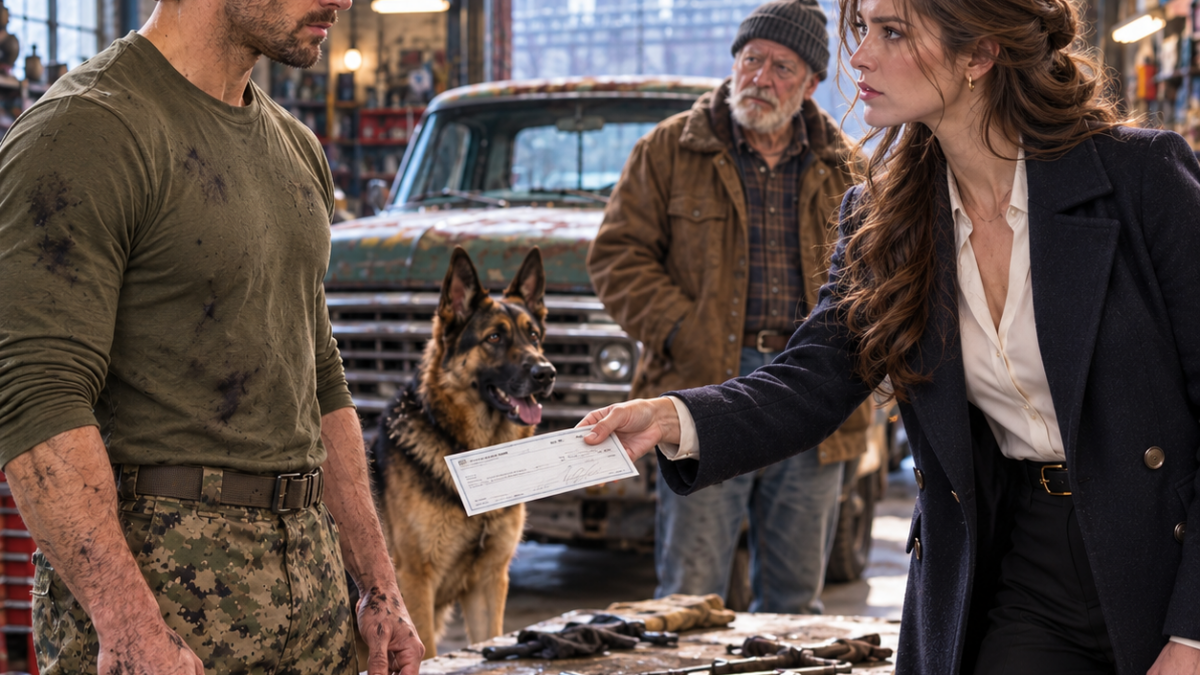
Frank had returned early. The noise caught him off guard. He stopped in place for a moment, shoulders tightening.
Mason saw it. So did Atlas.
The dog looked toward Mason and waited. Mason gave a small hand signal.
Atlas crossed the room and sat beside Frank.
Frank rested one hand against the dog’s neck.
A few breaths later, the tension left his shoulders. He nodded once and returned to what he had been doing. One of the inspectors noticed.
He said nothing. Later, another inspector set a clipboard on the edge of a table while checking a doorway. It slipped to the floor.
Atlas looked toward Mason again. Another small cue.
The German Shepherd picked it up carefully and carried it back. Harold watched from several feet away. At least one employee passed.
Julia closed her eyes. The inspector smiled despite himself. It was the first light moment of the morning.
The final conversation happened near the main entrance. The result was not perfect. The workshop with the unresolved safety issue would remain closed.
No exceptions. Mason expected that the classrooms, diagnostic area, office spaces, and other approved sections could open with restrictions while the remaining work was completed. The inspectors would return after the repair.
Julia listened closely. The disappointment on her face was controlled but visible. For months, she had measured the project against a clean opening date.
Now, second watch would begin with one section behind a closed door. Mason did not argue with the decision.
He did not ask the inspectors to overlook anything. He simply confirmed what could open, what had to remain closed, and what needed to be finished before the follow-up.
That calmness seemed to matter more than persuasion would have. After the inspectors left, Julia stood in the hallway looking toward the closed workshop. We were supposed to be finished.
Mason leaned against the wall beside her.
We’re ready enough to open safely.
That isn’t the same thing.
No. He let the silence sit.
Then he told her something Jack had never taught him. That lesson had come earlier.
A good plan was not one that survived every problem unchanged. A good plan was one that still gave people a way forward after something went wrong.
Julia looked toward the classrooms where chairs were already in place. Then toward the temporary barrier, closing the workshop. For once, she did not open the schedule.
3 days later, the technicians finished the remaining work. The inspectors returned.
The workshop passed. By that afternoon, the temporary barrier was gone.
Second watch could open fully. Mason stood in the center of the workshop while Atlas wandered in, circled once, and lay down beneath one of the adjustable workts Julia had approved weeks earlier.
Frank came through the doorway behind him. Harold followed, carrying coffee. Julia entered last.
For several seconds, nobody said anything. The room was not perfect. There were still small marks on the floor.
One cabinet door closed harder than the others. A corner of the wall would eventually need another coat of paint. Mason looked around anyway.
Second watch was ready. Not because nothing had gone wrong, because they had learned what to do when it did. Opening day arrived beneath a clear morning sky and 6 ines of fresh snow.
The roads had been plowed before sunrise. Thin steam lifted from rooftops as daylight spread across Spokane Valley, turning the warehouse roofs bright enough to make people squint.
Second Watch did not open with a crowd large enough to block traffic. Harold had resisted that idea from the beginning.
There were veterans, family members, instructors, a few Northline employees, local partners, and the people who had spent weeks carrying boxes, arguing over equipment placement, cleaning floors, filling out forms, and discovering that opening a building required far more decisions than anyone admitted at the beginning. That was enough. Inside, coffee was already disappearing faster than expected.
Atlas moved through the room with the confidence of someone who believed the entire event had been arranged for him. Harold wore his old canvas jacket. Julia had brought a suit coat anyway.
It remained hanging in her office. Mason found Harold near the main bay, listening to Frank Delaney explain a diagnostic tool to another veteran.
A few months earlier, Frank had stood near the entrance, saying he was not looking for another career and had barely wanted to touch equipment newer than the tools he remembered. Now he was leaning against a workbench.
Patient and unhurried, showing someone else where to begin, he never grabbed the controls. He asked questions.
What changed? What stayed the same? What had the machine already told them?
Mason recognized his own influence in that, though he suspected Frank would deny it if asked. More important, Frank looked different, not younger.
That would have missed the point. He looked occupied.
There was somewhere his attention belonged. A local utility contractor had offered him part-time work 3 days a week, inspecting returned equipment, reviewing maintenance records, and helping younger mechanics catch problems before they became expensive. Frank had accepted.
He did not call it a new career. He said he was simply tired of having Mondays with nowhere to go.
That answer stayed with Mason longer than any speech could have. The short opening ceremony ended without much ceremony. Harold refused a podium.
Julia gave a brief welcome. Mason said even less.
Second watch had not been built to make speeches about veterans. It had been built to give people a place to use what they still knew. That seemed explanation enough.
Afterward, Frank found Mason near the workshop and asked him to bring Harold outside. They followed him around the side of the building to a sheltered space near the main entrance.
A bench sat against the brick wall. It was heavy, simple, and clearly handmade. Frank had built the frame from leftover steel that had once supported old warehouse shelving.
The seat and back were made from reclaimed timber found inside the building, sanded smooth, but not polished enough to erase every mark. Mason ran one hand across the wood. He could still see old nail holes.
Frank had left them. At the center of the back rest was a small brass plaque. Second watch.
Frank stood with both hands in his coat pockets. For once, he seemed uncomfortable being the person everyone was looking at. He did not make a speech.
He only said the center had reminded him of something he had apparently forgotten for a while.
Useful and young aren’t the same word.
Harold looked away for a moment. Mason understood why.
Frank had spent enough years being needed that losing that feeling had been harder on him than losing a job. Now he had made something with his hands and put it outside a building where other people might find their own reason to come back tomorrow.
Harold sat first. Mason joined him.
Atlas walked beneath the bench, turned once and lay down across both men’s boots.
Harold looked down. Well, ownership appears settled.
Frank laughed. So did Mason. The bench stayed.
By late afternoon, most visitors had gone. Mason was helping stack extra chairs when Julia appeared carrying a folder. He stopped.
She noticed his expression. You realize not every folder contains an ambush.
Statistically, I’m still cautious.
Julia handed it over. Northline wanted Mason to continue running the technical side of Second Watch after the six-month project term. The offer was longer term with stable salary, benefits, and enough authority to make the work worth accepting.
Mason read more carefully than Julia expected. Then he reached the second proposal.
Northline also wanted to invest in Reed Motorworks, not buy it, not rename it, not absorb it into Northline. The plan was to help Mason expand enough to handle a limited number of fleet accounts without turning the garage into something Jack Reed would not recognize. The investment came with defined terms.
Mason retained control over repair standards, staffing, and customer recommendations. There was no clause requiring him to sell unnecessary work. No condition that he stop serving longtime customers.
No attempt to replace the old name above the door. Mason closed the folder halfway. And if I say no, Julia leaned against the table.
Second watch still wants you. That answer mattered more than the proposal. The first time Julia had offered him money, it had been attached to disappearance.
This time, the money was attached to work he had already proven he could do. There was another difference.
Over the previous several weeks, Julia had begun helping Reed Motorworks with Mason’s permission.
She had not redesigned the garage. She had organized the parts Mason had never been good at organizing. Customers could now request appointments online without losing the option to call.
Service reminders went out automatically instead of depending on Mason remembering that Mrs.
Callahan’s Buick had been due 3 weeks earlier.
Outstanding invoices were tracked. Estimates waiting for approval no longer vanished beneath supplier statements.
Julia had also helped arrange a small number of predictable fleet accounts carefully scheduled so the garage would not become overwhelmed by volume. The website remained plain.
The waiting room still had the same old chairs. There was no espresso machine, no leather sofa.
The coffee pot remained old enough to vote. Most important, Mason still told customers the truth. If a vehicle was worth fixing, he said so.
If it was time to stop spending money on it, he said that, too. Julia had not made Reed Motorworks more aggressive, she had made it less forgetful. The bank noticed stable second watch income, improved collections, and the new fleet agreements gave Mason enough consistency for the loan to be restructured.
The heater was replaced. The lift received the parts it actually needed. Mason hired another veteran from Second Watch for part-time work and created a few scheduled hours each month for customers facing real financial difficulty.
That mattered to him. For years, helping people had meant giving away time whenever someone asked. Now the garage could plan for kindness instead of allowing kindness to quietly drain it.
Jack might have called that suspiciously organized. Mason thought he would have approved anyway.
The sign outside Reed Motorworks was repainted in the same red Jack had used years earlier. Mason kept the old lettering style.
Inside, Jack’s stool remained beside the workbench.
Nobody sat on it. Some traditions were still traditions.
Others had simply needed better paperwork. Several weeks after opening day, Harold called Mason and Julia to a small vehicle bay behind second watch. The green pickup waited beneath the lights.
For the first time since Mason had known it, the truck looked ready for another 20 years. The body had been repaired, the engine rebuilt, the seats restored.
Chrome had been cleaned rather than replaced wherever possible. Harold walked around it slowly, taking in each change.
Julia opened the passenger door. Most of the interior looked renewed. One thing did not.
Beneath the dashboard sat an old CB radio. The casing was scratched. The microphone had faded from years of use.
A strip near the cord had once been wrapped and rewrapped enough times to leave a permanent mark. Julia had originally suggested replacing it with something cleaner. Mason had not.
He had repaired the bracket, cleaned the contacts, secured the old microphone, and left the case exactly as it was. Harold reached through the open door and touched it. For several seconds, he said nothing when North Line had consisted of only a few trucks.
That radio had been one of the ways drivers stayed connected across long winter routes. Margaret used to call the base station when weather turned bad. She would ask whoever answered how far Harold was from home.
Sometimes he would hear her voice come through that old radio before he reached Spokane. Harold rubbed his thumb across the worn microphone.
Then he stepped away before anyone could turn the moment into something larger than he wanted. Runs better now. Mason nodded.
Much. Harold looked pleased.
Good. He left them standing beside the truck. Julia remained near the passenger door.
Across the lot, Reed Motorworks could be seen beyond the edge of the property. Its repainted sign bright against the late winter gray. She looked toward it.
I changed the system. Mason followed her gaze. You kept the soul.
He looked at her.
I’m not sure if that’s a compliment or an invoice.
Julia laughed. The sound had become easier around him over the last few months. Then she asked if he wanted to have dinner.
Not a meeting, not a working dinner. Not a conversation about contracts, budgets, veterans programs, fleet accounts, or the survival of Reed Motorworks.
Dinner. Mason looked at her for a moment. He had spent months learning Julia through disagreement.
He knew when she was tired by the way she removed her glasses. He knew when a number bothered her before she mentioned it.
He knew she had begun keeping dog biscuits in one desk drawer while insisting they were there only because Atlas expected them. What he did not know was what they would be when there was finally nothing left to negotiate.
That seemed worth finding out. I picked the restaurant.
Julia narrowed her eyes. Why?
I’d like somewhere with prices on the menu.
She shook her head. Deal.
Atlas had been lying near the bay door at the word dinner. His head came up.
Then the rest of him followed. Julia looked at the German Shepherd already standing beside Mason. Is he invited?
Mason glanced down. Atlas was looking toward the exit.
I don’t think either of us was consulted.
Outside, snow had begun falling again over Spokane Valley. Light enough to drift beneath the parking lot lamps without covering the pavement. Back at Reed Motorworks, the new heater ran steadily through the cold.
No rattle, no hesitation.
And beneath Jack Reed’s old sign, the garage stayed open.
There are some sounds that tell you more than words ever could. An old heater finally running without a rattle.
A coffee mug settling onto a workbench before sunrise. A German Shepherd shifting under a bench because somebody has stayed talking longer than expected.
Those little things stayed with me.
I’ve known people who could fix almost anything with their hands, yet had a hard time believing anyone still needed what they knew.
Age can do that quietly. So can retirement, loss, or simply waking up one morning without a place that expects you to show up.
Maybe that is why Frank’s Monday mornings mean so much to me.
Not because he became somebody new, but because he found a place where the man he already was still mattered. This is a fictional story, but that feeling is not fictional at all.
I suspect many families have watched someone they love struggle with the question of whether they still have something to give. Sometimes a little grace looks less like an answer and more like a chair pulled closer, useful work waiting, or a patient dog resting nearby.

