Former Navy SEAL Heard Two Women Laugh at a Widow—Then He Quietly Stepped In – Part 1
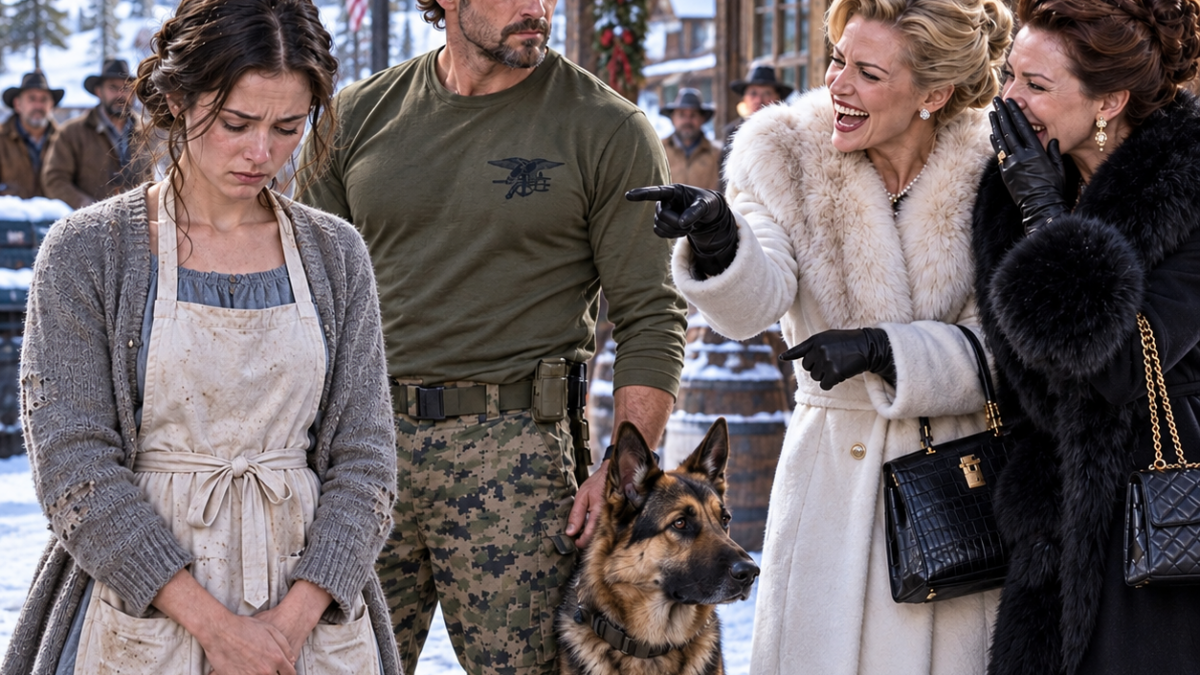
Former Navy SEAL Heard Two Women Laugh at a Widow—Then He Quietly Stepped In
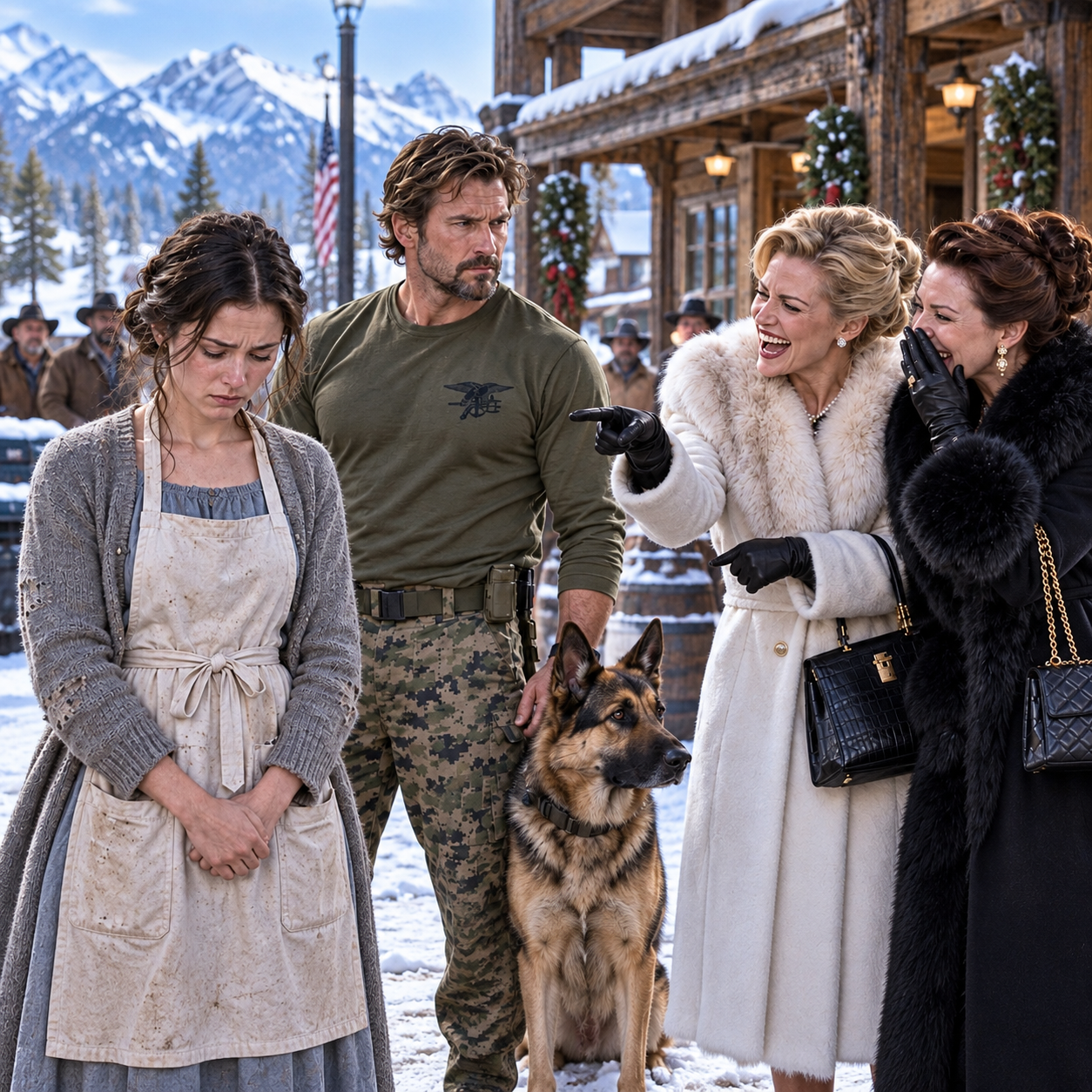
That red wool is nearly $40 a yard. The other woman looked Clara over and laughed.
Sweetheart, judging by those clothes, I’d say expensive fabric is the least of your problems.
Clara quietly put the thread she couldn’t afford back on the counter and reached for her bag.
Everyone knows she can barely keep that farm anymore. The laughter followed her toward the door.
Neither woman noticed the man standing near the entrance, his German Shepherd beside him. Ethan Mercer had heard every word.
The former Navy Seal didn’t raise his voice or make a scene.
He walked to the counter, glanced at the deep red wool they had been admiring, and said, “Wrap the whole bolt.” The women thought that was the end of it.
By 8 that morning, bitter root merkantile and feed had already collected the usual winter clutter near its front door. Salt tracked in from boots, cardboard boxes waiting to be broken down, and two feed sacks left against the wall. Outside, the last snow had gone gray along the parking lot edges beneath a pale, dry sky.
Clara Whitmore came in with a folded list in one hand and a canvas grocery bag in the other. She moved through the store without browsing, pausing first at the feed counter, then the rack of industrial needles, then the register where Walt Brener kept heating oil vouchers in a locked drawer. She added two spools of heavy upholstery thread only after checking the prices twice.
Walt rang up the feed, the voucher, the needles, and the thread. Clara watched the total climb on the small display.
She opened her wallet, counted the bills once, then again with her thumb pressed against the edge of the counter. There was no embarrassment in the motion. Only arithmetic.
“Take the black thread off,” she said.
Walt glanced at the spool.
“You sure?”
“I can hold it till Friday.
I know you can.”
She put the spool back beside the register herself. No request for credit followed, and Walt knew her well enough not to offer again.
A few feet away, Denise Voss had been comparing wool blends with Gwen Talbot. Denise wore a cream coat that still looked new despite the season, and Gwen had spent several minutes deciding between two shades of red, as though the choice might alter the course of her winter.
Neither woman had been part of Clara’s morning, until Denise looked toward the register.
That red is nearly $40 a yard,” Denise said, loud enough to travel.
Gwen followed her glance to Clara’s patched work coat, and laughed.
Denise lifted one end of the deep red bolt and ran the fabric through her fingers.
“Some things just require the right setting,” she said.
“You don’t buy wool like this to wear it around a feed shed.”
Clara slipped her wallet back into her bag. Gwen gave a small laugh. Looking at some people, any new fabric would be an improvement.
Walt stopped moving behind the counter. Clara did not. She took the receipt he offered and folded it once before putting it away.
Denise had heard enough at home to know that Whitmore Farm was under pressure. Martin did not discuss customers by name as a rule, but small town privacy had a way of thinning at the edges, especially when a property had been mentioned more than once over dinner. Denise knew there had been late payments.
She knew an appraisal vehicle had gone up Whitmore Road. She knew Clara had sold a piece of equipment in the fall. Knowledge that incomplete should have made her careful.
It did the opposite. Honestly, Clara, she said, shifting to a tone that pretended concern.
There’s no shame in admitting when a place has become too much for one person.
You can work yourself into the ground and still end up in the same place. Clara turned.
Then Clara looked at Denise, then at Gwen. Morning.
That was all. She picked up her bag and the feed ticket Walt had stapled to it.
Near the far end of the counter, Nash lifted his head.
The German Shepherd had been lying beside Ethan Mercer’s boots while Ethan waited for a box of fencing staples from the stock room.
Nash did not growl or stand. His ears moved forward at the change in voices, and his eyes followed Clara as she crossed toward the door. Ethan had heard enough.
He was 43, old enough to know that not every ugly moment improved when another man inserted himself into it. Years in the Navy had left him with a preference for understanding a problem before acting, and ranch life had reinforced the habit.
“This one was simpler.
” Denise turned back to the fabric as though Clara had already left the room.
“I’ll take 5 yards,” she told Walt.
“Maybe six.”
“I haven’t decided.”
Ethan walked over. He remembered a conversation from the cooperative meeting the week before.
Two ranch hands needed winter liners replaced and the usual supplier was backorded until January. He looked at Walt wrap the whole bolt.
Denise blinked. Excuse me.
Ethan did not look at her. Add it to mine.
Walt’s eyebrows rose, but only for a moment.
All of it? Ethan nodded. There was no speech after that.
No explanation about manners or money, and no pause designed to make Denise feel the room turning against her. Ethan went back to his list and asked Walt whether the mineral blocks had come in. By the time Clara pushed through the front door, the red wool was being rolled tighter and tied for the pickup.
She did not see it. Nash watched the door close, then lowered his head onto his paws again.
10 minutes later, Ethan and Walt carried the bolt outside along with mineral blocks, staples, and two bags of dog food. Ethan wedged the fabric behind the passenger seat where Nash could not step on it.
Walt shut the truck’s tailgate with both hands.
That was subtle. It was wool.
That’s one word for it.
Ethan glanced through the store window. Denise and Gwen were still inside, but whatever conversation they were having now required less volume. Walt pulled on his gloves.
Clara’s had a rough couple years.
Ethan looked at him, waiting rather than asking.
Daniel’s been gone almost two years now.
She’s kept the place going, more or less.
Sold the old BOR in October. Then some appraisal outfit was up there a while back.
Walt rubbed a thumb along the seam of his glove. Folks notice things. Folks usually notice half of things.
That, too.
Walt did not know the balance on Clara’s loan, and Ethan did not ask.
If Clara Whitmore wanted half the valley involved in her finances, she could invite them herself. Ethan climbed into the pickup. Nash rose from the passenger footwell.
Turned once and settled again with the resigned expression of a dog who had spent years learning that errands rarely ended when a human claimed they would.
“You’re right,” Ethan said, starting the engine.
“We bought too much.”
Nash looked out the window. The morning should have ended there. By 3 that afternoon, Ethan was sitting in the meeting room above the Bitterroot Range Livestock Cooperative Office with six other producers, a pot of stale coffee, and a preliminary packet from Northwest Range Foods.
The proposed regional processing and cold storage facility could shorten hauling distances for smaller ranches and farms, and the cooperative had been asked for input on supply volume and truck access. Nothing guaranteed the project would happen.
Most of the packet was still estimates, arrows, and boxes labeled proposed. Ethan listened more than he spoke. A project liaison moved through a slide showing three possible access concepts.
The first followed an existing county road, but required expensive improvements. The second approached from the south.
The third was marked in blue. Ethan leaned forward.
The line crossed a patchwork of private parcels before bending west. He knew most of those boundaries without needing the names.
A rancher learned the shape of neighboring land the same way other people learned streets. Then he saw one printed beside the blue line. Whitmore.
He looked again. The corridor ran close to Witmore Farm.
then continued toward the country west of it. Nothing on the page said the route was final. Nothing even said the listed owners had agreed to discuss it.
Still, the name stayed with him.
That morning, the talk inside the merkantile could have been nothing more than the small cruelty of people who knew a little too much about someone else’s hard year.
The blue line on the map belonged to a different kind of conversation, and Clara did not seem to know she was part of it. Ethan rested one hand on the edge of the packet.
He did not assume the bank was involved. He did not assume the appraisal vehicle meant anything beyond what appraisal vehicles usually meant.
Projects drew possible routes across private ground all the time before anyone negotiated seriously with an owner. But one practical question would not leave him alone.
Why was a proposed corridor already drawn across Whitmore property if Clara Whitmore did not seem to know there was a corridor at all? Three days later, Ethan turned off Whitmore Road with the Red Wool secured behind the seats and Nash sitting upright on the passenger side of the pickup.
The morning had cleared hard and bright after two nights below freezing. Brown fields showed through where the wind had stripped away old snow, and the Bitterroot mountains stood sharp against a pale blue sky.
Whitmore Farm sat farther back from the road than Ethan expected. The house was modest. White paint weathered at the corners with a narrow porch and a mudroom added sometime after the original structure went up.
Beyond it stood a low barn, a machine shed, and a smaller outbuilding with a handpainted sign that read Whitmore Stitch and canvas. Clara came out of that building before he reached the porch.
She looked at the bolt of red wool in his arms, then at Ethan. You actually bought all of it. I did.
That seems excessive. Probably. Nash climbed down after Ethan and paused beside the pickup.
He looked toward Clara, then toward the open door of the sewing shop, where warm air carried the faint smell of machine oil and coffee. Ethan shifted the fabric higher.
The cooperative needs winter work jackets. Some liners, too. 24 sets if you can do them.
Clara did not reach for the fabric. That why you bought it, it is now. Her mouth moved slightly.
Not quite a smile.
I don’t need charity, Mr. Mercer. Good. That made her look at him.
Ethan carried the bolt inside and set it on the long cutting table. Beside it, he placed a folder with names, rough measurements, quantities, and a delivery date 3 weeks away.
Several measurements were missing. One chest size had been crossed out twice, and somebody named Dale had apparently written regular, where a number should have been.
Clara opened the folder.
If you don’t want the job, Ethan said, I’ll take the fabric somewhere else.
But I need the jackets and you set your own labor price. She read the first page before answering. Who measured these men?
Mostly themselves. That explains a lot. This time she smiled briefly.
She turned another page, then looked at the wool. 3 weeks is tight.
Tell me what isn’t.
I’ll need the corrected measurements by Friday, and I’m not discounting the labor because you supplied the fabric.
I didn’t ask you to, Clara closed the folder.
Then I can do it. The agreement did not become warmer than that, but it became real. The shop was larger than Ethan had guessed from outside.
Two industrial sewing machines stood near the windows along with shelves of canvas, zippers, buckles, thread, repair patches, and folded horse blankets waiting for pickup. A pegboard held shears and hand tools in careful rows. The house connected to the shop through the mudroom.
From where Ethan stood, he could see a dark green work jacket hanging on a hook beside Clara’s coat.
It was a man’s jacket, old enough that the cuffs had gone soft.
On a shelf near the coffee maker sat a ceramic mug with Daniel printed across one side. Clara noticed where his eyes had gone. She did not explain.
Ethan did not ask. Nash entered the shop only after Ethan gave him a quiet cue.
He made one slow circuit around the room, nose low, then settled near a small propane heater. Clara glanced down at him.
He always inspect a workplace before approving it. Only the ones with heaters. She brought out a roll of pattern paper and spread one end across the floor.
Nash watched the paper move, stood, and stepped directly onto the cleanest open section before lying down. Clara stopped. Ethan looked at the dog.
Move. Nash looked back at him.
Nothing happened. Clara folded her arms.
Very disciplined.
He has a finely developed sense of where he’ll be most inconvenient.
How many years of training did that take? Most of them.
Clara caught the edge of the paper and slid it gently out from under Nash, one inch at a time. The dog allowed this without helping.
Clara spent another few minutes sorting Ethan’s measurement sheets into three piles: usable, questionable, and useless.
By the time she finished, Ethan had a list of eight people he needed to contact again. Before he left, Clara asked if he had a minute to look at the south gate.
The hinge on one side had dropped enough that the gate dragged whenever she opened it. Ethan followed her across the yard with a wrench and a small pry bar from his truck.
Nash came along at an easier pace. The repair was simple. Ethan lifted the gate, reset the hinge, and tightened the hardware while Clara held the far end steady.
She tested it twice. It swung cleanly.
Clara nodded toward the narrow field beyond the barn.
Since you’re already standing out here, tell me if this looks normal to you.
At first, Ethan saw only fence, dry grass, and the shallow irrigation ditch that crossed the lower edge of the property. Then he noticed three orange ribbons tied low along a line of temporary stakes. He walked closer.
Each stake had a small printed tag fixed beneath the ribbon. NRFA tree.
Northwest Range Foods. Access Concept 3.
the same blue route from the cooperative map. When did these go in?
Last week. Clara stood a few feet behind him. Two men came through with survey equipment.
Said they were checking a utility route for some development outside Hamilton. Did they ask permission? No.
What did you do? Told them they were on private property and they left. There was no pride in the answer, only fact.
Ethan looked along the stakes toward the ditch. Did they say who sent them? One said they were working off a preliminary order.
I didn’t recognize the company name.
He straightened. Has Northwest Range Foods contacted you? Who?
That answered more than he wanted it to. The project from the cooperative meeting processing and cold storage.
They’re looking at access routes.
Clara’s eyes moved back to the ribbons.
No one’s contacted me about a route.
Your bank? She frowned. Why would the bank contact me about that?
An easement, utility access, anything tied to the property? No. Ethan let the silence sit long enough for her to consider the question on her own.
Then Clara looked toward the house. I did get something from the bank.
She led him inside through the mudroom. Nash followed and settled by the kitchen wall. Clara opened a drawer beside the refrigerator and took out a white envelope with the Valley Heritage Bank logo.
I got this three days ago. The notice was only a few pages.
Ethan read the first one standing at the table. The language was formal but clear enough in its purpose. The loan had entered a cure period.
Clara had until a stated date to bring the account current. The figure due included missed portions of payments, late charges, property inspections, default servicing fees, and other account adjustments. Clara tapped the total with one finger.
That number isn’t what I thought I owed.
You keep your statements all of them. Have you compared them?
I tried. Her answer sounded irritated, mostly with herself.
Some of the fees don’t make sense to me.
Every time I think I’ve got the balance straight, something else shows up.
Ethan read the itemized section again. He had seen enough complicated numbers in contracts, ranch loans, and cooperative accounts to know that confusion was not evidence of fraud. Fees could be legitimate.
Inspections could be legitimate. A badly explained statement could still be correct.
One line made him stop. A property inspection fee had been posted during the same week.
Clara said the survey crew appeared on her land. That did not prove anything either.
It was simply the first detail that belonged to both pieces of paper.
“You have somebody who does your books?”
Ethan asked.
“I do my books for the farm and the sewing shop.”
“Yes,” he nodded.
The cooperative has a bookkeeper who’s better at bank statements than I am.
Clara took the pages back, but did not put them in the envelope.
“You want to show her this?
Only if you do.”
She looked at him for a long moment. Ethan did not fill it. Finally, Clara slid the statement across the table.
You can take a picture. Not the original. Fair.
And this does not mean you’re fixing my life.
Ethan took out his phone.
I wouldn’t know where to start.
That earned him the faintest change in her expression. He photographed the statement, returned it, and put the phone away.
Outside, the winter sun was lowering over the fields. The orange survey ribbons near the ditch moved lightly in the dry air, bright against everything around them.
Ethan had seen enough complicated numbers to know that one confusing statement did not make a conspiracy. What held his attention was simpler.
The inspection charge and the survey visit belonged to the same week. For now, that was all he knew.
Clara had opened the door an inch. He had no intention of pretending it was wider.
Chapter 3. What the land was worth.
By the middle of December, the red wool had stopped looking like a dramatic purchase and started looking like work. Clara had cut the first six jacket liners and stacked them by size on the long table in witmore stitch and canvas. Two were already finished.
A third hung from the back of a chair with one sleeve basted in place while she waited for Ethan to confirm whether the man listed as Dale actually had a 36-in arm or had simply guessed. Ethan returned that afternoon with a corrected sheet. Claraara, read it once.
39. That sounds more believable.
You have 24 men who spend their lives measuring fence lines, loading cattle, and judging distance by eye.
That’s true.
And eight of them cannot measure their own sleeves. That also appears to be true.
Nash settled beside the propane heater as though the conversation had nothing to do with him. The next two weeks found a rhythm neither Ethan nor Clara had planned. Some mornings came with a light dusting of snow that disappeared from the south-facing fields before noon.
Other days were so clear that the mountains looked close enough to touch, their ridges sharp against the winter sky. Then a warm spell moved through just before Christmas, softening the frozen ground and turning the yard near the barn into a brown mess that clung to boots and tires. Ethan came and went with measurements, zippers, jacket hardware, and the occasional apology on behalf of a ranch hand who had written large, where Clara required numbers.
She worked steadily. He rarely stayed longer than necessary at first. Nash did.
The German Shepherd had learned exactly where the warmest part of the shop was, and had also learned that Clara did not object as long as he stayed clear of the sewing machine pedals. He kept a respectful distance when the machine was running, but during quieter work, he sometimes rested his head on whatever object happened to be nearest.
One morning, it was Clara’s measuring tape.
She pulled gently. Nash did not move.
You know, she said, “For a dog with military training, you’re remarkably committed to making simple tasks harder.
” Ethan was checking a box of buckles near the door.
“That’s retirement.”
Clara finally worked the tape free. A few days later, while Nash stood beside the cutting table, she noticed a seam opening near the edge of his working harness.

