“Free Water for the Dog, But You? Marry Me,” She Told the Former Navy SEAL – Part 4
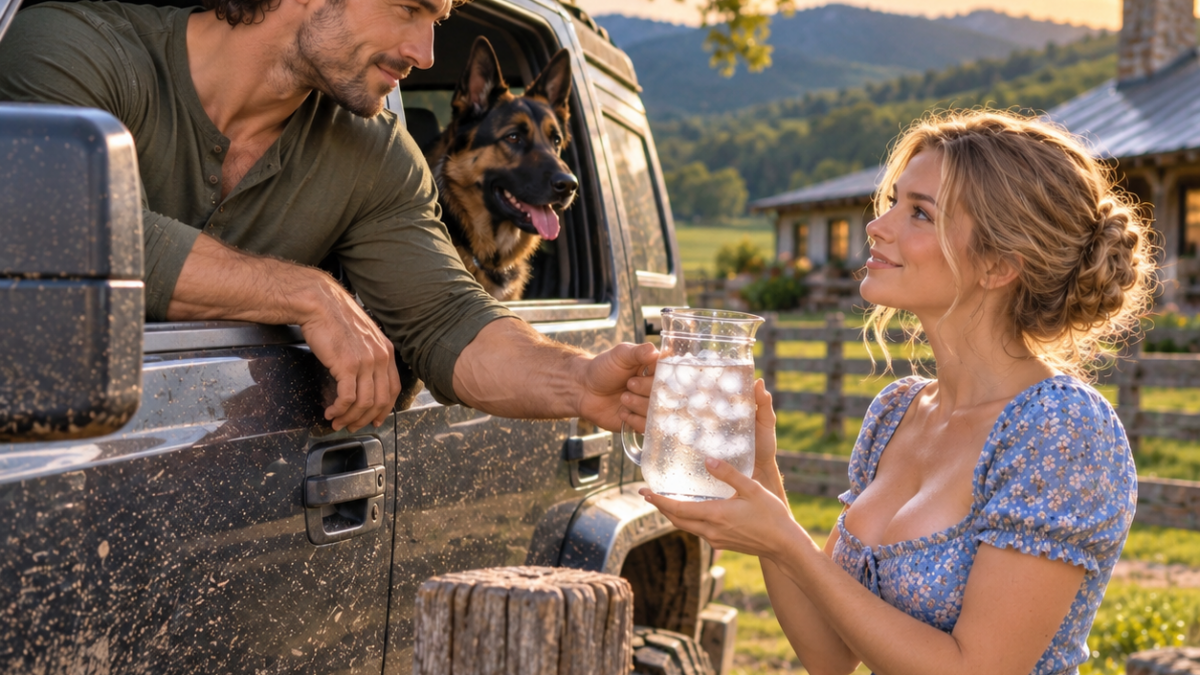
Wesley leaned back in the chair. Natalie used to take care of things while I was gone. Things she probably should have asked somebody to help with, but asking offended her on principal.
Maggie’s mouth moved slightly.
She was like that worse. Maggie laughed.
The tension left her shoulders. Wesley continued more carefully.
At first, it was the way you were standing out there fighting that fence. Maybe the hair a little.
He looked toward her.
But the longer I’m here, the less you remind me of her.
Maggie raised an eyebrow. That sounded almost insulting.
It wasn’t.
I’ll take your word for it.
He smiled. What he meant did not need to be polished into a better sentence.
Natalie remained. Natalie.
Maggie was becoming someone else entirely. The light faded from the pasture until the fence lines disappeared into the dark.
Arlo stretched beneath them, turned once and settled again.
Wesley sat in Henry’s old chair.
Maggie sat beside him. Neither mentioned the joke about marriage.
Neither had forgotten it. By the time 3 weeks had passed since Wesley stopped at Cedar Draw for water, there was almost nothing left on the ranch that required him to stay.
The pump system worked again. The repaired section of roof had survived two smaller rains without leaking. The north fence stood straight.
The temporary hoses had been rolled and stored, and the tools that had spent days scattered across the yard were back where Maggie kept them. Even the county road had lost the last dark patches of mud left by the storm. Cedar Draw could manage without him.
That fact became harder to ignore once the work was finished.
Wesley noticed it while putting a wrench back into Maggie’s tool cabinet.
He noticed it the next morning when there was no damaged board waiting by the pump house. He noticed it again when Arlo walked directly to his usual place near the kitchen door after breakfast.
Turned twice and settled as if the ranch had always been part of his map. Nothing was keeping Wesley there anymore.
He stayed. Not because the weather had trapped him. Not because Maggie needed another pair of hands.
Not because something was broken. Some afternoons he found small reasons to remain busy. A gate latch could be adjusted.
The mower deck needed cleaning. One of the porch steps had begun holding water along the back edge. But Wesley knew the difference between a job that needed doing and a job found by a man who was not ready to leave.
Maggie seemed to know it, too. She did not ask.
That made things easier and more difficult at the same time. One late afternoon, after the heat had backed off enough for shadows to stretch across the yard, Maggie carried two glasses of iced tea onto the porch. Wesley was standing near the rail, looking toward the section of fence where they had first met.
Arlo lay beneath the cottonwood, one ear moving whenever cattle shifted in the pasture. Maggie handed Wesley a glass.
You checking my fence work? Your fence work? You were the temporary labor.
I remember doing most of the lifting. You remember incorrectly. They drank in silence for a while.
The repaired fence caught the lower sunlight in thin silver lines. Wesley rested his forearms against the porch rail.
That first day, he said, “You told me my water cost a marriage.
” Maggie kept looking toward the pasture.
“That was before I knew you bought terrible coffee, so the terms changed substantially.”
He smiled, but did not let the subject disappear. Maggie sensed it before he said anything else. She set her glass on the railing.
Wesley had thought about this conversation several times and disliked every version he had rehearsed. They had all sounded either too clean or too serious, as if a man could prepare three weeks of uncertainty into the right combination of sentences, so he stopped trying.
“I’ve thought about leaving.”
Maggie’s fingers remained around the cold glass.
“I figured more than once.”
She nodded. Wesley watched the light move across the fence. The strange part is I never got stuck on the work.
Maggie looked at him then. The pump could be fixed by somebody else. The fence was already done.
You were doing fine before I got here. I was I know. There was no argument in his voice.
That mattered. Wesley took a drink and lowered the glass. Every time I pictured getting back on the highway, I kept seeing your kitchen.
Maggie frowned slightly. My kitchen? One mug?
The answer caught her off guard. Wesley looked down at his hands.
I’d think about breakfast here the next morning.
Coffee strong enough to ruin a spoon. Arlo waiting by the door.
Then I’d picture the same room with one cup on the counter.
Maggie did not rescue him from the silence. He appreciated that, too. Wesley went on slowly.
If I leave someday because this doesn’t work, that’s one thing.
He paused.
But I don’t want to leave because leaving is what I’m good at.
Maggie’s expression changed only a little, enough for him to continue.
He looked toward the house.
If there are ever kids in there, I don’t want to be a story you tell them about some guy who stopped for water and disappeared when the repairs were finished.
Maggie said nothing. Wesley had expected that part to be difficult. The next part surprised him by being easier.
I want to hear them crying at 2:00 in the morning and wonder why we thought this was a good idea.
Maggie’s mouth curved.
I want to teach them how to hold a wrench without dropping it on their foot. That seems ambitious. I want to tell them no after you already told them yes.
Then find out which one of us they respect less. That will be you probably. The humor faded naturally.
Wesley turned toward her. I want to be their father. Maggie looked at him for a long moment.
She had heard men talk about children before. usually as a future category, something filed beside a bigger house or a better job.
Wesley was talking about noise, lost sleep, tools, disagreements, ordinary inconvenience. That made it harder to pretend she misunderstood. Maggie picked up her glass and set it down again without drinking.
The marriage thing wasn’t entirely a joke.
Wesley waited. She gave a quiet laugh at herself.
I mean, it was mostly comforting. Maggie ignored him.
It’s easier to say things like that when nobody thinks you mean them.
She looked toward the yard. For years, people had called her married to the ranch. Maggie had repeated the line herself at feed stores, church suppers, anywhere someone asked why she never seemed to bring anyone with her.
It had become useful. If she laughed first, nobody had to notice what was underneath it.
“I wanted this place,” she said.
I wanted my dad to be able to stay here. I wanted all of that.
Her hand moved slightly toward the house and pasture.
But wanting those things didn’t mean I stopped wanting a husband or a family.
She breathed out. I just got tired of saying it in ways somebody could turn down.
Wesley understood more of that than he wished he did. Maggie continued. So I made jokes.
Safe. Eight.
Usually. He reached for her hand.
Not quickly. She let him take it. Neither of them said anything for a while.
There was no proposal on the porch. No promise that they had figured out the rest of their lives in 3 weeks. What they agreed to was smaller and probably harder.
If Wesley stayed, he would stop treating departure as the default ending. If Maggie let him stay, she would stop pretending she did not care whether he eventually chose her. That was enough for one afternoon.
The months that followed were less graceful than either of them might later remember. Wesley took short maintenance jobs around Chase County and occasionally farther toward Emporia.
Some lasted a day, some three or four. He always came back.
The backpack stopped going with him unless he actually needed it.
At some point, Maggie moved Arlo’s folded canvas pad away from the kitchen door and replaced it with a proper dog bed.
Wesley objected to the price. Arlo did not.
There were arguments. Maggie discovered Wesley repaired things without asking because he assumed a loose hinge or dripping faucet was automatically a request for assistance.
Wesley discovered Maggie considered cereal containing dried fruit a perfectly respectable breakfast. It tastes like roofing material.
You ate military food.
That’s how I know.
Sometimes they annoyed each other for real. Maggie disliked the way Wesley went quiet when something bothered him and assumed silence counted as processing.
Wesley disliked Maggie’s habit of saying she was fine while moving kitchen objects with unnecessary force.
They learned that affection did not make either habit disappear. They also learned to apologize before a small irritation had three days to become something larger.
Arlo became expert at leaving the room whenever their voices took on a certain tone. though he usually returned once food became involved.
Summer moved toward fall. Wesley left a pair of work boots permanently beside the back door.
Then two shirts appeared in the guest room closet. The toothbrush stopped disappearing every morning. The photograph remained in the truck.
Maggie never asked him to move it. The old rocking chair remained on the porch.
Wesley continued to sit in it only when Maggie was there. They married quietly several months later. There was no large reception, no long guest list, and no effort to make the day grander than it needed to be.
Rey stood with them, wearing a jacket that fit badly across the shoulders, and complaining that Maggie had given him too little notice to find a better one. A handful of people who mattered came. Maggie wore a simple cream colored dress.
Wesley wore a dark suit he had bought in Emporia because the only other formal clothes he owned had belonged to a different part of his life. Arlo was not given a ceremonial role.