“Free Water for the Dog, But You? Marry Me,” She Told the Former Navy SEAL – Part 5
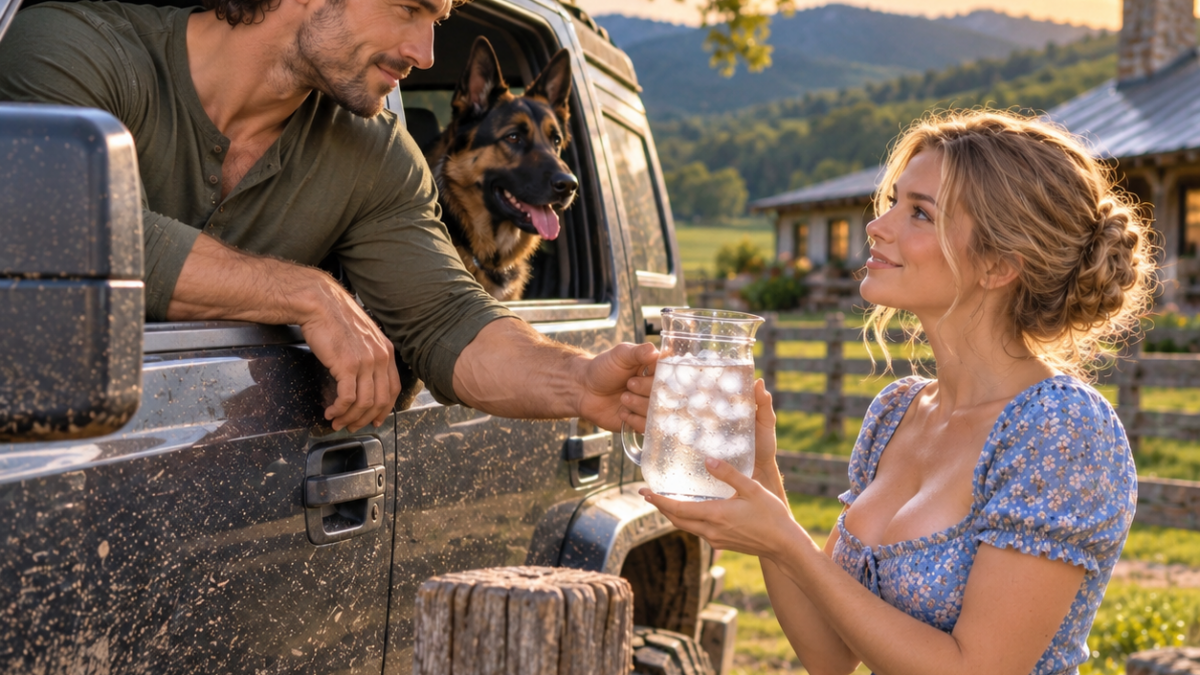
Maggie said this was because he could not be trusted around the food table. Wesley said the accusation was unsupported. Arlo spent most of the afternoon beneath a shade tree and proved Maggie correct the moment someone stopped watching a plate of sliced ham.
By evening, Cedar Draw was quiet again. No transformation announced itself.
There were dishes to wash. A gate still needed checking before dark.
One of Ray’s folding chairs had been left near the porch.
Marriage did not make the ranch stop being a ranch. Wesley preferred it that way.
Later, he stepped outside because he had left his phone charger in the truck. The air had cooled and insects moved through the grass beyond the porch light.
Arlo followed halfway to the pickup, reconsidered, and went back toward the house. Wesley opened the rear door.
For a moment, old habit reached for him. Check the duffel, backpack, everything ready if the truck needed to move. He looked through the window toward the farmhouse.
Maggie crossed the kitchen with two glasses in her hands. Wesley took the charger and closed the truck. When he returned to the bedroom, the backpack was still where he had left it.
Inside the closet, Marriage changed the shape of Cedar Draw, but it did not immediately give Maggie everything she had once imagined would come with it.
Wesley’s boots stayed beside hers at the back door.
His shirts occupied one side of the bedroom closet instead of a duffel. Arlo had a bed near the kitchen and another old blanket on the porch because Maggie insisted that a dog his age had earned options. The house was no longer quiet in the way it had been before Wesley stopped for water.
But months passed and no child came. At first, Maggie treated the calendar casually.
Then she began noticing dates she had not intended to count. A month became two, two became four. Wesley noticed that too.
Though he did not turn it into a problem every time another month ended, they kept living. Spring fencing still needed checking.
Feed bills still arrived. Rey continued appearing at inconvenient times with stories that somehow required coffee. Wesley picked up maintenance work around Chase County, occasionally leaving Cedar Draw before sunrise and returning after dark.
He always returned. That mattered more than Maggie expected it to.
One evening, she opened the bottom drawer of an old dresser and found a folded baby blanket beneath a stack of towels. She had bought it years earlier in Cottonwood Falls, not because she had been expecting anything, because she had seen it in a store window.
pale cream with a narrow green border and had allowed herself one small act of foolish optimism after Henry became ill. She had pushed it deeper into the drawer, then forgotten it was there. Maggie carried it into the bedroom and sat on the edge of the bed.
Wesley came in several minutes later and stopped when he saw what she was holding. She ran her palm across the folded cloth.
What if it doesn’t happen?
Wesley did not pretend he misunderstood. He sat beside her.
Maggie kept looking at the blanket.
I know we haven’t been trying that long.
I know that. She folded one corner back into place.
But what if this is it? Wesley answered before she could make the question smaller.
Then I’m still here.
Maggie looked at him. He reached for the blanket, not taking it away, only holding the other side.
I didn’t marry you for a child.
Her eyes stayed on his face. I want one, he said.
I want that with you. He looked around the room, but I already chose this.
Nothing about his tone made it sound heroic. That helped.
Maggie leaned against his shoulder, and they sat there with the blanket between them until Arlo appeared in the doorway to remind them that dinner had somehow become late again. Life continued.
Several months later, Maggie began waking hungry at strange hours. Then, coffee tasted wrong. That bothered Wesley almost as much as it bothered her.
You said my coffee was terrible when we met. Yours was terrible. You make the coffee now.
Exactly. A few days later, Maggie stopped making jokes about it. They made an appointment.
The first visit was ordinary enough to make Wesley grateful. Paperwork.
Waiting room. A nurse asking routine questions.
Maggie squeezing his fingers while pretending she was not. The ultrasound room was dimmer than he expected.
Wesley sat close enough that his knee touched Maggie’s chair.
The technician moved the probe, studied the monitor, adjusted something, then became quiet for several seconds. Wesley watched her face.
Years of training had taught him to notice when people became more focused than the situation seemed to require. His body reacted before his thoughts did.
Maggie felt his hand tighten. The technician pointed to the monitor.
There’s one.
Maggie stared at the screen. Then the technician moved slightly.
And there’s the other.
Wesley looked at Maggie, then back at the monitor. Another what?
Maggie began laughing. Wesley. He leaned closer.
The technician smiled. Baby.
Um. Wesley blinked.
There are two. Maggie laughed harder.
He looked as though somebody had changed the language in the room without warning. For the rest of the appointment, he alternated between staring at the screen and looking at Maggie as if he needed independent confirmation that she had heard the same thing.
Two
heartbeats. Two. The drive home was quieter.
Maggie expected excitement. It was there.
So was something else. That evening, Wesley sat on the porch after sunset. Arlo lay near his feet.
Older now around the muzzle, but still alert whenever cattle moved beyond the fence. Maggie brought two glasses of water outside and sat beside him. For a while, Wesley listened to the insects in the pasture.
Then he said, “I’m happy.”
Maggie waited.
That’s the problem.
She looked at him.
Wesley rubbed his thumb along the armrest of Henry’s chair.
The more I have, the more there is to lose. Maggie did not tell him nothing bad would happen.
She had lived too long to make promises life had never offered. We already know things can be taken from us, she said.
Wesley looked toward her.
If we let that decide how much we’re allowed to love, then it’s still running the house.
He looked through the screen door into the kitchen. For years, his fear had kept moving because movement gave it nowhere to settle.
Now it had a home, too.
He reached for Maggie’s hand.
The twins arrived safely months later. There was exhaustion, noise, very little sleep, and more laundry than Wesley had believed two people that small could produce. No one became wiser overnight.
Wesley learned that military discipline had limited usefulness against two infants who had no respect for schedules. Maggie discovered that a man who could remain calm through severe weather could still spend 10 minutes checking whether a sleeping baby was breathing normally. Arlo adapted in his own way.
He did not become a guardian from a story book. He simply learned where the bassinets were, where not to lie when people were carrying bottles through the hallway. And that dropped blanket sometimes meant he would be asked to move.
Years passed without announcing themselves. The twins became children who left muddy shoes in places shoes did not belong. Cedar draw remained a working ranch.
Invoices accumulated on the kitchen table. Fencing still failed at inconvenient times. The pickup still needed oil changes and someone was always forgetting to close a cabinet door.
Arlo slowed. His muzzle turned gray and he preferred shade to long walks in the afternoon heat. He still chose the place between kitchen and porch because from there he could keep track of most of what mattered.
One fall afternoon, Wesley carried several lengths of oak into the shed. Maggie found him there measuring them against an old pattern.
You’re building something.
Sharp observation. What?
You’ll see.
It took him several weekends.
The finished rocking chair was not an exact copy of Henry’s.
Wesley had considered making it one and changed his mind. The back was slightly wider.
The arms curved differently. The seat sat a fraction higher. New chair, new hands.
When he carried it onto the porch, Maggie understood before he said anything.
She turned toward Henry’s old rocker.
The oak had weathered another few years. The brass screws remained crooked.
The coffee ring was still there. Together, they carried it inside.
They placed it near the front window beside a small framed photograph of Henry. Maggie rested her hand on the left armrest.
She did not cry. She only stood there a moment longer than necessary. Then she went outside and sat in the chair Wesley had built.
Nothing had been replaced. Something had been added.
The photograph in Wesley’s truck took longer.
One warm afternoon, Maggie came outside and found him sitting behind the wheel with the driver’s door open.
The truck was parked. The engine was off. Wesley had pulled the photograph from behind the sun visor.
Natalie stood beside him in the picture. Their daughter between them. The clear sleeve had yellowed slightly at one corner.
Maggie stopped beside the open door. Wesley looked at the photograph for a long time.
“You sure?”
she asked. He nodded.
They’ve been riding shotgun with me for 5 years.
He climbed out. Inside the house was a wooden keepsake box Maggie had cleared for him months earlier and never mentioned again.
Wesley opened it and placed the photograph among several things he had carried from his old life but rarely handled. His old wedding ring, a folded note, a small navy patch. The photograph went on top.
Maggie remained near the doorway. Wesley closed the lid.
I think they can come inside now. She understood what he meant. He had not put them away.
He had brought them home. Years later, another hot June afternoon settled over Cedar Draw.
The twins were somewhere near the barn, arguing over a bucket neither of them had wanted 5 minutes earlier. Arlo lay beneath the porch shade, gray around the face and content to let younger people handle unnecessary movement. Wesley sat in the rocking chair he had built.
Henry’s remained inside near the window.
A car slowed on the county road. The driver stopped near the gate and called out asking if there was any chance of getting some water. Maggie walked down with a cold bottle.
Waters free,” she said.
From the porch, Wesley called, “Rates, come down.”
Maggie looked back at him, “Only for guests.”
Wesley laughed. The new rocking chair moved beneath him with a soft wooden creek.
“Inside the house, Henry’s chair stood where the afternoon light could reach it.
One had been kept because the people who were gone still belonged there.
The other had been built because the people who remained needed somewhere to sit.”
I keep thinking about the things Wesley carried for all those years. The backpack by the door, the photograph above the windshield, everything packed as if leaving were simply part of waking up. There is a kind of safety in living that way.
If nothing becomes permanent, there is less to lose. If no place becomes home, there is no empty room waiting when someone is gone.
But there is a cost to that kind of safety. Sometimes we spend so much effort protecting ourselves from another goodbye that we quietly remove every chance of having somewhere to return to. Maggie wanted a family.
Wesley wanted to stop losing one. Neither received exactly what they thought they were looking for when that truck stopped beside the fence.
What they found first was much smaller. Cold water, unfinished work, a chair on a porch, and somebody who kept showing up the next morning. Maybe that is how some of the most important things enter our lives.
Have you ever asked life for one thing only to understand years later that what you truly needed was the person, the place, or the second chance that came with it?

