“Go Back to Overflow, You’re Just a Nurse” — Then Rookie Nurse Revealed Her Elite Military Past – Part 1
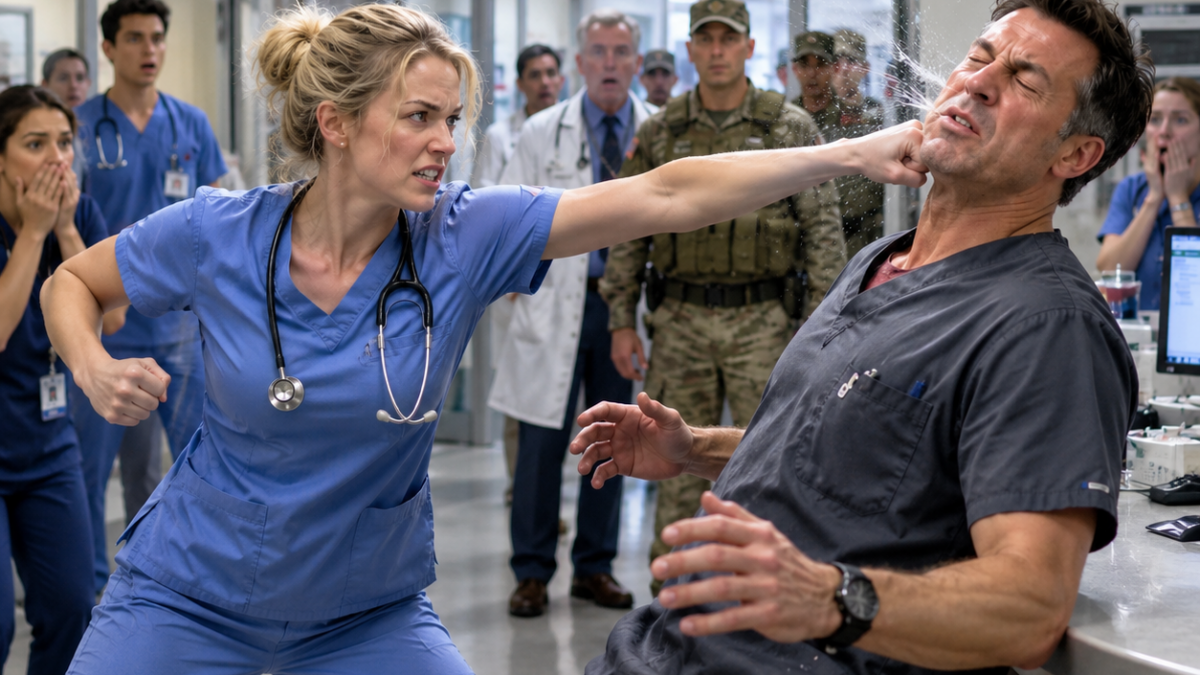
“Go Back to Overflow, You’re Just a Nurse” — Then Rookie Nurse Revealed Her Elite Military Past
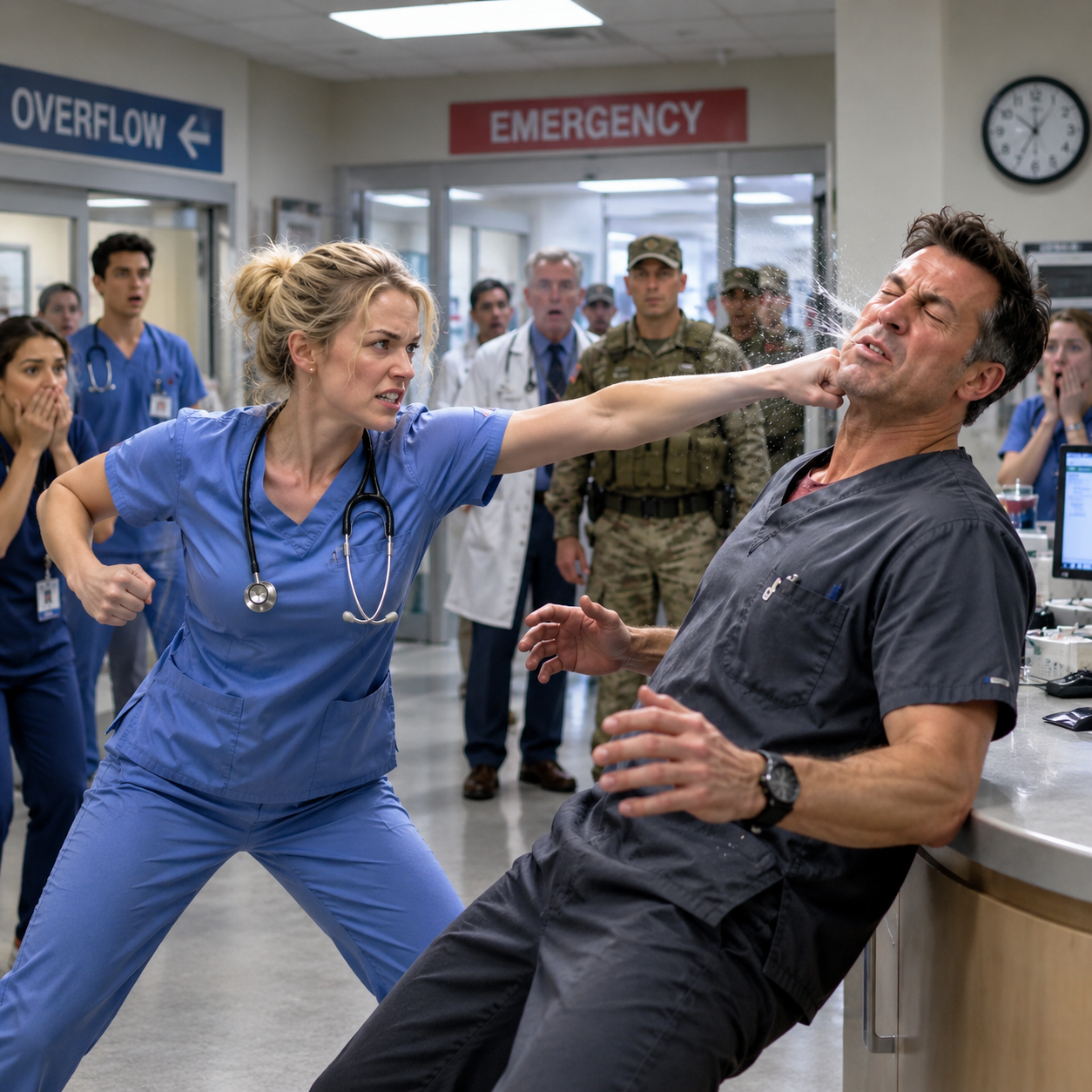
She had 30 seconds to decide whether to keep lying or let a man die.
The monitor was screaming. The surgeon was frozen.
Three Navy operators stood in the doorway with blood on their boots and nowhere left to turn. Every person in that trauma bay had a degree framed on a wall somewhere.
Years of school, boards, residency, the whole architecture of credentials that was supposed to mean something in a room like this. Every person in that trauma bay had just run out of ideas.
And the woman in the corner, the one nobody looked at twice, the one who restocked saline bags and answered to anyone who snapped their fingers at her, she already knew exactly what was killing him.
She’d seen it before, not in a hospital, in a ditch outside a burning village at 2:00 in the morning with no equipment and no backup and a soldier who had maybe 90 seconds before his heart gave out for good.
She saved that man, too. Nobody here knew that. Nobody here knew anything about her.
Mercy Medical Center sat on the outer edge of Harlo Falls, a midsized city in the Pacific Northwest that nobody outside of it had much reason to think about. The hospital was functional in the way most regional hospitals were functional.
underst staffed, overscheduled, perpetually short on parking and long on institutional politics. The emergency department ran three shifts a day.
The breakroom coffee was always burned by the time anyone got to it, and every physician above a certain paygrade had learned to protect their turf, the way people protect things they’re afraid of losing.
Lauren Mercer had worked the evening shift there for 14 months. She was 34 years old.
She kept her dark hair pulled back in a clip that had broken on one side.
The hinge had cracked sometime in October, and she’d never gotten around to replacing it.
Her scrubs were clean, but not new.
She wore no jewelry except a narrow silver band on her right hand, the kind of ring that didn’t read as a wedding band, but wasn’t quite not one either.
And nobody asked about it because she didn’t invite questions, and people generally understood that without being told.
She moved through the ER the way water moves through a crowded space, finding the gaps, filling them quietly, never making the kind of impression that lingered after she left the room. To Dr.
Preston Caldwell, the ER director at Mercyest, Lauren Mercer was exactly the kind of nurse he preferred. Quiet, compliant, not the type to raise liability concerns in front of patients or question his clinical decisions in front of residents.
He’d hired her through a temp agency 11 months ago and had kept extending her contract in 30-day increments, mostly because she showed up on time, made no demands, and never generated paperwork he didn’t expect.
He did not know her real name. He did not know that Lauren Mercer was not a name she had been born with, not a name that appeared on any document predating 3 years ago, not a name that meant anything except what she had built it to mean, which was ordinary and invisible and safe. He did not know that the woman currently refilling IV bags in bay 6 had spent four years as a special operations combat medic attached to an army SOCOM unit conducting missions in locations that still did not appear on unclassified maps.
He did not know about the commenation sitting in a classified file that most people with the appropriate clearance had never been permitted to access. He did not know about the call sign that a small group of operators still used when they talked about her in the way that soldiers talk about people who reached into somewhere dark and pulled them back.
Not with ceremony, not with volume, but with the particular reverence of people who understood exactly what the alternative had looked like.
Caldwell didn’t know any of it.
That was exactly how she designed things to be. The shift had been running quiet for a Wednesday.
A compound fracture in Bay 2. a teenager with a dislocated shoulder in bay 4 who cried considerably louder than the injury warranted. A chest pain admission parked in the hallway waiting on cardiology to return a call that had been placed 40 minutes ago.
Lauren had triaged 11 patients in 4 hours, started two IVs on difficult sticks that two other nurses had already attempted and talked a 17-year-old through a panic attack in the waiting room using a voice so even and unhurried that the girl’s mother had grabbed Lauren’s arm afterward and said something that Lauren had deflected with a small nod and walked away from because receiving gratitude was something she’d never
gotten comfortable with.
She’d eaten half a granola bar at 8:15, standing next to the supply closet with her back to the corridor so nobody would try to hand her something while she was eating.
Around 9:00, she was at a charting station when she heard Caldwell’s voice behind her.
Mercer. She turned.
He was standing with a tablet in his hand, eyes on the screen. He had a habit of addressing staff while looking at something else.
Not distraction, she’d decided, but a choice, a way of signaling that the conversation mattered less than whatever he was reading.
I’m moving you to overflow for the rest of the shift.
They’re short.
Overflow is all low acuity right now, she said.
We’ve got two pending labs on the chest pain in the hall and a possible pulmonary embolism in bay.
I didn’t ask for your assessment.
He still hadn’t looked at her.
Overflow, you’ve got 30 minutes to hand off.
She didn’t argue.
She turned back to her chart, finished the note she’d been writing, completing it properly, every field, because an incomplete chart was a problem for whoever picked it up next, and then found the charge nurse, and handed off her patients with the kind of verbal summary that covered everything the next person needed to know.
This was the thing about Caldwell that she had taken a long time to categorize correctly.
He didn’t dislike Lauren Mercer, in particular.
She wasn’t sure he had the bandwidth for particular dislikes.
What he had was a general system, a way of managing nurses who showed any sign of having clinical opinions that hadn’t been solicited.
The mechanism was simple. Reassign them to lower acuity areas. Reduce their access to interesting cases.
Find administrative reasons to keep them out of rooms where thinking was required.
It wasn’t vindictive.
It was just steady. And it worked on most people who either shrunk themselves down to fit the shape of what was available or eventually transferred out.
Lauren had been receiving this treatment for 14 months and absorbing it without visible reaction. Caldwell probably read that as compliance.
It wasn’t.
It was something she’d learned to do in circumstances that made this hospital look uncomplicated.
She had learned to be invisible, not as a coping mechanism, as a skill, as a tool she had picked up in places where being seen at the wrong moment had consequences that had nothing to do with getting moved to overflow. So, in overflow, she settled in beside a nurse named Petra Olsen, who was 43 and had the specific energy of someone who had been in conflict with institutional bureaucracy for long enough that the conflict had become comfortable.
Petra handed her a stack of charts without preamble.
GI Bleeded in 7 has opinions about his care and isn’t shy about sharing them, Petra said.
Psych holden 9 needs vitals every 30 minutes. Gian 11 is rating his knee pain at a nine, but he walked in without limping. So, got it.
Also, Petra paused and Lauren noticed the pause.
Caldwell left a note that you’re not to perform any procedures tonight.
Monitoring and documentation only. Lauren looked up. He specified that.
He specified that. Petra held her gaze for a moment. Something moved between them.
Not sympathy exactly, more like recognition. the recognition of one person who has been managed in this particular way by this particular institution and another who is currently being managed in the same way.
I’m just passing along what I was told.
Understood, Lauren said and looked back at the charts.
She worked through the first hour and a half in overflow with the kind of focused, quiet competence that didn’t announce itself.
The GI bleed patient, a man in his 60s named Walt, who was genuinely uncomfortable and also genuinely difficult, responded better to her than he had to the two previous nurses, not because she did anything special, but because she listened to the actual complaint underneath the difficult behavior and addressed that instead. The
psychold was a young man in his mid20s who was testing the edges of every boundary available to him.
And she held those edges without escalating and without being cold, which was a harder balance than it sounded. The man in 11, when she spent 4 minutes actually talking to him instead of about him, admitted his knee was a four and accepted ibuprofen with something close to dignity.
It was 11:47 when the alert tone came from the charge desk, not the standard ambulance notification. The other one, Lauren heard it from the hallway and felt a particular shift happen in her chest. Not quite alertness because she was already alert, but something more specific.
The recalibration that happens when a sound tells your nervous system something your conscious mind hasn’t caught up to yet.
That tone was for federal or military notifications or for the kind of incoming patient that required hospital administration to be contacted regardless of the hour. She had heard it once before in 14 months and that had been a false alarm, a miskeyed code that had sent two administrators running from their offices for nothing.
She walked to the edge of the overflow area and looked down the main corridor toward the ambulance bay. Well, through the glass she could see three black SUVs parked at angles that suggested their drivers had been focused on speed over precision.
Government plates. The vehicles were still running.
She could see the exhaust in the cold night air and the doors on two of them were standing open the way doors stand when the people who were inside them left in a hurry and the doors weren’t the priority.
Men in tactical gear moved around the vehicles with the specific purposeful efficiency that civilian emergency responders never quite managed to replicate. Not panic, not adrenaline for its own sake.
The rehearsed economy of people who had run this particular scenario in conditions that didn’t permit mistakes whose bodies had internalized the sequence to the point where thinking about it would only slow them down.
Between two of them on a stretcher was a man. Even from the distance of the hallway, even through two panes of glass, Lauren could see the color of him.
He was gray, not pale, not the white of shock or the yellow of compromised liver function. Gray, the specific shade that meant profusion had begun to fail systemically, that blood was not reaching the places it needed to reach, that somewhere in his chest, the body had run into a problem.
It was losing the ability to compensate for. She had seen that color before. She knew what it meant.
She knew what it meant. Not the way you know something from a textbook.
Not even the way you know something from clinical experience in a controlled environment.
Sarah, but the way you know something you’ve seen in the dark with your hands covered in blood, and nothing between the knowing and the doing, but the decision to act.
She watched the men carry the stretcher through the ambulance bay doors and felt her own hands close slightly at her sides, a reflex she didn’t bother trying to suppress.
She turned away from the glass. She went back to her patient in bay 7 because going toward the main ER trauma bay was not what she had been assigned to do and she was not authorized for procedures tonight and Caldwell was in there and the careful structure of her life here. The specific shape of invisible she had worked 14 months to become depended on not walking toward things that would make her visible.
She lasted 4 minutes. The sound from the main trauma bay was what broke her.
Not loud. That was the thing.
When a trauma team is functioning correctly, there’s a particular controlled noise to it, coordinated, rhythmic, people calling numbers and equipment sounds, and the sense of a system moving in sequence toward a defined outcome.
What she heard instead was the fractured sound of a team that had lost its sequence. Voices overlapping wrong. A pause in the monitor alarm response that was 3 seconds too long.
The specific auditory signature of people who had been handed a situation outside their training and were managing it with the tools they had, which were not quite the right tools. 3 seconds of wrong sound.
She walked to the trauma bay door and looked through the wire reinforced window. Caldwell was at the head of the table. Two residents flanked him.
Three nurses she recognized were moving around the perimeter.
The operators who had arrived with the patient, five of them, had positioned themselves against the walls, trying to be out of the way and not quite managing it because the room was not built to hold five large men who couldn’t make themselves stop watching.
On this table, the man was crashing. She could see it without the chart, without the labs, without the imaging that Caldwell appeared to be ordering based on the way he was directing one of the residents toward the phone.
She could see it the way she’d learned to see it in the distended neck veins visible even from outside the room in the monitor numbers that showed 74 over 40 and were not holding there, but moving in the absence of breath sounds on the left that she could infer from the way the man’s chest was moving asymmetrically
with each mechanical breath.
tension pumothorax air trapped in the chest cavity building pressure compressing the heart and great vessels not survivable with a CT scan delay not survivable with the protocol Caldwell was working through which was a reasonable protocol for a patient who had more time than this one had she pushed the door open he has attention numo the room turned Caldwell turned his face moved through surprise so fast she almost missed it before it settled into the expression she knew the specific
controlled irritation of a man whose authority had been walked into without an invitation. Mercer, urine overflow.
His trachea is deviated. Breath sounds on the left are absent.
His pressure is 74 and moving down. And his neck veins are I can evaluate my own patient. The flatness in his voice was practiced.
Go back to overflow. You have approximately 3 minutes before he arrests.
I have an ER director position and you have a temp contract. He held her gaze. Go back.
She was aware of the room, the residents watching. The nurses who had gone still in the particular way that people go still when they understand that what is happening in front of them has consequences for everyone in it.
The operators against the wall who had stopped being tactfully inattentive and were now simply watching. She was also aware of the monitor.
68 over 38.
“If you’re not going to decompress him,” she said, keeping her voice level, “the hand me a 14 gauge and step back and I will.”
“You are not authorized.
” “I know I’m not authorized.
I’m asking you to do it.
Pick up the needle, find the landmark, second intercostal space, mid-clavicular line. You know this.
Do it right now and I’ll walk out of here and we never have this conversation.”
Something crossed his face. She had expected anger. What she got instead was something that looked uncomfortably like uncertainty, and that was worse, because uncertainty was not what the man on the table needed from the person in charge of his care right now.
“Now get her out of the bay,”
Caldwell said.
An orderly move toward her from the left.
“Nobody moves her.”
The voice came from the doorway behind her. not raised, not commanding in the way that commands get performed for an audience. Just a voice with weight in it, the weight of someone who had spent enough years being listened to that the expectation of it had become structural, invisible, built into the way he used the air.
Everyone turned. The man in the doorway was in civilian clothes, dark jacket, open collar, no insignia. He was in his late 50s with the kind of face that had been weathered into something more precise than it had probably started as.
He wasn’t physically imposing.
He didn’t need to be.
He walked into the room the way certain people walk into rooms, which is to say, he walked in and the room reorganized itself around him without anyone deciding to let that happen. The orderly stopped moving.
Caldwell said, “I’m the director of this emergency department and whatever you think authorizes you to Rear Admiral Dale Voss, United States Navy.”
Quiet. Even the man on your table is Senior Chief Marcus Tate. He belongs to a unit under my command.
He moved to the side of the stretcher and looked at the monitor for a moment with no visible reaction. Then he looked at Lauren. You said tension numo.
Yes. How confident? Not quite a question.
A test, but not a hostile one.
The kind of question that isn’t really asking for the information, but for the quality of the person delivering it.
Fully confident, she said. What do you need? She was already at the supply cart.
14 gauge needle, second intercostal space, mid mid-clavicular line, gloves. Do it.
Caldwell said something. She heard the words as sound without processing them as meaning.
because she had already gone to the place she went when the work was this specific and this time-sensitive. Not a dissociation, not a dramatic narrowing of consciousness, but the clean functional focus of someone whose body had been trained to do this thing and was now doing it.
She had been here before. The room was different, the equipment was better, the lighting was adequate, and the floor was not dirt, and nobody was shooting at anyone. None of that changed the essential geometry of the moment.
She snapped the gloves, found the landmark on his chest by touch, second rib, mid-clavicular, the intercostal space just below.
The man’s chest was moving shallowly.
His color up close was worse than it had looked through the glass. She held the needle.
She felt the resistance of the chest wall. She had felt this before.
She knew the resistance and she knew what was on the other side of it, and she pushed through it cleanly in a single controlled motion. No hesitation and no drama.
The hiss was immediate. Air releasing pressure that had been building to a point of cardiovascular collapse, escaping now through the pathway she had made for it.
The monitor changed. 72 over 41. Then 85 over 54.
Resident made a sound. Not a word. Just a sound.
The involuntary audio of watching something work that you weren’t certain was going to work.
One of the operators exhaled. Just one breath audible in the room. 96 over 60.
The deviation in the trachea was already visibly correcting. The neck veins were softening.
The monitor was no longer screaming, but had settled into the steady, urgent, but stable tone of a patient in serious condition rather than a patient in the immediate process of dying. Lauren stepped back from the table.
Her hands were steady. They were always steady.
She’d stopped thinking about that years ago.
It wasn’t composure.
It wasn’t talent.
It was just the way her hands were, the way they’d always been under this kind of pressure.
And she’d made peace with it, not being a virtue a long time back.
The room was very quiet. Caldwell was looking at her with an expression she had not seen on his face in 14 months. Not the managed irritation, not the professional condescension, something more complicated and considerably less comfortable than either.
Admiral Voss was also looking at her.
“Who are you?”
he said.
The question arrived the way she’d known it would arrive eventually.
She had known for three years in the abstract that this moment existed somewhere in her future. The moment when the thing she was hiding ran into the thing she was unable to stop doing, and the collision produced a reckoning she had no more room to postpone.
“Len Mercer,” she said, “I’m a nurse.
” “That’s not what I asked you.”
He said it quietly, and he was watching her with an expression that was not suspicious and not hostile, just that quality of recognition pressing toward the surface, like something his memory had filed under a name he couldn’t quite retrieve.
I think, he said, low enough that it didn’t carry to the rest of the room, that we should talk.
She did not run. Running would have been the operationally intelligent choice, and she knew it, and she did not do it.
She stayed in the trauma bay while the team worked to fully stabilize Marcus Tate and prepare him for the surgical consult that would determine what else needed to happen before morning.
She charted what she had done in clean clinical language, the clinical reasoning, the intervention, the immediate patient response, because the chart was a legal document, and she had done nothing she wasn’t prepared to defend.
Regardless of
what Caldwell said about authorization, she answered the surgical residents questions about Tate’s current hemodynamics with the same quiet precision she brought to everything in this building.
Caldwell left the trauma bay at some point without speaking to her. She registered his departure the way she registered most things in her peripheral environment. Noted, filed, not given more weight than it warranted.
One of the operators had positioned himself in the corner nearest to where she was charting.
He wasn’t watching her overtly.
He was doing the thing people do when they’re trying to watch someone without being noticed watching them, which works better on people who aren’t trained to notice it.
He was young, early 30s, with a bruise along his jawline that was fresh enough to still be spreading.
She didn’t look at him directly, and she didn’t acknowledge that she’d noticed him because acknowledging it would have required explaining how she’d noticed it.
She finished the chart. She logged out of the station.
Tell the admiral I’ll be in the consultation room at the end of the hall,” she said to no one in particular, meaning whoever was paying enough attention to relay it.
She walked out. In the hallway, she stopped, pressed her back against the wall beside a biohazard disposal unit, and breathed.
Not to calm down.
She wasn’t not calm, but because it was the first moment in the past 20 minutes that hadn’t had a task inside it, and she allowed herself that much.
One breath, two. Her name was not Lauren Mercer.
Her name was Nora Vance. And she had been Norah Vance for the first 29 years of her life.
And for four of those years, she had been Specialist Vance, then Sergeant Vance, and then for the last 18 months of her service. She had been something that was not a name, but a designation, a two-cllable call sign used in the language of people who operated in the spaces between official records, in places that official records did not acknowledge.
She had left it behind. All of it as cleanly as she could manage. She had built Lauren Mercer from the outside in.
Real nursing credentials earned over 2 years of school and clinicals in a city where she didn’t know anyone, living in a studio apartment and eating cheap food and constructing the visible architecture of an ordinary life.
Because the ordinary life was the only protection she had left, and she had needed that protection in ways she wasn’t going to explain to anyone.
She pushed off the wall. She walked toward the consultation room at the end of the hall.
The question wasn’t whether Admiral Voss was going to find out who she was.
He already knew, or he was close enough that the difference was technical.
She could see it in the way he’d looked at her.
Not the way people look at strangers, but the way they look at something they’ve seen before in a different context, in different light, under different circumstances, that their brain is working to reconcile with what’s in front of them.
Now, the question was, “What happened after he confirmed it?”
And underneath that question, quieter and older, was another one she hadn’t let herself look at directly in a long time.
The question of whether she had spent the past 3 years constructing a life around the wrong premise, whether what she had called self-preservation was just another word for something she wasn’t ready to name.
She pushed open the consultation room door, sat down in one of the gray upholstered chairs, folded her hands on the table. Down the hall, past two sets of double doors in a trauma bay that had been a disaster site 40 minutes ago, a man was breathing on his own.
She waited. The door opened. Admiral Voss walked in alone, which told her something.
He sat across from her, and for a moment, neither of them said anything, and she let the silence run because she had learned in her previous life that the person who breaks a silence first is usually the person who has already decided something. He looked at her for a long moment.
Then he set a phone on the table face down and said nothing. Then the call sign was Ren. Her hands folded on the table did not move.
I think you have me confused with someone else. She said Fort Marik 2019.
A JTAC team took casualties during Xfill. The combat medic attached to that unit kept two of them alive for 4 hours in the field without resupply under active contact until the rescue package arrived. He paused.
One of those men is currently serving on the same team as Marcus Tate. He described the medic to me.
I’ve been looking at you since I walked into that trauma bay.
She said nothing. Outside down the hall, she could hear the faint rhythm of the hospital continuing to be a hospital.
A PA announcement, a cart moving, someone’s radio at the nursing station.
You buried yourself pretty well, Voss said.
It wasn’t a compliment and it wasn’t a criticism, just an observation.
The paperwork is clean. Someone helped you.
I don’t know what you’re talking about.
You don’t have to confirm anything tonight.
He picked up the phone, but I think you already know that the thing you just did in that trauma bay isn’t something most nurses can do.
and I think you’ve known for a while that the life you’ve been living in this building isn’t actually where someone like you ends up.
He stood.
We’ll talk in the morning.
He moved toward the door. Then he stopped.
“Marcus Tate has a daughter,” he said.
“She’s seven.
Her name is Lily.
” He was 3 minutes from not going home to her.
He looked back at her.
Whatever you’re running from, whatever the reason for all of this, he gestured vaguely at the room, at the building, at everything she had built, you should think about whether it’s worth more than what you just demonstrated you’re capable of.
He walked out. Lauren Nora sat in the gray chair in the consultation room and did not move for a long time. Down the corridor, someone was paging a surgeon.
On the other side of the wall, the hospital kept running. And the careful, quiet, invisible life she had spent 3 years constructing was already coming apart at every seam. And there was nothing left to do about that now except decide what came next.
And there was nothing left to do about that now except decide what came next. She sat in that consultation room for 11 more minutes. She knew because she watched the clock on the wall, the old institutional kind with a second hand that moved in discrete jumps rather than a continuous sweep.
each jump audible in the quiet room. She sat and watched it and let herself think, which was something she had trained herself not to do in excess, because thinking in her experience was most useful when it was pointed at a problem and least useful when it was pointed at yourself.
The problem was this. Admiral Voss knew or knew enough that the distinction was academic.
By morning, if he didn’t already have her full file, he would.
The file that didn’t exist in any civilian database that required specific clearances and specific request channels to access, that she had been assured 3 years ago was sealed tight enough that a routine background check would return nothing unusual.
That assurance had come from a man she trusted, which meant it was probably still Mostly true. Mostly was doing a lot of work in that sentence. She stood up, straightened her scrubs, and went back to finish her shift.
This was the other thing she had learned in her previous life and in the one she’d built since.
The value of continuing to do the ordinary thing while the extraordinary thing sorted itself out.
Panic was for people who hadn’t yet learned that panic was a cost with no corresponding benefit.
She walked back to overflow, checked on her patients, updated her charts, and did not think about Admiral Voss or Marcus Tate or the name she hadn’t answered to in 3 years.
Petra looked at her when she returned.
“Everything okay?”
“Fine,” Lauren said.
“Walt’s drainage output.”
Petra studied her for half a second longer than the question warranted. Then she handed over the chart, slowing down.
“He might actually behave himself the rest of the shift.
” “Don’t count on it,” Lauren said, and went to check.
Walt, as it turned out, had decided to cooperate, which made him the only uncomplicated thing about the next 3 hours. At 6:40 in the morning, she clocked out, changed in the locker room, and walked to her car in the staff parking structure.
The Pacific Northwest morning was doing its usual thing, gray and softedged, the kind of light that made everything look slightly provisional, like the world was still deciding whether to commit to the day.
She sat in the driver’s seat for a moment without starting the engine.
She lived 12 minutes from the hospital in a two-bedroom apartment that she’d chosen because the lease didn’t require a co-signer and the parking was included.
She had furniture that was functional and personal effects that were minimal and a kitchen that she cooked in more than most people expected based on the exterior presentation of her life. She had a neighbor named Frank who was 71 and fed the birds on his balcony every morning at 7:00 and had once knocked on her door to borrow a Phillips head screwdriver and stayed for 40 minutes talking about his late wife. She had a route she ran three mornings a week, the same route calibrated to a pace that kept her cardiovascular capacity where she needed it without drawing attention.
She had, in short, a life that was designed to look like the kind of life that a person who had nothing to hide would live. She started the car and drove home.
She didn’t sleep.
She made coffee, stood at the kitchen window, watching the bird feeder on Frank’s balcony accumulate its morning crowd, and thought about Fort Marik.
She didn’t do that often.
Think about Fort Marik specifically.
She thought about the work in general sometimes, the texture of it, the way time moved differently in those conditions, the things she’d learned about herself that she would not have learned any other way.
But Fort Marx specifically was a place she’d filed somewhere that took effort to access because the effort was a checkpoint.
If it was easy to access, you’d go there too often.
And going there too often was a thing she’d watched do damage to people she respected.
Two men from a JTAC team, 4 hours, no resupply, under fire. One of them had a femoral bleed.
The other had a sucking chest wound and a broken orbital bone and was trying to die from the head injury. while she kept hauling him back.
She’d used her own belt as a tourniquet for the first one.
She’d used the chest seal from his own kit for the second.
And when that failed, she’d used her hand, literally her hand flat against the wound for 47 minutes while she waited for the sound of rotors.
She’d saved both of them.
She’d never known their names.
That wasn’t how the work operated.
You knew call signs. You knew the mission parameters.
You knew the specific human being in front of you with absolute clarity for the duration of the crisis. And then the crisis ended and they were extracted and you were extracted separately and the specific humans became part of the general record of the work.
One of them was on Marcus Tate’s team.
She drank her coffee. At 9:15 her phone rang. She looked at the number unfamiliar, but the area code was local.
She considered not answering. she answered.
Ms.
Mercer, Caldwell’s voice, which meant he was using his administrative phone, which meant this was an administrative call, which meant something had been set in motion.
Dr. Caldwell, I need you to come in.
There’s a meeting at 11 with hospital administration.
Your presence is required.
I’m off shift.
I understand that. A pause.
This is not optional. She looked at the bird feeder. Frank had appeared on his balcony in his robe, shaking seeds into the feeder tray with the unhurried ritual of someone for whom this was the most important part of the day.
“I’ll be there,” she said.
She arrived at 10:50.
She had slept for exactly 90 minutes, not by design, but because her body had made the decision independent of her intentions, the way bodies do when they’ve been running on professional adrenaline for too long, and they find a seam.
She’d woken up with her phone in her hand and 14 minutes to get ready, and she’d done it in 12.
The administrative wing of Mercy Crest was a different architecture than the clinical spaces, carpeted, quieter, with the slightly artificial quality of rooms designed to have difficult conversations in surroundings neutral enough that the difficulty couldn’t attach itself to anything specific.
The conference room held a long table. around it.
Caldwell sitting stiffly in a chair that was too comfortable for the way he was sitting in it.
A woman Lauren recognized as the hospital’s chief operating officer.
Diane Marsh, mid-50s. The kind of precise professionalism that could read as warmth or as its exact opposite depending on which side of a decision you were on.
A man from legal whose name Lauren didn’t know.
And at the far end of the table, Admiral Voss. Lauren sat down without being directed to a specific chair.
Marsh opened. Miss Mercer, thank you for coming in. I want to be transparent about the purpose of this meeting.
She had a tablet in front of her and she wasn’t looking at it.
That was either a good sign or a very bad one.
Last night’s incident, Trauma Bay 1, involved several issues that the hospital needs to address.
The clinical outcome for the patient was positive. The manner in which that outcome was achieved raises questions about scope of practice, chain of command, and the specific circumstances that led to she saved his life, Voss said. Marsh looked at him.
Admiral, I appreciate that. And the hospital is she performed a needle decompression on a deteriorating tension pumothorax.
While the attending physician was ordering imaging on a patient who had at most 3 minutes before cardiac arrest, the clinical outcome was not incidental to the manor. The manner was why there was an outcome.
Caldwell’s jaw moved.
The intervention was unauthorized. She is a temporary staff member operating outside her designated.
You told her to go back to overflow, Voss said. He said it without heat, which made it worse. while your patients blood pressure was 68 over 34.
The room was quiet. Lauren watched Caldwell. Something was happening in his face that she had not seen before.
Not the managed authority, not the performed irritation, something that looked like a man recalculating something he’d thought was already calculated.
Ms.
Mercer Mart said, redirecting the hospital’s position isn’t that the clinical intervention was wrong.
We’ll let the review process speak to that.
What we need to address is the circumstance of your employment more broadly. She glanced briefly at Voss.
Admiral Voss has indicated that he has information relevant to your background that the hospital was not aware of when you were hired. Lauren looked at Voss.
He met her eyes and said nothing. Not yet.
I was hired through a staffing agency.
Lauren said, “My credentials are current.
My nursing license is valid.
I’ve worked here for 14 months without incident.”
without incident, Caldwell said, and the edge in it was barely controlled.
You walked into my trauma bay and performed a procedure on a critically ill patient without authorization, and he’s alive, she said.
She didn’t raise her voice.
She didn’t need to.
That’s not the It is the point.
She turned to look at him fully, which she’d made a deliberate practice of not doing in this building for 14 months.
It is exactly the point. You can dress it in scope of practice and chain of command and whatever administrative framework makes it feel like a process question, but there is a man who is alive this morning because someone in that room did what needed to be done, and there was someone in that room who was trying to prevent it.
She held his
gaze.
I’m not interested in pretending those two facts don’t exist in the same sentence.
Caldwell looked at Marsh. Marsh looked at her tablet. The legal man had been writing something and had stopped writing.
Voss had the expression of someone watching something he’d expected to happen and was quietly noting that it was happening on schedule.
“Ms.
Mercer,” Marsh said after a moment.
“Given the circumstances and the information the admiral has provided, the hospital is conducting an administrative review of last night’s incident.
Pending that review, your assignment here is suspended.”
Lauren looked at her suspended with pay. The review will How long? We anticipate.
How long, Miss Marsh? A pause. 48 to 72 hours.
Lauren nodded once.
She picked up the bag she’d set beside her chair, stood, and looked around the table.
at the legal man who was avoiding her eyes, at Caldwell, who was not, at Marsh, who was watching her with an expression that was professionally neutral, and behind it something that Lauren chose to interpret as discomfort, because discomfort meant the woman had a conscience that was currently being inconvenienced at Voss, who looked back at her steadily. She walked out of the conference room.
Yeah. In the elevator, she pressed the button for the lobby and stood with her back against the rear wall and thought about what had just happened with the particular clarity that came from not being surprised.
She had known or had been willing to consider that this was a possible shape the morning could take.
Suspension was the administrative move that protected the institution from both sides from Caldwell’s anger and from the military’s scrutiny.
While the review process generated enough documentation to justify whatever decision had already been made, the decision had probably already been made. She walked through the lobby and out the main entrance into the gray morning and was three steps toward the parking structure when she heard footsteps behind her, measured and unhurried.
and she didn’t turn because she already knew.
“Wait,” Voss said.
She stopped, turned. He looked the same as he had at 11:47 the previous night and in the conference room 20 minutes ago.
Composed in a way that wasn’t performed, settled in a way that meant he wasn’t worried about how he appeared because he’d stopped caring about that sometime a long time back.
“Walk with me,” he said.
I don’t really have anywhere to be right now,” she said, which came out with a dryness she hadn’t intended, and he caught it.
Something shifting briefly in his expression that might have been the beginning of a smile. They walked to a bench near the hospital entrance, the kind of institutional outdoor seating that nobody ever sat on by choice. And he sat and she sat beside him.
And for a moment there was just the morning, the ambient sound of the hospital at its front face, a car pulling out of the parking structure, a food delivery truck idling at the service entrance. Marcus Tate is out of surgery, he said.
He’s in recovery.
The surgeon says the prognosis is good. She nodded.
You want to know how I found the file? I know how you found the file. I want to know who cleared you to access it.
There are three people who can authorize access to that record. One of them owed me a conversation.
He said it without elaboration in the tone of someone who understood that the details were not what the other person was actually asking about. Your cover was solid.
It should have been solid. The problem is that what you did last night is not something that a nurse with 14 months of ER experience does.
It’s something that someone with a very specific kind of training does.
And one of the men in that trauma bay has seen that training in practice before in field conditions in the dark. He paused. He knew your hands.
She didn’t respond to that.
I’m not here to blow your cover.
Voss said, “If you want to walk away from this conversation and go back to being Lauren Mercer and find another hospital in another city and run that life until when?”
Until when exactly.
I’d like to know what the end point is.
I don’t owe you an explanation for my choices.
No, you don’t.
He looked at the parking structure.
You also don’t owe Marcus Tate’s daughter a father, but she has one this morning.
She looked at him.
That’s not fair, she said.
No, he agreed.
It’s not.
He reached into his jacket and set a card on the bench between them, face down, and stood. The review is going to conclude in your favor.
I’ll make sure of that.
What Caldwell did last night will be part of the record whether he wants it to be or not. He buttoned his jacket.
When you’ve had time to think, that number reaches me directly.
He walked back toward the hospital entrance. She sat on the bench and looked at the card.
She didn’t pick it up for a full minute.
When she did, there was no name on it, just a number, handwritten, and below it two words. When ready. She put it in her pocket.
The next 48 hours were the particular misery of having nothing required of you when what you needed was to be occupied.
She ran her route each morning longer than usual, pushing past the calibrated pace she normally maintained into a harder register that left her winded in a way she didn’t often let herself get.
She cooked things she didn’t eat.
She sat with a book open in her lap and read the same paragraph four times without retaining it. On the second evening, she got a call from Petra.
Thought you should know.
Petra said Caldwell’s been in meetings all day.
Administration, legal, risk management.
I don’t know what’s happening, but the charge nurses are talking, and what they’re saying is that it’s not small.
What are they saying specifically?
That there’s a review of multiple incidents, not just last night.
Apparently, someone’s been talking to nursing staff about petroped choosing words about patterns in the way certain patients get managed and in the way certain staff members get handled.
Another pause. I think someone asked about you by name, about your assignments and your scope restrictions and the frequency of your overflow transfers.
Lauren was quiet for a moment.
Who’s doing the review?
I don’t know.
Hospital admin is involved and I think someone from outside.
Someone from I couldn’t hear all of it.
Petra lowered her voice even though she was presumably calling from somewhere private. Lauren, there were military people in the building today. Not the guys from the other night.
Different people. Suits. Okay.
Okay.
That’s it.
What would you like me to say, Petra? A long pause. Are you all right?
The question landed in the middle of her chest with more weight than she expected because Petra had not asked it to be asking something. Petra had asked it because she wanted to know the answer.
And Petra was one of approximately three people in Harllo Falls who would have noticed the difference.
I’m working on it.
Lauren said good enough a beat.
For what it’s worth, what you did in that trauma bay.
I know you can’t tell me how you knew what you knew, but I’ve been a nurse for 16 years and I’ve worked with a lot of people and I have never seen someone move through a room like that.
She paused.
Like it wasn’t a decision, like it was just the next thing, the obvious thing.
Lauren looked at the window.
Frank’s balcony was empty.
The bird feeder swayed slightly in the evening wind.
“Get some sleep,” she said.
You too,” Petra said, which they both knew was unlikely for either of them.
On the third morning, her phone rang at 7:12, and it was a number she didn’t recognize, and she answered it, and the voice that came through was female and efficient and said, “Miss Mercer, this is Karen Aldis.
I’m the chief of staff
for Rear Admiral Voss.
He’d like to see you this morning if you’re available.
10:00, Harlo Falls building, room 412.”
“That’s not a hospital,” Lauren said.
No, ma’am, it’s not.
Why the federal building? A brief pause. The admiral will explain that when you arrive.
She arrived at 9:55 because arriving early to an unknown situation was a habit she’d never broken.
The federal building was downtown, the kind of mid-century architecture that communicated permanence without beauty.
and room 412 turned out to be a conference room with a window that looked out over the city’s modest skyline and a table with six chairs around it, only two of which were occupied.
Voss sat at the far end.
Beside him, in civilian clothes that were clearly not his natural habitat, was a man she hadn’t seen before, late 40s, thick-necked with the particular way of sitting that meant he was more comfortable in a different kind of chair
in a different kind of room.
Special operations background, she guessed. senior NCO or junior officer, retired or recently separated. There was a third person in the room.
He was in a hospital bed that had been positioned against the far wall, elevated enough that he could sit partially upright with monitors on a portable stand beside him and an IV in his left arm. And he was looking at her with dark eyes that were tired and alert at the same time in the way of someone whose body had been through something serious, but whose mind was running ahead of it. Marcus Tate.
She stopped in the doorway.
“Close the door,” Voss said.
She closed it and walked into the room and stood at the end of the table and looked at Marcus Tate, who looked back at her with an expression she couldn’t immediately categorize.
“You don’t know me,” he said.
His voice was rougher than she’d expected, probably from the intubation.
“I was unconscious.”
“I know, but I know you.”
He glanced at the thick-necked man beside Voss. Rearen told me he was there.
Fort Merrick. She looked at the man.
Reirden younger than she’d registered when he was standing against the wall of the trauma bay with a bruise forming along his jaw.
The bruise was more developed now, a full spectrum of purples and yellows.
She looked at his face and tried to find the 26-year-old she’d held together in a ditch for 4 hours in the dark.
She couldn’t find him.
He’d become someone else in the intervening years.
She probably had, too.
I don’t have anything to confirm about that, she said.
You don’t have to.
Reirden’s voice was even.
I’m not asking you to confirm anything.
I’m just telling you that I know who saved my life at Fort Marik, and I know who saved his life four nights ago.
He nodded toward Tate. And those two people are the same person.
That’s all I’ve got to say about it.
The room held that for a moment. Sit down, Voss said. She sat.
Voss folded his hands on the table. The hospital review concluded this morning.
The finding is that the clinical intervention you performed was appropriate, justified, and within the scope of emergency necessity given the circumstances.
Caldwell’s decision to order imaging on a patient in active hemodynamic compromise is part of the record.
His pattern of restricting nursing staff below their competency level is also part of the record because it turns out that once someone starts pulling on that thread, it doesn’t stop at one incident.
How far does it go? She asked.
far enough that it’s no longer just a hospital problem.
The board met this morning. Caldwell is on administrative leave pending a full review that will take significantly longer than 72 hours. She took that in.
She had not let herself think about Caldwell with anything that resembled satisfaction because satisfaction was a distraction and also because she was aware of her own capacity to want something that looked like justice but was actually something more personal and less clean. But she noted it.
the board administrative leave that the thread being pulled. Your suspension is lifted, Voss continued. You can return to your position whenever you choose.
But that’s not why I’m here.
No. Tate shifted in the bed.
The monitor beside him registered the movement, a small spike, a return to baseline. He was watching her with that same tired alert quality.
I have a daughter, he said. I know, she said. Lily 7.
Something moved across his face.
Voss told me you’d been informed.
He was quiet for a moment.
I’m not going to make a speech at you.
I know people in my situation tend to do that, and I know it’s uncomfortable.
So, I’m just going to tell you that I understand what you risked, what it cost you for someone to be in that room asking the questions they’re asking now.
And I wanted to say that directly to you.
That’s it.
That’s that’s all I’ve got.
She looked at him.
Tate was not what she had expected, though she hadn’t been sure what she’d expected.
She’d had limited data given that when she’d met him, he was gray and unconscious and dying.
He had the look of someone who’d been around long enough to have stopped performing.
He was direct without being aggressive about it.
He’d said exactly what he meant and had clearly decided in advance that he was going to, and now he was done.
“Thank you,” she said.
She meant it. Voss cleared his throat.
There’s something else and I want to be clear.
This is not a condition of the hospital’s decision or of anything else.
This is a separate conversation that you are under no obligation to have. She looked at him.
There’s a position, he said, attached to a joint medical training program under SOCOM oversight.
The program works with special operations units to develop and maintain highle trauma capability. Not just for medics in the field, but for integrating civilian medical professionals who have the background to bridge both environments.
It is not a return to active duty. It is a consultancy.
It is structured in a way that accommodates a civilian life. He held her gaze.
It also comes with a renegotiated identity situation, something more stable than what you’ve been working with.
The room was quiet. Outside the window, Harlo Falls was being the midsized ordinary city it always was. Traffic on the street below, a transit bus pulling away from a stop.
Two pigeons on the window ledge of the building across the street doing whatever pigeons found worth doing at 10:00 in the morning.
She thought about the consultation room in Mercy Crest, the gray chairs, the institutional clock, the 11 minutes she’d sat there deciding whether to stay or run.
She thought about Petra saying like it wasn’t a decision, like it was just the next thing.
She thought about the 4 hours at Fort Marik and the 90 seconds in Trauma Bay 1, and the common thread running through both of them, which was not training and not skill, but something more stubborn than either.
The inability to be in a room with someone dying and be the person who decided that someone else’s authority mattered more than the dying.
She had built a life around being invisible.
She was sitting in a federal building with a Navy admiral and a senior operator and the man she’d saved.
And none of them were looking at her like she was invisible. And she was not sure in this moment that invisible was still what she wanted to be.
I need time to think, she said. Of course, Vos said.
I also need to know. She stopped started again. The stability of the new arrangement.
If I step out of the current structure, how solid is it?
Solid enough that what happened this week doesn’t happen again.
She looked at him.
That’s a significant promise, she said.
Yes, he agreed. It is.
She stood, picked up her bag, looked at Tate one more time.
The man who was alive because she had been standing in the wrong part of the building at exactly the right moment or the right part of the building at a moment that had been inevitable regardless of where she’d started.
Tell Lily her dad is going to be okay, she said. Tate looked at her for a moment and something in his face did something complicated and brief and then resolved. She already knows, he said.
I told her this morning. Lauren nodded. She turned toward the door.
She had her hand on the handle when her phone buzzed in her pocket.
She almost didn’t look.
She looked.
It was a text from a number she didn’t recognize.
And the text was four words. And those four words were enough to stop her hand on the door handle and hold her there in the space between staying and leaving while the federal building hummed its neutral hum around her.
And in the bed behind her, Marcus Tate’s monitor kept its steady rhythm.
Four words. We know where you are.

