Gun to Her Head, the Quiet Nurse Saved Him—Then “Ghostline Six” Was Revealed – Part 4
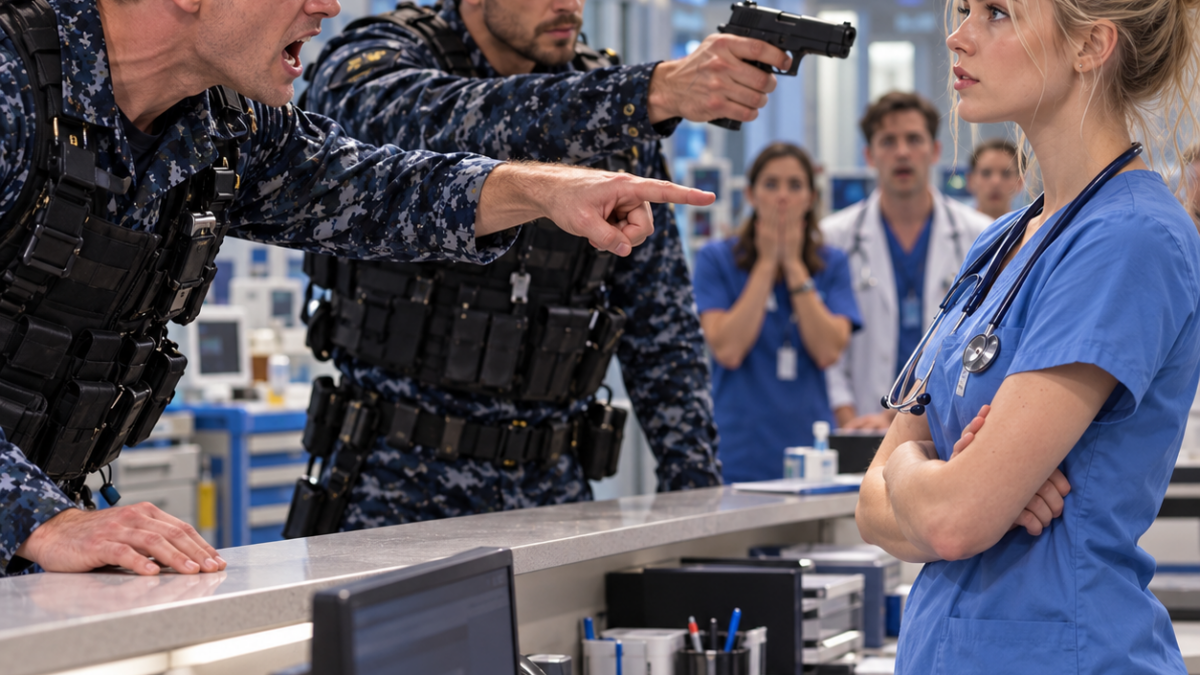
She stood up, not because the conversation was over, because she had been sitting down for 3 minutes, and her body was telling her that 3 minutes was what she’d needed, and the rest of what needed processing was going to have to wait for
a time and place.
We’re not this corridor at 3:51 in the morning.
I need to get back, she said. Mara.
He used her first name the way she’d used Rors earlier.
Not casually, deliberately. What you did tonight.
I want to be clear that I understand what I’m looking at.
She looked at him. You had at least three windows where you could have gotten out of that room safely.
I’ve been briefed on the sequence, the corridor.
The gap when Ortega’s attention was divided after you disarmed.
I didn’t disarm anyone, she said.
Ror put the weapon down. The timeline shows Ror decided to put it down.
She said that’s what happened.
He studied her.
You’re going to say that in your statement cuz it’s accurate.
It’s also generous.
It’s accurate.
She said again. What he decided to do at the end is part of the record of who he is.
I’m not interested in removing it.
Navaro was quiet for a moment. She could see him recalibrating something.
the specific process of a person updating their understanding of another person in real time. Okay. He said she went back to the bay at 422A.
M commander Grant Sloan was taken into custody at the Naval Base housing facility where he had been waiting apparently for confirmation that the situation at Harrove had resolved in his favor.
The officers who brought him in reported that he had been dressed and awake, which suggested he hadn’t slept, which suggested a man who was managing rather than resting.
The sess Mara learned this secondhand through Delgato, who delivered the information with the contained satisfaction of someone who had been working toward a specific outcome and had arrived at it. The immediate charge was evidence tampering. the remote access request to the training facility archive logged and timestamped and now attached to his facility credentials in a way that his attorneys were going to have a very detailed conversation about.
The medical research violations, the unauthorized compound sourcing, the coercion of trainee those were coming, but they took longer to build formally and the system moved at the speed it moved. The tampering charge was immediate. It was also, as Mara understood it, the kind of charge that collapsed a specific kind of credibility that was hard to rebuild.
Sloan had spent 18 months as a program with an outstanding record, exceptional selection rates, no formal complaints, commendations from two different flag officers. That record was now in the same investigative frame as the tampering charge, and every commendation in it was going to be reviewed against the question of what those outcomes had actually been built on. That was not nothing.
At 4:55 a. m.
, Noah Bell opened his eyes. Mara was not in the bay when it happened. She was at the nursing station completing a documentation review that needed to be submitted before the incoming shift arrived at 6:00.
One of the other nurses came and found her. She went in. Noah was awake in the incomplete way of someone surfacing from a long sedation.
Eyes open, tracking, not yet fully assembled into coherence. He was looking at the ceiling and then at the IV in his arm and then at the monitor beside him and then at Ren who was talking to him in the slow, clear cadence used for patients who need time for information to land.
He turned his head when Mara came to the bedside. She had not thought about what she was going to say to him.
She hadn’t planned it.
She’d been focused on the documentation and the handoff and the incoming shift and the 17 things that needed to happen in the next 17 minutes.
And the idea that Noah would be awake to have a conversation with had been an abstract good thing rather than a concrete immediate reality. She stood at the bedside and looked at him. He looked back at her.
His eyes were clearer than she expected, not fully clear. There was still the blurred quality of someone whose body had been through something significant, but present enough to show that the person behind them was there.
“Blue vial,” he said horarssely.
“Yes,” she said.
“We know.”
“I didn’t.
” He stopped, swallowed.
His throat was dry from the oxygen and the long unconsciousness.
I didn’t agree to a different compound.
Ror and Ortega had the standard injection. Sloan told me mine was a concentration adjustment.
He said it was for the advanced cohort protocol. We know, she said again. I started asking questions two weeks ago, CeCe said about the previous candidate who left about whether the data was actually going to an approved research program.
Sloan told me the questions were a sign I wasn’t ready for the advanced selection.
A pause. That was the same week I got the blue vial.
Something cold settled into Mara’s chest.
Not surprise, she’d assembled most of this from the fragments of the past 4 hours, and Noah’s account fit the shape she’d built.
But hearing it from him, from the man who’d been lying unconscious on that table, while the argument about what to do with his blood happened around him, that was different from assembling it from clinical evidence.
Ror, he said, and Ortega, both stable, she said. Ror had the same compound at lower concentration.
He’s being treated.
Noah was quiet for a moment. His eyes went to the ceiling again, not avoiding, just thinking.
Ror didn’t know about the blue vial, he said.
Not at first. I think he found out that night after I went down. Sloan must have told him what it was when he called.
We<unkll sort that out, Ren said from the other side of the bed.
He’s not voice caught.
Not on emotion, exactly. on something more complicated.
The specific difficulty of a person trying to be accurate about someone who had done something that hurt them because accuracy required holding multiple things that didn’t simplify into one.
He’s not entirely what tonight looks like.
Noah said, “I’m not saying what he did was.
I’m saying he wasn’t the one who built this.
I want someone to know that.
Someone does,” Mara said.
He looked at her again. You were here the whole time, he said. Not a question.
He’d pieced it together somehow from fragments her voice before he lost consciousness, the IV in his arm, the specific smell and sound of the bay he’d been in since midnight.
Yes, thank you, he said. She nodded once.
Didn’t say anything back because there wasn’t anything back.
There wasn’t anything to say back that wasn’t either too much or not enough.
and she’d learned a long time ago that those were the moments for brevity.
She finished the documentation at 5:34 a. m.
and submitted it to the medical records system where it joined the chart she’d been maintaining since 114 7p m a continuous unbroken record of everything that had happened to Noah Bell from the moment he’d come through the doors.
every intervention, every
medication, every vital set, every clinical decision and its reasoning timestamped and attributed and complete in a way that left nothing ambiguous about the sequence of events or the medical rationale behind each one. The chart was also incidentally a comprehensive reputation of any claim that the medical record had been altered because an unbroken documentation record with no gap and no amendment flags was its own form of evidence. She had known that at 11:59 p.
m.
when she’d kept charting while Ror stood 6 ft away with a weapon.
She had continued knowing it for the next 5 and 1/2 hours. At 5:41, Delgato found her again. The footage, she said, and there was something different in her voice, not the controlled operational tone of the past 3 hours.
Something with more weight in it. What about it?
Mara said, “The three segments,” Sloan requested.
“We’ve had preliminary review,” she paused.
“Sgment one shows the injection procedure.
All three trainees in sequence. Sloan administering the compound vials are visible in the footage. The blue vial is distinct.
Sloan handles it separately from the others. Mara absorbed this.
Segment two shows Belle’s adverse reaction beginning approximately 40 minutes after injection.
Sloan is present. He observes for 11 minutes before directing the trainees to transport Bell offsite rather than calling emergency services directly. 11 minutes.
Sloan had watched Nobel beginning beginning to go into physiological crisises for 11 minutes before he decided what to do about it. And what he decided was not call for help, but manage the logistics of where the problem went.
Segment three, Delgato said and stopped. Commander. Segment 3 shows Sloan removing and pocketing the data cards from all three monitoring devices while Belle was on the ground being attended to by the other trainees.
She said it evenly clinically, the same way Mara delivered information.
She didn’t want to perform.
He is looking directly at the camera in a portion of the segment. Mara was quiet.
He knew there was a camera.
Delgato said he’d worked in that facility for 3 years.
He knew the camera positions. He requested science specifically. He requested those three segments specifically because they were the three segments that showed him clearly and he intended to pull them before anyone else reviewed them.
But he didn’t know the security officer was offsite.
No, the room the corridor where they were standing was one of those spaces that existed in a kind of institutional suspension at 5:41A. M too late for the overnight staff and too early for the dayshift.
The specific quiet of a large building between its people. The kind of quiet that made conversations feel more contained than they were.
There’s something else, Delgato said.
Tell me. We ran the credentials that access the archive remotely.
The login belongs to a training administrative assistant junior civilian staff. Access granted as part of routine facility work. She has no record of accessing the archive tonight.
Her computer was in sleep mode in her home office with her home IP address logged at the relevant time. A pause. Her access credentials were used from a device registered to the naval base officer housing network at 2 6a m.
Sloan’s residential unit is on that network.
The silence after that was complete.
Sloan had used someone else’s credentials, had had access to them.
How? Through what process of proximity or opportunism or methodical planning, and had used them tonight?
Because using his own credentials to pull footage that showed him committing research, fraud, and evidence, tampering would have been a different kind of problem. He had thought of that.
He had been careful enough to think of that, but he had not thought of the security officer being offsite or he had thought of it and assumed it wouldn’t matter because the request would go through before anyone noticed.
8 months of a program.
18 months really and it had come down to a call back that hadn’t completed.
He’s going to say he gave her credentials to someone else for legitimate facility access purposes, Mara said.
His attorneys are going to say that. Delgato agreed. Yes.
The device location will be central to the investigation. Yes.
They stood in the early morning corridor and neither of them said anything for a moment because there was a point passed which the analysis stopped being useful and started being the thing you did instead of sitting with what had actually happened. A man had run an unauthorized experiment on young people he was responsible for.
He had given one of them a compound that nobody outside his private sourcing chain could identify by name in a higher concentration when that person had started asking questions. He had watched that person go into crisis and made logistical calculations rather than medical ones. And then he had spent the night trying to scrub the record.
He had assumed the night shift nurse was an obstacle to be managed. Mara looked down at the silver trauma shears clipped to her badge. 5 years of hanging there through a thousand shifts.
Through the inventory of ordinary nights that constituted her second life in this building, her chosen life, the one she’d built on the other side of everything she’d left behind.
She thought about the interpreter. She thought about him the way she always thought about him.
Not as a ghost, not as a wound exactly, but as a fixed reference point. The moment she had made the decision she was told to make, the decision that was tactically correct and operationally justified, and that she had received a medal for, and that she had spent the years since understanding the shape of in ways that the medal ceremony had not addressed. She had chosen who came home that night.
She had spent 5 years in this building trying to be someone who didn’t have to choose.
Tonight she had not chosen. Both patients were alive.
She thought about whether that resolved something and decided it didn’t.
Not cleanly, not completely, not not in the way that a clean resolution felt in fiction. What it did was add a data point to a longer accounting.
She was still in the middle of and the countman wasn’t finished and might not uh be for a long time.
Her shift was supposed to end at 6:00. It was going to be considerably later than 6:00.
At 58, 22 minutes before the day shift was scheduled to begin, a JAG officer came through the secondary access with two documents and a request for Mara’s formal statement.
She told him she’d give it in 40 minutes after handoff.
He accepted this and went to wait. At 6:30, the dayshift charge nurse arrived and found the trauma wing populated with military personnel, investigators, and two patients in bay 3 and looked at Mara with an expression that was 90% questions. Mara began the handoff.
She gave it the same way she gave every handoff complete, sequenced, nothing omitted.
She went through Noah’s current status, the treatment protocol, the follow-up blood work that needed to run at 8 and 10 and noon, the specifics of his exchange transfusion and recovery trajectory.
She went through Ror’s status, his medications, his cardiac monitoring parameters.
She noted which rooms were involved in the active investigation, and which needed to remain undisturbed. The day charge listened with the specific focused attention of someone receiving an unusual amount of information in a short time and managing it.
At the end, she asked, “How long were you in the locked unit alone?”
“53 minutes,” Mara said.
A pause.
“Are you I’m fine,” Mara said.
“Get someone to restock bay 3.
The blood product supply is low.”
She handed over the chart access and walked out to give her statement. The JAG officer was thorough. He asked good questions, and he did not mislead, and he let silences sit without filling them, which was the mark of someone who had learned that silences in a statement were where the most precise answers came from.
She told him everything.
The clinical sequence, the behavioral observations, Ror’s radio communications, Sloan’s transmission into the sealed bay, the physiological monitor device, and Ortega’s decision to produce it, her medical reasoning at each step, and the documentation that supported it.
She told him that Ror had made the decision to lower the weapon. The JAG officer noted this carefully.
She told him what Noah had said about the two weeks before the session, the questions, Sloan’s response, the blue vial.
She told him about the texts and provided the number and let him determine what to do with it.
at 7:44a m when the statement was done and she had signed it and the JAG officer had stood and thanked her with the formal politeness of someone who understood the weight of what they’d been given.
She walked back through the wing toward the locker room. She passed bay 3 on the way.
The door was open. Noah was awake, propped slightly, the monitor above him showing stable vitals in green.
Someone from the dayshift was with him taking vitals, adjusting something at the IV site. The ordinary business of a patient in recovery, the machine of care that continued regardless of what had surrounded the previous night.
He saw her through the door. She stopped. He raised one hand just barely, a fraction of movement.
The gesture of someone whose body was still limited, but whose intention was clear. She lifted her chin once, brief, and kept walking.
In the locker room, she changed out of her scrubs. She clipped the silver trauma shears to the lanyard of her personal badge, out of habit, the way she always did when she was leaving the building, the building, and putting hospital property away. Then she looked at them for a moment and unpinned them from the lanyard and held them in her hand.
battered, scratched the engraving. Everyone comes homeworn thin in the middle of the age from years of contact with badge clips and drawer edges and the accumulated friction of constant proximity to whatever she was doing.
She thought about the person who’d given them to her.
She thought about why she’d kept them.
She put them in the pocket of her jacket where they’d been a hundred times before and went to her car.
She sat in the parking structure. She sat in the parking structure for 4 minutes without starting the engine in the early morning light that came through the concrete levels, watching the light moved the way it did when you had been awake through a whole night. And the morning looked slightly unreal, not wrong, but altered in its color and its depth.
Then she started the car and her phone rang.
Unknown number, not the same one as the text’s different format, different area code.
She looked at it for a moment. Then she answered. The voice on the other end was female older with the specific vatricness of someone who had decided before dialing exactly how this conversation was going to begin.
Miss Vance, she said. My name is Dr. Adrien Forsythe.
I’m the director of the Naval Medical Research Review Board.
I’ve been in contact with Commander Delgato in the last hour.
A pause.
I’d like to meet with you today at your convenience, not mine.
About the investigation, Mara said, about the investigation, Foresight confirmed. And about what you knew in that room last night that nobody else there knew.
Another pause, brief and deliberate. We have a file that was sealed 7 years ago. A field incident report from a classified deployment.
It describes a sim similar compound presentation and an improvised treatment response that saved four lives in a non-hosp environment. She stopped. Mara held the phone and looked at the concrete ceiling of the parking structure.
That file has your name on it. Foresight said the parking structure was very quiet. Mars sat with the phone against her ear and let doctor.
Foresight’s last sentence settle into the space around her.
The way a sound settles after the source of it has stopped. Not disappearing, just changing form, becoming part of the room rather than a thing traveling through it. A file with her name on it, sealed.
7 years old. She had known the file existed.
She had known it the way you knew about the locked drawer in a house you no longer lived in.
not thinking about it daily, but aware that it was there, that it contained something real, that the containing of it was a choice someone someone had made on her behalf or on the institution’s behalf or on the behalf of operational security, and that the choice had never been hers.
“What do
you want from me?”
she said into the phone.
Foresight didn’t hesitate.
“I want to understand what happened in that treatment bay last night from someone who was inside it.
I want to understand how a nurse with no official special operations record on file made a correct differential diagnosis on an experimental compound that isn’t in any medical reference database.
A pause and I want to talk about what should happen next for the program for the trainees for the oversight structure that that failed to catch Sloan before a young man nearly died.
That’s three things Mara said.
Yes.
Foresight said, “I know.”
Mara looked at the parking structure ceiling. A water stain on the concrete above her, the color of old rust, shaped like nothing in particular.
She’d parked in this spot many times over 5 years, and had never once looked up at it.
2:00, she said.
“I need to sleep first.”
2:00. Foresight agreed.
I’ll send you the address.
The call ended. Mara put the phone on the passenger seat and finally started the engine and drove home.
She slept for 5 hours, not well, not cleanly, the kind of sleep that was more like a negotiated ceasefire between her body and her mind than actual rest. She woke at 12:40 p. m.
to two missed calls from Ren, a text from an internal hospital number that was probably HR, and a message from Navaro that was three words, “Call me later.”
She showered. She ate something. She stood at the window of her apartment for a few minutes drinking coffee and watching the neighborhood do its midday business.
And she let herself feel the specific quality of being outside the building after a long night inside it. The air moving differently, the light coming from a different angle, the ordinary scale of ordinary things. Then she drove to the address Foresight had sent.
The Naval Medical Research Review Board occupied a building that looked like every other administrative building on a military installation, rectangular, functional. The aesthetic of an institution that has never once considered that architecture might communicate something.

