“Have You Eaten?” She Asked—And the Former Navy SEAL Kept Finding Reasons to Return – Part 1
“Have You Eaten?” She Asked—And the Former Navy SEAL Kept Finding Reasons to Return
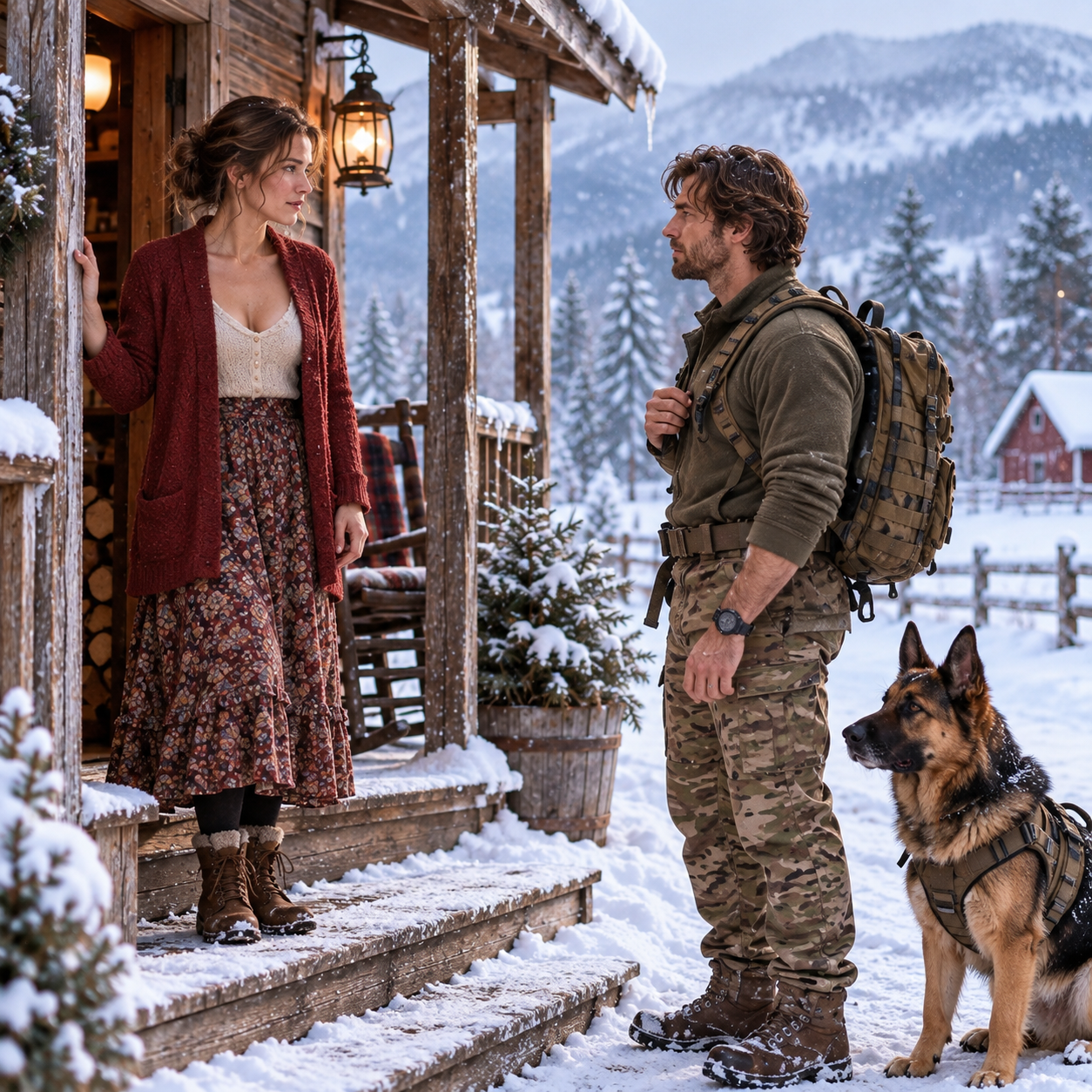
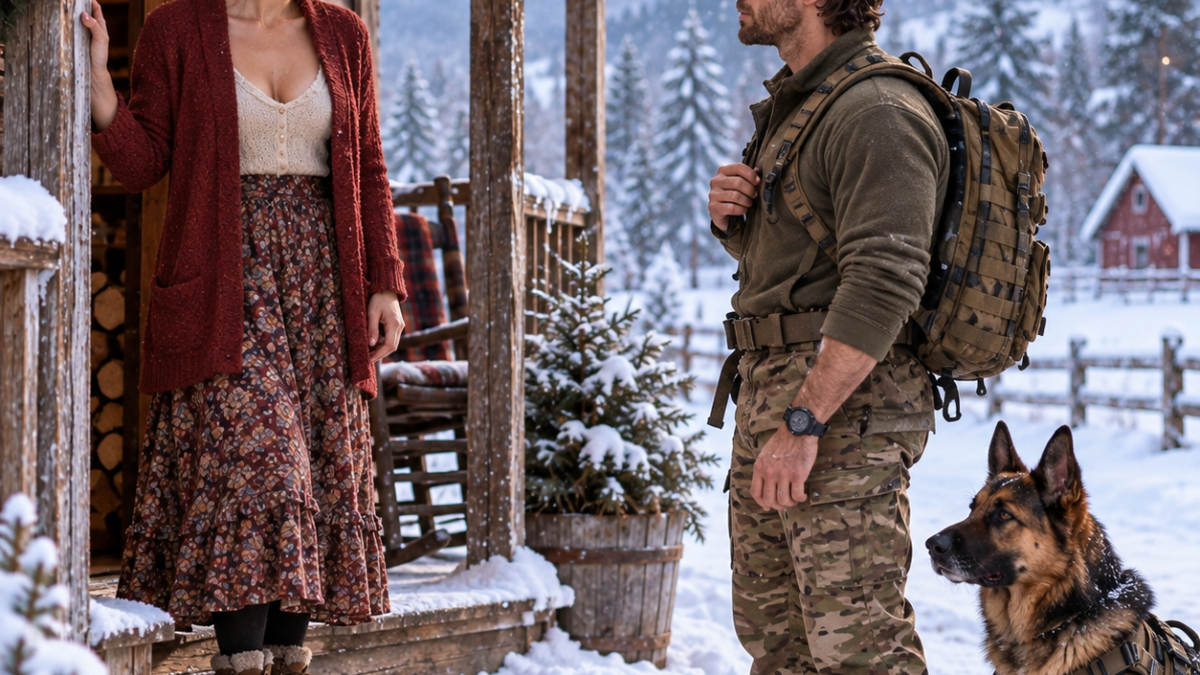
Wellsboro, Pennsylvania, 2016. Mara Whitfield had run the little mending shop at the edge of town for 5 years. Ever since the week she lost both of her parents, she kept mostly to herself, worked long hours, and every evening left a small candle burning on the porch before closing for the night.
The people of Wellsboro had stopped asking about it. Then Grant Keller came to town with his German Shepherd.
A former Navy Seal, he was only looking for temporary work and a quiet place to stay before moving on again.
But he began passing Mara’s shop almost every evening.
At first, he noticed the light. Then he noticed the woman who was always there beside it. What began as a few quiet encounters would soon bring two carefully guarded lives closer than either of them had planned and test what each of them was still willing to hold on to.
By the middle of January, the snow along Route 6 had lost most of its clean white edges. Plow trucks had pushed it into gray banks beside the road, and salt dried in pale streaks across the pavement wherever afternoon traffic had carried the meltwater. Beyond the last crowded blocks of Wellsboro, houses stood farther apart, fields opened behind them, and bare maple branches showed dark against a clear Pennsylvania sky.
Whitfield Mending and Leather sat near that change in the road. The building had once been a narrow country house with a deep front room and a porch barely wide enough for two chairs.
Over the years, Ruth Whitfield had turned the front half into a working shop, adding shelves, a cutting table, a heavy sewing machine, and enough hooks along one wall to hold the things people brought in from farms, garages, and logging crews around Tyogga County. Mara Whitfield had been running it alone for 5 years. At 35, she had learned that most things came through the door for one of two reasons.
Either replacing them cost too much or replacing them meant more than the customer wanted to admit. Work jackets came in with broken zippers and sleeves rubbed thin at the cuffs. Canvas tarps arrived folded under one arm, smelling of hay, oil, or wood smoke.
She repaired leather tool pouches, boot upers, work gloves, hunting bags, and the occasional horse tack someone still preferred to keep another season. Near the coat rack stood a small wooden bin with a handwritten card tucked into the front. Winter repairs.
Pay when you can. Mara never mentioned the sign unless someone asked.
On the shelf beside her workbench sat an old army mug with a chipped green rim. Her father Thomas had carried it to the county road garage almost every morning after leaving the service. And Mara still used it to hold alls and marking pencils.
Beside it rested a shallow wooden box containing spools of wax thread arranged by size rather than color, exactly the way her mother had kept them. Ruth had taught her that good repair began before the first stitch.
Run your fingers over the material. Find where it is still strong.
Find where it has already given up. Never promise more than the thing itself can carry. Mara had heard those instructions so often as a girl that she no longer remembered learning them.
The largest thing Ruth had left behind was not a tool at all. A quilt hung on the wall behind the workbench, wide enough to cover most of the plaster between two windows. Its dark blue and faded red pieces formed a Northstar pattern, though closer inspection revealed that several sections had once been something else entirely.
Part of Thomas’s old work shirt, a square from one of Ruth’s aprons, a strip of fabric Mara remembered from a childhood winter coat.
Customers sometimes admired it. Mara usually thanked them and returned to work.
The people who had known Thomas and Ruth also knew not to linger too long over the subject. 5 years had passed since Mara lost them within the same week.
Yet Wellsboro remained the kind of town where grief developed its own manners. People still lowered their voices around certain memories. Men who had known her father sometimes tried to carry boxes she had already lifted.
Women who had sat with her mother at church occasionally touched Mara’s arm before leaving, even when there was nothing sad in the conversation.
Nobody meant harm by it. Mara had simply learned to make room for it.
Across town, Grant Keller had not yet been in Wellsboro long enough for anyone to have developed habits around him. He was 44, staying by the week at the Laurel Ridge Motorcourt in a room with a microwave that hummed louder than the heater and curtains that never quite met in the middle.
His duffel remained halfpacked at the foot of the bed because that was how he kept it in most places. The truck carried more of his life than the room did.
Hobbs seemed unconcerned by any of this. The German Shepherd had inspected the motel room on their first night, chosen the strip of carpet between the bed and the heater vent, and treated the matter as settled.
Grant had taken winter work with Marsh Creek Farm and Fence 3 days after arriving. Sam Dwire, the owner, needed another pair of hands through the season and appeared satisfied with the fact that Grant arrived early, knew his way around tools, and did not require much supervision.
The men on the crew knew he had been in the Navy. Beyond that, nobody had asked. Grant preferred it that way.
On Thursday afternoon, Sam sent the crew home early after they finished resetting a gate line before the ground hardened again overnight. Grant drove into Wellsboro with dried mud along the lower panels of his truck and Hobbs sitting upright behind the passenger seat.
They stopped at Tyogga Outfitters and feed for dog food, work gloves and coffee that had probably been on the warmer too long. Norah Pritchard was behind the counter checking invoices with reading glasses pushed low on her nose.
She had the efficient manner of someone who could answer a question while continuing three other tasks. Grant set a large bag of dog food beside the register.
You know anybody around here still works leather? Norah looked over the top of her glasses. Saddles?
Not exactly. Grant reached into his coat pocket and placed an old brown leather collar on the counter.
Time had darkened the leather almost black around the edges. A wide brass D-ring sat at the back, worn smooth in places, and several inches of stitching near the hardware had begun to separate.
The small brass identification plate showed more scratches than lettering. Norah picked it up.
Her expression changed just enough to show that she understood why Grant had asked for repair instead of replacement. Whitfields, she said.
East side, where Route 6 starts opening up. Grant nodded.
Mara Whitfield. Best leather hands left around here.
As far as I’m concerned.
Norah turned the collar once more before giving it back.
If she tells you it can’t be saved, don’t waste your afternoon asking somebody else.
Grant slipped it into his pocket. Friendly?
Norah’s mouth moved slightly.
Depends what you require from friendly. Grant glanced toward Hobbs, who had positioned himself near a display of package treats without touching anything.
Apparently, we’re not in a position to judge.
That earned a short laugh from Nora. 20 minutes later, Grant pulled into the narrow gravel turnout beside Whitfield Mending and Leather. A small bell sounded when he opened the door.
The shop smelled faintly of leather conditioner, coffee, and fabric that had been warmed all day by an old radiator under the window. Mara stood at the cutting table with a canvas work apron over a dark sweater marking a line along a piece of heavy material. She looked first at Grant, then at Hobbs.
He’s all right, Grant said.
I assumed he was. Mara set down the chalk pencil.
Grant took the collar from his coat and placed it on the counter between them. I was told you might be able to do something with this.
She did not answer immediately. Mara turned the collar over, ran her thumb along the cracked section near the D-ring.
Then flexed the leather carefully between both hands. Her fingers stopped where the old stitching had begun pulling through the weakened edge. How big is the dog?
Grant glanced down. Hobbs was already sitting beside him.
Mara followed his eyes. That big? Grant waited.
She examined the collar a little longer, then set it flat on the counter.
I wouldn’t put this back on him.
Grant’s expression remained unchanged.
You can’t repair it.
I can sew it.
That doesn’t mean I should tell you it’s safe.
She touched the section around the D-ring. This part has been carrying stress for years.
The leather’s tired underneath the surface.
If you want a working collar, buy another one. There was nothing rude in her voice.
There was not much softness either. Grant picked up the collar.
Fair enough. Mara looked at him as though she had expected another question.
None came. Grant slipped the collar into his coat and gave a small nod.
Thanks for looking. He turned toward the door.
Something about that bothered her more than an argument would have. Mara had dealt with customers who wanted her to promise impossible repairs, men who explained leather to her while standing inside the shop her mother had built, and people who considered sentiment a reason to ignore safety. Grant had done none of those things.
He had accepted her answer before she had even finished defending it. His hand was already on the door when she spoke.
“Why that one?”
Grant stopped. He looked back at her.
Hobbs has three newer collars in the truck. Mara glanced toward the German Shepherd.
Grant rested one hand lightly against the old leather inside his coat pocket. This was the one he wore near the end of our Navy years.
It was still around his neck the day the paperwork stopped calling him government property and started calling him mine. Mara said nothing.
I’m not asking you to make it equipment again.
He continued.
I thought maybe I’d find somebody who could keep it from falling apart in a drawer.
His tone carried no accusation, which somehow made her hear her own mistake more clearly. Grant opened the door.
Mr. Keller.
He turned again. Mara looked past him for a moment toward the Northstar quilt on the wall.
Ruth had once spent three evenings repairing one corner because throwing away the damaged pieces would have meant losing part of Thomas’s old shirt.
Mara wiped her hands on her apron. I can preserve it. Grant waited.
I can reinforce the back, stabilize the stitching, and condition what’s left without pretending it’ll ever be safe for working use again.
She nodded toward Hobbs. And if you want, I can make him a new one with roughly the same width and fit. Grant brought the old collar back to the counter.
That’s what I was looking for.
This time, Mara heard the difference. She pulled a measuring tape from a drawer and came around the workbench.
Hobbs watched her approach. Does he mind strangers?
Usually less than strangers mind him. Mara stopped beside the dog.
Hobbs stood when Grant gave a quiet cue. Mara passed the measuring tape carefully around his neck, keeping two fingers beneath it. For several seconds, he remained perfectly still.
Then the tape brushed the thick fur under his jaw. Hobbs sat down.
Mara straightened. Grant looked at him.
Stand. Hobbs stood again.
Mara tried once more. The tape touched his neck. Hobbs sat.
Grant studied the dog with the resigned patience of a man witnessing deliberate insubordination carried out very politely. Years of serious work, he said.
Apparently, tailoring is where he draws the line. Mara laughed before she could stop herself. Hobbs looked up at her.
Grant did too. The laugh disappeared quickly, but the room felt less formal after it. On the third attempt, Mara got the measurement.
She wrote Grant’s name and motel number on a repair ticket.
estimated several days for the preservation work, then placed the old collar on the far side of her bench beside Ruth’s wooden thread box.
Grant noticed where she put it. He did not comment.
By the time he drove away, the January light had begun thinning over the fields behind the shop. Through the rear view mirror, Grant saw Mara step onto the porch carrying a small glass hurricane holder.
She set it on the rail. Then she struck a match, cupped one hand around the flame, and lit the candle inside.
Grant watched only as long as the mirror allowed. He did not know why she did it. He kept driving.
2 days later, Grant returned just before noon. The sky had gone pale and hard above Wellsboro, and the snow left along the road had frozen into ridges that looked solid enough to stand on.
Hobbs came through the door first this time, paused just inside Whitfield mending and leather, and gave the room a slow inspection before settling beside Grant instead of directly against his leg. Mara noticed. She also noticed that he looked toward the workbench before looking at her.
The old collar lay there beneath a folded cloth. Mara had cleaned the leather carefully, removed years of surface dirt without stripping away the wear, and opened several inches of the inner seam so she could reinforce the weakened section from behind. The collar would never hold working tension again, but it would hold its shape.
“I need to check the lining before I close it,” she said.
Grant nodded. Hobbs watched her pull the measuring tape from the drawer. His ears shifted.
Grant looked down at him. You remember her? Hobbs sat.
Mara stopped with the tape still in her hand. Grant gave the dog a long look.
That’s not what I meant.
Mara smiled despite herself and crouched beside Hobbs. This time she let him sniff the tape first, then touched it lightly to the new collar he was wearing.
He remained still for nearly 5 seconds. Then the scissors snapped shut across the workbench.
Hobbs turned his whole head toward the sound. Mara waited. Grant waited.
The dog returned his attention to her with the expression of someone who had been interrupted by poor management. Better, Mara said.
I’ll put it in his performance review.
She measured the inside fit and wrote the number on the back of the repair ticket. While she worked, Grant stood near the counter and looked around the shop in the way he often looked at unfamiliar places.
He was not nosy. His eyes simply took in where things were, which door opened to the back room, how the shelving was arranged, where Mara kept finished orders, and which part of the floor creaked beneath the radiator.
Mara had noticed that habit during his first visit. She had also noticed that he never touched anything without asking.
“How long are you in town?”
she asked. Grant considered the question longer than it required.
“Don’t know yet.
That usually means not long. Usually Mara threaded a needle through the reinforced backing.
Where was the last place? Nevada. Before that, Idaho for a while.
She glanced up. You move a lot.
Grant looked toward Hobbs. He complains less than most landlords. That was all he offered.
Over the next week, Mara collected the rest in pieces. Virginia Beach came up because Grant knew exactly how quickly wet air could get into tools stored badly. Southern California came up when Mara complained about people who thought Pennsylvania winters were unbearable after seeing 3 in of snow.
Nevada appeared because Grant had spent part of one summer helping repair fencing on a property where shade had been treated almost like currency. None of it arrived as biography.
Grant never said, “Here is who I am.
” He simply answered whatever question happened to be in front of him, then let the subject move on.
Since leaving the Navy, he had worked ranch maintenance. short-term security jobs, property repair, and fence crews.
He liked work that left something visible behind at the end of the day. A hinge lined up, a gate closed, a fence ran straight where it had sagged that morning. Mara understood that kind of satisfaction.
She did not yet understand the moving. Grant, in turn, learned about her without asking many questions. One Thursday afternoon, a man in sawdustcovered workpants came through the door carrying a winter coat with the zipper separated completely at the bottom.
His name was Ray Mullen, and he worked at a small sawmill north of town. Mara examined the coat. Tomorrow afternoon, Ry shifted his weight.
Friday, any chance? Tomorrow is Friday.
He rubbed a hand over his face. Right.
Mara looked at him. Ry lowered his voice. Payroll got pushed again.
I didn’t ask.
I know. She wrote his name on the ticket.
Pick it up tomorrow. Ry hesitated. Mara, pay me when they straighten it out.
His shoulders loosened in a way Grant noticed from across the room. Ry thanked her once quietly and left. Mara went back to the zipper.
Grant said nothing for perhaps 20 seconds. Then she looked at him.
If you’re about to turn that into a speech about kindness, you can drink your coffee somewhere else.
Grant lifted the mug she had given him.
I was going to say, “Your coffee is stronger than the motel coffee.
That was almost believable.
It wasn’t meant to be.”
She returned to the coat. Grant drank his coffee. The silence afterward was comfortable enough that neither of them needed to improve it.
Hobbs discovered the biscuit jar three visits later. Mara had kept it on the lower shelf behind the counter for years because customers sometimes brought dogs with them.
The first time she offered one, she looked at Grant for permission before opening the lid. Grant nodded. Hobbs accepted the biscuit neatly without grabbing, then returned to his place near the door.
The next visit, he glanced toward the jar once. On the third, he walked into the shop, looked directly at the shelf, then turned his head toward Mara.
Only after that did he acknowledge Grant. Grant stared at him.
Six years of discipline. Mara took down the jar. Apparently worth one biscuit.
Grant shook his head.
That’s disappointing.
Mara handed Hobbs the treat. Still cheaper than most men. Grant looked at her.
She looked back. Then both of them laughed, though neither laughed very long. After that, humor entered the room without introduction.
It appeared around small things.
Hobbs’s suspicion of the measuring tape, Grant’s inability to make motel coffee drinkable, Mara’s refusal to believe any man needed four identical pairs of work gloves, and Grant’s opinion that people who own 12 kinds of thread had surrendered their right to judge anyone else’s excesses.
Outside the shop, his
days settled into a different rhythm. Marsh Creek Farm and Fence kept a six-man winter crew, though reduced that number whenever road conditions turned poor.
Sam Dwire was 57, broad through the middle, and permanently unimpressed by the idea that being an owner meant staying warm in an office. He worked beside the crew, carried his own tools, and had a habit of answering complaints with useful information rather than encouragement. Grant liked him almost immediately.
They replaced gate hinges, reset posts loosened by repeated freeze and thaw, repaired livestock fencing, and cleared branches that had come down along property lines after a windy night. Grant did not rush, but he rarely repeated work.
When he saw something wrong, he corrected it before someone else had to point it out. Sam noticed.
He did not compliment Grant very often, which Grant also appreciated.
You’ve done this before, Sam said one morning while they were rehanging a steel gate.
Some version of it. Ranch work.
That too. Sam waited a moment. Perhaps expecting more.
Grant tightened the final bolt. Sam handed him the next wrench.
That was the end of the conversation. The weather changed almost every few days. One Monday morning, the sky came out clear enough that distant ridge lines looked sharpened at the edges.
By Wednesday, temperatures had climbed and Route 6 was lined with dirty runoff, slush dragging under tires and collecting around storm drains. Two mornings later, low fog settled through the hollows toward Pine Creek and stayed until nearly noon.
Grant found he liked the variation. It kept a person from pretending the season owed him consistency.
On the afternoons, when work brought him back through the east side of Wellsboro, he passed Whitfield, Mending, and Leather. The first few times he noticed the candle because it was unusual. After that, he noticed whether Mara was sitting beside it.
Some evenings she was outside with a mug in both hands, a wool coat buttoned high at the neck, watching traffic thin along the road. Other evenings the porch was empty, but the light had been moved just inside the east window where it remained visible from the road.
Grant never asked her about it. Once after a day of wet snow, he saw her brushing the porch rail clean before setting the glass holder down. Another evening, the temperature dropped so quickly that ice began forming along the gutters, and the light appeared behind the window instead.
The habit remained even when the weather changed. Grant began looking for it before he realized that was what he was doing. By the end of the following week, Mara had finished both collars.
She placed them side by side on the counter. The old one looked almost unchanged from a distance.
Up close, Grant could see where she had reinforced the inside with a thin backing, preserved the original stitching where it remained strong and matched new thread to the faded color instead of making the repair look fresh. The brass plate had been cleaned but not polished. The scratches were still there.
The new collar was simpler. Dark brown leather, solid hardware, practical stitching.
Mara had copied the width and general fit of the old one without trying to manufacture age into something new. Grant picked up the old collar first.
He ran his thumb along the inside. You kept the wear.
It wasn’t damage.
Mara leaned one hand on the counter. Some of it was just history. Grant looked at her.
Then he picked up the new collar, checked the stitching, then crouched and fastened it around Hobbs’s neck.
The dog shook once, tags clicking softly against the buckle. Grant stood.
This is right. Mara nodded.
He paid the full amount without asking for a discount. Before leaving, he held the old collar in both hands for another moment. You understood what I wanted.
It was not a dramatic thing to say. Mara still remembered it after he left. That should have been the end of the job.
There was no more fitting to check. No leather waiting for conditioner.
No practical reason for Grant Keller to come through the door again. Two days passed. Late Saturday afternoon.
The bell above the entrance sounded. Mara looked up from a canvas repair.
Grant stood inside with Hobbs beside him and one leather work glove in his hand. A seam had opened along the base of the thumb. Mara looked at the glove.
Then she looked at Grant. Grant had repaired enough fencing, tack, and equipment in his life to close that seam himself in less time than it had taken him to drive across town.
Neither of them said so. Mara held out her hand. Grant gave her the glove.
I can have it Monday. That works. Hobbs was already looking at the biscuit jar.
Mara reached for it.
Mara finished Grant’s work glove before Monday.
The open seam had taken less than 10 minutes to repair, which only confirmed what both of them already knew when he brought it in. She left it beside the register anyway, folded neatly with his name written on a small paper tag, and found herself looking toward the door twice that morning before becoming annoyed enough with herself to move it beneath the counter.
Grant did not come in until Tuesday. By then, the temperature had climbed above freezing, and the hard snow along the road had softened into gray slush.
He collected the glove, paid without commenting on the fact that Mara had charged him almost nothing, and stayed for one cup of coffee before heading back to Marsh Creek. Neither of them mentioned why the glove had required a professional.
Hobbs received a biscuit that seemed to satisfy everyone. Several mornings later, Grant stopped at Maple and Main Cafe before work.
The place occupied the corner of an old brick building near the center of Wellsboro, with tall windows facing the street and a narrow counter where regulars seemed to know which stool belonged to whom. The breakfast crowd had thinned, leaving two men in work jackets near the window, a woman reading the local paper, and an older couple sharing toast across from the coffee station.
Grant chose a table near the back.
Hobbs settled beneath it without being told, his body angled so that his shoulder rested lightly against Grant’s boot.

