“Have You Eaten?” She Asked—And the Former Navy SEAL Kept Finding Reasons to Return – Part 5
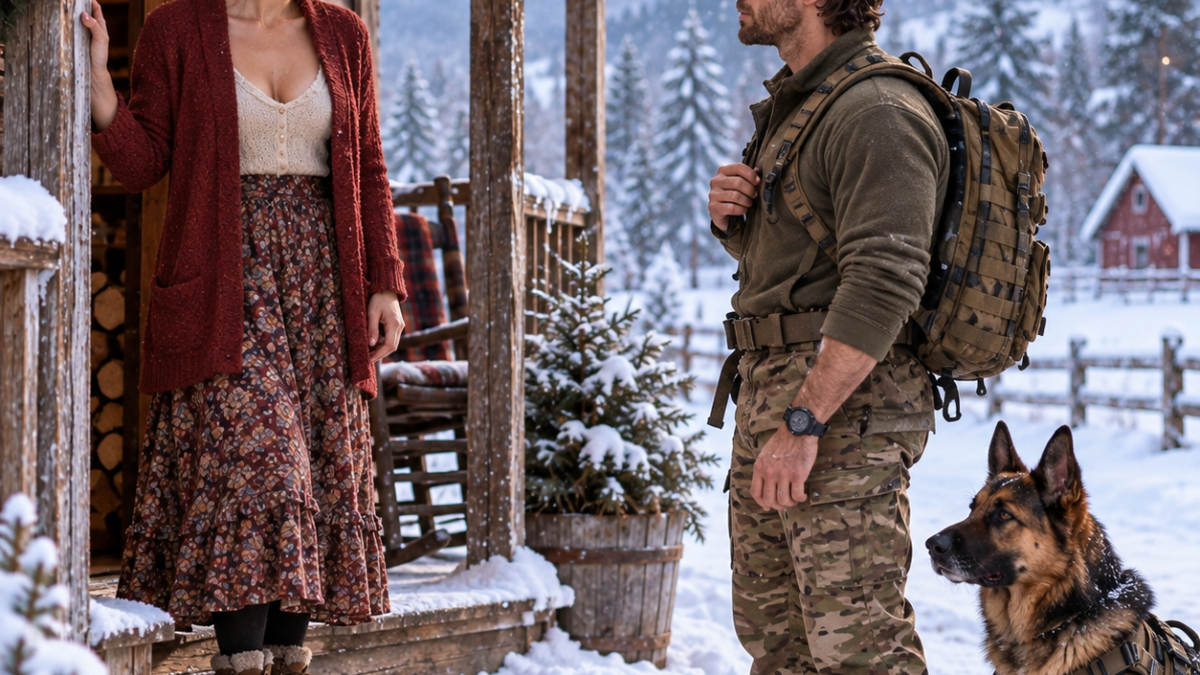
Grant did not answer. Hobbs was not interested in Dale. His head turned toward the open side of a storage shed 30 yard from the garage.
He stood still, then lifted his nose. Grant recognized the change. It was subtle, nothing theatrical.
Hobbs moved forward. Grant followed.
Dale stepped off the gravel. Hey, keep him out of there.
Grant stopped. The words had come too fast.
Hobbs continued looking toward the shed. Grant looked at Dale.
Why?
Because it’s my property.
Aaron Bell was already watching Dale now. Grant walked closer to the shed. Old plow blades, fuel cans, stacked lumber, and several storage bins filled the interior.
A blue contractor tarp covered a pile along the back wall. Hobbs went directly to it. He sniffed along one edge.
Grant saw something before he touched the tarp. A triangle of faded blue fabric.
Beside it, a small red square. He knew the pattern.
Grant pulled the edge of the tarp back. The Northstar quilt lay folded beneath it. For a moment, nobody spoke.
Dale stared at the ground. Grant looked at him.
That’s a difficult coincidence.
Whatever fight Dale had brought outside with him seemed to drain away. Belle stepped forward.
From there, the matter became simple enough. The truck matched what witnesses had seen.
Dale had already been involved in the argument at Mara’s shop.
The quilt was sitting on his property under a tarp. His explanations changed twice before Grant stopped listening.
When Grant returned to Wellsboro later that morning, the quilt was folded carefully on the passenger seat. Belle carried it into the shop. Mara did not move at first, then she reached for it.
One edge had torn where someone had pulled it down from the wall. Mud marked part of the lower border, and one seam had opened near the corner. Mara unfolded enough to find a crooked line of hand stitching in faded cream thread.
Her fingers stopped.
Mom always said she’d redo this.
Grant stood beside the counter. Mara traced the uneven stitch. She never did.
Her hands began trembling. Grant did not step toward her. He stayed close enough.
That was all. Mara looked up. Then she crossed the space between them herself.
Her arms went around him. Grant held her carefully, one hand between her shoulder blades, saying nothing.
Beside them, Hobbs sat. He watched for several seconds.
Then his head turned toward the biscuit jar. Mara noticed. A small laugh broke through the tears she had been trying not to show.
“Seriously?”
Grant looked down at Hobbs. Timing was never his strongest skill.
The shop reopened 2 days later. By then, half of Wellsboro seemed to have heard what happened.
Sam Dwire arrived with lumber and rebuilt the damaged door frame. Norah brought coffee and stayed to sweep.
Clare Row appeared with two boxes of pastries and claimed the bakery had made too many, though nobody believed her. Ray Mullen showed up after his sawmill shift carrying a shop vacuum.
Another customer repaired a bent shelf. Someone replaced the rear light.
Mara tried to protest during the first hour. By lunch, she stopped. There was a difference.
She began to understand between people assuming she could not stand on her own and people choosing to stand beside her anyway. She had spent 5 years confusing the two whenever they arrived wearing the same face.
The Northstar quilt remained off the wall for several days. One evening after closing, Mara spread it across the workbench. Grant held the far side flat.
Hobbs slept on the canvas mat nearby.
Mara opened Ruth’s wooden thread box and took out a small piece of dark blue fabric that had been folded beneath the spools for years.
“One of mom’s scraps,” she said.
Grant held the quilt steady while she shaped the patch. Mara could have hidden the damage. She knew enough to make the repair nearly invisible.
Instead, she reinforced the torn section and let the new seam show. When she finished, the line was neat but unmistakably newer than the rest. Grant ran one finger near it without touching.
You leaving it like that? Mara nodded.
That’s what happened to it.
They carried the quilt back to the wall together. The North Star returned behind the workbench with one new piece among all the old ones.
If a person stood close enough, the repair was easy to find. Mara decided that was all right. Some things could be mended without pretending they had never been hurt.
By the first week of March, winter had begun loosening its hold on Wellsboro. Snow still covered the shaded edges of the fields, but the broad white stretches had broken into patches of brown grass and wet earth. Water dripped from the roof of Whitfield Mending and Leather during the warmest part of the afternoon, and Route 6 carried the dull shine of a road that had spent months under salt, slush, and plow blades.
The mornings remained cold. The light stayed later.
Inside the shop, ordinary life returned faster than the weather did. The repaired shelf stood straight again.
Sam Dwire’s new door frame at the back fit better than the old one ever had.
Though Mara refused to tell him that because she knew he would become unbearable about it. Northstar quilt hung behind the workbench. Its newer patch easy to find if someone knew where to look.
Mara knew. She no longer avoided looking at it.
Dale Weller faced charges related to the break-in, theft, and property damage. along with the practical consequences that followed when a man running a local business gave half the county a reason to stop trusting him.
Mara heard updates from Aaron Bell and little pieces from customers. She rarely asked for more. Dale had occupied enough space in her shop already.
Grant seemed to feel the same. He came through most evenings after Marsh Creek.
Sometimes with a repair in hand and sometimes with nothing except hobbs. The German Shepherd no longer paused at the door to inspect the room.
He walked directly to his canvas mat, turned once, dropped heavily onto it, and looked toward the biscuit shelf as though the entire arrangement had been legally established. Grant had almost given up objecting.
“That’s Mara’s mat,” he told Hobbs.
“One afternoon, the dog closed his eyes.”
Mara continued threading her machine.
“He disagrees.
I can see that.
Maybe you should take it up with him.”
Grant looked down at the 80 lb German Shepherd pretending to be asleep. I know when negotiations have failed.
Mara smiled without looking up. That sort of exchange had become common enough that neither of them noticed when it happened.
What Grant did notice was the absence of urgency. For years, every temporary job had carried a quiet clock in the back of his mind. Even when nobody mentioned an end date, he knew there would be one.
He kept his tools organized for loading, his mail simple, and his belongings reduced to what could fit in the truck without requiring a second trip. Wellsboro had begun interfering with that system. One Tuesday morning, Sam Dwire asked Grant to stay behind after the rest of the Marsh Creek crew headed toward a fencing job outside town.
Sam stood beside the workbench in the equipment shed, filling a travel mug with coffee from a dented thermos.
I’ve got a question.
Grant waited. Sam screwed the lid onto the mug. You planning to disappear when the ground thaws?
Hadn’t decided.
Decide. Grant looked at him. Sam leaned one hip against the bench.
I need somebody year round. Maintenance, fieldwork, some crew supervision. Nothing fancy.
He took a drink. You show up.
You fix things, right?
The younger guys listen when you tell them something because you don’t spend half the day telling them how much you know.
Grant considered that.
Sam added, “That’s about as close as you’re getting to a compliment.”
I figured pays better than winter rate. Benefits after the usual period.
Truck allowance when you’re using yours for company work.
Grant nodded slowly.
“When do you need an answer?”
Sam shrugged.
“Tomorrow.”
Grant almost laughed. In another town during another season, he would have needed less than an hour.
He would have thanked Sam, finished whatever commitment remained, and started deciding which direction to drive.
Instead, he said, “Give me the day.”
Sam nodded as though he had expected nothing else. That evening, Grant returned to Laurel Ridge Motorcourt earlier than usual.
Hobbs drank from his bowl while Grant stood in the middle of the room. Nothing had changed.
That was the problem. The same duffles still sat near the foot of the bed, partly packed. Several shirts remained folded in travel cubes instead of drawers.
A pair of boots he had not worn since Nevada stayed beneath a chair because unpacking them had never seemed worth the effort. The motel room looked exactly like the room of a man leaving soon.
Grant sat on the edge of the bed. For years he had taken some pride in that. He had confused readiness with freedom so thoroughly that he could no longer remember when one had become the other.
Hobbs walked over and rested his head briefly against Grant’s knee.
Grant scratched behind one ear.
Don’t suppose you have an opinion?
Hobbs yawned. Helpful.
Grant thought about Sam’s offer.
Then he thought about the shop at the edge of town. A coffee mug waiting near the workbench.
The canvas mat that no longer belonged to Mara in any practical sense. A repaired quilt. A candle appearing every evening.
And a woman who had never once asked him how long he intended to stay. that mattered more than he expected. Mara did not ask the next day either.
Grant stopped by after work and she told him Nora had sent over another canvas order and complained that Sam had somehow convinced half the county that Mara could repair anything made before 1990. Grant helped move a box.
They drank coffee. He left an hour later. No question, no pressure.
The following morning, he told Sam he would take the job. Sam handed him a folder. Good.
Grant waited for something else. Sam looked at him.
What? Nothing.
Then go help Calvin with the gate. Grant smiled and went.
Within two weeks, Grant found a small rental house several miles outside town. It had two bedrooms he did not need. A narrow kitchen, an old shed, and a fenced yard large enough for Hobbs to patrol.
with the exaggerated seriousness of a dog inspecting property he had contributed no money toward. Grant signed a year lease.
He stared at the term before writing his name. A year?
It should have felt restrictive.
It didn’t.
He bought a proper coffee maker because the motel machine had offended him for long enough. Unpacked every shirt he owned and put the travel cubes into the back of a closet. Hobbs claimed the sunny patch beside the living room window on the first afternoon.
Apparently, he had also decided Grant did not tell Mara immediately. There was no strategy in the delay. He simply wanted to understand his own decision before making it part of theirs.
Several weeks passed. March settled more firmly over Tyogga County.
The roads dried. Mud replaced ice along the shoulders.
Mara began opening the front door for an hour in the afternoons when the air warmed enough, letting the shop smell briefly of damp soil instead of radiator heat. One of those afternoons, Grant arrived while she was repairing a leather work bag. Hobbs entered first.
He crossed the room without looking at Grant and dropped onto the canvas mat. Mara watched him.
Good to see who he belongs to. Grant removed his work gloves.
I’ve lost control of the situation.
You had control years ago. Mara smiled and returned to the bag. Grant did not sit.
That made her look up again. He stood near the end of the workbench, turning the gloves once in his hands.
Mara waited. Grant had rehearsed nothing. That was probably why the words came out plainly.
I took Sam’s job.
Her expression warmed. Year round.
Year round. Good. I rented a house, too.
That stopped her. Near Marsh Creek yard for Hobbs.
Mara placed the leather bag on the table. Grant looked toward the open doorway for a second, then back at her. I spent a lot of years thinking I was choosing where to go next.
Mara said nothing. After the Navy, leaving felt like the first decision that belonged completely to me. So, I kept making it.
His gloves became still in his hands. I got good at finding reasons to move before a place had time to become mine. Outside, a truck passed along Route 6.
Hobbs lifted one ear and lowered it again. Grant continued.
I don’t want to do that here.
Mara’s eyes stayed on his.
I like the work. I like this town more than I expected to.
Hobbs has apparently entered into a permanent agreement concerning that mat. That brought the smallest smile.
Grant let it pass. And I want these evenings.
I want to know I’ll see you tomorrow without needing to invent something broken first.
Mara looked down briefly at the work bag.
Grant’s voice remained even.
I’ve had plenty of reasons to leave places.
He paused. I have a better reason not to leave this one.
Mara looked back up. Grant set the gloves on the workbench.
I’d like to stay, Mara.
Not until the next job.
Not until winter’s over.
There was nothing ceremonial in the room. No ring displayed on the counter. No audience.
Only Mara Grant and an aging German Shepherd asleep beside a sewing machine. Grant went on.
I’d like to stay as your husband if you’ll have me.
and if you’ve seen enough of the less impressive parts of Grant Keller to know what you’re agreeing to.
Mara stood very still. Then she placed both palms on the workbench.
For a long moment, she looked at the man who had arrived carrying an old collar he could not throw away, who had never asked her to stop remembering her parents, and who had somehow become part of the room without either of them noticing exactly when it happened. She put the work bag aside, then stay.
Grant let out a slow breath. A smile came over his face without hurry. From the floor, Hobbs opened his eyes, decided no immediate action was required, and closed them again.
That evening, Mara heated roast beef left from the day before, and added potatoes to make enough for two. They ate in the kitchen behind the shop. There was no champagne, no announcement.
No one came through the door. Hobbs received a piece of roast beef that Grant considered excessive. Mara disagreed.
He’s been very supportive.
He slept through the proposal, emotionally supportive. Grant looked beneath the table.
Hobbs waited.
“You’re exploiting her.”
Mara gave the dog another small piece. They finished dinner, cleared the plates, and carried their coffee back into the shop. Outside, the last daylight had disappeared.
Grant gathered the mugs.
“Mara,” he turned.
She stood near the workbench, looking toward the porch. The old glass hurricane holder waited on the rail.
“Would you light the candle?”
Grant did not answer immediately. He understood what she had asked. Mara reached toward a small shelf near the door and took down the box of matches Thomas Whitfield had once kept there.
She held it out. Grant accepted it carefully. Then he walked onto the porch.
The evening air carried the damp smell of thawing earth. He opened the glass, struck one match, and touched the flame to the wick.
Mara heard the faint scratch from inside. When she stepped onto the porch, Grant had already taken his usual place on the lower step.
Hobbs settled beside him. Mara sat in the old chair. Through the window behind them, the Northstar quilt hung above the workbench.
Old fabric joined to one newer patch. The candle still belonged to Thomas and Ruth. To a father who slowed his voice when he read stories, to a mother who sewed while pretending not to know the ending.
to 5 years of evenings. Mara had kept the small ritual alive because remembering them had never been something she needed repaired. Grant did not replace any of it.
He had simply been given a place beside it. The flame held steady in the glass.
They sat together until the road went quiet. No one needed to say anything else.
What stayed with me wasn’t the broken door or even the quilt coming home.
It was that plain canvas mat beside the workbench put there because an aging German shepherd needed a warmer place to rest. No announcement. No gratitude expected.
Just one person noticing what another creature needed and making room for it. That kind of care feels familiar to me. It can be a fresh cup of coffee left within reach, a coat repaired before the cold sets in or someone sitting nearby without trying to fix what still hurts.
Sometimes the hardest part isn’t surviving loss.
It’s allowing kindness back into the places grief taught us to guard.
Mara, Grant, and Hobbes are fictional, but the quiet things around them are not. People really do carry old memories into new relationships, and sometimes belonging begins with something as ordinary as showing up again tomorrow.

