He Drained the Millpond to Save the Dam—A Forgotten School Rose First – Part 1
He Drained the Millpond to Save the Dam—A Forgotten School Rose First
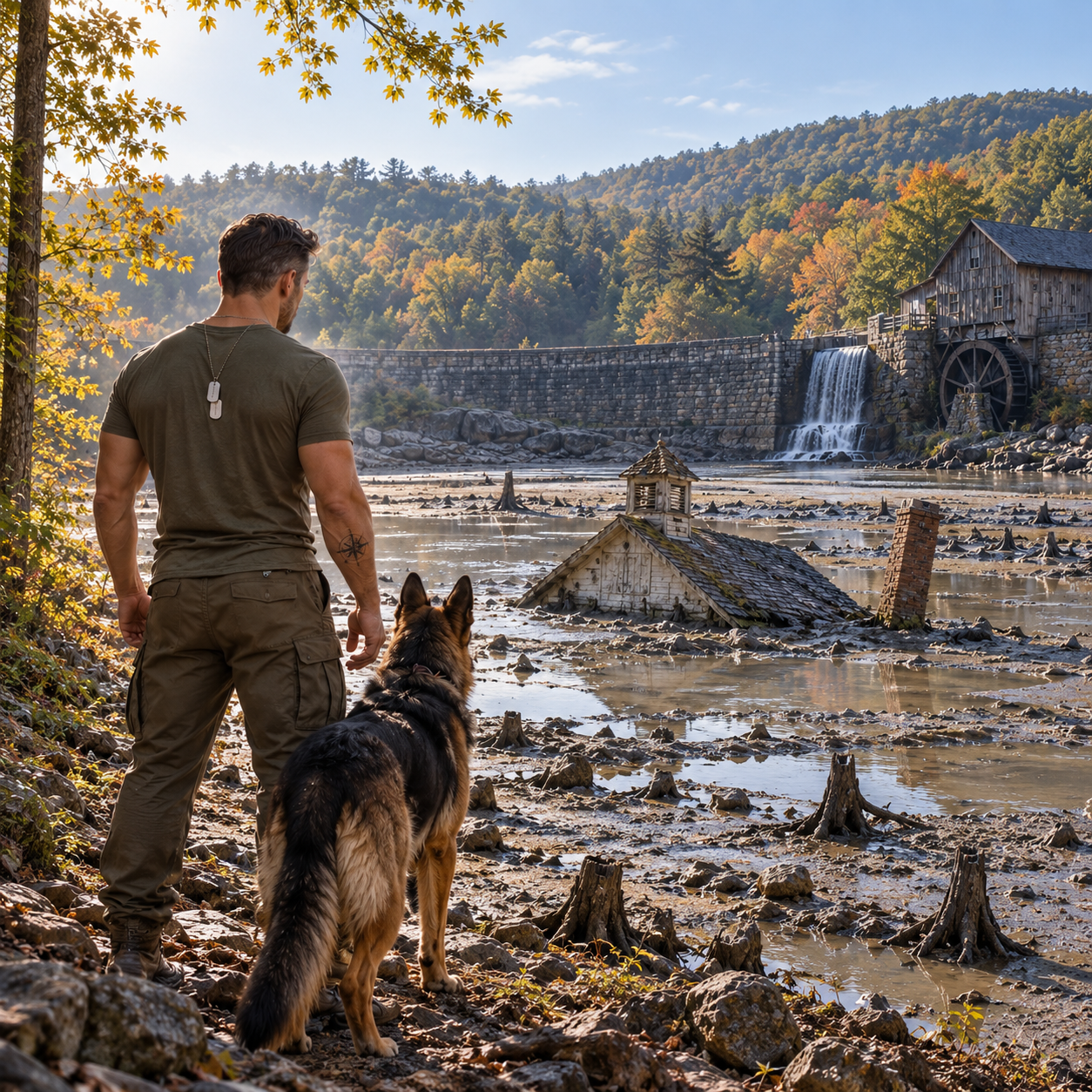
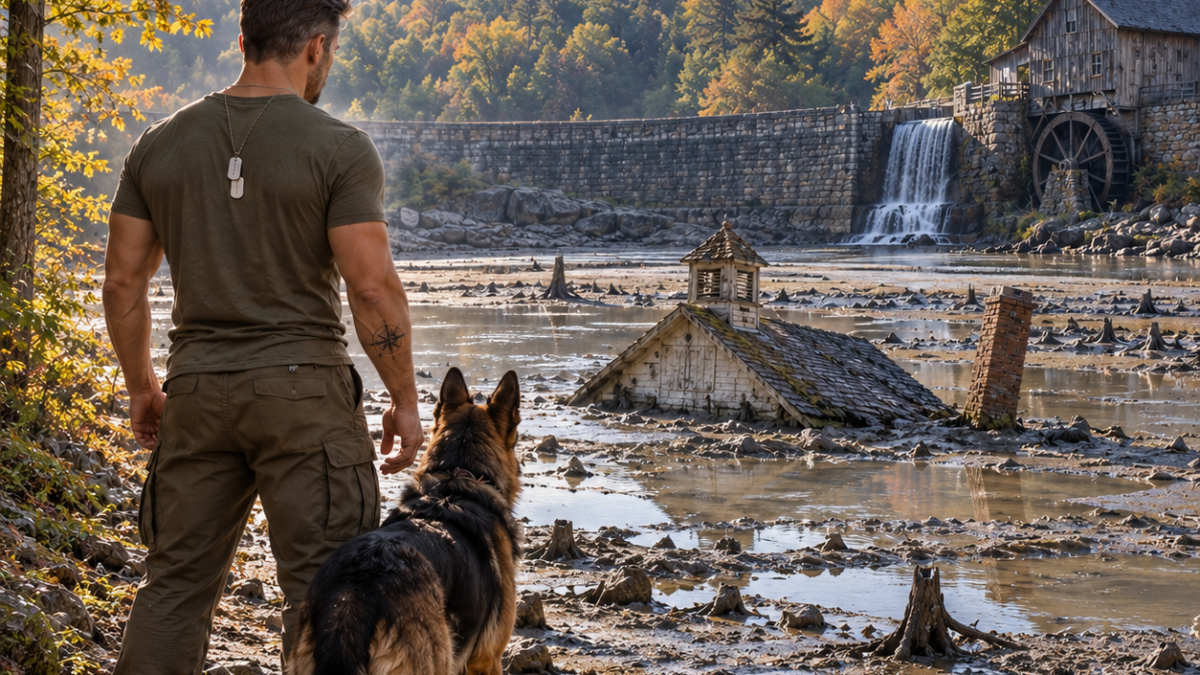
At dawn, the old Vermont mill pond looked like the earth had forgotten how to breathe. EMTT Hollis came there with no home.
One duffel bag and a German shepherd named Anchor. He only meant to lower the water before the failing stone wall gave way.
But when the pond began to drain, something small rose from the mud first. Not treasure, not a body, a schoolhouse roof.
For generations, the town had called the place haunted because grief was easier to fear than to remember.
When EMTT Hollis came back from his final deployment, the house was already gone. Not burned, not broken, not swallowed by any storm dramatic enough to deserve a photograph.
Gone in the quieter, more surgical way, ordinary life sometimes destroys a man. Sold, emptied, signed away in blue ink by a woman who had once known exactly how he took his coffee.
He stood in the driveway for almost 3 minutes before he understood the new owners had painted the front door green. It used to be navy blue.
That was the detail that found the soft place under his ribs. Not the missing porch chairs, not the bare windows, not even the forale sign lying face down near the mailbox, abandoned like a flag after a small private war.
The green door did it. That color belonged to strangers. It had no memory of his boots beside the mat.
No knowledge of the nights he had sat on the front step because sleep had become a country that refused him entry. Anchor sat beside his left leg and said nothing.
The German Shepherd was 8 years old, large through the chest, black and dark brown, with a graying muzzle and a long pale scar running down his left side, where the fur grew thin and uneven. Rain had not yet started, but the air smelled of it.
Anker lifted his nose toward the house, then toward Emtt, as if measuring which one was more damaged. EMTT held the envelope from his wife in one hand. It was not a long letter.
Long letters were for people who still believed explanations could change the shape of grief. This one was short, careful, almost kind, which made it worse.
She had written that she could not keep living with a man who woke up reaching for explosions that were not there. She could not keep lying beside someone whose body came home while the rest of him remained underwater, under fire, under orders.
She had sold the house because staying inside it felt like waiting for a blast wave every night. EMTT read the letter only once.
He did not curse her. That surprised him.
Some part of him had expected anger to come like a loyal dog, fierce and hot, ready to bite something. But anger did not come.
What came instead was a tired recognition. She had not lied.
There had been nights when a truck backfired three streets away and EMTT was already on the floor before his eyes opened. Nights when thunder rolled over the roof and his hands shook so badly he had to sit in the bathroom with the light off until morning. Nights when his wife whispered his name as if approaching a wounded animal, and he hated himself for making love sound dangerous.
Anker had been there for those nights. Not all of them, but enough.
The dog never asked questions, never cried in another room, never made EMTT feel like a ruined house someone had tried to repair and finally abandoned.
Anchor simply came close, pressed his warm weight against EMTT’s knee or ribs or shoulder, and waited until the invisible sea inside him stopped rising.
That was the thing about Anchor. He did not rescue people by dragging them out of water only. Sometimes he rescued them by refusing to move away.
EMTT folded the letter, though the creases were already sharp enough. He put it in the pocket of his dark charcoal t-shirt and looked once more at the green door.
The new owner opened it. A woman in a cardigan stood there holding a mug with both hands. She looked startled, then sorry, then afraid of seeming sorry.
EMTT knew that sequence well. People often passed through it when they saw him.
The broad shoulders, the thick neck, the square jaw held too tight, the gray blue eyes that did not soften quickly enough. The old teams had called him steady. Civilians sometimes called the same thing frightening.
“Can I help you?”
she asked.
“No, ma’am,” Emmett said.
His voice sounded unused. He turned before she could ask more.
Anchor rose with him.
The dog’s metal tag clicked once against his old leather collar.
Anchor. The name had been a joke once.
A rescue dog assigned to a Navy man who worked underwater demolition. Men had laughed about it in that harsh way.
Men laugh when they are too tired to pray. But the name had outlived the joke.
It had become a job, then a promise. By noon, EMTT was sitting in his truck at the edge of a rest stop with nowhere sensible to go.
His duffel bag lay on the passenger side floor. Olive fabric faded almost gray. One strap repaired with black tape.
Anchor occupied the seat itself. Chin on the open window.
Ears tilted toward the interstate.
A few white hairs dusted the dog’s muzzle.
Now the left ear still stood mostly upright, though the tip bent slightly, giving him the look of a retired sentry who had heard too much nonsense from younger soldiers. EMTT had a storage unit two towns over, a bank account that would not survive a long winter, and a phone full of numbers he did not want to call. Men from the old unit, a counselor from the VA.
his wife’s number still saved under home, which now seemed either cruel or foolish.
He deleted nothing. Deleting required certainty. He had none.
That was when he opened the second envelope. It had arrived 3 weeks earlier, forwarded twice, its corners soft from travel. The return address belonged to a land management office in Vermont.
EMTT had almost thrown it away, thinking it was another mistake produced by the machinery of paperwork.
His mother’s family had come from Vermont generations ago, but she had left the mountains before he was born, and never spoke of them except in weather.
Hard winters, short summers, stone everywhere. Inside was a formal notice written in neat legal language.
He had inherited property through the Hollis line, an old watermill outside a mountain town called Alder Creek along with the mill pond behind it, the access road, and several acres of overgrown woodland. There was also a handwritten note tucked at the bottom.
Mr. Hollis, the wall behind the mill is no longer sound. If you intend to visit, do so soon.
And please do not be quick to name whatever rises when the water lowers. Marabel Voss EMTT read the note three times.
Anker shifted beside him and placed one heavy paw on the edge of the duffel bag, pinning it lightly as if voting against another knight in the truck. For the first time all day, EMTT almost smiled. Vermont, he said.
Anker looked at him. Cold mud, old rocks, probably mice.
The dog’s tail gave one slow thump.
That wasn’t a recommendation.
Another thump. EMTT leaned back against the headrest and closed his eyes. A mill, a pond, a failing wall.
It was not a home. Not yet. Maybe not ever.
But it was a problem with edges. A thing made of stone, water, pressure, gravity. Real dangers had mercy compared to the imaginary kind.
Real dangers could be measured. Sandbagged, diverted, cut loose before they killed someone.
He started the engine. The drive north took him through a country that seemed to shed noise mile by mile.
Strip malls gave way to farms, farms to wooded hills, hills to mountains wearing the last bruised colors of late autumn. By the time he crossed into Vermont, rain had begun to stitch silver threads across the windshield.
Anchor slept for most of the drive, but not deeply.
The dog’s ears moved at every bridge, every change in road sound, every rush of water under culverts.
He had once been trained for flood rescue after disasters, taught to read scents trapped in wet wood and mud, to find breath where humans found only wreckage. That training had stayed in him.
So had the patience. So had the strange dignity of dogs who have seen people at their most helpless and still chosen to love them.
Alder Creek appeared near dusk. It was the kind of town that looked carved rather than built, tucked between steep ridges dark with spruce and maple.
A white church steeple rose above slate roofs. A tavern glowed amber at the corner. A general store leaned slightly toward the road as if listening.
Behind it all, the mountains stood close. Old judges in robes of pine.
EMTT did not stop in town. The road to the mill narrowed quickly. Wet leaves plastered themselves to the tires.
Branches scraped the truck doors with long, dry fingers. Finally, the trees opened, and the old hollis mill stood before him.
For a moment, EMTT forgot to breathe. The building was larger than he expected, three stories of weathered timber and stone foundation, its windows dark, its roof patched in mismatched shingles.
The great water wheel hung on one side, half rotted and still, like the rib cage of some wooden beast that had died standing up. Beyond it, hidden partly by mist, the mill pond pressed against a curved stone wall. The wall was the first thing Emmett truly saw.
Not the romance of the mill, not the family history, not the idea that some ancestors blood might have once warmed this cold place. The wall, it bowed outward.
Not dramatically enough for a postcard, but enough for a man like EMTT to feel the warning in his teeth. Stone shouldered against pressure. Mortar lines dark with seepage.
Frost cracks, moss, a bulge near the eastern section, almost a handspan forward from the rest. Water did not need hatred to destroy.
Only time, weight, and an opening. Anker jumped down from the truck before EMTT could call him.
The dog stood very still, head raised, nostrils working. Then he moved toward the pond wall with a certainty that made EMTT follow.
“Easy,” Emmett said.
Anchor ignored him. That more than anything sharpened the air. The dog walked along the base of the wall, paws sinking slightly into wet grass and leaf mold.
He passed three sections of old gray stone without interest. Then he stopped at a patch where the stones were not gray at all, but a faded yellow beige, paler than the rest, as if another hand in another year had mended the wall with whatever could be found before winter closed its fist.
Anchor lowered his nose to a seam between two stones. He did not bark.
He did not paw. He simply stood there, silent as a church bell before the rope is pulled.
EMTT crouched beside him. Rain gathered along his undercut hair and ran past the faint scar at the tail of his right eyebrow. He placed one hand against the pale stone.
It was cold, slick, and trembling, not visibly, but he felt it, a tiny vibration. water moving where water should not have been moving.
Be behind the wall, under the wall, through some old wound in the structure. He leaned closer and smelled wet mineral, rotted wood, and the sour breath of trapped mud.
Anchor turned his head slightly and looked at him. No command had passed between them. None was needed.
EMTT rose and studied the dark pond beyond the wall. In the failing light, the water looked almost black, not deep in a grand way. Deep in the way, a secret is deep when generations have agreed not to disturb it.
He thought of the green door. He thought of his wife writing that she could not live beside explosions no one else could hear.
He thought of Marabel Voss’s note.
Do not be quick to name whatever rises when the water lowers. Behind him, the mill creaked in the rain.
The old wheel shifted a fraction, though there was no current strong enough to turn it. Somewhere inside the building, loose metal tapped against wood with a patient, irregular sound. Anchor remained at the yellow stones.
EMTT should have gone inside. He should have checked the roof, the wiring, the stove, whatever passed for a bed. He had driven half a day, eaten nothing since morning, and his hands were stiff from gripping the wheel.
But the dog would not leave the wall, and EMTT had learned long ago that survival sometimes began with respecting what would not move. So he stood there beside anchor until the last light drained from the pond.
Only then did he understand the shape of what had happened to him. He had come to Vermont because he had no home.
But the place waiting for him was not empty. It was holding its breath.
Morning did not make the mill kinder. It only made its age easier to see. The rain had thinned into the cold mist, the kind that did not fall so much as settle on everything with quiet persistence.
The old hollis mill stood in the gray like a witness too tired to testify. Its roof sagged at one corner. Ferns grew from the stone foundation.
The waterhe, black with damp, held still beside the building as if ashamed of its own purpose. EMTT had slept less than 2 hours.
The mill’s upstairs room contained a narrow cot, three dead flies on the windowsill, and a stove that looked old enough to have voted in several elections.
Anker had refused the cot entirely, and slept by the door, one ear pointed toward the pond wall.
Twice in the night, Emmett woke to the soft click of the dog’s tag and found Anchor standing at the window, staring toward the dark water.
By dawn, EMTT was outside with a flashlight, a notebook, and the same dark charcoal shirt he had worn the day before, now smelling faintly of rain and old timber. He moved along the wall slowly, measuring with his eyes before more measuring with his hands. The bulge in the stone was worse in daylight, not catastrophic yet.
That was the dangerous part. Disasters often wore modest clothes until the last possible minute.
Anchor paced a few yards away, nose low. Every time the dog passed the pale yellow stones, he slowed.
EMTT crouched there again. Water seeped through a hairline gap beneath one stone and disappeared into moss.
He pressed his thumb against the mortar. It crumbled more easily than it should have.
“Yeah,” he muttered.
“I see it.”
Anker looked at him with the solemn patience of a creature who had been saying the same thing all night. The sensible move was to ask questions before touching anything.
The less sensible move was to pretend old military training gave him permission to solve every civilian problem with muscle and stubbornness. EMTT had survived long enough to mistrust pride when it sounded like confidence.
So he he drove into Alder Creek. The town looked smaller in daylight, though not friendlier. Pickup trucks lined the main road.
Wet flags hung from porches. Smoke curled from chimneys and flattened under the low clouds.
The tavern sat at the corner beside the general store, its windows glowing with breakfast light.
A handpainted sign over the door read, “The lantern room.
Food, drink, gossip.
if you can afford it.”
EMTT paused before going in. Anchor remained at his side.
Wet fur darkened along his spine, scar pale where the rain had parted the hair.
The dog’s presence changed the way people looked at EMTT.
Without Anchor, he was just a hard-faced stranger built like trouble. With anchor, he became something more complicated, a man followed by loyalty. A man something still trusted.
Inside the tavern smelled of coffee, fried potatoes, woods smoke, and damp wool. Conversations did not stop all at once. They faded by layers.
A man near the counter lowered his fork.
Two women in a booth glanced at anchor, then at EMTT’s boots.
Someone behind him whispered the word mill. Emmett walked to the counter.
The woman behind it was broad-shouldered, red-cheed, and unimpressed by silence. She wore a flower dusted apron over a green sweater, and had the efficient stare of someone who could break up a fight with one hand while pouring coffee with the other. Dog friendly?
EMTT asked. She looked at Anker. Anchor sat neatly as if applying for citizenship.
That dog looks better behaved than half my lunch crowd, she said. Coffee, please. Name?
EMTT Hollis. This time the room did stop. Not dramatically.
No glass fell. No chair scraped, but stillness moved through the tavern like a hand passing over a candle.
The woman’s expression changed by one careful inch.
Hollis, she repeated, from the mill.
That’s what the paperwork says.
A laugh came from the far end of the counter. It belonged to a man with a thick body, a reddish nose, and sawdust clinging to the shoulders of his red and black flannel shirt, like pale dandruff from some wooden beast.
He had a carpenters’s pencil tucked behind his right ear, and a beard that looked as if it had been argued into existence rather than grown.
His hands were large, scarred, and restless around his coffee mug.
“Well,” the man said, “that paperwork must have a sense of humor.”
The woman behind the counter gave him a warning look.
“Elias, what?
I’m welcoming him.
You’re salulting him.
Same thing in Vermont.”
A few people smiled. EMTT did not. The man turned on his stool, looking EMTT over with the open assessment of someone pricing timber.
“Elias Puit,” he said.
“I run the sawmill down the road.”
“Which means I’ve been listening to that old pond wall complain longer than you’ve owned a toothbrush.
” EMTT accepted his coffee.
“Then you know it’s failing.”
Elias barked a laugh.
“Failing?
That wall’s been failing since my grandfather was young enough to disappoint women properly.
Doesn’t mean a stranger rolls in and starts playing engineer.
I haven’t started anything.
Good. Keep it that way.
Anchor’s ears tilted forward.
Not a growl. Not yet.
Just attention.
EMTT put one hand lightly against the dog’s neck.
Waters moving under the east section. pale repair stones, bad mortar, soft ground at the base.
The tavern grew quieter, but Elias only narrowed his eyes. You learned that and that in this navy.
The word landed with a different weight in the room. Someone had already talked. Of course, someone had.
Small towns did not need radios. They had windows. EMTT took one sip of coffee.
It was too hot and strong enough to strip paint. Some of it.
Elias leaned back. Let me guess. Underwater demolition.
Big brave work. Blow things up. Come home.
See a pond. Decide it needs your personal attention.
The line earned a few uneasy chuckles. Not many. EMTT looked at him for a long moment.
The old instinct rose in him, clean and cold. Answer force with force. Cut humiliation off before it spread.
Instead, he set the mug down. I know enough not to blow the wrong thing.
That should have ended it. It did not.
Elias smiled, but the smile had no joy in it.
Here’s some free local wisdom, Hollis.
That mill is rotten. That pond is trouble. That wall is expensive trouble.
You start draining water without knowing this valley.
You’ll send half of Alder Creek downhill before supper.
A woman near the window crossed herself without seeming to notice she had done it. EMTT saw that. So did Anker.
Fear was present in the room, but it wore work clothes. It sat behind coffee cups. It pretended to be jokes.
It pretended to be Elias. Who knows the valley? EMTT asked.
No one answered at first. Then the woman behind the counter sighed and refilled his mug without being asked. You want Ruth called her.
Elias groaned.
Don’t sick Ruth on him.
May. May gave him a flat look. You want the wall to stand or your opinion to stand?
That got a better laugh. Even Elias had to swallow one. Ruth called her?
EMTT asked. Retired state hydrarology engineer May said lives up on Brier Road.
Measures rainfall like some people read scripture. Mean as sleet twice as useful.
She won’t come.
Elias muttered. May shrugged.
She’ll come if the walls worse.
And if it isn’t?
May looked toward the window where the mist pressed white against the glass.
Then she’ll enjoy telling him he’s wrong.
For the first time since entering the tavern, EMTT felt the faint outline of a path. Not a solution, a path.
He paid for the coffee, though May waved off the coins for Anker’s bowl of water.
As he turned to leave, Elias spoke again.
“You planning to sell once you see the repair bill?”
EMTT stopped. There it was. Not mockery, not concern, hunger with its coat buttoned.
Why? EMTT asked. Elias tapped his mug with one thick finger.
Might save you a win. Winter of misery.
I could use the land beside my sawmill. You could use cash more than a haunted waterhe.
Haunted? Emmett asked.
The word seemed to make several people uncomfortable.
Elias’s jaw tightened.
Figure of speech.
May’s face said it was not.
EMTT nodded once and left before the room could decide what to do with him. Outside, the cold air felt honest after the tavern. Anker shook water from his coat, then looked back at the door.
“Don’t,” Emmett said.
The dog’s expression remained innocent.
I know. He smells like bacon and bad decisions.
Anchor sneezed.
Ruth Calder’s house sat on a rise above town, surrounded by bare apple trees and drainage ditches that looked too precisely cut to be accidental.
The woman who answered the door did not invite EMTT in. She stood with one hand on the frame, silver hair cut short at the jaw, pale eyes moving from his boots to anchor to the truck and back again.
May called, she said. EMTT glanced toward the road.
That was fast. May has two phones and no hobbies. Ruth looked at Anchor.
Dog bite? No. People always say that before the dog bites.
Anchor doesn’t waste effort.
Ruth studied the dog more closely. Anchor sat in the wet gravel, dignified and mildly offended.
H, she said. Better manners than most engineers.
That was apparently the invitation. Ruth stepped out wearing a moss gray rain jacket, waterproof pants, black rubber boots, and reading glasses hanging from a cord around her neck.
In one hand, she carried a folded aluminum measuring rod. in the other a small waterproof notebook.
At the mill, Ruth did not speak for several minutes. She walked the wall, measured the bulge, pressed mortar with a gloved finger, checked the ground below the east section, stared toward the pond, then down the slope where the land fell toward town. EMTT stayed back and let her work.
That cost him more than he expected. Waiting was harder than labor. Finally, Ruth turned toward him.
You were navy.
Yes, ma’am.
Demolition. Underwater demolition.
And now you want to save a 19th century mill pond wall by instinct?
No, ma’am.
That answer seemed to interest her. What do you want? Emmett pointed toward the low swale, half hidden by brush behind the mill.
Old stream bed. It curves west before dropping.
If it’s clear enough, it could take a controlled release.
Not all at once. Small cut, slow draw down. Lower pressure before the next hard rain.
Ruth’s pale eyes narrowed, not with anger, but calculation.
Who told you that was the old stream bed? No one.
How did you see it? Water remembers where it used to go.
Ruth looked at him, then truly looked, and something in her expression shifted by the smallest degree. Not trust, not warmth. A door unlatched in a locked house.
She walked to the swale and pushed aside wet brush with the measuring rod. Beneath the leaves, a shallow channel curved through the ground, choked with roots and silt.
Hm,” she said again.
EMTT was beginning to understand that Ruth Calder’s h contained a whole library of weather.
She took measurements for nearly an hour. Anchor followed at a respectful distance, occasionally pausing to sniff the damp ground near the yellow stones.
Ruth noticed that dog keeps marking the same section.
He’s not marking it.
I can see that he worked flood rescue. He notices water movement, rot, trapped scent.
Useful dog. He knows. Anchor wagged once as if accepting professional recognition.
By late afternoon, Ruth had drawn a rough plan in her notebook. A temporary relief channel could work, but only if the grade was right and the banks were braced. Cut too sharply and the water would scour the soil.
Drain too quickly and the pond bottom could slump. Wait too long and the bulged wall might fail on its own. How much time?
EMTT asked. Ruth looked at the sky. Clouds had stacked over the ridge, dark and lowbellied.
Depends on the weather, she said. And Vermont weather is just gossip with consequences.
EMTT almost smiled again. Almost.
Ruth closed her notebook.
You’ll need help.
I can start clearing the channel. That is not what I said.
I heard what you said. No, Ruth replied.
You reacted to the version of it that lets you suffer alone.
The words landed harder than Elias’s jokes.
EMTT looked away toward the pond. The water lay dark behind the wall, quiet in the smug way dangerous things can be quiet.
Ruth’s voice softened only slightly.
I don’t care how strong you are, Mr.
Hollis.
Mud doesn’t respect pride.
Neither does water.
For a moment, EMTT saw his wife’s green door again.
saw himself standing in a driveway with a letter folded in his hand, unable to argue because some accusations were just grief wearing shoes.
Anchor moved close and pressed his shoulder against EMTT’s leg, not to steady him from falling to remind him he was allowed to stay standing without pretending it was easy.
EMTT exhaled.
I’ll start with brush and top soil, he said.
No water cut until you say. Ruth gave one sharp nod.
Good.
Then you’re less foolish than advertised.
Advertised by Elias, among others. Popular man.
Loud man, different thing. She left before dusk, promising to return in the morning with old survey maps if she could find them.
EMTT watched her truck disappear down the wet road, then turned back to the swale. The town did not come to help.
A few people slowed their vehicles as they passed. One man lifted two fingers from the steering wheel. Another stared openly.
By evening, Elias Puit appeared at the fence near the sawmill, arms crossed over his flannel sawdust still clinging to him like stubborn snow.
“That your grand plan?”
Elias called.
“Dig a ditch and pray.”
EMTT drove the shovel into the ground, not praying yet. Good.
Hate to see you waste both effort and theology. EMTT lifted the first heavy slice of wet earth and threw it aside. The work was ugly, slow, and immediate.
Roots caught them shovel blade. Stones hid under mud.
Cold seeped through his boots. Within half an hour, his shoulders burned.
Within an hour, the skin at the base of his fingers had opened under the friction of the handle. Anchor stayed near the channel, not in the way, never far.
When EMTT paused too long, the dog came close. When Elias laughed from the fence, Anker looked at him with such calm disapproval that the man eventually stopped.
The light drained from the valley. EMTT kept digging, not because he believed he could save the wall alone. Ruth had made sure that lie could not survive the afternoon.
He dug because beginning was the only answer he had. Because a controlled channel was better than a burst wall, because the town below the hill had old people, children, tavern windows, church steps, and all the small, ordinary things water could erase without hating them. At last, Elias pushed away from the fence.
When you quit, he called.
I’ll make a fair offer.
EMTT did not look up. You and I define fair differently.
Maybe, but winter defines it for both of us. Then Elias walked back toward the sawmill, leaving the sound of machinery and distant water behind him. Anker came to stand beside EMTT at the raw edge of the shallow trench.
Mud freckled the dog’s legs.
His scar showed pale in the blue dusk. EMTT flexed his torn hand. Blood marked the shovel handle in a thin dark line.
Nothing dramatic, just enough to prove the day had taken its tax. He looked toward the pale yellow stones in the wall, then down the hidden curve of the old stream bed, then at Anchor.
All right, he said quietly. We start small. Anker lowered himself beside the trench, front paws crossed as if settling in for a long watch.
Behind them, the mill waited. Above them, clouds gathered their next argument.
Below them, Alder Creek glowed with warm windows, and no idea how close water could come before anyone bothered to believe in it. Ruth Calder arrived the next morning with three maps, two pencils, a thermos of coffee, and the expression of a woman prepared to be disappointed by gravity.
She parked her old green truck beside the mill without ceremony.
The driver’s door complained when she opened it.
Ruth ignored the sound, tucked a roll of survey paper beneath one arm, and walked straight toward the half-cleared swale as if the mud itself had scheduled an appointment. EMTT was already there. He had started before dawn, not because Ruth had told him to, but because sleep had become thin again.
The upstairs room in the mill was cold enough to make his breath visible. The cot had creaked under him like an accusation. At some hour before morning, he gave up, pretending rest would come and went outside with anchor.
The first light found him cutting brush from the old stream bed. He wore the same dark workclo now marked with mud at the knees and shoulders.
His hands were wrapped in strips of clean cloth torn from an old undershirt. The cloth had already darkened where the shovel handle rubbed.
Ruth noticed immediately.
“You trying to dig a relief channel or audition for a cautionary poster?”
she asked. EMTT glanced at his hands.
“It’s under control.”
Ruth unscrewed the cap of her thermos. Men say that about bleeding, debt, and marriage. Rarely true.
Anchor sitting beside the raw line of the trench gave a low huff through his nose. Ruth looked at the dog. Thank you.
At least one professional agrees. EMTT did not smile, but the corner of his mouth betrayed him for half a second. It was gone before Ruth could claim victory.
She unrolled the old survey map across the hood of her truck and weighted the corners with stones. The paper showed Alder Creek as it had been long before paved roads and power lines. The mill pond was smaller in the drawing.
Behind it, a crooked blue line marked the original stream, bending west through the swale before dropping toward a lower channel. Ruth tapped the map with a pencil. This is what you saw.
EMTT leaned over the hood. The ground still remembers it. That poetic nonsense happens to be correct.
She dragged the pencil along the faded streamline. The old bed is silted in, but if we clear a narrow relief channel here and brace the cut with boards, we can take pressure off the wall without draining the pond like a bathtub with the plug kicked out.
How much water? Not enough to make you feel heroic.
Good. Ruth glanced up, surprised by the answer. EMTT kept his eyes on the map.
Heroic usually means somebody planned badly. H Ruth capped the pencil. Maybe the Navy did teach you something besides how to terrify breakfast crowds.
From the millard, Anker’s metal tag clicked as he rose.
He walked toward the pale yellow section of the wall, stopped, sniffed the damp seam, then returned to the trench. He had done that six times since sunrise. Ruth watched him.
That dog is going to make me suspicious of every stone in this valley.
He’s not wrong often.
No one is not wrong often. Anchor is closer than most.
The dog settled beside EMTT’s shovel, as if the compliment had been properly filed.
Work began with Ruth’s rules, which were less like suggestions and more like commandments carved on wet slate.
No cutting into the waterline. No deepening the channel without checking the grade.
No removing roots from the bank until bracing boards were ready. No pretending pain was measurement.
That last rule she added after EMTT drove the shovel into the same route for the fourth time with more force than sense. You keep punishing the dirt, Ruth said.
The dirt will remain unimpressed. EMTT stopped, breathing through his nose. Cold air filled his chest.
The old habit wanted to take over. Push harder, move faster, become useful by becoming unbreakable. It had served him once.
It had also cost him things no metal had named.
Anker came close and pressed his muzzle to EMTT’s wrapped wrist.
Not dramatic, not pleading, just contact. EMTT looked down at him.
The dog’s graying muzzle was damp with mist.
His amber brown eyes held the steady patience that had pulled EMTT through nights when walls were not made of stone, but memory. Anker did not understand shame the way humans did. He only understood strain, breath, heat, danger.
He knew when the man beside him was turning work into punishment. Emmett loosened his grip on the shovel. Ruth saw it, but for once she said nothing.
By midm morning, a thin shape appeared on the road above the millard, a red bicycle wobbling through puddles. The rider coasted down carefully, boots lifted from the pedals when the mud grew deep. She was small, maybe 11, with a mustard yellow puffer jacket bright enough to offend the weather.
Her brown blonde hair was tied in a low ponytail that had already lost its argument with the mist. A paper bag hung from one handlebar and the bicycle bell gave an uneven little chirp every time the front tire struck a stone.
Ruth looked over her glasses. June Abernathy.
If your grandmother knows you’re riding down this hill after rain, she has grown braver or more tired.
The girl stopped near the truck and planted both red rubber boots in the mud.
Graham knows knowing and approving are cousins who don’t visit.
June ignored this with the skill of a child experienced in adult warnings. Her eyes went first to Anchor, then to EMTT.
You’re the soldier from the haunted mill, she said.
EMTT leaned on the shovel.
Is that what they’re calling it?
Not everybody. Mr. Puit calls it the rotten mill.
Mrs. Veil at the store calls it the Hollis Place.
Graham says haunted is what people call history when they’re too lazy to read.
Ruth’s mouth twitched.
Your grandmother remains dangerously sensible. June held up the paper bag.
She sent corn and lemonade. She said men digging in the rain forget they have stomachs. She say anything about retired engineers?
Ruth asked.
She said you’d steal the coffee and pretend it was for safety.
Ruth took the bag. Your grandmother is a slanderer and a prophet. June stepped closer to Anchor but stopped before reaching him.
Can I pet him? EMTT looked at Anker.
The dog stood, sniffed once in June’s direction, then sat calmly.
Let him smell your hand first, Emmett said. June offered her hand, palm down, solemn as a knight presenting a treaty.
Anchor sniffed, then leaned his head just enough for her fingers to touch the fur between his ears.
June’s face changed.
Children often smiled at dogs. June did not simply smile. She softened as if some small lamp had been lit behind her freckles.
He looks like he knows secrets, she whispered. He knows mud, Emmett said.
And people, Ruth added.
June stroked Anchor’s graying muzzle with careful fingers.
Was he in the Navy, too? No, EMTT said. Good.
He seems too polite. Ruth choked on coffee. Emmett looked away quickly, but not before June saw the ghost of amusement cross his face.
It startled her enough that she grinned wider, proud of having found a crack in the stone man.
“What happened to his side?”
she asked, nodding at Anchor’s scar.
EMTT’s hand tightened, not on the shovel this time, but around memory.
“Flood rescue,” he said after a moment.
collapsed fence, old metal. He kept searching anyway.
June considered this with grave respect.
So he’s a retired knight.
Anker’s tail moved once.
Don’t encourage him, Emmett said.
He already knows. For a few minutes, the millard belonged to corn cakes, lemonade, and the strange mercy of a child who could ask blunt questions without cruelty.
June told them the lower part of town flooded every spring, just enough to make everybody complain and nobody move.
Ruth corrected the girl’s estimate of flood depth twice.
June corrected Ruth’s pronunciation of her grandmother’s cat’s name with equal seriousness.
The work resumed lighter than before, not easier. The mud was still heavy.
The channel still fought every inch. But the air had changed.
EMTT found himself listening to June’s bicycle bell when the wind nudged it.
The crooked little sound drifted over the yard, silly and brave, refusing to match the gloom. Late in the afternoon, Ruth marked the next cut with two stakes and a length of orange string.
Only to this depth, she told EMTT, “No deeper.
We are shaping a channel, not digging a grave for common sense.
Yes, ma’am.
That answer is only useful if attached to obedience. EMTT set the shovel blade into the marked line.
The first strike hit mud. The second found gravel.
The third rang. It was not the dull thud of stone buried naturally in earth.
It was a flatter sound, sharper at the edges. almost like striking a plate. EMTT froze.
Ruth turned. What did you hit?
EMTT knelt and scraped mud away with his gloved fingers. Anchor came forward but did not crowd him.
June abandoned her bicycle and hurried close until Ruth held out one arm to stop her. Stay there, Ruth said.
I can see from here. You can imagine from there. Emmett cleared more earth.
A rectangular edge appeared, green black with moss. He worked slowly now, using his hands instead of the shovel.
The object was thin, heavy, and carved from dark slate. When he lifted it free, mud slid from its face in thick ribbons.
Ruth took one step closer. June stopped breathing loudly, which for June appeared to require effort.
EMTT wiped the slate with the heel of his hand. Numbers emerged first.
Below them, shallow letters lay half filled with age and dirt. Alder Creek estich. The rest had broken away.
No one spoke. The millyard seemed to draw itself inward.
Even the stream beyond the brush sounded smaller. EMTT held the slate tile in both hands and felt absurdly that it was warmer than the air.
Not because it was, because things touched by human hands long ago carry a different weight from stones that have only slept in the ground.
June’s voice came softly.
School. Ruth removed her glasses, wiped them though they were not wet, then put them back on.
There was no school here, she said. But the sentence lacked conviction before it ended. Marbel Voss arrived 20 minutes later in a brown wool coat, her white hair pinned low, a leather folder clutched against her chest as if it might try to flee.
May must have called her, or June’s grandmother, or the town itself.
Through that invisible wire, small places keep strung between kitchens. Marabel looked older when she saw the tile. Not in body, in memory.
Where? She asked. EMTT pointed to the cut in the channel.
Marabbel came close but did not touch the slate. Her pale blue eyes moved over the carved year and the broken word.
For a moment, her lips shaped something soundless. You knew, Ruth said. Marbel shook her head.
No, I suspected a building in the basin. Not this, not. She stopped, swallowing.
There are land notes, fragments, schoolhouse, basin. Do not disturb after thaw.
But the page after that is missing, torn out long before my time. Convenient, Ruth said.
Cowardly, Marbel replied, and the quiet force of it silenced even Ruth. EMTT looked from one woman to the other. What happened in 1889?








