He Drained the Millpond to Save the Dam—A Forgotten School Rose First – Part 2
Marabel held the folder tighter. That is a question for the church records.
The church bell in Alder Creek rang 5:00 while they were still standing in the mud. By 6, Reverend Caleb Row arrived in a dark cardigan under a black raincoat, carrying a worn leatherbound register wrapped in cloth.
He was not an old man, maybe late 40s, but he had the tired gentleness of someone who had sat through many hospital nights and kitchen table confessions. His brown hair, touched with silver, clung damply to his forehead. He greeted Ruth with a nod, Marbel with concern, and EMTT with a steady look that did not flinch from his face.
Then he opened the register on the hood of Ruth’s truck.
The pages smelled of dust and old paper. Caleb turned them carefully, fingertip hovering rather than pressing. births, baptisms, marriages, burials, weather notes in the margins.
The small arithmetic of a town trying to prove it had existed. At last, he stopped. December 1889, Caleb said the wind moved through the wet trees.
He read without ceremony, which made the words heavier. Six children of Alder Creek had died within one week during a diptheria outbreak. Their names were written in different ink, as if the entries had been made in haste or with a hand that could not steady itself.
The school had closed after that winter. A small burial ground near the schoolhouse was mentioned once, then never clearly again.
June stood very still beside her bicycle.
“How old?”
she asked. Caleb hesitated. Between 6 and 12.
The answer moved through the adults like cold water entering a room. EMTT looked down at the slate tile. The year had seemed old a moment ago, distant and almost archaeological.
Now it felt unbearably young. Children had touched this school, had hung coats on hooks, had tracked mud across a floor and been scolded for it, had laughed at some joke now lost forever because no one had thought to write it down.
Anchor leaned against EMTT’s leg.
The contact brought him back before he knew he had gone somewhere else. Marbel closed her eyes.
The maps after 1900 show only the pond.
Ruth’s voice was low.
Someone removed more than at a building. No, Caleb said gently.
Maybe they failed to remember it. Honestly, that is not always the same sin.
Ruth looked at him. It can do the same damage. Yes, Caleb said.
It can. They wrapped the tile in clean cloth and carried it into the mill before dark.
The inside of the building felt different afterward. The same damp beams, the same dust, the same old machinery hunched in the shadows. But now every board seemed to listen.
EMTT set the tile on a workbench beneath a cracked window while Ruth and Marbel argued quietly about records, permits, safety, and whether anyone should be told before they knew more. June had been sent home, protesting all the way up the road that history should not have bedtime.
Caleb promised to speak with her grandmother. Ruth promised to pretend she had not heard June call him the sad church man.
Caleb, to his credit, looked only mildly wounded. After they left, evening settled hard. EMTT remained in the mill with anchor.
He should have eaten. He should have rewrapped his hands. He should have slept while sleep was still possible.
Instead, he searched, not frantically, not tearing through the place like a man hunting treasure. He moved with slow attention, opening drawers swollen with damp, checking shelves, lifting old canvas tarps from gears and pulley wheels. If the tile had belonged to a school and the pond had hidden the school, then the mill might have kept the reason.
Near the base of the main gear assembly, Anchor stopped. He sniffed along a section of floorboards half covered by broken sacks. Then he looked at EMTT.
This time he pawed once. EMTT cleared the sacks away. One board sat slightly proud of the others, not enough to notice unless a man had spent his life distrusting surfaces.
He worked the tip of a pry bar into the seam and lifted. Beneath the boards sat an iron chest.
It was smaller than a foot locker, black with age, its corners red brown with rust. Across the lid, beneath a film of dust, someone had scratched a name. Nathaniel Hollis.
EMTT stared at it longer than he meant to. A family name was a strange thing. Most of his life, Hollis had been something printed on uniforms, orders, medical forms, and the back of a mailbox that no longer belonged to him.
Here, in the dim belly of the mill, the name looked older than his grief. He was not the first Hollis to stand beside water and not know what to do with what it held.
The lock resisted, then gave under careful pressure. Inside were papers wrapped in oil cloth, a folded drawing of the mill pond, a small brass handbell green with corrosion, and several letters tied with thread so old it broke when EMTT touched it.
He lifted the bell first. It fit in his palm.
A school bell maybe, or a teacher’s bell.
The handle was worn smooth by fingers long gone. Anchor sat beside him, quiet. On the workbench, the slate tile marked 1889 caught the last gray light from the window.
The old radio near the stove crackled suddenly, startling enough that EMTT’s shoulders locked, static.
Then a weather bulletin broken by distance. Heavy rainfall expected across the Green Mountain region.
Flash flooding possible in narrow valleys. Residents near old mill ponds, culverts, and retaining structures should monitor conditions. EMTT turned the volumes higher.
The voice dissolved into static, then returned. Storm intensification likely after midnight tomorrow. The mill seemed to listen with him.
EMTT looked at the pond drawing in the chest, then toward the dark window where the wall waited beyond the rain. He had found a school tile, a buried chest, a bell that had once called children inside from the cold. But none of it changed the simple arithmetic Ruth had already spoken into the mud.
Water was coming. The wall was weak, and Alder Creek still did not know how much of its past was holding back its future.
The storm reached Alder Creek before sunset, wearing no mercy and no hurry. All afternoon the mountains had been gathering darkness into their folds.
Clouds pressed low over the ridge until the spruce trees seemed to hold them up by force. The air turned green gray, heavy with the metallic taste that comes before hard rain.
Even the birds went quiet as if the valley had raised one finger to its lips. EMTT stood inside the mill with the iron chest open at his feet.
The old school bell lay on the workbench beside the slate tile marked 1889. The letters on the tile looked darker in the dim light, as if the mud had not been cleaned from them, but awakened inside them.
Papers from Nathaniel Hollis’s chest remained wrapped in oil cloth, not yet fully read.
There had been no time. The radio near the stove hissed and crackled, flash flooding possible in narrow valleys.
EMTT listened until the words dissolved into static. He did not need the broadcaster to finish. He had already heard the storm outside.
He had heard water in the roof gutters, water in the trees, water in the earth itself. Anchor stood at the door, not pacing, not whining, just standing, body angled toward the pond wall.
The dog’s scar showed pale through damp fur where the rain had already touched him.
His graying muzzle lifted once, taking in the smell of the valley. Then he looked back at EMTT.
“All right,” Emmett said.
He pulled on his rain jacket, checked the flashlight, gloves, pry bar, rope, and the small coil of reflective marking tape Ruth had left behind. His hands hurt when he flexed them.
The cloth wraps had stiffened with dried mud and small stains of blood. He should have changed them.
He should have eaten. He should have done 20 things that sensible men did before walking into bad weather. But storms did not wait for sensible men to catch up.
Outside the millard had already changed. The shallow relief channel they had spent days clearing now glistened like a dark scar through the grass.
Rainwater ran along its bottom in thin threads. The pond beyond the wall had risen several inches since morning. Not enough for panic, enough for mathematics.
And mathematics, Ruth Calder had said, was simply fear with better handwriting. EMTT moved toward the east section of the wall.
The pale yellow stones were wet and shining. Water seeped through the seams more strongly now.
No longer a patient sweating of old mortar, but a small insistent breathing. One line of water spat from beneath a stone and struck the moss below.
Anker stopped beside it and lowered his head. The dog did not bark. EMTT wished suddenly and foolishly that he would.
A bark would have been ordinary. A bark would have belonged to a dog warning his owner about a raccoon in the brush or a stranger in the yard. This silence belonged to something older.
Headlights swung across the trees.
Ruth’s truck came hard up the road and stopped near the mill, tires sliding slightly in mud.
She stepped out in her moss gray rain jacket, hood up, aluminum measuring rod in one hand and flashlight in the other. Rain ran from the brim of her hood down her cheeks, but her face carried the same granite calm. That frightened EMTT more than if she had shouted.
She went straight to the wall, planted the measuring rod at the pawn side, and watched the waterline for 10 seconds.
“Bad,” she said.
“How bad?”
“Bad is already an adjective doing charity work.”
EMTT waited. Ruth pointed her flashlight toward the swollen pond. Runoff from the north slope is coming faster than forecast.
The culvert above Puit’s sawmill is partly blocked.
Water is backing into the pond instead of bypassing it. The wall.
If the rise continues at this rate, we may lose the east section before morning. The words did not crash. They settled.
That was worse. EMTT could feel them finding places inside him, setting up equipment.
Ruth turned toward the relief channel. We open it wider now, not all the way.
Controlled notch, brace the outer bend. If the flow scour that bank, it will cut sideways and undermine the channel.
If we don’t, Ruth looked down the valley toward the faint warm dots of Alder Creek beginning to glow through rain.
Then those people have less time than they think. Another set of headlights appeared, smaller, wavering.
Marbel Voss arrived in an old sedan that looked personally insulted by the road. She stepped out clutching her brown leather folder under her coat. Though paperwork had no business in a storm, her white hair had come loose from its low knot, strands sticking to her temples.
I called Caleb,” she said before either of them asked.
“He’s ringing the church bell.
May is sending people uphill from the lower street.”
Ruth nodded.
“Good.”
Marbel looked at the wall. Her face lost color.
“Is it going to break?”
“Not if everyone does exactly what I say,” Ruth replied.
From anyone else, it might have sounded arrogant. from Ruth.
It sounded like the valley’s best remaining prayer.
The first bell rang from town. It came thin through rain, then again stronger.
The church bell did not sound like alarm systems in cities, bright and mechanical. It sounded human because it required a hand.
Someone had to pull the rope. Someone had to decide the warning mattered before proof arrived at the door. EMTT looked down toward Alder Creek.
Windows lit one by one. Shapes moved behind curtains.
A truck started, then another. Anchor pressed close to his leg.
For a moment, the bell became something else. Not church bronze, not town warning.
A sharp ringing in a narrow corridor, a blast alarm, metal shouting through water, men moving fast with tools in their hands, and fear disciplined behind their teeth.
EMTT’s chest tightened.
Rain struck his hood. His hands remembered weight. His ears searched for orders that were not there.
Then Anchor leaned harder against him, not gently, hard enough to make EMTT shift his stance.
The dog’s body was warm, even through wet fabric.
Real present, breathing. Not memory, not ocean, not war. Mud under boots, rain on skin, Vermont, a wall, a town below.
EMTT bent, placed one hand on anchor’s neck, and held there until his breath came back in a rhythm he recognized.
Ruth saw, Marbel saw. Neither woman spoke.
That silence was a kindness. A truck roared up from the sawmill road. Elias Puit jumped out before it had fully settled.
Red and black flannel half hidden beneath a slicker. Suspenders loose at one shoulder.
Carpenter’s pencil still behind his ear as if even disaster had to respect habit.
Rain plastered his thinning gray brown hair to his head. He carried two coils of rope and three long planks in the truck bed.
“I came to check my lower shed,” he said too loudly.
Ruth pointed at the planks.
“You check sheds with bracing lumber.”
Elias scowlled.
“I like to be thorough.”
Marabel gave him a look that would have made a confession easier.
Elias’s eyes went to the wall.
Whatever he had planned to say next died before becoming a joke. Lord, he muttered.
Not currently on site, Ruth said.
You’ll do.
EMTT grabbed a coil of rope from Elias’s truck.
For one second, the two men stood close enough for old insult to return between them. A day earlier, Elias had watched him dig from a fence line and waited for him to quit.
The words were still there, playing engineer, haunted waterhe fair offer. In another life, Emmett might have held them like stones. Instead, he tossed Elias the end of the rope.
Hold the outer brace when we cut, Emmett said. If it kicks loose, let it go.
Don’t wrap the rope around your hand.
Elias stared at him. No lecture, no repayment, no righteous speech under the rain, only instruction.
Something in Elias’s face shifted, though not enough to become gratitude.
I know rope, he snapped. Then know this one fast.
Ruth barked orders with the ruthless clarity of a battlefield commander who had chosen hydrarology instead of artillery. Emmett and Elias dragged planks to the outer bend of the relief channel. Marabel ran marking tape between stakes and then hurried down the road to make sure the last residents near the lower street were moving uphill.
The rain thickened.
Water ran off EMTT’s sleeves and down his gloves.
Mud sucked at his boots.
Anchor stayed near the channel’s upper edge, never wandering into the cut, but never retreating to the mill.
Each time thunder rolled over the ridge, the dog looked first at EMTT, then at the wall. Not afraid, checking.
From below came the distant shape of town in motion, truck doors slamming, May’s voice carrying even through weather, the church bell pulling people from warm rooms into wet uncertainty.
Reverend Caleb Rose’s silhouette appeared briefly under the church porch light far down the slope, guiding an elderly man toward a pickup.
The lower town did not panic. That made the scene more frightening. Panic would have admitted the danger.
This was obedience mixed with disbelief. Ruth knelt beside the channel and drove a stake into the bank.
“Here!”
she shouted over the rain.
“We cut here first.
Narrow! Let the water find the old bed. Do not deepen until I say.
EMTT nodded. Elias braced one plank with his shoulder, boots sliding.
This bank’s soft.
I know, Ruth said.
It’s going to move.
I know.
I hate it when you know things that don’t help.
Then push harder. Elias pushed harder.
Emmett set the shovel into the marked earth. The first cuts were controlled, almost delicate, despite the violence of the weather.
He removed wet soil and slabs. Water began to gather against the small notch.
It trembled there, impatient. Ruth raised one hand.
“Wait!”
EMTT waited. The pond behind the wall pressed through the temporary opening in a thin black tongue.
It slid into the channel, found the slope, and began moving west through the old stream bed. For a moment, it worked.
Then the edge beneath Elias’s plank crumbled.
“Brace!”
Ruth shouted. Elias threw his weight forward. The plank bowed.
Mud broke loose and water bit into the bank, widening the cut faster than planned. EMTT dropped the shovel and grabbed the second plank.
He drove it down at an angle, shoulder slamming into the wood. Pain sparked through his torn hands. Elias cursed.
Ruth moved close enough to be foolish and hammered a stake through the brace with three savage blows. Water struck the boards and split around them.
The channel held barely. Anchor barked once. The sound cracked through the rain.
EMTT looked up just as a section of the upper bank slumped behind him. Not a landslide, not a dramatic collapse, but enough mud to take his footing. His boot slid.
The shovel handle vanished under brown water.
He went down on one knee at the channel’s edge.
The current caught the loose fabric of his rain jacket. It pulled not hard enough to sweep him away like a river would. Hard enough to turn a mistake into another mistake.
Before Elias or Ruth reached him, Anchor lunged.
The dog caught the back of EMTT’s sleeve in his teeth and pulled sideways with the stubborn power of every rescue he had ever performed.
EMTT twisted, planted his free hand in the mud, and shoved backward. Pain tore through his palm.
The current lost him. Elias grabbed his shoulder and hauled him up.
For half a second, Emmett stood bent over, breathing hard, anchor’s teeth still gripping fabric.
Elias’s hand still locked on his jacket.
No one moved. Then Elias said, voice rough.
Dogs got better timing than either of us. Anchor released the sleeve and sneezed mud.
Ruth did not smile. Less commentary, more bracing, but her voice had changed.
They worked for another hour, though time lost shape in the storm. EMTT cut only when Ruth signaled.
Elias held boards until his arms shook. Ruth measured flow, angle, depth, and scouring with a flashlight in her teeth, and the fury of a woman personally offended by erosion.
Twice, thunder slammed close enough to flash white behind EMTT’s eyes.
Twice, Anchor came near before the memory could claim him fully.
Each time, EMTT touched the dog’s wet head and returned.
Not healed, not cured. Those were words people used when they wanted suffering to be tidy, but returned. At last, the relief channel found its old path.
The water changed sound first. It stopped slapping wildly at the raw cut and began to run with a lower, steadier force.
The current bent west through the swale into the buried channel Ruth had traced on the map. It still moved fast, but no longer blindly. It had been given somewhere to go.
Ruth climbed toward the pond wall and checked the measuring rod. No one spoke while she watched.
Rain struck the surface of the mill pond in silver bursts. The waterline trembled, held, then began slowly, almost grudgingly, to fall.
One inch did not look like salvation, but Ruth closed her eyes for one breath.
Pressure’s dropping,” she said.
Elias leaned both hands on his knees, mud running down his sleeves.
“That means we live.
That means the wall gets to reconsider dying tonight.”
Emmett looked at the east section. The pale yellow stones still seeped, but the spray had weakened.
The wall remained bowed, wounded, old. Yet it stood down in Alder Creek.
The bell had stopped. That silence felt enormous.
Marabel returned near midnight, soaked through, her folder now wrapped in a flower sack from May’s tavern.
She said the lower street was empty. June and her grandmother were at the church with the others.
Caleb had counted everyone twice because May did not trust holy arithmetic. Elias gave a short laugh, then wiped rain from his face.
The laugh broke apart before it could become anything light. He looked at EMTT.
The man at the ta tavern had been loud, sharp, eager to make a stranger smaller. The man in the rain looked older. Sawmill debt, pride, fear, and exhaustion had all come to stand in his face at once.
“I was wrong,” Elias said.
“The words were not dramatic.
They did not heal the valley. They did not repay a single insult.
But they came honestly, and in some men honesty arrives bruised because it has had to fight its way out. Emmett could have said many things. He could have reminded Elias of the fence, the jokes, the offer to buy the land cheap.
He could have taken the apology and sharpened it into a weapon. The knight would have allowed it.
Rain makes every man sound righteous if he speaks loudly enough. Instead, EMTT crouched beside Anker. The dog was shivering now.
Not badly, but enough that EMTT saw it.
Anker’s muzzle was wet, his scar bright along his side, his eyes still fixed on EMTT with that old working dog refusal to stand down until released.
Hey, Emmett whispered. Anchor leaned into his hand.
You did enough. The dog did not believe him.
EMTT unzipped his rain jacket and pulled one side around Anker’s shoulders as best he could.
It was awkward, insufficient, and made Elias stare at the ground as if seeing something private. Ruth turned away under the pretense of checking the channel again.
Marbel pressed one hand to her mouth. The rain softened, not stopped, only softened.
The kind of mercy storms offer when they are not finished, but have made their point. EMTT stayed crouched beside anchor while water ran through the relief channel behind them, guided into the old stream bed and away from the sleeping town below. The wall had not fallen.
Alder Creek had been spared for one more night. Elias stood nearby, no longer laughing.
Ruth watched the measuring rod with the devotion of a priest before an altar. Marbel looked towards the dark pond, as if trying to see what the lowering water might someday reveal. EMTT did not look that far ahead.
He kept one hand hand on anchors trembling back, and one eye on the wounded wall. In the mud and rain with the old mill behind him and the town breathing below, he understood something simple and terrible.
A man could survive the blast. He could survive losing the house.
He could survive being laughed at by strangers. But if the one creature who had never left him began to fail, the whole world would feel like a wall bowing outward in the dark. Morning came to Alder Creek, pale and careful, as if the sun itself were afraid to step too hard on what the storm had left behind.
The rain had stopped before dawn. Water still dripped from the mill roof, from the spruce branches, from the iron teeth of old gears inside the building.
The relief channel ran black and steady through the swale west of the mill. No longer wild, no longer biting at the bank.
It carried the Mil Pond’s burden away.
It’s a voice lower than thunder, lower even than speech.
EMTT stood beside it with one hand on Anchor’s back.
The dog had slept for less than an hour near the stove, wrapped in EMTT’s rain jacket like an old soldier under a borrowed flag.
Now Anchor was awake again, stiff but alert, his graying muzzle wet from the grass. The scar along his side showed pale where his fur had dried unevenly. Ruth Calder was already at the pond wall.
Of course she was. She stood in her moss gray rain jacket, measuring rod planted near the stones, watching the lowered waterline with the grim satisfaction of a woman who had argued with disaster all night and forced it to sit down. Elias Puit leaned against a shovel nearby, face gray with exhaustion, red and black flannel dark under his slicker.
He had not gone back to the sawmill. He had not said why. Below them, Alder Creek began to wake.
People came up the road in twos and threes after Reverend Caleb Row gave word that the lower street had been spared. May from the lantern room arrived first with a basket of biscuits and the look of a woman who intended to feed fear until it behaved.
Behind her came Marbel Voss clutching her leather folder under one arm and a scattering of towns people whose faces held the same question. Did we survive? And if we did, what did the water take?
The answer lay in the mill pond. It had not drained dry. Ruth had made certain of that.
The surface still stretched dark in the deeper middle, trembling under a skim of mist, but the eastern basin had fallen lower than anyone alive in Alder Creek had ever seen. Where water had covered everything for generations.
There was now mud, wide black, glistening mud, riged with leaves, roots, stones, and long lines of silt, like the fingerprints of something ancient waking. At first, people only stared at the exposed pond bottom because any change that large felt indecent. Then June Abernathy pointed.
No one had seen her arrive. She stood beside her grandmother near the edge of the road, mustard yellow jacket bright against the gray morning, red rubber boots sunk slightly in the soft earth. Her bicycle was nowhere in sight, which meant someone had successfully forbidden it for once.
“There,” she said.
Her voice was not loud. It did not need to be.
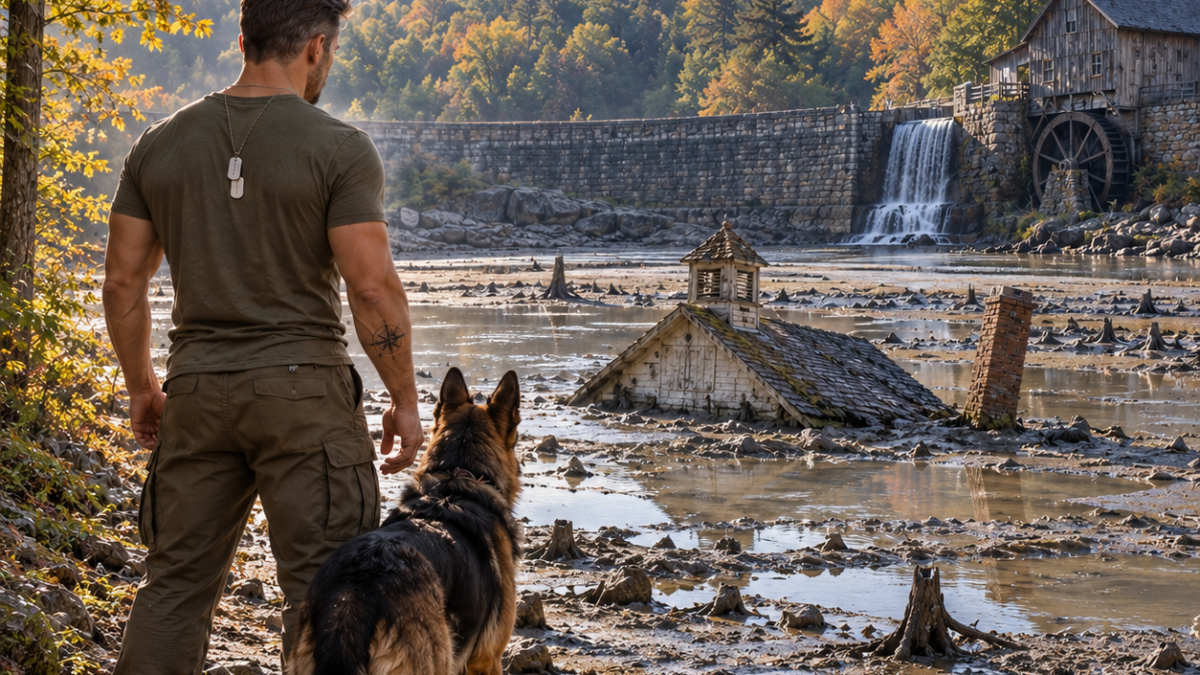
Across the eastern basin, beyond a fan of black mud and half- buried branches, something angular broke the surface of the earth. A roof. Not a whole building, not a revelation clean enough for legends, just the upper portion of a small roof, crooked and dark with age, slate tiles clinging to it in patches.
Beside it, a short brick chimney leaned to one side, as if the storm had woken it from a long sleep, and it had not yet found its balance. The crowd went still. No tavern joke rose to meet the sight.
No one asked a question quickly enough to protect themselves from understanding. The roof had come up first.
EMTT felt anchor shift beneath his hand. The dog took one step forward, then another, stopping at the safer rim where wet grass gave way to sucking mud.
Anchor did not pull, did not bark. He sat down slowly, deliberately, his head lowered until his muzzle pointed toward the exposed roof.
It was not a trick, not a command, not the performance of an animal sensing ghosts for the comfort of human imagination. Anchor knew unstable ground.
He knew flood mud and waterlogged timber. He knew places where breath had once mattered and silence had grown too thick.
So he sat at the edge of danger and gave it the one thing humans rarely offer the past. Respect.
EMTT stood beside him, the old olive duffel at his boots. Someone had carried it from the mill without asking.
May probably. She had set it down near him as if a man without his bag might float away.
The duffel looked absurd against the ancient pond, the wounded mill, the old stone wall, military canvas beside 19th century slate, a life of war standing at the lip of a buried school.
June whispered, “Is that a house?”
Marbel did not answer. Her face had gone bloodless.
She walked forward until Ruth lifted one hand and stopped her.
“No farther,” Ruth said.
“I know.
You don’t look like you know.”
Marabel swallowed and looked again at the roof.
“I know now.”