He Drained the Millpond to Save the Dam—A Forgotten School Rose First – Part 3
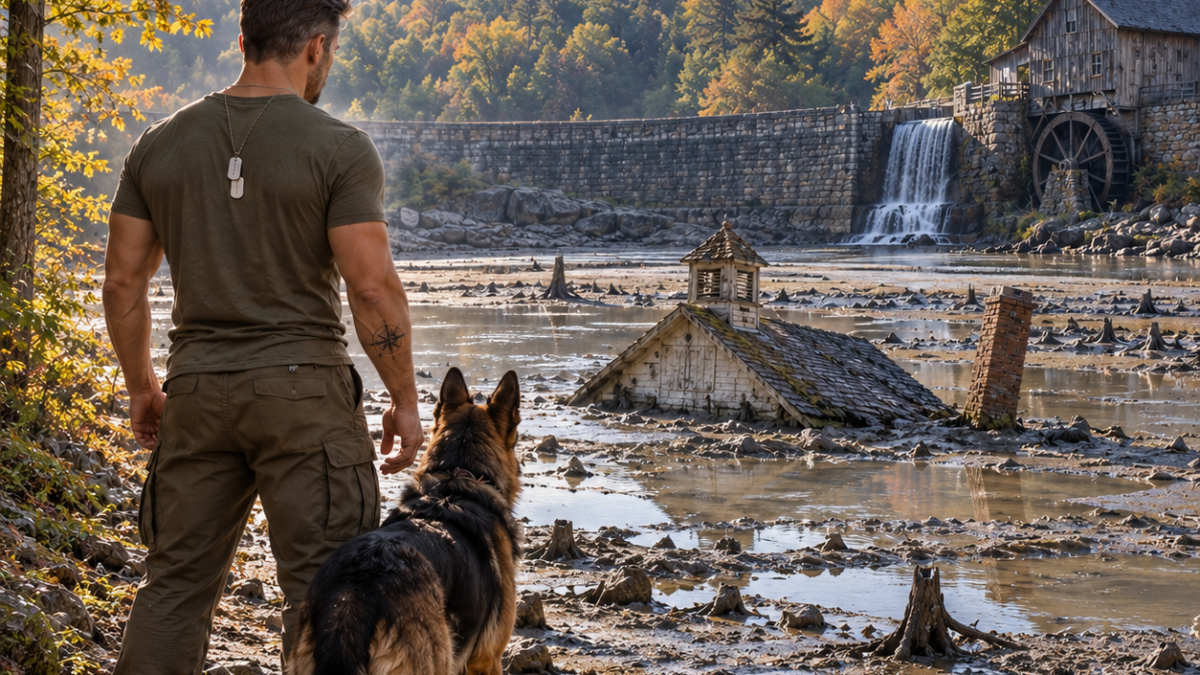
Caleb Row came up the road carrying the church register in both arms, wrapped in cloth to protect it from damp. He looked as though he had not slept either.
His black raincoat was buttoned wrong at the top and there was mud on the hem of his trousers. He followed the direction of every stare, then stopped. For a long moment, the pastor said nothing.
That too was a kind of prayer.
Elias removed the carpenter’s pencil from behind his ear, then seemed to forget what he had meant to do with it.
His fingers rolled it once, twice. The sawmill owner, who had called the place haunted, looked suddenly like a boy remembering something his grandfather had refused to explain.
“My old man,” Elias said, voice low.
“Don’t fish on the east side after Thaw.
Said the hooks came back wrong.”
May folded her arms.
“Hooks don’t come back wrong, Elias.”
I know that now. No, Ruth said quietly, looking toward the roof.
Maybe you don’t.
EMTT crouched beside Anchor and looked across the mud. The scene should have felt impossible.
Yet, it had the terrible calm of something that had always been true. The roof had been there yesterday. It had been there when Elias laughed from the fence.
It had been there when EMTT arrived with no home and no plan beyond surviving the next hour.
It had been there under every winter ice, every spring thaw, every child’s rumor, every old person’s silence.
Hidden things did not begin existing when they were found. They began accusing.
Marbel opened her leather folder with shaking hands.
“I have notes,” she said.
fragments only. Land transfers, old basin maps, references to the schoolhouse. I thought perhaps the building had been moved or dismantled.
The later maps show nothing but pond. Maps lie when people pay them to, Ruth said.
Marbel shook her head. Not paid.
I don’t think so.
She looked at EMTT, then at Caleb. Ashamed, perhaps.
That word moved through the group differently. Ashamed was softer than guilty, but it had roots. Caleb opened the register on a flat stone near the road.
May held an umbrella over him, muttering that if the Lord wanted church records water damaged, he could come down and explain himself. Caleb turned pages with care.
The crowd gathered loosely, held back by Ruth’s glare and the treacherous mud.
December 1889, Caleb said.
June’s grandmother pulled the girl close.
EMTT remained by anchor. Caleb read the names again. Six children ages 6 to 12, all dead within 7 days of one another during the Dtheria outbreak.
Lydia Hollis was among them. At the sound of his family name, EMTT felt something open under his breastbone. Not grief exactly.
One could not honestly grieve a child dead more than a century before. A child whose face he had never seen.
But blood has its own dark libraries. The name reached back through him and found a shelf he had not known existed.
Lydia Hollis, 8 years old. The valley had hidden not only a school but a daughter. Caleb continued.
The school had closed after the winter outbreak. A burial ground near the schoolhouse was mentioned in one entry.
Then the record became thin, uncertain. Spring flooding damaged the lower ground.
Several families left Alder Creek. The following year, Nathaniel Hollis filed work orders to raise the pond edge and reinforce the millwater system. Ruth looked sharply at Marbel.
Raise it how much? Marbel searched a document.
Not enough to call it a new dam. Enough to expand the east basin.
Enough to cover low ground, Ruth said. No one answered. The roof waited in the mud.
EMTT rose slowly. We need to keep people out of there.
Ruth gave him a short nod, approving the practical thought. Mud could swallow a boot past his knee.
Maybe worse near the old structure. Waterlogged roofs collapse without apology.
Caleb closed the register.
I’ll call the county historical office, too.
Medical examiner, Ruth said. The word made June flinch.
Caleb’s voice softened.
Yes. Carefully. No one needed him to explain more.
No one wanted him to. Marbel looked toward the exposed roof with tears standing in her eyes but not falling. I said not to name what rose.
“You were right,” Emmett said.
She turned to him. He kept his gaze on the mud.
“Not because it didn’t have a name, because we weren’t ready to say it.”
For the first time since he had met her, Marbel seemed to lose the tidy border around herself. Her lips trembled once, then steadied.
“Schoolhouse,” she whispered.
The words settled over them all.
“Not haunted, not cursed, not rotten.
schoolhouse, a place where children had learned letters, tracked mud on floors, hidden notes, mispronounced geography, complained about sums, and looked out windows when snow began to fall.
June stepped away from her grandmother just enough to ask, “Did they have a teacher?”
Caleb looked down at the register, Clara Witam, did she die, too? No, he said.
“Not then.
” Then who remembered them?
No adult answered quickly enough? That was the question, sharp as a bell. By late morning, Ruth had strung warning tape along the safest boundary.
Elias, without being asked, hauled stakes from his truck and drove them into the ground. May sent a boy from the tavern to tell curious towns folk to stay back unless they wanted Ruth Calder to personally educate them on the weight of wet silt. Nora Bellamy arrived just before noon.
She came in a dark blue wool blazer under a beige gray trench coat which was not an outfit designed for pond mud and knew it. Her shoulderlength chestnut hair had been pinned back with a metal clip, and she carried a black leather document case tight under one arm. She was younger than most of officials EMTT had dealt with, mid-30s perhaps, but her eyes were quick and unscentimental.
She stopped at the mudline, looked at the roof, then at the wall, then at EMTT.
You’re Hollis.
Yes, I’m Nora Bellamy, town legal office.
I handle property records, preservation filings, and preventing people from turning emergencies into lawsuits before lunch. May called from behind her. She also ruins perfectly good gossip.
Norah did not turn. Only poorly sourced gossip.
EMTT liked her slightly for that. Norah opened her case and removed a yellow notepad already crowded with tabs.
No one touches that structure. No souvenirs, no private digging, no photographs posted until county officials assess it.
Elias snorted. You going to arrest half the town?
I’m going to bore them into surrender with paperwork.
Ruth nodded. Effective method.
Norah’s gaze returned to EMTT.
As current property holder, you’ll need to authorize site access for officials.
I’ll draft temporary permissions.
Also, if this is connected to a burial ground, everything changes.
I’m not trying to keep anyone out, EMTT said.
No, Norah replied, studying him. You look more like someone trying not to be buried with it.
The remark might have been cruel from another person. From Norah, it sounded like observation sharpened by fatigue.
EMTT did not answer. Anker stood and moved beside him.
Norah looked down at the dog, her expression softened by one private degree. That Anchor.
Yes. June has already named him a retired knight.
He’s considering the title.
Anchor sneezed, which June, from a safe distance, took as confirmation. The morning lengthened into the day of boundaries, calls, measurements, and murmurss. County officials were delayed by washed out roads.
The historical preservation office promised to send someone. Caleb returned to the church for more records. Marbel stayed near the mill, combing through her folder as if apology might be hidden between pages.
EMTT went back inside the mill near dusk. The iron chest waited where he had left it. This time he opened the oilcloth letters carefully with clean hands and a patience that felt almost ceremonial.
Anker lay beside the workbench, exhausted but awake. Outside, people still moved in low voices near the pond. But inside the mill, the old timber seemed to hold its breath.
The first papers were worknotes, pond measurements, stone orders, payments to laborers.
Nathaniel Hollis’s handwriting was firm, practical, a miller’s hand trained by weather and accounts.
Then came a letter written in a different script, smaller, finer, slanted, slightly right. Dear Mr.
Hollis, Emmett read slowly. Clara Witam had written after the school closed. Her words were faded but legible where the oil cloth had protected them.
She did not accuse Nathaniel. She did not accuse the town. That made the letter harder to bear.
She wrote of desks still bearing the scratches of little knives, of six hooks on the wall where coats no longer hung, of a slate board where Lydia Hollis had drawn a crooked sun the week before she took ill. Clara begged Nathaniel not to tear the building down for lumber.
Not because wood mattered, but because memory did. If the town could not bear to use the school again, then at least let its walls remain until grief learned how to stand upright.
EMTT stopped reading. Outside the pond breathed through the relief channel. Anker lifted his head.
EMTT looked toward the old bell on the workbench, green with corrosion, small enough to fit in one hand. In that moment, he understood Nathaniel Hollis not as a villain.
And that was almost worse. A villain would have been easier. A villain could be hated cleanly.
Nathaniel had been a grieving father with a mill, a dead daughter, a town broken by disease, and a schoolhouse no one could pass without hearing children who were no longer there. He had not destroyed the place.
He had covered it. Water as a blanket, water as a locked door, water as mercy that became forgetting.
EMTT read the final note in Nathaniel’s own hand, written months later beneath the pond measurements.
Let the basin fill before winter. Clara asked that the school not be broken.
I cannot look upon it, nor can I raise a hammer against it. God forgive the cowardice of fathers.
EMTT sat down on an overturned crate. For a long while he did not move.
He thought of his wife selling the house with the navy blue door. He had told himself she had erased him. Maybe she had.
But perhaps she had also done what drowning people do when no one teaches them how to swim. She had pushed away the thing pulling her under. Even if that thing was a man she once loved.
Nathaniel had covered a school. His wife had sold a house.
EMTT had spent years sealing rooms inside himself and calling it discipline.
Anchor rose painfully, came to him, and rested his graying muzzle on EMTT’s knee.
The mill darkened around them. Beyond the cracked window, the roof of the old schoolhouse remained visible in the mud, small and crooked under the evening sky.
The town had wanted a curse because curses were easier than sorrow. It had wanted a ghost because ghosts required less responsibility than names.
But there was no monster beneath the pond, only children, only a teacher who remembered, only a father who could not bear to see.
EMTT placed one hand over Anker’s head and the other on Clara’s letter.
For the first time since arriving in Alder Creek, the inheritance felt heavier than land. It felt like being chosen by a grief that had waited long enough.
The county men arrived two days later. After the washedout road north of Alder Creek was patched with gravel and patience, they came in white trucks with mud up the tires, carrying orange flags, folding tables, clipboards, tarps, and the solemn inconvenience of official procedure. No one complained, not even Elias Puit, though complaining was usually his way of confirming he was alive.
By then the eastern basin of the mill pond had settled into a strange half silence.
The water remained low, held in check by the relief channel, and Ruth Calder’s fierce supervision.
Mist gathered every morning over the exposed mud. The schoolhouse roof still rose from the basin, crooked and dark, while the leaning chimney kept its wounded angle like an old finger trying to point at something no one had wanted to see.
Ruth would not let anyone close without rope lines. Wet silt does not care about your feelings, she told one curious man who had stepped past the warning tape with a camera.
Neither do collapsed roofs, hidden voids, or my temper. The man retreated so quickly, May applauded from the road. Norah Bellamy had established a makeshift command table under a canvas awning beside the mill.
Yellow notes multiplied around her like autumn leaves with legal opinions.
She had forms for access, forms for documentation, forms for the county, forms for preservation officers, and a special expression reserved for anyone who began a sentence with, “Can’t we just No one finished that sentence twice.
EMTT stayed near the edge of the work, never far from anchor.”
The German Shepherd had not fully recovered from the storm. He still rose whenever EMTT moved, still watched the wall and the basin with working dog discipline.
But the effort showed now. His hips were slower. His breathing deepened after short walks.
In the colder mornings, his scarred side trembled before the rest of him admitted the air was hard. EMTT pretended not to notice for most of one day.
Anchor did not allow it for two. On the second afternoon, the dog simply stopped halfway between the mill door and the pond edge and sat down. Not dramatically, no collapse, no cry.
He just sat, ears forward, eyes annoyed, as if the body beneath him had filed a complaint. Emmett turned back at once.