He Drained the Millpond to Save the Dam—A Forgotten School Rose First – Part 4
“You all right?”
Anker blinked.
Ruth passing with her measuring rod said, “That dog is older than your denial.”
Emmett gave her a look. She gave one drier than old kindling.
Don’t glare at me.
I’m not the one pretending gray muzzles are decorative.
That evening, May drove him an anchor to a veterinarian in the next town because EMTT’s truck had a tire soft from a nail, and because May had decided he looked like a man likely to call a clinic from the parking lot and then leave if placed on hold.
The veterinarian was a narrow woman with silver rimmed glasses and calm hands. She examined Anchor gently, listened to his heart, checked the stiffness in his joints, and looked at the old scar with professional respect.
“He’s not in crisis,” she told Emmett.
“But he is tired.
The storm, the cold, the strain.
It took more out of him than he wants you to know.”
Anker, lying on the exam mat, looked away as if insulted by accurate intelligence. The veterinarian smiled. He needs rest, warmth, short walks.
No more heroic mud duty for a while.
EMTT placed his hand on Anker’s ribs, feeling the slow rise and fall.
“How long?”
he asked before he could stop himself.
The veterinarian’s face softened, but not too much.
Mercy, Emtt had learned, became dangerous when it lied. He could have good time left, she said, but he is not a young dog.
Start treating the days like they matter. On the drive back, May kept both hands on the wheel and said nothing for almost 10 miles. That was unusual enough to feel sacred.
Finally, she said, “Hard thing about dogs.”
EMTT looked out at the dark road. They teach you how to stay, May said. Then one day they teach you how to let go.
EMTT did not answer.
Anchor slept in the back seat, muzzle on EMTT’s folded jacket, tag resting against the leather collar without a sound.
The next morning, the county team confirmed what Caleb’s register had suggested.
There had been a small burial ground near the schoolhouse. time, spring flood, the raised mill pond, and layers of silt had erased its visible markers.
The team spoke carefully. They used professional language, soft voices, and no unnecessary detail.
Norah kept towns people back. Caleb stood with his hands folded.
Marbel held the old register as though the book itself were a frightened child. No one was allowed to turn grief into spectacle. That rule, unspoken at first, became the law of the place.
When a few strangers from two towns over drove in after hearing rumors of a school under the lake, May met them by the road with a tray of coffee and the kind of smile that could nail boards shut. Historical site is closed, she said. Coffee is $2.
Respect is free but required. They left with neither photographs nor coffee. Over the following days, the names were gathered like scattered buttons from an old coat.
Caleb read from the church register. Marbel found a faded school tax list.
Norah located a family Bible scan in county archives. Ruth, who claimed genealogy was sentiment with filing errors, nevertheless spent three hours comparing old property lines so the burial ground could be marked properly.
The six names were written on a clean page in Caleb’s hand.
Lydia Hollis, 8, Thomas Vale, 6. Miriam Puit, 9. Samuel Keane, 12.
Annie Bell, 7. Josephine Ward, 10. When Elias saw the name Miriam Puit, he sat down on a pile of lumber without a word.
No one teased him. No one asked if she had been kin.
In a town as old as Alder Creek, names did not fall far from their trees. He took off his cap and held it between both hands.
“My grandmother used to sing a song,” he said at last, “About little Miriam losing her mitten.”
He stared toward the basin. I thought it was just one of those nonsense songs. Caleb stood beside him.
Maybe someone was trying to remember the only way they could. Elias rubbed one hand over his face. Sawdust still clung to his beard, though he had not worked that morning.
“I laughed at this place,” he said.
May softer than usual replied. You laughed at what you were afraid of.
Elias looked toward EMTT, but EMTT was kneeling beside Anchor, adjusting the blanket over the dog’s back.
The apology waiting in Elias’s throat had to wait, too.
That was good. Some apologies needed to ripen past embarrassment before they became useful. The rebarial was held on a clear, cold afternoon beneath the maples at the church cemetery.
No one called it a funeral for the dead. Caleb called it a service of return.
Six small markers had been prepared from pale Vermont stone, each engraved with a name, an age, and a tiny school bell. Elias had paid for the stone cutting before anyone could argue.
Norah made certain the permits were proper. Ruth inspected the hillside drainage because even in sorrow she refused to let water behave suspiciously. The whole town came.
They did not come dressed as if for spectacle. They came in work coats, black dresses, patched gloves, boots cleaned, as well as mud season allowed.
Men removed caps. Women held flowers.
Children stood unusually still, except for one toddler who announced loudly that the pastor’s shoes were dirty.
May whispered that the child had a future in journalism. The laugh that followed was small, grateful, and gone quickly. EMTT stood near the back with Anker.
He had brought the dog’s wool blanket folded over one arm in case the ground proved too cold.
Anker remained upright beside him, dignified in the way of old dogs who accept weakness as long as no one makes a speech about it. June Abernathy stood beside Caleb. Her mustard yellow jacket had been replaced by a navy coat, too formal for her restless hands.
Her hair was brushed smooth, though one curl had escaped above her ear in rebellion. She held the page with the six names. At first, Emmett thought Caleb would read them.
Then the pastor stepped back. June looked terrified.
Not of the crowd, of the responsibility. Her grandmother touched her shoulder.
Slowly, the old woman whispered. June nodded. She read the first name.
Thomas Vale, 6 years old. The wind moved through the bare branches.
Miriam Puit, 9 years old. Elias bowed his head.
Samuel Keane, 12 years old. A woman near the front began to cry quietly. Annie Bell, 7 years old.
Norah looked down at her folder, though there was nothing in it that needed reading. Josephine Ward, 10 years old.
June’s voice trembled on the final name.
Lydia Hollis, 8 years old. EMTT felt the name enter him differently this time. At the pond, Lydia had been history.
In the register, she had been Inc. here, under the maples, spoken by a living child, she became almost present.
Not as a ghost, not as a vision, as an absence finally given shape.
Anchor leaned against EMTT’s leg.
EMTT placed one hand on the dog’s head.
For years, he had believed grief was something to survive by sealing compartments. Shut the door.
Label nothing. Keep moving.
A man could build an entire life out of internal locked rooms and call it discipline. But a name was a door opening. And once opened, it did not destroy him.
It let air in. Caleb spoke briefly after June finished. He did not accuse the dead.
He did not flatter the living. He said Aldder Creek had inherited sorrow without instructions and generations had mistaken silence for peace.
He said the children had not been waiting for shame. They had been waiting for remembrance.
Then Elias stepped forward. No one had expected it. Perhaps Elias least of all.
He held his cap in both hands, twisting the brim until May muttered.
“That hat’s going to confess, too.”
Elias swallowed.
“I wanted the Hollis land,” he said.
The crowd shifted, he looked at EMTT.
“I wanted it cheap.
I told myself the mill was rotten, the pond was trouble, and a stranger had no business stirring up what had stayed buried.
Truth is, my sawmill’s in debt.
My boy left because he didn’t want to spend his life breathing sawdust and disappointment.
I figured if Hollis failed, I could buy the place, expand the yard, and call it saving my family business. His voice roughened.
I didn’t think about what would happen if the wall went.
Didn’t want to.
Didn’t think about who lived downhill.
Didn’t think about the school.
Didn’t think about much beyond my own fear.
He turned toward the six small markers. Fear makes a coward out of a man while letting him keep his boots on. No one moved.
I’m sorry, Elias said.
To the town, to EMTT Hollis, to those children if sorry carries that far. Caleb answered quietly. Sometimes it does.
Elias nodded once hard. My mill will provide lumber for the wall repairs in the schoolhouse memorial. No charge.
Labor, too, if my men agree.
They’ll agree, May said, or they’ll eat my cooking unsalted.
That earned the day’s second small laugh.
This one stayed a little longer. After the service, people did not rush away. They lingered in clusters, speaking in low voices, touching the new markers, reading the names again, as if repetition could stitch them properly into town memory.
EMTT remained until the cemetery thinned. Elias approached him slowly.
The man looked as awkward without mockery as a bear wearing Sunday shoes. I meant it, Elias said. I heard.
I’ll bring lumber tomorrow.
All right. Elias looked down at Anchor.
Vet say he’s okay.
EMTT’s jaw tightened before he answered.
Tired.
Aren’t we all?
EMTT almost resented the truth of that, but Elias had not said it carelessly. The sawmill owner cleared his throat. Miriam Puit was my great great aunt, best I can figure.
EMTT looked toward Lydia’s marker.
Lydia was Nathaniel’s daughter.
Hell of a thing, Elias said, then glanced toward Caleb and corrected himself. Sorry, Reverend. Caleb, several yards away, replied without turning.
Accurate theology is not always polite. Elias blinked. May laughed outright.
For a moment, the cemetery breathed. That evening, EMTT returned to the mill with Anchor, walking slowly beside him. He did not light the stove right away.
Instead, he sat at the workbench where Clara Witam’s letter lay unfolded beside Nathaniel’s note.
He took out his wife’s letter from the pocket of his duffel.
The paper was creased from being carried too long. He read it again. This time he did not read it as a verdict.
He read it as a woman trying to escape a house where invisible explosions had become weather. He still hurt.
He still w wished she had waited or shouted or asked or left the door navy blue a little longer. But the wish had less teeth now.
Nathaniel had covered a school because he could not look at grief. His wife had sold a house because she could not keep living inside his.
EMTT had hidden whole rooms of himself because he believed naming pain gave it power. Maybe all of them had been wrong in human ways.
He found a blank sheet in Ruth’s abandoned stack of sight notes and began writing.
Not to ask his wife back, not to excuse himself, not to reopen a door that had closed with a green coat of paint. He wrote because some things became less poisonous when set outside the body. I understand more than I did, he began.
The sentence looked small. It also looked true. Anker sighed from the blanket near the stove.
EMTT stopped writing and looked at him.
The dog’s eyes were half closed.
His muzzle had gone almost silver in the firelight. His scar softened under the rise and fall of breathing. EMTT crossed the room, knelt beside him, and adjusted the blanket around his shoulders.
“You’re off duty,” he said.
Anchor opened one eye. I mean it. The eye closed again, unconvinced but willing to postpone argument.
Later, June came by with Caleb and May to return the clean school bell. May had polished it carefully, though not enough to erase the green marks of age. June carried it in both hands as if it were a bird.
“Can we hang it?”
she asked. EMTT looked at Caleb.
The pastor smiled temporarily until the memorial is planned.
Ruth, who had appeared in the doorway without anyone hearing her, said, “If you hang it from that beam without checking the load, I will personally haunt all of you while alive.”
Elias arrived 5 minutes later with a proper bracket, claiming he had anticipated incompetence. Norah followed with a note saying temporary installation had been approved, which made May declare paperwork had finally learned to clap.
They hung the bell from a beam near the center of the mill. Not high, not grand, just where a hand could reach the rope. June looked at EMTT.
You should ring it. He shook his head. You read the names.
That’s why I’m tired.
No one argued with that logic. June took the rope and pulled once. The bell sounded small, not triumphant, not mournful, exactly.
Clear, thin, imperfect, the kind of sound that could have called children in from snow or workers from a field, or a tired man back into the room where his own life waited. EMTT did not flinch.
The sound passed through the mill, through the old beams and gears, over Anker’s resting body, past Clara’s letter and Nathaniel’s confession, and into the damp evening beyond the door.
EMTT stood very still. For the first time in years, an unexpected sound did not become a battlefield.
It became a bell. By the time the first red leaves began to loosen from the maples, the old Hollis mill no longer looked abandoned. It did not look new, either.
No one in Alder Creek wanted that. New would have been an insult.
New would have smoothed away the weathered beams, the dark stone foundation, the iron gears with their tired teeth, the water wheel that still leaned a little like an old man listening through a bad ear. knew would have lied.
Instead, the mill looked mended. That was different. Fresh boards held where rot had been cut out.
The roof had been patched in slate and cedar, close enough to the old pattern that Ruth Calder called it acceptable, which everyone understood to be a hymn of praise in her native language. The windows had been reglazed.
The floor no longer dipped near the main gear assembly. The stove breathed clean heat into the central room each morning, and the smell of damp ruin had slowly given way to sawdust, coffee, wood oil, wool blankets, and the peppery bite of cold air coming through doors that opened too
often.
The pond wall stood safer now, though still visibly old. Ruth had supervised the structural work with a ferocity that made even the contractors from Mont Pelleier speak softly.
The bulged eastern section had been reinforced from behind, not hidden. The pale yellow repair stones remained visible, marked with a small brass plate, explaining the weakness that had nearly taken the lower town. Ruth insisted on that.
People forget what they can’t see, she said.
No one argued because everyone in Alder Creek had recently become educated on the cost of forgetting. The relief channel remained open, lined with stone, guided into the old stream bed the valley had remembered before any person admitted it. The mill pond still held water, but not enough to drown the eastern basin again.
In that basin, under a simple timber shelter built on safe ground, the recovered schoolhouse roof had been preserved in sections. The leaning chimney, stabilized with hidden supports, kept its tilt like a stubborn witness, refusing to stand straight for the comfort of others. There was no gift shop.
May had threatened to haunt anyone who suggested one. Instead, there was a small board with six names, six ages, and a sentence Caleb Row had written after three failed drafts and one argument with Norah Bellamy over whether sorrow required punctuation.
Here stood Alder Creek Schoolhouse. Here grief was hidden underwater. Here memory was returned by name.
EMTT read it often, not every day. That would have turned remembrance into a duty polished too smooth, but often enough, sometimes alone, sometimes with anchor, sometimes with June Abernathy, who had appointed herself unofficial guardian of spelling, bell ropes, and anyone who looked too sad near the memorial.
People read slower when they’re crying, she told EMTT one afternoon, arms crossed over her navy coat.
That bother you? No, but they block the path.
You want me to install traffic rules for grief? June considered it seriously. Maybe arrows.
EMTT looked at Anker.
She’s Ruth in training.
Anker sneezed. June took that as an insult and a compliment, which was usually safest with June.
The idea for the workshop did not arrive in a single noble flash. It came awkwardly like a calf learning legs. At first, EMTT only meant to make the mill livable enough to survive winter.
Then Elias Puit showed up with lumber too warped for paying customers, though every board was straight and clean. Then Caleb asked whether the upstairs rooms could hold temporary beds for two veterans he knew through a regional outreach group.
Then Norah said temporary beds required paperwork, insurance, inspection, fire plans, nonprofit registration, and possibly divine intervention. Though she added that divine intervention would still need a signature. Marbel found a preservation grant for historic mills.
Ruth found flaws in the grant application, corrected them with a pencil so sharp it seemed morally opposed to vagueness, and denied helping. May began sending soup on Thursdays and biscuits whenever men arrived looking hungry enough to make pride dangerous.
By the second week, EMTT stopped saying, “It isn’t ready.”
By the third, he stopped believing readiness was a door that opened all at once. The first man to stay was named Ray Donnelly.
Ray was 58, a former army mechanic with hands that shook when idle and steadied around tools. He arrived in a brown coat missing two buttons, carrying a backpack small enough to embarrass a life.
He did not speak much the first day. He stood in the doorway of the mill and looked at the workbenches, the patched roof, the stove, the beds against the far wall, the old school bell hanging from a center beam. Then he looked at Anker.
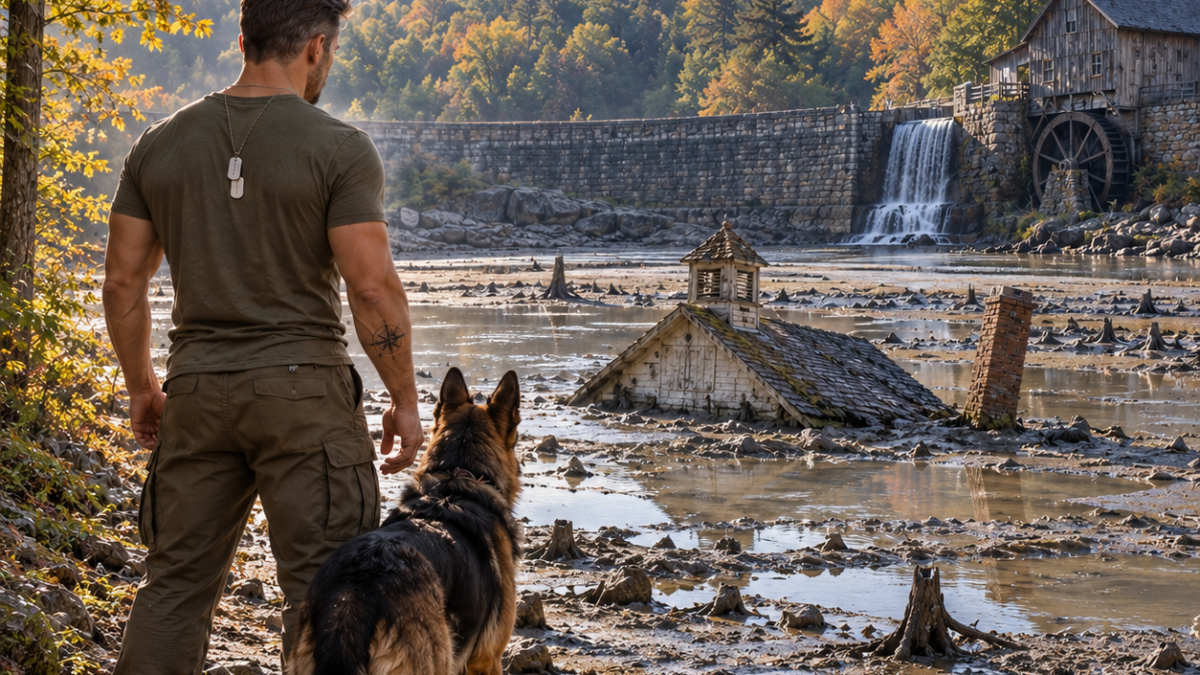
Anker lay on a thick wool blanket near the stove, muzzle silver in the fire light. One ear tipped slightly, scarred side turned toward the room as if he no longer felt the need to hide any part of himself.
He raised his head when Rey entered, but did not get up. The veterinarian had been firm about that.
EMTT had been firmer, which Anker considered a betrayal of working standards. Ry took two steps inside.
“Dog friendly?”
he asked, voice rough. May who had come to inspect whether anyone was starving, snorted.
“This place is doggoverned.”
Ry sat on the bench nearest Anker slowly as if asking permission from the floor. Anker looked at him for a long moment, then placed his chin back on his paws.
Ray’s shoulders lowered.