He Grabbed the Quiet Nurse — Then Her Hidden Rank Silenced the Entire Chow Hall – Part 4
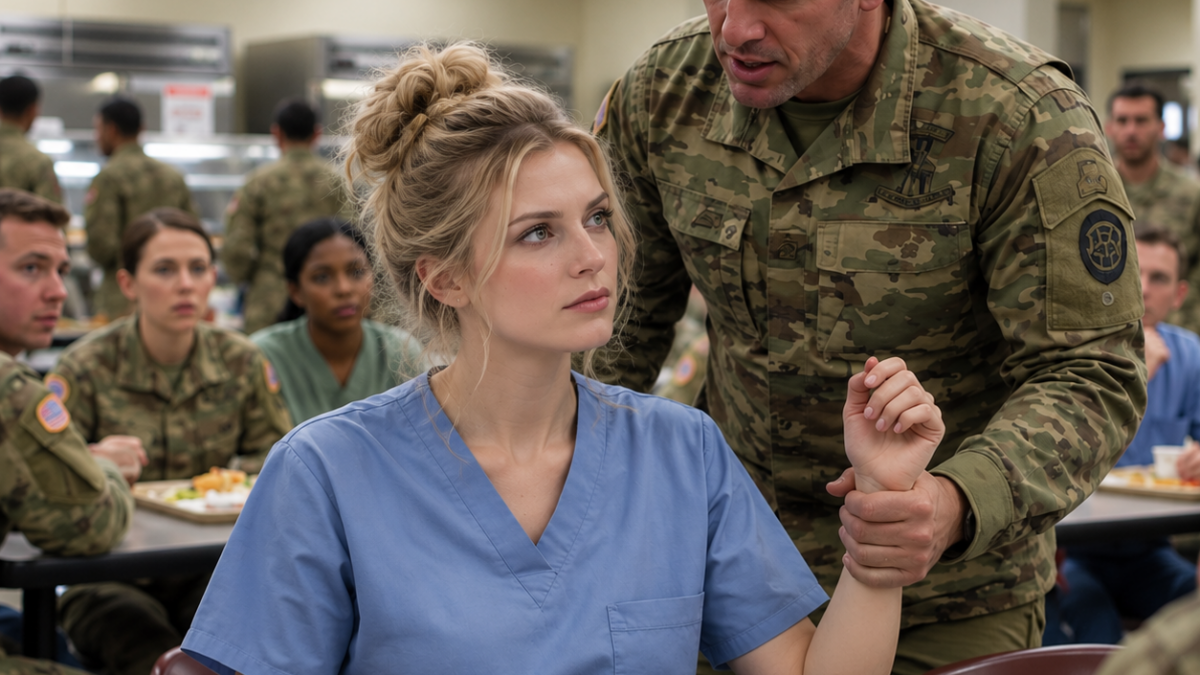
He sat in a plain conference room with Captain Kincaid to his right and an appointed counsel to his left. Mercer sat across from him with one investigator, one recorder, and a folder she did not open right away.
“Specialist Rourke,” she said, “describe your interaction with Nurse Whitcomb.
” Ethan did.
Badly at first. He said disagreement.
He said coffee station. He said brief contact.
He said he did not intend harm. Mercer let him finish.
Then she opened the folder.
“Did you place your hand around her wrist?”
“Yes, ma’am.”
“Did she ask you to remove it?”
“Yes, ma’am.”
“Did you remove it immediately?”
“No, ma’am.
” “What did you say after releasing her?”
Ethan looked down.
“I don’t remember exact words.”
Mercer read from Mara’s report.
“You nurses need to understand your place in this facility.
Civilian staff are here because we allow it.
Ethan’s face tightened.
Does that sound accurate? A long silence.
Yes, ma’am.
Did you know Nurse Whitcomb’s prior military rank at that time?
No, ma’am.
Would it have changed your behavior? He looked up as if the question gave him a way out.
Then he saw Mercer’s face and understood there was no safe answer.
It should not have needed to. That is not what I asked. Ethan swallowed.
Yes, ma’am.
It probably would have. Mercer studied him.
At Redstone Military Hospital, did you block Nurse Caroline Briggs during a patient transport dispute? I remember a disagreement.
That is not the question.
Yes, ma’am.
Did you touch her arm? I may have. Mercer did not look at the investigator, but the silence sharpened.
Ethan corrected himself.
Yes, ma’am.
At Port Haven Base Clinic, did you block Nurse Hannah Keen in a medication storage room? His confusion returned. Port Haven?
Yes. That was 3 years ago.
So, you remember it. He realized the trap only after stepping into it.
Council shifted beside him. Ethan closed his eyes briefly.
Yes, ma’am.
Did you touch her? I grabbed her arm for a second.
Why? She was walking away.
Mercer waited. Ethan heard his own answer in the room.
He opened his mouth and closed it. Mercer leaned back.
Specialist Roark, do you understand the difference between getting someone’s attention and controlling their movement?
He did not answer quickly. I do now. That is not the same as having understood it then.
No, ma’am.
Mercer turned a page. Were you aware that Captain Owen Slater discouraged Nurse Keen from filing a formal report?
No, ma’am.
Were you aware that Captain Slater later supervised the administrative handling of Nurse Briggs’s report at Redstone?
No, ma’am.
Were you aware that Mr.
Miles Verrick, currently associated with Slater’s legal division, accessed the Fort Whittaker review schedule before entering the proceeding today?
Ethan looked at Kincaid.
Kincaid’s face gave him nothing.
No, ma’am.
Mercer watched him carefully. For the first time that day, Ethan looked less like a man defending himself and more like a man seeing the room built around him.
Mercer’s voice stayed level.
You are responsible for your conduct. Do not confuse the existence of a larger failure with a reduction in your own.
Yes, ma’am.
But you should understand something else. Systems rarely protect people by accident. If someone believed you required protection before you understood you were in danger, that tells me someone knew more about your pattern than you did.
Ethan sat very still. The recorder captured the silence. That evening, Mercer called Nora into a separate room for intake.
Not full testimony. Not yet. Just a boundary.
Nora sat across from her, hands folded, scrubs clean but wrinkled after another long day. Mercer looked at the file. You made three calls today that affected evidence collection.
Yes, ma’am.
Why time pressure? Verrick was pushing a delay.
Caroline Briggs’s live statement changed the procedural posture.
Hannah Keen’s information established broader scope.
You sound like an officer. Nora said nothing. Mercer looked up.
You also sound like a nurse who has spent too many years believing a crisis becomes yours if you can see how to solve it. Nora held her gaze. I saw a gap and stepped into it.
Yes. Do not step into the next one.
There it was again. The order beneath the observation. Nora nodded.
Mercer closed the file. Your formal statement is scheduled for tomorrow at 900. You will speak to your own experience.
You will not speak for Briggs, Keen, or any other nurse. Understood.
Yes, ma’am.
Mercer paused. One more thing. Nora waited.
Your service record is relevant only because Roark’s assumptions about your status formed part of his conduct and because others may attempt to frame your credibility through it.
I have read enough to know it is significant. I am not interested in turning this into a medal ceremony.
Nora felt something in her chest unclench by a fraction. Thank you.
That was not reassurance. It was scope control.
Yes, ma’am.
Mercer stood signaling the meeting was over. Nora stood, too.
At the door, Mercer said, “Captain Whitcomb.
” Nora stopped.
The old rank struck harder than she expected.
Mercer’s voice remained even.
You are not on a battlefield here. Nora looked back.
No, ma’am.
Then stop bleeding like you are. Nora left without answering. The hallway outside had dimmed into evening.
Most administrative offices were closed. The review suite was dark now except for one light near the anteroom desk where an IG evidence seal had been placed over a file cabinet. Near the elevators, Harlan waited with his coat folded over one arm.
“You heard Nora said?”
“Enough.
She told me to stop.”
“She was right.”
Nora looked at him.
“You agree quickly.”
“I have rank and age.”
“It saves time.”
That almost made her smile. For a moment, neither moved. The hallway held them in the strange quiet that follows a day when too much truth has entered rooms built to manage less of it.
“Hannah gave a statement,” Harlan said.
“I know.”
“Caroline, too.”
Nora nodded.
“And two Redstone witnesses.”
She looked at him then.
“They found them?”
“Yes.”
“Will they talk?”
“They already started.”
Nora took that in.
The file was no longer a single page, no longer Mara’s report, no longer Nora’s wrist.
It had names now and dates and rooms and women who had waited long enough to sound calm when they finally said what happened. Harlan studied her face.
“Go home.”
“You are all very committed to that sentence.”
“Because you are resistant to it.”
“I have rounds.”
“Mara covered them.”
“Of course she did.”
“She threatened me by text.”
“That sounds like Mara.”
The elevator arrived. The doors opened. Nora stepped inside.
Before they closed, Harlan said, “Tomorrow they ask for your statement.
” “Nothing more.”
Nora met his eyes.
“Nothing more.”
The doors slid shut. On the second floor, Nora stepped out instead of going to the lobby.
She told herself it was because she had left her jacket near Ward C. It was not. Lilly Carter was asleep when Nora reached C7.
The deck of cards sat on the bedside table squared perfectly now. Someone had turned the lights low.
The monitor hummed softly.
Lilly’s face looked younger in sleep, sarcasm gone, pain held back by medication and exhaustion.
Nora stood in the doorway for a moment.
Then she moved quietly to the nurses’ station.
Mara was there writing notes with one hand and eating crackers with the other. You were supposed to be gone.
Mara said without looking up. I am getting my jacket.
Your jacket is on the chair behind me because I knew you would use it as an excuse to come here. Nora picked it up.
Mara finally looked at her. How bad?
Bigger. Mara set the pen down.
How much bigger, Port Haven? Three years ago, contract nurse, same pattern. Slater told her reporting could affect renewal.
Slater also touched the Redstone closeout. He is now in the same legal division as Varick.
Mara’s face went still.
That little cafeteria report just hit a wall under the floor. Yes.
IG Mercer. Mara let out a slow breath. Good.
Nora leaned against the counter. She told me to stop coordinating.
She is also good. I know.
Do you? Nora gave her a tired look. Mara softened.
Nora, listen to me. Nurses are terrible at letting go of a problem once we have our hands on it.
We think if we can stabilize a patient, we can stabilize a system. But systems bite differently. I know.
Do you? This time, Nora did not answer. Mara reached under the counter and pulled out a sealed evidence copy receipt.
She slid it across. What is this confirmation from staff safety?
My original report photos timestamp and metadata were preserved under IG order. It is not just floating around admin anymore. Nora touched the paper.
For some reason that almost undid her. Not the confrontation, not the trauma bay, not phone calls.
This. A receipt.
Proof that the first page had not vanished. Mara saw it and looked away giving Nora the dignity of not being watched too closely. Go home, Mara said.
Nora folded the receipt once and placed it in her jacket pocket. This time she did.
Outside night had settled over Fort Whittaker. The hospital lights reflected on the wet pavement turning the parking lot into broken strips of white and gold.
Nora walked to the bus stop with her jacket over one arm and her phone silent in her pocket. She sat on the metal bench.
Across the road the hospital kept moving. Ambulances came and went.
Nurses changed shifts. Families waited. Somewhere inside Ethan Rourke sat under administrative restriction.
Somewhere across the country Caroline Briggs and Hannah Keen were looking at old documents that had suddenly become evidence instead of private grief. Somewhere in the building behind her General Mercer was turning locked doors into numbered exhibits. Nora looked down at her hands.
They were steady. At 8:17 p. m.
her phone buzzed. A message from an unknown number.
This is Hannah. I gave the statement.
I did not shake until after. Nora stared at it for a long moment.
Then she typed back. After is allowed.
She put the phone away. The bus arrived with a sigh of brakes.
Nora stepped on, paid her fare, and took a seat near the back. As the hospital slid out of view, she leaned her head against the window.
For the first time since Ethan Rourke’s hand had closed around her wrist, she let her eyes close without counting exits.
The next morning at 8:52, Nora stood outside the IG interview room. Carolyn Briggs appeared on a video screen inside.
Hannah Keen’s file sat beside Mercer’s folder.
Ethan’s statement was sealed.
Slater’s access history had been printed and marked.
Varick’s badge logs were clipped under a red evidence tab.
Mara stood beside Nora with two coffees. You ready?
Nora looked through the glass. General Mercer sat at the table reading. Colonel Harlan was not in the room.
That mattered. Nora took one coffee from Mara. No.
Mara nodded. Good. Ready people make mistakes.
The door opened. An investigator looked out. Nurse Whitcomb, they are ready for you.
Nora set the coffee down untouched. She stepped inside and let the door close behind her. The room was colder than the hallway.
Nora noticed that first. Not the general at the table, not the recorder blinking red beside folder, not the two investigators seated with tablets open and hands still.
The cold came first, sliding beneath the sleeves of her scrubs, touching the place on her wrist where Ethan Rourke’s fingers had been, and where no mark remained.
Brigadier General Elaine Mercer looked up from the file. Nurse Whitcomb. Nora stepped to the chair.
Ma’am.
Sit. Nora sat.
The room had no windows. A flag stood in one corner.
A clock ticked above the door with a sound too small to matter and too steady to ignore. On the table in front of Mercer were four folders.
Nora saw the names printed on the tabs. Whitcomb, Briggs, Keen, Roark. A fifth folder sat slightly apart.
Slater. Mercer folded her hands.
This is a formal Inspector General interview. You are here as the reporting party in the Fort Whittaker cafeteria incident and as a witness to events that occurred afterward.
You will answer only what is asked. If you do not know, say you do not know. If you are estimating, say you are estimating.
Do you understand?
Yes, ma’am.
The recorder captured the answer. Mercer began with the cafeteria.
Time. Location. Who was present?
What Ethan said. How close he stood.
Which hand he used. How long he held her wrist.
Nora answered in clean pieces. She did not decorate the memory. She did not make her voice heavier where it hurt.
She gave the room what happened and let the words carry their own weight.
At that point, Mercer said, “What did you do?”
“I looked at his hand.
Then I told him to take it off my wrist.
” “Did you pull away?”
“No, ma’am.”
“Why not?”
Nora looked at the recorder light.
“Because pulling against a controlling grip can turn a small act into a larger one.
I wanted him to choose to release me in front of witnesses.”
Mercer watched her.
“That sounds like tactical assessment.”
“It was habit.”
“From military service?”
“Yes, ma’am.
” Mercer turned one page.
When specialist Roark grabbed you, did he know you had previously served as an Army medical officer?
No, ma’am.
Did you tell him no? Why?
The question sat there sharp and plain. Nora felt the old irritation rise, not at Mercer, but at the shape of a world where the answer needed saying aloud. Because I should not have needed to.
The investigator to Mercer’s right looked up from her tablet.
Nora continued. I was wearing a hospital badge.
I was working a shift. I was a nurse in a medical facility. That should have been enough information for him to keep his hands to himself.