Her Abusive Father Struck Her at Thanksgiving—Then the Mafia Boss Said, “You’re Coming With Me” Now! – Part 2
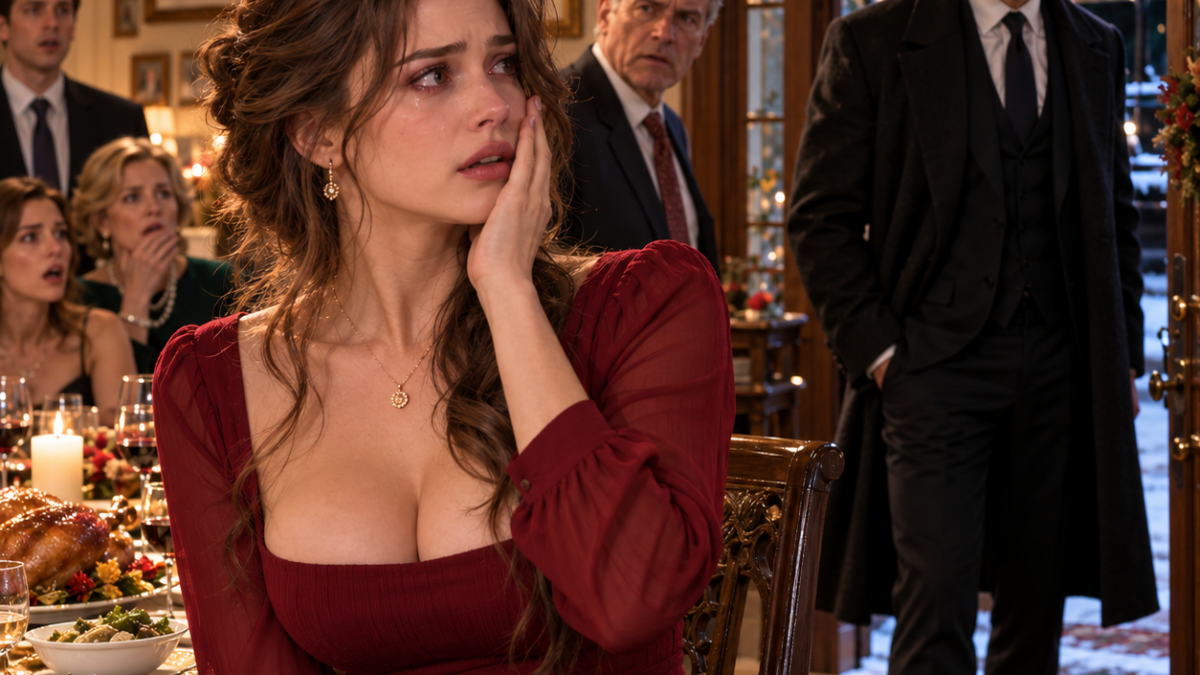
He looked at the bruise on her cheek. 10 days in, it had faded to a yellowish shadow at the edge of her cheekbone.
Almost gone.
“It’s healing.
It’s fine,” she said.
“You should eat something.”
“I came for water.”
The bread from tonight is in the cabinet above the toaster. Elena makes it.
Saraphina looked at the cabinet, looked at him. He had his back to the counter, arms loose at his sides, and he was watching her with the same attention he gave everything, complete, unhurried, neither warm nor cold, simply present. She got water, she got bread.
She stood at the counter on the opposite side and ate half a piece and tried to be someone who was comfortable existing in a kitchen at 11 at night with a man who had more power than anyone she’d ever known and was at this particular moment wearing a gray t-shirt and looking like
someone who hadn’t slept well in probably several years.
The music, she said.
She hadn’t planned to say it.
He looked at her down the hall. I heard it Wednesday last week.
He was quiet.
You don’t have to explain it, she said.
It’s not a secret, he said.
It’s just not a conversation I’ve had in a while.
She waited. He looked at the counter.
My mother played piano. She was She was good at it. A pause.
She died when I was 11. I kept the instrument.
Saraphina was quiet.
I can’t play, he said.
I never learned properly. But sometimes at night I go in there and he stopped.
It sounds exactly like it sounds. It sounds like you miss her, Saraphina said.
He looked at her. Something in his face was very unguarded for a moment. Just a moment.
A crack in the surface that closed almost immediately. Yeah, he said. It does.
She finished the bread, rinsed her glass, set it in the rack. Good night, she said.
Good night. She went back to her room. She stood at the window looking at the lake and made herself be precise about what she was feeling.
Not romance, not foolishness, not the catastrophic stupidity of developing feelings for a man whose world was made of things she could not touch and survive. Just recognition.
The specific ache of recognizing someone who has been damaged in ways that shaped them rather than destroyed them and has done the difficult invisible work of learning to function. Anyway, she recognized it because she had done the same work.
She stood at the window until she was sure she was only tired and not anything more complicated than that. And then she went to bed.
She almost convinced herself. The second week ended with a Sunday that felt like a held breath.
She was in the sitting room adjacent to her suite reading through contract amendments when she heard voices in the entrance hall below, raised voices, which was unusual enough that she stopped reading and listened.
She couldn’t make out words, just tone.
Someone was angry, controlled, but angry with the particular bittenoff quality of anger that has been in the room for a while and is reaching its limits. She went to the landing and looked down.
There were three men in the entrance hall she hadn’t seen before, well-dressed, 40s, the kind of men who carry their wealth like an extra layer of clothing.
Two of them were standing near the door.
The third was closest to the foot of the stairs, facing Caruso, who was blocking the hallway toward Dante’s office with the particular stillness of someone who has done this before and will do it as many times as necessary.
The third man’s voice came up clearly.
Tell him it’s not a request.
We had an agreement and the timeline has changed. He needs to be available. Caruso said nothing.
You tell him Marchetti is not a patient man. Caruso said Mr. Verchelli is aware of Mr.
Marchetti’s schedule.
He’ll be in contact at his convenience.
The man, not Marchetti, she understood, but someone speaking for him, took a step closer to Caruso. It was the kind of step designed to communicate something through proximity.
Caruso didn’t move.
His convenience, the man said, voiced dropping, is no longer, “That’s enough.”
Dante’s voice came from the hallway behind Caruso.
He came through and stood beside Caruso and looked at the three men with the exact same expression he used for everything. Level, present, unimpressed by the drama being performed for his benefit.
Gentlemen, he said, you’re in my house without an appointment.
Mr.
Verscelli, that’s not an apology, Dante said.
That’s that’s a name.
The man recalibrated. We apologize for the intrusion. Mr.
Marchetti has asked us to communicate the urgency personally. I understand the urgency.
I’ve understood it since Friday.
Dante glanced at the two men near the door. A quick cataloging glance.
Tell Marchetti I’ll call him Tuesday.
Not because I don’t understand his schedule, but because the terms he’s proposing require my attorney to review language that I received this morning.
A pause. Tuesday, the man said. Tuesday, Dante said.
There was a long moment in which nothing moved and the quality of the silence was something that Saraphina watching from above could feel in her sternum. Then the three men left.
Dante stood in the entrance hall for a moment after the door closed. He looked at Caruso. Caruso looked at him.
Something passed between them. Not words, just the compressed exchange of people who have worked together long enough to have a language made of silences.
Then Dante looked up. He saw her on the landing.
He didn’t look surprised.
He didn’t look anything.
“Come down,” he said.
“I need you to pull the Marchetti file and find every reference to timeline language.
” She came down.
She found the references, six of them spread across four documents, two of which she’d flagged in her first week for the precisely the kind of vagueness that could become a weapon in a dispute.
She brought them to his office. He read them.
He marked them. He asked her three precise questions about the filing dates, and she answered all three from memory. When he was done, he leaned back in his chair and looked at the ceiling for a moment.
The cut on his jaw had fully healed. There was a new tension across his shoulders that she recognized as something that had not been there in the first week. The Marchetti situation, she said.
He looked at her. Is it going to require scheduling changes?
Probably. Then I should know enough to work around it without knowing enough to be a liability. He held her eyes long enough that she felt the weight of it.
Marchetti is a partner in a real estate operation I control 40% of.
He said he’s decided he wants to control 60.
The timeline language you found is his argument.
My attorney’s counterargument is the clause on page 11 of the original agreement.
He paused.
That’s what you need to know.
That’s enough, she said.
Yes, he said. It is. She gathered the files, stood.
Saraphina. She stopped. He was looking at her with something different in his face.
Not the professional attention, not the measuring look, something more exposed, shorter, like he had started a sentence and was only now discovering what it was. The man at the door, he said.
Were you frightened? She considered this honestly. No, she said, watchful, not frightened.
He nodded slowly. You should have been a little frightened, he said.
And it wasn’t a criticism.
It sounded almost like concern.
I’ll work on it, she said.
She went back to her office.
She sat at her desk and put the files in order and told herself that the thing in his voice when he said she should have been frightened, the thing that sounded like he was worried about her, specifically not in general, was the tone of an employer who didn’t want to
be responsible for a casualty.
She told herself this with some conviction. And then at 7:43 on a Sunday evening, her phone rang.
Unknown number.
She almost didn’t answer.
She answered, “Saraphina,” her father’s voice thicker than usual.
Words slightly imprecise at the edges.
He’d been drinking, but not so much that he’d lost the thread, just enough to have decided he was entitled.
“I know where you are.”
She was very still.
“I don’t know what he told you,” Martin said.
I don’t know what kind of arrangement you think you have, but you need to come home.
That’s not my home, she said.
I’m your father.
I know who you are.
He’s using you.
Martin’s voice had the certainty of someone who has rehearsed this.
Whatever he told you, whatever he’s he showed me the debt documents, she said, all four years of them.
Silence. He showed me the amounts, the dates, the terms.
She kept her voice level. She had learned level from a master in the past 2 weeks.
I know what you borrowed. I know what you spent it on. I know you went back three times.
Martin’s breathing on the line was audible and ragged.
Saraphina, don’t call this number again, she said.
She hung up. She sat with the phone in her hand and waited for the anger or the grief or the complicated love that had always followed the anger and the grief.
She waited for the specific pull of it. The gravitational field of the person who raised you. Damaged and damaging and still somehow home.
She waited. What came instead was something quieter, steadier. Not peace exactly, but the early architecture of it.
She set the phone down. She went back to work.
What she didn’t know, couldn’t have known, was that her father had made a second call immediately after she’d hung up.
that this call had gone not to a number in his contacts, but to the number he’d been given three weeks ago by the man who’d answered his first call on Thanksgiving night.
What she didn’t know was that the voice on the other end had said, “Good.
Keep her rattled.
We need Vertelli distracted.”
What she didn’t know was that Richi, the Richi, whose messages had changed tone, whose patience had replaced his aggression, had been in the same room as that voice.
And what she didn’t know was that somewhere in the city, a man named Marchetti had just decided that Tuesday was too long to wait and that the fastest way to resolve a dispute over 60% of a real estate operation was to remove the 40% entirely.
She found out the following Thursday. She found out because she was the one who opened the envelope. It arrived in the morning mail addressed to the estate.
No return address, postmarked from a mailbox six blocks from Richie’s last known address.
A detail she only connected later after everything had already The envelope was standard, white, letter sized, the kind you buy in bulk from any office supply store.
Her name wasn’t on it, just the estates address, printed from a machine.
No handwriting to analyze, no personality to read. She almost set it in the general correspondence pile without opening it.
She opened it because it had no return address, and she had learned in 3 weeks that the communications most worth paying attention to were the ones that didn’t identify themselves.
Inside was a single photograph. She looked at it for 4 seconds before she understood what she was seeing. Then she sat it face down on the desk and sat very still and made herself breathe through the specific nausea of comprehension arriving too fast.
She picked it up again. The photograph showed the entrance to the estate taken from outside the gate through the iron bars with a telephoto lens. The kind of shot that communicates not just information but intent.
Communicates I have been here. I have been watching.
I know the shape of your perimeter and I am not impressed by it. In the foreground of the shot, walking up the interior path toward the main door was Saraphina. She recognized the coat.
Tuesday, 2 days ago. The time stamp in the lower right corner confirmed it.
8:47 a. m. On the back of the photograph, written in ink, three words.
She works here.
She turned it back over, looked at herself in the photograph, small, purposeful, crossing the path she’d walked a 100 times in 3 weeks without once thinking about what she looked like from the outside of the gate.
She picked up her phone and walked down the hall to Dante’s office and knocked once and opened the door.
He was on a call. He looked up. He saw her face.
He said into the phone, “I’ll call you back.”
And hung up before the other person could respond. She crossed the room and put the photograph on his desk.
He looked at it. He picked it up.
He turned it over. He read the three words on the back with an expression that did not change in any way that a stranger would notice. But she was not a stranger anymore.
And she noticed the thing that happened to his eyes. a sharpening, an internal shift, like a room where someone has just locked the door. When did this arrive?
He said, “This morning’s mail.
I opened it 10 minutes ago.”
He set the photograph down, picked up his own phone, sent a text. She saw his thumbs move, brief and precise, and put the phone face down on the desk.
“Did you touch the envelope?”
“Yes.”
“With gloves?”
“No.”
He nodded.
“It won’t matter.
This wasn’t sent to be traced.”
He looked at her.
“Are you all right?”
“I’m trying to figure out if I should be frightened,” she said.
Something moved through his face.
“Yes,” he said.
“This one, you should be frightened.”
She sat down in the chair across from his desk.
She hadn’t been invited to sit.
She sat anyway because her legs had made a decision her composure hadn’t caught up to yet.
“This is from Marchetti,” she said.
Dante was quiet for a moment. Tell me why you think that, he said.
Because Richie’s messages changed tone two weeks ago.
Because Marchetti sent people to your house on a Sunday without an appointment, which is a communication about power, not about not about scheduling. Because whoever sent this used her as the subject rather than sending it to her, which means it was sent to you and she was the message.
She stopped, heard herself. Me? I was the message.
Dante looked at her steadily. Yes, he said.
They know I’m here.
They’ve known since approximately your second day, he said.
I knew they knew.
I didn’t know how they planned to use it.
He tapped the photograph once with his index finger. Now I know.
She felt the cold of this move through her. Not panic, just the clean physical fact of fear settling into her bones, like the November cold had settled into the veil house.
Recognizable, manageable if you didn’t fight it.
My father,” she said.
Dante was quiet.
“He called me Sunday,” she said.
He said he knew where I was. She looked at the photograph.
He told them, “Still quiet.”
“Dante.”
He looked at her when she said his name. She had not used it before. The contract had been signed with Mr.
Vchelli, and she had used it everyday since, the formal distance of it, a structure she’d relied on.
Your father, he said, made contact with Richie’s people the night you arrived here.
The room was very still. How long have you known that? She said, since the following morning, she looked at him.
The steadiness she’d built over 3 weeks was doing something complicated.
Not collapsing, not cracking, but flexing in ways she hadn’t tested yet.
You knew my father was feeding them information, she said.
And you didn’t tell me.
I knew he’d made contact.
I didn’t know what he was providing until Rachi’s messages changed.
He met her eyes.
He did not look away or offer the softening that people offer when they’ve done something they know was wrong.
I should have told you sooner. That was a mistake.
She took a breath. Let it out.
The anger was there. She could feel its heat behind her sternum. But she had learned too well in her life what anger spent recklessly cost.
So she held it. What does this photograph mean?
She said, “What does it do?”
It means Marchetti has decided negotiation isn’t efficient.
It means he’s telling me that he has access to someone close to me.
It means Dante stopped, chose the next words precisely.
It means he’s considering using you as leverage.
The word leverage sat in the room between them. Leverage, she said. Yes.
To get the 60%. Yes. She looked at the photograph again.
Herself, small and purposeful, crossing a path she’d walked a hundred times, watched, recorded, filed.
What happens now?
She said, now I make some calls and you don’t leave the estate without Caruso or S until this is resolved.
He was already reaching for his phone.
I know that’s not what you agreed to.
It’s fine, she said.
He paused. I can work from here indefinitely, she said.
I’m not going to argue about mobility in the middle of a threat assessment.
That would be stupid and I’m not stupid.
He held her eyes for a moment.
No, he said you’re not.
She stood, picked up the photograph, handed it back to him. I want to know what you find out, she said.
About my father’s involvement.
All of it.
Not the amount you’ve decided I can handle.
Said all of it. A pause. All right, he said.
She went back to her office. She sat at her desk. She opened the scheduling system and looked at it without seeing it for approximately 90 seconds.
And then she closed the scheduling system and sat with her hands flat on the desk and let herself feel the full shape of what she’d just learned.
Her father had made a call the night she arrived.
He had traded her location, her safety, the fragile new things she’d built in 3 weeks of difficult, honest work for whatever reaches people had offered him.
She did not know what they’d offered.
She could guess more time on the debt, a reduced figure, the particular currency of people who are drowning and will grab at anything that floats, regardless of what it costs the person standing next to them. She had known in an abstract way that her father was capable of this.
You don’t grow up in a house like that without understanding the arithmetic of a man who has always spent other people’s resources to cover his own losses.
She had known it abstractly, knowing it specifically, knowing it as a fact with a date and a phone number and a photograph with three words on the back was a different country entirely. She stayed at her desk.
She did not cry.
She had made a policy years ago about crying, which was that she reserved it for things she couldn’t solve.
And this this was solvable, difficult and dangerous and requiring more of her than she’d planned, but solvable.
She opened the scheduling system again. She worked.
The call Dante made lasted 2 hours, and when it was finished, the information that came back through Caruso and into Saraphina’s office at 5:30 that afternoon was worse than the photograph.
Caruso stood in her doorway. He was not a man who led with emotion.
She had never seen him look rattled in 3 weeks, had come to rely on his steadiness as a kind of ambient indicator, the way you rely on a calm animal to tell you whether the air is safe.
He looked rattled now, not visibly, not to someone who didn’t know him, but his weight was forward in a way she hadn’t seen before, and he had his phone in his hand with the grip of someone who wants to be doing something more than standing in a doorway.
Mr. Villi would like you in the office, he said. She went.
Dante was standing at the window when she came in, not sitting.
Standing, which she’d come to understand meant the situation was moving and he needed to move with it.
He turned when she entered.
“Close the door,” he said.
She closed it.
“Your father didn’t just tell them you were here,” he said.
“He’s been in contact with Richie’s people for the past 3 months before Thanksgiving, before he came to our arrangement.”
She stood very still.
“The debt to my organization was real,” Dante said.
“But Richi approached your father 6 weeks before Thanksgiving and offered him a deal.
If Martin could get information about my estate, my schedule, my current operations, information that someone inside a domestic capacity could access, the debt would be cleared by Richie’s people directly.
The room was so quiet she could hear the lake. My father came to the Thanksgiving dinner, she said slowly, already planning to leverage me.
He didn’t know I would be there that night.
My visit was unannounced, but when I made the offer, when you accepted, he made the call to Reachi within the hour. Yes. She thought about her father at the Thanksgiving table, the bourbon looseness, the familiar aggression, the blow to her face with the open palm of a man who had stopped caring who was watching.
She thought about how quickly he had turned sober when Dante walked in the door. The calculation behind the performance of the grieving patriarch.
“He put me in here,” she said as an informant.
She He put you in here believing you would eventually have access to information reach he could use.
He didn’t know you’d be given the actual administrative role that exceeded what he told them to expect.
And when I did have access, he called you Sunday to rattle you to make you feel unsafe enough to reach out to him.
If you’d called him back, if you’d been frightened enough to want his help, he would have told you what to do, what to look for, what to photograph, what to send.
She sat down. Not because her legs gave out, because she needed to be deliberate about everything right now and standing felt like performance and she was done performing. He used the hit, she said at the table.
He hit me so that I would look like someone worth rescuing.
Dante’s jaw moved.
I believe the escalation that night was real, he said carefully.
I don’t believe it was entirely strategic.
That’s generous.
It’s accurate.
The pattern doesn’t require deliberate planning, just opportunism.
She looked at her hands in her lap.
Her father’s hands were larger than hers, broader, and she had spent her whole life watching them and reading their tension for what was coming.
She knew those hands better than she knew almost anything. She had never considered not once in 26 years that they were also the hands of a man willing to sell her.
“Okay,” she said.
Dante looked at her.
“Tell me the rest,” she said.
“There’s more.”
Caruso looked wrong. a pause.
Reachi’s people have made contact with a woman named Sandra Hol.
He said, “She’s a journalist, City.
They’ve given her a partial version of this situation enough to construct a story about me using a vulnerable woman as residential staff under coercive circumstances.”
Saraphina looked up.
“The photograph,” she said, “the photograph would be exhibit A in a story that positions you as a victim of trafficking adjacent activity.
The story runs. My operations are investigated.
Marchetti’s attorneys file during the disruption and take control of the real estate portfolio before I can counter.
He said this without drama, laying it out the way she laid out contract language, precise and unsparing. The timeline is probably 72 hours. She thought about the story.
She thought about what it would look like from the outside. A young woman with a bruised face leaving her family home in a car sent by a known organized crime figure moving into his estate working for him visible in a photograph taken through the gate bars.
She thought about how it would read, how it was designed to read.
There’s a version of this story, she said, that’s completely wrong and completely believable.
Yes, and the counter to it requires me to go on record.
It would help significantly if you were willing, he said, though I won’t ask you to stop.
She looked at him.
Don’t tell me you won’t ask.
We both know the situation.
Tell me what going on record requires and what it doesn’t require and let me make an informed decision.
He looked at her for a long moment. Then he told her all of it.
The attorney, the statement, the controlled interview with a different journalist who owed Dante’s organization a professional debt.
the timeline, the risks, the exact shape of what her name attached to the story would mean for the next year of her life. She listened. She asked four questions.
He answered all four.
“I’ll do it,” she said.
“Saraphina, I said, I’ll do it.”
She stood. Her voice was level.
She had worked very hard to make it level, and the effort was not invisible to her, even if it was invisible to him. This is my life in that story.
my face in that photograph.
If someone is going to speak about what I am and what I chose and why I’m here, it will be me.
He was quiet. He was looking at her with something in his face that she was not going to examine right now.
Not in the middle of this. All right, he said. She went to the door.
Your father, he said, “What do you want to do about him?”
She turned. She thought about Martin Vale, the suit he wore once a year, the bourbon reaching, the palm of his hand flat and hard and certain.

