Her Abusive Father Struck Her at Thanksgiving—Then the Mafia Boss Said, “You’re Coming With Me” Now! – Part 3
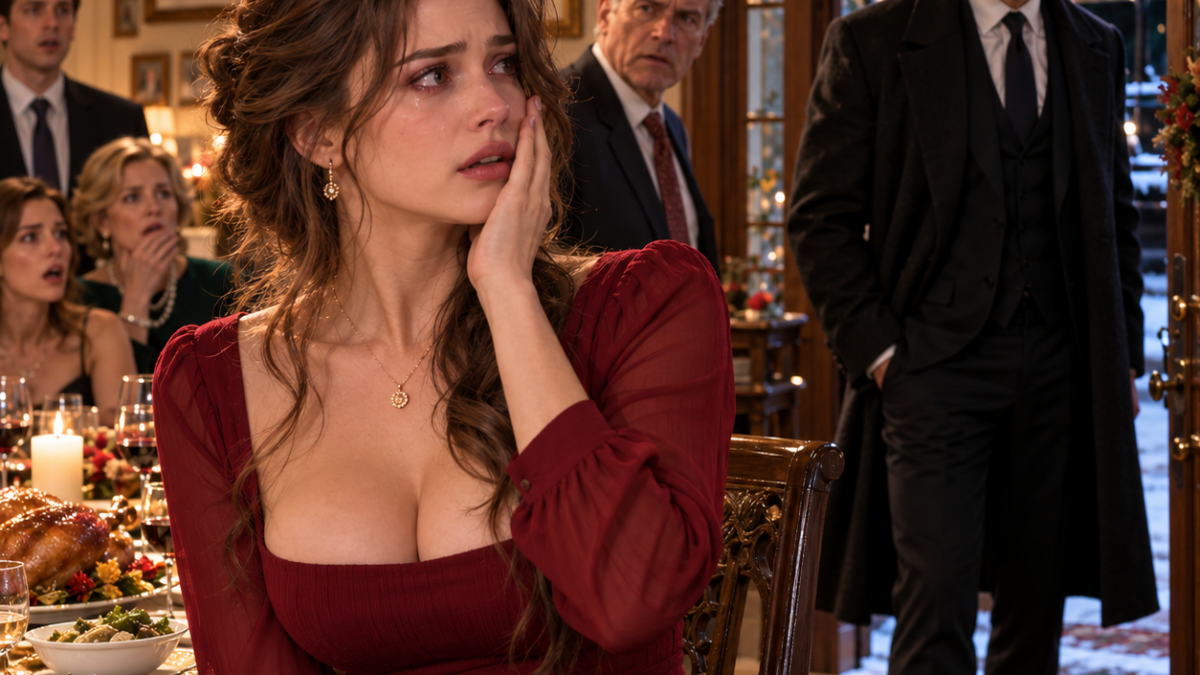
The phone call to Reachi made within the hour of her leaving. She thought about what it cost her to hold the image of this man in the same space as the word father.
The particular expense of grief of that. Nothing, she said.
I don’t want to do anything about him.
I want him to become someone I used to know. She left. She went to her suite.
She stood at the window and looked at the lake and the bare trees and the iron gate visible at the edge of the drive. And she thought about the photograph of herself walking the path.
And she thought, “Someone stood at that gate and watched me and I did not know.”
And her father had sent them there. And none of that changed what she was going to do in the next 72 hours.
The interview was arranged for the following morning.
She spent the night preparing for it with the same rigor she’d brought to the contract on her first day.
Thinking through every question that could be asked, every frame that could be imposed, every angle that would require a clear and precise answer. She wrote nothing down.
She sat in the chair in the sitting room with the lamp on and the lake dark outside, and she worked through it in her head until she knew it the way she knew the scheduling system, the way she knew the Marchetti file, the way she knew the sound of this house. at night.
At 2:00 in the morning, she heard footsteps in the corridor. They stopped outside her door, a long pause, then moved on.
She recognized the weight of them. She sat in the chair and listened to the footsteps move away, and the house settled back into its nighttime silence and told herself it meant nothing.
That a man walking the corridors of his own house at 2:00 in the morning was doing exactly that and nothing more. and that the fact of him stopping outside her door was probably coincidence or habit or the architecture of a house with limited hallway configurations. She told herself this.
At 9 the next morning, the journalist came. Her name was Petra Voss, 40s, with the particular worn alertness of someone who has been doing this long enough to be immune to theater.
She shook Saraphina’s hand in the sitting room off the entrance hall and set a recorder on the table and looked at Saraphina with the professional directness of someone who is trying to assess whether the person across from her is going to be useful or performing.
I’ve been given a general outline, Petra said.
I’d prefer to hear it from you.
Good, Saraphina said.
I’d prefer to tell it myself.
Petra turned on the recorder. Saraphina talked for 40 minutes.
She was precise. She was clear.
She told the truth in sequence, beginning with Thanksgiving night and the dining room and the bruise and the choice, continuing through three weeks of work and contract terms and filing systems and the photograph in this morning’s mail.
And she said her father’s name once and did not say it again.
And she said Richie’s name and Marchetti’s name with the same flat accuracy she brought to contract language.
And she did not apologize for any of it. When she finished, Petra turned off the recorder. She looked at Saraphina for a moment.
You understand?
Petra said that once this runs, you’re in it, attached to his name.
Whatever that means going forward. I understand. Whatever that means, Petra said again more slowly.
Saraphina looked at her. I made a choice 3 weeks ago with full information.
I’m making this choice with full information.
The name attached to mine is mine to manage. Petra looked at her for another moment.
Then she packed her recorder and stood and shook Saraphina’s hand again.
“It’ll run tomorrow,” she said.
“Page three, above the fold.”
She left. Saraphina sat in the empty sitting room.
The recorder was gone. The chair across from her was empty.
The house was quiet in its mid-m morninging way, purposeful, inhabited, doing its business around her. She thought it will run tomorrow. She thought by tomorrow evening everyone who needs to know will know she chose this that she chose it clearly that nobody used her because nobody can use someone who has decided what they are.
She thought my father will read it. She pressed her fingers once just once to the fading yellow shadow on her cheekbone.
Then she got up and went back to work.
What she didn’t see, what she had no way of seeing from the sitting room was that 40 minutes before Petravos arrived, a car had stopped on the service road at the back of the estate, that the car had sat there for 11 minutes, that it had contained two men, and that one of those men had made a call, and that the call had gone to a number Dante had spent 3 weeks trying to trace, and that the voice on the other end had said, “The interview is a problem.
Move the timeline up.
” What she didn’t know was that Marchetti had decided not to wait for the story.
What she didn’t know was that the thing coming was not a journalist and not a photograph and not a phone call from a man with a bourbon problem and a moral vacancy.
What she didn’t know was that Dante in his office at that moment was looking at a message on his phone from Caruso that said three vehicles north road and that he was already moving toward the door with the particular compressed stillness of a man who has known this kind of moment before
and knows exactly what it the message on Dante’s phone said three vehicles north road and he was already moving before he’d finished reading it.
Saraphina heard him in the corridor. Not footsteps exactly, but the particular compression of air that happens when a large man moves fast through a confined space. The sound of purpose with the volume turned down.
She came out of the sitting room into the hallway, and he was already past her, jacket on, phone in hand, and he stopped when he saw her with the involuntary halt of someone whose plan did not include an obstacle at this specific location.
“Go to your suite,” he said.
Lock the door.
What’s happening?
Saraphina, tell me what’s happening or I follow you.
His jaw. That careful contained thing his jaw did. Three vehicles on the north service road.
Marchetti moved the timeline. She felt it go through her. Not panic, just the cold hydraulic drop of adrenaline arriving.
How many men? Unknown yet.
He was already moving again. Sweet.
Lock the door. Do not open it for anyone except Elena or Caruso.
And if it’s not Elena or Caruso, he stopped, turned, looked at her with an intensity that had nothing diplomatic in it.
Then you go out the east window, drop to the garden roof, and you run for the treeine, and you do not stop. He held her eyes.
You understand me? She understood him.
He left. She did not go to her suite.
She went to her office because her office had a window facing the north grounds and she was not going to sit in a locked room while the situation she was partially responsible for.
Her father, Richi, the photograph, all of it feeding the intelligence that had brought those three vehicles to the service road, played out somewhere she couldn’t see.
She stood at the window. The north grounds were gray and bare in the December morning light.
The treeine 50 yard from the fence. The service road invisible from this angle, but the gate at its entrance visible.
A secondary gate narrower than the main approach, designed for deliveries and maintenance. She watched it. 2 minutes three.
Then movement at the gate, and she saw Caruso and S and two other men she knew by sight, but not by name, moving across the north lawn in the spread formation of people who have trained for exactly this kind of approach. They moved without urgency in the way that the most dangerous people move without urgency. Conserving, reading, already three steps ahead of the moment they were currently in.
Then the gate opened. Not forced, opened.
Someone had a key or a code or had convinced the mechanism through means she couldn’t see from this angle, and the gate swung inward and the first vehicle came through.
A black SUV moving slowly, which was somehow more alarming than speed would have been. Her phone buzzed.
Elena, she answered.
Get away from whatever window you’re standing at, Elena said.
I need to see. You need to not be a target in front of glass.
Move. She moved back from the window to the wall beside it where she could see the angle of the grounds without being visible from outside. Her pulse was in her throat.
She pressed her back against the wall and breathed through it. From this angle, she could see the SUV had stopped inside the gate. The door opened.
A man got out.
Not one of Marchett’s soldiers, someone above that, someone with the particular bearing of authority, which meant this was a negotiation with muscle attached rather than an assault, which meant there was still a window, still a frame within which words could operate.
Then the second vehicle came through the gate, and the third.
And from the third vehicle’s passenger side emerged a man she recognized from the photograph Dante had shown her two days ago in the briefing she hadn’t been supposed to see but had because she’d been standing in the doorway of his office when Caruso spread the surveillance images on the desk and Dante had chosen not to close the door.
Marchetti he was here himself which meant this was not a negotiation. Her phone buzzed again.
Dante this time are you in your suite?
I’m in my office.
A pause. Of course you are.
His voice was controlled, but she could hear something underneath it. Not fear.
Something more functional than fear. The voice of someone managing multiple things simultaneously and adding her to the list. Listen to me.
There’s a safe room behind the north wall of Elena’s office.
Elena knows the code. Get there now.
Marchetti’s here.
She said, I can see him.
I know he’s here.
What does that mean for the negotiation? Saraphina, her name in his voice at this register. Not sharp, not angry, something raw than either.
Please. She had never heard him say please. She left her office.
She found Elena in the corridor already moving toward her with the set expression of a woman who has managed crises in this house for 12 years and has a protocol for all of them. Come, Elena said.
The safe room was behind a panel in the north wall of Elena’s office, a room off the main corridor, not large, with a monitor showing feeds from the estate’s external cameras, and a phone hardwired to a line that didn’t run through the main system.
Elena entered the code and the panel swung inward and Saraphina went in and Elena started to follow and then stopped.
“Someone needs to manage the house staff,” Elena said.
“Keep them calm.
Keep them in the kitchen away from windows.”
She looked at Saraphina. You know how to watch a monitor?
Yes.
Caruso’s frequency is four.
If anything on those screens changes and you can’t reach Dante, you call Caruso.
She put a radio on the shelf beside the monitors.
Don’t open this door, Elena.
But Elena had already pulled the panel closed, and Saraphina was alone in the small room with six camera feeds and a radio and the sound of her own breathing. She looked at the monitors.
Feed one, main entrance clear.
Two of Dante’s men visible on the steps positioned.
Feed two, east grounds clear. Feed three, north gate.
The three vehicles Marchetti’s men spreading across the interior lawn in a pattern she didn’t have military vocabulary for, but understood instinctively was designed to cover multiple retreat paths simultaneously.
Feed four, the north approach path leading from the gate to the house’s service entrance.
And on that path, standing still, facing Marchetti across 20 ft of frozen gravel, was Dante. He had no jacket.
He’d left too fast.
He was in the dark suit he’d been wearing all morning.
And he was standing in December without a coat, and the cold was visible in his breath, small clouds of it, regular and unhurried, like he was breathing at his normal rate because he had decided that was what he was going to do. and his body had complied.
Marchetti had four men flanking him. Dante had Caruso to his right and S to his left.
And that was all. She pressed her hand flat against the monitor and watched.
She couldn’t hear them.
The feeds were visual only. She watched Marchetti speak.
She could see his mouth moving, could see the performance in his posture, the way he used his hands in the expansive gestures of a man making a final offer. She watched Dante listen.
Dante’s posture didn’t change.
He stood with his hands at his sides and his feet planted, and he listened to whatever Marchetti was saying with the specific attention of someone cataloging everything for later use. Then Dante spoke.
She watched his mouth. She could not read lips, but she could read register.
Short sentences, she thought direct. He was not performing anything.
Marchetti’s posture changed.
The expansiveness contracted. He leaned slightly forward. One of his flanking men moved.
Caruso moved at the same time, intercepting the angle, not touching, just repositioning a chest piece claiming a square. The flanking man stopped. Marchetti held up one hand without looking at the man.
A command issued from peripheral vision, the unconscious authority of someone accustomed to having his gestures obeyed. Dante said something else. Short, definitive.
She watched his face, the face she had come to know in 3 weeks. the small shifts and compressions of it, the language of a man who said less than he meant and meant everything he said.
And what she read on it was not threat and not apology and not the performance of negotiation. It was an ending.
He was telling Marchetti it was over. Marchetti was still for a moment. Then he laughed.
She could see it. The laugh.
The head tilted back slightly. The laugh of a man who believes the person across from him has miscalculated the dimensions of the situation. Then he reached into his coat.
The next 4 seconds happened the way things happen when several people who have been waiting simultaneously decide to move.
Overlapping fast, the kind of motion that has no clean sequence when you’re watching it, but that your nervous system registers as a single compressed event.
Caruso’s hand went to his jacket.
Sal stepped forward. Dante did not move. What Marchetti produced from his coat was not a weapon.
It was a phone. He held it up deliberately at eye level facing Dante and showed him the screen.
She couldn’t see the screen from the monitor.
She watched Dante’s face instead.
She watched him read whatever was on that screen. She watched something happen to his face that she had not seen before in 3 weeks.
Not fear, something older than fear.
The specific expression of a man who has just seen evidence of a thing he’d hoped wasn’t true.
She pressed harder against the monitor. Dante looked at the phone for two seconds.
Then he looked at Marchetti. Then he said something, one sentence, and Marchetti lowered the phone and pocketed it and tilted his chin in a direction that meant something to his men because they began moving back toward the vehicles, not retreating, withdrawing.
The distinction mattered. Marchetti walked back to the third vehicle. He opened the door himself, stopped with his hand on the door, and turned back toward Dante and said one more thing.
She could see it brief across 20 ft of frozen gravel. Then he got in.
The vehicles moved. The gate closed behind the third one. Dante stood on the north path for a moment after the vehicles were gone.
Just stood there. Caruso said something to him.
Dante didn’t respond.
Caruso waited. Then Dante turned and walked back toward the house.
She watched him cross toward the service entrance and disappear from feed three. And then she watched feed one and he appeared at the main entrance coming through the front door and then the feed showed only the empty steps. She reached for the radio then stopped.
She waited. The panel opened 7 minutes later.
Dante stood in the opening. He had found his coat somewhere. It was on unbuttoned.
And he looked at her in the small room with the six monitors and he looked at the monitors and then back at her. You watched?
He said. Yes. He came in, sat down on the edge of the shelf below the monitors.
He did something she had not seen him do in 3 weeks, which was put his head down and press the heels of his hands against his eyes and stay there for a moment. She waited.
He lifted his head. What did he show you?
She said. He looked at the monitors. Feed three.
The north path empty now. The gate closed.
Financial records, he said. originals showing that the real estate portfolio, not the 40% in dispute, the entire portfolio, was initially capitalized with money that has a traceable history I cannot afford to have traced.
She was quiet.
It’s old, he said.
15 years. The sourcing is from an operation that no longer exists, but on paper it looks he stopped.
It looks like the company was built on the wrong foundation, she said. Yes.
And Marchetti has the originals. He has copies.
The originals are somewhere I haven’t identified yet.
He looked at his hands.
He’s giving me 48 hours to sign over the 60% voluntarily.
After that, the records go to the Federal Financial Crimes Unit. She thought about this precise and fast, the way she processed contract language.
The records are 15 years old.
She said, “The statute of is complicated by certain subsequent transactions that kept the original money in motion.
” He looked at her.
“My attorney has been aware of this exposure for some time.
We believed it was managed.”
Marchetti found the unmanaged part.
“Yes,” she looked at the monitors, then at him.
“Who gave it to him?”
she said.
“The specific transactions that connected the old money to current operations.
That’s not public record.
Someone told him where to look. Dante was quiet.
Dante. He looked at her.
His eyes were tired in a way that had nothing to do with sleep. Richie, she said.
Richie had it.
Richie’s been inside of this organization for 6 years.
He said, not a soldier, an accountant. The kind of person who, he stopped, jaw, that careful thing. The kind of person you trust because they make themselves invisible.
And my father called Richi. Your father called Reichi.
And Richi used that connection to identify you as an access point. And while we were managing the threat from the outside, the information had already been out for, he paused.
I don’t know how long, long enough.
She sat with this. The betrayal had not come from Marchetti, who was simply opportunistic.
It had not come from her father, who was simply desperate and selfish in the precise way he had always been desperate and selfish. It had come from inside.
from six years of proximity and invisible trust and an accountant who had made himself indispensable and had spent that indispensability building an exit strategy on someone else’s exposure.
Reachi’s gone, she said.
Since yesterday morning, we think she looked at the monitors. Feed two east grounds, the tree line, the lake beyond.
The December light was flattening toward afternoon, the sky pressing down gray and indifferent. 48 hours, she said. Yes.
What does your attorney say? My attorney says we fight it and we probably win in 3 to 5 years and the portfolio is effectively frozen for the duration. He said this without self-pity, just the arithmetic, which means Marchetti gets operational control anyway while we litigate.

