K9 Refused Everyone Near the Wounded SEAL — Until the NURSE Used a SECRET MILITARY Skill – Part 2
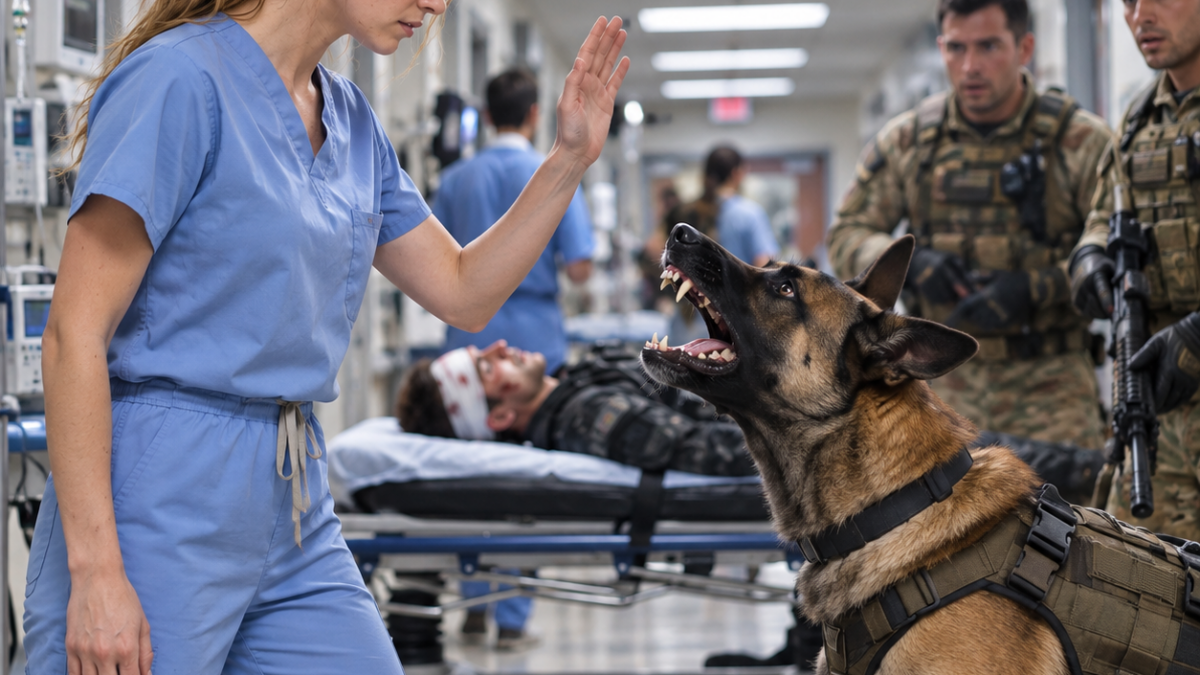
She noticed it in the way she noticed everything right now clinically logged and set aside.
She was at the nursing station checking the afternoon assignments when Carla came up beside her and said quietly, “There’s a man in the family waiting area.
He’s been there since about noon.
He’s not on any of the visitor signins.”
Lydia kept her eyes on the screen. Description: Late 50s, heavy coat. He keeps looking at his phone and then toward the ICU wing.
How long since you noticed him? Hour, maybe.
I thought he was just anxious.
Family stuff, but he hasn’t talked to anyone, and he’s moved twice to stay inside of the ICU corridor, even when we moved the waiting room chairs for cleaning.
Lydia’s hands didn’t stop what they were doing on the keyboard.
Don’t do anything different, she said.
Don’t look at him.
Go take your break in exactly the way you would take your break on a normal Tuesday. Lydia.
Carla’s voice had dropped to something that was not quite a whisper, but was close.
What is going on?
I’ll tell you what I can when I can, Lydia said.
Right now, I need you to act normal and I need you to trust me on that. A pause. Okay.
Carla said. Okay.
She picked up her water bottle and walked toward the breakroom with the careful slightly too deliberate gate of someone performing normaly under pressure, which was the best any of them were probably going to manage today. Lydia waited 30 seconds.
Then she walked unhurried to the supply corridor that ran parallel to the waiting area and had a secondary window that looked into it from the hallway junction. She got to the junction and looked.
The man was there, like Carla had said. heavy coat, phone in hand, sitting in the chair positioned nearest to the sighteline down the ICU corridor.
He was looking at his phone, but his posture had the specific quality of managed stillness. A person who was keeping themselves from looking at something by looking at something else.
She’d been in enough situations to know the difference between anxious family and tactical patients.
This was the second one.
She took out her own phone and typed a message to Vance’s number.
Waiting area, man in dark coat, not on visitor log. Been repositioning to maintain ICU sight line for approximately 1 hour.
Recommend approach with cover.
Don’t approach alone.
The response came in 40 seconds. Copy.
Hold position. Do not engage. She put her phone away and was turning back toward the nursing station when she nearly walked into Dr.
Marcus Holt.
He was standing 2 ft behind her, which meant he’d come down the supply corridor after her, which meant he’d seen where she went when she left the station, which meant he’d been watching the station.
His face was composed in the way it was always composed.
Authority as a resting state, but he was too close physically, and he’d come too quietly, and neither of those things was accidental.
Mercer, he said, his voice was level. We need to talk about your scope of practice today. Lydia looked at him.
Sure, she said. Now, my office. She kept her face neutral.
Going alone with Hol to a part of the building that was away from the investigators, away from the perimeter, away from every person who knew what she’d told them this afternoon.
That was not something she was going to do. But she needed him not to know she was declining for that reason.
I’m in the middle of a med pass, she said.
Can it wait 20 minutes? No, he said.
Then I’ll need to hand off to Carla first and she’s on break.
Mercer Marcus. She used his first name the way Reyes had used it that morning.
Not with hostility, just with the calm weight of someone who was no longer adjusting their register to accommodate his. I have patience on this floor.
Give me 20 minutes to hand off properly and I’ll come to your office.
That’s not a refusal.
That’s a process.
He studied her. She held the look without changing anything in her face. 20 minutes, he said.
He turned and went back up the supply corridor the way he’d come.
She waited until she heard the stairwell door at the far end. Then she sent a second message to Vance. Holt is trying to get me alone.
Office location. I need someone between me and that corridor before I go anywhere with him.
She went back to the nursing station, picked up the medication cart, and began the med pass in exactly the way she would on any Tuesday. Her hands were steady. They were always steady.
That wasn’t the same as calm, and she’d stopped confusing the two a long time ago.
The cart’s wheels made their small routine noise on the corridor floor.
The afternoon light came through the windows at its long winter angle. At the far end of this corridor near the junction to the ICU wing, Agent Solano appeared from around the corner with his hands in his jacket pockets and positioned himself in the comfortable, unhurried way of a man who was simply standing somewhere with nowhere particular to be.
And in the family
waiting area behind the window, Lydia couldn’t see from here.
The man in the heavy coat looked up from his phone, looked toward the ICU corridor, looked back at his phone. His hand, for the first time since Carla had noticed him, was moving, not to type, to dial.
The man’s thumb moved across his phone screen with the deliberate pressure of someone entering a number from memory rather than a contact list.
And Lydia was already three rooms into her med pass when Vance’s response came through.
We have eyes on him. Stay on your route.
She kept moving. Room 214.
Mrs. Patricia Holloway, 71 years old, posttop day two from an emergency appendecttomy that had caught a perforation nobody had expected. Lydia checked the IV site, confirmed the antibiotic drip rate, listened to breath sounds on both sides, made a note about the slight weeze on the left that was new since morning.
Mrs.
Holloway asked if everything was okay because the building had seemed busier than usual and there were men in the corridor she didn’t recognize.
Building maintenance issue, Lydia said. Nothing that affects you.
How’s the pain?
6 maybe. It was a 4 this morning.
I’ll adjust the order and let your doctor know.
She made the notation, checked the time, moved on. Room 216. Room 218.
The cart’s wheels, the routine sounds, the specific smell of the trauma floor that she’d stopped noticing years ago and had noticed again today for reasons she couldn’t fully account for.
Antiseptic and recycled air, and beneath it, something older. The smell of a building that had absorbed a long accumulation of difficult moments. Her phone buzzed.
Vance man in waiting area made contact.
We’re moving.
Lydia stopped the cart beside the nursing station and looked down the corridor toward the waiting area junction.
She couldn’t see the waiting area from here, but she could see Solano, who had straightened from his casual position near the ICU corridor entrance and was moving with the purposeful, unhurried pace the trained personnel used when they were moving towards something they didn’t want to spook.
2 seconds later, she heard the voice, the man’s voice, carrying from around the junction in the specific way that voices carried when someone was surprised and had stopped managing their volume.
I’m a visitor.
I have every right, sir. I need you to come with me.
Solano’s voice, flat and certain.
Then a third voice, female, not Vance, one of the soldiers from the perimeter, Lydia realized. And then the sounds of movement, and then nothing, because the junction absorbed it all, and the corridor went quiet again with the hollow quality of a space where something had just concluded. Carla appeared from the breakroom at the far end, coffee in hand, and looked toward the junction with wide eyes.
She looked at Lydia.
Lydia gave her a small, deliberate nod that she hoped conveyed its handled, “Keep moving.”
And Carla, to her credit, turned back toward the nursing station without asking anything out loud. Lydia left the cart, went to the supply al cove, and called Vance directly.
“Who is he?”
she asked when Vance picked up. working on that. He had a phone and a hospital visitor pass that someone issued from the front desk registration system at 7:42 this morning before the helicopters landed.
The pass has a name that doesn’t match any family member in the patient registry.
So, he was already in position before Ror arrived. Yes, Lydia let that settle.
He knew Ror was coming here or knew the general operational area and positioned across multiple facilities.
We’re checking the other hospitals within range.
But yes, that’s the current read.
The phone call he made. Did you get the number? We have the device.
We We’ll have the number in under an hour.
A pause on the line. The faint sound of Vance moving through a space. Mercer, you said Holt wants you in his office in she checked the time 12 minutes.
Don’t go.
If I don’t go, he knows something shifted.
If you do go and he’s connected to the network that hit Ror’s team, you’re alone with him in a part of the building our perimeter doesn’t cover well.
Then extend the perimeter before I go. Another pause, longer this time. Give me 8 minutes, Vance said.
8 minutes was enough time to finish the med pass through room 222, document the new Whis and Mrs.
Holloway’s chart, update two other patient notes, and stand at the corridor window long enough to watch one of the rooftop soldiers descend via the interior stairwell and position himself near the junction to the administrative wing.
Subtle, if you didn’t know what you were looking at, completely visible if you did.
Lydia went to Holt’s office.
It was at the end of the administrative corridor, past the department secretary station and the conference rooms that were used for staff meetings and the occasional difficult conversation with a family. The door was half open. She knocked once and pushed through.
Holt was behind the desk.
He wasn’t looking at a computer or papers.
He was sitting with his hands on the desk surface and looking at the door, which meant he’d been waiting for her specifically watching the door for some portion of the last 20 minutes.
And that told her something about his state. He was not calm.
He was performing calm. And there was a difference.
“Sit down,” he said.
She sat. She kept her hands loose in her lap and her posture open and her face where it had been all day, neutral, present, giving nothing unnecessary away.
“I’m going to ask you something,” Hol said.
“And I need you to answer me straight.”
“Okay.”
“What did those investigators tell you specifically?”
She looked at him for a moment. Not long.
Long enough to let him think she was deciding how honest to be. They asked me about my military background, she said. They confirmed what they already knew from my service record.
They asked about my interaction with the patient and the dog.
That’s all.
That’s the relevant part, she said.
His jaw shifted. He was reading her the way he always read the room as a system to be managed. But something in his usual confidence had a crack in it today, and she could see him working harder than he usually had to.
The man they detained in the waiting area, he said.
She hadn’t told him about the waiting area.
There was no way he should know that yet. It had happened 12 minutes ago. The corridor had been quiet.
The soldiers had been discreet. She kept her face where it was.
I don’t know what you mean.
One of the nurses told me security pulled someone from the family waiting area. He watched her. You reported that?
I reported what I observed to the investigators.
She said, “That’s what they asked me to do if I noticed anything unusual.”
And you decided a man sitting in a waiting area was unusual.
“He’d been repositioning himself for over an hour to maintain a sight line on the ICU corridor, and he wasn’t on the visitor log,” she said.
“Yes, that seemed worth mentioning.”
Holt was quiet for a moment. He looked at the desk. When he looked back up, something had changed in his face.
Not a dramatic shift, just a small settling, like a man who’d been carrying something for long enough that the decision about what to do with it was finally becoming clearer than the carrying.
“You need to understand,” he said, and his voice had dropped to something that was not the administrator register or the surgical authority register, but something more unguarded than either, that there are things happening around this situation that are larger than what those investigators have told you.”
Lydia waited.
The network they’re investigating, he said.
It’s not.
He stopped, started again.
People who cooperate with that kind of investigation don’t always come out the other side intact.
Are you warning me? She asked, genuinely asking, not rhetorically.
I’m telling you that there are people involved who have resources that federal investigators don’t fully appreciate yet.
and that a floor nurse who puts herself in the middle of this. Who was the man in the waiting area? Lydia asked.
The shift was immediate, his face closed back down the unguarded moment over.
I don’t know what your You knew he was detained before anyone on this floor had time to spread that information casually, she said.
Which means you were watching for him or watching for whether he got detained. She kept her voice even.
You told someone on that phone call this morning that you’d handle me.
I heard you say it. I was in the stairwell.
The silence in the office had a texture to it now. Not hostile, not yet, but dense.
Holt looked at her for a long time. The kind of look that was a reassessment.
Not of the immediate situation, but of something further back. A longer calculation being revised.
You should have stayed out of the trauma bay this morning, he said finally. not cruel, flat, factual almost.
The patient would have died, she said. Yes, he said he probably would have. And the way he said it was not the way a physician said something about an unavoidable outcome.
It was something else, and she felt it land in her chest with the specific weight of something confirmed. She stood up.
Sit down, Mercer. No, she said, and she walked out of the office. Peppa.
So she made it to the corridor and pulled out her phone and typed to Vance without breaking stride. He knew about the waiting area detention before it could have spread through staff channels.
He made a reference to Ror’s likely death that wasn’t clinical.
I need you to pull his financials and cross reference with the procurement contracts in your case file. I need it now, not in an hour. She was at the junction to the trauma wing when Vance called her instead of texting back.
Say that again about the detention, Vance said. Lydia said it again. How long between the detention and when you got to his office?
12 minutes. The soldiers were discreet.
There was no reason for a department chief to have that information in 12 minutes through normal channels. Unless someone told him directly.
Unless someone told him directly, Lydia confirmed. She heard Vance say something away from the phone.
to Solano probably or to someone else in whatever room she was currently in. Then back to Lydia.
We’re running the cross reference.
It’ll take time we may not have because the device we pulled from the waiting area subject.
We just got the number he dialed and it’s a burner, but the tower it pinged is local.
Whoever he called is in the building or within 200 m of it. A beat.
Mercer, I need to ask you something and I need a straight answer. Go ahead.
Is there any part of your history with this operational community? Any contact, any ongoing connection, anything that would give someone a reason to have flagged you as a risk before today?
It was a fair question, asked carefully, and she understood why it needed to be asked. No, she said, I separated cleanly.
I’ve had no contact with anyone from that community since I left, except professional nursing references.
What I know about Operation Harrow, I told you outline only. Three years old.
Then why? Vance stopped.
Why? What?
The man in the waiting area. When we pulled his phone and ran the recent call log before the call he made today, there are two numbers.
One matches a burner we’ve been tracking in connection with a procurement liaison who’s already a named subject in the case file.
She paused. The other number, Mercer, is registered to a landline in this building.
Lydia was at the nursing station now. Carla looked up at her. Paulo was at the medication computer, the ordinary machinery of the floor running, the patient monitors, the distant sound of a ventilator alarm being silenced on the ICU floor above them.
Which extension? Lydia asked. Vance told her.
She knew the extension.
She dialed it dozens of times over three years for supply authorizations, for procedure approvals, for the routine bureaucratic transactions of a trauma floor nurse who needed a department chief’s signoff.
It was Holt’s direct office line.
What happened in the next 40 minutes was the kind of operational compression that Lydia recognized from a different context. the way a situation that had been building for hours could suddenly begin moving at a pace that stopped allowing for deliberate thought and started requiring something faster and less comfortable.
Vance pulled two additional agents from the building perimeter and positioned them in the administrative corridor.
She did not approach Holt’s office directly.
The calculation was the same one Lydia had made at the stairwell door. moving too early without the full picture would give the network time to collapse inward, destroy what could be destroyed, and leave the case with the waiting area subject and a phone number and not much else. What they needed was the camera secured intact in federal custody.
What complicated that was that the camera was in the ICU and the ICU had visiting hours protocols and staff access protocols and a director who was running a legitimate medical unit and could not simply be converted into a containment zone. Lydia went upstairs. The ICU was its own world, quieter than the trauma floor with a different quality of urgency.
the slow sustained tension of bodies in precarious balance rather than the acute spike in resolution of the emergency bay.
She badged through the unit door and went directly to bay 6, which was where they’d put Ror.
Kodiak was still positioned beside the bed.
He’d been given water, and the soldiers monitoring the room had managed some kind of provisional arrangement with the ICU staff that Lydia didn’t need the details of.
The dog looked at her when she came through the curtain. His ears moved.
“Hey,” she said quietly.
His tail moved once, “Small, not a greeting.
” Exactly.
More of an acknowledgement. Ror was stable in the cautious, qualified sense of ICU stable.
His pressure was holding. The chest tube was draining appropriately. The ventilator settings had been adjusted twice since the original intubation.
He was not going to die in the next hour.
Whether the next 12 hours held the same promise depended on things that were not fully in any physician’s control.
The vest was still on the bed rail hook where the ICU nurse had hung it for access.
Standard practice for tactical equipment when the patient couldn’t be fully stripped due to ongoing procedures.
The camera housing was visible, black matte, the older clip mount Lydia had identified from Solano’s photograph.
Undisturbed, she looked at Kodiak. He looked at the vest, then back at her. I know, she said.
I’m not taking it.
She wasn’t there for the camera.
She was there because she needed to think.
And the only place in this building right now where the background noise of institutional politics and professional consequence, and the weight of what Hol had said, he probably would have settled into something manageable was beside this bed with this dog who was doing exactly what he’d been trained to do, and not one thing more or less.
She sat in the chair beside the bed and looked at Ror’s face.
28 years old, third deployment.
She didn’t know him, had never met him, had no connection to his unit beyond the overlapping mission geography that Vance had described.
But she knew the category he belonged to, the particular kind of person who ended up in those operational roles. And she knew the specific texture of the risk they took on, which was not the dramatic risk of combat, but the quieter risk of living inside a structure that sometimes decided, for reasons of bureaucratic convenience or institutional self-p protection, that the people it had sent into difficult situations were expendable on the way back.
Ror had found something, whatever was on that camera, and someone had decided that what he’d found was worth more than his life.
Her phone vibrated. Vance, we have a problem.
Solano is outside your location. She went to the unit door.
Solano was in the corridor and his face had the controlled tension of someone delivering news he’d rather not be delivering.
The financial cross reference came back. He said Holt has a consulting arrangement registered through a Shell entity that receives payments from two of the contractors named in our procurement file.
It’s been running for 4 years.
4 years?
she said, “Before you were hired at this facility,” she absorbed that, the timeline of it, Holt’s contempt for her from the start, the deliberate sustained campaign to keep her marginal, to keep her off the trauma bay when anything significant came through, to ensure she never accumulated the kind of
institutional standing that would make her observations carry weight.
Four years, not random, not personality. He knew who I was before I was hired, she said.
Solano didn’t confirm or deny it, but his silence was the specific kind that wasn’t neutral.
He knew my service record, she said.
He knew I’d been in the same operational community.
He put me on this floor and kept me small because someone in that network told him to. She stopped. Or he volunteered it.
We’re pulling his communications with the facility’s HR director at the time of your hire, Solano said.
That’s going to take a little longer.
How much longer? hour, maybe less.
What’s Hol doing right now?
His office doors been closed for the last 35 minutes. We have someone watching the corridor.
She nodded.
Looked back through the unit door window at Ror’s Bay.
At Kodiak, visible from here, his head up and his posture steady. Someone needs to formally secure that camera, she said. Not just physically, legally.
Chain of custody documented.
If Hol is connected to the network and he knows we’re close, he’s going to look for a procedural angle to challenge the evidence before it gets to the case file.
Vance is working on the custody documentation now.
We need a supervising agent signature that isn’t in the field.
We’re routing it through the regional office.
He checked his own phone. 40 minutes maybe. And in 40 minutes, we move on hold.
She looked at him. With what you have now or with the HR records?
With what we have now, if we have to, the phone connection to the waiting area subject is enough for a material witness hold. He put his phone away. But if the HR records show what we think they show, the hold becomes something else.
Lydia went back inside the ICU unit.
She was beside Ror’s bed checking the drainage output on the chest tube.
Not because she was his nurse, but because she was there, and it was a thing worth checking.
when the ICU charge nurse appeared at the curtain with the look of someone who had received two pieces of information that didn’t fit together.
“I’m sorry,” the charge nurse said.
Her name was Deline.
She’d been on this unit for 12 years and had the particular unflapable quality of someone who’d seen the full range of what an ICU could produce.
“We just got a request from Dr.
Hol.
He’s listed as a consulting physician on this patient’s record.”
Lydia looked at her. Since when?
The order came through the system 8 minutes ago. He added himself to the care team. On whose authorization?
Delphine’s expression gave the answer before she said it.
He entered it himself. As department chief, he has system access to add himself as a consulting physician.
Lydia finished. Yes, I know. She looked at Ror, looked at the vest on the rail hook, looked at Kodiak, who was now fully upright, ears forward, reading something in the room that had changed.
“He’s requesting a consult visit,” Deline said.
“He’s on his way up.”
Lydia pulled out her phone. She typed to Vance as she moved toward the unit door.
“Hol added himself to Ror’s care team 8 minutes ago.
He’s coming to the ICU.
He’s going to try to access the vest.
You need people at the unit door right now.
” She sent it and pushed through the ICU door into the corridor.
The elevator at the end of the hall dinged. The doors opened.
Doctor Marcus Holt stepped out, white coat on, stethoscope around his neck, badge visible, the full performance of legitimate medical authority constructed in the 12 minutes since she’d walked out of his office.
He was not alone.
The man beside him was in his late 50s, heavy coat that he hadn’t removed despite being inside.
and Lydia recognized him from Carla’s description before she recognized him from anything else.
He hadn’t been detained.
He was here. He was walking beside Holt toward the ICU unit with the unhurried confidence of a man who had resolved whatever had happened in the waiting area to his satisfaction.
And the way Holt’s body was positioned beside him, slightly differential, slightly behind, told Lydia everything about who the second voice in the stairwell had belonged to.
She stepped into the corridor and put herself between them and the unit door.
“Marcus,” she said.
Holt stopped 3 m from her. His eyes ran over her position, the door behind her, the empty corridor in either direction.
His companion stopped beside him and looked at Lydia with the flat, measuring attention of someone conducting a rapid assessment.
“Step aside, Mercer,” Holt said.
His voice was perfectly controlled.
“I have a consult to see.
You’re not going in there, she said.
I have system authorization. I know what you did to the system, she said.
And so does the federal case file that’s been building on your consulting arrangement for the last 4 years.
The corridor went very quiet.
Holt’s face did something complicated.
The composure held, but underneath it, something was moving fast. The rapid recalculation of a man whose timeline had just compressed. The man in the heavy coat took one step forward.
And in the same moment, Lydia heard the stairwell door at the end of the corridor bang open. Not the elevator end, the other end. And agent Vance came through it with two soldiers behind her at a pace that was not the careful, deliberate pace of the last several hours.
Federal agents, Vance said loud and clear. Nobody move. Hol turned toward the sound.
The man beside him turned the other way toward the elevator, instinctive, and found Solano there, who had apparently taken the elevator up and been waiting and said simply, “Don’t.”
For 3 seconds, nobody moved.
Then from inside the ICU unit, through the closed door at Lydia’s back, came a sound she knew.
Kodiak. Not barking, not growling, but a single sharp alert vocalization. The kind that meant something in his environment had registered as a threat.
the vest on the rail hook, the camera, whatever was on it. Lydia put her back flat against the unit door and looked at Hol and the man beside him and thought with the specific clarity that pressure produced in her.
19 hours on that camera, 14 months of someone’s work, 28 years old, third deployment.
Vance and the soldiers were 8 m away and closing. And the man in the heavy coat reached into his coat with his right hand. The hand came out of the coat holding a phone, not a weapon.

