She Thought the Former Navy SEAL Was Just the Handyman—He Let Her Believe It – Part 3
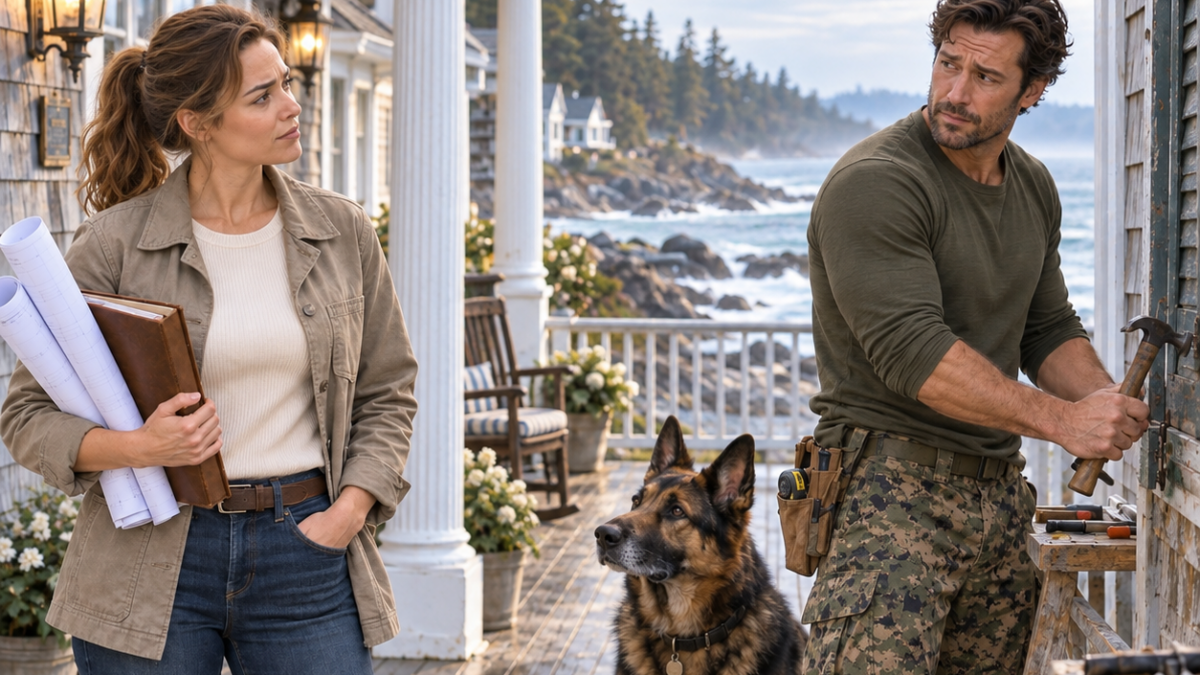
Sophie thought about telling him that Daniel would want the room open. The sentence came easily, too easily.
She had never met Daniel. She did not know what he would have wanted at 30, 40, or 50.
She knew only what would make her own design easier. So, she left the sentence where it belonged. Unspeaking.
I can redesign around it, she said instead. Mason looked at her. The event plan that makes your job harder.
Yes.
Costs more probably, and you’re still willing.
Sophie glanced through the ballroom glass.
I’m designing Alderwick for the people who have to live with it after I leave.
For several seconds, Mason said nothing. Then he nodded.
That evening, Sophie sat alone at the library table with the circulation plan spread beneath both hands. Harbor ballroom occupied the center of the west wing. She drew a new line around it, then another.
The sea parlor took more ceremony traffic. The dining room absorbed flexible reception space. The library became part of the smaller event plan.
When she finished, Sophie selected the harbor ballroom layer on her digital plan and removed it from the active event route. The room remained on the drawing.
It simply stopped being a requirement. By the end of October, Sophie had redrawn the ground floor often enough that Colleen stopped asking whether a new sheet was final.
The sea parlor became a 40 person ceremony room with chairs that could be cleared within half an hour after a service. The dining room gained movable partitions and furniture light enough for staff to reconfigure without calling three contractors.
In fair weather, the veranda could handle cocktails. The library, which Sophie had once treated as wasted event space, became the quiet room for families who wanted somewhere to sit away from music and speeches. None of it required Harbor Ballroom.
That had not been true two weeks earlier. The redesign cost Sophie several late evenings and forced Hearth to revise part of the furniture package, but she never mentioned the extra work to Mason.
He noticed anyway. One afternoon, he stood over the new circulation plan while Sophie taped two tracing sheets together. You moved the service path.
Yes. And the ceremony entrance.
Yes. You rebuilt half the first floor around one unavailable room. Sophie pressed the tape flat with her thumb.
I prefer adapted. That sounds expensive. It sounds professional.
Mason looked over the drawing again. It works. It works better.
He gave her a look. Sophie shrugged.
I’m still allowed to be right.
There was an ease between them again, though not the careless kind from before the meeting. Sophie knew who owned the house now. Mason knew she had seen the part of his family history he avoided discussing.
Neither pretended otherwise. Still, she handed him ladders.
He held measuring tape. She argued about paint. He carried sample boxes when she was too distracted to notice him taking them.
Their familiarity returned in pieces rather than all at once. Flint had no interest in the distinction. At 3 each afternoon, sunlight crossed the library floor through the west windows and landed in the same rectangular patch beside the hearth.
Flint began arriving several minutes early to claim it. Sophie objected on principal.
You have an entire house. Flint stretched one front leg farther into the light. She bought him a dog bed.
It was thick, expensive, and placed 3 ft from the rug. Flint sniffed it once. The next afternoon, he was back on the floor.
Mason found Sophie staring at the untouched bed. You bought him furniture? I bought him an option.
He exercised it. He rejected it.
That’s still an option.
Sophie pointed at Flint. He is exactly like you. Mason looked at the dog, then at her.
That sounded insulting. It was meant efficiently. November arrived quietly.
The bright canopy above the drive thinned until more sky showed between the branches. Leaves collected along the stone walls and in the corners of the porch.
One morning, the lawn carried the first shallow frost of the season, silver, until the sun reached it. Harbor ballroom stayed locked. Sophie stopped asking about it.
That was what Mason noticed most. Contractors came and went through the west hall.
Sophie walked past the doors with rolls of drawings under one arm and never slowed. When a furniture vendor asked whether the ballroom should be included in the final count, she answered no and moved on.
No explanation, no meaningful look toward Mason. No suggestion that he should be ready by now.
Once Mason found himself alone in the west corridor after everyone had left, Flint was on leash beside him because they had just come in from the lawn. Mason stopped in front of the doors. The leash loosened.
Flint stopped, too. The shepherd looked at Mason, then sat. That was all.
Mason stood there perhaps 20 seconds before moving on. A few days later, it happened again.
He began to realize Sophie had done something he had not expected. She had removed the pressure without pretending the room did not exist.
The ballroom was still there. The decision was simply his again.
On the first Monday of November, Sophie arrived early and found a brass key sitting beside her coffee on the library table. Mason stood near the window. Flint lay at his feet.
Sophie set down her bag. She looked at the key but did not touch it.
Tomorrow morning, Mason said. She waited.
If you’re still willing.
Sophie glanced toward the west hall. I am.
I am. Mason nodded. No plan followed.
No discussion of what they might find. The key remained on the table until he picked it up himself.
The next morning was clear and cold. Sunlight sat low over Penobscot Bay, bright enough to make the water look metallic between the bare branches. Alderwick was quiet.
Colleen had arranged for contractors to begin later, though Sophie did not ask who had requested it. Mason was already outside the ballroom when she reached the west corridor. Flint sat several feet behind him.
For once, Mason carried no toolbox, only the key. The lock did not turn immediately.
He pushed the key farther in, drew it back slightly, and tried again. Metal scraped inside the old mechanism. Sophie stood beside him without offering help.
On the third attempt, the lock moved. The sound was heavier than she expected.
Mason left one hand on the handle for a moment, then opened the right door. The second followed with more resistance.
Dust shifted in the morning light. The harbor ballroom was not ruined.
It looked unfinished. White sheets covered stacked chairs and two long tables along the far wall.
The chandeliers overhead were a soft gray film, but crystals beneath the dust still caught the sun in small flashes. Salt had clouded the three tall windows facing the bay. The curtains hung straight and faded, untouched by years of use.
The hardwood floor remained intact. Mason stepped inside first.
Sophie followed only after he had crossed the threshold. Flint came last and stopped near the doorway, nose working over scents too old and layered to mean anything useful. The room smelled of wood, dust, fabric, and faint salt air leaking through old frames.
Mason walked slowly near the stage. Several cardboard boxes had been stacked against the wall. One held folded line and another contained place cards tied in small bundles.
Mason picked up one. The ink had faded slightly.
Grandmother did these. Sophie looked at the careful handwriting. She wrote all of them.
She wrote everything. His thumb moved over the edge of the card.
She didn’t trust anybody else’s penmanship.
Sophie almost smiled. Reasonable.
Mason looked at her.
You’ve seen her wallpaper.
That is a separate case. The joke did not break the moment. It simply allowed air into it.
Mason set the card back. He moved toward the small stage.
The old music stand Sophie had seen through the glass still stood near one corner, tilted slightly forward. Mason reached for a thin folder resting behind it. When he lifted it, a folded scrap of paper slipped free and landed on the floor.
He stared at it before bending down. The paper was ordinary notebook stock, yellowed at the edges.
Sophie stayed where she was. Mason unfolded it.
His face changed less than his hands did. The fingers holding the paper became very still.
What is it?”
Sophie asked. He turned the note toward her.
The handwriting was quick and slanted. Mace quit counting.
“Listen to the song.”
Sophie read it once. Then she understood.
Over the previous month, she had watched Mason count without mentioning that he was counting. 16 dining chairs before a meeting. 14 porch steps.
Three damaged hinges. Minutes until rain reached the lawn.
number of guests a room could hold before he trusted anyone else’s estimate.
The habit had looked like discipline. Now it looked older.
“Daniel,” she asked.
Mason nodded.
“He tried to teach me to dance in here once.”
Sophie looked around for his wedding.
“No, years before.
A faint smile appeared.
Clean up after somebody else’s.”
He decided empty ballrooms shouldn’t be wasted.
Were you any good? No.
That sounded very certain. I have evidence. He held up the note.
Mason folded it carefully. For a while, neither of them spoke. Flint moved to the edge of the stage and lay down with a quiet sigh, chin resting between his paws.
Mason walked to the center of the floor. He looked toward the windows, then the chandeliers, then back at the open doors. Sophie could have named what she thought the room represented.
She did not.
Instead, she asked, “Do you want to go outside?”
Mason looked toward the hallway. The doors were still open.
No. His voice was rougher than before. He cleared it.
No, I want to stay a little. Sophie nodded, so they stayed. The sun moved higher.
Light reached farther across the boards. After several minutes, Mason lowered his eyes to the floor.
One foot shifted then the other. Sophie noticed the pattern before he did. You remember some of it?
That is not confidence.
It’s accuracy.
She stepped onto the open floor. Mason looked up. Zofhi held out one hand.
He stared at it.
You should know I’m not a dance instructor.
That helps. I once stepped backward into a floral arrangement at a wedding site. That does not.
It was mostly greenery. Mason gave a quiet laugh.
Then he took her hand. His other hand settled carefully at her side.
There was no music, only the faint sound of water beyond the closed windows and a loose pain clicking once when the wind touched the house. Mason moved one step, then another. His eyes dropped.
Sophie saw it. The counting had started again.

