She Was Left to Die in a Burning Cabin—Then a Navy SEAL & His K9 Found Her Alive – Part 1
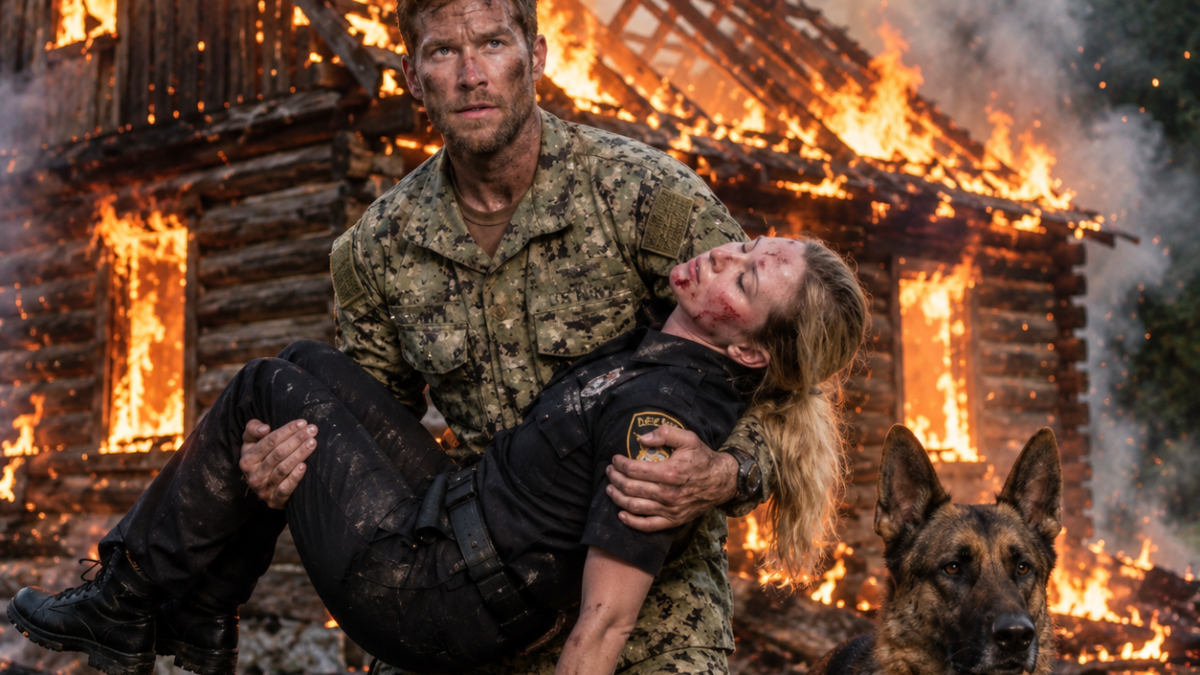
She Was Left to Die in a Burning Cabin—Then a Navy SEAL & His K9 Found Her Alive
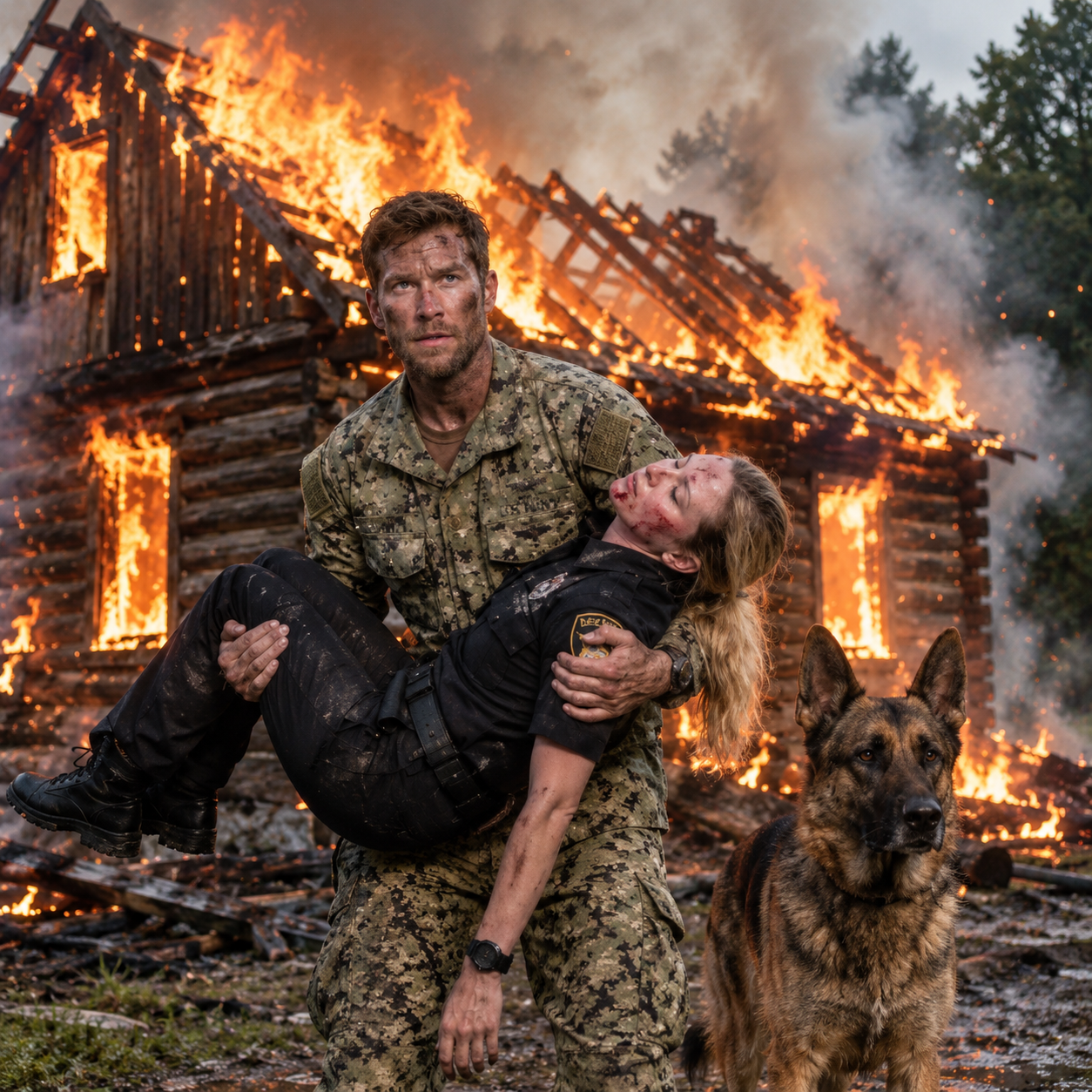
A woman is tied to a bed inside a burning cabin. Gasoline soaked into the walls, her mouth sealed shut. No one was supposed to find her.
In the frozen wilderness outside a forgotten town called Iron Hollow, the man who did find her wasn’t a cop.
Wasn’t a hero.
He was a broken veteran who hadn’t spoken to another human being in 11 months.
Living alone with a dog that understood him better than any person ever had.
The cabin wasn’t an accident.
It was a message. and the people who sent it were already on their way back.
The temperature outside Mason Cross’s cabin had dropped to 11° by the time Titan stopped eating.
That alone was enough to put Mason on edge. The German Shepherd was 8 years old, gray around the muzzle with a scar running from his left ear to the corner of his jaw.
a souvenir from Fallujah that neither of them talked about. Titan had seen firefights in three countries.
He didn’t spook at wind.
He didn’t freeze over shadows.
When that dog stopped mid meal and turned his head toward the treeine with his ears locked forward like twin radar dishes, Mason didn’t ask questions.
He put down his coffee and reached for his boots. It was a Friday in February. Iron Hollow, Montana, population 412.
And that number included the people who’d stopped answering their phones.
Mason had been living six miles outside of town since the previous April, renting the cabin from a retired electrician named Gus Hadley, who asked for cash, didn’t want a lease, and made it very clear on the day Mason arrived that he wasn’t interested in backstories.
That had suited Mason just fine.
He laced his boots with the muscle memory of a man who’d done it 10,000 times in the dark.
Tactical habit. Left boot first.
check the knot twice.
He didn’t know why he’d kept that ritual.
He’d left the Navy two years ago and spent the first year pretending he hadn’t.
The second year, he’d stopped pretending and started disappearing instead.
First from his apartment in Spokane, then from his sister’s calls, then from his own reflection, which had started looking like a stranger somewhere around October.
Iron Hollow had no mirrors he hadn’t already turned against the wall.
He pulled on his coat, grabbed the small LED flashlight from the kitchen counter, and pushed open the door. The cold hit him like an open hand.
Dry, serious cold.
The kind that doesn’t sting so much as press, like the air itself is trying to flatten you.
The pines around the cabin stood perfectly still. No wind, no animals, just the kind of silence that has weight.
Titan was already three steps ahead of him, nose low, moving in a slow arc toward the northeast corner of the property. What is it, boy?
The dog didn’t look back.
Mason scanned the treeine with the flashlight. Nothing.
Just snow and dark and the faint creek of frozen branches settling under their own weight. He swept the beam left, then right, then clicked it off, stood still, let his eyes adjust.
Old training.
You don’t use white light when you don’t know what you’re looking at.
Light tells them where you are before you know where they are. He listened.
30 seconds passed. A minute. Then he heard it.
Not close. Maybe 2 mi northeast.
Maybe a little more. A low mechanical growl overhead.
The kind that vibrates in the sternum before it reaches the ears.
He’d heard that sound in Afghanistan.
Small aircraft, low altitude, no navigation lights that he could see through the canopy. He was still processing it when the explosion came.
Not massive, not a bomb blast concussion, more like a crack followed by a heavy rolling wump. The specific sound of something large catching fire all at once.
He’d heard it before, too.
In Rammani, a structure burning. Not gas lines, not electrical.
The kind of burn that starts too fast, too uniform, too complete. Someone had used an accelerant.
Titan, come. He was already moving before the dog turned.
Mason didn’t take the road.
Roads were predictable. He cut northeast through the timber, following the faint orange stain bleeding upward through the treetops. The snow was 8 in deep in the open and deeper in the drifts, but he kept to the protected ground under the pines, where the pack was thinner, and his footing was better.
He carried nothing except the flashlight and a folding knife clipped inside his right pocket, a habit he’d carried from the teams, the same way some men carried rosaries.
Titan ran slightly ahead and to his left. The dog moved through snow the way he always had, efficiently without wasted motion, reading the ground with his nose the way Mason read it with his eyes.
They’d run enough terrain together overseas that the rhythm was automatic.
Dog left, man right. Separation of 3 to 5 m.
You don’t bunch up.
Bunched up means one grenade takes both of you. Old muscle memory still firing.
The cabin came into view through the trees after about 12 minutes at a hard jog.
It was smaller than Mason’s place, a single room structure with a tin roof sitting in a shallow clearing edged by rock and hardwood.
Or it had been a single room structure. Now it was a box of orange fire. The entire structure was involved.
Walls, roof, door frame, all of it burning with an intensity that explained itself. The snow around the perimeter had melted back 6 ft in every direction.
The heat hit Mason’s face, even from the edge of the treeine, sharp and heavy, like opening an oven door.
His first instinct, the sane one, was to stay back. His second instinct pulled him forward before the first one finished making its case.
Titan was already at the treeine edge, stiff-legged, staring at the structure.
His body language wasn’t fear.
It was something else. The dog was telling him something was wrong in a way that went beyond fire. Mason moved fast, pulling his coat sleeve up over his mouth and nose, cutting around the left side of the structure, where the fire seemed slightly less advanced.
He checked the roof, still partially intact on that side, the tin absorbing heat, but not yet collapsed. He had maybe 30 seconds, maybe less.
He hit the wall with his shoulder. The door had already burned away from its hinges, replaced by a curtain of fire. He went in low, under the worst of the smoke, and the heat was immediate and punishing.
The kind that dries your eyes before you can blink pulls the moisture out of your lungs on the first breath. He almost missed her.
She was on the bed in the far corner, and the bed was still partially shielded by a burning dresser that had fallen against it at an angle, creating something close to a pocket. Not safe. Not even close to safe, but enough.
She was bound at the wrists and ankles with zip ties, the black plastic kind you could buy at any hardware store. A strip of duct tape across her mouth.
Dark hair plastered flat against her face from sweat or melted snow or both. Her eyes were open and they found his and they said everything words would have taken too long to say.
I’m still here.
Get me out. Mason crossed the room in four steps. He had the knife out before he reached the bed.
He cut the ankle ties first. Mobility first.
always because a person who can’t run is already dead.
Then the wrists. He ripped the tape from her mouth and she gasped so hard she choked on it.
And he didn’t wait for her to stop coughing.
He got one arm under her back and one under her knees and he picked her up and turned for the door. The roof chose that moment to make its decision. The tin on the left side peeled back in a cascade of sparks and burning debris.
A ceiling beam came down 6 ft to Mason’s right and hit the floor like a hammer striking an anvil, throwing a spray of embers that peppered the back of his coat and the side of his face.
He didn’t stop moving.
He hit the door frame at a run, bent his head, and came out into the night air like a man breaking the surface after too long underwater. He carried her 15 ft from the structure before his legs made a different suggestion, and they both went down into the snow.
him on his knees, her half across his chest, both of them breathing like they’d just been pulled out of deep water.
Titan materialized out of the dark beside them.
The dog put his nose against the woman’s hand and held it there.
She looked at the dog, then at Mason.
“Your dog,” she said, voice shredded from the smoke.
It wasn’t a question.
“Yeah, he knew I was in there.”
He knew something was wrong. Mason sat back on his heels and looked her over. burns on the wrists where the zip ties had been, a cut above her left eyebrow that had dried but would need cleaning.
Her clothes were those of someone who hadn’t dressed for outdoors.
Dark slacks, a flannel shirt that had no business being in February. Whoever had put her in that cabin had brought her in from somewhere else.
She hadn’t walked here.
Can you tell me your name? She blinked, swallowed. Rowan.
Claire Rowan. She paused.
I’m a detective.
Ashridge County Sheriff’s Department.
Mason looked at her for a moment. Okay.
You don’t seem surprised.
I’m not much of anything right now, he said honestly.
Are you injured? Anything broken? She flexed her hands, winced.
I don’t think so.
My head. She touched the cut above her eye and pulled her fingers back to look at the dried blood.
Someone hit me. I was at my car in the parking lot behind the station.
And then I was here. She looked back at what was left of the cabin.
Now a heaving structure of orange and black, mostly collapsed. How long was I in there?
I don’t know.
I heard the fire from about 2 mi out. 2 mi. She said it to herself like she was doing math.
I live up the ridge. Mason stood and held out his hand.
She took it and he pulled her upright. She was steadier than he expected.
My cabin’s not far.
We need to get you warm and we need to figure out who to call. She turned to look at him directly for the first time. And there was something in her expression that stopped him.
Not gratitude exactly. Something harder than that.
Something that had already done its math and didn’t like the answer.
That’s the problem, she said.
He built up the fire in the wood stove and found a wool blanket and an oversized flannel shirt that had belonged to Gus Hadley, judging by the size of it. Clare sat at the small kitchen table with both hands wrapped around a mug of coffee that was too hot to drink, but which she held anyway, like she needed something solid to anchor herself.
Titan lay in the corner with his head on his paws, watching her with the patient attention of an animal who had learned that humans in distress were worth monitoring. Mason sat across from her with his own coffee, untouched.
Tell me. She looked at him.
You said calling someone was a problem, he said. Tell me why. She set the mug down, wrapped the blanket tighter around her shoulders.
Outside, the wind had picked up, pressing against the singlepane windows with a low, persistent moan. The man who did this, she said slowly, like she was still deciding whether to say it at all, is a deputy in my department. His name is Lucas Mercer.
He’s been my partner for 3 years.
Mason kept his face still. your partner.
For 18 months, I’ve been building a case against him, quietly, off the books, mostly because I couldn’t trust anyone inside the department to not run straight back to him.
She pressed one thumb against the edge of the coffee mug. There have been eight suspicious house fires in Ashridge County over the last four years, all of them insured, all of them total losses. In six of those cases, the homeowners collected and relocated within 2 months.
Two of those homeowners I’ve since confirmed were paid cash to let their houses burn.
She paused.
The other two weren’t home when the fire started.
Those families lost everything.
One of them had a dog that didn’t make it out.
Mason said nothing. I found a pattern in the insurance filings.
Same adjusters, same contractors hired for site cleanup, same attorney handling four of the six payout claims. She met his eyes.
Every thread I pulled came back to Mercer and to his supervisor, a man named Captain Dale Vero, who runs the Eastern Division and whose brother-in-law is one of the contractors. She exhaled slowly.
I made the mistake of accessing a case file I shouldn’t have been able to access, and I think that’s what triggered it.
Someone was watching the access logs. When did they take you?
Tonight, shift change.
I walked to my car, and that’s the last thing I remember until I was coming awake to smoke.
Mason turned his coffee mug on the table once thinking, “You said you couldn’t trust anyone inside the department.”
I can’t.
State police. Vero has a contact in the state police.
I don’t know who.
I only know it exists because I found a communication in Mercer’s trash, actual paper, not digital, that referenced it.
FBI? She hesitated. Possibly, but without the evidence, she stopped.
What evidence? Something shifted in her expression.
The calculation of someone deciding how much to say to a man they’d known for 30 minutes.
There’s a phone, she said finally.
Mercer kept a secondary device, a burner, but a smart one.
He thought he’d hidden it in a false compartment inside his truck’s center console.
He didn’t know I’d found it.
She looked down at her hands. He had copies of everything on it.
photos, financial records, texts between him and Ver and at least three other people whose names I don’t recognize yet.
Enough to build a federal case. Enough to put all of them away.
Where’s the truck now?
Wherever Mercer is.
She looked up, which means it’s probably not far.
The silence stretched between them. Outside, a sound that was not wind moved through the trees.
Titan’s head came off his paws.
Mason stood up from the table slowly without sound and moved to the window. He put his back against the wall beside it and turned his head just enough to see through the glass at an angle rather than straight on. Another habit that had no name for civilians, but had saved his life twice in Mosul.
Through the trees, maybe 300 m down the slope, he saw the thin white beam of a flashlight, then a second one, moving slowly, methodically.
The way you move when you’re looking for something and you want to be thorough or someone.
He turned back to Clare. She had already read his face.
She was on her feet, blanket forgotten on the chair.
“How many?”
she said quietly.
“Two that I can see.”
He moved back toward the table and picked up her mug and his and put them in the sink without thinking.
“Reflex?
Reduce visual evidence. Clear the table. Could be more.
They think I’m dead.
They’re making sure.”
She looked at the door, then back at him. The highway is east, 2 mi.
That’s where they’ll be, he said.
They’re not walking these woods at midnight because they think you escaped.
They’re walking them because they know you might have.
He pulled his coat from the hook by the door. The highway is where they want you to run. He looked at her.
We’re not running.
We’re going up.
She stared at him.
You’ve done this before, she said.
It wasn’t a question this time either.
Put your boots on, he said. She moved to get them. Titan stood, shook once from nose to tail, and walked to the door.
The flashlight beams through the trees were closer now, slower. A third one had appeared to the south, cutting off the easier downhill approach.
Whoever was running this sweep knew what they were doing. Not professionally, but well enough.
Enough to know you covered the easy exits first. Mason watched the third beam for a moment. Three men minimum.
Probably not more than five. Too many flashlights in closed timber gets noisy.
They were staying spread, but not too spread, which told them they had comms, earpieces, probably, maybe just cell phones. Either way, they were talking to each other. And somewhere beyond them, Lucas Mercer was listening.
Clare appeared at his shoulder, boots laced, the borrowed flannel shirt untucked over her slacks, blanket wrapped around her shoulders like a cape because there was nothing else warm enough.
“I’m ready,” she said.
Mason looked at her once.
She had a cut on her face and smoke in her hair, and she’d been tied to a burning bed 40 minutes ago.
Her hands weren’t shaking.
Her voice wasn’t either.
He pulled the door open.
“Stay tight,” he said.
“Don’t use the light.
Match my steps exactly.”
“And the dog.
” Titan was already through the door and moving uphill into the dark.
A gray shape disappearing into deeper gray.
“He knows where we’re going,” Mason said.
They went out into the cold. The slope ran northeast at a grade that punished the lungs and numbed the thighs within the first/4 mile. Mason set a pace that was faster than comfortable and slower than reckless.
The seals called it the uncomfortable middle. The speed where you could still hear, still think, still shoot if you had to, but you were covering ground.
He hadn’t thought about that phrase in over a year.
Some things don’t leave when you need them not to.
Clare kept up. She was breathing hard within 10 minutes.
the cold air working against her, but she didn’t ask him to slow down, and she didn’t fall behind.
He made a note of that. Behind them, somewhere lower on the mountain, a voice called out.
Not loud, just conversational, but sharp enough to cut the night.
She didn’t make it far.
Check the trees on the north side. Another voice responded, too low to make out words.
Mason moved left, pulling Clare with a brief touch on her arm. No words, just direction. the way you directed your partner when noise was a liability.
She moved with it without question. They climbed. Titan appeared from ahead, trotted alongside them for 60 m, then angled left and paused with one paw raised a point.
Mason stopped, looked where the dog was looking. A dark scar in the rock face ahead, the entrance to a shallow hollow, maybe 8 ft deep, where a section of granite had sheared away from the hillside and created a natural overhang. not warm, but out of the wind and out of the sightelines below.
He brought Clare in tight against the rock wall and pressed his back to the stone beside her. And for a moment, they just breathed.
“They have radios,” she said.
“I know.
Mercer will know about your cabin.
He’ll run the property records.”
“Gus Hadley’s name, not mine,” he looked at her.
“But they’ll figure it out eventually.”
She was quiet for a moment. The wind moved through the pines overhead and sent a small avalanche of loose snow off the overhang that dusted both their shoulders.
“There’s something else,” she said.
Something in her voice pulled his attention.
“The phone,” she said.
“It’s not just evidence.
” She paused as if the weight of it was something physical.
“There’s a name on it, a federal name.
Someone inside a government office who’s been feeding Mercer information about ongoing investigations.
She met his eyes in the dark.
That’s why he can’t let me live.
It’s not just the insurance fraud.
It’s the person on the other end of those messages.
Mason looked at her for a long moment. Do you know who it is?
I have a partial name, she said. And an agency initial.
Before she could say it, Titan’s low growl came from the darkness just outside the hollow.
Not a warning bark. Something tighter, something that meant close.
Mason put his hand on Clare’s arm and his finger to his lips.
Below them on the slope, the crunch of boots on crusted snow came slow and deliberate. Someone had found their trail.
Show more. The boots stopped. Not because whoever was wearing them had given up, because they were listening.
Mason heard it the same way he’d heard it in a dozen different countries.
That particular quality of silence where a person stops moving and starts calculating.
He’d done it himself more times than he could count.
You stop. You listen.
You let your breathing go shallow. And you wait for the terrain to give you something.
The terrain was giving this man something right now. Bootprints in the snow leading up the slope, still fresh enough to hold their edges in the cold.
Whoever was down there didn’t need a degree in tracking to follow them.
He just needed a flashlight and patience.
Mason pressed his back flat against the granite overhang and put his mouth close to Clare’s ear.
Don’t move until I come back.
She turned her head to look at him. Where are you? He was already gone.
He came out of the hollow at a low crouch, moving right instead of up, cutting laterally across the slope where the wind had swept the snow thinner, and his steps would leave less impression. He kept Titan in his peripheral vision. The dog had gone still near a boulder 10 m to the northeast, crouched low to the ground, watching the slope below with the focused intensity of an animal that had learned what hunting actually looked like.
The flashlight beam appeared through the trees 60 m downhill, moving slow, deliberate. The man behind it was breathing hard from the climb.
Mason could hear it now, the ragged edge of someone who wasn’t used to altitude work.
civilian fitness, not a soldier, then someone hired or coerced, which in Mason’s experience made them either more dangerous or less, depending on how scared they were.
He let the man come another 20 m. Then he moved.
He came off the slope from above and to the right, staying in the dark seam between two pine trunks, and he was within arms reach of the man before the flashlight beam swung anywhere near him. Up close, the man was thick through the shoulders, wearing a canvas work coat, a wool cap pulled down over his ears.
He had a radio clipped to his breast pocket and what looked like a hunting rifle slung over one shoulder, muzzled down, not a tactical carry.
He was holding the flashlight in his right hand and had his left hand free, which meant he wasn’t expecting contact this close.
That was the mistake.
Mason stepped in hard from behind, got his left forearm across the man’s throat in a rear naked choke.
not to render him unconscious, just to shut the airway enough to stop any sound.
And with his right hand, he found the radio on the breast pocket and depressed the transmit button at the same moment the man’s hands came up in panic.
2 seconds of static broadcast to whoever was listening on the other end.
Then Mason released the transmit and let the man’s knees buckle.
He controlled the descent, keeping the man’s back against his chest, lowering him to the snow without impact.
The rifle came loose from the sling and Mason caught it before it could hit anything solid. He held the choke for another 6 seconds, long enough to drop the man to the threshold of unconsciousness, not past it, then released and stepped back.
The man lay gasping in the snow, hands at his throat, too disoriented to do much else. Mason crouched beside him.
He pulled the wool cap up off the man’s face and looked at him.
mid-40s, weathered, a thin scar along the jaw that looked like a very old knife wound.
He’d seen this face before, not personally, but the category of it.
Men who’d done work they weren’t supposed to talk about, who’d gotten comfortable with the gray margins of what was technically legal, and who’d been pointed at a problem and told to make it go away.
Radio, Mason said quietly.
Who’s on the other end?
The man’s eyes were still finding their focus.
He coughed, swallowed, looked at Mason the way a man looks at something that shouldn’t have been able to sneak up on him.
“The hell are you?”
he said. His voice was a wreck from the choke.
“Radio,” Mason said again.
“Deputs frequency,” he coughed again.
“Three of us plus Mercer.”
“How far back is Mercer?”
The man didn’t answer.
Mason held up the radio.
“I already keyed your transmit for 2 seconds.
You know what that sounds like on the other end. Your friends are going to come check on you whether you want them to or not.
He set the radio down in the snow between them. Tell me where Mercer is and I leave you here.
You tell them you slipped. They find you in 10 minutes. The man looked at the radio, looked at Mason.
The calculation happening behind his eyes was simple and visible.
This was not the night he’d been prepared for.
He’s at the truck, the man said finally.
Road pulloff half mile east.
He doesn’t come into the woods himself.
A brief bitter pause. He never does.
Mason stood. He took the rifle and the radio. Lie still.
Count to a 100. He went back up the slope.
Clare was exactly where he’d left her, pressed against the cold granite with Titan sitting at her feet as if the dog had appointed himself personally responsible for her safety.
When Mason came back through the rock opening, she looked at his hands and registered the rifle without comment, which told him something useful about her. One man, he said quietly.
Down. Three total plus Mercer at the road.
You didn’t.
He’s fine.
He crouched and checked the rifle out of habit. Bolt action.
306. Two rounds in the magazine, one chambered.
Not what he’d choose, but it changed the math of the evening in a direction he preferred.
Mercer’s at the truck.
East Road, half mile. She was quiet for a moment.
You’re thinking about the phone.
I’m thinking about a lot of things.
The phone is the only thing that matters.
She said it with a flatness that told him she’d already had this argument with herself.
Without it, there’s nothing.
I have notes. I have my testimony, but against three corrupt county officials and a state contact.
My word is worthless. She looked at him directly with the phone.
It’s over for all of them.
You said it’s in his truck.
Center console. False bottom.
He showed me once. He thought he was being clever, showing off.
Something crossed her face that she didn’t bother to hide.
The specific betrayal of someone who’d trusted a person and watched that trust turn into something ugly over time.
I was his partner. He thought I was safe.
Mason looked at her for a moment. If we go east, we walk toward two of his men.
I know. And Mercer. I know that, too.
She shifted her weight. But right now, his men are spread across this mountain looking for a body.
They’re not watching the truck.
He turned it over.
She wasn’t wrong.
The tactical reality was simple enough. Three men in the field meant three men not at the road.
Mercer, if the first man’s description held, was the type who directed from a comfortable distance.
He’d be at the truck with his heat on and his radio at his ear, listening to his men work.
A man who stays warm while other people do his dirty work for him underestimates what cold does to people’s decision-making.
It was the only opening they had. Mason unslung the rifle and handed it to Clare.
She took it without hesitation, checked the action the way someone who’d been to the range more than a few times would check it.
No drama, just function, and held it at a low ready along her right side. He noted that, too.
“Stay behind me,” he said.
“If we hear anyone, stop and wait for my signal.
If I signal you to run, you run east and you don’t stop.
And you?
I’ll catch up.
She looked like she wanted to say something about that.
She didn’t.
Titan appeared from the dark and fell in beside Mason’s left knee, and they moved out of the hollow and turned east along the mountain.
The wind picked up as they descended, which was a problem for body heat and a benefit for sound discipline. It covered the soft crunch of their steps and pushed any vapor from their breathing sideways instead of straight up where a flashlight beam might catch it. Mason had learned to be grateful for small advantages.
In his experience, the big advantages were things that happened to other people. They moved for 20 minutes through broken timber, cutting a wide arc around the direction the two remaining flashlight beams were sweeping.
Once a voice called out from somewhere to their south, one of Mercer’s men checking in with another, and they stopped and pressed against a pine trunk and waited until the voice stopped.
Titan went flat beside Mason’s feet without being told.
The road appeared through the trees as a gray ribbon of packed snow, and beyond it, parked in a pull-off with its engine running and one dim interior light burning, set a black pickup truck. Late model, extended cab.
The exhaust made a thin white plume in the cold air. Mason surveyed it for two full minutes before he moved.
No second vehicle.
One door, the driver’s side, slightly visible through the windshield.
A shape inside, head turned toward the passenger window, watching the mountain. Mercer. The posture of a man listening to his radio and waiting for good news.
The positioning was wrong for a direct approach from the road.
too much open ground and the interior light would give Mason’s silhouette away before he reached the truck.
He went around.
He came through the timber on the passenger side of the truck where Mercer’s sightelines were blocked by the cab itself.
He covered the last 15 m in a low crouch overground that had no snow cover under the overhang of the road bank and he reached the passenger door without the man inside ever turning his head. He tried the door handle unlocked.
the logic of arrogance. A man who believes himself safe enough to leave his doors unlocked because no one alive knows exactly where he is.
Mason opened the passenger door and was inside the cab before Mercer had fully processed what was happening.
Lucas Mercer was somewhere between 40 and 45 with the build of a man who’d stayed athletic past the age when it came easy.
Wide shoulders, thick neck, a jaw that looked like it had absorbed a few hits and learned from them. He was in plain clothes, not a uniform, dark jacket, dark jeans. He had his phone in his left hand and a radio in his right, and he was already turning when Mason got a hand on the radio and pushed it against the center console before Mercer could key the transmit.
Hands, Mason said. Mercer went very still. The stillness of a man running calculations, not the stillness of fear, which was the more dangerous kind.
I don’t know you, Mercer said.
His voice was controlled. The kind of controlled that comes from practice.
Someone who’d been trained to manage his voice the way other people manage their breathing.
“I don’t know who you are or what you think you’re doing, but I’m a law enforcement officer.”
And you tied a woman to a bed and set her on fire.
Mason said, “I was there.”
Silence. Outside, the wind moved through the pines.
The truck’s heater ran its quiet mechanical exhale.
Mercer turned his head slowly and looked at Mason with an expression that had reordered itself from surprise into something flatter and more considered.
The expression of a man who’d been caught in the act of something and was now deciding which story he was going to tell.
“Where is she?”
he said.
“Safe.
Safe.”
He said the word like it was a category that didn’t quite exist in the world he operated in.
“You have no idea what you’ve walked into.”
“Senter console,” Mason said.
Open it.
Mercer didn’t move.
Son, I have three men in those woods who One of your three men is sitting in the snow counting backward from a hundred.
Mason said, “The other two are still looking for a body they’re not going to find.”
He held Mercer’s eyes.
You’re the only one who knows what’s actually happening right now, so open the console.
Something shifted in Mercer’s expression.
A small recalculation, the kind that happens when a man realizes the person across from him knows more than they should, which means the person across from him is more dangerous than they looked. He opened the center console, standard contents, insurance card, a pack of gum, a folding utility knife, a phone charger. Below the standard tray was the false bottom Clare had described, a thin panel with a pressure catch along the left edge.
Mercer’s hand moved toward it, then stopped.
“She told you about this,” he said.
“Open it.”
“Whatever she’s told you.”
Mason reached past him and pressed the catch himself. The panel released.
Inside the compartment sat a phone in a waterproof case, a folded document that looked like a financial statement, and a small USB drive. Mason took all three and sat back. Mercer watched him with an expression that had shed its calculation and arrived at something raw.
Not fear. Exactly.
Something close to it. You are making a mistake you cannot come back from.
Mercer said the people connected to what’s on that phone.
They are not county officials.
You understand what I’m saying to you?
This goes places you have never been. You mean the federal contact.
Mason said the silence that followed that was different from the others. Heavier. She told you that too.
Mercer’s jaw worked slightly.
She doesn’t even know what she has.
She thinks it’s about insurance money.
He shook his head slowly. It is so much bigger than insurance money.
It always is, Mason said. He pocketed the phone and the USB drive and got his hand on the door handle.
Give me your radio and your phone.
Mercer handed them over with the deliberate motion of someone who knows they’ll have other opportunities.
You’re a veteran, Mercer said.
I can tell something in the way you move. He paused. What branch?
Mason didn’t answer.
Here’s the thing about veterans.
Mercer said, “When they get out, they fall one of two ways.
They find a structure. Law enforcement, government contract, something with a chain of command, or they disappear.
” He looked at Mason steadily.
“You disappeared, which means whatever the world took from you was enough to make you stop trusting the structure.”
He leaned back slightly in his seat.
“I can use that.
Whatever they did to you, whatever made you hide in these woods, I can make it worth your while to put that phone back and walk away. Mason opened the door.
“You can’t buy what you’re not selling,” he said.
He stepped out into the cold.
Clare was at the treeine where he’d left her, rifle at her side, tighten pressed against her leg.
When she saw him come across the road alone, she straightened and he saw something move across her face. Relief, maybe?
or the kind of exhale that happens when you’ve been holding tension for so long you’ve forgotten what relaxation feels like.
“You got it,” she said, looking at his jacket pocket.
“And a USB drive and what looks like a financial document.”
She closed her eyes for exactly 1 second. That document is the contractor payment records, she said.
“I’ve been trying to find that for 3 months.”
She opened her eyes.
Where’s Mercer?
In the truck.
He’ll radio his men the second you’re out of range.
already thought of that.
He held up Mercer’s radio, then his phone.
He’s got no comms for the next 20 minutes.
Long enough. She looked at both items, then at him. Who are you?
She said.
It wasn’t an accusation.
It was an honest question from someone who had been assembling data points all night and had arrived at a picture that didn’t fit the man she’d first seen hauling her out of a burning building.
Mason Cross, he said. I live up the ridge.
That’s not what I’m asking.
He looked at her for a moment. The cold had put color in her face despite everything, and the cut above her eyebrow had started a thin, fresh bleed from the temperature change.
She looked tired in the way that goes past physical. The kind of tired that comes from 18 months of carrying something enormous by yourself. I used to be someone else, he said.
I’m working on figuring out what I am now.
She absorbed that without pushing it. We need to get this evidence to someone we can trust.
She said, “Tonight, before Mercer reestablishes contact, you said you don’t know who you can trust inside the state system.
I know one person.
” She said it carefully.
A federal prosecutor in Billings, Kathleen Marsh. I went to law school with her before I changed tracks.
She’s not connected to anything here.
She’s on organized crime cases, nothing local.
She looked down at the phone in his pocket, still sealed in its waterproof case. If I can get to a landline or a clean cell, I can reach her. My cabin has a landline, Mason said.
Gus Hadley never trusted cell reception in the mountains. She almost smiled at that.
Almost.
Behind them, the truck’s interior light was still on.
Mercer sat exactly where Mason had left him, visible through the rear window, not moving.
A man with no calms and no options, who was nonetheless radiating the specific stillness of someone who wasn’t done, who was simply waiting for the next move in a game he believed he still controlled.
Mason turned away from the truck. They went back into the trees and Titan moved ahead of them up the slope, and the darkness closed around them like water.
They were halfway up the mountain when the sound reached them. Not boots this time, not a flashlight, an engine, not the truck. something else coming from the north from the far side of the ridge where there was no road that Mason had ever found in 11 months of walking these hills.
Titan stopped. Mason stopped. The engine sound resolved itself as it grew.
a specific familiar oscillation that bypassed his ears and registered somewhere older in his nervous system in the part that had been trained to distinguish between sounds that meant routine and sounds that meant everything had changed. Rotor blades.
A helicopter was coming over the ridge running dark, no navigation lights at an altitude that put it below the treeine on the far side and would put it directly over this slope within 90 seconds. Clare heard it too. She turned to look at him.
“That’s not search and rescue,” she said.
“No,” he said.
“It’s not.”
He looked at the ridge above them, at the dark sky beginning to lighten in the way it does when something large is about to appear over a horizon, and he thought about the thing Mercer had said inside the truck.
“This goes places you have never been.”
The rotor sound grew louder, filling the canyon between the peaks, echoing off granite and pine and frozen stone until it seemed to be coming from everywhere at once.
Titan pressed against Mason’s leg and looked up at the sky.
Mason looked up, too.
And when the helicopter cleared the ridge and its spotlight blazed on, cutting a white column down through the dark forest below, he understood with complete clarity that whoever was on that phone, whatever named Clare had half read in those messages, they hadn’t waited for Mercer to call them.
They’d already been moving.
The spotlight swept the slope below them in a slow, methodical arc, the kind of pattern used by people who know what they’re looking for and have enough altitude to be patient about finding it.
Mason watched it for 3 seconds. That was enough.
He grabbed Clare’s arm and pulled her sideways into the tree cover, moving perpendicular to the slope rather than up or down, keeping the canopy between them and the light.
The helicopter was a dark shape against a darker sky, running without navigation lights, which told him everything he needed to know about its legal status and the people inside it. Legal aircraft announced themselves.
Legal aircraft have lights. This one was a tool, not a vehicle.
Move, he said.
Don’t look up.
Why not? Looking up puts your face toward the light. Keep your head down.
She kept her head down. They went hard through the timber, Titan weaving between the pine trunks 10 m ahead.
The helicopter’s rotor wash beginning to bend the upper branches as it dropped altitude.
It was a small craft, four seat, maybe six.
Not military, not police, but the kind of private charter that costs enough per hour that whoever was paying didn’t think about the invoice.
Mason filed that detail the way he filed everything. Useful shape of a thing.
Exact meaning to be determined later.
The spotlight hit the clearing where they’d been standing 15 seconds after they left it.
It held there, circled, moved on.
Mason released a breath he hadn’t registered holding.
They covered 200 m through the trees before the terrain forced a decision. The north face of the ridge dropped sharply here.
A granite shelf edge that he knew from 11 months of walking, and below it the land opened into a secondary valley where a seasonal creek ran under 3 ft of ice.
Nowhere to go that way without crossing open ground under the helicopter’s sweep range.
He stopped, looked at his options, did the math the way he’d been trained to do it, not calmly exactly, but with the practice compression of someone who’d learned that panic was a luxury and clarity was a skill.
How long until Mercer gets his hands on another radio?
He said, “His men have radios,” Clare said.
“He just has to wait for one of them to come back to the truck.”
“How long until they realize something’s wrong and one of them comes back?”
She thought about it. 20 minutes, maybe 30.
We’ve used 10 of that already.
He looked up through the canopy. The helicopter had moved north along the ridge, its spotlight working the open face above the treeine. It would circle back.
They always circled back. Who has access to a private helicopter at 2:00 in the morning that can be over this mountain in he stopped. When did you last have contact with Mercer?
Before tonight. Yesterday afternoon.
Shift briefing. He activated this inside 12 hours. He looked at her.
That’s not a county level resource.
No, she said it’s not.
The federal contact on the phone.
She pressed her back against a pine trunk and looked at him with an expression that had moved past tired and into the territory of someone who’d accepted that the situation was significantly worse than they’d originally understood.
I only saw part of the name, she said.
The conversation thread was mostly Mercer’s side, but there was a signature on one message, two initials, and a partial RK, and then what looked like div or division.
She paused, and the area code on the contact number was 202 Washington. Mason looked at the phone in his jacket pocket.
the waterproof case, whatever was on it, had someone in a federal building monitoring for the exact moment their name came within reach of the wrong hands and that someone had an asset in a private helicopter that could be airborne over rural Montana inside of an hour. That was not a mid-level bureaucrat. That was not someone who could be managed with a phone call to a prosecutor in Billings.
That was a problem of a different kind entirely. the prosecutor.