“She’s just a disabled girl” They Sneered—Until the Navy SEAL’s K9 Recognized the One Who Saved Him – Part 3
I’m moving it up.
Sandra was already scrolling. This changes the documentation profile entirely.
If we have voluntary motor activation in the right ankle on top of the left leg’s propriceptive progression, the 30-day review becomes a formality.
But I need it on record now before she stopped. Before Hol sees it, Amelia said. Sandra looked at her.
Say it. Amelia said before anyone has a reason to contextualize it differently than what it is, Sandra said carefully.
They both understood what that meant. Logan uncrossed his arms.
“Is there a scenario where Hol tries to reframe this?”
“There’s always a scenario,” Sandra said.
“That’s why I’m documenting it right now in front of two witnesses.”
She looked at Logan, then at Amelia.
“You’re both going to sign this session note when I’m done.”
“Fine,” Amelia said.
“Fine,” Logan said.
Rex sat down on the edge of the mat. His tail moved once.
him too?”
Logan asked.
“He can’t sign,” Sandra said.
She was already typing again, but I’m noting his presence.
The independent evaluator’s name was Dr.
Patricia Voss, and she arrived on Tuesday. She was not what Amelia had expected.
She’d constructed a mental image, older, institutional, the particular manner of someone brought in to validate a predetermined conclusion.
And Voss was none of that. She was 40some, direct with the efficient a effect of a clinician who found small talk wasteful and had organized her professional life accordingly.
She had done her residency at UCSF, ran her own spinal cord injury practice in Missoula, and had a publication record in neuro rehabilitation that Sandra had shown Amelia on Friday with the expression of someone presenting useful ammunition. Voss spent 2 hours with Amelia on Tuesday morning.
She did not ask about the conflict with Hol. She did not ask about Rex or Logan or the lobby incident. She asked about the injury, the acute care period, the rehabilitation timeline.
And then she did her own evaluation, systematic, unhurried, starting at the extremities and working inward, asking Amelia to attempt specific movements and rating the results on a scale Amelia recognized from her early months in acute rehab.
At the end of it, Voss sat back in her chair and looked at her notes and said, “You’ve been doing this 5 days a week for 7 months.”
“Yes,” Amelia said.
“And the current recommendation is to reduce to three.”
“That’s what the letter says.”
Boss was quiet for a moment. The right ankle activation Sandra documented on Thursday.
“Show me.
” Amelia showed her.
It took three attempts before it was reproducible, which was frustrating. But Voss watched all three attempts with the same level attention and said nothing until it happened the third time.
There, Voss said. There, Amelia said.
Voss made a note. T6 incomplete with this level of voluntary motor return at 7 months on an aggressive daily protocol reducing to three sessions is contraindicated.
She said it without inflection like she was reading a measurement. The neural pathway work your body is doing right now requires consistent input to consolidate.
You interrupt that schedule and you’re not just slowing progress.
You’re potentially losing ground that took 7 months to gain.
Can you put that in writing? Amelia asked.
That’s why I’m here.
Vos said. Ambassan.
The review meeting was Thursday afternoon.
Chver had arranged it in the main conference room on the second floor, a room Amelia had never been in that turned out to be a long table with eight chairs and a whiteboard and a view of the same parking lot that Chiever’s office faced.
Voss was there. Sandra was there.
Holt was there with a folder that he’d set down on the table in front of him with a deliberateness that communicated something about how he felt the meeting was going to go.
Amelia was there. Logan was in the waiting area downstairs with Rex because the meeting had not extended to him.
This was her meeting, her record, her argument, and she had told him that on the way in and he had said, “I know.”
and found a bench. Chver opened it. She ran it the way she apparently ran everything, efficiently, without preamble, with the particular authority of a woman who had been managing competing clinical opinions for long enough that she had no patience for the performance of objectivity when actual objectivity was available.
Voss presented her findings 12 minutes documented, sourced, referenced against current literature on T6 incomplete recovery trajectories. She did not recommend a specific protocol.
That wasn’t her role, but her findings made the shape of an appropriate protocol unmistakable.
Then Hol spoke. He had prepared.
She gave him that he had organized his position carefully, led with his clinical authority and years of practice, and made an argument that was coherent on its surface.
The core of it was that Voss’s evaluation, while thorough, was a single-day snapshot, and that his assessment had been based on a longer observational period.
He used the word trajectory several times. He talked about resource allocation.
He talked about patient outcomes at the population level. He did not address the specific data points Chver had asked him about in the first meeting.
She noticed that when he finished, Chver looked at Sandra. Sandra walked through her session notes.
She didn’t editorialize.
She didn’t look at Hol.
She presented the numbers in chronological order and let them build their own argument, which they did steadily and without room for interpretation. Then Chver looked at Amelia. Miss Carter, anything to add?
One thing, Amelia said. She had not prepared a speech.
She’d thought about it.
Carol had offered to help her draft something.
Logan had offered the same thing with a different style, and she’d declined both.
What she had instead was a set of facts she’d been carrying for 7 months.
And she arranged them now the same way Sandra had arranged the session notes in order without decoration.
When I came to this clinic in April, she said, “I had incomplete voluntary sensation below T6 and no reproducible motor activation below the injury level.
7 months later, I have progressive proprioceptive return in the left leg. documented voluntary motor activation in the right ankle and a standing tolerance that has improved by approximately 300% since month one.
She looked at Holt. None of those outcomes happened because I was managed carefully. They happened because I was pushed consistently.
Reducing my protocol now isn’t conservative medicine.
It’s the opposite of what the data recommends and everyone in this room knows it.
Holt’s expression did not change, but something behind it did.
a fractional withdrawal, the look of a man updating his assessment of what he was dealing with.
“I’m not asking for special treatment,” she said.
“I’m asking for the protocol the evidence supports.”
Chver looked at her notes for a moment, then she looked at Hol.
Nathan, do you have a documented clinical rationale for the reduction that isn’t addressed by Dr.
Voss’s evaluation?
A pause. I maintain that clinical judgment.
documented Chver said specific in writing something I can attach to this file another pause longer I can prepare by end of day Friday Chver said if I don’t have it the reduction is reversed and the current protocol continues pending the 90-day review she closed her folder we’re done blah Amelia was in the elevator when Hol caught up with her she hadn’t heard him behind and her tit the elevator doors were already beginning to close when he put his hand on the frame to stop them and she was
already in the car and for a moment they were just the two of them in a small metal box going nowhere.
“Miss Carter,” he said.
“Dr.
Holt,” he stepped in, let the doors close.
The elevator began to descend. He was looking at the floor indicator above the doors, not at her.
“You handled that well,” he said.
She waited. I want to be clear about something.
He said, “My assessment was not.”
He stopped, reorganized.
“I have 46 patients in this facility.
The resource allocation question is real.
It’s not personal.”
“I know resource allocation is real,” she said.
“Then you understand a I understand it was my sessions being reallocated,” she said.
“And I understand that the assessment used to justify it didn’t match the data.
Those two things can both be true. He was quiet.
The elevator reached the ground floor. The doors opened.
“Will you have the documentation by Friday?”
she asked.
He looked at her for the first time since they’d been in the elevator.
His expression was difficult to read. Not hostile, not apologetic, somewhere in between. A man who had been a clinician long enough that his face had learned to present a version of neutrality that covered a range of actual states.
“Probably not,” he said.
The doors began to close again. She put her hand out and stopped them.
“Okay,” she said.
She wheeled out into the lobby. He stayed in the elevator. Phil looked up from the desk.
“There she is.”
“Phil,” she said.
“Good meeting.”
“Getting there,” she said.
Logan was on the bench where she’d left him, Rex beside him, both of them watching the lobby with the patience of beings that had learned to wait without making the waiting into a problem.
When she came out of the elevator, Logan read her face and nodded once. An acknowledgement, not a question. Protocol continues, he said.
Friday’s the deadline for his documentation.
He told me he won’t have it.
So, it’s done.
The immediate thing is done.
She said, “The 90-day review is still happening.
Holt’s still here.
” But you’ve got Voss’s eval on file and Sandra’s notes and a documented outcome that contradicts the assessment.
Yes. Logan leaned back against the wall.
Rex stood up and came to her chair. Voss, was she good? She was very good.
What did she say about the ankle activation? Amelia looked at her hands.
She said it’s the kind of marker that in her experience tends to indicate that the recovery trajectory is steeper than the imaging predicted.
She paused.
She said she’d seen it before in patients who’d been doing exactly this kind of consistent daily work.
Logan was quiet for a moment. Steeper than predicted, he said.
She was careful.
She didn’t make specific promises, but but she said I should keep going.
Amelia said, “Every day, same intensity.”
She looked at Rex. She also said, and this is the part Sandra was very interested in. She said she wanted to follow the case personally.
She asked if she could consult monthly. She wants to follow it, Logan said. Apparently T6 incomplete with this recovery profile at 7 months is her word was notable.
Rex pressed his nose against her palm. Okay, Logan said. He stood up.
Then that’s what we do.
It struck her not for the first time the way he said we, not as an assumption of permission, more as a statement of fact, the way he stated most things. like the decision had been made somewhere prior and this was simply the report.
She didn’t correct it.
I want to ask you something, she said. He looked at her.
The shoulder, she said. How is it actually? A small pause long enough to mean something.
It’s functional.
That’s what you said about Rex last week.
Yeah. He looked at the exit back at her.
It’s about 60% of where it was before.
Maybe 65. He said it with the flat honesty of a man who had been trained to accurate damage assessment and applied it to himself with the same discipline he applied it to everything else.
The surgeon said 75 to 80% is the realistic ceiling with PT timeline is 6 months to a year and after that he was quiet.
The field she said he looked at the middle distance I don’t know yet what that looks like.
The words came out slower than his usual pace. Not reluctant exactly, but considered like he was speaking them into a form while he said them. Three deployments and a shoulder that tops out at 80%.
The Navy makes its own calculations about that. Are you afraid of what the calculation will be?
He looked at her directly. Yeah, he said without hesitation, like it was just another fact.
She respected that more than she could easily say.
Rex’s retirement is 6 weeks out, he said.
Official.
After that, he’s a civilian.
After that, he stopped. Rex looked up at him.
I’m figuring out what comes next.
With a 65% shoulder. With a 65% shoulder and a retired MWD and the rest of it.
He said the rest of it the way people said things that had too much inside them to inventory right now. She understood that.
Can I ask you something else?
She said, “You’ve been asking me things all week.
” “I know.
One more.”
He waited.
“The compound in Kandahar,” she said.
“The one where Rex got the shoulder scar.”
His expression didn’t change.
It became more still, which was different.
“You don’t have to.”
“He moved before I knew there was someone in the room,” Logan said.
We’d cleared the first two rooms.
Third room, I was on point. Rex behind me. Standard stack.
I breached right, checked my sector, and I was moving to the center when Rex broke protocol. Went left hard, fast, without a command.
I spun around, and there was a man in the corner who’d been completely silent, and Rex had already He stopped.
The knife was in Rex’s shoulder.
Rex had already neutralized the threat. He looked at the dog.
“I didn’t even see the guy.”
Silence.
“He saved my life,” Logan said.
Not dramatically, just clearly. I know, she said. You saved his.
He looked at her. She looked at Rex.
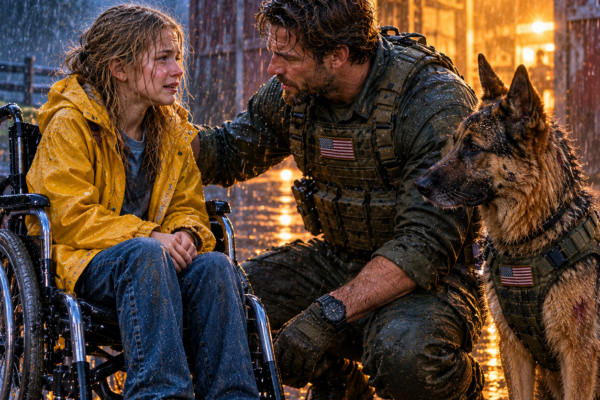
Rex was looking at Logan with patient amber eyes. And she thought about what it meant to be a creature that made those specific decisions.
To break protocol, to go left without a command, to absorb what was meant for someone else. And then to carry that history in a scar on a shoulder and a noise sensitivity in the left ear and the specific untrainable instinct to stand between people you had decided to cover and anything that was coming for them.
He figured it out. She said what?
That they’re the same thing.
She said saving and protecting.
He doesn’t distinguish.
Logan looked at her.
Then at Rex, then back at her, and the expression on his face was the one she’d seen last Thursday in the PT wing.
The recognition, the recalibration, but clearer now, less new.
Rex stood up and walked between their chairs and sat with his shoulder against the wheel of her chair and his flank against Logan’s leg, and he looked at the lobby with the professional calm of a being that had completed an operation and found the outcome satisfactory.
Sandra called on Friday morning at 7:43.
Holt didn’t submit documentation.
She said, “I know.”
Amelia said she was already dressed, coffee already made. Chver confirmed 20 minutes ago. Protocol continues 5 days a week.
The 90-day review will proceed as a formality. A pause. Dr.
Voss called this morning, too. She wants to schedule monthly consults through the end of your first year.
Amelia was quiet for a moment.
Amelia, I’m here.
You understand what this means? the ankle activation, the proprioceptive progression, Voss wanting to follow the case personally.
I understand.
It doesn’t mean I know it doesn’t mean anything certain.
I know that. She held the coffee cup. Outside the window on Elm Street, the frost was doing its morning thing.
The parked cars whitened over, the light coming in low and sharp from the east. It means I keep going.
Yes, Sandra said.
That’s exactly what it means.
She hung up, finished her coffee, got her bag, wheeled to the door. She paused before she went out. She pressed her right foot against the floor.
She held it there. The floor pushed back.
She went out into the cold. Gerald was already in the lot, the van idling. Country 105 at its standard volume.
He held the platform steady without being asked. She got on.
He raised it. Cold one, he said.
Yeah. she said.
“You doing okay today?”
She thought about it.
“Getting better?”
she said. He nodded.
Got back in the driver’s seat, pulled out of the lot.
She watched Elm Street go past the window, the dry cleaners, the bakery on Fifth, the hardware store with its handlettered sale signs in the window, and she let herself feel the motion of the van, the specific vibration of it through the frame of her chair, and the morning cold that was already beginning to give at the edges as the sun came up over the ridge and started its slow work on the frost. Her phone buzzed, a text from Logan.
Rex is already at the door.
You’re late.
She looked at the time. 8:38.
She texted back.
I’m never late.
The clinic opens at 8:45. Three dots.
Then he disagrees. She put the phone in her bag. For the first time in longer than she could pinpoint, she was not thinking about the chair or the assessment or the 90-day review or the ceiling that someone had tried to install over her head and that she was in the process of methodically removing.
She was thinking about a dog sitting at a door waiting.
She was thinking about how that was its own kind of answer to a question she hadn’t known she was asking.
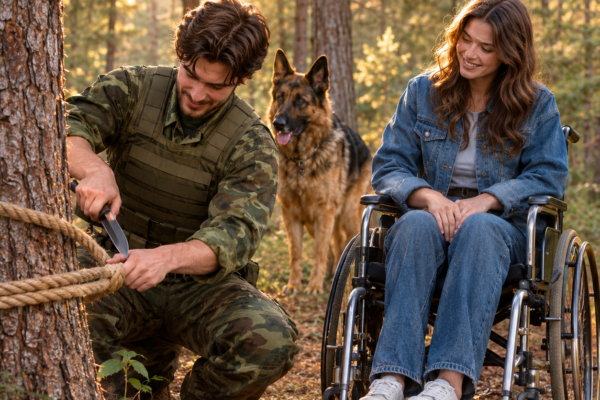
Rex was sitting at the clinic entrance when Gerald pulled into the lot. Not inside the glass doors, outside on the concrete apron at the top of the ramp in the cold with his breath making small clouds in the morning air.
He was upright and formal the way he got when he was waiting for something specific.
And when the van pulled in, his head turned and tracked it across the parking lot with the precision of an animal that had cataloged the sound of Gerald’s engine sometime in the previous two weeks and filed it under relevant.
Amelia saw him through the window and felt something move in her chest that she didn’t examine too closely.
Logan was inside the glass doors, visible through them, coffee in hand, watching Rex watch the van with the expression of a man who had stopped being surprised by his dog and had arrived somewhere past that, a place that looked like appreciation. Gerald lowered the platform.